Ability to Improve Learning Practices through the
Lesson Study Model in the Field Experience
Program at IAIN Pontianak
Fahrul Razi*, Rusmono, Marzuki Ismoyo
Department of Educational Technology, Postgraduate of State University of Jakarta, Indonesia
Received July 9, 2019; Revised September 9, 2019; Accepted September 16, 2019
Copyright©2019 by authors, all rights reserved. Authors agree that this article remains permanently open access under the terms of the Creative Commons Attribution License 4.0 International License
Abstract In general, this study aims to improve the
ability to carry out Learning Practices in the Field Experience program (learning practices) through the Lesson Study model. The method used is qualitative with work procedures using a research model of action by Stephen Kemmis and Robin MC. Taggart uses a spiral cycle carried out at the Department of Islamic Education, Tarbiyah Faculty and Teacher Training at the State Islamic Institute (IAIN) Pontianak. Data was collected by inventory, observation sheets, focus group discussions and documentation. Content validation was analyzed by expert judgment, while data analysis was carried out descriptively. The results of the study showed that the lesson study model implemented in the learning practices Education activities could improve the teaching ability of prospective PAI teachers at IAIN Pontianak. The results of this study recommend that the implementation of the Education learning practices be carried out with the Lesson Study approach.Keywords Action Research, Field Experience
Program, Learning Practices, Lesson Study1. Introduction
The Field Experience Program (learning practices) is an intra-curricular activity that must be taken by almost all citizens studying in higher education, including education science students. The aim of learning practices activities is to provide space for students (practical) to gain factual learning experiences in the field, their place, later, will work professionally. It is realized that learning experiences based on authentic experiences such as learning practices are very important (Nee Ting and Thong Wong & Ming Thang, 2009) (eg Brown et al., 2005; Joshua & Fleming,
2002).
Many terms are used which refer to this Educational Field Experience Program (learning practices). Among them are "Field experience"(Freeman, 2010); (Liakopoulou, 2012); (Eisenhardt, Besnoy, & Steele, 2012); and (Hixon & So, 2009) ;
"Teaching practice"
(Sally E. Arnett, Beth Winfrey Freeburg, 2008; and "apprenticeship" (Kennedy, 1999);(Liu, 2005); (Korpan, 2014).
Learning practices activities such as educational students are organized in the form of limited learning (Micro Teaching), guided training, and independent training directed at the formation of teacher skills, which are scheduled systematically under the guidance of tutors and tutors.
The State Islamic Institute (IAIN) Pontianak as one of the educational personnel education institutions, also organizes performance-based learning practices activities. Experience in the field as one of the members of the Team for the Implementation of learning practices activities at the FTIK PAI IAIN Pontianak department found several things that needed to be improved. Among them is the knowledge and skills of carrying out the learning possessed by students during the learning practices process is very colored by the abilities possessed by tutors and supervisors. It was also found that the learning community among fellow learning practices students, supervisor teachers during learning practices activities in training schools was not formed.
to build learning communities (Directorate General of Higher Education, Ministry of National Education, Book 2: Guide to Implementation of Lesson Study, Program for Lesson Study for Strengthening LPTK).
The formulation of the problem of this research, in general is: "How is the implementation of lesson study on learning practices activities for prospective teachers of FTIK PAI IAIN Pontianak academic year 2015/2016
In particular, the questions that will be searched for are: a. What is the process of implementing the learning
practices that implements Lesson Study conducted at the FTIK PAI IAIN Pontianak department?
b. Is there an increase in the ability to implement learning candidates for the IAIN FTIK PAI Pontianak teachers through learning practices activities that implement lesson study?
c. What are the opinions of the stakeholders regarding the implementation of lesson study in learning practices activities in the Department of Islamic Education FTIK IAIN Pontianak?
2. Literature Review
Lesson Study comes from Japan, with the name jugyokenkyu, which means "a systematic process used by Japanese teachers to test the effectiveness of teaching in order to improve learning outcomes" (Directorate of Labor Directorate General of Higher Education Ministry of National Education, Lesson Study Expansion Program for Strengthening LPTK (Lesson Study Dissemination Program for Strengthening Teacher Education in Indonesia - LEDIPSTI), Book 1 Guide to Implementation of Lesson Study in LPTK: 2010). The Study Study itself means "a model of educator professional development through the study of collaborative and sustainable learning based on principles collegiality and mutual learning to build learning communities "(Staffing Directorate, Directorate General of Higher Education, Ministry of National Education, Book 2: Guide to Implementation of Lesson Study, Program for Lesson Study for Strengthening LPTKs, (Lesson Study Dissem Information Program for Strewening Teacher Education in Indonesia - LEDIPSTI: 2009).
Indeed, in the beginning Lesson study was used as a model of teaching (training) the teaching profession through the study of collaborative and sustainable learning based on collegiality principles that help each other in learning to build learning communities (Sumar Hendayana, et al.: 007). But since 2006, lesson study has been carried out in the SYSTEMS program (Strengthening in-Service Teacher Training of Mathematics and Science Education of Junior Secondary Level). In implementing Lesson Study in three districts (Sumedang, Bantul, and Pasuruan), the three pioneering universities became assistants or provided assistance to resource persons. While at the three pioneering universities (UPI, UNY and Malang State
University), lesson study has also been disseminated in their respective faculties to several departments outside the MIPA, and even tried to be implemented in the Field Experience program (learning practices) (Directorate of Employment, Directorate General Higher education, Ministry of National Education, Book 3: Guidance for Mentoring, Lesson Study Program for Strengthening LPTKs, (Lesson Study Dissemination Program for Teacher Teacher Education in Indonesia - LEDIPSTI,: 2009). This means that lesson study in its development can be done through Action Research (Directorate General of Higher Education, Ministry of National Education, Lesson Study Expansion Program for Strengthening LPTKs, Book 2,). This is in line with Ciptianingsari's (2016) thinking, which refers to the integration of lesson study on microteaching conducted by Fernandez in 2005, namely lesson study integration on the mic roteaching with the term Microteaching Lesson Study (MLS).
The Lesson Study model is actually not a new program. Lesson Study is an adaptation of a program to improve the quality of learning carried out in Japan. With the concept of forming a school-learning community and implementing Lesson Study, a collapsed school has risen and revived (Ashintya Widhiartha, Dwi Sudarmanto, Nining Ratnaningsih: 2008)
The main principle of Lesson Study is to improve the quality of learning in stages by learning from one's own experience and the experiences of others in conducting learning activities.
3. Methods
This research has action research with the work procedures of the research model of the actions (McTaggart, 1991), which is in the form of a spiral cycle. Each cycle consists of four steps: planning, action, observation, and reflection. There are several action studies in learning practices activities, including those conducted by José Federman Muñoz Giraldo (Giraldo, Federman, Quintero Corzo, & Munévar Molina, 2002);
Daniel B. Robinson and William Walters (2016); (Lattimer, 2012); as well as (Albakri, Abdullah, & Jusoh, 2017). The followings are presented in detail the four stages of the first cycle.
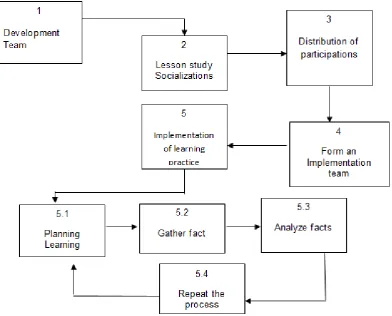
Planning stage. During holding down planning, researchers along with the learning practices committee, PAI department leaders, and several supervisors discussed and conducted Lesson Study socialization for prospective tutors and tutors, distributed learning practices participants, formed an implementation team, and developed a learning practices Manual Lesson Study model draft. .
Agency in the form of Lesson Study Workshops, which were held in 2014, namely on July 19-20 2014 at Pontianak Beringin. The number of participants present in this activity was 16 people, namely 8 tutors and 8 lecturers at Pontianak IAIN. The product produced from this socialization is the learning practices Education Lesson Study Model manual.
Before the students go down to the location of the learning practices, by Pantia the learning practices implementers hold debriefing for students in general, and end with symbolic surrender to the training schools. On the last day of the debriefing activity (16 July 2016) a socialization of learning practices was implemented to implement Lesson Study for students. The socialization was delivered directly by the researcher and accompanied by a supervisor and tutor from the school / madrasah pilot.
After debriefing and socialization, each supervisor brings students guidance to the location where the learning practices is held.
Form an Implementation Team. The team consists of Chairperson, secretary and members. This team is tasked with planning the program and schedule of student learning practice, followed by developing a draft learning practices Manual Lesson Study model.
Implementation phase. At this stage, students carry out learning activities with the material set by the tutor teacher. The steps taken in the implementation of Learning Practices follow the Education Field Lesson Study Program (learning practices) model adapted from the Cerbin and Kopp version (Cerbin & Kopp, 2004).which was modified specifically for Pontianak IAIN students as presented in Figure 1,
Education of the IAIN Pontianak Islamic Education Department (Adapted from the version of Cerbin and Kopp)
[image:3.595.104.497.286.602.2]During learning practice activities, students practice in accordance with their respective roles that have been agreed upon. There are those who act as teachers and others as observers. When they carry out RPP planning discussions and reflection discussions, there are those who act as moderators, note takers and others as members of the discussion, according to the guidebook provided.
Observation stage. The symptoms observed were: the process of discussing the draft RPP, the process of implementing learning practice activities, the process of discussion of reflection. In making observations, researchers are assisted by students, tutors and supervisors. Observation activities are carried out by recording and recording all events based on observation guidelines that have been prepared in advance.
Reflection stage. The last stage of this cycle is students, tutors and supervisors reflect on the activities that have been carried out. At this reflection stage, data obtained from observations and recorded notes are analyzed qualitatively. The question that needs to be answered if resistance reflection is: is learning practices by implementing lesson study able to improve student learning skills? In addition, the shortcomings that will be corrected in the second cycle are also sought with stages such as in the first cycle.
Research Instrument. There are three types of instruments used. The first instrument was used to collect data about the process of implementing lesson study. The instrument of this study consists of 12 questions to collect data about the planning process, 11 questions to capture data about the implementation of Learning Practices, and 10 questions to collect data about the reflection process in lesson study activities.
The second instrument is used to assess RPP and implementation of learning. This instrument is used by supervisors and tutors to provide an assessment of the performance of students' Learning Practices. There are 9 questions to assess RPP and eight questions to assess the Learning Practices. The third instrument consists of 23 questions that are used to express the opinions of students, tutors and supervisors about implementing learning practices that implements lesson study.
Data analysis. Qualitative analysis is done by summarizing the results of minutes of notes in discussions, the value of lesson plans, the value of Learning Practices, and notes on the reflection stage.
4. Research result
This learning practices activity was carried out in three schools: I MTsN, SMPN 8, and SD Al Azhar. There were 14 students participating in the distribution of the three, 4, 5, 5 people respectively. Each student is accompanied by a supervisor and one tutor teacher. This learning practices activity is carried out in the form of lesson study. So,
enthusiasm begins with planning, implementation, observation and reflection.
Learning material is determined by the tutor teacher in accordance with the Learning Practices cable curriculum, students practice compiling lesson plans, preparing learning resources and doing the learning process in the classroom that has been set by the tutor teacher. Before RPP, they used to discuss it with fellow students at the same school.
Pamong teachers, in addition to setting classes and teaching materials for each student who is guided, also evaluate the quality of lesson plans and the lessons learned and feedback.
The supervisors, in addition to helping students who are guided in developing instructional materials through adequate reading sources, also conduct external observations when students carry out learning activities, assess lesson plans and the process of learning and provide feedback.
There are three questions that the answers sought in this study. First concerns the process of implementing this LEARNING PRACTICES senacan, the second is the impact on students and third is the opinion of stakeholders.
5. Implementation Process
5.1. Making Lesson Plan
Before being used, RPP is discussed in advance among students at the same school. Suggestions for improvements that are often delivered include: formulation of subject identity, formulation of basic competencies, formulation of indicators, formulation of learning objectives, formulation of learning scenarios, and formulation of evaluation.
In addition to suggestions, there are several things that are worth noting. Among them are: lesson plans are not always distributed to all preliminary students, not all participants give advice, there are students who are not happy with their suggestions and comments, and there are students who make lesson plans while following the discussion.
5.2. Learning Practice
Unlike learning practices in general, the learning practices implements the Study Lesson, when a student implements the learning process not only with the tutor teacher but also fellow practitioners. They are tasked with observing the learning process that takes place in accordance with the list of observations prepared by the learning practices Team.
practitioners reported that the choice of learning strategies was inappropriate. Some also lack mastery of teaching materials. Learning media are not well prepared. There are also students who have not used the language properly and correctly as an instruction language in the class. There are a number of students who have not been able to master / manage the class optimally. And, what is also important to note is that there are a number of displays of students who are not right as educators.
5.3. Reflection Activity
At the end of the cycle, reflections were carried out followed by all students, tutors, supervisors, and researchers. During the reflection activity, participants flashed what had been done during that period. Most of the participants reflected that the implementation of the learning practices by implementing the lesson study had been carried out well. However, there are several things that need to be improved.
Among them is the mastery of the material of the student
practitioner, the obedience to follow the rules that Learning Practices and the observer as an educator. The results of the first cycle reflection were used as the basis for improvement in the second cycle.
6. Impact on Student Practice
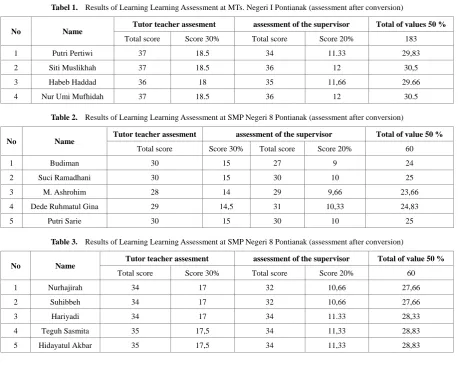
In accordance with the purpose of the study to improve the ability to carry out chasing activities, the impact of students is indicated by the value of the practice of studying students from the tutors and supervisors. Tables 1, 2, and 3 respectively present a recap of values per school for learning practices locations.
Dishes per school location were chosen because the three schools had different characteristics. MTsN as a religious school, Junior High School I as a public school and elementary school al Azhar, besides the general division is also affiliated with religion. And it will be better if it is presented separately.
The combined three tables are presented in table 4.
Tabel 1. Results of Learning Learning Assessment at MTs. Negeri I Pontianak (assessment after conversion)
No Name Tutor teacher assesment assessment of the supervisor Total of values 50 %
Total score Score 30% Total score Score 20% 183 1 Putri Pertiwi 37 18.5 34 11.33 29,83 2 Siti Muslikhah 37 18.5 36 12 30,5 3 Habeb Haddad 36 18 35 11,66 29.66 4 Nur Umi Mufhidah 37 18.5 36 12 30.5
Table 2. Results of Learning Learning Assessment at SMP Negeri 8 Pontianak (assessment after conversion)
No Name Tutor teacher assesment assessment of the supervisor Total of value 50 %
Total score Score 30% Total score Score 20% 60
1 Budiman 30 15 27 9 24
2 Suci Ramadhani 30 15 30 10 25
3 M. Ashrohim 28 14 29 9,66 23,66
4 Dede Ruhmatul Gina 29 14,5 31 10,33 24,83
5 Putri Sarie 30 15 30 10 25
Table 3. Results of Learning Learning Assessment at SMP Negeri 8 Pontianak (assessment after conversion)
No Name Tutor teacher assesment assessment of the supervisor Total of value 50 %
Total score Score 30% Total score Score 20% 60 1 Nurhajirah 34 17 32 10,66 27,66
2 Suhibbeh 34 17 32 10,66 27,66
3 Hariyadi 34 17 34 11.33 28,33
[image:5.595.70.529.338.703.2]Table 4. Recapitulation of the Score of the First Cycle Lesson Study Model in three schools
Recap of ALearning Practicesication of the Lesson Study Model
No. School Name
Score of acquisition
Average act1 Act2 Act3 Act4 Act5 Total
1 MTs,Neg.I Ptk 29.83 30,5 29,66 30,5 - 120,49 30,122 2 SMP N 8 Ptk 24 25 23,66 24,83 25 122,49 24,498 3 SDI Al-Azhar Ptk 27,66 27,66 28,33 28,33 28,33 140,31 28,0625
Rerata 27,52
Information: Act 1 = action 1 Act 2 = Action 2 Act 3 =Action 3 Act 4 = Action 4 Act 5 = Action 5
Range of value: 40,2 – 50,0 : very skilled category Range of value 30,40 -40,15 ; Skilled
[image:6.595.69.533.362.471.2]Range of value 20,6 – 30,35 : quite skilled Range of value: 10,80 – 20,55 : less skllled Range of value: 1,00 – 10,55 :unskilled
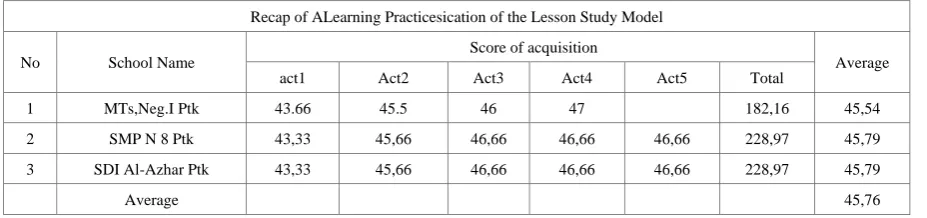
Table 5. Recapitulation of the Score of the Second Cycle Lesson Study Model in three schools
Recap of ALearning Practicesication of the Lesson Study Model
No School Name
Score of acquisition
Average act1 Act2 Act3 Act4 Act5 Total
1 MTs,Neg.I Ptk 43.66 45.5 46 47 182,16 45,54
2 SMP N 8 Ptk 43,33 45,66 46,66 46,66 46,66 228,97 45,79
3 SDI Al-Azhar Ptk 43,33 45,66 46,66 46,66 46,66 228,97 45,79
Average 45,76
Table 4 using the agreed range of scores shows an average score of 27.52. Means, learning practices by implying lesson study produces prospective teachers who are skilled enough to carry out learning activities. Average scores according to location schools are 30.12 (MTsN I), 28.06 (Al Azhar Elementary School) and 23.50 (SMPN 8). By paying attention to the suggestions on the reflection of the first cycle, it turns out that the results achieved by the students in the second cycle increased significantly. The recapitulation of the second cycle is presented in Table 5.
The average score is 45.76. Achievements in each location school are approximately the same 45.54-45.76, in the
The average score is 45.76. Achievements in each location school are approximately the same 45.54-45.76, in the highly skilled category.
6. Stakeholder Opinion
Towards the end of the second cycle reflection meeting, the researchers asked all participants to fill in a
questionnaire that aimed to capture data or information about learning practices participants' responses to the implementation of the lesson study model.
From the data from the questionnaire filling learning practices participants gave varied responses both positively (strongly agree or agree) and negative towards the implementation of lesson study-based learning practices.
All stakeholders agreed that the learning practices that implements lesson study can improve the quality of the learning implementation of the students both in their lesson plans and in the implementation of classroom learning.
7. Discussion
Tadris S1 students showed that learning practices with Lesson Study could improve the competence of prospective learning practices teacher students in IAIN Walisongo Chemical Tadris S1. The research conducted by Siti Malikhah on the teaching practices of Social Sciences students also showed the same results. Likewise the research conducted by Rahmad Bustanul Anwar and Dwi Rahmawati and Kostara et al., showed that there was an increase in the ability in micro teaching students after using lesson study in their learning.
The results of this study are also supported by the results of research conducted by Fitri Budi Suryani et al. On students of English Language Education, Semarang State University, which showed:
Despite their lacks in teaching practice which are still found in their third teaching practice, the better areas the student teachers perform indicate that they have implemented the steps in microteaching lesson study better than those in their previous teaching practices. After the teaching practice, together with their group members they evaluated their teaching practice and discussed for further improvements for their next teaching (Fitri Budi Suryani, dkk, 2017)
The results of research supporting this study indicate that although there is still a lack of Learning Practices at the end of the research cycle, it seems that the better performance of Learning Practices carried out on students who are taught with Lesson Study than those who are not treated with Lesson Study.
The results of the calculation of the application of lesson study in improving the ability to carry out the practice of learning carried out for two cycles and 4-5 stages, has shown a very skilled score. It is based on the results of the calculation of observation scores which are then converted to predetermined categories. With the essence of Lesson Study is able to form a learning community. Students who join PPL with the Lesson Study model are able to form learning communities that consistently carry out continuous improvements both at the individual, group level and on a more general system. The results of this study are in line with the results of Ciptianingsari Ayu Vitantri's research, (Vitantri & Asriningsih, 2016), which states that the Learning Practices of lesson study based learning is one way to improve the quality of prospective teachers in Indonesia. With the provision of learning experiences for prospective teachers who are based on lesson study it is expected that prospective teachers who have completed their studies have good quality competency in science and teaching competencies (Fitri Budi Suryani, et al, 2016) (eg Brown et al., 2005; Joshua & Fleming, 2002;....,,.
Increasing the score of Learning Practices conducted by Pontianak IAI PAI students through the Learning Practices of the lesson study model illustrates that students, tutors and supervisors as learning practices participants have been able to implement the steps to implement the lesson
study model in accordance with the manual given. In other words, if the Lesson Study model is Learning Practices consistently, then the results of Learning Practices conducted by Pontianak IAIN PAI students will increase. This result is in line with research conducted by Penny Lamb which stated: “The surveys revealed that 100 per cent of the PSTs felt Lesson Study contributed in a positive way to their professional and pedagogical knowledge development” (Lamb, 2015).
The increase in the success of Learning Practices by Pontianak PAI IAIN students conducted through lesson study can be explained that Learning Practices are carried out through joint observation activities and supported by multi-directional reflection. In this way, there will be openness for each student to accept a lack of self and try to improve their abilities.
The increase in scores on the Learning Practices of the lesson study model illustrates that students, tutors and supervisors as learning practices participants have been able to implement the steps in Learning Practicing the essay study model in accordance with the manual given. Exactly What is said by Marit Ulvik & Kari Smith (2011), that "practicums that focus educatively will help prospective teachers to understand the scope of the teacher's role, develop the capacity to learn from future experiences and to achieve the main goals of learning". If the learning practices model is conventionally still wanted to be maintained, then Dewey, suggests it is very important to have qualified tutors as mentors (Tuli, 2009).
Another result of the study was that there was a positive response delivered by parties involved in learning practices activities carried out through the lesson study model. There are variations in the response of participants to lesson study-based learning practices activities, giving positive responses (strongly agree or agree) and negative (disagreeing and strongly disagreeing) to the implementation of lesson study-based learning practices that can improve the quality of learning activities and other matters relating to learning practice activities of students. This finding is in line with the results of a study conducted by Frederik Voetmann Christiansen (Christiansen, Klinke, & Nielsen, 2007) who stated, "By changing the focus from the individual teacher to the group of teachers, lesson studies have the potential to be shared with the shared knowledge base of teachers and lead to less vulnerable educational systems". In other words, changes in focus from teachers to individual groups of teachers, Lesson Study are potential to improve the ability of sharing among teachers so that they can cover the shortcomings in the education system.
lesson study experience. (the teachers who were participants in lesson study research also showed that more confidence in implementing the learning approach). In other words, the lesson study model turned out to be able to grow the confidence of prospective high teachers.
The positive attitude that increases in Learning Practices through the implementation of the lesson study model is in line with the findings of Mary T. McMahon (McMahon & Hines, 2008), who stated:
After the preservice teachers’ participation in the lesson study experience, their responses to this question showed greater consideration of collaboration as an option for improving teaching and learning. They indicated that they would be more likely to seek the advice of a colleague about handling the situation or even requesting peer observation in the classroom. These responses suggest that the preservice teachers valued the collaboration from their lesson study experience.
The results of this study also revealed evidence that the response of learning practices participants to lesson study activities was positive in the sense that they could improve the quality of the learning activities of the students. This is in line with the study conducted by C. Hart et al. (2011) in Mathematics learning, which revealed a good ability among teachers in developing students' ability to respond to teacher questions;(Towaf, 2016) who found that LS is a way to improve the practice of English students' field experience; and, (Hollingsworth & Oliver, 2005), which revealed that LS was able to bridge the gap in teacher understanding of material and pedagogic problems with practice in the classroom.
The results of this study are also in line with the thoughts of Tracy C. Rock & Cathy Wilson (Rock & Wilson, 2005), which explains that LS can build teacher professionalism in learning that is very likely to inspire students to achieve good learning outcomes.
8. Conclusions and Suggestions
In general, it can be concluded that LEARNING PRACTICES by implementing lesson study can improve the skills and teaching abilities of prospective PAI teachers at IAIN Pontianak. Because ‘is still new', before the study, the students, tutors and supervisors were 'introduced' first about lesson study. Another impact of this research is the growing learning community in location schools. Although in the beginning the community only attended to those who participated, it was possible that this community would develop to all school members.
Another finding was the presence of positive responses from stakeholders. Not only because of the novelty but also because it fosters their motivation to progress together. Since there were only 13 students involved in this study, it was suggested that further research would involve more participants. Thus, the ecological validity of this research
can be improved. One of the drawbacks of this study was that no control group was provided. It is recommended that in further research be developed experimental research that is able to compare quantitatively between the students who are in Learning Practices lesson study and conventiona l students. Such research needs to be done to improve the internal validity of the results of this study.
REFERENCES
Albakri, I. S. M. A., Abdullah, M. H., & Jusoh, A. J. (2017). [1]
Lessons from experience: ESL student teachers' reflection during practicum through reflective journals. Studies in English Language and Education, 4(2), 226-234.
Anwar, R. B., & Rahmawati, D. (2014). [2]
PENGEMBANGAN MODEL PEMBINAAN KOMPETENSI CALON GURU MATEMATIKA MELALUI LESSON STUDY. AKSIOMA: Jurnal Program Studi Pendidikan Matematika, 3(1).
Cerbin, B., & Kopp, B. (2004). Lesson study for college [3]
teachers: An online guide. Retrieved November, 24, 2004.
Christiansen, F. V., Klinke, B., & Nielsen, M. W. (2007). [4]
Lesson study as a format for collaborative instructional change. Pharmacy Education, 7(2).
Eisenhardt, S., Besnoy, K., & Steele, E. (2012). Creating [5]
Dissonance in Pre-Service Teachers' Field Experiences. Srate Journal, 21(1), 1-10.
Direktorat Ketenagaan Direktorat Jenderal Pendidikan [6]
Tinggi Kementerian Pendidikan Nasional,(2010), “Program Perluasan Lesson Study untuk Penguatan LPTK (Lesson Study Dissemination Program for Strengthening Teacher Education in Indonesia – LEDIPSTI), Buku 2 Panduan Pelaksanaan Lesson Study di LPTK, pp. 15-16.
Direktorat Ketenagaan Direktorat Jenderal Pendidikan [7]
Tinggi Kementerian Pendidikan Nasional,(2010), “Program Perluasan Lesson Study untuk Penguatan LPTK (Lesson Study Dissemination Program for Strengthening Teacher Education in Indonesia – LEDIPSTI), Buku 3 Panduan Pelaksanaan Lesson Study di LPTK,p.1.
Direktorat Ketenagaan Direktorat Jenderal Pendidikan [8]
Tinggi Kementerian Pendidikan Nasional, (2010), “Program Perluasan Lesson Study untuk Penguatan LPTK (Lesson Study Dissemination Program for Strengthening Teacher Education in Indonesia – LEDIPSTI), Buku 1 Panduan Pelaksanaan Lesson Study di LPTK,p.3.
Direktorat Ketenagaan Direktorat Jenderal Pendidikan [9]
Tinggi Kementerian Pendidikan Nasional,(2010), “Program Perluasan Lesson Study untuk Penguatan LPTK (Lesson Study Dissemination Program for Strengthening Teacher Education in Indonesia – LEDIPSTI), Buku 2 Panduan Pelaksanaan Lesson Study di LPTK, p.1.
Direktorat Ketenagaan Direktorat Jenderal Pendidikan [10]
Pelaksanaan Lesson Study di LPTK,p.1.
Direktorat Ketenagaan Direktorat Jenderal Pendidikan [11]
Tinggi Kementerian Pendidikan Nasional,(2010), “Program Perluasan Lesson Study untuk Penguatan LPTK (Lesson Study Dissemination Program for Strengthening Teacher Education in Indonesia – LEDIPSTI), Buku 2 Panduan Pelaksanaan Lesson Study di LPTK, pp.7-11.
Freeman, G. G. (2010). Strategies for Successful Early Field [12]
Experiences in a Teacher Education Program. Srate Journal, 19(1), 15-21.
Giraldo, M., Federman, J., Quintero Corzo, J., & Munévar [13]
Molina, R. A. (2002). Experiencias en investigación-acción-reflexión con educadores en proceso de formación. Revista electrónica de investigación educativa, 4(1), 01-15.
Hixon, E., & So, H.-J. (2009). Technology's role in field [14]
experiences for preservice teacher training. Journal of Educational Technology & Society, 12(4), 294-304.
Hollingsworth, H., & Oliver, D. (2005). Lesson study: A [15]
professional learning model that actually makes a difference. Paper presented at the Mathematics–Celebrating Achievement: 2005 MAV Conference.
Kennedy, M. M. (1999). The role of preservice teacher [16]
education. Teaching as the learning profession: Handbook of policy and practice, 54-85.
Korpan, C. J. (2014). The apprenticeship of teaching [17]
assistants: time to change? Transformative Dialogues: Teaching & Learning Journal, 7(3).
Kostas, K., Galini, R., & Maria, M. (2014). The practicum in [18]
pre-service teachers’ education in Greece: the case of lesson study. Procedia-Social and Behavioral Sciences, 152, 808-812.
Lamb, P. (2015). Peer-learning between pre-service teachers: [19]
embracing Lesson Study. International Journal for Lesson and Learning Studies, 4(4), 343-361.
Lattimer, H. (2012). Action research in pre-service teacher [20]
education: is there value added? ie: inquiry in education, 3(1), 5.
Liakopoulou, M. (2012). The role of field experience in the [21]
preparation of reflective teachers. Australian Journal of Teacher Education, 37(6), 42-54.
Liu, T.-C. (2005). Web-based cognitive apprenticeship [22]
model for improving pre-service teachers' performances and attitudes towards instructional planning: Design and field experiment. Journal of Educational Technology & Society, 8(2), 136-149.
McMahon, M. T., & Hines, E. (2008). Lesson Study with [23]
Preservice Teachers. Mathematics Teacher, 102(3), 186-191.
McTaggart, R. (1991). Action research: A short modern [24]
history: Deakin Univ Geelong.
Mulyatun, M. (2017). LESSON STUDY: STRATEGI [25]
ALTERNATIF PENINGKATAN KOMPETENSI CALON GURU KIMIA. Jurnal Inovasi Pendidikan Kimia, 11(1).
Rock, T. C., & Wilson, C. (2005). Improving teaching [26]
through lesson study. Teacher Education Quarterly, 32(1), 77-92.
Towaf, S. M. (2016). Integration of Lesson Study in [27]
Teaching Practice of Social Study Student Teachers to Improve the Quality of Learning and Promote a Sustainable Lesson Study. Journal of Education and Practice, 7(18), 83-91.
Tuli, F. (2009). Understanding undergraduate students [28]
Practicum experience: A qualitative case study of Jimma University. Ethiopian Journal of Education and Sciences, 5(1).
Vitantri, C. A., & Asriningsih, T. M. (2016). Efektivitas [29]
Lesson Study pada Peningkatan Kompetensi Calon Guru Matematika. JMPM: Jurnal Matematika dan Pendidikan Matematika, 1(1), 23-33.
Widhiartha, Putu Ashintya, Dwi Sudarmanto, Nining [30]