Journal of Chemical and Pharmaceutical Research, 2014, 6(3):424-429
Research Article
CODEN(USA) : JCPRC5
ISSN : 0975-7384
The study of service enterprise knowledge search absorption effect on product
innovation performance after service failure
1
Lu Penghu and
2Li Xiaojin
1Business School, Central South University, Changsha, Hunan, China
2Business Administration College, Zhejiang University of Finance & Economics, Hangzhou, Zhejiang, China
_____________________________________________________________________________________________
ABSTRACT
From the Angle of enterprise external knowledge search, this paper discusses how service companies through cross-border open and exploratory search for knowledge in order to realize the organization learn quickly and complete product innovation, which has a important practical significance to promote our country enterprise innovation ability. This research bases on "the service enterprise how to improve product innovation through knowledge search absorption performance" , Comprehensive analysis using the previous method and inheriting predecessors research results to build model of the search for knowledge, absorptive capacity and product innovation performance relationship, revealing the knowledge search on product innovation performance mechanism of the black box.
Key words: Corporate knowledge search; Absorptive capacity; Product innovation performance; Open innovation _____________________________________________________________________________________________
INTRODUCTION
Background
As China's economy increasingly integrated into the globalization, especially after China's entry into the world trade organization, China's service manufacturing enterprises embedded in the extent of the global manufacturing network is more and more deep, however, the transformation and upgrading of local service enterprises in China is neither easy nor smoothly. China's service enterprises presents a series of problems in the process of global manufacturing network work specialization, such as product technology level backward, weak capacity for independent innovation, service manufacturing technology and equipment backward, management extensive etc, with the shortage of production factors and the constraint of the appreciation of the RMB and the comparative advantage of manufacturing enterprises gradually eroded. In global manufacturing network, our country manufacturing enterprises is still in low-end manufacturing value chain link, and the design of the product, brand, marketing and services value chain link is still dominated by developed countries, at the same time, such as both technology and product upgrading to a more advanced upgrade process, the isolation mechanism of multinational companies’ exclusive purchasing relationship and key technology knowledge supply factors seriously block the knowledge learning and imitation innovation of local enterprises in our country (Peng Xinmin, 2009)[1]. In addition, Zhu Chaohui (2007) [2]through an empirical investigation found that current manufacturing enterprises’ innovation mainly blindly follow leading companies’ leading technology (27.12%), lack power of exploring new technology and potential of emerging markets. In the environment of global competition and market demand dynamic change, the traditional core competitive advantage based on heterogeneous resources would be difficult to continue, even though innovation that is endogenous by the enterprise knowledge could also imitate rapidly by competitors, so enterprise only continuously across organizational boundaries to learn and update knowledge base, and explore the knowledge for product innovation that will change the original competitive basis (Xu Guanna, 2008)[3]。
imitated, shortened product life cycle, core strengths accelerating loss of many enterprises, leading to theoretical and practical circles doubt on the traditional closed innovation model.(Grant,1996;Chesbrough,2003)[4-5]。In recent years, open innovation gradually got the attention of management scholars and practitioners, its core idea is to encourage the search and utilization of external access knowledge and technology for innovation ,to build the organization's sustainable competitive advantage (Grant, 1996; Chesbrough, 2003). Open innovation advocated the integration enterprises’ inside and outside resources for the company, it also emphasized the independent demand enterprises break through the enclosed technical (know how), pay attention to in search of an external rich knowledge in order to make up for the inadequacy of existing technology and market knowledge (know-who), which can overcome the "Not invented Here" and Not Sold Here (NSH) (Sigurd franco-german harrison, 2004; Chesbrough, 2003)[6]. Sigurd franco-german harrison survey many companies’ existing product development situation such as Ribeiro, SONY, Canon, Toyota etc, concluded that these companies very value "know - who" knowledge, which is through a large number of formal and informal way to search and obtain external knowledge.Across organizational boundaries of knowledge search has become the third method of enhancing enterprise technology competitive advantage following the internal development and external acquisitions . It search, use of external knowledge acquisition of new ideas and knowledge, and integrate these ideas to promote the new product development from different channels (Gary, Aldor & Hildy, 2000)[7].
Therefore, from the Angle of service enterprise external knowledge search after service failure, it has the important practical significance. Of discussing how companies through cross-border open and exploratory search to realize the fast learning and knowledge complete product innovation which can promote our country service enterprise innovation ability, our country service manufacturing industry transformation and upgrading of enterprise success, and the "made in China" to "created in China"
2.Theoretic Framework
2.1 The study of knowledge search
Technical knowledge and market knowledge are the two most important types of knowledge of enterprise innovation and development, previous studies of technological innovation are more focus on the width and depth of technical knowledge search, not indicating the direction of the knowledge search and the potential value of search knowledge sources. In addition to study of current customers and market knowledge, successful companies must search for the knowledge of the potential customer needs, market preferences, the productuses (Maru Fei, 2009)[8]. Previous studies more emphasis on the Search of technological knowledge, such as Fleming (2001)[9] put forward the idea of uncertainty of the restructuring in the search of technical knowledge, Technical Katila & Ahuja (2002) [10]explore that the width and breadth of technical knowledge have impact on innovation. In recent study of marketing research, Market knowledge search as part of market-oriented has valued (Slater & Narver, 2000)[11]. According to two types of knowledge search strategy, knowledge search Can be further subdivided into four categories: development and technical knowledge search, discover-technical knowledge search, development and market knowledge search and exploratory knowledge of the market. Through development and exploratory technical knowledge search can help businesses take advantage of the enterprise external technical knowledge overflow and the opportunity of the industry technical knowledge overflow. It also can promote different areas of technology integration and innovative integration of resources, thus improving the innovation performance of enterprises. .Market knowledge search can help businesses better understanding of customer needs, meet customer needs and preferences,at the same time identifying market opportunities to reduce market uncertainty during product innovation in constantly changing environment. On the basis of the search market knowledge, using development and market knowledge search strategy search markets, products, customers etc and provide guidance for the future development of new products; import exploratory market knowledge search, and maintain sensitivity to changes in market dynamics inorder to strive to achieve rapid response to the new demands of the market.
knowledge, and integration of knowledge across borders to create new knowledge.
Figure 1: Dimension partition of corporate knowledge search
2.2 The study of absorptive capacity
Zahra & George (2002)[13] put forward the absorption capacity which is the set of standards and processes definition after summary previous study of the concept of the absorption capacity’s inoperability. Enterprises can use this set of standards and processes to realize knowledge acquisition (acquire), absorption (assimilate), transformation (transform) and development (exploit), so as to foster the development of dynamic capability. Absorption the capabilities include potential absorptive capacity (RACAP) and the reality of absorptive capacity (PACAP) two dimensions, the former including knowledge acquisition and knowledge absorption capacity, latter includes knowledge transformation and knowledge development capabilities. Two dimensions exist contemporary, and it has become a necessary condition to improve enterprise performance. With ratio of RACAP divided PACAP as an efficiency factor, assuming that the organization profits depend on reality absorptive capacity, companies can be done through a high efficiency factor or maintaining a high level of performance (Grant, 1996). This study uses absorption capacity of potential and reality two mediating variable to explain the mechanism of Enterprise Knowledge Search effect product innovation performance.
2.3 External environment dynamics and redundant resources to the enterprise have effect on product innovation
The core characteristics of organization theory is to emphasing the dependence of the enterprise external environment, scholars put forward the dynamic and competitive business environment is a very important boundary condition to enterprise search and innovation (Raisch & Birkinshaw, 2008)[14]. Lewin, Long & Caroll (1999) proposed organization - environment common evolution model, the model associated exploration and development of the enterprise with competitors company’s changes. Baum et al. (2005), Chen and Miller (2007) [15]study shows that the gap between actual performance and expected performance determines the choice of search strategy, the bigger it will promote enterprises to invest more resources in the search of knowledge. In addition, the redundant resources enable administrators to relax restrictions on resource and innovation, it also encourage enterprises to make new technology or knowledge under the uncertain environment.
This study belongs to the enterprise level, which centre on "the enterprise how to implement product innovation through knowledge search and absorb" , trying to open black-box function mechanism of “inner-enterprise how to translate knowledge into innovation performance” based on the related theory of absorptive capacity, analyze the influence of different knowledge search strategy of product innovation mechanism, so it can provide advice and theoretical basis for upgrading of domestic manufacturing enterprises and promoting independent innovation capacity in China . The research object of this study is to have characteristics of different industries, different size, different age of local manufacturing enterprises, including state-owned enterprises, private enterprises, sino-foreign joint ventures, etc.
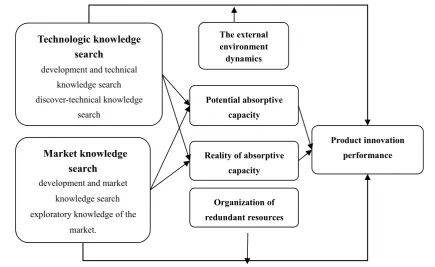
Comprehensive views of scholars, this paper puts forward the research’s conceptual model of “the enterprise knowledge search and absorption effect on product innovation performance after service failure” (figure 2).
Development of technical knowledge search
Development of Market knowledge search
Exploratory technical knowledge search
Exploratory Market knowledge search
Search strategy Knowledge
Technologic knowledge search
development and technical knowledge search discover-technical knowledge
search
Market knowledge search
development and market knowledge search exploratory knowledge of the
market.
Potential absorptive capacity
Product innovation performance Reality of absorptive
capacity
Organization of redundant resources
The external environment dynamics
Figure 2 the study of service enterprise knowledge search absorption effect on product innovation performance after service failure
3.Innovative points in the study
The analysis focuses on the basic question that how service enterprise could benefit from knowledge-searching and digesting to improve innovation performance of product after service failure. Through making comprehensive use of former’s analysis method and their study results and by making strict theoretical analysis and logical derivation, the major point in the study is thus formed.
On the basis of analysis of relative documents at home and abroad, and by focusing on the influence system about how the product’s innovation performance is affected by knowledge-searching and digesting on the point of enterprise, we study on what differences that environmental dynamism and enterprise’s redundant resources and other situational factors could make on product’s innovation performance. Compared with former studies, the innovation points in this study could be concluded as three respects as followed:
(1) By constructing a whole system of knowledge-searching and digesting ability and product’s innovation performance, we are meant to unveil the black box of the role which knowledge-searching plays on product in the ways of innovation performance.
On basis of analysis of documents of Rosenkopf & Nerkar(2001)[16], Fleming(2001)[17], Katila & Ahuja (2002)[10],Wu and Wu(2009)[18], Laursen & Salter(2006)[19], Gao Zhongshi(2008)[20]and Ma Rufei (2009)[21], the study has made efforts of subdivide and explore of structure of knowledge-searching. In respects of exploration and development, the study aimed at discovering the effect system and differences which different knowledge-searching strategies make on digesting ability and product’s innovation performance. The traditional analysis of relations between digesting ability and knowledge -searching is rarely done, as in Ma rufei ‘s theory where he believes that antecedent variables of knowledge- searching is digesting ability. While as Rothaermel & Alexandre see, the analysis and digesting ability could make positive adjustive influence as some confirmed proof in American manufacture and other industry. In short, this study comes up with the rudiment and relative proposition of knowledge -searching, digesting ability and product’s innovation performance. Benefiting from the digesting ability structure by Zahra & George, we mean to unveil the important effects which the lurking digesting ability and actual ability could do in knowledge-searching, digesting and its translating and exploitation.
[image:4.595.86.522.73.340.2]and interaction of different searching strategies. This fact is needed to change to help enterprise gain maximize innovation performance by drawing up a moderate balance searching strategy.
Now the study stands on the ground of a combining resources and relative theory and explorative innovation theory, with the aim to searching the methods where the balance of different searching strategies and their influence on product, to explain the mode of action and performance transfer process of different searching strategies.
Meanwhile, the study is based on the research statistics from China’s local manufacturing industry which confirm the obvious effect of enterprise knowledge-searching to its product innovation performance. All of those researches is useful to unveil the micro-action mode of knowledge-searching with product’s innovation performance, and improve pertinence and effectiveness of enterprise benefit from knowledge-searching.
(3) By explaining how environmental dynamism and enterprise’s redundant resources and other situational factors could make on product’s innovation performance, the study aims to gain a common sense that a valuable knowledge-searching strategy is based on comprehensive consideration of the enterprise’s inner and outer environment.
Based on the analysis of Chen & Miller(2007)、Raisch & Birkinshaw(2008)、Li Yi and Si Youhe (2008)[22], this study is aimed at constructing a mode of product innovation performance by adding up two other variables , redundant resources and environmental dynamism. We try to gain a confirmed result of the adjustable effect between knowledge-searching and product innovation system by some real cases, which could contribute to further understanding of enterprise knowledge-searching effect situation and inspire the enterprise to choose a suitable knowledge-searching strategy with a consideration of surroundings and resources-constructing, and therefore lead to enrich the theory gained from the interaction mode between manufacturing industry’s knowledge-searching and its product innovation after service failure.
Acknowledgment
This work has been supported by the Research Project in Humanities and Social Sciences by the Ministry of Education of China (Project No. 12YJA630064), Zhejiang Provincial Natural Science Foundation Project of China (Project No. LQ13G020003), and Zhejiang Provincial Philosophy Social Science Planning Project of China (Project No.13NDJC047YB).
REFERENCES
[1] Peng Xinmin. “The mechanism study of business network affecting the technology innovation performance---mediator effect of usability sex and exploratory learning”. Zhejiang university,2009(Chinese). [2] Zhu Chaohui. “Technology learning and mechanism study of open innovation research”. Zhejiang university,
2007(Chinese).
[3] Xu Guanna. “The Relationship between embeddedness and technology innovation performance” . Zhejiang university,2008(Chinese).
[4] Grant, R M.Strategic Management Journal, vol. 17, No. 2,1996, pp.109-122.
[5] Chesbrough, “Open innovation: The new imperative for creating and profiting from technology”,2003.
[6] Sigurd franco-german harrison. “Japan's technology and innovation management--from seeking knowhow to seek partners”,2004.
[7] Gary, Aldor & Hildy, “Determinants and performance impacts of external technology acquisition”, Business venturing,2001.
[8] Ma Rufei. “Cross-border search for corporate performance influence mechanism research” . Zhejiang university,
2009(Chinese).
[9] Fleming, L., & Sorenson, O.Research Policy, No. 30,2001, pp.1019-1029.
[10] R. A. Katila, and G. Ahuja,Academy of Management Journal, vol. 45, No. 6,2002, pp.1183-1194
[11] Slater and Narver , “The positive effect of a market orientation on business profitability: a balanced replication”, business research,2000
[12]Rosenkopf, L, & Nerkar, A.Strategic Management Journal, vol. 22, No. 4,2001, pp.287-306.
[13] Zahra and George, “Absorptive capacity: A review, reconceptualization and extension”, Academy of management review,2002
[14] Raisch, S, and Birkinshaw, J.Journal of Management, vol. 34, No. 3,2008, pp. 375-409 [15] W. R. Chen, and K. D. Miller,Strategic Management Journal, vol. 28, No. 4,2007, pp.369-381. [16] Rosenkopf and Nerkar,Strategic Management Journal,2001
[17] Fleming, L., & Sorenson, O.Research Policy, No. 30,2001,pp.1019-1029.
[19] Laursen, K, and Salter, A.Strategic Management Journal, vol. 27, No. 2,2006, pp.131-150.
[20] Gao Zhongshi. “Relationship Study of Knowledge transfer, knowledge search and organizational learning performance” . Zhejiang university,2008(Chinese).
[21] Ma Rufei. “Cross-border search for corporate performance influence mechanism research” [D]. Zhejiang university,2009(Chinese).