
FOR GRID CONNECTED PV SYSTEM
NORHANISA BINTI KIMPOL
A thesis submitted in
fulfillment of the requirement for the award of the Degree of Master of Electrical Engineering
Faculty of Electrical and Electronic Engineering Universiti Tun Hussein Onn Malaysia
ii
ABSTRACT
ABSTRAK
iv
CONTENTS
ACKNOWLEDGMENT i
ABSTRACT ii
ABSTRAK iii
CONTENTS iv
LIST OF TABLES vii
LIST OF FIGURES viii
LIST OF SYMBOLS AND ABBREVIATIONS ix
LIST OF APPENDICES x
CHAPTER 1 INTRODUCTION 1.1 Introduction 1 1.2 Objective of the Project 3 1.3 Problem Statement 3 1.4 Scope of Project 4 1.5 Thesis Outline 4 CHAPTER 2 LITERATURE REVIEW 2.1 Photovoltaic 6
2.1.1 Grid connected PV 6
2.1.2 Standalone PV 8
2.1.3 Hybrid System 9
Circuit Current 14 2.1.7 PV Cell, Module and Array 15
2.1.8 Types of PV Cell 16
2.2 Inverter 18
2.3 Inverter for Photovoltaic Applications 19
2.3.1 Centralized inverter 21
2.3.2 String inverters 21
2.3.3 Multi-string inverter 22
2.3.4 Module-integrated inverter 22
2.4 Classification of Inverters 23
2.5 Resonant Circuit 24
2.6 Leakage Current in Transformerless PV Systems 25
2.7 Ground Capacitance 26
2.7.1 Estimating Ground Capacitance Based
on Physical Structure 27
2.8 Pulse Width Modulation (PWM) 28
2.8.1 Bipolar PWM 29
2.8.2 Unipolar PWM 31
2.9 Anti-parallel Diode 33
CHAPTER 3 METHODOLOGY
3.1 Introduction 34
3.2 System Block Diagram 36
3.3 Design of PWM Controller 37
3.3.1 Switching Controller for H-Bridge 37 3.3.2 Switching Controller for
Modified-HBZVR 38
3.3.3 Switching Controller for NPC 39
3.4 Reviews of Inverter Topology 40
3.4.1 H-Bridge Tranformerless Bipolar
switching Inverter Topology 40 3.4.2 Neutral Point Clamped (NPC)
vi
3.4.3 HB-ZBR Tranformerlss
Inverter Topology 42
3.5 Model of Filter Design 42
3.6 Model of Grid Design 43
CHAPTER 4 RESULTS AND DISCUSSION
4.1 Introduction 44
4.2 H-Bridge Transformerless Bipolar
Switching Inverter Topology 45 4.2.1 Switching Circuit for Bipolar
H-Bridge 46
4.2.2 Ground Current Pattern for Bipolar
H-Bridge 49
4.3 Modified HB-ZVR Transformerless
Inverter Topology 51
4.3.1 Switching circuit for Modified-
HBZVR 52
4.3.2 Ground Current Pattern for Modified-
HBZVR 55
4.4 NPC Transformerless Inverter Topology 57
4.4.1 Switching circuit for NPC 58
4.4.2 Ground Current Pattern for NPC 61 4.5 H-Bridge Bipolar Switching Inverter Topology
with Transformer 63
4.6 Comparison of Selected Inverter Topologies 64
CHAPTER 5 CONCLUSIONS AND RECOMMENDATION FOR FUTURE WORKS
5.1 Conclusions 67
5.2 Recommendation for Future Works 68
REFERENCES 69
LIST OF TABLES
2.1 PV cells image 17
2.2 Types of PV inverter/converter configurations 20
4.1 Simulation Parameters 45
4.2 Switching states for H-Bridge inverter topology 47 4.3 Switching states for Modified HB-ZVR inverter topology 53 4.4 Switching states for NPC inverter topology 59
4.5 Common mode voltage for NPC 62
4.5 Comparison of selected inverter topologies 66
viii
LIST OF FIGURES
1.1 Renewable energy based distributed generation system 2
2.1 Grid connected PV system 7
2.2 Stand alone PV system 9
2.3 Block diagram of the hybrid system 10
2.4 Solar cell equivalent circuit 11
2.5 I-V Curve for solar cell 13
2.6 PV cell, PV Module and PV Array relationship 15
2.7 LCL Filter 19
2.8 Voltage source inverter and Current source inverter 23
2.9 Leakage current flow in resonant circuit 24
2.10 Common mode voltage, Vcm point A-B in H-Bridge
inverter topology 26
2.11 PV panel ground capacitance 27
2.12 PWM Comparison Signals 29
2.13 Bipolar PWM 30
2.14 Switching scheme for bipolar 30
2.15 Standard full bridge inverter bipolar and unipolar
switching scheme 31
2.16 Unipolar PWM 32
2.17 Switching scheme for unipolar 32
2.19 Anti parallel diode connected to ideal switch 33
3.1 Project Flowchart 35
3.2 Block diagram of the simulated system 36
3.4 Modified HB-ZVR unipolar PWM switching controller 39
3.5 NPC unipolar PWM switching controller 39
3.6 Conventional H-Bridge topology 40
3.7 Conventional NPC topology 41
3.8 Conventional HB-ZVR topology 42
3.9 Modelling of LCL filter 43
3.10 Modelling of grid 43
4.1 Simulink model for Bipolar H-Bridge transformerless
PV system connected to the grid 46
4.2 Simulink model for Bipolar H-bridge switching circuit 47 4.3 Bipolar H-Bridge switching gate pulse at
fc = 500 Hz, t=0.02 (1 cycle) 48
4.4 A Current flow for H-Bridge transformerless inverter 50 4.5 Ground current patterns for H-Bridge transformerless
inverter topology at fc = 10 kHz 49
4.6 A Simulink model for Modified HB-ZVR transformerless
PV system connected to the grid 51
4.7 A Simulink model for Modified HB-ZVR switching circuit 52 4.8 Modified HB-ZVR switching gate pulse at fc = 500 Hz 53 4.9 Current flow for Modified HB-ZVR transformerless
inverter topology during switching state 1 to state 4 54 4.10 Ground current patterns for Modified HB-ZVR
tranformerless inverter topology at fc = 10 kHz 55 4.11 A Simulink model of the NPC transformerless
PV system connected to the grid 57
4.12 A Simulink model for NPC switching circuit 58
4.13 NPC switching gate pulse at fc = 500 Hz 59
4.14 Current flow for NPC transformerless inverter 60 4.15 Ground current patterns for NPC transformerless inverter
topology at fc = 10 kHz 61
4.16 Complete circuit of H-Bridge connected to the transformer 63 4.17 Ground current patterns for H-Bridge connected to the
x
LIST OF SYMBOLS AND ABBREVIATIONS
ɛo - Permittivity, Physical Constant : 8.85*10-12As/Vm ɛr - Permittivity Number
ID - Diode current (A) ISC - Short circuit current (A)
K - Boltzman constant, 1.38 x10⁻²³ J/(K mol) q - Elementary charge, 1.602x10⁻¹⁹ (C) RS - Series resistance (Ω)
RSH - Shunt resistance (Ω) T - Absolute temperature (K) Vdc - DC voltage (V)
Vg - Grid Voltage (V) Cp - Parasitic capacitance Imax - Maximum current Vmax - Maximum voltage Vcm - Common mode voltage Icm - Common mode current fsw - Switching frequency AC - Alternating current DC - Direct current
CSI - Current source inverter VSI - Voltage source inverter MPP - Maximum power point NPC - Neutral point clamped PWM - Pulse width modulation
LIST OF APPENDICES
APPENDIX TITLE PAGE
A H-Bridge bipolar PWM switching controller 72 B Modified HB-ZVR unipolar PWM switching
controller 73
C NPC unipolar PWM switching controller 74
D Simulink model for Bipolar H-Bridge transformerless
PV system connected to the grid 75
E Simulink model for Bipolar
H-bridge switching circuit 76
F A Simulink model for Modified HB-ZVR
transformerless PVsystem connected to the grid 77 G A Simulink model for Modified HB-ZVR
switching circuit 78
H A Simulink model of the NPC transformerless
PV system connected to the grid 79
I A Simulink model for NPC switching circuit 80
CHAPTER 1
INTRODUCTION
This chapter presents the introduction of the thesis including with a short overview of grid-connected PV systems. Furthermore, it details the aims of the project, continuing with the objective as well as the scope of the project and finishing with the outline of the thesis.
1.1 Introduction
Protecting the energy and environment becomes a major problem for humans due to the worsening the world energy shortage and environmental pollution problems. Therefore, solar, wind, fuel cells, tides, and geothermal heat, and etc. are getting more interactive in development and the use of clean renewable energy. Renewable energy sources are major issues in order to deal with energy problems. Solar energy will be dominant among them because of its availability and reliability [1].
Photovoltaic (PV) power generation has become one of the main ways to use solar energy. Inverter is the medium in which the renewable energy is typically interfaced to the grid based on distributed generation systems (DG) as shown in Figure
1.1.Thus developing a photovoltaic grid connected inverter system is important for the
Figure 1.1: Renewable energy based distributed generation system [1]
Quite often, commercially used inverters include a transformer to ensure galvanic isolation for safety reason. Transformer used in PV systems is large in size depending on rated power and complicate to assemble the whole PV system. Futhermore, the cost is higher and led to a lower efficiency due to higher loss of power [2]. Therefore, more improved efficiency, smaller size and weight as well as more reducing cost are obtained in the transformerless topologies.
3
1.2 Objective of the Project
The main goal of this project is to design a model for single phase transformerless PV inverter systems with respect to the leakage current phenomenon. It is summarized in two points as stated below:
(i) To design the bipolar or unipolar pulse width modulation (PWM)
switching technique for each inverter topology.
(ii) To observe and compare ground current pattern with three different
inverter topologies as well as determine the most effective topology that will minimize the leakage current.
1.3 Problem statement
According to [4], the line transformer in grid connected PV guarantees galvanic isolation between the grid and the PV systems, thus providing personal protection and avoiding leakage currents between the PV system and ground. Additionally, it significantly reduces leakage currents between the PV and system and the ground as well as ensures that no direct current (DC) is injected into the grid. However because of its low operating frequency (50 Hz), the transformer is big, heavy and expensive.
1.4 Scope of project
The scope of this project is to study and analyze the ground current pattern for the different transformerless PV inverter topologies in single phase as stated
below:-(i) Bipolar H-Bridge transformerless inverter topology.
(ii) Modified HB-ZVR transformerless inverter topology.
(iii) NPC transformerless inverter topology.
The switching pattern of the inverter is controlled using Pulse Width Modulation (PWM) - Bipolar for H-Bridge inverter topology while Unipolar for NPC and Modified HB-ZVR inverter topology. The proposed topology has been verified in the simulation
based on MATLAB SIMULINK®.
1.5 Thesis Outline
This report is arranged and distributed into five chapters. Chapter 1 has presents a brief introduction of the project mainly about PV and a problem that cause leakage current, the problem statements, the objectives of the project and its scope, and the limitations identified using the proposed approach.
Chapter 2 of the dissertation includes literature survey related to this project as per referred to previous studies and results obtained by past researchers. It also contains some important findings from past researchers such as a review of existing inverter control and switching strategies. Their respective advantages and disadvantages, with specific reference to single phase photovoltaic systems, are discussed.
5
controller and PWM design. Details in the circuitry are explained and description is provided in this chapter
Chapter 4 contains the results and findings of the project. A simulation is run on construction circuit for three transformerless topology which is H-Bridge transformerless bipolar switching inverter topology, NPC transformerless inverter topology and Modified HB-ZVR transformerless inverter topology. Simulation result is analyzed and studied.
CHAPTER 2
LITERATURE REVIEW
2.1 Photovoltaic
Solar energy is considered to be one of the most useful natural energy sources because it
is free, abundant, pollution-free, and most widely distributed. Electricity can be
produced from sunlight through a process called photovoltaic (PV). “Photo” refers to
light and “voltaic” refer to voltage. Because the source of light is the sun, usually they
are called solar cells [4]. Indirectly, photovoltaic (PV) grid-connected generation system
is the trend of solar energy application. While the world’s power demand increases, grid
connected PV systems is expected to become increasingly prevalent in the near future
since they process power from renewable energy source. The price of the PV modules is
now much lower than that in the past due to the increasing production capacity;
therefore a cost reduction for the grid-connected inverter has great significance in
making PV-generated power more attractive.
An electrical field is created near the top surface of the cell where these two
materials are in contact (the P-N junction). When the sunlight strikes the surface of a PV
cell, this electrical field provides momentum and direction to light-stimulated electrons,
resulting in a flow of current when the cell is connected to an electrical load [8]. PV
7
photovoltaic is “producing electricity directly from sunlight”. One of the major
advantages of PV technology is that it has no moving parts. Therefore, the hardware is
very robust; it has a long lifetime and low maintenance requirements. And, most
importantly, it is one solution that offers environmentally friendly power generation [2].
Nowadays, PV panels are not only used in space applications, but they are
present in everyday life: powering wrist watches, small calculators, supplying loads in
remote sites and, last but not least, they are connected to the public grid, generating the
green power of the future [7]. In the current market, photovoltaic system is divided into
two major categories which are grid connected PV system and stand alone PV system.
2.1.1 Grid Connected PV
This is currently the most common PV installation. All energy that can be generated by
the array is delivered to the public utility grid as shown in Figure 2.1. Compared to the
other PV system, the grid connected PV in term of power system design criteria shows
the reliability means no blackouts i.e. always have the capability to generate more
[image:18.595.113.531.462.682.2]energy than will actually be used.
When using grid-connected systems solar photovoltaic, electricity is fed into the
grid. As the electricity generated by a PV module is in the form of direct current (DC),
the electricity needs to be converted to alternating current (AC) for which an inverter is
required. Energy surplus will be fed into the grid, while in times of shortage (e.g. At
night) energy will be consumed from the grid. The other option is utility scale, central
station PV fields, managed by the utilities in the same way as other electric power
plants.
All DC output of the PV field; which is generally in the megawatt range, is
converted to AC and then into the central utility grid after which is distributed to the
customers. In a grid-connected power system the grid acts like a battery with an
unlimited storage capacity.
2.1.2 Standalone PV
Stand alone application basically operates independently of the grid network. Stand
alone applications relate mainly to rural areas of developing countries and the majority
of grid-connected application relates to industrialized countries.
The areas of application for standalone PV system (also called off-grid
applications) consist of:
(i) Isolated facilities (cottages, coastal cottage settlements, fish farms,
hunting lodges, etc.)
(ii) Telecommunication systems (transmitters, repeaters, base stations) .
(iii) Street lighting, bus stops, parking lots, various signaling.
(iv) Mobile Units, camping cottages, campers and boats .
(v) Systems for automatic acquisition and tracking data.
The standalone system as in Figure 2.2 is very useful for application such as
outdoor activity or travel. Since PV only able to store energy provided when sunlight is
available, this required a battery bank to store charge for guarantee few hours an even up
9
night time. To protect the battery, a charge controller is implemented to regulate the
[image:20.595.112.518.163.398.2]charge and prevent the battery from excessive charge and discharge.
Figure 2.2: Stand alone PV system [11]
Nevertheless there are some advantages of standalone PV system where it is easy
installation due to photovoltaic modules is lightweight and portable as well as system
scalability, longevity, no maintenance and complete energy independence. This system
also can protect the environment and has no electricity bills.
2.1.3 Hybrid System
Aside from grid connected and standalone system, another PV system is the one shown a
very high reliability by combining of two renewable energy or implement the used of
backup generator in a PV system. A hybrid system based on photovoltaic is considered
an effective option to electrify remote and isolated areas far from the grid. This is true
Using a diesel generator as a standby source will make utilization of hybrid
systems more attractive. An economic feasibility study and a complete design of a
hybrid system consisting of photovoltaic (PV) panels, a diesel generator as a backup
power source and a battery system is shown as Figure 2.3. AC generator will allow the
batteries to regenerate charge when they achieve a certain discharge point. Ideally, the
AC generator will be used as little as possible for noise and pollution control, but it is
[image:21.595.124.515.260.454.2]necessary in the event the load is simply too high.
Figure 2.3: Block diagram of the hybrid system [16]
2.1.4 Equivalent circuit for solar cell
A solar cell can be electrically represented as in Figure 2.4, where the non-ideal
characteristic is shown. The solar cell placed as a source in parallel with a diode. The
series resistance RS, give a more precise shape between the maximum power point
(MPP) and the open circuit voltage (Voc). The shunt resistor RSh, in parallel with the
diode which is corresponds to the leakage current to the ground. The output of the solar
cell is proportional due the lighting fall on the cell. More solar irradiance on solar cell,
11
Figure 2.4: Solar cell equivalent circuit [12]
The equation (2.1), of the solar cell is given by:
I=IL−ID−ISH (2.1)
The diode current ID can be expressed by the Schokley equation and current Ishthrough
Rshcan be solved by Ohm’s law. Then the current from a solar cell can be given by the
following equation (2.2):
sh S o L R IR V 1 nKT ) IRs V ( q e I I
I − +
− + − = (2.2)
Where IL = photo generated current (A)
Io = saturation current (A),
n = the diode ideality factor (1 for ideal diode)
q = electronic charge (1.6 × 10⁻⁹ C)
K = Boltzmann’s constant (1.38 × 10⁻²³)
T = cell temperature (°C)
I = cell current (A)
2.1.5 Current-Voltage I-V Curve for Solar Cell
The I-V (current-voltage) curve of a PV string (or module) describes its energy
conversion capability at the existing conditions of irradiance (light level) and
temperature. Conceptually, the curve represents the combinations of current and voltage
at which the string could be operated or ‘loaded’, if the irradiance and cell temperature
could be held constant.
Figure 2.5 shows a typical I-V curve, the power-voltage or P-V curve that is
computed from it, and key points on these curves. The span of the I-V curve ranges from
the short circuit current (Isc) at zero volts, to zero current at the open circuit voltage
(Voc). At the ‘knee’ of a normal I-V curve is the maximum power point (Imp, Vmp), the
point at which the array generates maximum electrical power. In an operating PV
system, one of the jobs of the inverter is to constantly adjust the load, seeking out the
particular point on the I-V curve at which the array as a whole yields the greatest DC
power [16].
At voltages well below the maximum power voltage, Vmp the flow of
solar-generated electrical charge to the external load is relatively independent of output
voltage. Near the knee of the curve, this behavior starts to change. As the voltage
increases further, an increasing percentage of the charges recombine within the solar
cells rather than flowing out through the load. At Voc, all of the charges recombine
internally. The maximum power point, located at the knee of the curve, is the (I,V) point
13
Figure 2.5: I-V Curve for solar cell [16]
The fill factor (FF) can be determined from the I-V curve as well. It shows the
performance of PV cell towards power production. The fill factor (FF) and the
conversion efficiency (η) are metrics used to characterize the performance of the solar
cell. The fill factor is defined as the ratio of Pmax divided by the product of Voc and Isc,
given in (2.3). The conversion efficiency is defined as the ratio of Pmax to the product of
the input light irradiance (E) and the solar cell surface area (A) as given in (2.4) [16].
Fill Factor, oc sc mp p m oc sc max
V
*
I
V
*
I
V
*
I
P
FF
=
=
(2.3)Conversion efficiency, A * E FF * I * V A * E
Pmax oc sc
= =
η (2.4)
+ = 1 I I ln q kT V o L oc
2.1.6 Open Circuit Voltage and Short Circuit Current
Short circuit current, Isc is the maximum value of current generated by a solar cell. It
produces by the short circuit conditions. The short-circuit current can be measured by
exposing the device to sunlight and measuring current with an ammeter or multimeter.
The measuring procedure depends on the actual current and the type of meter. If the
short-circuit current is less than the fused current rating of the meter (typically 1 A or 10
A), the test leads can be connected to the output terminals. The meter short-circuits the
PV device with a very small resistance and measures the resulting current [10]. If the
current is expected to be closer to or higher than the meter rating, this in-line method
should not be used. Instead, a conductor with a switch is used to short-circuit the output
terminals and a clamp-on ammeter is put around the conductor to measure the resulting
current [4].
The open circuit voltage, Voc is the maximum voltage drop across the diode and
generated current I = 0. Since there is no current at the open-circuit voltage, the power
output is also zero. The open-circuit voltage is used to determine maximum circuit
voltages for modules and arrays. The open-circuit voltage of a PV device can be
measured by exposing the device to sunlight and measuring across the output terminals
with a voltmeter or a multimeter set to measure DC voltage [4]. The open-circuit voltage corresponds to the amount of forward bias on the solar cell due to the bias of the solar cell junction with the light generated current as given by (2.5) [15].
15
2.1.7 PV Cell, Module and Array
There are several types of photovoltaic cells available on the market. Different types of
solar cells have different efficiency. Solar cells can be represented by an electrical
equivalent circuit. A single solar cell cannot provide an adequate amount of voltage and
current to power up electrical equipment. Connecting solar cells in series and parallel
produces higher current and voltage. These combinations of solar cells are called solar
panels.
It is to be noted that, connection of each single PV cell in series makes up a PV
module. Connection of PV module with another PV module can be in either parallel or
series and the combination of them results in a PV array. PV array aims to achieve
desired voltage, contrarily by having PV module connected in parallel will leads the
system to achieve a greater current or in the other hand is to provide sufficient charge to
[image:26.595.114.521.414.594.2]charge the battery bank. Their relationship can be illustrated as Figure 2.6.
2.1.8 Types of PV Cell
PV cells can be categorized into 4 types namely Monocrystalline Silicon Cells,
Multicrystalline Silicon Cells, Thick-film Silicon and Amorphous Silicon. The images
can be differentiated as shown in the table 2.1.
For Monocrystalline Silicon Cells, this silicone is made using cells saw-cut from
a single cylindrical crystal of silicon where this is the most efficient of the photovoltaic
(PV) technologies. The principle advantage of monocrystalline cells is their high
efficiencies, typically around 15%, although the manufacturing process required to
produce monocrystalline silicon is complicated, resulting in slightly higher costs than
other technologies [12].
Multicrystalline Silicon Cells are made from cells cut from an ingot of melted
and recrystallised silicon. In the manufacturing process, molten silicon is cast into ingots
of polycrystalline silicon; these ingots are then saw-cut into very thin wafers and
assembled into complete cells. Multicrystalline cells are cheaper to produce than
monocrystalline ones, due to the simpler manufacturing process. However, they tend to
be slightly less efficient, with average efficiencies of around 12%, creating a granular
texture [12].
Thick-film Silicon is another multicrystalline technology where the silicon is
deposited in a continuous process onto a base material giving a fine grained, sparkling
appearance. Like all crystalline PV, this is encapsulated in a transparent insulating
polymer with a tempered glass cover and usually bound into a strong aluminium frame.
Amorphous Silicon cells are composed of silicon atoms in a thin homogenous
layer rather than a crystal structure. Amorphous silicon absorbs light more effectively
than crystalline silicon, so the cells can be thinner. For this reason, amorphous silicon is
also known as a "thin film" PV technology. Amorphous silicon can be deposited on a
wide range of substrates, both rigid and flexible, which makes it ideal for curved
surfaces and "foldaway" modules. Amorphous cells are, however, less efficient than
crystalline based cells, with typical efficiencies of around 6%, but they are easier and
17
Table 2.1 : PV cell image [12]
Type of PV Cells Images
Monocrystalline Silicon Cells
Multicrystalline Silicon Cells
Thick-film Silicon
2.2 Inverter
The electricity generated by a PV module is in the form of direct current (DC).
Transformation of direct current to alternating current (AC) required by many common
appliances and for grid connection is achieved with an inverter. The efficiency of
inverters is generally greater than 90%. Inverters connected directly to the module (as
opposed to through a battery) incorporate a Maximum Power Point Tracker (MPPT),
which continuously adjusts the load impedance such that the inverter is always
extracting the maximum power from the system.
Inverters fall into two main categories which are line-commutated and
self-commutated. In line-commutated inverters, thyristors as switching elements are used.
Line-commutated inverters are not suitable for use in standalone system because AC
voltage is required to turn off thyristors. In self-commutated inverters, these can be
operated without AC grid voltage. In these inverters IGBT, MOSFET or GTO (Gate
Turn Off) thyristors are used. According to the inverter operation, voltage and current
control scheme are distinguished [9].
Because of some advantages in grid connected inverters in most cases current
control scheme is applied. The advantages are higher power factor, better transient
current suppression and short circuit current are limited to rated AC current. Utilities
require that inverters connected to the grid must contain suitable control and protection
to ensure that systems are installed safely and do not adversely affect the power quality.
In a grid connected PV, inverter converts the DC power produce by PV Array
into utility frequency AC before transmitted to the utility. Inverter performs conversion
of DC to AC in the form of switching operation where the switch On and OFF in a
dedicated sequence with respect to the square pulse applied to the switch gate in a
dedicated interval pattern. Controlling the switches can be done in two modes, either
using square pulse or Pulse Wave Modulation (PWM). However, PWM is to be more
preferable due to the advantages offered over square pulse switches control scheme
(PWM produces sinusoidal, low in ripple output waveform which consists less of
19
To design an inverter, many power circuit topologies and voltage control
methods are used. The most important aspect of the inverter technology is the output
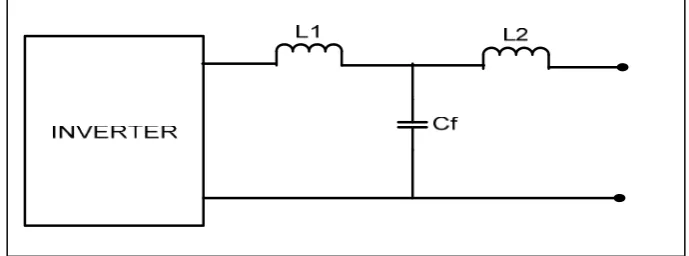
waveform. To filter the waveform (Square wave or Sine wave) capacitors and inductors
are used. Low pass filters (LCL filter) as illustrated in Figure 2.7 below has good current
ripple attenuation with small inductance values. If the inverter has adjustable output
frequency, the filter must be tuned to a level above the maximum fundamental
[image:30.595.148.493.270.398.2]frequency.
Figure 2.7: LCL Filter
2.3 Inverter for Photovoltaic Applications
In a PV system, inverter contributes only a fraction of the overall initial installation cost
of PV systems. By referring to the percentage of initial cost distribution, inverter itself
occupies only 10% of overall cost compare to 70% of module and 20% of installation
and planning [9]. Even the value of inverter account is a small amount of cost but their
roles in overall system performance must not take lightly. The inverter has the capability
in the leading PV system towards a high efficiency, low cost and convenience in design
(size).
As seen in currently market available PV system topology, string inverters
capable of reduce in installation cost and higher input voltage [9]. Table 2.2 shows a PV
system configurations namely Large Single Inverter (Centre inverter), Multi Small
Table 2.2: Types of PV inverter/converter configurations [18]
Type of Inverters Block Diagram
Centralized inverter
String inverter
Multi-String inverter
21
2.3.1 Centralized inverter
Centralized inverter topology is the most common PV inverter topology which
implemented widely in the high rated power system, typically for rated power of more
than 10 kW. In central inverter, PV modules are connected in series to form a string and
the string are placed in parallel to each other. Each string connected to only one inverter.
Having only one inverter in the system contributed to both advantage and disadvantage.
The advantage of having only one inverter in the system can greatly reduce the
conversion losses which subsequently reduce the overall cost. Other than that, having
only one inverter allows easy monitoring and maintenance to the system. However the
list of its disadvantages is significant [18]:
• Need for high-voltage DC cables between PV panels and inverter
• Power losses due to common MPPT
• Power loss due to module mismatch
• Losses in the string diodes
• Reliability of the whole system depends on one inverter (the breakdown of a
single inverter will affect the whole system)
2.3.2 String inverters
String inverters are slightly evolved from central inverters. The key difference is that
they perform MPPT on strings rather arrays which may consist of multiple, parallel
strings. A string inverter may literally be a self-contained inverter for just one (short)
string of modules, so that multiple string inverters are needed for larger systems. In other
words, a string inverter may be a central inverter that has multiple inputs, one for each
string in the array. The advantages compared to the central inverter are as follows:
• No losses in string diodes (no diodes needed)
• Separate MPPTs for each string
• Better yield, due to separate MPPTs
2.3.3 Multi-string inverter
The multi-string inverter configuration combines string inverter and central inverter
concept into one configuration. The main advantage of this configuration is the
independent individual MPPT. In multi-string inverter, a DC/DC converter is connected
for each string and then connect to the one central inverter. By having this DC/DC
converter, the input voltage will remain constant and the control scheme of the inverter
becomes easier because of the MPPT is controlled by the DC/DC converter. The major
disadvantage of this system is when the inverter is break down, the whole system will
also fail to work [17].
2.3.4 Module-integrated inverter
The Module-integrated inverter known as AC modules is considered as new technology
and is gaining popularity in the PV world. This is a major advantage since the MPPT
mismatch is no longer a problem because the inverter (built-in MPPT system) controls
the tracking of one module only. This will lead to maximum power for each module.
Since each module has its own inverter, expansion of the system is rather easy. The
output of the module can be directly connected to the grid, thus DC cabling can be
reduced or eliminated. Installing the AC module is also easy, hence no expertise is
needed. The AC module also eliminates the need for the bypass and string diode,
therefore eliminating the associated losses.
The drawback of the AC module system is that the power per unit produced is
low, with the DC boosting system inherent to the inverter adds to the losses. This
reduces the efficiency of the systems. Another disadvantage of this configuration is that
the inverter lifetime is shorter than the module, so bundling up the inverter to the module
often leads to the failure of the module because they need to be able withstand the harsh
environmental conditions. Since the AC module is still a new technology, the production
cost remains high. New trends are observed where more and more inverters are proposed
23
module to be expanded and widely used in the future. The simplicity of connection is the
main reason for AC modules to draw users towards this technology. Cost, however, has
been, and remains, one of the critical obstacles to further expansion of AC models in PV
applications [18].
2.4 Classification of Inverters
The two major classifications of the inverter are the voltage source inverters (VSIs) and
the current source inverters (CSIs). The VSI is the most commonly used in many
applications. Figure 2.8 illustrates how the voltage source inverter and current source
inverter can be used in a photovoltaic system. In the VSI, the capacitor in the DC link
constitutes the actual voltage source, since the voltage across the capacitor cannot
change instantly. The main task of the inductor is to isolate the high frequency
components of the input current [11]. In some applications, the inductor is removed to
reduce the size and cost of the inverter and to avoid the reduction of the maximum
available output voltage due to the voltage drop across it.
The absence of the freewheeling diode across the switch is the obvious
difference of the CSIs compared to the VSIs as well as reducing the size and weight of
the inverter. The freewheeling diode becomes redundant if the inverter is supplied from
a DC current source, since the current cannot change its polarity in any half-leg of the
inverter. Therefore, it can only flow through the switches. The input current to the
inverter is maintained at a constant level and the DC link inductor attenuates the current
[image:34.595.117.523.571.688.2]ripple [11].
Figure 2.8: (a) Voltage source inverter and (b) Current source inverter [14]
2.5 Resonant Circuit
Low power PV application in single phase grid connected PV system allows the
possibility of eliminating the implementation of transformer [12]. According to [13],
leakage current tends to flow through the resonant circuit which consists of DC source
(PV Array), input/output filter, inverter, parasitic ground capacitance and grid
impedance as shown in Figure 2.9.
The galvanic connection between DC and AC side resulting from an absence of
isolation transformers together with particular switching scheme with varying common
mode voltage, will cause the resonant circuit to excite and results in the flow of leakage
current. The grid itself, switching scheme with respect to converter topology and also the
resonant circuit formed by the ground capacitance are the factors which will cause the
[image:35.595.137.495.389.584.2]leakage current to flow in the resonant circuit.
69
REFERENCES
1. Roberto Gonzalez, Lopez, Pablo Sanchis, Gubia, Alfredo Ursua (2006), High-Efficiency Transformerless Single-phase Photovoltaic Inverter, Power Electronics and Motion Control Conference, EPE-PEMC, pp. 1895-1900.
2. Fen Tang, Fei Zhou, Xinmin Jin, Yibin Tong (2008), Leakage Current Analysis of a Single-Phase Transformer-less PV Inverter Connected to the Grid,
Sustainable Energy Technologies, ICSET 2008. IEEE International Conference, pp. 285-289.
3. Pankaj H zope, Pravin G.Bhangale, S.R.Suralkar (2012), Design and Implementation of Carrier Based Sinosoidal PWM (Bipolar) Inverter,
International Journal of Science and Research (IJSR), Indian Online ISSN:
2319-7064, pp.129-133.
4. D. Barater, G. Franceschini, E. Lorenzani (2009), Unipolar PWM for Transformerless Grid-Connected Converters in Photovoltaic Plants, Clean Electrical Power 2009 International Conference, pp. 387-392.
5. Roberto Gonzalez, Lopez, Pablo Sanchis, Gubia, Alfredo Ursua (2006), High-Efficiency Transformerless Single-phase Photovoltaic Inverter”, Power Electronics and Motion Control Conference, EPE-PEMC 2006. 12th
International, pp. 1895-1900
7. Mounir Bouzguenda, Tarak Salmi, Adel Gastli, Ahmed Masmoudi (2010), Assessment of Topologies to Minimize Leakage Currents in Transformerless PV Inverters, Energy Conference and Exhibition (Energy Con), 2010 IEEE International, pp. 417-422
8. Roberto Gonzalez, Jesus Lopez, Pablo Sanchis, Luis Marroyo (2007),
Transformerless Inverter for Single-Phase Photovoltaic Systems, IEEE Transactions on Power Electronics, Vol. 22, No. 2, pp. 693-697.
9. P M. Martino, C. Citro, K. Rouzbehi, P. Rodriguez (2012), Efficiency Analysis of Single-Phase Photovoltaic Transformer-less Inverters, International Conference on Renewable Energies and Power Quality (ICREPQ’12) Santiago
de Compostela (Spain).
10. Lopez O, Teodorescu R, Doval-Gandoy J (2006), Multilevel transformerless topologies for single-phase grid-connected converters, IECON 2006-32nd annual conference on IEEE industrial electronics, pp. 5191 – 5196.
11. Sunil Panda, Anupam, Mishra B. Srinivas (2009), Control of Voltage Source Inverters using PWM/SVPWM for Adjustable Speed Drive Applications: Master Thesis, Department of Electrical Engineering, National Institute Of Technology Rourkela.
12. A.M. Trzynadlowski (1998), Introduction to modern power electronics, John Wiley & Sons, Inc. ISBN 0-471-15303-6.
13. Remus Teodorescu, Marco Liserre, Pedro Rodriguez (2011) “Grid Converter for Photovoltaic and Wind Power Systems”, John Wiley & Sons, Ltd, pp.21-23. 14. X. Su, Y. Sun, and Y. Lin (2011), Analysis on leakage current in transformerless
single phase PV inverter connected to the grid, Power and Energy Engineering Conference (APPEEC), 2011 Asia Pacific, pp. 1-5.
15. C. Morris (2009), Grid connected transformerless single phase photovoltaic inverters: An evaluation on DC current injection and PV array voltage
71
16. M.S. Ismail, M. Moghavvemi, T.M.I. Mahlia (2011), Design of a PV/Diesel Stand Alone Hybrid System for a Remote Community in Palestine, Journal of Asian Scientific Research 2, pp.599-606.
17. Solmetric Corporation , Technical note on Guide to interpreting I-V curve measurement of PV arrays, CA, United Stated, Retrieved Februari 2013, from
http://resources.solmetric.com/get/Guide%20to%20Interpreting%20I-V%20Curves.pdf.
18. E. Lorenazani, Giovanni Franceschini, Alberto Bellini and Carla Tassoni (2009), Single-Phase Grid Connected Converter for Photovoltaic Plants, Industrial Electronics, 2009. IECON '09. 35th Annual Conference of IEEE, pp. 90-108. 19. Professor Chem Nayar, Lecturer notes on Photovoltaic Power Systems-Grid
connected PV, Curtin University of Technology Perth, Retrieved April 2013. 20. Lopez, O.Teodorescu, R. Freijedo, F. Doval-Gandoy (2007), Eliminating Ground
Current in a Transformerless Photovoltaic Application, Power Engineering ociety General Meeting IEEE, pp. 1-5.
21. Lin Ma, Tamas Kerekes, Remus Teodrescu, Xinmin Jin, Dan Floricau, Marco Liserre (2009), The High Efficiency Transformerless PV inverter Topologies Derived From NPC Topology, Power Electronics and Applications, 2009. EPE '09. 13th European Conference, pp.1-10.
22. D. Barater, G. Butticini, A.S. Crinto, G. Franceschini, E. Lorenzani (2009), A new proposal for ground leakage current reduction in transformerless grid-connected converters for photovoltaic plants, 35th Conference of IEEE Industrial Electronics, 2009. IECON ’09, pp. 4531-4536.
23. Tamas Kerekes, Remus Teodorescu, Pedro Rodriguez, Gerardo Vazquez, Emiliano Aldabas (2011), A New High Efficiency Single Phase Transformerless PV Inverter Topology, IEEE Transaction on Industrial Electronics, Vol 58, pp. 184-191.
![Figure 1.1: Renewable energy based distributed generation system [1]](https://thumb-us.123doks.com/thumbv2/123dok_us/8773416.900080/13.595.117.518.112.293/figure-renewable-energy-based-distributed-generation.webp)
![Figure 2.1: Grid connected PV system [19]](https://thumb-us.123doks.com/thumbv2/123dok_us/8773416.900080/18.595.113.531.462.682/figure-grid-connected-pv-system.webp)
![Figure 2.2: Stand alone PV system [11]](https://thumb-us.123doks.com/thumbv2/123dok_us/8773416.900080/20.595.112.518.163.398/figure-stand-alone-pv-system.webp)
![Figure 2.3: Block diagram of the hybrid system [16]](https://thumb-us.123doks.com/thumbv2/123dok_us/8773416.900080/21.595.124.515.260.454/figure-block-diagram-hybrid.webp)
![Figure 2.4: Solar cell equivalent circuit [12]](https://thumb-us.123doks.com/thumbv2/123dok_us/8773416.900080/22.595.111.525.114.266/figure-solar-cell-equivalent-circuit.webp)
![Figure 2.5: I-V Curve for solar cell [16]](https://thumb-us.123doks.com/thumbv2/123dok_us/8773416.900080/24.595.112.506.109.301/figure-v-curve-for-solar-cell.webp)
![Figure 2.6: PV cell, PV Module and PV Array relationship [15]](https://thumb-us.123doks.com/thumbv2/123dok_us/8773416.900080/26.595.114.521.414.594/figure-pv-cell-pv-module-pv-array-relationship.webp)
![Table 2.1 : PV cell image [12]](https://thumb-us.123doks.com/thumbv2/123dok_us/8773416.900080/28.595.107.535.138.611/table-pv-cell-image.webp)
![Table 2.2: Types of PV inverter/converter configurations [18]](https://thumb-us.123doks.com/thumbv2/123dok_us/8773416.900080/31.595.110.525.135.711/table-types-of-pv-inverter-converter-configurations.webp)
