© 2017, IRJET | Impact Factor value: 6.171 | ISO 9001:2008 Certified Journal | Page 1377
“Study of Compressive Strength of Concrete by Partially Replacing Fine
Aggregate with Quarry Dust”
D.Vinay kumar
1, Usha K
2,Abhilash K
3, D.Apurva
4, V.SaiRam
4, Ch. Premsagar
41,2
Assistant Professor, Civil Engineering Department, BITS, Warangal
3Assistant Professor, Civil Engineering Department, SSE, Puttaparthi
4
UG Students, Civil Engineering Department, BITS, Warangal
---***---Abstract -
Nowadays the availability of Natural fineaggregates reduced, so we want to find substitute materials, so we have to search for any other easily available materials like Quarry dust, Copper slag, Granulated blast furnace slag , Bottom ash, Foundry sand, Construction and demolition waste etc.., By replacing the substitute materials we can check whether the strength remains same or varies. Anyhow we are getting quarry dust easily and it is eco Friendly also so we can use quarry dust as a substitute for fine aggregate and we can check the strength, if strength remains same we can replace quarry dust as a substitute in the construction fields
.
In the production of concrete, fine aggregate place a vital role. In Warangal district resources material of fine aggregate of natural sand is less available. So my studies on compressive strength test by partial replacing fine aggregate with quarry dust. Partially replacing quarry dust in fine aggregate mixing ratios at an interval of 10%, 20% and 30%. Mix proportions for M15 concrete is prepared with reference to IS: 10262-2009and IS: 456-2000 for the study of workability. Compression testing machine test results with the conventional concrete. The strengths were obtained at the ages of 7 days, 14 and 28 days. Compression test compressive strength increased marginally from 0% to 20% replacement. There is a slight decrease in the corresponding compression test compressive strength at 30% replacement. Good correlation was observed between compression test compressive strength. It was observed that the addition of quarry dust that would replace the fine material at particular proportion has displayed an enhancing effect on properties of concrete. This investigation proves that quarry dust can be used as a partial substitute for natural sand in preparing concrete.
Key words: compression test, quarry dust…
I. INTRODUCTION
Common river sand is expensive due to excessive cost of transportation from natural sources. Also large-scale depletion of these sources creates environmental problems. As environmental transportation and other constraints make the availability and use of river sand less attractive, a substitute or replacement product for concrete industry needs to be found. River sand is most commonly used fine aggregate in the production of concrete poses the problem of
acute shortage in many areas. Whose continued use has started posing serious problems with respect to its availability, cost and environmental impact?
A comparatively good strength is expected when sand is replaced partially or fully with or without concrete admixtures.
Quarry dust has been used for different activities in the construction industry such as road construction and manufacture of building materials such as light weight aggregates, bricks and tiles. This paper presents the results for compressive strengths by compression testing machine test by partially replacing fine aggregate with quarry dust. Quarry dust is used an alternative for natural sand is collected from nearby quarry. Quarry dust is easily available, effective usage of quarry dust as a partial or full replacement to natural sand can reduce the demand for natural sand, pollution in environment and topography of the area. Hence, it is essential to find some way to use the quarry dust.
This study initiated to assess the suitability of quarry dust as partial substitute for fine aggregate in concrete. The evaluation is based on parameters such as gradation results, compressive strength with both compression testing machine and Rebound hammer test.
II. SCOPE OF PRESENT STUDY
In this study, M15 grade of concrete was obtained and the mixtures were modified by partially replacing natural sand with quarry dust. The strength of concrete was evaluated in terms of compressive strength by compression testing machine.
1. To check the compressive strength of concrete by replacing quarry dust.
2. To observe whether the compressive strength varies with percentage of substitute material.
© 2017, IRJET | Impact Factor value: 6.171 | ISO 9001:2008 Certified Journal | Page 1378
III. COLLECTION OF SAMPLES
The quarry dust was collected from the dumps of quarry near Warangal.
IV. MATERIAL PROPERTIES
Materials:
The constituent materials used in this investigation were procured from local source. Necessary tests are carried out on these materials to choose the kind and type of materials. We are using cement, Sand, Quarry Dust, Coarse aggregate, Fine aggregate, water.
Definition of OPC: Cement can be defined as the bonding
material having cohesive & adhesive properties which makes it capable to unite the different construction materials and form the compacted assembly. Ordinary/Normal Portland cement is one of the most widely used types of Portland cement.The name Portland cement was given by Joseph Aspdin in 1824 due to its similarity in colour and its quality when it hardens like Portland stone. Portland stone is white grey limestone in island of Portland, Dorset.
Composition of OPC:
The chief chemical components of ordinary Portland cement are:
1. Calcium 2. Silica 3. Alumina 4. Iron
Calcium is usually derived from limestone, marl or chalk while silica, alumina and iron come from the sands, clays & iron ores. Other raw materials may include shale, shells and industrial byproducts.
Basic Composition:
Table 1: Basic Composition of OPC
Contents CaO SiO2 Al2O3 Fe2O3 MgO Alkalis SO3
%
60-67 17-25 3-8 0.5-6.0 0.5-4.0 0.3-1.2 2.0-3.5
The chief compounds which usually form in process of mixing:
Tri-Calcium Silicate (3CaO.SiO2) Di-Calcium Silicate (2CaO.SiO2)
Tri-Calcium Aluminates (3CaO.Al2O3) Tetra-Calcium Alumino Ferrite
(4CaO.Al2O3.Fe2O3)
Uses of OPC (Ordinary Portland cement):
It is used for general construction purposes where special properties are not required. It is normally used for the reinforced concrete buildings, bridges, pavements, and where soil conditions are normal. It is also used for most of concrete masonry units and for all uses where the concrete is not subject to special sulfate hazard or where the heat generated by the hydration of cement is not objectionable. It has great resistance to cracking and shrinkage but has less resistance to chemical attacks.
Quarry Dust:
Quarry Rock Dust can be defined as residue, tailing or other non-voluble waste material after the extraction and processing of rocks to form fine particles less than 4.75mm
Necessity of using Quarry dust sand
(Environmental significance):
Common river sand is expensive due to excessive cost of transportation from natural sources. Also large-scale depletion of these sources creates environmental problems. As environmental transportation and other constraints make the availability and use of river sand less attractive, a substitute or replacement product for concrete industry needs to be found. River sand is most commonly used fine aggregate in the production of concrete poses the problem of acute shortage in many areas. Whose continued use has started posing serious problems with respect to its availability, cost and environmental impact.
Advantages:
1. The addition of quarry dust has shown significant increase compared to plain cement concrete with natural sand. This can be safely concluded that quarry dust concrete can lead to significant improvement in microstructure due to different size fractions.
2. Permeability Test results clearly demonstrate that the permeability of Quarry Rock Dust concrete is less compared to that of conventional concrete.
© 2017, IRJET | Impact Factor value: 6.171 | ISO 9001:2008 Certified Journal | Page 1379
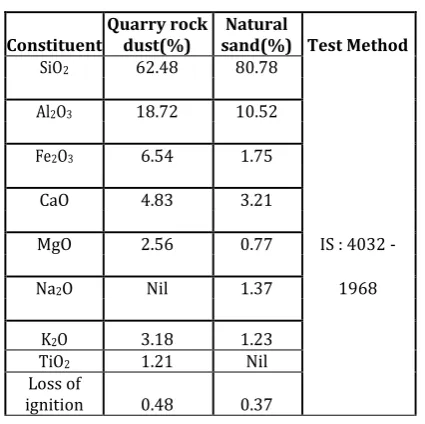
Chemical Composition of Quarry dust
Table 2:
Typical Chemical Composition of Quarry Dust and SandConstituent Quarry rock dust(%) sand(%) Test Method Natural
SiO2 62.48 80.78
Al2O3 18.72 10.52
Fe2O3 6.54 1.75
CaO 4.83 3.21
IS : 4032 -
MgO 2.56 0.77
1968
Na2O Nil 1.37
K2O 3.18 1.23
TiO2 1.21 Nil
Loss of
ignition 0.48 0.37
Physical Properties
Table 3: Physical properties of Quarry Rock Dust and
Natural SandProperty Quarry dust Natural sand Test method Specific gravity 2.54-2.60 2.60 IS2386(PartIII)1963
Bulk relative 1720-1810 1460 IS2386(PartIII)1963 density(kg/m3)
Absorption (%) 1.20-1.50 Nil IS2386(PartIII)1963 Moisture content
(%) Nil 1.50 IS2386(PartIII)1963
Fine particles less
than 12-15 6 IS2386(PartI)1963
0.075mm (%)
Sieve analysis Zone –II Zone-II IS383-1970
Coarse Aggregate
:
Normal aggregate that is crushed blue granite of maximum size 20 mm was used as coarse aggregate. We are conducting tests on coarse aggregate are Water Absorption Capacity, Specific Gravity and Fineness Modulus of coarse aggregate.
Fine Aggregate:
Well graded river sand passing through 4.75 mm was used as fine aggregate. The sand was air-dried and sieved to remove any foreign particles prior to mixing. We are conducting tests on fine aggregate are Water Absorption
Capacity, Specific Gravity and Fineness Modulus of fine aggregate.
Water:
The quality of water is important because contaminants can adversely affect the 3strength of concrete and cause corrosion of the steel reinforcement. Water used for producing and curing concrete should be reasonably clean and free from deleterious substances such as oil, acid, alkali, salt, sugar, silt, organic matter and other elements which are detrimental to the concrete or steel. If the water is drinkable, it is considered to be suitable for concrete making. Hence, potable tap water was used in this study for mixing and curing.
V .METHODOLOGY
The experimental work is broadly classified into three stages, namely
a) Sieve analysis
b) Evolving mix proportions c) Strength studies
Sieve Analysis
The main objective of the investigation is to partially replace natural sand with quarry dust and study the behavior of concrete in the fresh and hardened state. The materials used for the investigation is first sieved and grading of aggregates is carried out then the zone value is obtained.
Natural sand replaced with quarry dust at an interval of 0% up to 30%.
Mix Proportions
[image:3.595.30.294.441.584.2]© 2017, IRJET | Impact Factor value: 6.171 | ISO 9001:2008 Certified Journal | Page 1380
Strength Studies
Compressive Strength:
Compression Testing Machine: Standard moulds of 150mmx150mmx150mm size are used for casting concrete cubes. The cubes were compacted in three layers. Nine concrete cubes were casted for each mix. A total of forty five concrete cubes were casted. Cubes were immersed in water for curing till the date of testing. The specimens were prepared as per IS: 516-1989 and tested for uniaxial compressive strength at 7, 14 and 28 days. The results obtained are the average of three specimens tested and the results are presented.
The standard method of determining strength of hardened concrete consists of testing concrete cubes in compression. The quality of entire concrete of a structure cannot be fully assessed by testing a few concrete cubes. The results obtained in testing cubes do not always reflect the actual strength of concrete in construction.
In addition, the number of test cubes is generally so small that they can only be considered as random tests. Sometimes, in case of failure of cubes, doubtful concrete, cracks, deterioration of concrete, etc. it becomes necessary to assess the quality and strength of concrete of the structure.
VI. RESULTS AND DISCUSSIONS
Compression testing Machine Test results:
Mix design (% of replacement)
Avg. Compressive Strength (N/mm2)
7 Days 14 Days 28 Days
0 9.75 13.5 15
10 9.82 13.81 15.18
20 10.52 15.55 18.6
30 9.8 12.4 16.31
VII. CONCLUSIONS
In this experimental investigation, an attempt has been made to use Quarry dust to replace the fine aggregates in concrete.
Following are the some of the conclusions drawn from the results of this investigation:
1. Quarry dust can be used as a finer material which can reduce the voids in concrete.
2. Up to 10% replacement of fine aggregates by quarry dust, the results obtained are satisfactory.
3. From the above results 20% replacement of quarry dust gives high Compressive Strength.
4. By using quarry dust substitute instead of conventional materials, which would not only be preserving the natural precious resources.
5. Construction of buildings from quarry dust is eco-friendly as it utilizes rocky dust and reduces air, land and water pollution. It is energy efficient and also cost effective.
Future scope of study
1. In this study we substitute quarry dust in proportions of 10%, 20% & 30%, so further can do the increasing of proportions like (40%, 50%, 80% & 100%).
2. 2. As we make the concrete with the Mix ratio of M15, so we can do further mix ratios like M20 & M25.
3. In this present study we have Replaced Quarry dust, further we can replace substitute materials like Copper slag, Granulated blast furnace slag , Bottom ash, Foundry sand, Construction and demolition waste etc.., to get same Compressive strength or varies.
REFERENCES
1. Studies on Quarry Dust as Partial Replacement of Fine Aggregates in Concrete, (IJLTEMAS) Volume VI, Issue IV, April 2017.
© 2017, IRJET | Impact Factor value: 6.171 | ISO 9001:2008 Certified Journal | Page 1381 3. Lohani T.K.1, Padhi M.2, (Mar-Apr 2012) Orissa,
Bhubaneswar, Optimum utilization of Quarry dust as partial replacement of sand in Concrete; In JASER Vol.1 ISSN; 2277-9442.
4. “Partial Replacement of Sand with Quarry Dust in Concrete” by Chandana Sukesh, International journal of innovative Technology and Exploration and Engineering (IJITEE), VOL.2, MAY 2013.
BIOGRAPHIES
D. Vinay Kumar, Assistant Professor, Civil Engineering Department, Balaji Institute of Technology & Science. Narsampet, Warangal.
K. Usha Krishna, Assistant Professor, Civil Engineering Department, Balaji Institute of Technology & Science. Narsampet, Warangal.
D. Apurva, UG Student, Civil Engineering Department, Balaji Institute of Technology & Science. Narsampet, Warangal.
V.SaiRam, UG Student, Civil Engineering Department, Balaji Institute of Technology & Science. Narsampet, Warangal.