© 2018, IRJET | Impact Factor value: 6.171 | ISO 9001:2008 Certified Journal
| Page 4029
Grey Wolf Optimizer for Economic Dispatch Issues
N. J. Patil
1, K. J. Gandhi
21
Professor, Instrumentation Engineering, D. N. Patel College of Engineering, Shahada, India
2Assistant Professor, Electrical Engineering, D. N. Patel College of Engineering, Shahada, India
---***---Abstract
- This work suggests a new algorithm named GreyWolf Optimizer (GWO) that motivated by grey wolves. The leadership pyramid and hunting mechanism of grey wolves are imitated by the GWO algorithm. alpha, beta, delta, and omega are the four wolves which works for act out the leadership pyramid. Additionally, the three key steps of hunting, searching for target, surrounding target, and attacking target, are applied. The algorithm is then used on 20 generating units and compared with Particle Swarm Optimization (PSO). The results indicate that the GW algorithm is ready to deliver economic results compared to PSO.
Key Words: Economic Dispatch; Grey Wolf Optimizer; Loss minimization; Meta-heuristic technique;
1. INTRODUCTION
Optimization issues are usually met in several fields in science and technology. Because of the actual and practical nature of the objective function or the model constraint these issues can be very difficult. ED is the most significant optimization issues in power system operation and planning by planning of generators to minimize the total operating cost and to fulfill load demand whereas fulfilling several equality and inequality constraint. The ED essentially considers the load balance constraint alongside the generating capability limits. In practical ED, ramp rate limits along with prohibited operating zones (POZ), valve point effects, and multi-fuel option essential consider to deliver the comprehensiveness for the ED problem formulation [1]. In the past few years, variety of approaches are developed for explaining the ED by classical mathematical programming methods [2-8]. But, they are highly sensitive to starting points and often converge to a local optimum solution or diverge altogether so conventional method failed to explain the problem. Further, conventional method generally have simple mathematical model and high search speed. Therefore, Particle Swarm Optimization (PSO) has grown over the past few years to resolve the ED problem by using meta-heuristic optimization techniques [9]. Meta-heuristic have become remarkably common because of its simplicity,flexibility, derivation-free mechanism, and local optima avoidance [10]. In the first place, they have been motivated by basic ideas with respect to physical occurrences, animals’ behaviors. Second, adaptability alludes to the applicability of meta-heuristics to various issues with no unique changes in the structure of the algorithm. Third, the larger part of meta-heuristics has derivation-free systems. Rather than gradient-based optimization approaches, metaheuristics optimize issues stochastically.
Lastly, metaheuristics have better skills to avoid local optima compared to conventional optimization techniques. This is owing to the stochastic nature of meta-heuristics which permit them to avoid stagnation in local solutions and search the entire search space widely. Therefore, the new algorithm, GWO suggested by S. Mirjalili [10] is applied in explaining ED issues.
II. ECONOMIC DISPATCH PROBLEMS
The Objective of Economic Dispatch is to diminish the fuel cost while fulfilling some equality and inequality constraints. Therefore, the problem is expressed as below.
A. Economic Load Dispatch Formulation
To diminish of its objective function is the main concern of ED problem. The objective function is expressed as below, where Ft is total fuel cost, N is number of generating unit and Fi (PGi) is operating fuel cost of generating unit i.
(1)
B. Minimization of Fuel Cost
The generator cost curve is given by quadratic functions and the total fuel cost F(PG) in (RM/h) can be stated as:
(2)
Where N is the number of generators; ai, bi, ci are the cost coefficients of the i-th generator and PG is the vector of real power outputs of generators and given as:
(3)
C. Constraints
• Power Balance/Equality Constraint
The total generated power must cover the total power demand PD and the real power of transmission loss, Ploss which can be defined as:
0 (4)
© 2018, IRJET | Impact Factor value: 6.171 | ISO 9001:2008 Certified Journal
| Page 4030
(5)Where,
Pj = the output generation of unit j (MW).
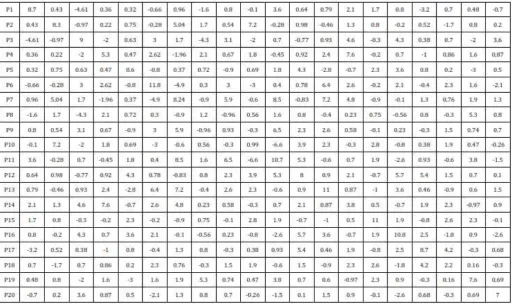
Bij = the ij-th element of the loss coefficient square matrix. Bi0 = the i-th element of the loss coefficient.
B00 = the loss coefficient constant.
• Generation Capacity/Inequality Constraint
For stable operation, the real power output of each generator is controlled by lower and upper limits as follows:
(6)
III. GREY WOLF OPTIMIZER (GWO)
In this section the inspiration of the proposed method is first discussed. Then, the mathematical model is provided. A. Inspiration
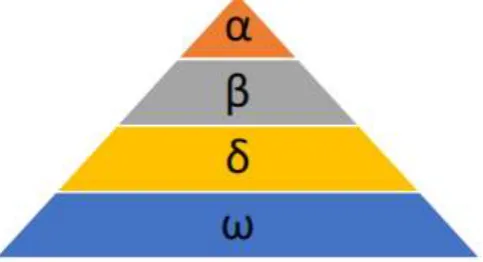
[image:2.595.41.283.413.544.2]Grey wolves are determined as predators, which means that they are at the top of the food chain. They live in group of about 5-12 on average. The specific importance is that they have an exceptionally strict social dominant order as shown in Fig. 1.
Fig -1: grey wolf social pyramid
The leader can be a male or a female, known as alpha. The alpha’s verdicts are dictated to the box. Though, some type of self-ruled conduct has also been detected which implies the alpha is not essentially the strongest however the most effective in term of managing the box. Hence, it shows that the discipline of the box is much more important than its strength. Beta is the second level within the pyramid of grey wolf. He or she most likely the best candidate to be the alpha if one of the alpha wolves died or becomes very old. The beta wolf assumes the part of a guide to the alpha and discipliner for the box. The beta fortifies the alpha’s instructions throughout the box and offers feedback to the alpha. Delta is the third level. Delta wolves go through to alphas and betas, however they control the omega. Scouts, sentinels, elders, hunters, and caretakers belong to this category. Lookout the
boundaries of the area and warning the box if any risk is the duties of Scouts. Sentinels are responsible for protection and assurance the safety of the box. The experienced elder wolves are used to be alpha or beta. Hunters’ support the alphas and betas in hunting target and providing food for the box. Lastly, the duties of caretakers are caring for the weak, ill, and injured wolves in the box.
Omega is the lowest position grey wolf. The omega assumes the part of substitute. They are the last wolves that are permitted to eat. It might appear that the omega is not a significant individual in the box, however it support to sustain the dominance structure of the complete box. Sometimes the omega is additionally the babysitters within the box. Group hunting is one more remarkable social conduct of grey wolves. According to Muro et al. [11] the key stages of grey wolf hunting are as given below:
• Tracking, rushing, and moving toward the target. • Pursuing, surrounding, and irritating the target until it quits moving.
• Attack towards the target
This hunting methods and the social pyramid of grey wolves are mathematically demonstrated in order to outline GWO.
IV. MATHEMATICAL MODEL AND ALGORITHM
In this segment, the mathematical representations of social pyramid, tracking, surrounding, and attacking target are given.A. Social Pyramid
We find the proper solution as the alpha (α).Consequently, beta (β) and delta (δ) are the second and third best solutions respectively. Omega (ω) is supposed to be the rest of the candidate solutions. α, β, and δ direct the optimization in the GWO algorithm. ω wolves follow these three wolves.
B. Surrounding Target
When the wolves do hunting, they tend to surround their target. The equations given below will be illustrated the surrounding behavior [5]:
(7) (8)
Where t specifies the current iteration, and are coefficient vectors, is the position vector of the target, and specifies the position vector of a grey wolf.
The vectors and are calculated by the expression given below:
© 2018, IRJET | Impact Factor value: 6.171 | ISO 9001:2008 Certified Journal
| Page 4031
(10)
Where components of are linearly diminished from 2 to 0 over the progress of iterations and, and are random vectors in [0, 1].
The final position X (t+1), is determined by the locations of alpha, beta, and delta in the search area. These situations are expressed by the expressions given below:
(11)
(12)
(13)
To sum up, the optimization method for GWO is starting with making a random population of grey wolves which can be termed as candidates of solution. During the simulation, alpha, beta and delta wolves guess the probable location of the target. Exploration and misuse are guaranteed by the adaptive values of and A. Candidate solutions are diverged from the target if and converged towards the target if Finally GWO algorithm is terminated by the criterion that has been set initially.
V. SIMULATION RESULTS
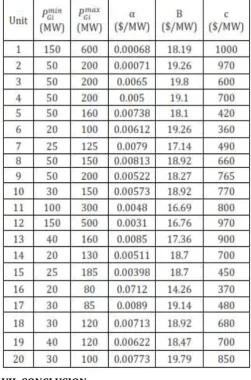
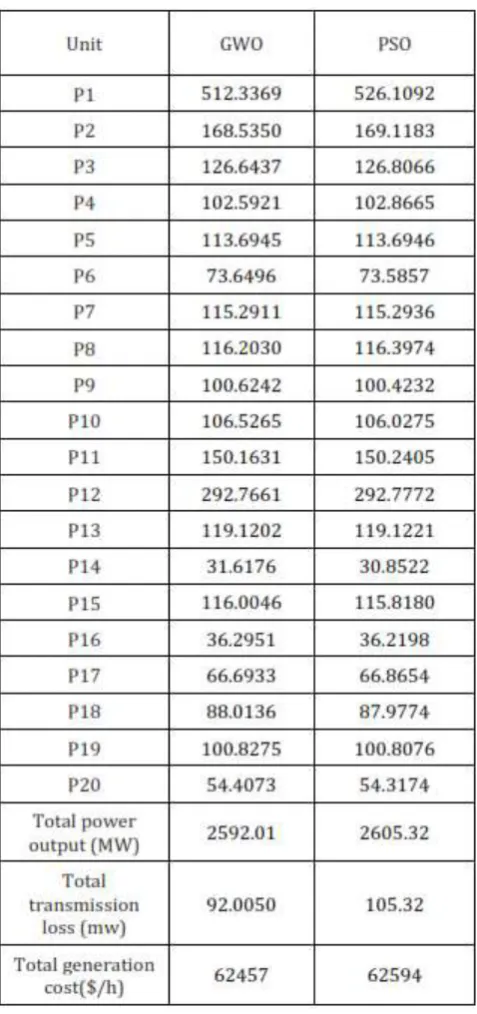
A system with 20 generators is utilized to demonstrate the effectiveness of GWO. The system data are charted in Table1 [12, 13]. The system only considers transmission loss, the valve point loading impact is not considered by the system. 2500 MW load demand is considered for this system. The results of PSO are compared with the GWO-based results and the potential benefit of the GWO as an optimizing algorithm for this specific application is established. The simulation results for GWO, PSO are charted in Table 2 where the real power generation by each generator unit for the given demand and the total cost are given.
[image:3.595.307.559.103.484.2]From Table 2, the minimum costs attained by the GWO based system for test system is 62457 $/h, also the power generated by GWO is within the range of the minimum and maximum bounds at each generator. Therefore, it is determined that the performance of the GWO is best one for all the stated test system.
Table -1: System data for 20 generators system
VII. CONCLUSION
The PSO technique has been applied to an economic problem in this paper. Following conclusions are drawn from the results obtained in previous section.
The results obtained prove that GWO has been effectively implemented to solve various ED issues.
GWO is capable to deliver very economical results with minimizing total fuel cost and lower transmission loss.
It is clear that, the GWO is capable to converge to an enhanced quality near-optimal solution and keeps improved convergence characteristics than PSO.
Finally, GWO displays a decent stability between exploration and exploitation which results in high local optima avoidance.
© 2018, IRJET | Impact Factor value: 6.171 | ISO 9001:2008 Certified Journal
| Page 4032
Table -2: Total Power Generator for Each Unit and TotalCost for Two Meta-Heuristic Techniques
REFERENCES
[1] Sharma, J., & Mahor, A. Particle Swarm Optimization Approach for Economic Load Dispatch: A Review. 3 (1), 2013.
[2] Chen CL, Wang CL. Branch-and-bound scheduling for thermal generating units. IEEE Trans Energy Convers 1993; 8(2):184–9.
[3] Lin CE, Viviani GL. Hierarchical economic dispatch for piecewise quadratic cost functions. IEEE Trans Power Apparatus Syst 1984; 103(6):1170–5.
[4] Granville S. Optimal reactive dispatch through interior point methods. In: IEEE Summer Meeting, Paper no. 92 SM 416-8 PWRS, Seattle, WA, USA; 1992.
[5] Yang HT, Chen SL. Incorporating a multi-criteria decision procedure into the combined dynamic programming/production simulation algorithm for generation expansion planning. IEEE Trans Power Syst 1989; 4(1):165–75.
[6] Liang ZX, Glover JD. A zoom feature for a programming solution to economic dispatch including transmission losses. IEEE Trans Power Syst 1992; 7(3):544–50.
[7] Yan X, Quintana VH. An efficient predictor-corrector interior point algorithm for security-constrained economic dispatch. IEEE Trans Power Syst 1997; 12(2):803–10.
[8] Lin CE, Chen ST, Huang CL. A direct Newton–Raphson economic dispatch. IEEE Trans Power Syst 1992; 7(3):1149–54.
[9] G. Zwe-Lee, "Particle swarm optimization to solving the economic dispatch considering the generator constraints," IEEE Transactions on Power Systems, vol. 18, pp. 1187-1195, 2003.
[10] Mirjalili, S., Mirjalili, S. M., & Lewis, A.. Grey Wolf Optimizer. Advances in Engineering Software, vol. 69, pp. 46-61, March 2014.
[11] Muro C, Escobedo R, Spector L, Coppinger R. Wolf-pack (Canis lupus) hunting strategies emerge from simple rules in computational simulations. BehavProcess 2011; 88:192–7.
[12] Su, C. T., & Lin, C. T.. New approach with a Hopfield modeling framework to economic dispatch.IEEE Transactions on Power Systems, 15(2), 541–545, 2000.
[image:4.595.38.277.111.619.2]© 2018, IRJET | Impact Factor value: 6.171 | ISO 9001:2008 Certified Journal
| Page 4033
Table-3: Loss Coefficients for 20 Generators SystemBIOGRAPHIES
N. J. Patil received his B.E. degree from NMU, Jalgaon in 1997. He completed his M.E. in 2000 and Ph.D. in 2013 from SRTMU, Nanded India. His research interests include fractional control, fuzzy control, nonlinear control, optimization and adaptive control.