© 2018, IRJET | Impact Factor value: 6.171 | ISO 9001:2008 Certified Journal | Page 3727
Effects of Soil Compressibility on Building Frames supported on
Isolated Footings
Vipin Kumar Verma
1, Dr. Vivek Garg
21
M.Tech. scholar, Maulana Azad National Institute of Technology, Bhopal (MP)
2
Assistant Professor, Dept. of Civil Engineering, Maulana Azad National Institute of Technology, Bhopal,
Madhya Pradesh, INDIA
---***---Abstract
- Generally, the structural analysts do not consider the effects of compressibility of soil despite having compressible nature of soil while analysing and designing the buildings, they assume fixity at the base and ignores the interaction effects to simply mathematical modelling which may result in unsafe and uneconomic design. In this paper, various multi-storeyed reinforced concrete residential building frame supported on isolated footings founded on different types of sandy soil and located in seismic zone V as per IS: 1893 (Part 1)-2002 are analysed using finite element software STAAD Pro. The structural stiffness of slab is also included by considering it as plate element. Initially, these building frames are modelled and analysed considering fixed base and support reactions are determined. The foundation sizes for all supports are calculated by using STAAD Foundation software. The respective fixed support is then replaced by a spring of equivalent foundation stiffness to perform flexible support analysis. In flexible support analysis, the significant maximum vertical and differential settlement between footings is observed which is neglected in conventional analysis performed by assuming fixed base. The effects of soil compressibility on both vertical support reaction and support moment are found to be more in building supported on the less stiff soil. The compressibility of soil also causes the redistribution of the forces in beams and columns and reversal in the nature of these forces. In this study analysis and design of structure assuming flexible support is found to be more accurate and economical.Key Words
: Soil compressibility, Isolated footing, STAAD Pro, Total vertical settlement, Differential settlement, Beam and column forces.1. INTRODUCTION
The buildings are the most extensively constructed structure within the construction industry. Nowadays, the reinforced concrete buildings have become quite common in India. The reinforced concrete building consists of horizontal structural members such as beams and slabs and vertical structural members such as columns and walls that are supported by foundation system. Normally, the structure is subjected to various loads such as self-weight, dead load, live load, wind load, earthquake load, snow load, etc. and the structural strength of slabs and the brick walls is not generally considered while designing the structures. The foundation support is assumed as either fixed or hinge support where the foundation transmit the loads from the structure to the
soil medium which undergoes a settlement depending on the characteristics of the soil medium, which in turn causes settlement (vertical, differential) and rotation of the footings, that results in redistribution of the column loads, the amount of which depends on the rigidity of structure and the load-settlement characteristics of the soil. Hence in reality, due to uneven deformation of supporting soil medium under the action of loads, the redistribution of forces in the frame members and stresses in the supporting soil media can effectively be seen. Thus, the concept of soil structure interaction comes into existence which can be defined as the process in which motion of the structure is encouraged by the response of the soil and the response of the soil is influenced by the structural motion. However, this effect is generally neglected by the structural analyst in the conventional structural analysis, and the structure is analysed and designed by idealizing the fixity at base neglecting the effect of soil structure interaction. For more realistic and safe design, the flexible base analysis should be performed compared to conventional analysis.
It is generally seen that buildings supported on isolated footings resting on compressible soil media are more susceptible to differential settlement and rotation of footings, which may cause a significant tilt in the structure, making occupants uncomfortable, cracks in the foundation and walls, non-uniform settling of doors and windows, bulging of walls and sinking of slabs, etc. So, such effects can be widely adverse and cannot be ignored. Thus, there is a need for investigation of the effects of soil compressibility on such buildings.
2. LITERATURE REVIEW
Several investigators performed the various type of studies considering the effects of soil compressibility. Some performed instrumental studies while some performed theoretical or parametric studies. The investigations of such researchers are discussed below.
© 2018, IRJET | Impact Factor value: 6.171 | ISO 9001:2008 Certified Journal | Page 3728 moment of inertia, rigid frames with a moment of inertia 5
times the base frame and flexible frame with a moment of inertia 1/5 times the base. They concluded that redistribution of loads due to the differential settlement may mitigate final settlements, so for safe and economic structure designers should consider the load redistribution while designing the structure.
Celebi et al. (1991) presented acceleration response data obtained from an instrumented sixty storey tall vertically tapered pyramid-shaped Transamerica building located at San Francisco during 1989 Loma Prieta earthquake. No significant torsional motion was indicated but Fourier analyses of accelerograms indicated a rocking type soil-structure interaction at 2 Hz in North-South direction and 1.8 Hz in East-West direction. It was also noted that the developments of the design response spectrum were affected due to the significant influence on motions at ground and basement, even when rocking amplitude was small.
Muria-Vila et al. (2004) investigated the response of two seismically-instrumented buildings in Mexico. One is fourteen stories reinforced concrete JAL building situated at Mexico City and another is seventeen stories reinforced concrete SIS building located at Acapulco, Both buildings are located on soft soil and have embedded box supported by friction piles as their foundation. It was found that the rocking moment is associated with several frequencies. Even for small levels of excitation, the dynamic responses are very sensitive to the amplitude of the imposed ground motion.
Aldea et al. (2007) investigated the seismic response of an instrumented high rise building having eighteen stories with dual reinforced concrete structure (inner shear wall tube and perimeter frames) comprising three underground stories situated at Bucharest, Romania. The sensors were instrumented at various levels in the building and on the adjacent ground in two boreholes at different depths. It was reported that in the event of an earthquake, peak accelerations at the third level basement are sensibly smaller than the nearby free field ground surface for recordings in all directions mainly in the frequency range of 2-3 Hz, a phenomenon associating kinematic soil-structure interaction effects.
Hora M (2008) developed a computer code in FORTRAN-77 for the elastoplastic soil-structure interaction analysis of two-bay two-storey plane frame-foundation beam-soil system using the finite element method. The superstructure is considered to behave in a linear elastic manner whereas the soil mass to behave in an elastoplastic manner. The coupled finite-infinite element discretization of soil mass with proper location of truncation boundary (the common junction between finite and infinite element layer, which is found by trial and error) was done for accurate and computationally economical solutions. He used the mixed incremental iterative approach for the elastoplastic analysis of the interaction system. He concluded that there takes a
transfer of forces and moments from exterior columns towards the interior ones, below which soil remains in as elastic state, although the soil mass below the outer edges has fully yielded.
Garg et al (2012) presented a review paper on interaction behaviour of soil structure foundation soil system. They made an attempt to study the possible alternative solutions proposed by various researchers to evaluate the effect of soil structure interaction from time to time. It was concluded that load redistribution significantly modifies the total and differential settlements, settlements are found more in the nonlinear analysis, a limited number of studies have been conducted considering the soil mass as elastoplastic, viscoelastic and viscoplastic interaction analyses and for designing of structures, Winkler hypothesis should at least be employed instead of carrying out an analysis with fixed base idealization of structures.
Hora et al (2012) analysed a three-bay three storeys reinforced cement concrete space frame founded on strap footing and resting on homogenous soil media and subjected to gravity loading using finite element method on ANSYS. They observed that the interaction effects cause significant redistribution of the forces and moments in the frame members. The use of strap beam caused the decrease in bending moments in columns except at the base of inner columns and it also decreases the higher values of shear force and bending moment in outer beams. So, strap beams were found to be effective when eccentrically loaded isolated footings were to be used.
Rao GVR et al (2014) made an attempt to analyse the structure considering the foundation soil settlement (soil medium defined by springs) under wind loads considering different wind zones i.e. by varying basic wind speed. They analysed the structure considering different heights by varying number of stories for variation modulus of subgrade of supporting soil. They used the results of the above analysis to study the effect of soil structure interaction on horizontal displacement at each floor level and vertical displacement at the supports and the forces such as shear forces and bending moment of an interior middle frame of a building.
© 2018, IRJET | Impact Factor value: 6.171 | ISO 9001:2008 Certified Journal | Page 3729 Ghandil et al (2016) investigated the nonlinear response of
moment resisting frames on nonlinear soft soils. They considered two different types of the soil profile, profile one consists of a single sand layer resting on bedrock while profile two include three clay layers resting on the bedrock and also considered buildings of different heights having 5, 10, 15 and 30 storeys assuming very high seismicity. The analysis of the soil structure interaction system was implemented in software OpenSees. The nonlinear behaviour was introduced to the structural system by inserting elastoplastic zero length hinge elements at the ends of the frame elements, these hinges are rigid before yield. Drifts, shear forces and ductility demands of storeys were calculated once assuming a rigid base and then a soft supporting soil for the structure with nonlinear time-history analysis. It was seen that soil structure interaction increases the drifts and ductility demands of the lower storeys while it decreases at upper storeys of a certain building.
Malviya et al (2017) made an attempt to acknowledge the effect of soil compressibility in analysis and design of the structure. A four-bay (G+7) reinforced concrete building frame supported on sandy soil subject to gravity and seismic loads was analysed using STAAD PRO software. They initially modelled and analysed the building frame assuming fixed base and support reactions were determined for different load cases. Then they replaced the fixed support by equivalent stiffness to perform the flexible base analysis. Based on the results, it was acknowledged that the soil compressibility caused settlements of foundations, change in support reactions, redistribution of forces in beam and column and also affected the requirements of reinforcement for design.
3. PROPOSED WORK
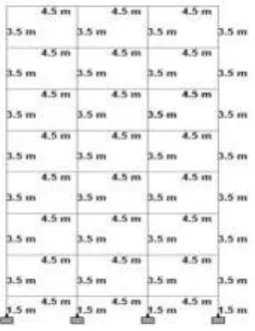
The seven-storeyed 3 bay by 3 bay reinforced concrete building frames supported on isolated square footing resting on compressible soil are analysed as per Indian Standard Codes under gravity and seismic loading using finite element package STAAD Pro. The three different types of sandy soil (dense, medium, and loose) are considered to account for the effect of compressibility of soil. The structural strength of slab is considered by assuming it as plate element. The building is assumed to be in seismic zone V as per IS: 1893 (Part 1)-2002. The size of beams and columns are optimised as per safety and economy for each building frame. The analyses is performed as both fixed support analysis and flexible support analysis. For flexible support analysis, the springs of equivalent foundation stiffness at each support are used. To calculate the equivalent foundation stiffness, the modulus of the subgrade is assumed depending upon the type of soil.
The plan, isometric view and elevation of the proposed building frame models is shown in figure 1, 2 and 3 respectively.
Fig -1: Plan of building frame model
Fig -2: Isometric view of building frame model
Fig -3: Elevation of building frame model
[image:3.595.348.519.74.245.2] [image:3.595.367.503.295.477.2] [image:3.595.374.502.533.699.2]© 2018, IRJET | Impact Factor value: 6.171 | ISO 9001:2008 Certified Journal | Page 3730 Table -1: Geometric properties of building frame models
Description Values
Material Concrete (M25)
Modulus of Elasticity 2.17 x 10⁷ kN/m2 Density of concrete 23.56 kN/m2
No. of storey 7
No. of bays (both direction) 3 bays Bay width (both direction) 4.5 m Floor to floor height 3.5 m Foundation depth below
plinth level 1.5 m
Slab thickness 150 mm
[image:4.595.45.280.102.352.2]Thickness of outer wall 230 mm Thickness of inner wall 130 mm Thickness of parapet wall 130 mm
Table -2: Soil properties considered for different types of sandy soil
Soil type
Modulus of subgrade reaction for 0.30 m X 0.30 m plate (Kplate) in kN/m3
Soil bearing
capacity in
kN/m2
Dense 65000 420
Medium 35000 220
Loose 14000 120
In this study, dead load (self-weight of the structural members i.e. frame, slab and masonry walls), live load and the seismic load is considered for analysis of building frame models. The dead load, live load and seismic load is taken as per IS: 875 (Part 1)-1987, IS: 875 (Part 2)-1987 and IS: 1893 (Part 1)-2002 respectively.
4. RESULTS AND DISCUSSION
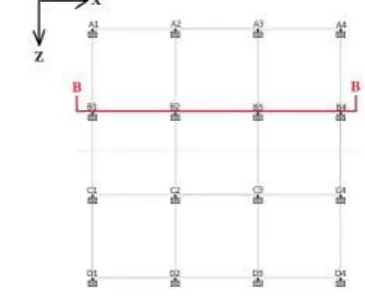
The results of various parameters are discussed in this section. The ratio of flexible to fixed support analysis is calculated which will be representing the ratio of forces developed in the structure considering soil compressibility to the forces developed during fixed support analysis. This ratio for various forces is shown in table 6. As the model is symmetrical about X-axis and Z-axis, the results are presented only for the symmetric half portion in positive X-direction only. The footing plan showing section BB for all the building frame models is shown in figure 4.
Fig -4: Footing plan showing section AA and section BB 4.1 Effects of soil compressibility on foundation settlement
Table 4 shows the comparison of vertical settlements obtained during flexible support analyses for gravity and seismic loading. In case of gravity loading, the maximum vertical settlement (14.50 mm, 16.95 mm, 20.78 mm for dense, medium, loose soil respectively) is observed at inner footings while for seismic loading, it is observed at footing B4 (15.34 mm, 18.59 mm, 24.04 mm for dense, medium, loose soil respectively). The values of the vertical settlement are found to be more in the direction of seismic loads.
The differential settlements between the footings are calculated in both the direction i.e. along X-direction and Z-direction for a flexible support system. The comparison of differential settlements obtained during flexible support analyses for gravity and seismic loading is shown in table 5. In case of gravity loading, the maximum differential settlement (1.65 mm, 2.20 mm, 2.50 mm for dense, medium, loose soil respectively) is observed between peripheral and inner footings along both the directions while for seismic loading, it is observed between footings B1 and B2 (3.79 mm, 5.44 mm, 7.24 mm for dense, medium, loose soil respectively) at section BB along X-direction. The maximum value of differential settlement (7.24mm) is more than that of the permissible value (6.75mm) as per IS 1904-1986 for building frame founded on loose soil subjected to seismic loading.
4.2 Effects of soil compressibility on support reaction The redistribution in vertical support reaction is observed due to soil compressibility. The variation of 0.94 to 1.08, 0.91 to 1.09 and 0.90 to 1.09 times for dense, medium and loose soil respectively is observed in flexible support system as compared to the fixed support system.
© 2018, IRJET | Impact Factor value: 6.171 | ISO 9001:2008 Certified Journal | Page 3731 supported on dense, medium and loose soil respectively as
compared to the fixed base system.
The redistribution of support reactions is found to be more in loose soil than that of dense or medium soil.
4.3 Effects of soil compressibility on column forces The flexible support system provides a variation of 0.94 to 1.02, 0.91 to 1.03 and 0.90 to 1.03 times in design axial forces for dense, medium and loose soil respectively as compared to the fixed support system. The axial forces obtained during flexible support analysis are found to be less in inner columns than that obtained during fixed support analysis for all type of soil and generally, it is found to be more in outer columns irrespective of floor level.
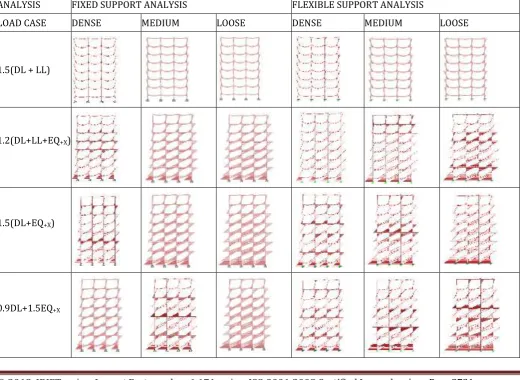
The comparison of bending moments between flexible and fixed support system reveals that the soil compressibility causes redistribution of the moments in columns. The flexible support system provides a variation of 0.88 to 1.46, 0.87 to 1.56 and 0.86 to 1.69 times in bending moment for dense, medium and loose soil respectively as compared to the fixed support system. Table 3 shows that the flexible support analysis gives significant values of bending moment for
interior columns which are negligible in fixed support analysis under gravity loading. The columns of lower storey are more affected by soil compressibility than that of the upper storey.
4.4 Effects of soil compressibility on beam forces The effect of soil compressibility on design shear forces in beams at section BB is evaluated and it is found that the flexible support system provides a variation of 0.79 to 1.21, 0.72 to 1.28, 0.68 to 1.31 times in design shear force compared to a fixed support system for dense, medium and loose soil respectively.
[image:5.595.39.560.406.786.2]The soil compressibility provides a variation of 1.16 to 1.21, -1.14 to 1.29, -1.20 to 1.32 times between flexible and fixed support system for dense, medium and loose soil respectively. It indicates the reversal in the nature of forces due to soil compressibility irrespective of soil type. The maximum value of design moment is found to be more for building frames supported on loose soil. Table 3 reveals that the variation in bending moments is more at the lower storey of building frames compared to upper storey in gravity as well as in seismic loading.
Table -3: Bending moment diagrams of members at section BB of building frames for various load cases ANALYSIS FIXED SUPPORT ANALYSIS FLEXIBLE SUPPORT ANALYSIS
LOAD CASE DENSE MEDIUM LOOSE DENSE MEDIUM LOOSE
1.5(DL + LL)
1.2(DL+LL+EQ+X)
1.5(DL+EQ+X)
© 2018, IRJET | Impact Factor value: 6.171 | ISO 9001:2008 Certified Journal | Page 3732 Table -4: Vertical settlement (mm) of foundations
Loads Gravity Load (DL+LL)
Seismic Load (DL+LL+ EQ X+) Footing Dense Medium Loose Dense Medium Loose A1 -11.61 -13.39 -16.87 -9.18 -9.64 -11.19 A2 -12.84 -14.75 -18.28 -12.52 -14.21 -17.34 A3 -12.84 -14.75 -18.28 -13.16 -15.29 -19.21 A4 -11.61 -13.39 -16.87 -14.04 -17.13 -22.56 B1 -12.84 -14.75 -18.28 -10.35 -10.91 -12.51 B2 -14.50 -16.95 -20.78 -14.14 -16.35 -19.75 B3 -14.50 -16.95 -20.78 -14.85 -17.56 -21.81 B4 -12.84 -14.75 -18.28 -15.34 -18.59 -24.04
Note: -ve sign indicates downward settlement of footing
Table -5: Differential settlement (mm) between foundations
Loading Gravity Load (DL+LL)
Seismic Load (DL+LL+ EQ X+) Footing
(Left–Right) Dense Medium Loose Dense Medium Loose A1-A2 1.23 1.36 1.40 3.34 4.57 6.16 A2-A3 0.00 0.00 0.00 0.64 1.08 1.86 A3-A4 -1.23 -1.36 -1.40 0.88 1.84 3.35 B1-B2 1.65 2.20 2.50 3.79 5.44 7.24 B2-B3 0.00 0.00 0.00 0.71 1.21 2.05 B3-B4 -1.65 -2.20 -2.50 0.49 1.03 2.24 A1-B1 1.23 1.36 1.40 1.16 1.27 1.32 A2-B2 1.65 2.20 2.50 1.62 2.14 2.41 A3-B3 1.65 2.20 2.50 1.69 2.27 2.60 A4-B4 1.23 1.36 1.40 1.30 1.46 1.48
[image:6.595.307.566.116.493.2]Note: -sign indicates that left footing settlement is more than that of right footing.
Table -6: Comparison between flexible and fixed support system for various parameters
5. CONCLUSIONS
Seven-storeyed reinforced concrete building frames founded on three different types of soil (dense, medium, and loose sand) are analyzed in STAAD Pro software considering the effects of soil compressibility. The soil compressibility causes settlement of foundation, change in support reactions, redistribution of forces in columns and beams. The following are the points concluded as a result of this work:
a) In flexible support analysis, the maximum vertical and differential settlement between footings is observed to be 24.04 mm and 7.24 mm respectively The values of the vertical settlement are found to be more in the direction of seismic loads. The foundation settlements are found to be more for building frame resting on loose soil.
[image:6.595.34.292.368.619.2]© 2018, IRJET | Impact Factor value: 6.171 | ISO 9001:2008 Certified Journal | Page 3733 c) The comparison of design axial forces and bending
moments between flexible and fixed support system reveals that the soil compressibility causes redistribution of column forces. The flexible support analysis gives significant values of bending moment for interior columns which are negligible in fixed support analysis under gravity loading. The columns of lower storey are more affected by soil compressibility than that of upper storey.
d) The soil compressibility causes redistribution of design shear forces and bending moments in beams. The reversal in the nature of beam forces is also observed due to soil compressibility irrespective type of founding soil. The variation in bending moments is more at the lower storey of building frames compared to upper storey in gravity as well as in seismic loading.
REFERENCES
[1] Weigel TA, Ott KJ and Hagerty DJ, “Load redistribution in
frame with settling footings”, Journal of Computing in Civil Engineering, Vol. 3, No.1, 1989, pp. 75-92
[2] Celebi M and Safak E, “Seismic response of Transamerica
building I: data and preliminary analysis”, Journal of Structural Engineering, Vol. 117, No. 8, 1991, pp. 2389-2404
[3] Muria-Vila, Taborda R and Zapata-Escobar A,
“Soil-structure interaction effects in two instrumented tall buildings”, 13th World Conference on Earthquake Engineering, Vancouver, B.C., Canada, 2004
[4] Aldea A, Iiba M, Demetriu S and Kashima T, “Evidence of
soil-structure interaction from earthquake records at a high-rise building site in Bucharest”, 4th International Conference on Earthquake Geotechnical Engineering, 2007
[5] Hora M, “Elasto-Plastic soil-structure interaction
analysis of building frame-soil system”, 6th International conference on Case histories in Geotechnical Engineering, Arlington, VA, 2008
[6] Garg V and Hora MS, “A review on interaction behaviour
of structure-foundation-soil system”, International Journal of Engineering Research and Applications, Vol. 2, Issue 6, 2012, pp. 639-644
[7] Garg V and Hora MS, “Interaction effect of the space
frame-strap footing-soil system on forces in superstructure”, ARPN Journal of Engineering and Applied Sciences, Vol. 7, No. 11, 2012, pp. 1402-1415
[8] Rao GVR, Kumar MP and Kumar DN, “Effect of soil
structure interaction under wind loads at different wind zones using staad pro 2007”; International Journal of
Education and Applied Research, Vol. 4, Issue Spl-2, 2014, pp. 16-19
[9] Lahri A and Garg V, “Effect of differential settlement on
frame forces- A parametric study”, International Journal of Research in Engineering and Technology, Vol. 4, Issue 9, 2015, pp. 453-464
[10] Ghandil M and Behnamfar F, “Ductility demands of MRF
structures on soft soils considering soil-structure interaction”, Soil Dynamics and Earthquake Engineering, Elsevier, 2017, pp. 203-214
[11] Malviya G and Garg V, “Effect of soil flexibility on
analysis and design of building”, International Journal of Engineering Research and application, Vol. 7, Issue 6 (Part-1), 2017, pp. 71-78
[12] IS 1893 (Part-1):2002, “Criteria for Earthquake
Resistant Design of Structures”, Bureau of Indian Standard, New Delhi
[13] IS 1904:1986, “Indian Standard Code of Practice for
Design and Construction of Foundations in Soils: General Requirements (third revision)”, Bureau of Indian Standard, New Delhi
[14] IS 875 (Part-1, 2 and 5):1987, “Indian Standard Code of
Practice for Design Loads (other than Earthquake) for Building and Structures”, Bureau of Indian Standard, New Delhi
[15] IS 456: 2000, “Indian Standard Plain and Reinforce