Content-Based Image Retrieval System using
Sketches and Colored Images
B. Prashanth Kumar B. N. Swamy
M. Tech Scholar Assistant Professor
Department of Computer Science & Engineering Department of Computer Science & Engineering PVP Siddhartha Institute of Technology, Kanuru PVP Siddhartha Institute of Technology, Kanuru
Abstract
The content based image retrieval (CBIR) is one of the most popular, rising research areas of the digital image processing. Most of the available image search tools, such as Google Images and Yahoo! Image search, are based on textual annotation of images. In these tools, images are manually annotated with keywords and then retrieved using text-based search methods. The performances of these systems are not satisfactory. The goal of CBIR is to extract visual content of an image automatically, like color, texture, or shape. This paper aims to introduce the problems and challenges concerned with the design and the creation of CBIR systems, which is based on a free hand sketch (Sketch based image retrieval – SBIR). With the help of the existing methods, describe a possible solution how to design and implement a task specific descriptor, which can handle the informational gap between a sketch and a colored image, making an opportunity for the efficient search hereby. The used descriptor is constructed after such special sequence of preprocessing steps that the transformed full color image and the sketch can be compared.
Keywords: Content Based Image Retrieval (CBIR), Sketch Based Image Retrieval (SBIR), Edge Histogram Descriptor (EHG), K-Means Clustering Algorithm
________________________________________________________________________________________________________
I. INTRODUCTION
Before the spreading of information technology a huge number of data had to be managed, processed and stored. It was also textual and visual information. Parallelly of the appearance and quick evolution of computers an increasing measure of data had to be managed. The growing of data storages and revolution of internet had changed the world. The efficiency of searching in information set is a very important point of view. In case of texts we can search flexibly using keywords, but if we use images, we cannot apply dynamic methods. Two questions can come up. The first is who yields the keywords. And the second is an image can be well represented by keywords.
In many cases for searching efficiently some data have to be recalled. The human is able to recall visual information more easily using for example the shape of an object, or arrangement of colors and objects. Since the human is visual type, we look for images using other images, and follow this approach also at the categorizing. In this case search using some features of images, and these features are the keywords. At this moment unfortunately there are not frequently used retrieval systems, which retrieve images using the non-textual information of a sample image. What can be the reason? One reason may be that the text is a human abstraction of the image. To give some unique and identical information to a text is not too difficult. At the images the huge number of data and the management of those cause the problem. The processing space is enormous.
The main purpose is to develop a content based image retrieval system, which can retrieve using sketches in frequently used databases. The user has a drawing area where he can draw those sketches, which are the base of the retrieval method. Using a sketch based system can be very important and efficient in many areas of the life. In some cases we can recall our minds with the help of figures or drawing. In the following paragraph some application possibilities are analyzed.
The CBIR systems have a big significance in the criminal investigation. The identification of unsubstantial images, tattoos and grafties can be supported by these systems. Similar applications are implemented in [5], [6], [7].
Another possible application area of sketch based information retrieval is the searching of analog circuit graphs from a big database[4]. The user has to make a sketch of the analog circuit, and the system can provide many similar circuits from the database. The Sketch-based image retrieval (SBIR) was introduced in QBIC[3] and VisualSEEK[8] systems. In these systems the user draws color sketches and blobs on the drawing area. The images were divided into grids, and the color and texture features were determined in these grids. The applications of grids were also used in other algorithms, for example in the edge histogram descriptor (EHD) method [2]. The disadvantage of these methods is that they are not invariant opposite rotation, scaling and translation. Lately the development of difficult and robust descriptors was emphasized.
Existing System:
In earlier days, image retrieving from large image database can be done by following ways. We will discuss briefly about the image retrieving of various steps
Indexing:
Indexing the whole set of images using K-means Clustering algorithm. Indexing is done using an implementation of the Document Builder Interface. A simple approach is to use the Document Builder Factory, which creates Document Builder instances for all available features as well as popular combinations of features (e.g. all JPEG features or all avail-able features).
In a content based image retrieval system, target images are sorted by feature similarities with respect to the query (CBIR) [1]. In this indexing, it is proposed to use K-means clustering for the classification of feature set obtained from the histogram. Histogram provides a set of features for proposed for Content Based Image Retrieval (CBIR). Hence histogram method further refines the histogram by splitting the pixels in a given bucket into several classes. Here we compute the similarity for 8 bins and similarity for 16 bins. Standard histograms, because of their efficiency and insensitivity to small changes, are widely used for content based image retrieval. But the main disadvantage of histograms is that many images of different appearances can have similar histograms because histograms provide coarse characterization of an image.
K-Means Clustering Algorithm:
K-means Clustering algorithm: Clustering is the process of partitioning a group of data points into a small number of clusters. For instance, the items in a supermarket are clustered in categories (butter, cheese and milk are grouped in dairy products). In general, we have n data points xi,i=1...n that have to be partitioned in k clusters. The goal is to assign a cluster to each data point. K-means
is a clustering method that aims to find the positions μi,i=1...k of the clusters that minimize the distance from the data points to the
cluster. K-means clustering solves
Annotation
Central part of Annotation is the so called “semantic description panel”. It allows the user to define semantic objects like agents, places, events and times which are saved on exit for reusing them the next time starting Annotation. These semantic objects can also be imported from an existing JPEG file to allow exchange of objects between users and editing and creating those objects in a user preferred tool. Semantic objects can be used for creating the description by dragging and dropping them onto the blue panel with the mouse.
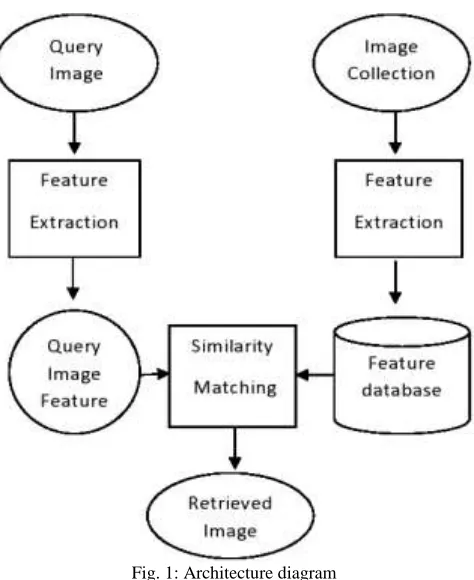
Fig. 1: Architecture diagram
The challenging problem of real-time image annotation in their project titled “Annotating Images by Mining Image Search Results.”
Different from recently published generative and discriminative modeling approaches for image annotation, the work represents a new dimension because it relies on searching in a very large collection of images with textual descriptions. The approach has three main steps: a search process, a mining process, and a filtering process. A large number of real-world images have been used to test the method and promising results are reported.
Color Layout
Color is one of the most widely used features in image retrieval. It is robust to background complication and invariant of image size and Orientation. As stated in chapter 1, three major properties of color image similarity are usually considered
Area of Matching, Color Distance, and Spatial Distribution.
Area of matching is most commonly used because its idea is very clear and it can be represented accurately by histograms. In most histogram representations, histogram entries lay on the selected color space.
The CLD represents the spatial distribution of colors in an image. The extraction process of the CLD consists of the following four stages.
The image array is partitioned into 8x8 blocks.
Representative colors are selected and expressed in YCbCr color space. Each of the three components (Y, Cb and Cr) is transformed by 8x8 DCT (Discrete Cosine Transform).
The resulting sets of DCT coefficients are zigzag-scanned and the first Few coefficients are nonlinearly quantized to form the descriptor.
III. RESULT AND TEST
Explanation:
Fig. 2: Image Indexing
We can select the image which is needed to search, which is shown in fig3 by selecting the search option we can select the image on folder.
Fig. 3: Select Image to Search
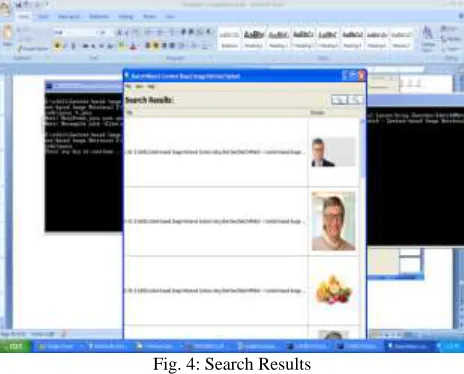
After selecting certain image, we click search option and then system shows most relevant images near to our target image. This will be shown in fig4.
Fig. 4: Search Results
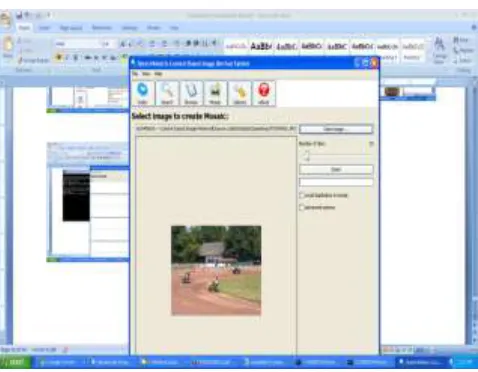
Fig. 5: Select Image to Create Mosaic
Testing Aspects, Used Metrics
We can evaluate the effectiveness of the system forming methods, and compare the different applied methods, if we de_ne metrics. Thus, we can determine which method works effectively in what circumstances, and when not. Let be a test database containing N pieces images, P length retrieval list, from which Q pieces matter as relevant results, and Z denotes the number of expected relevant hits. If we know this information, the following metrics can be calculated.
where the precision gives information about the relative effectiveness of the system.
where the recall gives information about the absolute accuracy of the system.
The number of all and expected hits is determined in each case of testing methods. The impact of multi-level retrieval to the efficiency of retrieval is measured, which confirms the importance of multi-level search. In addition, the ROC curves plot the true and false positive hit rate. The area under the curve rejects the efficiency of the method.
When the Object Databank database was used by EHD the provided precision and recall values can be seen in Fig. 11.
Fig. 6: Effect of block size change using EHD method. The threshold is constant 2.
Fig. 7: Effect of block size change using HOG method. The number of bins is constant 9.
IV. CONCLUSION
Content Based Image Retrieval (CBIR) is an automatic process for searching relevant images based on image features and user inputs. JPEG is an international standard for multimedia content description, and it is an important achievement for CBIR. JPEG has a collection of effective descriptors for images, videos, audios and other multimedia contents. In its visual part, several color descriptors are defined, in which Dominant Color Descriptor (DCD) is a compact and effective descriptor. However, due to the Short comings of its similarity measure method, the DCD’s performance is worse than a more compact Color Layout Descriptor. This is mainly due to the use of a modified Quadratic Histogram Distance Measure (DCD-QHDM) in DCD. DCD cannot be directly used in Relevance Feedback (RF) image retrieval with simple histogram weighting technique for further improving the accuracy using user feedback.
V. FUTURE WORK
This can be extending the texture feature extraction techniques into CBIR system. This area can be further explored and the techniques can be finely tuned with or without involving some pre or post processing works for increasing the retrieval efficiency. The fine-tuning may be done adding some shape and color information in well-determined form with the already existing texture information to suit the application this work can be further extended to some domain-based applications such as finger print recognition, retina identification, and object detection etc for large image database. Since texture analysis consumes a considerable amount of time for feature extraction, there is a scope for optimization also
REFERENCES
[1] B. Sz´ant´o, P. Pozsegovics, Z. V´amossy, Sz. Sergy´an,” Sketch4Match – Content-based Image Retrieval System Using Sketches”, DOI:
10.1109/SAMI.2011.5738872.
[2] M. Eitz, K. Hildebrand, T. Boubekeur, and M. Alexa, “An evaluation of descriptors for large-scale image retrieval from sketched feature lines,” Computers
and Graphics, vol. 34, pp. 482–498, October 2010.
[3] M. Flickner, H. Sawhney, W. Niblack, J. Ashley, Q. Hiang, B. Dom, M. Gorkani, J. Hafner, D. Lee, D. Petkovic, D. Steele, and P. Yanker, “Query by image
and video content: the QBIC system,” IEEE Computer, vol. 28, pp. 23–32, 2002.
[4] Gy. Gyor¨ ok, “Embedded hybrid controller with programmable analog ¨ circuit,” IEEE 14th International Conference on Intelligent Systems pp. 59.1–59.4,
May 2010
[5] A.K. Jain, J.E. Lee, and R. Jin, “Sketch to photo matching: a feature-based approach,” Proc. SPIE, Biometric Technology for Human Identification VII, vol.
7667, pp. 766702–766702, 2010.
[6] A.K. Jain, J.E. Lee, R. Jin, and N. Gregg, “Grafti-ID: matching retrieval of grafti images,” ACM MM, MiFor’09, pp. 1–6, 2009.
[7] A.K. Jain, J.E. Lee, R. Jin, and N. Gregg, “Content based image retrieval: an application to tattoo images,” IEEE International Conference on Image Processing, pp. 2745–2748, November 2009
[8] J.R. Smith, and S.F. Chang, “VisualSEEK: a fully automated content based image query system,” ACM Multimedia ’96, pp. 97–98, 1996. [9] J.R. Paek and
S. Smith, “Detecting Image Purpose in World-Wide Web Documents,” Proc. IS&T/SPIE Symp. Electronic Imaging: Science and Technology—Document Recognition, vol. 3305, pp. 151- 158, Jan. 1998.
[9] A.W.M. Smeulders, M. Worring, S. Santini, A. Gupta, and R. Jain, “Content-Based Image Retrieval at the End of the Early Years,” IEEE Trans. Pattern