© 2017, IRJET | Impact Factor value: 5.181 | ISO 9001:2008 Certified Journal
| Page 1867
Optimisation of Process parameter for Friction Stir Welding of
Aluminium alloy using cylindrical pin profile
Khwaja Muzammil
1, Prof. R.D.Shelke
21 Student,Dept of Mechanical engineering, Everest College of Engineering, Maharashtra, India
2 Professor,Dept of Mechanical engineering, Everest College of Engineering, Maharashtra, India
---***---
Abstract
Objective: Friction Stir Welding is a solid state joining process combining deformation heating and mechanical work to obtain high quality, defect free joints. The objective of the present work is to evaluate the tensile properties of FSW butt joint.
In this work, three process parameters such as spindle speed, welding speed and plunge depth were considered for friction stir welding .As it is difficult to perform number of experiments to find out the level combinations which yield good mechanical properties like tensile strength, TaguchiL9 orthogonal array is used to reduce the number of experiment. The material is bought and are cut into specific material and polished. They are then welded based on the different experiment obtained from Taguchi method. After welding is done the metals are cut as per the specific standard. The results are then analyzed using Taguchi method
Keywords: Aluminum Alloys, Axial Force, Friction-Stir Welding, Microstructure, Tensile Strength
1.
Introduction
Friction Stir Welding (FSW) was invented at The Welding Institute (TWI) of the United Kingdom
(Cambridge) in 1991 as a solid state joining technique and was initially applied to Aluminum Alloys (Dawes C and Thomas W, TWI Bull, 1995; Thomas W M, etal., 1991). Friction Stir Welding is a solid state joining process combining deformation heating and mechanical work to obtain high quality, defect free joints. Friction Stir Welding is especially well suited to joining Aluminum Alloys in a large range of plate thickness and has particular advantages over fusion welding when joining of highly alloyed Aluminum is considered.[1]. The heat input into the material and the resulting welding temperature can be controlled by adapting process parameters like the down-force, rotational speed or welding speed as shown in Fig. 1
© 2017, IRJET | Impact Factor value: 5.181 | ISO 9001:2008 Certified Journal
| Page 1868
A method of solid state joining on a workpiece offers a tool pin of material harder than the base metal’s continuous surface which causes relative cyclic movement between the pin and the base metal. The frictional heat is generated as the pin stirs the workpiece so as to create a plasticized region in the metal around the probe, stopping the relative cyclic movement, and allowing the plasticized material to solidify around the probe.[2]
2.
Literature Survey: Effect of Various Welding Parameters on FSW
Sr.
No Author Name Substrate material
Parameter selected for
study Conclusion
1
Shashi prakash
dwivedi [3] A356/C355 Alumnium Alloy Welding speed, tool speed, Axial force
Based on tool rotational speed, axial force and welding speed were found to be suitable for tensile strength with regression p-value less than 0.05 & lack of fit more than 0.05
2
Adil sheikh, K.D.Bhatt,
AlokB. Choudhary[8]
HDPE with 4% filler
material Rotational speed and welding speed
Although the tensile strength of the welded specimens was about 45MPa which is almost 80 % that of the base plate, the FSW process can be employed to weld HDPE plates with 4% filler minerals.
Increasing the work linear speed from 14 to 56 mm/min had a decreasing effect on tensile strength
3
L. Suvarna Raju, Dr Adep kumar,
Dr P.
Indrewaraiah[7]
Cu plates of
200*100mm Axial force, tool speed, Welding speed
Weldment made by FSW at the tool rotation speed of 900rpm and weld speed 40mm/min exhibited better mech properties. This is due to sufficient heat generation and proper mixing of material in the weld zone
4
M.P.Meshram,
Basant kumar, [12] Austinitic steel 120*80*4mm stainless tool Welding speed speed, A defect free weld with parameters of 1100rpm and traverse speed 8mm/min showed tensile strength of
Base material with 37% elongation
5
H. Ahmadi, N.B.Mostafa arab F.Ashenai Ghasami[4]
Plates of PP composites
With 20% CF 100*50*4 mm
Welding speed, Rotational speed, Tilt angle
The welding speed was the most significant welding process parameter whereas the tilt angle was the least significant one affecting the tensile-shear strength
6
G.Elatharasan
V.S.Senthil kumar[5] AA6061-T6 And AA7056-T6
Welding speed, Rotational speed, Axial force
Ultimate tensile strength of FSW joints increases with increase in tool rotational speed and welding speed upto a max value and then decreases.
© 2017, IRJET | Impact Factor value: 5.181 | ISO 9001:2008 Certified Journal
| Page 1869
3.
Experimental Set up
: The base material used in the investigation is 1100 Aluminium alloy and rolled plates of 6mm thickness have been used as the base material for preparing single pass welded joints. It has got good mechanical properties and exhibits good weldability.Table2 shows its Chemical composition.
Alloy Al Cu Si+Fe Mn Zn Others total
1100 99 min 0.20 max 0.95 0.05 max 0.10 max 0.10 max
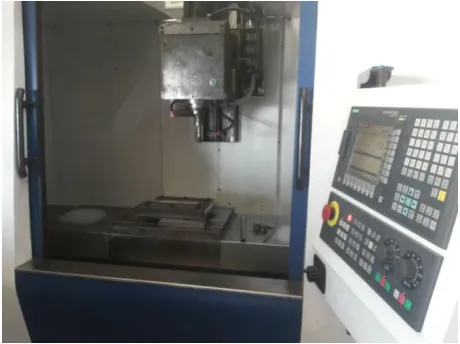
The Friction Stir welding technique uses a non consumable rotating tool to make the joint. The tool consist of body shoulder, probe or pin. The tool used in this process was made of High speed steel which has a cylindrical pin profile. Vertical Machine Centre is used to fabricate the required joints. It is equipped with high precision and heavy loading series linear guideways on 3 axes.
Fig. 2 Experimental setup describing FSW using VMC machine
3.
Methdology :
Three process parameter Tool rotational speed (N), Welding speed(S), Axial force(F) whichcontribute to heat input and subsequently influence friction stir welded aluminium joints, were selected for this study and were optimized using taguchi design concept.
Table -3: Factors and levels
Process parameter Level 1 Level 2 Level 3 Tool rotational speed (N), 900 1000 1100
Welding speed(S) 75 100 125
Axial force(F) 3 4 5
[image:3.612.189.419.291.463.2]© 2017, IRJET | Impact Factor value: 5.181 | ISO 9001:2008 Certified Journal
| Page 1870
4.1 Results
Signal to Noise ratio analysis
:
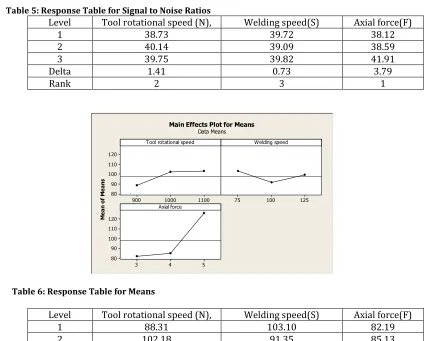
In this study, tensile strength had been investigated as main parameter in order to achieve a joint with proper quality. Signal to noise analysis was used to minimize fluctuations in ultimate tensile strength values. Therefore final results of strength values were more applicable and comparable. Proper ratio of S/N was considered based on experiment, knowledge and perception of whole process. Purpose of this study was to achieve maximum tensile strength of joints for mentioned alloys. Therefore, the optimal level of the process parameters is the level with the highest S/N ratio and for “higher the better” quality characteristics.According to Table 4, 9 main values for tensile strength and 9 corresponding values of S/N (orthogonal array OA) were obtained. Optimal combination of factors and levels were obtained by analyzing each calculated main values, in order to achieve the maximum tensile strength.
Table- 4:
Standard L9 orthogonal arrays as per Taguchi's suggestion
1100 1000
900 42 41 40 39 38
125 100
75
5 4
3 42 41 40 39 38
Tool rotational speed
M
e
a
n
o
f
S
N
r
a
ti
o
s
Welding speed
Axial force
Main Effects Plot for SN ratios
Data Means
Signal-to-noise: Larger is better
Exp no. Tool rotational
speed (N), Welding speed(S) Axial force(F) Tensile strength
1 900 75 3 66.46
2 900 100 4 87.12
3 900 125 5 111.35
4 1000 75 4 88.39
5 1000 100 5 112.48
6 1000 125 3 105.66
7 1100 75 5 154.45
8 1100 100 3 74.46
© 2017, IRJET | Impact Factor value: 5.181 | ISO 9001:2008 Certified Journal
| Page 1871
Table 5: Response Table for Signal to Noise RatiosLevel Tool rotational speed (N), Welding speed(S) Axial force(F)
1 38.73 39.72 38.12
2 40.14 39.09 38.59
3 39.75 39.82 41.91
Delta 1.41 0.73 3.79
Rank 2 3 1
Table 6: Response Table for Means
Level Tool rotational speed (N), Welding speed(S) Axial force(F)
1 88.31 103.10 82.19
2 102.18 91.35 85.13
3 102.93 98.96 126.09
Delta 14.62 11.75 43.90
Rank 2 3 1
Analysis of mean for experiments gives better combination of parameter levels. Means response refers to average value of performance characteristics for each parameter at different levels. Analyzing means and S/N ratio of various process parameters it is observed that a larger S/N ratio corresponds to better quality characteristics. Therefore, Effect of process parameter is level highest S/N ratio. Mean effect and S/N ratio axial force calculated by minitab software indicated that axial forrce was at maximum.
The optimum process parameter is found to be a combination of Spindle speed of 1100 rpm, welding speed of 75mm/min, and axial force 126.09
5.
Conclusion
FSW is the best process to welding of different alloys of aluminum for long lengths with an excellent quality.
Axial force has found to be the most dominant parameter which affects tensile strength. The other parameters which influence the tensile strength in order of ranking are Spindle speed, Welding speed. The optimum process parameter is found to be a combination of Spindle speed of 1100 rpm, welding speed of 75mm/min, and axial force 126.09
1100 1000 900
120 110 100 90 80
125 100 75
5 4 3 120 110 100 90 80
Tool rotational speed
M
e
a
n
o
f
M
e
a
n
s
Welding speed
Axial force
Main Effects Plot for Means
[image:5.612.76.512.117.458.2]© 2017, IRJET | Impact Factor value: 5.181 | ISO 9001:2008 Certified Journal
| Page 1872
6.
References
1. Mr. Sukhdeep Singh Virk, Mr. Rakesh Kumar, Mr. Parvesh Dhingra‘Evaluation of mechanical properties of Aluminium based alloy with friction stir welding ’ Vol. 3, Issue11, 2016.
2. D.Raguraman, D. Muruganandam, L.A.Kumaraswamidhas ”Study of tool geometry on friction stir welding of aa 6061 and az61” p-ISSN : 2320–334X PP 63-69
3. Shashi Prakash Dwivedi ” Effect of process parameters on tensile strength of friction stir welding A356/C355 aluminium alloys joint” PP 285~291 , 2014
4. H. Ahmadi, N. B. Mostafa Arab* and F. Ashenai Ghasemi ” Optimization of process parameters for friction stir lap welding of carbon fibre reinforced thermoplastic composites by Taguchi method” PP 279~284,2014
5. G Elatharasan , V.S.Senthil kumar ”Modelling and optimization of dissimilar aluminium alloy using RSM” PP3477-3481, 2012
6. H. Ahmadi, N. B. Mostafa Arab and F. Ashenai Ghasemi” Optimization of process parameters for friction stir lap welding of carbon fibre reinforced thermoplastic composites by Taguchi method” PP279-284,2014 7. L. Suvarna Raju, Dr. Adepu Kumar and Dr. P. Indreswaraiah “ Effect of Welding Speed on Mechanical Properties of Friction Stir Welded Copper” Vol. 4, No. 2, May 2014
8. Adil Shaikh, K.D. Bhatt, Alok B. Chaudhary “ Effect of friction stir welding process parameters on polymer weld” Volume 1, Issue 9, May-2014.
9. Jeroen De Backer & Gunnar Bolmsjö &Anna-Karin Christiansson “Temperature control of robotic friction stir welding using the thermoelectric effect” PP 375–383, 2014
10. I. Dinaharan, N. Murugan “Automation of friction stir welding process to join Aluminium Matrix Composites by Optimisation” PP 105-110, 2012
11. Hyung-Suk Mun and Sung-Il Seo “Welding strain analysis of friction stir-welded aluminum alloy structures using inherent strain-based equivalent loads” PP 2775~2782, 2013
12. Manish P. Meshram, Basanth kumar Kodli, Suhash R. Dey “Friction Stir welding of Austinitic Stainless Steel by PCBN tool and its joint analyses” PP 135-139, 2014
13. C Rathinasuriyan, V.S.Senthil kumar, Avin Ganapati Shanbhag “Radiography and corrosion analysis of Sub- merged Friction stir welding of AA6061-T6 alloy” PP 810 -818, 2014.
14. Jae-Hyung cho, Won jae Kim, Chang gil lee “Evolution of microstructure and mechanical properties during friction stir welding of A5083 and A6082” PP2080-2085, 2014
15. Arun kumar kadian, Gautam Puri and Pankaj Biswas “Prediction of Thermal History of Friction Stir welding by considering combined stick and slip condition of AA1100” PP21-27 ,2014
16. P Karthikeyan and K Mahadevan “A statistical approach on the mechanical property evaluation of friction stir welding of Al6351 alloy with addition of reinforcement” PP 232-236, Nov 2014
17. S. Raghunathan, S Malarvizhi, V Balasubramanian “Influence of tool rotational speed on mechanical and microstructural properties of friction stir welding of high strength low alloy steel joints” PP141-146 Sept 2016 18. Kulwant singh, Gurbinder singh and Harmeet singh “Friction stir welding of Magnesium Alloys: A review ” PP 5-8, Vol5 No1, 2016.
19. T Prasad, P. Saritha, B Raja Narender “Mechanical behavior of Friction stir welding of Magnesium AZ-91 Alloy”
PP 3288-3290 Vol 5, Dec 2016.