© 2017, IRJET | Impact Factor value: 5.181 | ISO 9001:2008 Certified Journal
| Page 1824
Comparative Theoretical Design of Leaf Spring and V-Shape Spring to
Improved Suspension with Part Loading
Pradosh Chaudhari
1, Kulbhushan Hatote
2, Sachin Dhengle
3, Rahul Bothe
4, Abhijeet Shirude
51
B.E. Student, Mechanical Department, G. H. Raisoni College of Engineering, Ahmednagar, India
2
B.E. Student, Mechanical Department, G. H. Raisoni College of Engineering, Ahmednagar, India
3
B.E. Student, Mechanical Department, G. H. Raisoni College of Engineering, Ahmednagar, India
4
B.E. Student, Mechanical Department, G. H. Raisoni College of Engineering, Ahmednagar, India
5
Asst. Professor, Mechanical Department, G. H. Raisoni College of Engineering, Ahmednagar, India
---***---Abstract -
Suspension system is one of the importantparameter in vehicle. It provides safety comfort to the passengers and also protect the vehicle from wear and damage. Up till now most of study done on improving working ability of suspension system on leaf spring but no such a type of work done on agricultural trolley. So, in this work rigid joint of agricultural trolley is to be replaced with flexible joint (V-shape spring) for suspension system. Theoretical calculations shows that the V-spring has more deflection and more bending stresses than leaf spring. But V-spring is only applicable for medium load conditions like agricultural trolley, mini ambulance etc.
Key Words: Suspension system, safety comfort, rigid joint, Flexible joint, V- shape spring, Deflection
1. INTRODUCTION
Suspension system is more important system in an automobile. It makes the interface between the vehicle chassis and the vehicle body, and it’s functions is to provide the better drive ability such as handling ability, stability, comfort to passengers and so forth. Hence the total optimization of such system requires much of design calculation and analysis of such system, a four-link suspension system is principally a parallel six-bar universal linkage, is mainly used to high grade passenger cars. Such complicated system make design more complicated. So it is not easy to design such complicated suspension system. This leads the necessity of a new generation of design methodology which have easy calculation and analysis better working than previous system. There is necessity to find design method for finding optimization possibilities with in initially established system structure, system configuration and its optimization. The Automobile industry show the less interest for replacement of steel leaf spring with that of progressive work rate spring, which has good part loading and max to max shock absorption properties. So
introduction of new mechanism of progressive rate spring i.e. V- shape strip spring. A comparative numerical analysis is shown between leaf spring and V-shape strip spring for part or medium loading condition.
1.1 Role of Suspension System
The role of suspension system in vehicles is as follows: 1. It support the weight of vehicle.
2. Provides smooth riding for the driver and passengers i.e. acts as cushion.
3. Protect the vehicle from damage and wear.
4. It also keeps the wheels pressed firmly to the ground for traction.
5. It isolates the body from road shocks and vibrations which would otherwise be transferred to the passengers load.
1.2
Working of Suspension System
© 2017, IRJET | Impact Factor value: 5.181 | ISO 9001:2008 Certified Journal
| Page 1825
1.3 Introduction of Leaf Spring and V-Spring
A spring is an elastic body, whose function is to distort when loaded and to regain its original shape and size when the load is removed. Leaf springs absorb the vehicle’s vibrations, shocks and bump loads (induced due to road irregularities) by means of spring deflections, so that the potential energy is stored in the leaf spring and then relieved slowly. Ability to store and absorb the strain energy ensures the comfortable suspension system. Leaf springs are almost universally used for suspension in light and heavy commercial vehicles. It also used for car, leaf spring suspension widely used in rear suspension system. The spring consists of a number of leaves also known as blades. The leaves are varying in length. The leaves are use usually given an initial curvature or cambered so that they will tend to straighten under the load.
The leaf spring is based upon the theory of a beam of uniform strength. When the leaf spring deflects, the upper side of each leaf tips slides or rubs against the lower side of the leaf deflects. Moreover, it produces squeaking sound. Further it moisture is also present, such inter-leaf friction will cause fretting corrosion which decreases the fatigue Strength of the spring, also leaf spring deflect under the full loading condition because it is design for full load condition that is the main drawback of leaf spring. This drawback overcome with replacing leaf spring by V-Spring, that allows maximum suspension effect under concern loading condition.
1.4 Factors Affecting Suspension System
The diameter of the tire, size of contact patch between tire and road, the rate of tire acting as a spring, and weight of the wheel and axle assembly affect the magnitude of shock transmitted to the axle, while the amplitude of wheel motion is affected by all these factors and the rate of suspension springs, damping effect of the shock absorbers and the weights of sprung and unsprang masses. The unsprang mass can be defined as that between the road and the main suspension springs. The sprung mass is that supported on suspension springs, through both may also include the weights of the parts of the springs and linkages. Two types of shocks are applied to the wheels:
1. Shock due to the wheel’s striking on the bump. This is influenced by the geometry of the bump and the speed of vehicle.
2. Shock caused by the wheels falling into a pothole. This is influenced by the geometry of the hole, the unsprang masses and spring rates, speed being an incidental influencing factor.
[image:2.595.346.522.161.259.2]1.5 Problem Statement
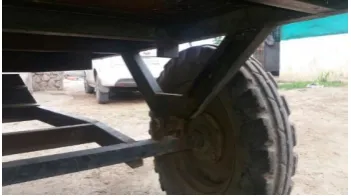
Fig. 1 shows that joint between the agricultural trolley and chassis is rigid.
Fig-1- Rigid joint of agricultural trolley
There is damaging of export quality agricultural products due to rigid joint in the agricultural trolley. Hence need of design and development of flexible joint like V- spring instead of leaf spring for rigid joint in agricultural trolley.
1.6 Objectives
Following are the objectives to be achieve from the theoretical calculations:
1. To design the V-spring suspension for agricultural trolley at economical rate than leaf spring.
2. Replace the rigid joint of agricultural trolley with the flexible V-spring suspension system.
3. To show V-spring suspension is better than leaf spring suspension system for agricultural trolley.
2. LITERATURE REVIEW
Anil Kumar and Ch. Ramesh [1] done the experimental and analytical comparison in the multi-leaf steel spring and mono leaf spring of composite material. They had done the work on the same load carrying capacity and stiffness. They found that at same load the defection in composite leaf spring was less than the steel leaf spring for all composite materials. The value of stresses and deflection were nearly equals to the theoretical result
© 2017, IRJET | Impact Factor value: 5.181 | ISO 9001:2008 Certified Journal
| Page 1826
They found that composite mono leaf spring having constantstress at any thickness point in parabolic type thickness of the spring.
Pankaj Saini and Ashish Goel [3] stated that the comparative analysis between the conventional steel leaf spring and composite material like glass fiber reinforced polymer i:e E-glass/epoxy, Carbon epoxy and Graphite epoxy used for designing the leaf spring. They done the modeling in the Auto-CAD 2012 software and ANSYS 9.0 software used for analysis from the static analysis result they found the maximum displacement of conventional steel leaf is 10.16 mm and that for E-glass/epoxy is 15 mm for Graphite epoxy is 15.75 mm and for carbon/epoxy 16.21 mm the values of stress for conventional steel leaf is 67 N/mm and 163.22 Mpa, 663.68 Mpa, and 300 Mpa, for composite material resp. Out of that graphite epoxy has more stress the conventional material steel leaf so E-glass/epoxy composite leaf spring can replaced from stress and strain point of view.
A.V. Amrute and R. K. Rathore [4] exchange the conventional steel spring and uses the E-glass/epoxy. Material composite leaf spring for experimental analysis of composite leaf spring for light commercial vehicle. They done the CAE analysis of three full length leaves or strip. They found that under defined loading condition with same dimension of both leaf spring composite leaf has high strength to weight ratio high stiffness lower weight reduces to 67.88% to that of conventional leaf spring that means composite material spring is better option for the existing steel leaf spring.
T. B. Sonawane and S. S. Sarode [5] does the comparative FEM analysis of V-shape and leaf spring. They change the shape of leaf spring into V-shape spring with same width and thickness. Design of both spring is preferred using software Pro-E and using ANSYS the load is applied on both spring material selected for spring is 65si7 (65% Carbon and 7% Silicon). It observed that V-shape spring has more deflection i:e 16% and strain energy 38.20% than that of steel leaf spring from observation it find that V-shape spring can used only for part load condition only.
2.1 Gap Statement
From the extensive literature review, it was observed that lot of work has been on conventional steel leaf spring and composite material leaf spring, the effect of suspension observed during full loading condition. It has also observed that various methodology and analyzing techniques are used to improve the performance and quality
of suspension effect, this leads to a very important area for R & D field to enhance the effect of suspension system.
As various parameters of spring like deflection, stress, etc. has been studied but seldom works done on part loading (i. e. not fully loaded), so this leads to a very important area for designing the special shape spring for part to full load condition with “Analytical, numerical & Experimental investigation”. Hence the present work is an attempt to study and workout theoretical calculations per requirement for special shape spring that gives the solution for part loading condition
.
3. DESIGN CALCULATION
Following are the design calculation for
experimental result. Notation given below are used in this calculation.
(σb)F = Bending stress in full leaves
Deflection in full leaves
nf = Number of extra full-length leaves
ng = Number of graduated-length leaves including master leaf
n = Total number of leaves
b = Width of each leaf (mm)
t = Thickness of leaf (mm)
L = Length of the cantilever or half the length of semi-elliptic spring (mm)
F = Force applied at the end of the spring (N)
Ff = Portion of F taken by the extra full-length
3.1 Design for Conventional Leaf Spring
Here Weight and initial design data of measurements of “TATA ACE” 4 wheeler Light commercial vehicle is taken. Weight of vehicle= 837 kg [6]
Maximum load carrying capacity= 1200 kg
Total weight= 837 + 1200 = 2037 kg;
Number of full-length leaves (nf) = 1
© 2017, IRJET | Impact Factor value: 5.181 | ISO 9001:2008 Certified Journal
| Page 1827
Hence, Total Weight = 2037*9.81 = 19982.97~20000As the vehicle is 4-wheeler, a single leaf spring takes up one 4th of the total weight. ∴ 20000/4 = 5000 N
But, 2F = 5000 N.
∴ F = 2500 N.
Table -1: Specification or Dimension of Spring
Straight length (2L) 800 mm
Leaf thickness (t) 15 mm
Leaf width (b) 60 mm
Density of leaf material EN 47 7700 kg/m3
Modulus of elasticity (E) 2.1*105
Tensile strength 1158 Mpa
[image:4.595.30.569.211.698.2]Yield strength 1034 Mpa
Fig-2- Leaf spring representation as triangular plate [7]
Deflection of leaf spring at load point is given by,
[7]
Bending stress for leaf spring at the support is given by,
= [7]
Table -2: Result Table of Leaf Spring
Sr.
no. Central load Cantilever load Deflection (mm) Stress N/mm2
1 5000 2500 15.05 444.44
2 6000 3000 18.06 533.33
3 7000 3500 21.06 622.22
3.2 Design for V-Spring
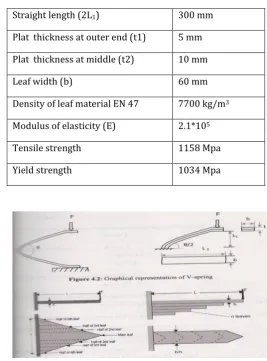
[image:4.595.296.564.331.693.2]Here weight of agricultural trolley and force acting on V-spring is taken same as for leaf spring and design data or dimension of V-spring as follows.
Table -3: Specification or dimension of V-spring
Straight length (2L1) 300 mm
Plat thickness at outer end (t1) 5 mm
Plat thickness at middle (t2) 10 mm
Leaf width (b) 60 mm
Density of leaf material EN 47 7700 kg/m3
Modulus of elasticity (E) 2.1*105
Tensile strength 1158 Mpa
Yield strength 1034 Mpa
Fig-3- V-spring representation as triangular plate
© 2017, IRJET | Impact Factor value: 5.181 | ISO 9001:2008 Certified Journal
| Page 1828
=Bending stressfor V-spring at the support is given by,
[image:5.595.36.302.400.539.2]
=
Table -4: Result Table of V-Spring
Sr. no.
Central load
Cantilever load
Deflection (mm)
Stress N/mm2
1 5000 2500 50.22 724.10
2 6000 3000 60.30 869.09
3 7000 3500 70.35 1013.94
3.3 Difference between Deflection of Leaf spring
and V-spring
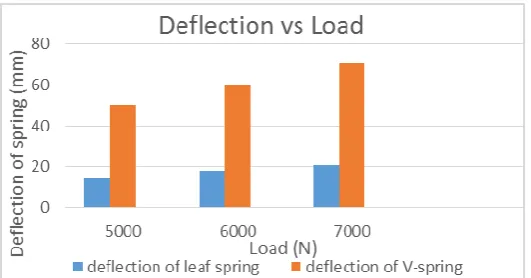
Chart -1: Deflection of Leaf spring and V-spring
Chart 1 show that the deflection of V-spring is more than the deflection of leaf spring at same load condition which we need in actual practice for V-spring suspension system in agricultural trolley.
4. CONCLUSION
From the above theoretical design calculations it can be observed that:
1. The deflection in V-spring is more than the leaf spring at same loading condition with same leaf spring dimension. 2. The bending stress for V-spring at different three
loading condition is also more than the leaf spring. 3. The V-spring suspension system is better only for part
loading or medium loading condition.
ACKNOWLEDGEMENT
It’s rightly said that we are built on shoulder of others for all our achievements. This credit goes to our guide, Prof. A. M. Shirude whose positive attitude, moral support, technical advice and encouragement lead to the success of this paper.
REFERENCES
[1].Malaga Anil Kumar, T. N. Charyulu, Ch. Ramesh, “Design Optimization of Leaf Spring”, International Journal of Engineering Research and Applications, ISSN: 2248-9622, Vol. 2, Issue 6, November- December 2012, pp.759-765.
[2].Jadhav Mahesh V, Zoman Digambar B, Y R Kharde, R R Kharde, “Performance Analysis of Two Mono Leaf Spring Used For Maruti 800 Vehicle”, International Journal of Innovative Technology and Exploring Engineering, ISSN: 2278-3075, Volume-2, Issue-1, December 2012, pp. 65-67
[3].Pankaj Saini, Ashish Goel, Dushyant Kumar, “DESIGN AND ANALYSIS OF COMPOSITE LEAF SPRING FOR LIGHT VEHICLES” International Journal of Innovative Research in Science, Engineering and Technology Vol. 2, Issue 5, May 2013, pp. 1-10
[4].Ashish V. Amrute, Edward Nikhil Karlus, R.K. Rathore, “Design and Assessment Of Multi Leaf Spring”, International Journal Of Research In Aeronautical And Mechanical Engineering ISSN (ONLINE): 2321-3051 Vol.1 Issue.7, November 2013, pp: 115-124.
[5].T. B. Sonawane, S. S. Sarode, M. D. Shende, A. P. Ghodake, D. P. Chavan, “Comparative FEM Analysis of V-Shape and Leaf Springs for Improved Suspension with Part Loading Functionality” IOSR Journal of Mechanical and Civil Engineering Volume 11, Issue 1 Ver. V (Feb. 2014), PP 53-57