© 2017, IRJET | Impact Factor value: 5.181 | ISO 9001:2008 Certified Journal | Page 3135
Preparation and Thermal Behaviour of Polyester Composite Filled with
TiO
2Parmeet Singh Saluja
1, J.K.Tiwari
2, Gaurav Gupta
3Department of Mechanical Engineering, SSTC, SSGI, FET, Bhilai (C.G.), India
---***---Abstract - The current research work deals with the experimental analysis of thermal behaviour of polyester composites filled with titanium dioxide (TiO2) particles. A new
class of composite material is prepared by using titanium dioxide (TiO2) particles as a filler material in thermoset
polyester matrix. The effective thermal conductivity (Keff)
results obtained from experiments are compared with other established models such as Rule-of-Mixture (ROM), Maxwell’s model, Geometric Mean Model and Lewis Nelson model. For experimental analysis Titanium dioxide (TiO2) reinforced
polyester composites are fabricated using hand lay-up technique and the thermal conductivity values are measured with the UnithermTM model 2022 tester according to the ASTM
standard E-1530. It is seen that the keff values obtained from theoretical model are in good agreement with the measured values for composites with TiO2 concentrations up to 25 wt%.
This study shows that addition of TiO2 particles improves the effective thermal conductivity of Polyester-TiO2 composites.
Apart from enhancing thermal conductivity, incorporation of TiO2 results in improvement of glass transition temperature
(Tg) and reduction in coefficient of thermal expansion(CTE).
Key Words: Polyester, TiO2, Effective thermal
conductivity, Tg, CTE.
1.INTRODUCTION
Nowadays, the use of composite materials in various technological fields (microelectronics, aerospace, transport, etc.) is constantly growing. The main interest for such a use is the possibility to develop new materials with properties suitable for a specific
application. These materials can combine the physical properties of various materials used in their manufacturing. In general, the composites are manufactured to undergo many physical constraints without properties change during their use [1].
Composite is a heterogeneous material created by the synthetic assembly of two or more materials, one a selected filler of reinforcing material and the other a compatible matrix binder. The binder and the filler have two very different properties but when combined together form a material with properties that are not found in either of the individual materials.
The matrix is responsible for the surface finish of composite materials and its durability. Its main function is to bind the reinforcement together and act as a medium to distribute any applied stress that is transmitted to the reinforcement. Fibers are widely used in aerospace, automotive, marine and industries [2]. Sometimes fibers were used in house hold applications [3]. The main reason is the cost Vs properties always good to prefer. Fiber components may be fabricated by different methods like resin transfer molding or hand layup method [4].
In view of this, in the present work, TiO2 is chosen as
© 2017, IRJET | Impact Factor value: 5.181 | ISO 9001:2008 Certified Journal | Page 3136
most widely used white pigment because of its brightness and very high refractive index (n = 2.7), in which it is surpassed only by a few other materials. It has a wide range of applications, from paint to sunscreen to food colouring. Its thermal conductivity and density values are 11.6 W/m.K and 4.197 gm/cc respectively. TiO2 incorporated into outdoor building
materials, such as paving stones in noxer blocks or paints, can substantially reduce concentrations of airborne pollutants such as volatile organic compounds and nitrogen oxides[5].
The objective of present work is fabrication of a new class of composites using TiO2 as the reinforcing filler
with an objective to improve the thermal conductive properties of neat polyester. Measurement of effective thermal conductivity (keff) of these particulate filled
polymer composite (with different weight fraction) experimentally. Estimation of equivalent thermal conductivity of this particulate-polymer composite system using various theoretical models developed in previous investigation. Study the effect of TiO2 on
various physical properties like density and void content together. Study on the effect of TiO2 content on
other thermal characteristics of the composite such as glass transition temperature (Tg) and coefficient of
thermal expansion (CTE).
Against this background the present work has been undertaken to investigate the thermal conductivity of TiO2 filled polyester composites. The focus has been on numerical study of a series of such particulate filled composites and on the assessment of their heat conduction capability by determining their thermal conductivities. Few well established theoretical model
are also been used to evaluate the equivalent thermal conductivity of such composites analytically. Later the calculated values obtained from both the methods are compared with the experimental results obtained under control laboratory conditions.
2. Experimental procedure
2.1 Materials and sample preparation
Unsaturated isophthalic polyester supplied by Reliance India Ltd. is taken as the matrix materials in the present investigation. Polyester is a category of polymer which contains the ester functional group in their main chain. The term unsaturated polyester resin is generally referred to the unsaturated (means containing chemical double bonds) resins formed by the reaction of dibasic organic acids and polyhydric alcohols. Polyester resin is also known as a thermosetting plastic, which implies the plastic sets at high temperatures Micro-sized titanium dioxide (TiO2)
is used as the filler material for the preparation of thermally conductive polymer composites in the present investigation. TiO2 powders with average
particle size of 90-100 micron are supplied by Qualikems Ltd. It is the naturally occurring oxide form of titanium and occurs in nature as rutile, anatase or brookite. Composite samples of various compositions are prepared by hand lay-up technique. Hand lay-up technique is the oldest and simplest technique for composite fabrication. The polyester- TiO2 composites
are prepared in the following steps (i) Uncured polyester and its corresponding hardener are mixed in a ratio of 10:1 by weight as per recommendation. (ii) Micro-sized TiO2 particles are mixed with the polyester
© 2017, IRJET | Impact Factor value: 5.181 | ISO 9001:2008 Certified Journal | Page 3137
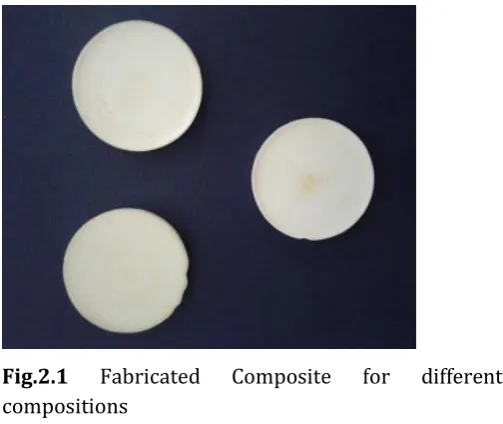
[image:3.595.35.287.290.502.2]decanted into the glass molds so as to get both disc type specimens (diameter 50 mm and thickness 3 mm), coated beforehand with wax and a uniform thin film of silicone-releasing agent. (iv) The castings are then left at room temperature for about 24 hours and then the glass molds are broken and the samples are released. Composite samples were of the same resin matrix but were filled with glass micro-spheres particulate by 0, 5, 10, 15, 20 and 25% filler weight fractions.
Fig.2.1 Fabricated Composite for different
compositions
2.2 Thermal properties measurements
.
Thermal conductivity of a variety of materials is measure by the Unitherm Model 2022. These materials are polymers, composites, ceramics, glasses, rubbers, some metals and other materials of low to medium thermal conductivity. Only simple relatively small test sample is required. Non-solids, such as pastes or liquids can be tested using special containers. Thin films can also be tested accurately using a multi-layer technique. The tests are in accordance with ASTM E-1530Standard. Glass transition temperature (Tg) and coefficient of thermal expansion (CTE) of the
composites are measured with a Perkin Elmer DSC-7 Thermal Mechanical Analyzer.
3. Experimental results 3.1 Physical characteristic 3.1.1 Density and Void Fraction
Density is a material property which is of prime importance in several weight sensitive applications. Polymers are well known for their low density. The low densities of polymer composites are found to replace the conventional metals and materials in many engineering applications. Density of a composite depends on the relative weight proportion of matrix and the reinforcing components. The theoretical and experimentally measured densities of polyester composites reinforced with TiO2, along with the
corresponding volume fraction of voids are presented in table 3.1
S.No .
Filler Content
(wt %)
Measured density (gm/cm3)
Theoretical density (gm/cm3)
Voids contents
(%)
1 0 1.35 1.35 ---
2 5 1.419 1.423 0.28
3 10 1.477 1.483 0.406
4 15 1.516 1.525 0.594
5 20 1.560 1.575 0.962
6 25 1.611 1.636 1.522
Table 3.1 Density values along with the void fractions
of the TiO2 filled polyester composites
© 2017, IRJET | Impact Factor value: 5.181 | ISO 9001:2008 Certified Journal | Page 3138
polyester composites increases with increase in filler content. It is further observed that the void fractions in these composites given by Agarwal and Broutman [6] also increase with increase in TiO2 content.
The reason for that is, while calculating the density using equation given by Agarwal and Broutman [6], there is no consideration of voids and defects, while is actual practice, fabrication of composite by hand layup technique give rise to considerable amount of voids into the composite material. These voids significantly affect the mechanical properties as well as the performance of composites. Higher void percentage in the composites reduces fatigue resistance, greater susceptibility to water penetration and weathering.
3.2 Thermal characteristic
3.2.1 Effective thermal conductivity
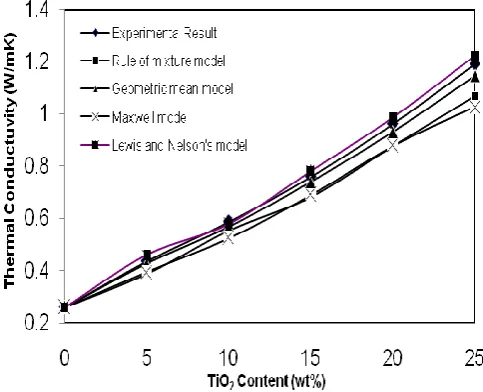
The effective thermal conductivities of polyester composites filled with TiO2 particles with filler weight
fraction ranging from 0 % to 25 % are shown in Figure 3.1. The values of effective thermal conductivities for similar combination are obtained using rules of mixture (ROM) model, Geometric mean model, Maxwell’s correlation, Lewis and Nielsen model are also presented in Figure 3.1. It presents a comparison among the results obtained using various empirical models with regard to the values of effective conductivity obtained experimentally. It can be seen from graph that with increase in content of TiO2 in
[image:4.595.311.553.108.304.2]polyester matrix, the conductivity of the composite body increases. This results in increase in the conductive capability of the fabricated composite.
Fig. 3.1 Effective thermal conductivity of polyester
composites as a function of filler content
The maximum value of effective thermal conductivity among the various sets of fabricated composites is obtained when 25 wt% of TiO2 is incorporated in
polyester matrix i.e. 1.19 W/mK. This increment is around 450 % when compared to the neat polyester. With further increase of filler the conductivity value can go up further but in present case it is not possible to increase the filler content more than 25 wt% because of percolation. Also hand lay-up technique restricts increase in filler content, though with other techniques like compression moulding or injection moulding it can be increased maximum by 5-10 wt % more.
© 2017, IRJET | Impact Factor value: 5.181 | ISO 9001:2008 Certified Journal | Page 3139
close approximation may be because it consider the heat conduction behavior both in series and parallel whereas Lewis and Nielsen model consider the shape factor which helps it to predict the values more accurately.
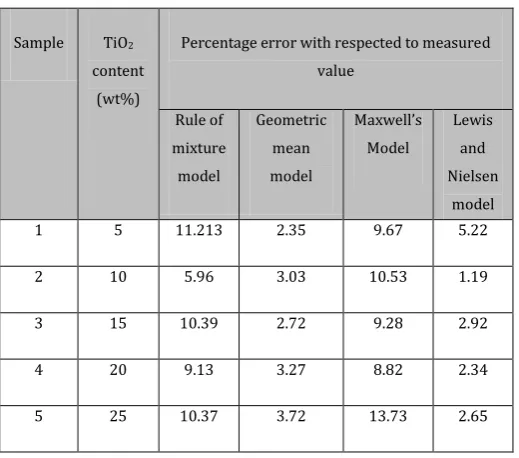
Table 3.2 shows the deviation in the value of different empirical model with the experimental determined values. On comparison, it is found that while the errors associated with Maxwell model is highest i.e. 13.73 % which is deviating maximum from the experimental value, the associated error for Lewis and Nielsen model is lowest i.e. 1.19 % which is the minimum deviation with the experimental value.
Sample TiO2
content (wt%)
Percentage error with respected to measured value
Rule of mixture model
Geometric mean model
Maxwell’s Model
Lewis and Nielsen
model
1 5 11.213 2.35 9.67 5.22
2 10 5.96 3.03 10.53 1.19
3 15 10.39 2.72 9.28 2.92
4 20 9.13 3.27 8.82 2.34
5 25 10.37 3.72 13.73 2.65
Table 3.2 Percentage errors of keff obtain from
different method with respect to the measured value
3.2.2 Glass Transition Temperature (Tg)
The glass transition temperature (Tg) of the fabricated
composite samples are measured with a Perkin Elmer DSC-7 thermal mechanical analyzer (TMA). Figure 3.2 presents the variation of Tg with TiO2 content. It is
observed that the Tg of neat polyester is about 92°C and
it gradually increases to 106.5ºC with an increase in filler content. A maximum increase of 16.6ºC in Tgis
obtained as the TiO2 content increases from 0 wt% to
25 wt%. A maximum increase of about 3.8ºC in Tgis
obtained between 5 wt% to 10 wt%. Usually, addition of such filler increases the Tg of the composites, which results from the interaction between a filler and a polymer by forming a network structure between them. Because of this network structure, the movement of molecular segment is limited in it and hence the glass transition temperature increases.
Fig
. 3.2
Glass transition temperatures of polyester/TiO
2 composites3.2.3 Coefficient of Thermal Expansion (CTE)
The intrinsic CTE values of TiO2 are lower compared to
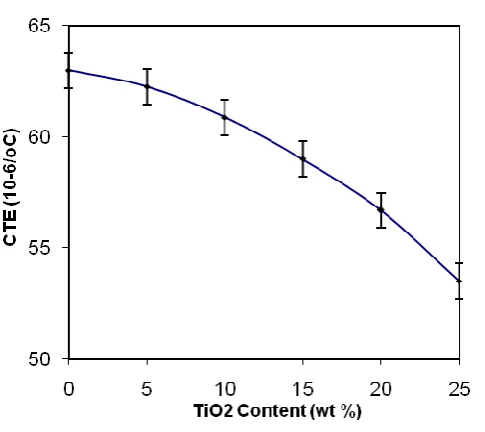
[image:5.595.309.566.349.546.2] [image:5.595.33.293.367.596.2]© 2017, IRJET | Impact Factor value: 5.181 | ISO 9001:2008 Certified Journal | Page 3140 Fig. 3.3 Coefficient of thermal expansion (CTE) of
polyester/ TiO2 composites
Figure 3.3 shows that the CTE of all the fabricated composites in present investigation. It is clear from the graph that CTE of the composite decreases with filler content and reaches from 63 × 10-6/°C to 52.5× 10⁻⁶/°C
for maximum filler content of 25 wt%. A maximum decrease of about 16.66 % in CTE is obtained. The constraint of mobility of the polyester chain due to the interaction of TiO2 and polyester are responsible for
the reduction of CTE. Hence, the thermal stability of polymer improves with addition of filler.
4. Conclusions
1) TiO2 particles possesses reinforcing potential to be
used as a filler material in polyester matrix composites.
2) Successful fabrication of polyester matrix composites reinforced with TiO2 particles is possible by
simple hand-lay-up technique.
3) The density of the fabricated composites increases with increase in weight fraction and it also possesses low void content; even when it is prepared by hand lay-up technique.
4) Incorporation of TiO2 particles is found to have
resulted in decrement in the value of thermal resistivity of polyester resin and thereby improves its thermal conductive capability. With addition of 25 wt% of this filler the thermal insulation capability of polyester improves by about 450%.
5) A significant improvement in the glass transition temperature is noticed with the incorporation of TiO2
particles in polyester matrix. These can be attributed to the good interaction between the filler and matrix phase, which might be restricting the mobility of the polyester. Improvement of around 17.67 % in the value of Tg is registered for maximum filler content of 25
wt%.
6) It is also observed that the coefficient of thermal expansion of polyester is reduced by the addition of TiO2 particles It is observed that a drop of 15.07 % in
CTE of polyester is obtained with 25 wt% inclusion of TiO2 particles. These changes improve the thermal
stability and expand the application domain of the composites.
7) With increased thermal conductivity, this new class TiO2 particle filled polyester composites can be used for
applications such as building material, insulated flask, thermal interface material etc.
References
[image:6.595.38.281.118.334.2]© 2017, IRJET | Impact Factor value: 5.181 | ISO 9001:2008 Certified Journal | Page 3141
2. S. Srinivasa Moorthy, K. Manonmani Fabrication and characterization of TiO2 particulate filled glass fiber reinforced polymer composite, (2013) 28-34
3. P.J. Herrera-Franco, A. Valadez-González, Composites Part : B Engineering 36 (2005) 597.
4. David Rouison, Mohini Sain, M. Couturier, Composites Science and Technology 66 (2006) 895.
5. Madhusmita Sahu, Alok Satapathy,Thermal
Characteristics of Polypropylene Composites Filled with TiO2, (2013), 49: 1747-1752.