
http://dx.doi.org/10.4236/ojce.2015.51006
Bridge Structures with GFRP Composite
Deck
Beata Stankiewicz
Department of Roads & Bridges, Faculty of Civil Engineering, Opole University of Technology, Opole, Poland Email: [email protected]
Received 7 February 2015; accepted 25 February 2015; published 26 February 2015
Copyright © 2015 by author and Scientific Research Publishing Inc.
This work is licensed under the Creative Commons Attribution International License (CC BY). http://creativecommons.org/licenses/by/4.0/
Abstract
In this paper, author’s first part of research of GFRP bridge deck (using ASSET fiber line composite modular system) took part at AGH University of Science and Technology Laboratory of Glass Technology and Amorphous Coatings Department. The analysis consisted spectrometer analysis of chemical constitution of glass fiber, identification of material according to Fourier spectroscopy, electronic scan microscopy (SEM/EDAX) and DTA analysis. The modal FEM analysis of chosen footbridge with light GFRP deck has been presented in the paper.
Keywords
GFRP Bridge Deck by Material Analysis, Modal Analysis of Footbridge Composite Deck
1. Introduction
Zobel’s and W. Karwowski’s research. Anisotropic GFRP is connected with steel or prestressed concrete main bridge beams. Ki-Tae Park, Yoon-Koog Hwangi, Hyeong-Yeol Kim have used various connectors in models of bridge structures and in situ investigation. There is an interesting science filed of bridge structures with GFRP deck. European researchers T. Keller, H. Gűrtler, W. Sebastian, J. Knippers prefer adhesive system between main bridge beam and composite deck, using epoxy glue. T. Keller, as the first in Europe, has published the re-sults of scanning analysis of GFRP Fiberline composite material [1] [2]. The researches based on laboratory models of DuraSpan composite orthotropic bridge system and FEM complex analysis have been created by J. Lesko, K. Turner and J. Harris. Vovesny, M. and Rotter, T. have published the results of research of temporary bridge structures using deck panels made by glass fiber reinforced polymer [3].
Anisotropic character of GFRP composite has been investigated and described in the paper. GFRP modular deck has been used in own project of footbridge. The natural frequency and vibrations with amplitudes of cho-sen footbridge can equal to the values recommended in EN 1990/A1.
2. Material Analysis of GFRP Bridge Deck
The author’s first part of research of GFRP bridge deck (using ASSET Fiberline composite modular system) took part at AGH University of Science and Technology Laboratory of Glass Technology and Amorphous Coatings Department. The analysis consisted of:
• spectrometer analysis of chemical constitution of glass fiber in polymer matrix, using ICP-MS Elan 61,000 by Perkin Elmer,
• identification of material according to Fourier spectroscopy in infrared with FTS-60 MV Bio-Rad,
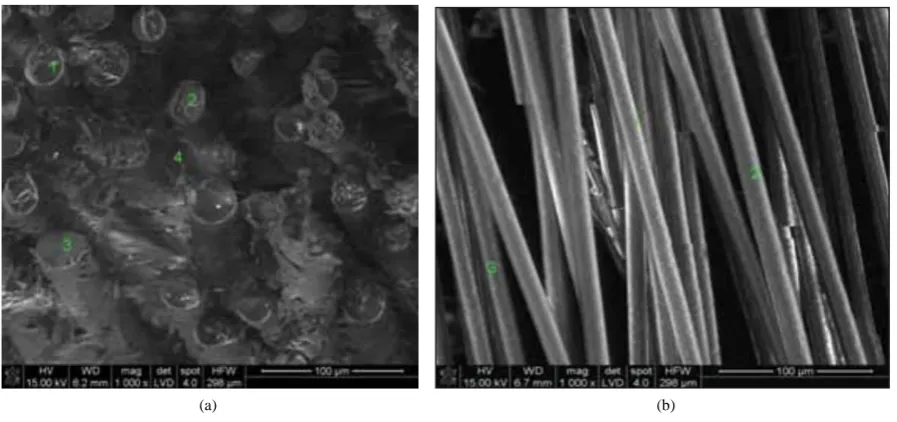
• electronic scan microscopy (SEM/EDAX) for estimate of morphology of composite, using Nora Nano-SEM (Figure 1),
• DTA analysis for estimation of physical and chemical transformation of glass fiber, with Perkin Elmer DTA-7 Series.
Composite material was tempered to 450˚C for isolation of glass fibers (Figure 1), which have been analyzed by DTA at chemical investigation and microscopy exploration. On DTA base (Figure 2), the temperature of glass transformation is Tg = 703˚C, the temperature of dilometric soften is Td = 852˚C.Table 1 has showed chemical content of glass fibers.
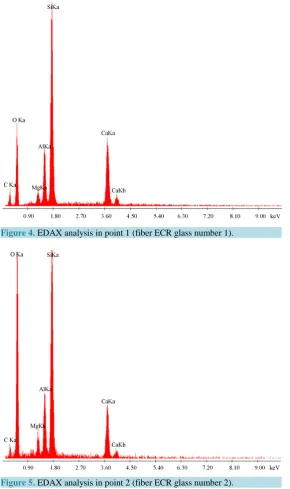
According to thermal analysis DTA and research of chemical content the main conclusion has been investi-gated, is that glass fiber is ECR type of glass. As complementary research EDAX analysis has been used for single fiber (Figure 3). Observation of morphology, surface of fiber and configuration has been possible using scanning microscope SEM. The isolation fibers by scanning analysis have been showed as number 1, 2 and 3
[image:2.595.91.540.489.700.2](a) (b)
Figure 2. DTA curve for single glass fiber from composite.
Figure 3. Anisotropic structure of composite on glass fibers base.
Table 1. The results of analysis for glass fiber (oxide content).
Oxide Content [%]
SiO2 55.33
Al2O3 14.12
CaO 24.02
Fe2O3 0.71
Na2O 0.40
K2O 0.42
TiO2 1.80
MgO 1.2
ZnO 2.0
(Summary) 100
400 600 800 1000 1200 1400
852
∆
T
[image:3.595.93.540.535.715.2](Figure 3). EDAX analysis of chemical elements at fiber’s surface by points 1 - 3 has been showed on Figures 4-6.
Fourier spectroscopy in infrared is useful for complex identification a type of matrix using to connect con-glomerate of fibers on structure elements. IR spectrum view describes material of matrix in Figure 7 [4].
[image:4.595.171.462.231.721.2]The paths in from 3084 - 2586 cm−1 are characteristic of both for epoxy and polymer material. But the path in 1734 cm−1 is characteristic for polyester. The path of absorption frequency at 1734 cm−1 is compatible with vibration C=O found in ester group but the path of absorption with frequency 3447 cm−1 is suitable with OH alcohol group. Double absorption paths with frequency 2930 cm−1 and 2856 cm−1 has connected with symmetric vibration =CH2. The matrix of glass fibers consists of epoxy resin with amine bisphenol A and epoxy polyester aliphatic by isophthalic polyester. The fiber fractions are approximately 50% per volume or 70% per weight. The matrix is a protecting cover for fiber and it is responsible for load propagation [4] [5].
[image:4.595.176.453.466.712.2]Figure 4. EDAX analysis in point 1 (fiber ECR glass number 1).
Figure 6. EDAX analysis in point 3 (in glass fiber ECR number 3).
Figure 7. The spectrum of IR matrix.
3. The Analysis of Chosen Footbridge with Light GFRP Deck
The existed footbridge in Opole, constructed by laminated wood main beams and wood deck with steel profiles, has been replaced to footbridge with GFRP Fiberline HD deck system.
sim-ple deck.
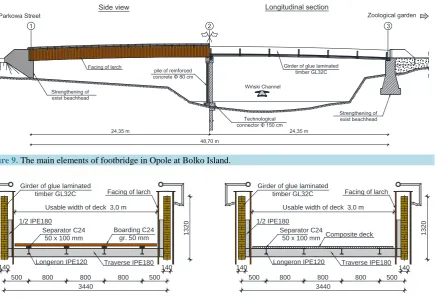
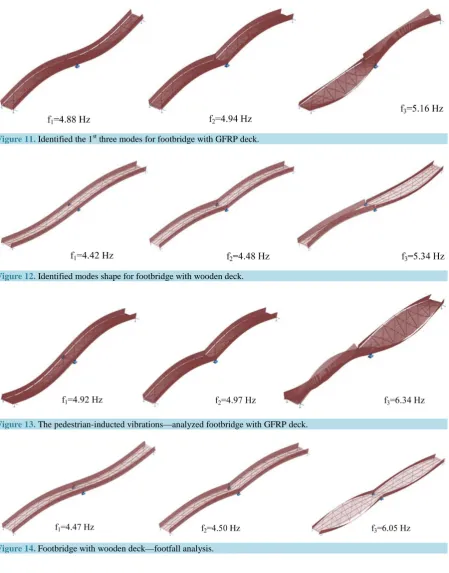
[image:6.595.173.456.202.375.2]The key points of numerical FEM analysis have been verified the collaboration between GFRP elements (by Fiberline HD deck system) with main beams (by laminated wood GL32C) of footbridge structure. The com-parison analysis has been provided for existed wooden deck and hypothetical composite deck. The basic view of footbridge is inFigure 9, cross section of two conceptions is inFigure 10. The three 1st modes and correspond-ing frequencies have been showed inFigure 11 for footbridge with GFRP deck. The dynamic investigation ac-cording to modal analysis, for wood deck has been summarized inFigure 12.
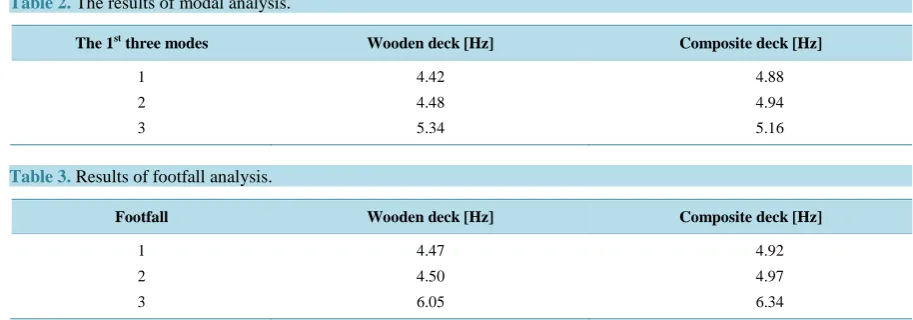
Table 2consists of natural frequencies for both kinds of decks. Important data base parameters of GFRP deck by Fiberline HD system—Modulus of Elasticity: 23,000 MPa, weight: 8530 g/m, height: H = 40 mm, shear
[image:6.595.103.539.403.701.2]Figure 8. Footbridge in Opole (during erection) used to FEM analysis.
Figure 9. The main elements of footbridge in Opole at Bolko Island.
Figure 10. Two conceptions of footbridge deck using wooden panels (left) and GFRP panels (right).
800 800 800 500
500 3440 132 0 140 140 Composite deck
800 800 800 500
500
3440
132
0
Separator C24 50 x 100 mm
Boarding C24 gr. 50 mm
140 140
Girder of glue laminated
timber GL32C Facing of larch
Longeron IPE120 Traverse IPE180
1/2 IPE180
Usable width of deck 3,0 m
Separator C24 50 x 100 mm Girder of glue laminated
timber GL32C Facing of larch
Longeron IPE120 Traverse IPE180
1/2 IPE180
modulus: 3000 MPa. Light orthotropic deck is promising alternative opposite traditional material, opposite typi- cal standard of structure. The FEM analysis has showed it in simple, basic investigation. Potential high resis-tance to corrosion of GFRP deck and longer durability create better alternative of such kind of bridge deck.
The dynamic response has been verified according to footfall, using 70 kg person weight and 2.0 Hz fre- quency. That kind of analysis has been applied for both types of deck, too. The pedestrian-inducted vibrations and all comparison effects have been presented inFigure 13& Figure 14and inTable 3 [6].
Figure 11. Identified the 1st three modes for footbridge with GFRP deck.
Figure 12. Identified modes shape for footbridge with wooden deck.
[image:7.595.90.540.163.737.2]Figure 13. The pedestrian-inducted vibrations—analyzed footbridge with GFRP deck.
Table 2. The results of modal analysis.
The 1st three modes Wooden deck [Hz] Composite deck [Hz]
1 2 3 4.42 4.48 5.34 4.88 4.94 5.16
Table 3. Results of footfall analysis.
Footfall Wooden deck [Hz] Composite deck [Hz]
1 2 3 4.47 4.50 6.05 4.92 4.97 6.34
The rules introduced in European standards require verification of natural frequency and level of vibrations of the footbridges. According to EN 1990/A1 verification the vibration comfort criteria should be performed when the fundamental frequency of the footbridge is less than 5.0 Hz for vertical vibrations and 2.5 Hz for horizontal and torsion vibrations. In the cases of medium and large span steel footbridges the fundamental vertical vibra-tion frequency is very often less than 5.0 Hz. With these reasons the verificavibra-tion of the vibravibra-tion comfort criteria becomes obligatory for almost all steel footbridges. Fundamental parameters determining the intensity of vibra-tion percepvibra-tion by human are: vibravibra-tions amplitude, frequency characteristic of the vibravibra-tions, direcvibra-tion of the vibrations, vibrations impact time (exposure time), repeatability of the vibrations, human activity. It should be noted that the recommendations of the EN 1990/A1 exclude the impact of the frequency characteristic of the vi-brations and type of human activity on the permissible amplitude of the vibration acceleration. In some cases, the vibrations with amplitudes equal to the values recommended in EN 1990/A1 can be clearly felt by walking and very clearly by standing pedestrians. It is necessary to define the appropriate and accurate criteria [7]. The analyzed footbridge with GFRP composite deck is suitable with EN 1990/A1 normative rules.
4. GFRP Decks for Road Bridge
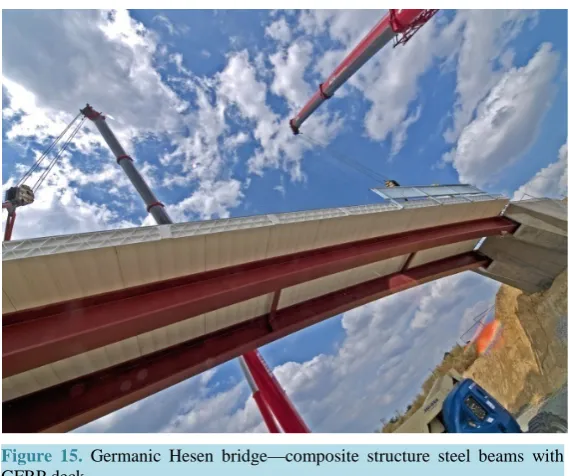
The use of fiber composites has great potential in bridge building [4]. The possibility of pre-assembling in the hall allows for rapid installation on site, low costs of maintenance, durability are very promising. For example in 2011 Karrebaksmide Bridge in Denmark with GFRP deck and steel main structure of moving span was con- structed. Germanic Hesen bridge with GFRP deck by Fiberline ASSET 600 system was erected in 2008 (Figure 15). Many steel footbridges with light GFRP deck were built in Denmark and Nederland, some of road bridges, in this system, were made in Great Britain, USA, Canada [4]. Traditional bridge decks are heavy and have poor durability but effective connection systems and better durability of pavement (by polymer concrete), which co- vered GFRP deck, at road bridge structures are very important directions in searching scale. GFRP deck is good alternative for old steel bridges, which need to exchange heavy old deck. Imposing strength values and fatigue parameters and all material properties (Table 4) [8] of glass fiber polymer give possibilities of modern shape of bridge structures using long-life material and coexistence traditional main part of bridge—steel girders with light, anticorrosion deck. Bridge engineering creates new directions in composite materials applications by strength parameters investigation. There are GFRP bridge deck panels for using in bridge structures with long durability. The capacity of GFRP is determinate by glass fiber’s pultruted direction in polymer matrix.
5. Conclusion
Figure 15. Germanic Hesen bridge—composite structure steel beams with GFRP deck.
Table 4. Material properties, strength & stiffness values (GFRP Fiberline profiles).
Typical strength values [MPa]
Flexural strength, 0˚ fiber direction 240
Flexural strength, 90˚ transverse direction 100
Tensile strength, 0˚ fiber direction 240
Tensile strength, 90˚ transverse direction 50
Compressive strength, 0˚ fiber direction 240
Compressive strength, 90˚ transverse direction 70
Typical stiffness values [GPa] [-]
Modulus of elasticity E0 23/28
Modulus of elasticity E90 8.5
Poisson’s ratio ν0,90 0.23
bridges and the application of modern light and high strength materials, as well as the pursuit of bridge esthetic in urban areas, the fundamental frequency of modern flexible footbridges decreases significantly. Present foot-bridge structures in the world are like explosion of modern engineering calculation and material parameters. Nonstandard solutions need special verification process. New conceptions of GFRP in footbridge projects must be explored by FEM model analysis.
References
[1] Keller, T. and Schollmayer, M. (2004) Plate Bending Behavior of a Pultruded GFRP Bridge Deck System. Composite Structures, 64, 285-295.
[2] Sebastian, W. and Keller, T. (2013) Influences of Polymer Concrete Surfacing and Localized Load Distribution on Behavior up to Failure of an Orthotropic FRP Bridge Deck. Composites Part B: Engineering, 45, 1234-1250.
http://dx.doi.org/10.1016/j.compositesb.2012.07.050
[image:9.595.103.537.350.542.2][4] Stankiewicz, B. (2014) Kompozyty GFRP w konstrukcjach mostowych. Monografia, Oficyna Wydawnicza Politech- niki Opolskiej, Opole. (In Polish, in Proceeding)
[5] Stankiewicz, B. (2012) Composite GFRP Deck for Bridge Structures. 23rd Czech and Slovak International Conference Steel Structures and Bridges 2012, Podbanské, 26-28 September 2012.
[6] Stankiewicz, B. and Tatara, M. (2014) The Possibilities of Glass and GFRP in Footbridges. 5th International Confer-ence Footbridge 2014, London, 16-18 July 2014.
[7] Pantak, M., Jarek, B. and Sredniawa, W. (2012) Application of EN 1990/A1 Vibration Serviceability Limit State Re-quirements for Steel Footbridges. 23rd Czech and Slovak International Conference Steel Structures and Bridges 2012, Podbanské, 26-28 September 2012.


![P, Y] is uncountable, and using this explain whyX does not have the homotopy](data:image/gif;base64,R0lGODlhAQABAIAAAP///wAAACH5BAEAAAAALAAAAAABAAEAAAICRAEAOw==)