www.hydrol-earth-syst-sci.net/19/1181/2015/ doi:10.5194/hess-19-1181-2015
© Author(s) 2015. CC Attribution 3.0 License.
Explaining and forecasting interannual variability
in the flow of the Nile River
M. S. Siam and E. A. B. Eltahir
Ralph M. Parsons Laboratory, Massachusetts Institute of Technology, 15 Vassar St., Cambridge, MA 02139, USA Correspondence to: M. S. Siam ([email protected])
Received: 1 April 2014 – Published in Hydrol. Earth Syst. Sci. Discuss.: 14 May 2014 Revised: 26 January 2015 – Accepted: 2 February 2015 – Published: 3 March 2015
Abstract. This study analyzes extensive data sets collected during the twentieth century and defines four modes of natu-ral variability in the flow of the Nile River, identifying a new significant potential for improving predictability of floods and droughts. Previous studies have identified a significant teleconnection between the Nile flow and the eastern Pacific Ocean. El Niño–Southern Oscillation (ENSO) explains about 25 % of the interannual variability in the Nile flow. Here, this study identifies a region in the southern Indian Ocean, with a similarly strong teleconnection to the Nile flow. Sea surface temperature (SST) in the region (50–80◦E and 25–35◦S) ex-plains 28 % of the interannual variability in the flow of the Nile River and, when combined with the ENSO index, the explained variability of the flow of the Nile River increases to 44 %. In addition, during those years with anomalous SST conditions in both oceans, this study estimates that indices of the SSTs in the Pacific and Indian oceans can collectively ex-plain up to 84 % of the interannual variability in the flow of the Nile. Building on these findings, this study uses the clas-sical Bayesian theorem to develop a new hybrid forecasting algorithm that predicts the Nile flow based on global model predictions of indices of the SST in the eastern Pacific and southern Indian oceans.
1 Introduction
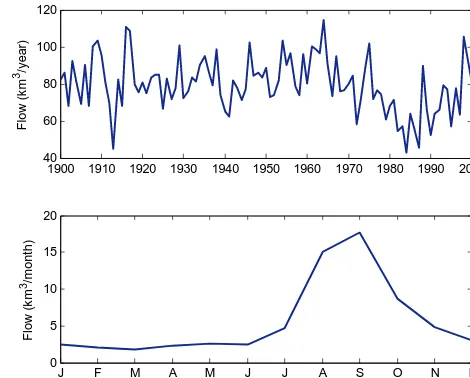
The Nile basin covers an area of 2.9×10⁶km2, which is ap-proximately 10 % of the African continent (Fig. 1). It has two main tributaries, the White Nile and the Blue Nile, which originate from the equatorial lakes and Ethiopian highlands, respectively. The upper Blue Nile (UBN) basin is the main source of water for the Nile River. It contributes
approxi-mately 60 % of the annual flow of the Nile and 80 % of the total Nile flow that occurs between July and October at Don-gola (Conway and Hulme, 1993) (Fig. 2). The UBN basin extends over an area of 175×103km2(7◦N to 12◦50N and from 34◦50E to 40◦E). The mean annual rainfall over this basin is 1200 mm yr−1(Conway and Hulme, 1993). Almost 60 % of the annual rainfall over the UBN occurs during the summer between July and August, resulting in a largely pre-dictable seasonal variability in the flow of the river.
Figure 1. Topographic map of the Nile basin showing the outlet of
the upper Blue Nile basin (shaded in gray) at Roseiras. The White and Blue Nile join together at Khartoum to form the main branch of the Nile that flows directly to Dongola in the north.
The mechanisms behind these teleconnections between the rainfall over Ethiopia and the global SSTs were exam-ined in several studies (e.g., Beltrando and Camberlin, 1993). However, a clear distinction must be made between rain-fall over the UBN basin in Ethiopia and rainrain-fall over east-ern Africa, defined as the region along the coast, east of the Ethiopian highlands (Fig. 1). The UBN basin has one rainy season (May to September) during which more than 80 % of the rainfall occurs, while along the eastern coast of Africa and depending on the location from the Equator, the seasonal cycle of rainfall can have two rainy seasons (Black et al., 2003; Hastenrath et al., 2011). This pattern in the seasonal cycle of rainfall is related to the migration of the intertrop-ical convergence zone (ITCZ) across the Equator. Camber-lin (1995) showed that the rainfall over eastern Africa, in-cluding the UBN basin, is strongly coupled with the dynam-ics of the Indian monsoon. During strong Indian monsoon seasons, the sea level pressure over India decreases signifi-cantly, which enhances the pressure gradient between east-ern Africa and India. As a result, westerly winds increase
1900 1910 1920 1930 1940 1950 1960 1970 1980 1990 2000 40
60 80 100 120
F
lo
w
(
k
m
3/y
e
a
r)
J F M A M J J A S O N D
0 5 10 15 20
F
lo
w
(
k
m
3/m
o
n
th
[image:2.612.52.285.66.401.2])
Figure 2. Annual Nile flow (top panel) and seasonal cycle (bottom
panel) of the flow at Dongola for the period from 1900 to 2000.
over eastern Africa and enhance transport moisture from the Congo basin to Ethiopia, Uganda and western Kenya. Giro et al. (2011) also showed that the warming over the Pacific Ocean, during El Niño events, reduces these westerly winds, which reduce the rainfall over eastern Africa. In addition, the monsoon circulation is weaker during El Niño events due to modulation of the Walker circulation and enhanced subsi-dence over the western Pacific and southern Asia; thus, the rainfall over Ethiopia decreases (Ju and Slingo, 1995; Kawa-mura, 1998; Shukla and Wallace, 1983; Soman and Slingo, 1997). The reduced Nile flows during El Niño events were also attributed to the enhanced tropical-scale subsidence that suppresses rainfall, as a consequence of the increased up-welling over the eastern Pacific Ocean (Amarasekera et al., 1996).
telecon-80°0'W 100°0'W 120°0'W 140°0'W 160°0'W 180°0' 160°0'E 140°0'E 120°0'E 100°0'E 80°0'E 60°0'E 40°0'E 20°0'E
30°0'N
20°0'N
10°0'N
0°0'
10°0'S
20°0'S
30°0'S
South Indian
ENSO
Nino 3
[image:3.612.103.499.67.179.2]Nino 3.4
Figure 3. World map showing areas that cover the ENSO and northern and southern Indian Ocean SST indices. El Niño 3 and 3.4 are outlined
in black and green, respectively. The whole Nile basin is outlined in black.
nections between the Pacific Ocean and the Nile basin and between the Indian Ocean and the Nile basin are reflected in different modes of observed natural variability in the flow of the Nile River, with important implications for the pre-dictability of floods and droughts.
The objectives of the study are (i) to investigate the strength of the teleconnection between the Indian Ocean and the Nile basin and its role in explaining observed natural modes of variability in the flow of the Nile River, and (ii) to develop a new hybrid forecasting algorithm that can be used to predict the Nile flow based on indices of the SST in the eastern Pacific and southern Indian oceans.
2 Data
In this study, we use observed SSTs over the Indian and Pacific oceans from the monthly global (HadISST V1.1) data set on a 1◦ latitude–longitude grid from 1900 to 2000 (Rayner et al., 2003). The monthly flows at Dongola from 1900 to 1984 were extracted from the Global River Dis-charge Database (RivDIS v1.1) (Vörösmarty et al., 1998) and from 1984 to 2000 through personal connection. The aver-age monthly anomalies from September to November of the SSTs averaged over the eastern Pacific Ocean (6–2◦N, 170– 90◦W; 2◦N–6◦S, 180–90◦W; and 6–10◦S, 150–110◦W) are used as an index of ENSO. This area has shown the high-est correlation with the Nile flows, and it almost covers the same area as the Niño 3 and 3.4 indices (Trenberth, 1997).
3 Relation between the variability in the flow of the Nile River, ENSO and the Indian Ocean SST
Based on extensive correlation analysis of the Nile River flow at Dongola and the observed SST in the Indian Ocean, this study identifies a region over the southern Indian Ocean (50– 80◦E and 25–35◦S) (see Fig. 3) as the one with the highest correlation between SST and the Nile flow. This correlation is especially high for river flow (accumulated for July, Au-gust, September and October) and SST during the month of August. An earlier study by ElDaw et al. (2003) used SST
indices over the Indian Ocean to predict the Nile flow; how-ever, they focused on regions of the Indian Ocean that are different from the region that we use in defining the southern Indian Ocean (SIO) index. In other words, the region of the SIO was not used by ElDaw et al. (2003). Table 2 describes the regions of the Indian Ocean identified in both studies.
This study emphasizes that the proposed forecasting methodology for the Nile flow is motivated by the physical mechanisms proposed by Siam et al. (2014) and described in Sect. 1. In contrast, the forecasting approach of some of the previous studies was based on purely statistical correlations found between the Nile flow and SSTs globally.
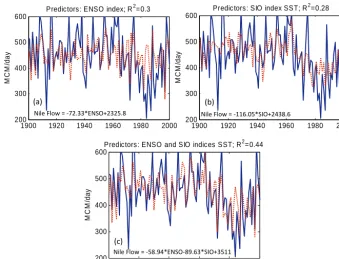
Figure 4 shows the observed and simulated time series of the average July-to-October Nile flow at Dongola, which accounts for approximately 70 % of the annual Nile flow. The Nile flow is predicted by three different linear regres-sion models using either ENSO averaged from September to November (Fig. 4a) or SIO August (Fig. 4b) indices, or both (Fig. 4c) as covariates. It is clear from this figure that the addition of the SIO index increases the explained variability of the Nile flow to 44 %, compared to only 30 % when the ENSO index is used alone. This indicates that the SIO index can explain almost 14 % of the variability of the Nile flow that is independent of ENSO. The north and middle of the Indian Ocean have also exhibited a high correlation between their SST and the Nile flow. However, the additional variabil-ity explained by the SST over the northern and middle Indian Ocean, when combined with the ENSO index, is negligible (not shown here). This is mainly because the SSTs over the northern and middle Indian Ocean are dependent on ENSO, while the SST over the southern Indian Ocean (i.e., the SIO index) is not, as described in Sect. 1.
1900 1920 1940 1960 1980 2000 200
300 400 500 600
M
C
M
/d
a
y
Predictors: ENSO index; R2=0.3
1900 1920 1940 1960 1980 2000 200
300 400 500 600
M
C
M
/d
a
y
Predic tors: SIO index SST; R2=0.28
1900 1920 1940 1960 1980 2000 200
300 400 500 600
M
C
M
/d
a
y
Predictors : ENSO and SIO indices SST; R2=0.44
(a) (b)
(c)
Nile Flow = -116.05*SIO+2438.6 Nile Flow = -72.33*ENSO+2325.8
[image:4.612.127.467.66.325.2]Nile Flow = -58.94*ENSO-89.63*SIO+3511
Figure 4. Observed (solid blue lines) and simulated (dashed red lines) average Nile flows in million cubic meters per day (MCM day−1) from July to October at Dongola using the (a) ENSO index, the (b) SIO index and the (c) ENSO and SIO indices as predictors for the period 1900 to 2000. The simulated flows are calculated based on the equations shown in each figure, in which the predictands are the average observed SSTs over the ENSO and SIO regions in degrees Celsius and the predictor is the average Nile flow from July to October in million cubic meters per day (MCM day−1).
or less than−0.5◦C, it is considered a non-neutral condition; otherwise, it is considered a neutral condition. Similarly, a
±0.3◦C value is used as a threshold between non-neutral and neutral years in the southern Indian Ocean using the SIO in-dex. This value is also about two-thirds of 1 standard devia-tion for the anomalies of the SSTs over this region. Thus, if both ENSO and SIO indices are used together, four different combinations can be defined based on these classifications. The first is when both ENSO and SIO indices are neutral (29 out of 100 events), the second is when both ENSO and SIO indices are non-neutral (19 out of 100 events), the third when SIO is non-neutral and ENSO is neutral (26 out of 100 events) and, finally, when SIO is neutral and ENSO is non-neutral (26 out of 100 events). Each of these combinations is considered a mode of natural variability in the flow of the Nile River. Then, the Nile flow is calculated as a predictand using multiple linear regression, with the ENSO and SIO in-dices of each mode as predictors.
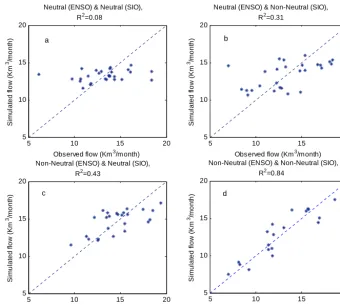
Four different modes are identified for describing the nat-ural variability in the flow of the Nile River and are sum-marized in Table 1. The ENSO and SIO indices do not ex-plain a significant fraction of the interannual variability in the flow of river when they are both neutral (Fig. 5a). The variability of the Nile flow in such years can be regarded as a reflection of the chaotic interactions between the biosphere
Table 1. Summary of the coefficient of determination (R2) between the average Nile flow from July to October and different combina-tions of indices of ENSO and SIO.
Mode ENSO SIO ENSO, Number of
ENSO SIO SIO events
(observed variance of Nile flow) Neutral Neutral 0.04 0.03 0.08 29
(6.76) Neutral Non-neutral 0.05 0.28a 0.31a 26
(10.24) Non-neutral Neutral 0.4a 0.02 0.43a 26
(5.8) Non-neutral Non-neutral 0.64a 0.6a 0.84a 19
(12.3) Note: the values between parentheses are for the observed variance of Nile flow of each mode in units of MCM2day−2. SIO: southern Indian Ocean SST index; ENSO: ENSO index.aValues that are significant at the 1 % significance level.
[image:4.612.309.544.453.603.2]5 10 15 20 5 10 15 20 S imu la te d f lo w ( K m 3/mo n th )
Observed flow (Km3/m onth) Neutral (ENSO) & Neutral (SIO), R2=0.08
5 10 15 20
5 10 15 20 S imu la te d f lo w ( K m 3/mo n th )
Observed flow (Km3/month) Neutral (ENSO) & Non-Neutral (SIO), R2=0.31
5 10 15 20
5 10 15 20 S imu la te d f lo w ( K m 3/mo n th )
Observed flow (Km3/m onth) Non-Neutral (ENSO) & Neutral (SIO), R2=0.43
5 10 15 20
5 10 15 20 S imu la te d f lo w ( K m 3/mo n th )
Observed flow (Km3/month) Non-Neutral (ENSO) & Non-Neutral (SIO), R2=0.84
a b
[image:5.612.127.468.66.371.2]c d
Figure 5. A comparison between the observed and simulated Nile flow showing the different modes of variability for the period from 1900 to
2000: (a) neutral ENSO (29 events) and SIO, (b) neutral ENSO and non-neutral SSTs in SIO (26 events), (c) non-neutral ENSO and neutral SSTs in SIO (26 events) and, finally, (d) non-neutral ENSO and non-neutral SSTs in SIO (19 events).
Table 2. Comparison between regions in the Indian Ocean used in
ElDaw et al. (2003) and this study to predict the Nile flow.
Region Location Study
1 (35–44◦S, 115–130◦E)
ElDaw et al. (2003) 2 (0–7◦S, 90–130◦E)
3 (35–44◦S, 20–60◦E) 4 (10–20◦S, 110–125◦E)
5 (50–80◦E, 25–35◦S) This study
these two modes, a significant fraction (i.e., 31 and 43 %) of the variance describing interannual variability in the flow is explained. Hence, these modes point to a significant poten-tial for predictability of the flow. Finally, indices of ENSO and SIO can explain 84 % of the interannual variability in the Nile flow when non-neutral conditions are observed for both the eastern Pacific and southern Indian oceans (Fig. 5d). Therefore, the SIO index can be used to predict the flow to-gether with the ENSO index, as collectively they can explain a significant fraction of the variability in the flow of the Nile River. This result indicates that, during years with anoma-lous SST conditions in both oceans, floods and droughts in
the Nile River flow can be highly predictable, assuming ac-curate forecasts of those indices are available.
4 A hybrid methodology for long-range prediction of the Nile flow
A simple methodology is proposed to predict the Nile flow with a lead time of about a few months (∼3–6 months). The forecast of global SST distribution based on dynamical models (e.g., NCEP coupled forecast system model version 2 (CFSv2); Saha et al., 2010, 2013) can be used together with the algorithm developed in this section to relate the Nile flow to the ENSO and SIO indices. The proposed method is shown in Fig. 6 and can be described in two main steps.
– Forecast of SST anomalies in the Indian Ocean and eastern Pacific Ocean using dynamical models of the coupled global ocean atmosphere system. Such fore-casts are routinely issued by centers such as NCEP and ECMWF.
[image:5.612.54.276.467.553.2]Computation of Indices of SSTs anomalies over the Southern Indian and Eastern Pacific Oceans
Application of the forecast algorithm
Dynamical models forecasts the global SSTs with different lead times
[image:6.612.84.251.69.278.2]Predicting the Nile flow at different lead times
Figure 6. Schematic of the hybrid methodology for predicting the
Nile flow using the SST forecasts of the dynamical models and the proposed forecast algorithm.
and eastern Pacific oceans (predictors) for the identified mode of variability.
In this paper, we focus on the second step of the proposed method: the development of the algorithm relating SSTs and the Nile flow. We develop the forecast algorithm using ob-served SSTs. We do not describe how this algorithm can be applied with forecasts of global SST distribution based on dynamical models, as this step is beyond the scope of this pa-per. However, we recognize that the overall accuracy of this method in predicting interannual variability of the Nile flow is dependent on the skill of global coupled models in fore-casting the global SSTs (see the Appendix for information about forecasting models). Thus, the selection of the forecast model that predicts the SSTs is an important step to ensure the accuracy of the prediction of the Nile flow. As global coupled ocean–atmosphere models improve in their skill of forecasting global SSTs in the Pacific and Indian oceans, we expect that our ability to predict the interannual variabil-ity in the Nile flow will improve too. In addition, the accu-racy in the prediction of the Nile flow on medium and short timescales (of weeks to 1 month) can be improved by adding other hydrological variables (e.g., rainfall and stream flow) over the basin, as demonstrated by Wang and Eltahir (1999). The proposed method can be described as hybrid since it combines dynamical forecasts of global SSTs and statistical algorithms relating the Nile flow and the forecasted SSTs. The same method can also be described as hybrid since it combines information about SSTs from the Pacific and In-dian oceans.
Here, we apply a discriminant approach that specifies the categoric probabilities of the predictand (Nile flow) accord-ing to the categories that the predictors (i.e., the ENSO and SIO indices) fall into. The annual Nile flow is divided into “low”, “normal”, and “high” categories. The boundaries of these categories are defined so that the number of points in each category is about one-third that of the data points (Fig. 7). On the other hand, the ENSO and SIO indices are divided into “cold”, “normal” and “warm” categories. (The words “normal” and “neutral” are used to describe the same conditions.) The boundaries for the normal category are
−0.5 and 0.5◦C for the ENSO index and−0.3 and 0.3◦C for the SIO index (Fig. 7). Any condition below the lower limit is considered “cold”, and higher than the upper limit is con-sidered “warm” for both indices.
The Bayesian theorem, described in many statistical books (e.g., Winkler 1972; West, 1989), states that the probability of occurrence of a specified flow category (Qi) and given two conditions (AandB) can be expressed as
P (Qi/AB)=
P (B/Qi, A) P (Qi/A)
P (B/A) , (1)
whereP (Qi/A) is the probability of event Qi given that eventAhas occurred, andP (Qi/AB)is the probability of event Qi given that events A and B have occurred, and similarly for other shown probabilities. In addition, if the eventsAandBare independent, we can rewrite Eq. (1) as
P (Qi/AB)=
P (B/Qi) P (Qi/A)
3
P
i=1
P (B/Qi) P (Qi/A)
. (2)
The advantage of assuming independence between A and
B and using Eq. (2) is that it simplifies the calculation of
P (B/Qi,A), since we do not have to split the data into a
relatively large number of categories, which reduces the er-ror due to the limitation of the data size (i.e. 100 years of data). The independence between the ENSO and SIO indices is a reasonable assumption, as the coefficient of determina-tion between them is less than 6 %.
In order to evaluate the predictions of the Nile flow, we use a forecasting index (FI) defined by Wang and Eltahir (1999) as
FP(j )=
3
X
i=1
Pr(i, j )Pp(i, j ), (3)
FI=1
n
n
X
i=1
FP(j ), (4)
-2 -1.5 -1 -0.5 0 0.5 1 1.5 2 40
60 80 100 120
ENSO index
N
il
e
f
lo
w
(
k
m
3 /y
e
a
r)
-1.2 -0.9 -0.6 -0.3 0 0.3 0.6 0.9 1.2 40
60 80 100 120
SIO index
N
il
e
f
lo
w
(
k
m
3 /y
e
a
r)
a
[image:7.612.129.466.67.358.2]b
Figure 7. Relations between the annual Nile flow and different indices for the period (1900–2000): (a) ENSO and (b) SIO. The horizontal
[image:7.612.98.236.455.522.2]lines represent the boundaries for the “high”, “normal” and “low” categories of the annual flow. The vertical lines represent the boundaries for the “warm”, “normal”, and “cold” conditions for the ENSO and SIO indices.
Table 3. Conditional probability of the Nile flow given SIO
condi-tions.
Nile flow SIO High Normal Low
Warm 0 0.25 0.75
Normal 0.23 0.39 0.39 Cold 0.57 0.26 0.17
year, [0, 1, 0] in a normal year, and [0, 0, 1] in a high flow year. Hence, a larger FI indicates a higher accuracy of the forecast. The FI without any information about SST should be about one-third, as we have classified flow data into three categories, each with a similar number of data points.
The data are split into a calibration period (1900–1970) and a verification period (1970–2000). Tables 3 and 4 sum-marize the conditional probabilities of Nile flow given certain conditions of the SIO or ENSO index. It is shown that during warm and cold conditions of SIO, the probabilities are signif-icantly higher for low and high Nile flow, respectively. The same is true for the ENSO, as was described originally by Eltahir (1996). Table 5 shows the probabilities that are con-ditioned on both SIO and ENSO, calculated using Eq. (2).
This table illustrates clearly how forecasts of the Nile flow can be improved by combining the two indices. For example, warm conditions in both oceans translate into 85 % probabil-ity of low flow in the Nile, and an insignificant probabilprobabil-ity of high flow. On the other hand, cold conditions in both oceans translate into 83 % probability of high flow in the Nile, and insignificant probability of low flow. Depending on the accu-racy of the dynamical forecast models of global SSTs, such forecasts of the Nile flow can be issued with lead times of 6 months. At present, the Eastern Nile Regional Technical Office (ENTRO) issues operational forecasts of the Nile flow based on ENSO forecasts and the probability table described by Eltahir (1996) (similar to Table 4). We anticipate that use of Table 5 would represent a significant improvement in these operational forecasts.
a
b
[image:8.612.98.500.69.427.2]c
Figure 8. Time series of the forecast probability using different indices: (a) ENSO and SIO together, (b) ENSO, and (c) SIO. The period
[image:8.612.329.525.510.662.2](1900–1970) is used for calculating the probabilities (shown in crosses) using Eq. (2) and 1970–2000 for validation (shown in stars).
Table 4. Conditional probability of the Nile flow given ENSO
con-ditions.
Nile flow ENOSO High Normal Low
Warm 0.15 0.31 0.54 Normal 0.22 0.38 0.41 Cold 0.68 0.32 0
(Fig. 8a). Hence, the new SIO index plays a role independent of ENSO in shaping the interannual variability in the flow of the Nile River. Thus, by using these two indices, we explain a significant fraction of the interannual variability in the flow of the Nile River, and illustrate a significant potential for im-proving the Nile flow forecasts.
Table 5. Conditional probability of the Nile flow given SIO and
ENS conditions.
SIO Nile ENSO
flow Warm Normal Cold
SIO warm High 0 0 0
Normal 0.15 0.22 1
Low 0.85 0.78 0
SIO normal High 0.1 0.14 0.57 Normal 0.31 0.4 0.43
Low 0.59 0.46 0
SIO cold High 0.33 0.42 0.83 Normal 0.29 0.33 0.17
[image:8.612.99.238.512.578.2]5 Conclusions
– In this paper, we document that the SSTs in the eastern Pacific and Indian oceans play a significant role in shap-ing the natural interannual variability in the flow of the Nile River. Previous studies have identified a significant teleconnection between the Nile flow and the eastern Pacific Ocean. El Niño–Southern Oscillation (ENSO) explains about 25 % of the interannual variability in the Nile flow. Here, this study identifies a region in the southern Indian Ocean with a similarly strong telecon-nection to the Nile flow. Sea surface temperature (SST) in the region (50–80◦E and 25–35◦S) explains 28 % of the interannual variability in the Nile flow.
– In addition, four different modes of natural variability in the Nile flow are identified, and it is shown that dur-ing non-neutral conditions in both the Pacific and Indian oceans, the Nile flow is highly predictable using global SST information. During those years with anomalous SST conditions in both oceans, this study estimates that indices of the SSTs in the Pacific and Indian oceans can collectively explain up to 84 % of the interannual vari-ability in the flow of Nile. The estimated relationships between the Nile flow and these indices allow for ac-curate prediction of the Nile floods and droughts using observed or forecasted conditions of the SSTs in the two oceans.
– This study uses the classical Bayesian theorem to de-velop a new hybrid forecasting algorithm that predicts the Nile flow based on indices of the SST in the eastern Pacific and southern Indian oceans. Warm conditions in both oceans translate into 85 % probability of low flow in the Nile, and insignificant probability of high flow. On the other hand, cold conditions in both oceans trans-late into 83 % probability of high flow in the Nile, and insignificant probability of low flow. Applications of the proposed hybrid forecast method should improve pre-dictions of the interannual variability in the Nile flow, adding a new tool for better management of the water resources of the Nile basin.
Appendix A: Forecast models of sea surface temperature
Table A1. Summary of some available forecast models of the sea surface temperature.
Model Type of Agency Domain Lead time Resolution Reference
model (up to (km)
months)
NCEP-CFS V2 Dynamical National Centers for Environmental Global 8 200 Saha et al. (2010) Prediction (NCEP)
NASA-GMAO Dynamical NASA Goddard Space Flight Center Global Global 12 200 Bacmeister et al. (2000) Modeling and Assimilation Office
ECMWF-System 4 Dynamical European Centre for Medium-Range Global 4 70 Molteni et al. (2011) Weather Forecasts
UKMO-GCM Dynamical United Kingdom Met Office Global 6 150 Graham et al. (2005) NOAA-CDC Statistical National Oceanic and Atmospheric Global 12 – Penland and Matrosova (1998)
Administration Climate Diagnostic Center
Edited by: T. Kjeldsen
References
Abtew, W., Melesse, A. M., and Dessalegne, T.: El Niño Southern Oscillation link to the Blue Nile River Basin hydrology, Hydrol. Process., 23, 3653–3660, doi:10.1002/hyp.7367, 2009.
Amarasekera, K. N., Lee, R. F., Williams, E. R., and Eltahir, E. A. B.: ENSO and the natural variability in the flow of tropical rivers, J. Hydrol., 200, 24–39, 1996.
Bacmeister, J. T., Pegion, P. J., Schubert, S. D., and Suarez, M. J.: An atlas of seasonal means simulated by the NSIPP 1 atmo-spheric GCM, NASA Tech. Memo. 104606, Vol. 17, Goddard Space Flight Center, Greenbelt, 194 pp., 2000.
Beltrando, G. and Camberlin, P.: Interannual variability of rainfall in Eastern Horn of Africa and indicators of atmospheric circula-tion, Int. J. Climatol., 13, 533–546, 1993.
Black, E., Slingo, J., and Sperber, K. R.: An observational study of the relationship between excessively strong short rains in coastal East Africa and Indian Ocean SST, Mon. Weather Rev., 31, 74– 94, 2003.
Camberlin, P.: June–September rainfall in North-Eastern Africa and atmospheric signals over the tropics: a zonal perspective, Int. J. Climatol., 15, 773–783, 1995.
Conway, D. and Hulme, M.: Recent Fluctuations in precipitation and runoff over the Nile subbasins and their impact on Main Nile discharge, Climatic Change, 25, 127–151, 1993.
ElDaw, A., Salas, J. D., and Garcia, L. A.: Long Range Forecasting of the Nile River Flows Using Climate Forcing, J. Appl. Meteo-rol., 42, 890–904, 2003.
ElSanabary, M. H., Gan, T. Y., and Mwale, D.: Application of wavelet empirical orthogonal function analysis to investigate the nonstationary character of Ethiopian rainfall and its tele-connection to nonstationary global Sea Surface Temperature variations for 1900–1998, Int. J. Climatol., 34, 1798–1813, doi:10.1002/joc.3802, 2014.
Eltahir, E. A. B.: ElNino and the natural variability in the flow of the Nile river, Water Resour. Res., 32, 131–137, 1996.
Giro, D., Grimes, D., and Black, E.: Teleconnections between Ethiopian summer rainfll and sea surface temperature: part I Ob-servation and Modeling, Clim. Dynam., 37, 103–199, 2011. Gissila, T., Black, E., Grimes, D. I. F., and Slingo, J. M.: Seasonal
forecasting of the Ethiopian Summer rains, Int. J. Climatol., 24, 1345–1358, 2004.
Graham, R., Gordon, M., McLean, P. J., Ineson, S., Huddleston, M. R., Davey, M. K., Brookshaw, A., and Barnes, R. T. H.: A per-formance comparison of coupled and uncoupled versions of the Met Office seasonal prediction general circulation model, Tel-lus A, 57, 320–339, 2005.
Hastenrath, S., Polzin, D., and Mutai, C.: Circulation Mechanisms of Kenya Rainfall Anomalies, J. Climate, 24, 404–412, 2011. Ju, J. and Slingo, J. M.: The Asian summer monsoon and ENSO, Q.
J. Roy. Meteorol. Soc., 121, 1133–1168, 1995.
Kawamura, R.: A possible mechanism of the Asian summer monsoon–ENSO coupling, J. Meteorol. Soc. Jpn., 76, 1009– 1027, 1998.
Melesse, A., Abtew, W., Setegn, S. G., and Desalegn, T.: Hydro-logical Variability and Climate of the Upper Blue Nile River Basin, in: Nile River Basin: Hydrology, Climate and Water Use,
1st Edn., edited by: Melesse, A. M., Springer, New York, USA, 3–37, doi:10.1007/978-94-007-0689-7_1, 2011.
Molteni, F., Stockdale, T., Balmaseda, M., Balsamo, G., Buizza, R., Ferranti, L., Magnusson, L., Mogensen, K., Palmer, T., and Vi-tart, F.: The new ECMWF seasonal forecast system (System 4), ECMWF Research Department Technical Memorandum no. 656, ECMWF, Reading, UK, 51 pp., 2011.
Penland, C. and Matrosova, L.: Prediction of Tropical Atlantic Sea Surface Temperatures Using Linear Inverse Modeling, J. Cli-mate, 11, 483–496, 1998.
Rayner, N. A., Parker, D. E., Horton, E. B., Folland, C. K., Alexan-der, L. V., Rowell, D. P., Kent, E. C., and Kaplan, A.: Global analyses of sea surface temperature, sea ice, and night marine air temperature since the late nineteenth century, J. Geophys. Res., 108, 4407, doi:10.1029/2002JD002670, 2003.
Saha, S., Moorthi, S., Pan, H.-L., Wu, X., Wang, J., Nadiga, S., Tripp, P., Kistler, R., Woollen, J., Behringer, D., Liu, H., Stokes, D., Grumbine, R., Gayno, G., Wang, J., Hou, Y.-T., Chuang, H.-Y., Juang, H.-M. H., Sela, J., Iredell, M., Treadon, R., Kleist, D., Van Delst, P., Keyser, D., Derber, J., Ek, M., Meng, J., Wei, H., Yang, R., Lord, S., van den Dool, H., Kumar, A., Wang, W., Long, C., Chelliah, M., Xue, Y., Huang, B., Schemm, J.-K., Ebisuzaki, W., Lin, R., Xie, P., Chen, M., Zhou, S., Higgins, W., Zou, C.-Z., Liu, Q., Chen, Y., Han, Y., Cucurull, L., Reynolds, R. W., Rutledge, G., and Goldberg, M.: The NCEP Climate Fore-cast System Reanalysis, B. Am. Meteorol. Soc., 91, 1015–1057, doi:10.1175/2010BAMS3001.1, 2010.
Saha, S., Moorthi, S., Wu, X., Wang, J., Nadiga, S., Tripp, P., Pan, H.-L., Behringer, D., Hou, Y.-T., Chuang, H.-Y., Iredell, M., Ek, M., Meng, J., Yang, R., van den Dool, H., Zhang, Q., Wang, W., and Chen, M.: The NCEP Climate Forecast System Version 2, J. Climate, 27, 2185–2208, 2013.
Shukla, J. and Wallace, J. M.: Numerical simulation of the atmo-spheric response to equatorial Pacific sea surface temperature anomalies, J. Atmos. Sci., 40, 1613–1630, 1983.
Siam, M. S., Wang, G., Estelle, M. E., and Eltahir, E. A. B.: Role of the Indian Ocean Sea Surface Temperature in shaping natural variability in the flow of the Nile River, Clim. Dynam., 43, 1011– 1023, 2014.
Soman, M. K. and Slingo, J.: Sensitivity of the Asian summer mon-soon to aspects of sea-surface-temperature anomalies in the trop-ical pacific ocean, Q. J. Roy. Meteorol. Soc., 123, 309-336, 1997. Tomczak, M. and Godfrey, J. S.: Regional oceanography: an
intro-duction, Pregamon, London, 1995.
Trenberth, K. E.: The Definition of El Niño, B. Am. Meteorol. Soc., 78, 2771–2777, 1997.
Vörösmarty, C. J., Fekete, B., and Tucker, B. A.: River discharge database, Version 1.1 (RivDIS v 1.0 supplement), available through the institute for the study of earth, oceans and space Uni-versity of New Hampshire, Durham, NH, USA, 1998.
Wang, G. and Eltahir, E. A. B.: Use of ENSO information in Medium and Long Range Forecasting of the Nile Floods, J. Cli-mate, 12, 1726–1737, 1999.
West, M.: Bayesian Forecasting and Dynamic Models, Springer, New York, 704 pp., 1989.
Xue, Y., Leetmaa, A., and Ji, M.: ENSO prediction with Markov model: The impact of sea level, J. Climate, 13, 849–871, 2000.