NOTICE: When Government drawings, specifications, or other data are used for any purpose other than in connection with a definitely re-lated Government procurement operation, the United States Government therebyincurs no responsibility nor obligation whatsoever; and the fact that the Government mayhave formulated, furnished or in any way sup-plied the said drawings, specifications or other data is not to be re-garded by implication or otherwise as in any manner licensing the holder or any other person or corporation, or conveying any rights or per-mission to manufacture, use or sell any patented invention that may in any way be related thereto.
MILDATA STUDY Final Report
Volume II
12 August 1963 to 30 September 1964
A study of advanced techniques in all aspects of data processing applicable to CClS in the time
frame 1975-1985.
DA-36-039-AMC-03275 (E) SCL - 4529
Submitted 30 September 1964
Published 15 April 1965
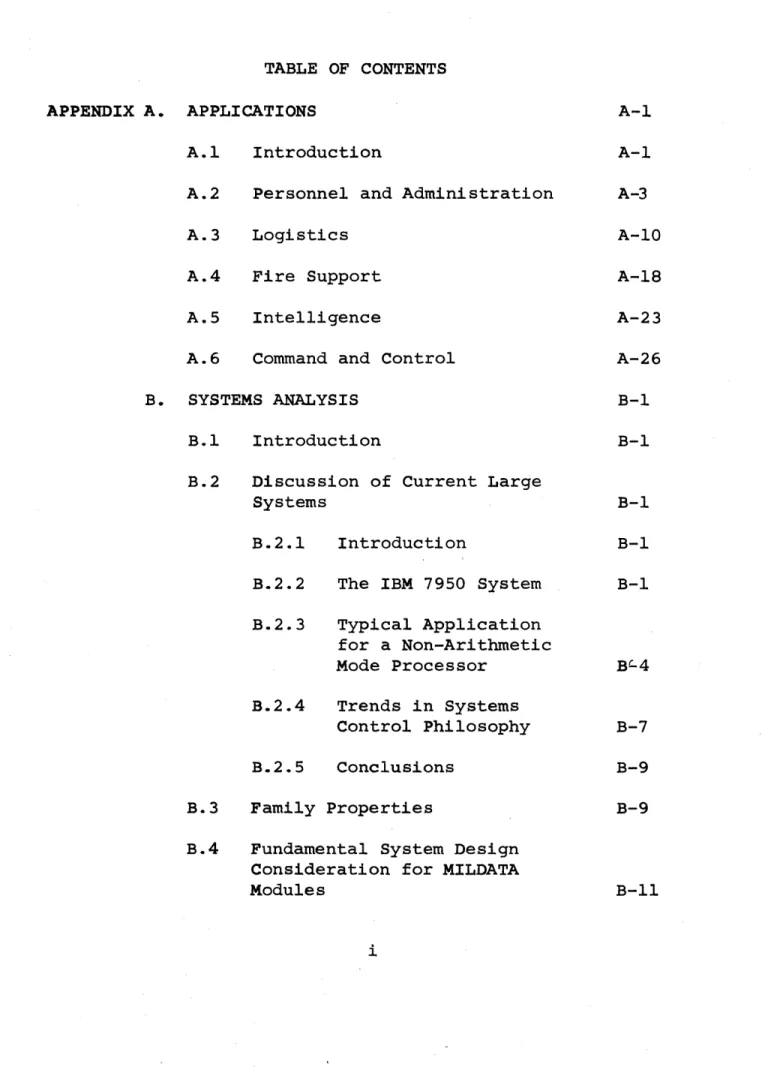
TABLE OF CONTENTS APPENDIX A. APPLICATIONS
A.l Introduction
A.2 Personnel and Administration A.3 Logistics
A.4 Fire Support A.S Intelligence
A.6 Command and Control B. SYSTEMS ANALYSIS
B.l B.2
B.3
Introduction
Discussion of Current Large Systems
B.2.l B.2.2 B.2 .. 3
B.2.4
B.2.S
Introduction
The IBM 7950 System Typical Application for a Non-Arithmetic Mode Processor
Trends in Systems Control Philosophy Conclusions
Family Properties
B.4 Fundamental System Design Consideration for MILDATA Modules
i
A-l A-l A-3
A-10
A-18
A-23 A-26 B-1 B-1
B-1 B-1 B-1
B-7 B-9 B-9
B.4.1
B.4.2
B.4.3
B.4.4
Reliability Considerations
Reliability Require-ments
The Decentralized Control Concept Implications C. SOFTWARE
C.l C.2
C.3 C.4
C.s
C.6 C.7
Introduction
Characteristics of Command and Control Software
Development and Maintenance Terminology
Programming Support Adaptive Programming Management Problems and Cost Factors
D. ARMY COMMUNICATIONS D.l
D.2
Background and Implications of Changing Army Tactical Doctrine
Communications Techniques D.2.l
D.2.2
D.2.3
Introduction
Random Access Discrete Address System (RADA) Pulse Code Modulation
(PCM)
i i
B-ll
B-12
B-12 B-17 C-l C-l
C-l C-4 C-10 C-12 C-13
C-14 D-l
D-l D-3 D-3
D-4
D.3
D.2.4
D.2.6
D.2.7
Single Sideband and Frequency Modulation
Security Considerations
Error Control Considerations
Conclusions
D-S
D-6
D-7
D-8
E. HARDWARE E-l
E.l
E.2
Introduction E-l
E.l.l General E-l
E.l.2 Summary of Discussion E-3
Circuitry and Packaging E-3
E.2.l
E.2.2
E.2.3
~storic Background
Discrete Component Technology
E.2.2.l Semi-conductor
E-3
E-4
Technology E-4
E.2.2.2 Cryogenics E-6
E.2.2.3 Magnetics E-7
E.2.2.4 Summary of Discrete Circuit
Investigations E-7
Integrated Electronic
Circuitry E-8
E.2.3.l Definitions E-8
E.2.3.2 Circuit Selection
Considerations
i i i
E.2.3.3 Summary and
Conclusions E-ll E.3 Internal Processor Storage and
Memory Systems E-l2
E.3.l Introduction E-l2
E.3.2 Status of Current
Memory Developments E-l3 E.3.2.l Active
Register
Storage E-l3
E.3.2.2 Magnetic Thin
Film Memories E-l4 E.3.2.3 Advanced Ferrite
Memories E-l6
E.3.2.4 Cryogenic
Memories E-20
E.3.3 Current Memory Design
Trends E-24
E.3.3.l Introduction E-24 E.3.3.2 Read-Only
Memories E-25
E.3.3.3 Associative
Memories E-26
E.4 Man Machine Input/Output Devices E-32
E.4.l Introduction E-32
E.4.2 Standard Input/Output
Devices-Current Status E-33 E.4.2.l Keyboards E-33 E.4.2.2 Paper Tape
Equipment E-34
E.4 .. 2.3 Punched Card
Equipment E-34
E.4.2.4
Character-at-a-time Printers E-35 E.4.2.5 High-Speed
Impact Printers E-35 E.4 .. 2.6 Non-Impact
Printers E-35
E.4.3 Advanced Input/Output
Devices E-36
E.4.3.l Character
Readers E-36
E.4.3.2 Voice
Recognition
Devices E-37
E.4.3 .. 3 Direct
Dis-play Devices E-38 E.4.3.4 Light Pens E-39 E.4.3.5 Audio Output E-39 E.4.4 Usage Considerations E-40
E.4_4.l Environmental and Physical
Factors E-40
E.4.4.2 System Response
Time E-4l
E.4.4.3 Programming
Considerations E-4l
.E. 4. 4. 4 Formating
Requirements E-4l E.4.4.5 Training
Requirements E-43
E.S
E.6
E.4.S Summary
Bulk - Peripheral Storage Systems
E.S.l Introduction E.S.2 Discussion
~.S.3 Summary
References
ATTACHMENT E-1 MECHANISM FOR COMPUTER CHARACTERISTIC EXTRA-POLATIONS
1. General
2. Program Description 2.1 Data
Transfor-mation - EDITIN, EDITIP, EDITIQ 2.2 Plot Selection
-FINGER
2.3 Curve Fitting -FITTER
E-44
E-44 E-44 E-4S E-47 E-48
E-I-l E-I-l E-I-l
E-I-3
E-I-3
E-I-6 2.4 Printout - HDCOPY
ATTACHMENT E-1I
ATTACHMENT E-1II
ANALYSIS OF EXTRAPOLATED RESULTS
1. Projected State-of-the Art
2. Physical Limita-tions
3. Summary
EXTRAPOLATION RESULTS
vi
E-I-6
E-II-l
E-II-l
ATTACHMENT E-IV AN ASSOCIATIVE PROCESSOR FOR THE
ROUTING PROBLEM E-IV-l
1. Introduction E-IV-l 2. The Routing
Algorithm E-IV-l
3. The Associative
Processor E-IV-3
4. The Computational
Procedure E-IV-5
5. Conclusions E-IV-6 ATTACHMENT E-V AN ASSOCIATIVE
PRO-CESSOR FOR CORRELATION
PROBLEMS E-V-l
1. Introduction E-V-l 2. The Problem E-V-l 3. Description of
the Processor E-V-2
4. Procedure E-V-3
5. Conclusions E-V-8
FIGURE A-I II A-2 II B-1 II B-2 II C-l II E-l
"
E-2II
E-3
"
E-4"
E-I-l"
E-I-2" E-I-3
"
E-II-l"
E-III-l"
E-III-2II
E-III-3
VOLUME II LIST OF FIGURES
Systems Expandability Pattern Minimum Associative System Organization
IBM-7950 Harvest System Byte Train Processor Flow Chart
MILDATA Time Schedule
Large Random-Access Memories: Cycle Time versus Capacity
Large Random - Access Memories: Packing Density versus Capacity Large Random - Access Memories: Cost versus Capacity
MILDATA Computer Characteristic Extrapolation System
Flow Chart FINGER Program Flow Chart FITTER Program Postulated Simple Von Neuman Machine - 1971
Memory Access Time vs. Installation Date
Memory Cycle Time vs. Installation Date
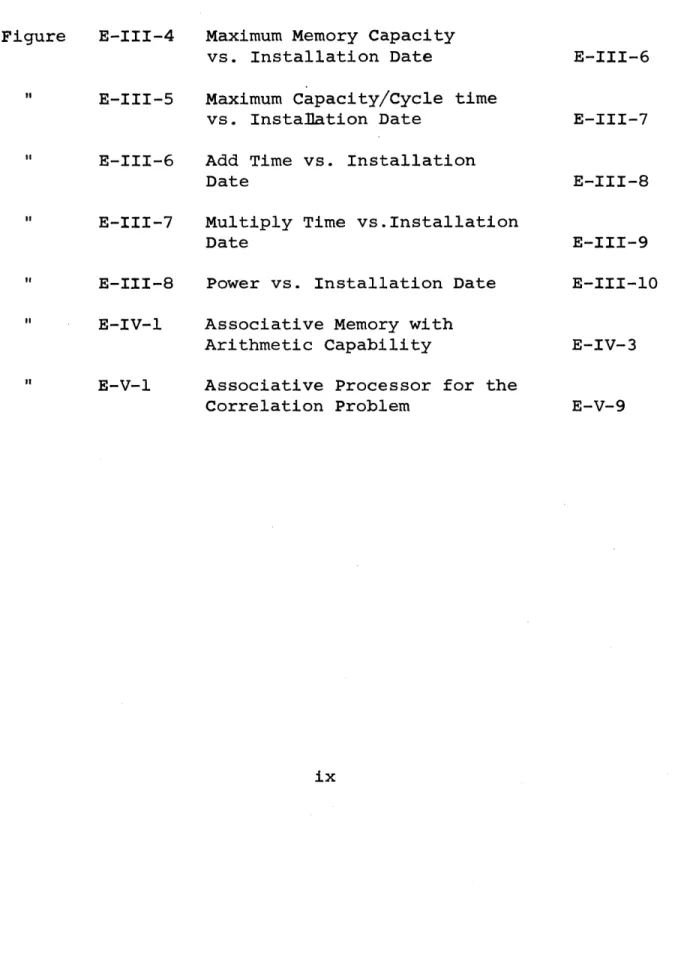
Figure E-III-4 Maximum Memory Capacity
vs. Installation Date E-III-6
"
E-III-5 Maximum Capacity/Cycle timevs. Installation Date E-III-7
II
E-III-6 Add Time vs. Installation
Date E-III-8
II
E-III-7 Multiply Time vs.Installation
Date E-III-9
II
E-III-8 Power vs. Installation Date E-IlI-lO
" E-IV-l Associative Memory with
Arithmetic Capability E-IV-3
II
E-V-l Associative Processor for the
Correlation Problem E-V-9
TABLE A-I
" A-2
II
A-3
" A-4
II
E-l
II
E-2
II
E-3
"
E-4II
E-S
II
E-II-l
VOLUME II LIST OF TABLES
Personnel and Administration Sub-System
Logistics Sub-System Fire Support Sub-System Intelligence Sub-System Current Thin Magnetic Film Memory Developments
Prognostications Concerning Future Thin Magnetic Film Memories
Processor Main Memories Bulk Ferrite Memory Efforts Associative Memory Studies Utilizing Magnetic Techniques Raw Projected Computer
Characteristics - 1971
x
A-7 A-12 A-17 A-21
E-IS
E-17 E-18 E-19
E-28
APPENDIX A Applications
A.l. Introduction
The major delineations found in the applications area of MILDATA are dictated by Army doctrine and experienceo The areas
where some computer processing already exists are Logistics, Intelligence, Fire Control, and a grouping called Personnel and Administrationo Superimposed upon these areas are Command and Control requirements which in some instances use these facilities and in some instances impose a totally new set of requirements on the loose system made up of the equipment applied to the foregoing areas.
The MILDATA system of the 1975-1985 era will very likely be an extension of this very general structure, but utilizing faster and radically more powerful equipment, communication facilities/which are at the same time internal links in the system, and external links to the user, and operating in an environment that is at once global and local.
I t is not inconceivable that the array of weaponry avail-able to the combatants in this time era will be so formidavail-able that actual use of all of them in combat would be unlikely and the utilization of military force for political gain will have ceased to be profitable in the cold war.
In such an environment the skill of analysis combined with the quickness of response will be the most effective weapon and the side which can demonstrate that i t can use its weaponry and survive will win.
Attendant on such a theory, admittedly over-simplified, is the mounting need for centralization of information from an ever growing and expanding system of information gathering sensors. The function of information reduction and display will be central to the system deSign, and the system which can enrich the picture thus generated will be valuable to the ~ who must evaluate all the information and select a course of action.
Within this frame of reference the description of the application for future systems must be consideredo
The computer system of the future (1975-1985) will likely lose its identity as a computer entity and emerge as an integral part of a larger system which is designed as a fast-reacting
military shield with two purposes; to coerce the enemy from using his weaponry and to protect the United states and its allies from the effect of this weaponry if i t is employed. Intrinsic to this system will be a wide and varying network of surveillance communications and countermeasures devices. A new aspect of this type of warfare will be the need to keep the enemy briefed on our capability in order to prevent a disastrous under-estimate of our capability and our resolution to use i t . Regular demonstrations of this strength on a global scale is one way to
accomplish this, another way is to build a military system that is as quickly effective on a limited warfare basis as on an ex-tended warfare basiso The enormous amounts of information available for analysis by a commander must be capable of utilization both in actual warfare and in the para military -political - economic half world in which the military operates today and will for the forseeable future.
The basic skills required to utilize the integrated system must be delineated and analyzed so that they may be taught to the various echelons of responsible rank within the Army organiza-tion. The system must be so designed that i t supplements the basic skills found in each rank within the Army and at the same time
enhances the fighting effectiveness of each occupant of these ranks. Only if these considerations are foremost throughout the design of the 'system can the system be properly integrated into the Army structure without causing a major disturbance of both structures. A quick integration of the system into the Army is desirable to prevent the debillitating effect of pro-tracted phasing in and out of equipment in the traditional mannero
A.2. Personnel and Administration
Under the category of work included in the Personnel and Administration Subsystem is found the Personnel Management and Control function, Financial, Medical, Discipline, and Special reporting (see Table A-l {Personnel and Administration»0 None of these work categories offer anything very new in the way of data processing requirements in that they are essentially in-formation storage and retrieval problems, with file maintenance procedures of varying efficiencies the measure of effectual usage of the computer/data processor. Such work as this is a sustaining work factor in the system and, for purposes of the Mildata system, can form a segment called the backlog job area.
The backlog area is the sustaining job area in which resides the job pool from which the system draws when i t has satisfied all priority processing requirements_ When system processing power becomes avail,able due to completion of high priority jobs, or a null period occurs in the real time demands upon the system, the System Control immediately takes account of which and how many systems components are available and then compares the contents of the backlog job pool against the available system components and processes the jobs for which components~ files,
and time are available. In the event that a job in the background pool becomes a priority job due to the passage of time, and the priority load on the systems is such that i t can be handled on a priority baSis, i t will appear as though it were a new priority job just entering the system queueo
It can be seen that the system under these circumstances must be as powerful and efficient as possible. Moreover, the
storage and retrieval of file items and the manipulation of
blocks of data become high rate of occurance items in the system operation. It is also evident that to function in such an en-vironment the Compile, Assembly, and Translate functions have to be held to a mini~um general system requirement and to be moni-tored, maintained, updated or modified by a central group of people who have this responsibility exclusively. In short, a Systems Software Maintenance Group, enjoying a status as a high priority users group~ will probably be a continuing requirement in the system. Each of the earlier d.tstinguJ$hed job areaS1 iQe., Intelligence, Fire Control, Logistics, and Personnel and Adminis-tration must have representation in this group. This group's responsibility will be great but briefly stated is as follows: keep the compiler efficient and general, make the object programs as short and fast as possible and arrange them so as to lend
themselves easily to segmentation. The latter requirement is to enable easy and fast system response to real time interrupt requirements on the system.
In addition to real time interrupt provision the type of system being proposed in this report entails an adaptive response capability. The Self adaptive aspect lies in the ability of the system to react to an unprogrammed for demand in the system by combining segments or pieces of programs and pieces of equipment to service the requirement in an unanticipated mannero This is possible only if the software array in the system is segmented into meaningful programming units, meaningful not only to the
program of which i t is a part, but also meaningful to an analytical control program which is attempting to match system demand jobs to system programming response. A further potential gain here is the possibility of the analytical control program being refined to a point where i t can choose between alternative software and hardware configurations in responding to a request from the
regular job sources. I t is easy to see the value of this power in being able to initiate or continue critical processing even though parts of the system are disabled or busy with other high priority work. Such processing needs as are represented by Personnel and Administration could essentially be serviced in parallel with priority jobs, depending on the availability of the system equipment segments to meet the job requirement;i~ol
the right number and type of tape drive, the right tape reel on the drive, the necessary memory space, etco
PERSONNEL AND ADMINISTRATION
""1nction Output Files Frequency
---r;-!rSs~erineT-- -;-Reports---from all other - FiTe Maintenance Input Processing 1 Upaa-tea-pIle; Master Record
Personnel Manage-ment and Manpower Control Financial Services Medical Services
i Record Keeping
1
-I Individual
I
P & A Sections i Hard Copy~~;laceme~~~e~~est~--
-!-F-1-'-1-e-M-a-i-n-t-e-n-a-n-c-e-'---~Pdated
File,d R . t t l R t G t .
I
~Ha
rd Copy Report an e-ass1gnmen s o ; epor enera 10n,Duty
i
Personnel AssignmentMaster Record, Strength Accounting
I
Replacement. . t . 1 t +
-Casualty Admittance Report I File Maintenance, Updated File, Master Record,
Reporting I Report Generation Hard Copy Report Strength Accounting,
Daily
_______________ ~ _ _ _ _ _ _ _ i~S~l~~p~ti~ _~---~I~M-e-d-1-.c-a_l-A-~-o-u-n-t_i-n-g---~-_ _ _ _ ~ Rotation Rotation Request
i
File Maintenance, Updated File, Master Record, Cyclic BasisI
Report Generation Hard Copy Report Strength Accounting~---~---.-.---.-. --.--.---t-.--- .-- - - .. - - .. __ . -.- .. +
-Graves Registration Personnel Locator Service
Death Report
Personnel Locator Request
I
File Maintenance, Hard Copy Report,I
Report Generation Updated File! File Maintenance IHard Copy Report,
Master Record, Strength Accounting
On Demand
On Demand
- -
--_._-I
Report Generation IUpdated FileMaster Record, Strength Accounting, Locator
__ . __ +~ocating 1
I! File Maintenance : Hard copy. Report, Master Record, On Demand
CBR Status Report
CBR Input from
Field . Report Generation iUpdated F1le Strength Accounting,
I ! Medica 1 Accounting
-- ---t---.---t----..
t +-Manning ! Report by ! File Maintenance iUpdated File Master Record,
----.-.-- - - _ ..
-Report ! Exception ' \ Strength Accounting
-
---~!---l---+---_r---+---_
Daily
Military Pay Data from Master File, Payroll Requests
~
.. -'--'-'---'-. . _---_._---_._---... _.---_.-I
FundingI
I
Patient Accounting!
I
Expenditure and Fund Request Reports Admittance and Discharge Reports
! Data Processing, ! Hard Copy Report File Maintenance I'and Checks, Updated
File
Master Record,
Payroll
I
Cyclic Basis I
-. --.---.. -.---1'---+---+ '.
---.-.-Data Processing, iHard Copy, Funding ! Cyclic Basis
File Maintenance 'Updated File i
File Maintenance, Report Generation, Statistical
TABLE A-l
Hard Copy Report, Updated File
Master Record, Strength Accounting, Medical Accounting
---~
System _--::.: _~::': __ -"~ Medical Services Strength Accounting Input Manpower Control ReportsPERSONNEL AND ADMINISTRATION (Continued)
I
I
Processing File Maintenance, Report Generation, Statistical
Output Hard Copy Report, Updated File
Files
Strength Accounting, Medical Accounting
Frequency Daily
--- --- ---+--~---+---+---+---(continued) Medical Regulating
Reports
Discipline, Law and Order
Special Reports
Patient Accounting Reports, Evacuation Reports
Prisoner of War Records and Reports, Intelligence System File on Area
Promotion Reports, AWOL Reports, Special Report Requests
I
File Maintenance, Report GenerationFile Maintenance, Report Generation
File Maintenance, Report Generation, Data Processing
Hard Copy Report, Updated File
Hard Copy Report, Updated File
Hard Copy Report, Updated File
Medical Accounting, Strength Accounting
POW' File,
Intelligence System Files
Daily
On Demand
Master Record, On Demand Strength Accounting,
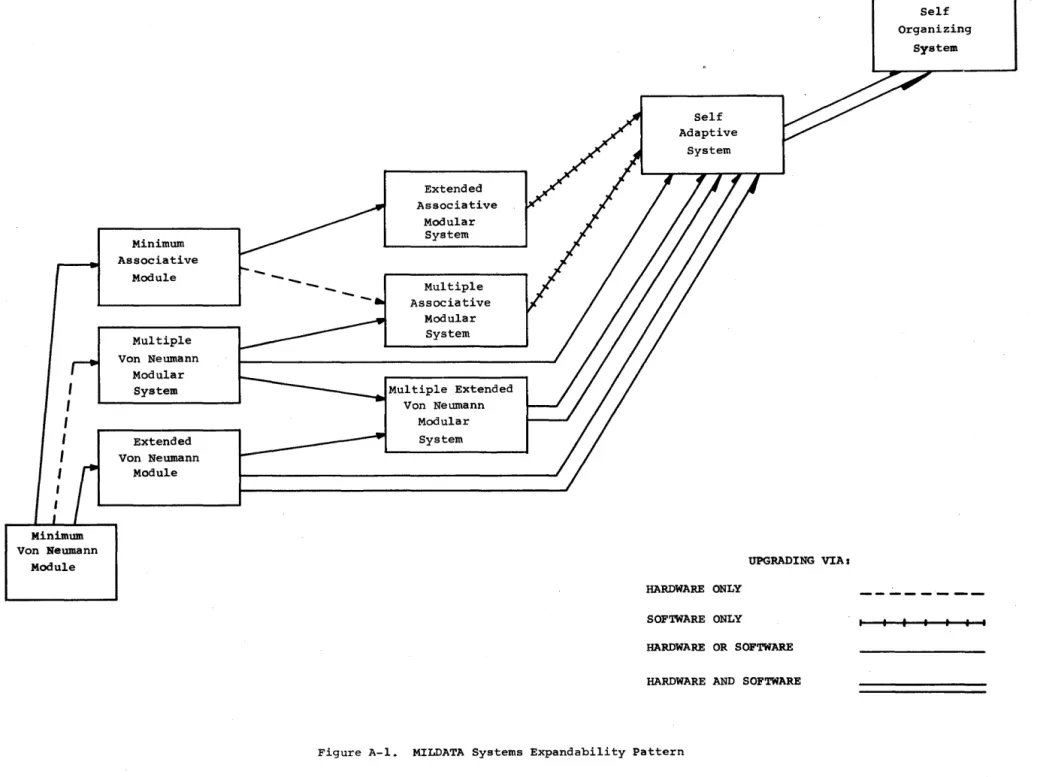
In Figure A-l, entitled "System Expandibility Pattern" is a module entitled Minimum Associative ModuleQ This is an opera-ting computer module organized on an associated basis, much as described in the Third Quarterly Report (see Figure A-2). One of the main reasons for the presence of such a module in the MILDATA System will be to function in direct connection with the analytical control program cited above. This module should contain all of the necessary hardwar~ and memory to implement the analytical control program 1 ioe., i t will be associatively organized with all of the
status registers and content addressable memory to permit the maintenance of a large descriptor matrix which can be quickly
searched due to its content addressability and which will provide the necessary pointers to indicate applicable algorithms in the system and initiate the concatination of the algorithm sub-programs or segments to generate the necessary object program for the job at hand. Good systems design should permit parallel processes here which will permit the execution of this process without interruption of processing on other moduleso The increase in depth of knowledge of how to improve the primitive analytical control program, will permit the expansibility indicated in
Figure A-l cited above. Under this system deSign, background jobs (or sustaining jobs) could be serviced continuously up to the capacity of the system modules at hando
I t seems reasonable to assign the function of Personnel and Administration processing to the background job pool with the
rough requirements that the processing requirement will be satis-fied on a 24 hour basis. The estimated processing load in terms of Function, Input, OUtput, Files size and description and the frequency of reoccurrence of job, can be quickly inspected by looking at Table A-lo From this table, i t can be seen that the natural segmentation of the processing load would be very con-venient for processing as a backgrouna jobo
I I I
,
I
I
Minimum Von Neumann
Module
Minimum Associative
Module
Multiple Von Neumann
Modular System
Extended Von Neumann
Module
Extended Associative
Modular System
Multiple Associative
Modular System
Multiple Extended Von Neumann
Modular System
Self Adaptive
System
HARDWARE ONLY
SOFTWARE ONLY
UPGRADING VIA I
HARDWARE OR SOFTWARE
HARDWARE AND SOFTWARE
Figure A-I. MILDATA Systems Expandability Pattern
A-8
Self organizing
-
Memory AddressProcessor
Processor 1 ~
-
~llocator..
Peripheral--
I - Equipment 1--" ~~
...
Processor 2
..
Peripheral 2...
":"
-
--
--I
I
II I Main
I
I MemoryI (
I
(I I
-~ Processor m
-
Peripheral n...
--
-~
Real~1
Real Time
/
Input~J
TimeUnit Inputs
-
ControlA.3. Logistics
Under the category of work in the Logistical Application is found Supply, Transportation, Evacuation and Hospitalization, Maintenance and Administration Planning (see Table A-2). In these
areas are found good applications for the most advanced business type data processing techniques and equipments. Here is the
area where a genuine increase in efficiency of the Army fighting machine can be realizedo The files of parts, spares, food,
clothing, ammunition are very large and diversified. They are also very active requiring almost constant updating, and pro-cessingo I t will be very important to the Army Logistical
Units of the future that the manner of use of the data processing equipment available to i t be dictated by the strategic and tactical situation in which i t must operate. The forcing of the Logistical Data Processing requirement into a mold designed for i t by System planners, without regard for the quickly changing environment will negate the more obvious gains in efficiency and will ultimately lead to the acquisition of specialized equipments with low frequency of use and great weight in the scale of over-head and rear echelon loadingo The system of 1975-1985 must accommodate the Logistical loa~ along with the other sections of data processing and have the same efficiency as the others. A greatly increased strategic value is shown here when the ex-treme mobility of fighting units of the future is considered. On one hand a large array of weaponry and consequent fire power must be transported with the fighting man but his means of
transport is likely to be airborne and therefore weight limited and somewhat vulnerable. He cannot be ~ or under supplied with the necessities of life and fighting power. As closely as is humanly possible he has to have at hand the right weapon for the tactical situation he faces, and an adequate supply to take, hold and/or destroy the objective depending on the situation with which he is faced. The enemy is apt to be of a type who is trained to seize his weapon and ammunition from a fallen enemyp likewise his food and clothing, where the situation permits. The creation of close-to-the-front supply depots generates an almost irresistable attraction not only for the undersupplied enemy soldier, but for the indigenous population who are theoretically on our side. Good logistics planning and
solid machine support for this planning can eliminate the close in location of supply depots and deny the enemy this source of supply for his foragerso Further, i t will increase the burden on
his
own
supply lines which are equally sensitive though not so exposed as ours.Transportation is another important facet of logistic operations. The transport and support of an army fighting unit in the tactical situation of the future will be a highly inte-grated and coordinated operation whose success will depend on tremendously detailed timing and advanced simulation of the combat situation and the power (fire & man) needed to assure success. The enemy can out-man us numerically for the rest of this century so judicious use of superior technology, adapted to rigorous climactical environmental conditions, is the best tactic in the para-military combat of 1975-1985, and at the same time intrinsic to the Posture of the U. S.
Army
vis-a-vis, the more traditional military units confronting it in EuropeoFunction
---~y~-~~-~---
--I Requisition
j Processing and Replenishment Supply Demand Analysis Physical Inventory
Fiscal Control and Audit
Intransit Accounting
Input
- : Requisition Requests, : Replenishment Report, Fire Support Requests
- Demand and
iConsumption Reports
; Request for Inventory lof Specified Classes : or Items
iAudit Request, Fiscal : Accounting Request,
Construction Requests
Bills of Lading, Cargo ,and Freight Movement
LOGISTICS
Processing
--- jFile Maintenari~e-, -:Availability, Physical ; Inventory, Report !Generation
1
-'I:ReqUirements Analysis ,Report Generation
'iFile Search, iReport Generation IPhysical Inventory
.-t-~
-iData Processing, IFile Search, iReport Generation
; Reports
'l'ransportat~:~----
--tor~c:st-R~~~~~~~
'File Maintenance, IReport Generation, :Data Processing
I _ _ _ _ _ _ _ _ _ _ _ _ _ _ _
I
iFile Search,
Transpor-tation
Capability Forecast ;
f-
I:Report Generation, Transportation Planning
Cargo and Freight Movements
Highway Traffic Regulation and Control
Integrated Move-ments and Supply
I
; Bills of Lading, Intran-iReport Generation, sit, Accounting Reports !File Maintenance,
iTransportation Planning
Road Reports iFile Maintenance, !Report Generation
_ .. _ . _________ . _ _ i ___________ _
Supply Reports, Bills of Lading, Intransit Accounting Reports
:File Maintenance, :Report Generation,
TABLE .A-'2
output
T
Hard--copYRepo~t-,---I
updated FileI I
Files Supply Inventory
- - - ' - - - -
-Hard Copy Report
Hard Copy Report
Hard Copy Report
Hard Copy Report, Updated File
Hard Copy Report
Hard Copy Report, Updated File
Hard Copy Report, Updated File
Hard Copy Report, Updated File
Supply Inventory
Supply Inventory
Supply Inventory
Transportation, Supply Inventory
Transportation, Supply Inventory
Transportation, Supply Inventory
Traffic
Transportation, Supply Inventory
Frequency On Demand
On Demand
Cyclic Basis
On Demand
Daily
Cyclic B.sis
Daily
Cyclic Basis
Evacua-tion and Hospitali-zation Mainten-ance
I
Accounting forI
Patients r! Forecast of j Patient Load
Input
LOGISTICS (Continued)
Processing
··r _.
-Admittance and !File Maintenance, Discharge Reports !Report Generation,
: Statistics
Ipatient
A~counting
Reports
File Search, Report Generation, Statistics
Output Hard Copy Report, Updated File
Files
P&A Master Record, Medical Accounting, Patient Accounting
I
Hard Copy Report Patient Accounting,Frequency Daily
Daily
I
I
I
Medical Accounting... ---._- --- --+i + ! + + -Patient Accounting : File Maintenance, ! Hard Copy Report
I
Supply Inventory, DailyBed Requirements
and Availability Reports : Availability, Report ! Updated File Medical Accounting, !Generation, Statistical Patient Accounting
I
-_.- -.-.-.- _. - - -- -- - --- --. --- + ; r -Evacuation Require- Patient Accounting
ments and Capability Reports, Transportation Capability Reports
File Maintenance, Hard Copy Report, Medical Accounting, , Daily Report Generation, i Updated File Patient Accounting,
Transportation Planning I Supply Inventory
r- -- -_. --' .. -- - .. --. -- -.---- - - .-.- - ._-
-.--I
Bard Copy Report,---+---Clinical and Lab and Medical Reports, File Maintenance, : Diagnostic Records Patient Accounting ; Report Generation
Medical Accounting, Patient Accounting
Daily
1 Updated File
-
---_.-.---.-._---+---+---'-1---I
Bard Copy Report'Forecast of , Requirements
Capability and Allocation of Units
Requirement Requests File Search, : Report Generation, : Statistical Disable and Damage ,File Maintenance, Reports, Damage Control 'Report Generation,
Reports 'Data Processing
I
Hard Copy Report, Updated File
Maintenance, Supply Inventory
Maintenance, Supply Inventory
Cyclic Basis
.~---- Sy Adminis-trative Planning Function stem
.t. .. -. .~-. ~ ----.-... - - - -...
Administrative Orders and Estimates
... _ .. _ .... - .-.-.• ~-.. -. -_ .. _ .•... --.... -Administrative unit Distribution
Construction Requirements
-I
Damage ControlI
Input
Financial Reports, Equipment Reports, Manpower Reports
-_ ..
_--._-Manpower Reports, Organization Changes
Damage Control Reports Requests for Con-struction
Disable and Damage Reports, Maintenance Reports
LOOISTICS (Continued)
Processing
Report Generator, File Maintenance, Data Processing
File Maintenance, Report Generator, Data. Processing
File Maintenance, Report Generator
File Maintenance, Data Processing, Report Generation
Output
Hard Copy Report, Updated File
. - - -..
Hard Copy Report, Updated File
-- -_.
Hard Copy Report, Updated File
Hard Copy Report, Updated File
Files Frequency
Administrative, Daily Master Record P&A
Administrative, Daily Master Record P&A
Supply Inventory On Deaand
Administrative
Supply Inventory, On DeJaand
Underlying all of the above requirements for swift and de-pendable transport, quick and adquate supply, maintenance of a fabulously varied array of equipments, expenditure of money of heroic proportions to support these large endeavors is a con-tinuing demand for positive control, positive knowledge of levels of supply, positive figures on necessary lead time for procurements, positive accountancy of supplied expended, where
and by whom, for what purposes. The positive nature of the required information requires an integrated system of data pro-cessing equipment, communication equipment, transportation
equipment and scheduling (see Table A-2) , which goes far beyond anything accomplished by the military previously. Building such a system surely requires recognition of the details of the problem in depthQ The gro~ng science of army logistics can supply a great many of these details and the work load presented by logistics to the MILDATA system will be a sizable portion of the total load.
In the interest of keeping the problem manageable, i t would seem to be worthwhile to adopt the most efficient File organizations found in the business world of the data
pro-cessing. Army part numbering systems, the traditional numeri-cal organization of part and number was efficient in the past but is no longer efficient and certainly not in the era under consideration. Any system which depends on human awareness to ferret out redundancies, repetitions, etc., cannot cope with the enormously expanding assemblage of items required by the fighting unit of the 1975-1985 time frame. Only a highly efficient com-bination of data processor, communication, data gathering and man-machine interfaces can cope with this problem and only highly imaginative, and,at the same time, technically sound system de-sign can solve the problema
At this point i t will be assumed that we will now have the two major factors which combined will make up the "background" work load for the system proceSSing load. Personnel and Adminis-tration plus Logistics will be the job source for all unassigned systems time plus sources of priority processing when the situa-tion requires i t .
A great deal of the intricate inter-relationship between transport management, Food, Fuel, Clothing and Ammunition Manage-ment, is easily handled on today's Data ProceSSing systems. These items of work begin to acquire serious proportions of the work load only when their proceSSing requirements clash with the
cessing requirements of the other working areaS1 i.e., Fire Control
or Intelligence. At the same time, future tactical situations may
not permit delaying Logistic processing in the traditional manner.
An advantage of the Expandibility design is the linking in of
ad-ditional capacity on demand, via communeations link, or even air
dropping additional modules if the situation required
QThe
im-portant thing is to have the control program intact, on
hand~and
accurate figures as to equipment
re~irementsfor expanded
pro-cessing capability.
j
i
Ammo. status
i
Fire Unit status
FIRE SUPPORT SUBSYSTEM
Input Processing
Battery File
Merge &
Update
Battalion File
Merge &
Update
Division Data Analysis Forward Observer
Battalion Solution of Algebraic Equation
--1
Output Files
Hard-copy Logistics Listing Ammunition Fire Planning: file
Visual DiSPlayiArtillery
Fire Planning !status file
:
Visual & Hard-IIArtillery copy status file
Visual Display None
Frequency
at
completion of each fire mission
continuous
Daily
i
l
I
continuous---~---+---+---+---~---Division
Division
Information Retrieval
Data Analysis
Hard copy & Target List
Intelligence Continuous O.B. files,
weather & terrain files
Visual Display Artillery status file
Continuous
-.---....+---+--- - - - 1 - - .-- - -. . -.-. -- . - . - - - -_ ... _
-Division statistical
Forward Observer Analysis
Hard copy Intelligence Weather & Terrain files
As required
---.--~~---~---~---4_---Battery Linear Program
Forward Observer
Visual Display Ammo. file status file
._---- - - + - . _ - - - _ . _ - _ . __ . -- .. - -. - _ .. _--
_._-Bcttalion Visual &
Hard copy
None
continuous
. - - 1 - - - _ . _ .. _._.
-continuous solution of
Differential Equation
---.. -_._---- - . -.. -._-
-.---
.... -.. --.. -. ___ 1. ____ __. _1 __________ .
_____ .
_
A
o4. Fire Support (Control)
The third segment of the work areas of the MILDATA system
is that of Fire Support
(Control)o (See Table A-3)
9Once again
Army doctrine and experience have placed the responsibility for
processing this area of work squarely on the functioning data
processor center for the Army of 1975-1985 era.
The Army touch-stone of success in this time period will be
mobility.
Again the real power of the future Army will be its
ability to get to the right place at the right time with as much
coercive power as can be generated.
By evidencing again and
again the willingness and ability to use this mobile power
any-where on earth
lthe Army can eventually diminish the rewards
accruing to any real or potential agressor. A succession of
confrontations on a global basis, accompanied by the growing
confidence of indigent peoples in the United
States~willingness
and ability to protect their young Democracies and prevent
sub-version of their Constitutional powers under the Aegis of the
United Nations, or otherwise, will make
th~profit from military
adventuring and subversion minimal, or even negative and further,
a succession of defeats in these circumstances will damage the
power image of the
Itagressor
1t•To accomplish this, there is a continuing demand for
compe-tent, fast, computational power to complement the complex weaponry
of the Army and to direct it.
Intrinsic to the complicated
na-ture of the weapons is a demand for simpler methods of
implace-ment and use
9These weapons systems are potentially dangerous
to the user as well as the target
oSimple and safe methods for
preparation and use of the weapon can be evolved with computer
support.
The simplicity thus achieved can be equally important
in contributing to the mobility which is so valuable to the
future Armyo
Quick analysis of targets and quick computation of weapon
requirements for the purpose at hand can have a direct effect
upon the difficult job of logistical support for the fighting
unit in what will conSistently be an inconvenient geographical
areao
Victory in the encounter
~lldepend on early and
ef-fective application of the weapons at hand to the targets of
greatest strategic and tactical value. To achieve this a fast
and extensive correlation of weapons, fire power, and range,
target evaluation, intelligence estimates, logistic support
and manpower availability will have to be accomplished
oSome
of this integration must be initiated before the undertaking
of the operation 1 however, the entry of the final variables into the computation will often have to wait until the site for the encounter is chosen and the enemy engaged. This entry will have to be easy to accomplish, and very likely will be via a
remote operation channel, generated by a surveillance sensor or by a forward observer at the end of a very narrow information transmission path (probably one way) 0
The net result of this sequence of operations should be the exact targeting of the objective and a near perfect coordination of the local effort with the overall plans and policy of the area commander.
I t follows, therefore, that the oomputational power re-quirement is high and the communications facility extensive and that they are both parts of one and the same system. The com-puting equipment will be modular, permitting the coupling of a number of modules to meet the exact requirements at the site,
i t will be ruggedized at least to the same degree as the weaponry, and i t will have the ability to function with equal facility as a communications controller and link allocatoro The commitment of
weapons, the use rate of ammunition, the kind of ammunition, (high explosive or nuclear), the evaluation of target, the si-tuation report and overall tactical summary of the action, ac-complished and contemplated, will all be functions of the integrated center and will represent peak processing require-ments when they occur. In contrast to the Personnel and Adminis-tration and Logistics processing requirements the Fire Control requirements will be a high priority segment of the load and will occur at irregular intervals-so cannot be a part of the background job area but must be part of the priority processing load opera-ting in a real time environment and responsive to both remote usage and evaluation within the computer center.
Included in the main body of this report is a system
configurator which contains the elements of system composition anticipated as adequate to the system demands of the future. This configurator can be applied against the immediate needs of the Fire Control site or against the integrated needs of a Field Army Headquarters. I t contains all of the possible combinations of the different components available to meet a small computer or a large System requirement. I t further provides for utilizing new developments when they are available in such areas as communi-cation devices1 i.e., voice input, or perhaps wall display output
for situation reporting_
For the time in question in this study,
all of the major systems components represented in this
Configura-tor are considered to be 'available to the 'systems designer. Further,
this array of System Components will permit the combination of
components for new and unanticipated applications with the
re-sult of providing special purpose processes if required.
With the inclusion of the Fire Control processing load into
the MILDATA system requirement, a new element in the system design
emerges.
This is the element of priority processingo For this
requirement, provision must be made for computer availability
under all circumstances. The inclusion of the computer as an
integral part of the weapon system automatically generates a
sur-vivability and availability requirement at least equal to the
weapons themselves.
It is imperative that the arrangement of
systems components
besuch as to assure a computation capability
when only the smallest incremental unit of the system is operating.
This
requirem~ntis equally" applicable for both software and
hard-ware components.
It is from this perspective that Honeywell is
proposing the Systems Expandability Pattern of system architectureo
INTELLIGENCE SUBSYSTEM
Input Processing Output Files Freq.
-.. -- -.•.. ,._-- - - - --r- . 1
-Infantry Outpost Observa. File Update Listing Numerical Order Daily Civilian Interroga. Queue Management Routing, Admin. Order Weekly Spec. Recon. File Search Visual Geographic Order Monthly
! Prog. Library Maint.
I
Display AnnuallyExec. Prog. Cont. Matrix
Order ~ I.
of Artillery Same
i
Same Visual Same Same
Battle Display,
Plotter
i I Display
~- --
-I
Mechanized Same Same Listing Same Same
i Visual
I Display
>
I
Plotter
J
r---N
t-' P Command Prisoner Interroga. Garble Eliminate Listing Administration Demand
i
E Structure Citizen Interroga.
I
Info. Corroboration Report Alphabetical-Name
R Intercept File Update General. Skills
S Observer-Recon. Visual
0
-~---
DisplayN -
-_
.. __ .. --- - - - -._---- . "A Alphabetical Same I Same Same Same Demand
L -- .--- -- . ---
-I Specialized Interrogation Same Same Skill File Demand
T by Observed Specializa- Special Training
Y Function tion
_ _ _ _ _ _ _ _ _ _ _ ---L _ _ _ _ _ _ _ _
Input
INTELLIGENCE SUBSYSTEM (continued)
Processing output Files Freq.
--- --- --- --- --- ---
,---~--- -
---,---~---~---__r---C o M B A T I N T E L L Recon Processing Weaponry Array capahility
Spec. Recon Infiltrators Air Surveillance
Publications Parades Diplomatic Interrogation
File Update File Search Rept Generator
File Update Rpt. Generator File Search
Capability Computation
Listings Terrain Info Visual Weather Info Display/ OB File Spec Rpts Psy File
AnalyticalWeapons Reports :Certified
Tested iEstimated
Periodic Demand
continuous
--- ---~---
---I~---'---__It__---"---Psy Factor
Weather Terrain
Time under fire Intercept
Logistics &
Comfort health
Meteorological Terrain Study Photo Analysis
I---+---~---'---Counter Intelligence
Current Objectives Known Psy Factors
si'tuation study Report generation
weather Prediction Terrain Analysis
Resource File Estimation of Enemy knowledge Reconunendation Computation Reports Listings Same Reports Battle Plans
lOB Pers.
!spec. functions
Meteorlogical Terrain Profiles
,OB-Pers
Terrain Weather Psy Factors
Periodic
continuous
A.S. Intelligence
The value of Intelligence in a military operation is a function of its accuracy and timeliness. The instances when a particular military secret of the enemy suddenly becomes avail-able to the Army - enabling victory in the immediate battle and ultimately leading to final victory, are very rare. Such se-crets may be a revelation of some intrinsic weakness in the
enemy defense posture or in his attack plan. In modern warfare, i t would be inadvisable to assume any such weakness. I t is much better to ascertain the enemies motivation, his strategic needs, his logistical system, and his morale. Information on the enemy in these areas is usally obtained by reducing a large mass of data to a manageable few reliable items of information.
The science of intelligence information generation is con-tained in the methodology of analysis, its completeness and the
speed with which i t can be applied. When data processing methodology is applied to intelligence generation (see Table A-4) Intelligence Subsystem) certain traditional similarities to more prosaic data processing requirements appear.
The first is the gathering together and ordering a large number of individual items. The relationship between these items may not be evident at first. In some cases the sheer number of items involved prevents immediate calculation and comparison, hence the relationship between the items is not immediately ascertained. An alternative approach is to set up an area of interest procedure
in which general file categories are arbitrarily delineated and all incoming items are inspected for relevance to these categories. In some cases, an item may fall into all of the category files -same item but of interest in a different way to each of the files. In this manner a duplication of file items occurs but i t is
justified by the speed i t permits in searching a particular file rather than using a cross referencing system to locate the item in question. So what we have seen here is a multistep process. The item in question must be identified for validity, for interest, and then inserted into the interested file according to the file organization.
Let us take an example - an item appears as follows
-A Russian national is identified as a military person, belonging to a certain artillery section, of a certain Artillary Army, with
with a certain Order of Battle number.
It is conceivable that
in the above item five areas of interest are contained.
If he
is determined to be Russian - this is important, particularly
if he happens to be in Vietnam, also if he belongs to an
Artillery Section which is thought to have Atomic capability
-this is of interest, also if his Artillery Army was thought to
be in East Germany, that is of interest, and finally if all of
the foregoing is true, then the order of battle of the Russian
Military in East Germany may have to be reexamined.
Thus we
see that our very small item of interest involves five (5) items
of high interest, ten
(10)
items of colation and checking, and
implicit in this a relatively large amount of data processing.
This very simple example should also serve to illustrate the
importance of quick cross checking between such apparently
un-related Files as Logistics and Fire Control to produce the
secondary information implicit in the item once its primary
information was extracted and incorporated into the concerned
files.
Thus we see the Order of Battles file, the Personality
File, and the Combat Intelligence file primarily involved in
processing with secondary involvment of Diplomatic Files,
Artillery Geographical Files, Artillery Capabilities Files and
possibly Atomic Weapons Files involved on a less immediate basis.
To sum up - the method of analysis and the broad data base are
the two main supports for successful production of Intelligence
information.
The next requirement is timeliness
qVery few things lose
their value so quickly as Intelligence information.
What is
critically important and highly useful one day may be worthless
clutter in your files the next day.
It is, therefore, imperative
that the end product (Intelligence) be produced as promptly as
pOSSible, in as complete a
form
as possible (iQe
q ,having all
secondary information brought out) and that duplicate and obsolete
items be deleted from the various files as
quic~yas possible.
The last is important because the size of the file is an important
factor in the speed with wh1ch an item can be processed.
It follows
that the files should not only be kept of manageable size but as
small as possible and still
becompleteQ
A secondary store,
possibly off line, may sometimes be of great value in keeping a
complete file of Active Items and a historical grouping at the
same time
o(The presence of a file of items, present for reason
of historical interest is questionable in a field installation,
but such a file should be present in the system somewhere,
perhaps at the Army Headquarters}
From the foregoing, i t can be seen that the principle method for producing Intelligence information is one of Information
Storage and RetrieVal plus effective analytical procedures. The MILDATA system of 1975-1985 must offer considerable improvement in both areas of processing.
A.6 Command and Control
The function of Command and Control is superimposed on the four functions discussed in this commentary on MILDATA appli-cations. Fire Control, Intelligence, Logistics, etc. are committed to Data Processing in this system as the sustaining and continuing loado
I t would seem that i f the extreme mobility talked of for the 1975-1985 time period is to be used effectively, then the calculation and planning needed to support a choice of strategy and an implementation of Tactics in support of the Strategy would require extensive computer support. This support can run the gauntlet from simple collation and comparison to the more sophisticated technique of gaming and trUddecision analysis. The Commanderls use of the information available to him from the data processing area is optional, and based upon his confidence in the information and the use to which he put i t .
Intrinsic to such a common requirement is the idea of current situation reporting. For the time period of concern, situation reporting via sophisticated display devices is probableo Equally probable will be the ability of a computer to respond to commands entered by Voice; mare than the entry console with its typewriter keyboard, card reader, or tape reader. At the point in the system where the computer and Commander come into direct intercourse, voice communication response is desirable. The cognitive aid which the machine system can supply in this design can make the Commander more effective because with the aid of the system he can operate from a much broader data base. His analysis of the s~·tuation can be supplemented by the testing of various options to determine the best possible choice both for the immediate Military success and the longer range economic and political goals. Warfare in the era under question will be a narrowing down of more general economic and political forces and bringing to bear a focused combination of these pressures on points which offer likely targets for this kind of probing. The agressor forces have shown their willingness to use Military force to sup~
press revolutionary movements which threaten the regime in power. Tactics of the 1975-1985 era must provide a quick and effective countermove i f desired. Fast exploitation of weakness will very likely require that the decision of how and when to exploit be left to the Area Commander who is on the ground and knows the situation. By broadening his data base via the computer, he can know a lot mare and in the knowing possibly save lives but
at worst he can see to i t that the objective for which the lives are expended is taken and retainedo The Military Commander of
this era must have a firm grasp of the Military situation as well as the political and economic situation facing him and
must be able to make quick responses when the situation requires i t . This response could range from calling two more tanks, to the other extreme of asking the President or the Director of the United Nations to intervene. I t may require that he be briefed on some local anomaly of religion, or custom which can make his acceptance in the area peaceful, or otherwiseo
The necessity for Command and Control functions is not of course limited to situation reporting requirements. Much of a Commander'S communication capability will be run, controlled and modified by the computational set he possesses in this time period. Message routing and much of the clerical work found at the communication center such as Diarization, Header affixation, etc. will be accomplished by a subunit of the MILDATA computer system. The security of his communications may involve
Encryption and Decryption under Computer Control. On line performance of such fundamental functions as these are al-ready under study and experiment by many groups within the Armed forces and the U. So Government. All of the aspects of the Command and Control system must be allocated to the Control aspect of the system. The Command aspect will be shaped by the echelon position of the user and by the situation confronting the user. I t is certain that a simple Stimulus-Response arrangement will not serve in this time period. The Command aspect of the
system will still be heavily influenced by the Command responSi-bilities of the user and any design for such a system must provide
for both expanSion and contraction of Command responsibility. I t is because of this requirement, among others, that the system ex-pandibility pattern of system design has been followed in this
report. The broad catalogue of available modules called out earlier in this report is specifically designed to fit the Commander's needs at all levels of Command and Controlq The Programming Software to use the modules must be tailored to operate on any and all combina-tion of modules with an optimum efficiency, measured in thru-put time. The net effect of using the system must equate to an en-hancement of the cognition of the using Commander and a con-traction of his response time to a decision requirement in real time.
APPENDIX B. Systems Analysis B.l Introduction
General system design approaches have been generated for the MILDATA study as the result of several studies of both large systems and families of equipment existant in the field today. Also a concerted effort has been made to determine the significance of reliability considerations on initial system and equipment design. The results of these studies have directed much of the effort of evolving the MILDATA Systems Design presented in this report.
B.2 Discussion of Current Large Systems B.2.1 Introduction
As the MILDATA Study progressed i t became evident that existing large computer systems could be studied with profit, with the view of evaluating their effectiveness, methods of
system control and structure of system language. As represen-tative large systems the Control Data Corporation 6600 and the IBM 7950 systems were chosen. These systems are both very large and powerful, with important differences in system philosophy.
B.2.2 The IBM 7950 System
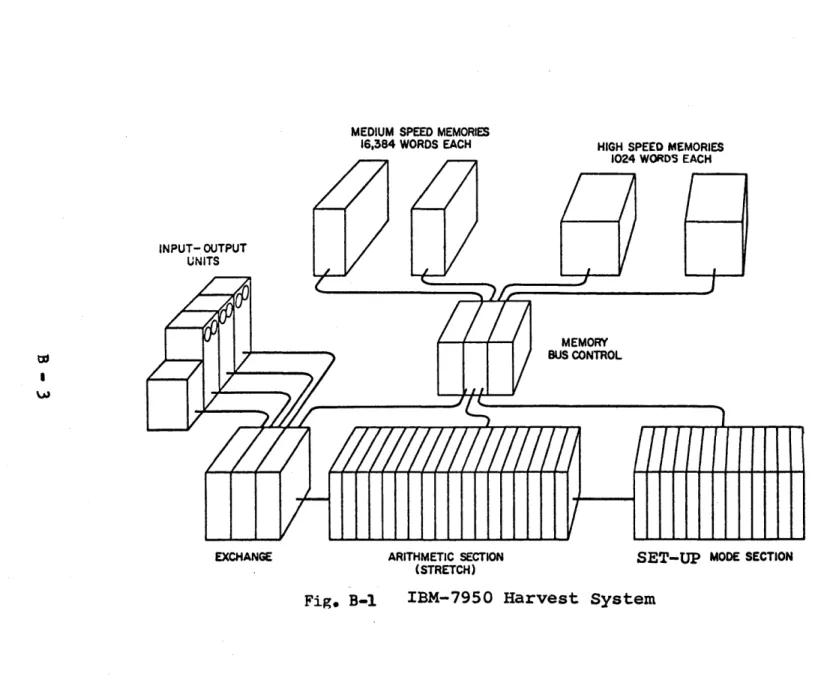
The IBM 7950 System (see Figure B-1) consists basic-ally of a high performance general purpose computer (STRETCH) which has been modified to include a powerful non-arithmetic processor and is provided with a high performance tape system and memories to maintain a balanced high speed of processing.
Programming control of the system resides in the general purpose computer (7030) which executes conventional instructions and directs all input/output activities, includ-ing the high performance tape system (7955). The non- arith-metic processor adds a set of powerful and flexible MACRO INSTRUCTIONS to the general purpose list. These macro's are useful in performing a wide variety of data editing,
The particular combination of macro's used to perform one of these functions is represented in the machine by, the configurations of the "Set Up" fields, a group of control fields directing and controlling these specific macro instruc-tions. The "Set Up" fields are loaded into the Set Up reg-isters by the basic program before processing begins. While a macro instruction is being executed the system is in "Set Up" mode. On the other hand, during execution of conventional instructions i t is in arithmetic mode.
The major classes of operations carried out in the arithmetic mode are:
1. Integer arithmetic operation
2. Floating point arithmetic operations 3. Radix conversion operations
4. Connective operations
5. Index arithmetic operations 6. Branching operations
7. Transmission operation 8. I/O operation
9. Miscellaneous operation
The "Branch Enabled to Set Up" mode specifies that the next instruction is in "Set Up· mode or is a MACRO INSTRUC-TION. I t enables the interrupt mechanism and guarantees that all interrupt conditions generated during prior arithmetic mode operations are recognized and acted upon, leaving the interrupt mechanism cleared for "Set Up" mode responses.
The set up mode is entered by the above mentioned Branch and Enter instruction. Each MACRO is organized by the programmer.
EXCHANGE
MEDIUM SPEED MEMORIES 16,384 WORDS EACH
ARITHMETIC SECTION (STRETCH)
HIGH SPEED MEMORIES
1024 WORDS EACH
MEMORY BUS CONTROL
SET-UP MODE SECTION
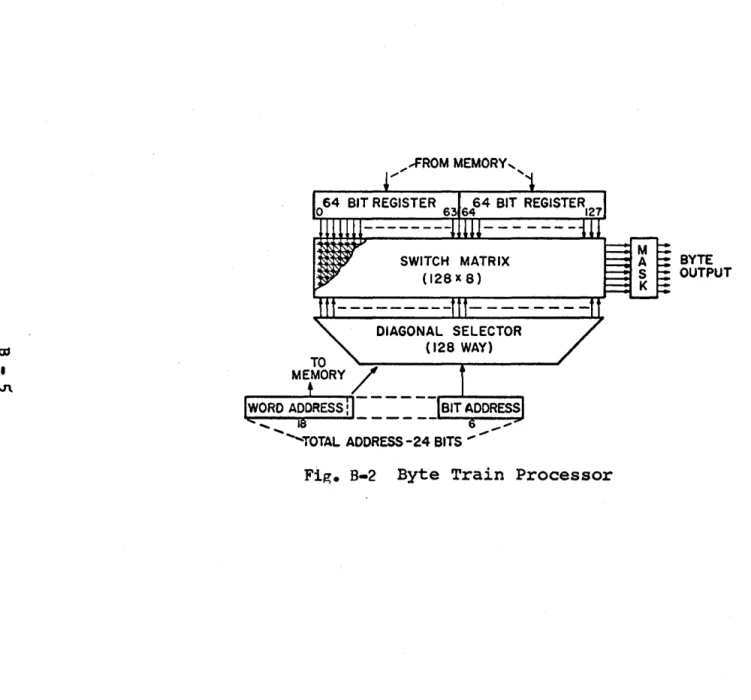
The byte (8 bits) is the fundamental unit of information in the "Set Up" mode. Bytes are selected from memory by two special indexing units forming two seq-uences which can be combined by a class of logical or variable radix addition operations, or can be formed into "Look-up" addresses which are sent to memory to select I
and return a table entry. In either case, the result sequence can be sent back to memory by means of a third special indexing mechanism, or accumulated for statistical purposes. The path which the Byte follows is selected by
the programmer, through the various logic junctions reflec-ted by the bit configuration in the "Set Up" registers. The basic process can in turn be altered momentarily or
permanently by a set of MICRO INSTRUCTIONS called Adjustments. The special indexing mechanisms are unique in that the indexing is expressed, directly in terms of the pattern of data selection. For the purpose of these indexing units the whole memory is treated as one long string of bits on which the pattern is imposed with no special notice taken
of actual word boundaries. See Figure B-2.
To sum up, the basic non-arithmetic process, the data pathways, the set of MICRO INSTRUCTIONS and the indexing patterns are the major tools with which the programmer designs his MACRO INSTRUCTION, while these specification constitute the IIS e t Up".
B.2.3 Typical Application for a Non Arithmetic Mode Processor.
The non-arithmetic data proceSSing, MACRO INSTRUCTION section of the 7950 offers an advanced capability primarily because of the powerful operation i t can bring to bear on a train of data in one pass.
This segment processed data in the form of 8 bit Bytes in a continuous flow pattern and is designed to be
applied in basic logical operations, counting, tablelook-ups, etc. The simple process of hunting for some particular piece of information in a mass of irrelevance can consume considerable machine time; moreover, if the mass of irrelevance is large
enough, the pursuit of the gem of information may not be possi-ble at all. The problem of too much data and too little infor-mation is found more and more often.