ScholarWorks @ Georgia State University
ScholarWorks @ Georgia State University
Political Science Honors Theses Department of Political Science
Spring 5-7-2011
Judicial Recusal: On the Brink of Constitutional Change
Judicial Recusal: On the Brink of Constitutional Change
Laura M. Beamer Georgia State University
Follow this and additional works at: https://scholarworks.gsu.edu/political_science_hontheses
Recommended Citation Recommended Citation
Beamer, Laura M., "Judicial Recusal: On the Brink of Constitutional Change." Thesis, Georgia State University, 2011.
https://scholarworks.gsu.edu/political_science_hontheses/3
This Thesis is brought to you for free and open access by the Department of Political Science at ScholarWorks @ Georgia State University. It has been accepted for inclusion in Political Science Honors Theses by an authorized administrator of ScholarWorks @ Georgia State University. For more information, please contact
JUDICIAL RECUSAL: ON THE BRINK OF CONSTITUTIONAL CHANGE
By
LAURA M. BEAMER
Under the Direction of Dr. Amy M. McKay
A Thesis Submitted in Partial Fulfillment of the Requirements for Graduation with
Undergraduate Research Honors
In the Department of Political Science
Georgia State University
2011
__________________________________________ Honors Thesis Advisor
__________________________________________ Honors Program Director
JUDICIAL RECUSAL: ON THE BRINK OF CONSTITUTIONAL CHANGE
by
LAURA MARTHA BEAMER
Under the Direction of Dr. Amy M. McKay
ABSTRACT
Recusal, or judicial disqualification, occurs when a judge abstains from a particular
legal proceeding because of a personal conflict of interest. All levels of the judicial system
and some administrative agencies in the United States apply the concept of recusal, but this
study focuses on the United States Supreme Court. Title 28 of the United States Code
provides standards (not obligatory by legal means) on when Supreme Court Justices should
recuse themselves. But Supreme Court Justices are themselves the arbiters of their own
recusal and often these substantive standards are not met. The method of study applied is
theoretical, using both quantitative and qualitative data from past Supreme Court cases.
INDEX WORDS: Supreme Court, Judicial Recusal, Judicial Disqualification, United
JUDICIAL RECUSAL: ON THE BRINK OF CONSTITUTIONAL CHANGE
By
LAURA M. BEAMER
An Honors Thesis Submitted in Partial Fulfillment of the Requirements for the Degree of
Bachelors of Arts and Sciences
in the Department of Political Science
Georgia State University
Copyright by Laura Martha Beamer
TABLE OF CONTENTS
LIST OF TABLES AND FIGURES vi
I: INTRODUCTION 1
II: ANALYSIS 12
PART 1: CASE STUDIES 12
PART 2: DATA ANALYSIS 22
III: DISCUSSION 31
REFERENCES 39
LIST OF TABLES AND FIGURES
TABLE 2.1 26
I. INTRODUCTION
Rumors of partiality quickly turned into allegations of bias February when
publicized documents showed just how strong the financial ties were between the
lobbying groups working against the Patient Protection and Affordable Care Act and the
wife of Supreme Court Justice Clarence Thomas. Just how much did Ginny Thomas earn
as a lobbyist against President Obama’s healthcare bill? The Washington Post obtained a
copy of the letter signed by seventy-four House Democrats to Justice Thomas which says
Ginny Thomas received $686,589 over a four year span from The Heritage Foundation, a
prominent opponent of healthcare reform. Representative Anthony Weiner (D- NY)
writes in the letter:
The appearance of a conflict of interest merits recusal under federal law. From what we have already seen, the line between your impartiality and you and your wife's financial stake in the overturn of healthcare reform is blurred. Your spouse is advertising herself as a lobbyist who has "experience and connections" and appeals to clients who want a particular decision - they want to overturn health care reform.1
Recusal, or judicial disqualification, occurs when a judge abstains from a particular legal
proceeding because of a personal conflict of interest. Is $686,589 paid by a lobbying
group to the wife of a Supreme Court Justice enough of a financial stake to warrant a
conflict of interest and ensuing judicial recusal? The answer depends on point of view
and interpretation of the judicial recusal statute. According to today’s Supreme Court
standard, the decision on whether to recuse oneself from a case is left exclusively in the
1
Weiner, Anthony to Clarence Thomas, Washington, D.C., February 9, 2011, in Sonmez, Felicia, “House
Democrats say Justice Thomas should recuse himself in health-care case,” The Washington Post, February
hand of the Justice in question. And since a justice is never up for reelection or
reappointment and there is no veto on a Supreme Court vote, what check on the recusal
power of the Supreme Court do the American people have? The answer is next to
nothing outside of impeachment, which has happened only once since our country’s birth,
there are no repercussions at all.2 Under the United States Constitution a Supreme Court
Justice is awarded a lifetime commission, one free of recusal mandates and ensuing
political consequences. They are themselves solely responsible for judging their ability to
be impartial. By examining parties to past cases and the history of past and current
Justices, we will determine that impartiality is not adequately questioned and that there are
clear and consistent flaws in the recusal system of the U.S. Supreme Court.
All levels of the judicial system and some administrative agencies in the United
States apply the concept of recusal, but this paper will focus solely on the Supreme Court
and particularly on recusal patterns of modern day Supreme Court justices. Throughout
this paper, while unraveling the complexities of recusal, I will continue to reference the
Justice Thomas case study mentioned in the first paragraph. I will also cite other
controversial recusal affairs in order to prove that a consistent flaw exists. Though it will
obviously be impossible for me to study every instance of Supreme Court judicial recusal,
it is necessary to note that of all the cases that have been brought before the high court, only
a miniscule fraction are surrounded by recusal controversy. As I continue in this paper,
2
The first and only instance where a Supreme Court justice was subject to impeachment proceedings was in 1804. The U.S. House of Representatives voted to impeach Samuel Chase, one of the signatories of the Declaration of Independence, on the grounds that his federalist background was influencing his Supreme Court opinions. The Senate acquitted him of all charges. This helped establish the precedent of judicial
independence and judicial review. (Dilliard, Irving, "Samuel Chase," In The Justices of the United States
keep in mind that I am making a study of only a slice of that miniscule fraction in
contention.
There is some confusion on the procedure of Supreme Court judicial recusal: what
is law and what is precedent? First, there are two laws that govern judicial recusal. Title
28 of the United States Code provides the two standards, Section 144 and Section 455 (not
obligatory by legal means) on when Supreme Court Justices should recuse themselves.3
Section 144 titled “Bias or Prejudice of Judge” is extremely similar to Section 455 but
applies exclusively to federal district court judges accordingly we will pay less attention to
it for the purposes of this paper.4 Section 455 entitled “Disqualification of Justice, Judge,
or Magistrate Judge” covers “actual bias,” “conflicts of interest” and “the appearance of
bias” concerning “any justice, judge or magistrate judge of the United States.”5 It states
that a judge should recuse himself/herself of his/her own accord when: his/her impartiality,
personal bias, or prejudice is questioned concerning the case presented.6 Section 455 (a)
deals with the appearance of impartiality: “any justice, judge or magistrate judge of the
United States shall disqualify himself in any proceeding in which his partiality might
reasonably be questioned.”7 The word “shall” bears all the weight in this statute, because
no matter how strongly the grounds for recusal may be, disqualification is the prerogative
of each individual justice and the decision of application is not up for review.8 Even if the
eight other Justices, seventy-four house democrats, or anyone else of political significance
directly petition Clarence Thomas to disqualify himself in Florida v. US when it reaches
3
Grant Hammond, Judicial Recusal: Principles, Process and Problems (Oxford and Portland: Hart
Publishing Ltd, 2009), 55.
4
Ibid., 56.
5
Ibid., 56.
6
Ibid., 56.
7
Ibid., 59.
8
the Supreme Court, which it undoubtedly will, the decision to recuse remains arbitrarily
his.9
Title 28 Section 455 (b) deals with conflicts of interest: (1) where he/she has
personal knowledge of the evidence concerning the proceedings or has previously
expressed an opinion on the case’s outcome (personal bias or prejudice); (2) where he/she
has previously served as a lawyer or witness concerning the same case; (3) where he/she
has come into contact with the matter while in government employment; (4) where he/she,
spouse or child has a financial stake in the outcome of the case; and a prohibition of
relationships, down to the third degree.10 In the letter to Clarence Thomas, House
Democrats use Section 455 (b) (4) as the rationale for his recusal.
Proponents of the Justice’s decision to sit use the more specific particularities of
Section 455 (b) (4) to defend their point of view:
Section 455 means ownership of a legal or equitable interest, however small, or a relationship as director, adviser, or other participant in the affairs of a party. The prohibition applies ‘only if the outcome of the proceeding could substantially
affect the value of the interest,’ but the proviso extends only to a mutual insurance company or a similar proprietary
interest.11
They argue that (1) The Heritage Foundation and Ginny Thomas’s previous employment is
not a party in Florida v. U.S., (2) the outcome of the case would not substantially affect
them, and (3) The Heritage Foundation is not a proprietary interest. However, delving
deeper into the context of Section 455 (b) (4) the democrats are wise to mention in their
9
There are rare instances in U.S. Supreme Court history where Justices have collectively manipulated their votes in order to diminish the voting power of another. In the 1970s Justice William Douglas suffered a stroke and the other eight Justices met in secret to agree that they would not pass down a 5 – 4 judgment where Douglas was in the majority. (Ross E. Davies, “The Reluctant Recusants: Two Parables of Supreme
Judicial Disqualification,” Green Bag 2d, Vol. 10, no. 1 (Autumn 2006), 88.)
10
Third degree relationships are present between individuals with 1/8 (12.5%) of a genetic link. Hammond, Judicial Recusal, 59.
11
letter the significance that Thomas did not, perhaps purposefully, disclose his wife’s
earnings.12
Supreme Court recusal precedent is just as ambiguous in relation to a Justice’s
recusal decision as its legal counterparts. First, there are nine justices on the Supreme
Court and all nine perceive the text of Section 455 differently, as have the justices before
them since the first federal judicial disqualification statute passed in 1792.13 Problems
caused by the different interpretations of judicial recusal law are just the tip of the iceberg;
recusal precedent is also extremely sensitive to the historical developments (formal and
informal, i.e. official Supreme Court opinion) of the law. Because of this, examining the
most influential changes to Supreme Court recusal procedure will help us understand the
context in which the precedent has developed. The most crucial reshaping of recusal policy
occurred in 1911, 1948, and 1974 and additionally interpreted by Supreme Court justices
throughout the Court’s history, most recently in 1993.
In 1911 Congress enacted Section 144 of Title 28 U.S.C. enabling litigants to
request a judicial disqualification motion, also known as an affidavit, based on a Justice’s
personal bias or prejudice.14 Though Section 144 applies only to federal district court
judges it is important to mention it when studying Supreme Court recusal policy because
Section 144 was and can still be interpreted by the Supreme Court – conveying how the
Supreme Court views recusal arbitration in relation to lower courts. In 1921, Berger v. US,
a World War I espionage case, reached the Supreme Court. In this case, the German
American petitioners who were accused of espionage filed a motion for the trial judge’s
recusal based on statements the judge had allegedly said – for example, “one must have a
12
Anthony Weiner to Clarence Thomas, Washington, D.C., February 9, 2011, in The Washington Post.
13
Hammond, Judicial Recusal, 14.
14
very judicial mind, indeed, not to be prejudiced against the German Americans in this
country. Their hearts are reeking with disloyalty.”15 When the constitutional question of
whether the judge should have recused himself (because he did not) reached the Supreme
Court, the Justices decided that the affidavit, which Congress intended to have a
peremptory effect, would actually have little influence on judicial disqualification. The
Court determined that a judge had the power to choose if the application for
disqualification and accompanying affidavit were legally “sufficient,” meaning they had to
have enough support and evidence that would give substance to the judge-in-question’s
prejudice – that is to say “sufficient” in the opinion of the judge-in-question.16
Congress pushed through further developments in 1948, mostly affecting Section
455. A first modification eliminated the requirement that a party initiate the motion for
recusal. A second development was the addition of the word “substantial” in Section 455
(b)(4), “only if the outcome of the proceeding could substantially affect the value of the
interest.”17 These two changes worked against the peremptory-style changes made in 1911,
widening the capacity for judicial discretion pertaining to recusal.
In 1993 the policy for recusals was altered in a less controversial way; the sitting
Supreme Court Justices presented their individualized criteria for their own recusals.18 The
impetus for such formal action on this subject started in 1974 when the text of U.S.C.
Section 455 (a) was changed from “in the opinion of the judge” to “ might reasonably be
questioned.”19 In the same year, the “duty to sit” criteria was eliminated by Congressional
15
Berger v. United States, 255 U.S. 22(1921).
16
Berger v. United States, 255 U.S. 33-34 (1921).
17
Hammond, Judicial Recusal, 58.
18
Stephen Wasby, “Issues in Judicial Recusal,” International Journal of Public Administration, 19(1),
(New York: Marcel Dekker, Inc., 1996), 82.
19
amendments which was aimed at widening the scope for judicial disqualification.20 The
real driving force behind the 1993 recusal statements was the Court’s ruling in Liljeberg v
Health Services Acquisition Corp (1988) which revolved around whether a judgment ought
to be reversed if it is found out that a judge who decided the case was also unknowingly
closely-connected financially to the outcome of the case.21 The Supreme Court ruled in a
5-4 vote that U.S.C. Title 5-455 (a)’s language – “shall disqualify himself in any proceeding in
which his partiality might reasonably be questioned”22 – refers to when a “reasonable
person” would expect a judge to be aware of the questionable partiality, regardless of
whether or not the judge himself knew circumstances were questionable.23
Even after Liljeberg, recusal issues continued to cause problems in lower courts
and when combined with the perpetual question of why the Supreme Court was not held to
the same standards as its subordinates, the 1993 “Statement of Recusal Policy” was
inevitable. Seven Supreme Court Justices signed on to the Statement, issuing independent
recusal standards they, as individuals, intended to uphold.24 This is one statement signed
by only seven of the Justices. Though it’s written in a collaborative effort the Justices are
independently aiming to uphold the policy within. “Statement of Recusal Policy” was
signed by Rehnquist, Stevens, O’Connor, Scalia, Kennedy, Thomas, and Ginsburg.25 In
20
Ibid., 91.
21
This case revolved around a federal judge in Louisiana, but is noted in this paper specifically because the opinion, written by Justice Stephens, institutes a new judicial recusal norm in regards to U.S.C. Title 28. Liljeberg v. Health Services Acquisition Corp., 486 U.S. 847 (1988).
22
Hammond, Judicial Recusal, 59.
23
John Paul Stevens delivered opinion in Liljeberg v. Health Services Acquisition Corp., 486 U.S. 847
(1988).
24
Wasby, “Issues in Judicial Recusal,” 90.
25
2005 Chief Justice Roberts adopted the policy as well.26 Of particular importance in the
statement is the declaration that Title 28 Section 455 (b)(2) concerning his/her or relative’s
legal association with the case:
Current participation as lawyer, and not merely past involvement in earlier stages of the litigation, is required [for a Supreme Court Justice’s recusal]. A relative’s partnership status, or participation in earlier stages of the litigation, is relevant, therefore, only under one of two less specific provisions of Section 455, which require recusal when the judge knows that the relative has “an interest that could be substantially affected by the outcome of the proceeding,” Section 455 (b), or when for any reason the judge’s “impartiality might reasonably be questioned,” Section 455 (a).27
The terms of this statement formally, but not legally,28 bind each Justice to the policy that
lawyer-partner relationships to a lawsuit only mandate recusal if financial interests are
substantially affected, there is an appearance of partiality, or if the relation is personally
participating in the representation of the firm, not just a member or partner to the
representing firm.29 Though the change seems small, the precision of the statement
nevertheless, substantially contributes to diminishing the vague nature of Supreme Court
recusal policy.
The American Bar Association’s Code of Judicial Conduct and Model Code of
Judicial Conduct is accredited little to none in regard to recusal policy. Its significance is
26
Hammond, Judicial Recusal, 66.
27
“Statement of Recusal Policy,” Supreme Court of the United States.
28
Supreme Court Justices as well as any federal judges are absolutely immune from suit for damages, Stump v Sparkman, 435 U.S. 349 (1978), therefore impeachment is the only way to hold a Justice officially accountable for not adhering to recusal policy.
29
Leslie W Abramson, “The Judge’s Relative is Affiliated with Counsel of Record: The Ethical Dilemma,” Hofstra Law Review, Vol 32: 1181 (2004),
more implied than it is officially recognized. Outside of the Supreme Court, 49 of 50 U.S.
states espouse moral regulations similar to those in the Model Code of Judicial Conduct,
which includes that every judge should aim to avoid impropriety, the appearance of
impropriety and any instance where the judge’s impartiality might reasonably be
questioned.30 Additionally in 1973 the Judicial Conference of the United States, the
principal policy making administration for the U.S. judiciary, adopted the Code of Judicial
Conduct for United States Judges, now known as the Code of Conduct for United States
Judges.31 The Code of Conduct is the federal equivalent of the ABA’s Model Code and it
calls for compliance from all judges – delving deeper into particular instances of the
appearance of a conflict of interest.32 Though it has provisions similar to Section 144 and
Section 455 of U.S.C 28, it states clearly that “not every violation of the code should lead
to disciplinary action” and so lends a hand to the ambiguity of Supreme Court recusal
policy.33
Arguably the most incomprehensible problem with Supreme Court recusal policy
is the Justice’s opinion of his/her eight counterparts. After all, the power of a Justice rests
in their power to vote and recusal is the only lawful way to remove an important vote from
an evenly matched case.34 Thus it seems obvious that an opinion on a Justice’s recusal
would depend largely on the politics within the Court, i.e. how evenly split the vote is
going to be and how each Justice predicts his/her counterparts will vote. Because the
Supreme Court makes its decisions in private, the only way to study these recusal politics
30
Grant Hammond, Judicial Recusal, 59.
31
U.S. Department of Justice, Judicial Conference of the United States, “Code of Conduct for United States
Judges,” Guide to Judiciary Policy, Vol. 2A, Ch. 2 (Washington, D.C.: Government Printing Office, 1973,
revised 2009), 2.
32
Ibid., 3.
33
Ibid., 3.
34
of the Supreme Court is to piece together information from memoirs and papers written by
past Justices.35 One such paper was written October 20, 1975 by then Associate Justice
Byron White (in office 1962 – 1993). It was delivered to seven of the eight other Justices –
those seven having been present at a private meeting which excluded the eighth, William
Douglas. The year before Douglas had suffered a serious stroke and the eight other Justices
were afraid he was no longer competent, at least in the interim, to serve as a judge.36 In the
letter White indicated the participants met on October 17 and discussed and came to the
decision that (1) “the Court [would] not assign the writing of any opinions to Mr. Justice
Douglas,” and (2) “they would not hand down any judgment arrived at by a 5-4 vote where
Mr. Justice Douglas is in the majority.”37 Conceptually, the Justices were plainly and
without regard for the legality of such measures, commandeering Congress’s authority to
impeach and remove judges. The other Justices felt Douglas should recuse himself and
made the decision for him.38
The fact that instances like the one from the White letter have happened before
signifies that real inconsistencies exist in Supreme Court recusal policy. If a Justice is
incapacitated, clearly there should be a more convenient route outside of Congressional
impeachment that would remove him/her from office. If judges of a lower court are forced
to adhere to a particularized procedure, recusal or otherwise, the Supreme Court should as
well, as they say, lead by example. If a Justice is explicitly breaking recusal policy, as
stated in the text of the Congressional amendments, there should be repercussions or at
35
Justice deliberations are private because (1) it protects the Justices from public influence and sentiment and (2) deliberations do not necessarily reflect the final decision and opinion, which may not be written for
weeks or months. (Epstein, Lee and Thomas G. Walker, Constitutional Law for a Changing America:
Institutional Powers and Constraints, 7th Ed., Washington, DC: CQ Press (2011), 22.
36
Davies, “The Reluctant Recusants,” 88.)
37
Letter of October 20, 1975, reprinted in Dennis J. Hutchinson, The Man Who Once Was Whizzer White,
(New York: Free Press, 1998), 463-65.
38
least protocol for those actions. When a Justice or multiple Justices determine a recusal is
appropriate, there should be procedures in order to maintain the constitutional purpose and
effectiveness of the Supreme Court. In Section II of this paper I’ll outline more specific
problems/inconsistencies with U.S.C. Title 28 Section 455, and in Section III I’ll examine
II. ANALYSIS
This section is split into two parts. In part one I go in depth into specific case
studies on Supreme Court judicial recusal examining specific circumstances, the justice’s
past, the Supreme Court makeup at the time, recusal standards (formal and informal) at the
time, and any other particulars I think necessary to mention. I organize the analysis into
categories based on established Congressional grounds for recusal and then arrange
contentious cases under the appropriate recusal category. In most cases, because of the
distinctiveness of each recusal issue, it so happens that recusal precedent is almost always
affected – and so I examine those effects as well.
In part two I use data from The Supreme Court Database to help me examine how
often a Supreme Court recusal is surrounded in controversy. The Supreme Court Database
has a comprehensive set of 200 facts about each case the Supreme Court has judged from
1953 to 2009 and a less comprehensive set of similar facts about cases dating back to
1946.39 Because of technicalities with the data I will be only running a statistical analysis
on cases where less than nine judges participated in the vote. When we arrive at part two I
will explain my intentions with the data set more clearly.
Part One: Case Studies
i. U.S.C. Title 28 Section 455 (a)
39
Section 455 (a) deals with the appearance of impartiality: “any justice, judge or
magistrate judge of the United States shall disqualify himself in any proceeding in which
his partiality might reasonably be questioned.”40 The language in this section is clearly not
the most comprehensive and so ample room exists for a Supreme Court Justice’s
interpretation. According to the text any type of past and/or current associations with
parties or indirect participants in a Supreme Court docketed lawsuit may cause a recusal
issue. It is for this reason that past and current associations with parties to a docketed case
are, in large part, found to be the most controversial recusal cases. Associations in this
sense could mean a friendship with a litigant, professional history with a party, prior work
on the case, previously stated bias, or a unique combination of them all.
(1) Current Supreme Court Justice Antonin Scalia declined to recuse himself in the 2004
Cheney v United States District Court for the District of Columbia case in which his good
friend, then Vice President Cheney, was a party. After the Supreme Court had accepted
and docketed the case, Justice Scalia accepted an invitation to fly with Cheney on a
government plane to go on a hunting trip. The party seeking Justice Scalia’s recusal
referenced §455 (a) – saying the justice’s impartiality in this case “might reasonably be
questioned.”41 Justice Scalia responded to the assertion in an issued Memorandum that his
friendship with Cheney did not jeopardize his impartiality, that Supreme Court Justices can
not be bribed by plane rides and hunting trips, and finished up by declaring the reality that
many Justices make it onto the Supreme Court exactly because of friends in high places.42
In addition to Scalia’s Memorandum, then Chief Justice William Rehnquist also issued an
40
Grant Hammond, Judicial Recusal, 59.
41
Ibid., 4.
42
opinion on the matter after he received a letter from two Senators voicing concerns about
an appearance of impartiality with Scalia.43 Rehnquist replied saying each Justice decides
for himself whether to recuse in a case; the way in which they come to that decision varies
but that each Justice “strives to abide by the provisions of 28 U.S.C. Section 455, the law
enacted by Congress dealing with the subject.”44 This recusal case is important because we
see that an irrefutable friendship with a party to a case, no matter how current or strong, is
not an irrefutable “appearance of bias.” Because if it were, according to then Chief Justice
Rehnquist, Scalia would have recused himself based on “the provisions of 28 U.S.C.
Section 28 Section 455.”
(2) A similar recusal issue was present in the very politicized Supreme Court case related
to the Watergate scandal of 1972. United States v Nixon reached the Supreme Court in
1974 to decide whether executive privilege could keep Nixon from handing over the
incriminating audiotapes to the Special Prosecutor.45 Of the nine justices on the Court,
Richard Nixon appointed four. Of the four Nixon appointments, then Associate Justice
William Rehnquist was the only one to recuse himself, citing his past association with the
Nixon administration.46 This may be related to the fact that upon Nixon’s election and
prior to serving on the Supreme Court, Rehnquist served as Assistant Attorney General of
the Office of Legal Counsel. If Rehnquist’s past association with the Nixon administration
had enough of an impact that his impartiality might be questioned, one has to wonder if the
43
Letter from Senators Patrick Leahy & Joseph I. Lieberman to Chief Justice William Rehnquist, Jan 22,
2004, reprinted in “Irrecusable & Unconfirmable,” 7 Green Bag 2d, George Mason University Law and
Economics Research Paper Series (2004), 277-279.
44
Letter from Chief Justice Rehnquist to Senator Patrick Leahy, Jan 26, 2004, reprinted in “Irrecusable & Unconfirmable,” 280.
45
Stanley L. Kutler, The Wars of Watergate, (London: W. W. Norton & Company, 1991), 508..
46
"Rehnquist recused himself in the case, citing his past association with the Nixon Administration."
other three Nixon appointees had strong associations with Nixon as well.47 Then Chief
Justice Warren E. Burger, who was at one point on Nixon’s list for possible Vice
Presidential candidates, was the only other Justice with a questionable recusal because of
his friendship with the President. The alleged fact that Burger was originally supposed to
vote in favor of Nixon, fuels fire to the recusal issue, but because he steered his vote to the
majority makes any recusal problem revolving around U.S. v Nixon moderate.48 The reality
is that, for the most part, Supreme Court Justices interpret judicial recusal statute differently
and this compounds the difficulties surrounding the development of a reliable Supreme
Court judicial recusal precedent. And on many occasions individual Justices alter their
interpretations with time, making the recusal procedure seem even more ambiguous.
Examining Laird v Tatum will be an example of just that complication.
ii. U.S.C. Title 28 Section 455 (b) (1)
Section 455 (b) (1) where he/she has personal knowledge of the evidence
concerning the proceedings or has previously expressed an opinion on the case’s outcome
(personal bias or prejudice); and a prohibition of relationships, down to the third degree.49
Developments in regard to this area of Section 455 are few and far between, however
controversy is rampant. The issues revolve around the very fine line between opinion and
prejudice. According to the text any type of past and/or current viewpoint could or could
47
The other three Nixon appointments besides Rehnquist were Warren E. Burger, Harry Blackmun, and Lewis F. Powell. Prior to being appointed, Burger was on the U.S. Court of Appeals for the District of
Columbia, Blackmun was on an 8th Circuit Judge and Powell was in private practice.
48
Kim Isaac Eisler, A Justice for All: William J. Brennan, Jr., and the decisions that transformed America
(New York: Simon and Schuster, 1993), 251.
49
Third degree relationships are present between individuals with 1/8 (12.5%) of a genetic link.
not be considered bias depending on the examiners point of view. We will examine some
of the comments past and current Justices have made concerning cases that have been
argued in the Supreme Court.
(1) Rehnquist’s “past association” recusal in U.S. v Nixon is attributed to his previous
involvement as Assistant Attorney General of the Office of Legal Assistant for President
Nixon.50 Similarly, Laird v Tatum (1972) was a case in which Rehnquist had prior
associations because of his time as Assistant Attorney General. The Office of Legal
Counsel is in charge of providing legal advice to the Executive Branch agencies and the
President through written opinions and oral advice. By official assignment, the Assistant
Attorney General is in charge of the Office of Legal Counsel and authorizing legal advice
that is provided.51 While in this position Rehnquist gave testimony in front of Congress on
whether or not he thought a Department of Defense surveillance scheme on “dissident”
civilians critical of the Nixon administration and mostly the Vietnam War presented a
constitutional issue.52 He also allegedly was a custodian of some of the digital evidence.53
Obviously his participation in the Supreme Court’s decision on the constitutionality of the
program was seen as controversial. In a rare instance where a Justice publicly defends their
decision to sit, Rehnquist said that his Congressional testimony expressed the position of
50
Kutler, The Wars of Watergate, 508.
51
U.S. Department of Justice, “About the Office,” http://www.justice.gov/osg/ (Accessed March 9, 2011).
52
Jeffrey Stempel, “Chief William’s Ghost: The Problematic Persistence of the Duty to Sit,” Buffalo Law
Review, vol. 57, (Buffalo Law Review, 2009)
http://www.buffalolawreview.org/past_issues/57_3/Stempel%20Web%2057_3.pdf (accessed March 30, 2011), 853.
53
Arthur John Keeffe, “Current Legal Literature: By What Standards Shall They Be Judged?” American
Bar Association Journal, 60 A.B.A.J. (1974),
his client, the government, and not his own.54 However if we compare this recusal issue
area to the U.S. v Nixon case, certainly Rehnquist’s professional capacity and involvement
was similar in both because he held the same professional relationship to both; why then
does he only recuse from one of the cases instead of both?
iii. U.S.C. Title 28 Section 455 (b) (2)
Section 455 (b) (2) where he/she has previously served as a lawyer or witness
concerning the same case; and a prohibition of relationships, down to the third degree.55
The language in this section is actually one of the more defined in all of Section 455. As I
stated in the introduction, there has been Supreme Court interpretations into recusal when a
Supreme Court Justice’s relative is affiliated with a case, but the actual Justice’s previous
legal relationship to a case and recusal in relation to it, is still open to interpretation.
Because several Justices were previously employed either in private legal practice or by the
government, it is not uncommon that a case they worked on or participated in might reach
the Supreme Court. And because of the arbitrary recusal policy of the Supreme Court,
some Justices may choose to participate in the vote while other Justices in a similar
situation might not.
(1) Before joining the Supreme Court in 1967 Thurgood Marshall was Solicitor General
for President Lyndon B. Johnson. Because of this prior involvement in the executive
54
Wasby, “Issues in Judicial Recusal,” 90.
55
branch, Marshall recused himself from about 40 percent of the cases in his first term.56
Despite this rational for recusal, his most referenced and critically revered recusals were
those related the National Association for the Advancement of Colored People (NAACP).
Marshall’s involvement with the NAACP began in 1934 and he won his first of 29
Supreme Court cases in 1940, the same year he was nominated to NAACP Chief
Counsel.57 His extensive involvement as Chief Counsel with the association’s legal team,
up until his appointment to United States Court of Appeals for the 2nd Circuit in 1961, was
the basis for his routine recusal in cases concerning the NAACP.58 After his retirement in
1991 and passing in 1993, his Supreme Court records were opened to the public at the
Library of Congress revealing a letter of memorandum he sent to the other Justices
describing and asking for advisement on his past and current recusal policy in relation to
the NAACP.59
His past practice had been, he said, to “routinely disqualify myself from all cases in which the NAACP has participated as a party or as an intervener.” Enough time had passed, however, since he had left the NAASCP, “that continued adherence to this self-imposed blanket disqualification rule is no longer necessary.” And so he planned “in the future not to recuse myself in cases in which the NAACP is a party or an intervener, unless the circumstances of an individual case persuade me, as with all cases, to do otherwise.”60
56
A rational like this falls under the recusal umbrella of Section 455 (b) (3). (Adam Liptak, “When a
Justice and a Case Are Too Close,” The New York Times, August 24, 2010,
http://www.nytimes.com/2010/07/25/weekinreview/25liptak.html (accessed March 12, 2011).)
57
Mark Tushnet, “A Tribute to Justice Thurgood Marshall,” Stanford Law Review, vol. 44 (Summer,
1992): 1277-1299, http://www.jstor.org/stable/1229060 (accessed 14 April 2011), 1277.
58
Thurgood Marshall College, “About Thurgood Marshall,” University of California San Diego,
http://marshall.ucsd.edu/about/thurgood-marshall.html (accessed April 1, 2011).
59
Justice Thurgood Marshall, Memorandum to the Conference, Oct. 4, 1984, in Papers of Harry A.
Blackmun, Library of Conress, Manuscript Division, box 1405, folder 14, reprinted in Davies, “The
Reluctant Recusants,” 93-107.
60
Not only did the eight other Justices condone the changes he proposed in his memorandum,
Justice John Paul Stevens was “delighted.”61 This proves how judicious Justices can be
when preparing to recuse, but of course it depends on the Justice. Would Justice Marshall
still have recused himself in so many cases if it was his wife who had worked for the
NAACP instead of him, like the Thomas case study mentioned previously?
iv. U.S.C. Title 28 Section 455 (b) (3)
Section 455 (b) (3) where he/she has come into contact with the matter while in
government employment; and a prohibition of relationships, down to the third degree.62
This subsection of text refers almost exclusively to a Justice’s previous government
employment and recusing when government associated material is brought before the
Supreme Court. Depending on a Justice’s interpretation, this could mean government
employment immediately preceding their Supreme Court nomination or it could mean
government employment years, if not decades, before service. This type of recusal would
apply to many Justices dating back to the beginning of the Supreme Court. Justices are
especially likely to encounter such a case in their first couple years on the Supreme Court.
Some examples would include Associate Justice William Rehnquist (previously Assistant
Attorney General), Associate Justice Thurgood Marshall (previously Solicitor General),
Chief Justice John Marshall (previously Secretary of State), Chief Justice Roger Taney
61
Ibid., 82.
62
(previously Secretary of the Treasury), Associate Justice John McKinley (previously U.S.
Senator), Chief Justice Charles Hughes (previously Secretary of State) and many more.63
(1) Current Associate Justice Elena Kagan is also a good example of when a Justice
practices routine recusals in relation to prior legal association. As the 112th Supreme Court
Justice, Kagan came to the Court directly from her position as Solicitor General under the
Obama administration, appointed by him in January 2009.64 The Solicitor General is in
charge of representing the United States government’s case in those suits that reach the
Supreme Court docket.65 The Solicitor General advises the executive branch and
supervises litigation (including amicus filing and oral arguments) in the Supreme Court and
lower federal courts. They also indirectly assist the Justices in selecting the docket by
submitting opinions of the U.S. government to cases where, of course, the U.S. government
is not a party.66 Though Kagan’s time as Solicitor General was short, she still played a
vital role in many cases that will be argued in the 2010 – 2011 term. That pre-judicial role
fueled speculation into how she would choose to practice recusal, especially in comparison
to the last Solicitor General appointed to the Supreme Court, Thurgood Marshall, who I
examined earlier in this analysis. For the 2010 – 2011 term, Kagan is recusing herself from
25 out of 51 cases because she either assisted writing a brief or she was actively
participating in a case while it was litigated in lower courts, according to the Washington
63
A brief biography is provided for each Justice on the Federal Judicial Center website. Federal Judicial Center, “History of the Federal Judiciary,”
http://www.fjc.gov/servlet/nGetCourt?cid=0&order=c&ctype=sc&instate=na (accessed March 8, 2011).
64
Paul Kane and Robert Barnes, “ Senate confirms Elena Kagan’s nomination to Supreme Court,” The
Washington Post, August 6, 2010,
http://www.washingtonpost.com/wp-dyn/content/article/2010/08/05/AR2010080505247.html (accessed March 8, 2011).
65
U.S. Department of Justice, “About the Office.”
66
The Solicitor General would submit a petition for the Supreme Court to hear whichever case and the Court accepts about 70 percent to 80 percent of the cases the federal government petitions for. (Epstein,
Post.67 The reputable SCOTUSblog.com also attributes the recusals to her filing a brief at
the invitation of the Court of the U.S. government’s opinion, signing certiorari grants
(memos she signed saying the U.S. government would not be involved), and recusing in
cases where the United States is the petitioner.68 Because of the substantial amount of
recusals in her first term some attorneys are going as far as holding out on applying for
certiorari, so that they can be sure Kagan will sit the case.69 As prudent, or should I say
logical and democratic, as Justice Kagan’s stance on Supreme Court recusal policy may be,
her recusals are still largely unpredictable because of the arbitrary nature of the policy.
v. U.S.C. Title 28 Section 455 (b) (4)
Section 455 (b) (4) where he/she, spouse or child has a financial stake in the
outcome of the case; and a prohibition of relationships, down to the third degree.70 By
now, the recusal issue most familiar with Section 455 (b) (4) is Clarence Thomas’s
financial tie, and possible bias, related to Florida v. U.S. Similarly, another Section 455 (b)
(4) recusal controversy revolves around Justice Scalia and the gender bias class action
lawsuit against Wal-Mart. The recusal issue is whether or not Justice Scalia will
participate in the case when his son’s law firm is representing Wal-Mart.71 However, in
67
Robert Barnes, “Kagan’s recusals take her out of action in many of the Supreme Court’s cases,” The
Washington Post, October 4, 2010,
http://www.washingtonpost.com/wp-dyn/content/article/2010/10/03/AR2010100303890_2.html?sid=ST2010100303908 (accessed April 4, 2011).
68
Tom Goldstein, “An update on recusal,” SCOTUSBlog.com, October 3, 2010,
http://www.scotusblog.com/2010/10/an-update-on-recusal/ (accessed April 7, 2011).
69
Stephen R. Shapiro, legal director of the American Civil Liberties Union in Barnes, “Kagan’s recusals,” The Washington Post, October 4, 2010.
70
Hammond, Judicial Recusal,” 59.
71
many cases the financial stake is clear and ensuing Supreme Court recusals are not
controversial.
(1) For example, current Supreme Court Chief Justice John Roberts Jr. used to own stock
in Pfizer Inc., a New York-based drug maker. Even though his stock was worth no more
than $15,000, practically pennies compared to Ginny Thomas’s earnings from The
Heritage Foundation, he routinely recused himself from lawsuits involving the company.
Where it gets tricky is when we examine the financial stakes Justices previously had with a
party to a case. In this example, everything was running smoothly with Justice Roberts’
recusal regimen until it was announced that he sold his Pfizer stock holdings on August 31,
2010. Now he is set to sit on two Pfizer Inc. cases this term, according to a docket entry
from September 2011.72 Can the appearance of bias be so easily shed in as little as a
couple of months? The period between Justice Roberts selling his company stock and then
judging the Supreme Court case which includes Pfizer as the party is not a substantial
period of time to disassociate the two. In the same way that Justices like Elena Kagan and
Thurgood Marshall recuse from cases they have associations with, recusal policy related to
financial investments should be heavily exhibited as well, even six months or perhaps years
after the fact – enough to remove the appearance that Justice Roberts may be bias.
Part Two: Data Analysis
72
Brent Kendall, “Chief Justice Roberts sells Pfizer shares,” The Wall Street Journal, September 28, 2010,
As stated previously, part two of this section utilizes data from The Supreme Court
Database, which organizes hundreds of facts about tens of thousands of cases dating all the
way back to 1946. The latest version of the Database was released February 11, 2011 and
this is the version I will be using for my statistical analysis.73 I was unsure of what to focus
on when I first encountered the vast range of Supreme Court data that was available. I
decided that I would only be looking at cases where a Justice did not participate in order to
first, concentrate on less-controversial recusals and second, determine the more common
grounds for recusal. Doing this automatically eliminated tens of thousands of cases from
my analysis, allowing me to focus on only the cases which include five, six, seven, or eight
Supreme Court Justices. At that point I still had over 2,000 cases in my data set and so to
narrow down my analysis further I decided to make a random sample of forty cases.74 I
chose forty cases instead of a higher or lower amount because of (1) brevity, being this
paper has limits of its own, and (2) because I know that much of the case data, found in the
Database and through other research methods, on these forty cases may lack information
pertaining to the specific grounds for non-participation. Thereafter I will sum up how often
controversy surrounds Supreme Court recusals and why Supreme Court cases do not
always have all nine Justices.
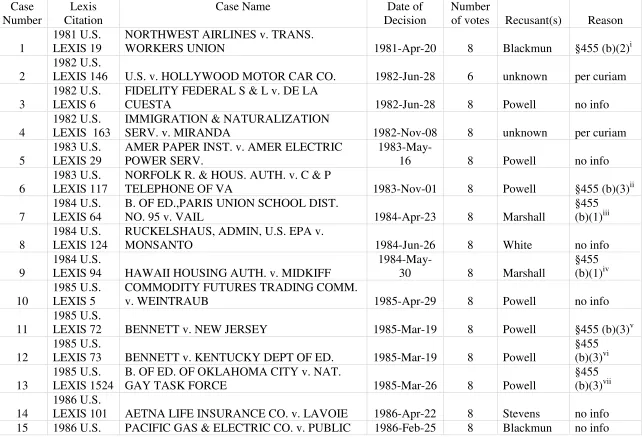
The following table supplies the primary information regarding the forty randomly
selected Supreme Court cases in which there were less than nine votes. The table identifies
a case number (which I assigned), lexis citation, date of decision, name, number of votes,
73
The Supreme Court database is available online at http://scdb.wustl.edu.
74
recusant and reason for nonparticipation, if obtainable.75 All the information in the table is
self-explanatory except for the “reason” column. 76 The explanations in the “reasons”
column state either one of the five subsections of United States Code Title 28 Section 455,
“per curiam,” or “no info,” all clarified below for convenience.77
Reference List:
§455 (a) – Justice disqualified himself in a proceeding where his partiality was
reasonably questioned
§455 (b)(1) – Justice had personal knowledge of the evidence concerning the
proceedings or previously expressed an opinion on the case’s outcome
§455 (b)(2) – Justice had previously served as a lawyer or witness concerning the
same case
§455 (b)(3) – Justice had come into contact with the matter while in government
employment
§455 (b)(4) – Justice, spouse or child had a financial stake in the outcome of the
case
per curiam – means that the court released an opinion on the case as a single entity
with the participating and nonparticipating Justices acting anonymously.
T/R – meaning “technical recusal;” that the nonparticipating Justice was not present
for oral arguments, therefore decided not to participate in the decision
75
For brevity’s sake I used the shortened case names for the table. The lexis citation is the U.S. Reporter Citation (usCite). The date of decision is defined as the day, month and year that the Supreme Court released its decision. The recusant(s) is the Justice that did not participate (I researched this independent of the Supreme Court Database).
76
The reasons for nonparticipation were obtained by me through research and my analysis thereof.
77
N/A – meaning “not applicable.” This means that all the Justices were voting, none
recusing, therefore there were only eight Justices on the Supreme Court
when the case was being decided.
J/D – meaning “jurisdictional dissent;” when the Justice disagrees with the Court’s
assertion or denial of jurisdiction. In The Supreme Court Database these are
counted as nonparticipations.7879
no info – meaning “no information.” I was unable to find information related to a
reason why the Justice did not participate – either I found nothing or I found
that they recused for unspecific reasons.80
78
The Supreme Court Database, “Online Code Book,” http://scdb.wustl.edu/documentation.php?var=vote 79
The phrase jurisdictional dissent comes from the idea of justiciable, meaning the Supreme Court’s power is limited to “cases” and “controversies.” Characteristics that make a case nonjusticiable are advisory opinions, collusive suits , mootness, ripeness, and political questions. A Justice would write a jurisdictional dissent if he/she thought one of these characteristics applied to a Supreme Court docketed case. (Epstein,
Lee and Walker, Constitutional Law for a Changing America, 93-6.)
80
The reason why The Supreme Court Database does not have information on explanations for
nonparticipation is because Supreme Court Justices are not required to disclose that information. Instead,
at the end of the opinion it will simply say, for example in U.S. v Nixon (1974), “Mr. Justice Rehnquist took
26 Case
Number
Lexis Citation
Case Name Date of
Decision
Number
of votes Recusant(s) Reason
1
1981 U.S. LEXIS 19
NORTHWEST AIRLINES v. TRANS.
WORKERS UNION 1981-Apr-20 8 Blackmun §455 (b)(2)i
2
1982 U.S.
LEXIS 146 U.S. v. HOLLYWOOD MOTOR CAR CO. 1982-Jun-28 6 unknown per curiam
3
1982 U.S. LEXIS 6
FIDELITY FEDERAL S & L v. DE LA
CUESTA 1982-Jun-28 8 Powell no info
4
1982 U.S. LEXIS 163
IMMIGRATION & NATURALIZATION
SERV. v. MIRANDA 1982-Nov-08 8 unknown per curiam
5
1983 U.S. LEXIS 29
AMER PAPER INST. v. AMER ELECTRIC POWER SERV.
1983-May-16 8 Powell no info
6
1983 U.S. LEXIS 117
NORFOLK R. & HOUS. AUTH. v. C & P
TELEPHONE OF VA 1983-Nov-01 8 Powell §455 (b)(3)ii
7
1984 U.S. LEXIS 64
B. OF ED.,PARIS UNION SCHOOL DIST.
NO. 95 v. VAIL 1984-Apr-23 8 Marshall
§455 (b)(1)iii
8
1984 U.S. LEXIS 124
RUCKELSHAUS, ADMIN, U.S. EPA v.
MONSANTO 1984-Jun-26 8 White no info
9
1984 U.S.
LEXIS 94 HAWAII HOUSING AUTH. v. MIDKIFF
1984-May-30 8 Marshall
§455 (b)(1)iv
10
1985 U.S. LEXIS 5
COMMODITY FUTURES TRADING COMM.
v. WEINTRAUB 1985-Apr-29 8 Powell no info
11
1985 U.S.
LEXIS 72 BENNETT v. NEW JERSEY 1985-Mar-19 8 Powell §455 (b)(3)v
12
1985 U.S.
LEXIS 73 BENNETT v. KENTUCKY DEPT OF ED. 1985-Mar-19 8 Powell
§455 (b)(3)vi
13
1985 U.S. LEXIS 1524
B. OF ED. OF OKLAHOMA CITY v. NAT.
GAY TASK FORCE 1985-Mar-26 8 Powell
§455 (b)(3)vii
14
1986 U.S.
LEXIS 101 AETNA LIFE INSURANCE CO. v. LAVOIE 1986-Apr-22 8 Stevens no info
[image:33.792.84.726.93.532.2]27
LEXIS 1 UTILITIES OF CA
16
1986 U.S.
LEXIS 87 BOWEN v. AMERICAN HOSPITAL ASS. 1986-Jun-09 8 Rehnquist
§455 (b)(4)viii
17
1986 U.S. LEXIS 88
BOWEN v. MI ACADEMY OF FAMILY
PHYSICIANS 1986-Jun-09 8 Rehnquist no info
18
1987 U.S. LEXIS 5190
MULLINS COAL OF VA v. WORKERS' C.P.,
U.S. LABOR DEPT 1987-Dec-14 8 N/A N/Aix
19
1987 U.S.
LEXIS 4815 CARPENTER et al. v. U.S. 1987-Nov-16 8 N/A N/Ax
20
1988 U.S.
LEXIS 938 ETSI PIPELINE PROJECT v. MO 1988-Feb-23 8 Kennedy T/R
21
1988 U.S.
LEXIS 946 BOWEN v. GALBREATH 1988-Feb-24 8 Kennedy T/R
22
1988 U.S.
LEXIS 942 U.S. v. THOMAS ROBINSON, JR. 1988-Feb-24 8 Kennedy T/R
23
1988 U.S. LEXIS 2863
CITY OF LAKEWOOD v. PLAIN DEALER
PUBLISHING 1988-Jun-17 7
Kennedy and Rehnquist T/R (Kennedy), no info (Rehnquist) 24 1988 U.S.
LEXIS 2882 PIERCE v. UNDERWOOD 1988-Jun-27 8 Kennedy T/R
25
1988 U.S. LEXIS 3030
COMMUNICATIONS WORKERS OF AM. v.
BECK 1988-Jun-29 8 Kennedy T/R
26
1989 U.S.
LEXIS 1738 AMERADA HESS v. N.J. TAXATION DIV. 1989-Apr-03 8 O’Connor no info
27
1991 U.S.
LEXIS 7061 SOUTHWEST MARINE, INC. v. GIZONI 1991-Dec-04 8 Thomas T/R
28
1991 U.S.
LEXIS 7262 HUNTER & JORDAN v. BRYANT, JR. 1991-Dec-16 7
Thomas and unknown T/R (Thomas), per curiam (unknown)
28
LEXIS 2815 20
30
1991 U.S.
LEXIS 6501 ZATKO v. CALIFORNIA 1991-Nov-04 8 Thomas T/R
31
1992 U.S. LEXIS 4537
LUCAS v. SOUTH CAROLINA COASTAL
COUNCIL 1992-Jun-29 8 Souter J/D
32
1994 U.S. LEXIS 3779
MORGAN STANLEY v. PACIFIC MUTUAL LIFE INSUR.
1994-May-23 8 O’Connor §455 (a)xi
33
1998 U.S.
LEXIS 4002 AT&T v. CENTRAL OFF. TELEPHONE 1998-Jun-15 8 O’Connor §455 (a)xii
34
1999 U.S.
LEXIS 4200 MARYLAND v. DYSON 1999-Jun-21 7
Breyer and
Stevens J/Ds (both)
35
2003 U.S.
LEXIS 8965 RAYTHEON COMPANY v. HERNANDEZ 2003-Dec-02 7
Souter and Breyer no info (both) 36 2006 U.S.
LEXIS 1818 OREGON v. GUZEK 2006-Feb-22 8 Alito T/R
37
2006 U.S.
LEXIS 4675 HOUSE v. BELL, WARDEN 2006-Jun-12 8 Alito T/R
38
2006 U.S.
LEXIS 2496 U.S. v. GRUBBS 2006-Mar-21 8 Alito T/R
39
2010 U.S. LEXIS 4971
STOP THE BEACH RENOUR v. FL DEPT OF
ENV PROT. 2010-Jun-17 8 Stevens
§455 (b)(4)xiii
40
2010 U.S.
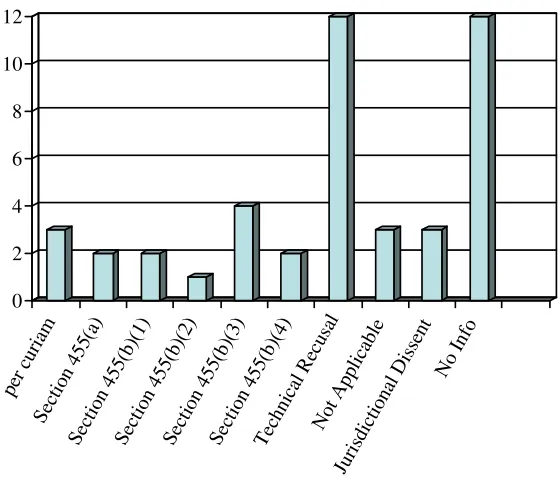
After examining Table 2.1 I simply compiled the recusal data that serves this
paper’s main purpose – the reasons for nonparticipation – into Figure 2.1.81
0 2 4 6 8 10 12 per curi am Sec tion 455 (a) Sec tion 455 (b)( 1) Sec tion 455 (b)( 2) Sec tion 455 (b)( 3) Sec tion 455 (b)( 4) Tec hnic
al R ecus al Not App lica ble Juri sdic tion al D
isse nt
[image:36.612.206.486.168.416.2]No Info Figure 2.1: Reasons for Nonparticipation
Occurrences
Right away, we see that the most common occurrence is “no information;” this is
due to the difficulty encountered when trying to find the exact reason for recusal. The next
common occurrences are “technical recusals,” probably due to the high number of cases the
Court hears relative to the amount of time the Court spends in transition between Justices.
The next most common occurrence is Section 455 (b) (3), but at a substantially less
common occurring rate. Immediately this tells us that nonparticipation in the Supreme
Court takes place less often because of recusal statute and more often because of
technicalities with the Court system.
81
Technical recusals, along with no information, not applicable, jurisdictional dissent,
and per curiam, are not the focus of this paper but studying the rate at which they occur
explains a lot about how The Supreme Court Database calculates its data on number of
votes. Just because 2,000 or so case decisions over the past half a century were made with
less than nine votes, doesn’t mean every nonparticipation was because of a conflict of
interest. However, as previously established throughout this paper, Supreme Court recusal
policy is not obligatory, so the Database also does not take into account cases that perhaps
should but did not have less than nine votes because a conflict of interest of interest or
III. DISCUSSION
Up until now, this paper has discussed the historic changes to Supreme Court
recusal policy as developed through Congressional statutes and the judicial review
subjected to them. After careful analysis of specific recusal cases, inconsistencies between
procedure and execution of United States Code 28 Section 455 are evident. While the
policy’s text is clearly written and the Justices swear themselves to it, their interpretations
of the text are of real consequence. As former Supreme Court Justice William Rehnquist
declared during the Cheney v United States District Court for the District of Columbia
recusal controversy about Associate Justice Antonin Scalia, “there is no formal procedure
for Court review of the decision of a Justice in an individual case. This is because it has
long been settled that each Justice must decide such a question for himself.”82 If that
wasn’t explicit enough for recusal critics, Rehnquist’s involvement in Laird v. Tatum is –
giving testimony before Congress on the constitutionality of an executive program and then
eventually reviewing the same program’s constitutionality before the Supreme Court.
Controversies like these surrounding Supreme Court recusal policy are certainly not a new
trend.
Many Supreme Court recusal disputes are politically charged, especially in a
polarized climate like today. However, proponents on both sides of the political spectrum
will still take notice to impropriety when evaluating nominees. The 1969 Senate rejection
of Associate Justice Abe Fortas to the Chief Justice seat is evidence that the legislature is
trying to keep a check on the Supreme Court’s power – deciding to reject the Fortas’
82
Letter from Senators Patrick Leahy & Joseph I. Lieberman to Chief Justice William Rehnquist, Jan 22,
nomination for many different reasons. First, it was public knowledge that Fortas had
consulted President Johnson on executive affairs numerous times during Fortas’ time as
Associate Justice.83 Second, Fortas had received $15,000 for speaking at American
University on different occasions – money raised for the university by corporations that
might presumably argue in front of the Supreme Court one day.84 Third, it was also
discovered in 1969 that Fortas signed a contract with a wealthy investor, agreeing to trade
legal advice in exchange for lifetime yearly payments of $20,000.85 After he failed to gain
the Chief Justice seat it became clear that Fortas would probably face impeachment and
consequently he resigned from the Supreme Court.86 Similarly in 1969, President Nixon
attempted to nominate Clement Haynsworth to the Supreme Court who also ended up
being rejected by the Senate, conceivably for previously judging cases where he held a
financial interest.87 Instances like these are ways in which the legislature reminds the
Supreme Court that bad judicial behavior has its consequences; but are Justices only held
accountable in politically charged circumstances?88 Impeachment might be more likely for
Justice Thomas’s recusal case if the media paid as much attention to it as it did for Fortas –
$686,589 is significantly more than $15,000.
83
Amanda Frost, “Keeping up Appearances: A Process-Oriented Approach to Judicial Recusal,” University
of Kansas Law Review, Vol. 53, 2005,
https://litigation-essentials.lexisnexis.com/webcd/app?action=DocumentDisplay&crawlid=1&doctype=cite&docid=53+Kan .+L.+Rev.+531&srctype=smi&srcid=3B15&key=ce89252e73d52fa0da84cbffb3e6167f (accessed April 12, 2011), 545.
84
Laura Kalman, Abe Fortas: a biography (Binghamton, New York: Yale University Press, 1990), 352.
85
Kalman, Abe Fortas, 362.
86
Ibid., 374.
87
Grant Hammond, Judicial Recusal, 65.
88
Historians claim that Nixon’s nomination of Clement Haynsworth was rejected by Democrats as payback for Conservatives rejecting Fortas. Historians also claim that Johnson’s nomination of Fortas was rejected because Conservatives did not like the left turn the Court was taking. (David Kaplan, “The Reagan Court –
Child of Lyndon Johnson,” The New York Times, September 4, 1989,
In Cheney v United States District Court for the District of Columbia we concluded
that the “appearance” of bias is a very loosely defined and heavily interpreted term.
Associate Justice Scalia traveling and socializing with Dick Cheney, who was a party to a
Supreme Court docketed case, does not signify an appearance of bias. According to Scalia,
friendships with parties to a case do not mean indicate possible nepotism or the
“appearance” thereof. Then Chief Justice Rehnquist also responded to the controversy,
which fueled the fire, saying that every Justice strives to adhere to U.S.C. 28 and though
the process may be different for each Justice, the recusal goals are the same. However,
Supreme Court recusal policy is extremely influenced by a Justice’s interpretation, so what
seems a recusal goal for one is likely to be different for another. Former Associate Justice
Thurgood Marshall recused himself, more often than not, from NAACP cases between the
time when he was nominated to the Supreme Court in 1967 until 1984, twenty-three years
after leaving his post as NAACP Chief Counsel. Looking back in time and being able to
reference the 1984 memorandum, even Marshall’s decision to end his “self-imposed
blanket disqualification rule”89 that year was occasionally renounced where “the
circumstances of an individual case persuade me, as with all cases, to do otherwise.”90
This helps us understand how dependent recusals are on a Justice’s reasoning and it acts as
an excellent example of how quickly recusal precedent changes, even according to Justices
themselves.
Although the text of Congressionally mandated judicial recusal policy seems
descriptive it’s clear that much of it depends on (1) Supreme Court interpretation, (2)
89
Marshall’s reference to his so-called “blanket disqualification” since 1984 is made in error because he actually did participate in NAACP Supreme Court cases between 1967 and 1984. He actively participated in Milliken v. Bradley (1974) and Meek v. Pitenger (1975), both involving the NAACP as the plaintiff. (Davies, “The Reluctant Recusants,” 84-5.)
90
individual Justices’ interpretations (in the instance that their recusal is the one in question),
(3) the political climate and (4) the particular “place” a Justice might be in their judicial
mindset and constitutionally interpretive development.
In regards to the first dependent variable, Supreme Court interpretation, the Court’s
ruling in Liljeberg v Health Services Acquisition Corp (1988) is a good example. The
Supreme Court’s ruling that a judgment ought to be reversed if it is found out that the
sitting judge who decided the case was also unknowingly closely connected financially to
the outcome of the case.91 In the ruling the Supreme Court interpreted Section 455 (a)’s
language – “might reasonably be questioned”92 to mean when a “reasonable person” would
expect a recusal.93 This ambiguous “reasonable person” test could be seen as an expansive
or contractive adjustment to recusal policy. It is all up to interpretation, in the same way
Section 455 (b)(4), “only if the outcome of the proceeding could substantially affect the
value of the interest,” is all up for interpretation.94 Is Ginny Thomas’s $686,589 from a
business indirectly affiliated to the healthcare bill a substantial interest or not?
In regards to the second dependent variable, individual Supreme Court Justice
interpretations, Associate Justice Elena Kagan provides a good example compared to her
counterparts. She is more disciplined in her recusal policy than other Justices, making the
task of overturning lower court decisions more difficult especially on those where a split
vote is predicted.95 The difference is how she interprets the policy compared to another,
91
This case revolved around a federal judge in Louisiana, but is noted in this paper specifically because the opinion, written by Justice Stephens, institutes a new judicial recusal norm in regards to U.S.C. Title 28. Liljeberg v. Health Services Acquisition Corp., 486 U.S. 847 (1988).
92
Hammond, Judicial Recusal, 59.
93
Stevens, John Paul, delivered opinion in Liljeberg v. Health Services Acquisition Corp., 486 U.S. 847
(1988).
94
Hammond, Judicial Recusal, 58.
95
plus before she was appointed she indicated her recusal from at least eleven cases – those in
which she represented the U.S. government in her previous job as Solicitor General.96
In regards to the third dependent variable, political climate, Associate Justice
Kagan’s recusal habits are also of interest. The relevance is intensified when combined
with Associate Justice Thomas’s recusal habits. As mentioned numerous times in this
paper, many people are calling for Thomas to recuse himself when the Patient Protection
and Affordable Care Act inevitably reached the Supreme Court judicature. The same is
being said about Kagan. The state lawsuits against the healthcare bill began while Kagan
was still Solicitor General, Kagan gave insight into the constitutionality of the bill during
her Senate hearings and Kagan practically said how she would vote if she was to
participate. 97 Much of the reasoning behind Thomas and Kagan’s refusal to recuse is
prompted by the political climate clouding the case itself. Universal healthcare in the
United States finally came to fruition in 2010 and after decades of Presidents in
pursuance thereof, it is ever more important than to the American government and
citizens that the Supreme Court have every constitutional authority reviewing the
legalities of the bill.
In regards to the last dependent variable as to why judicial recusal policy is so
unclear, two cases studied in Section II are the perfect example – Justice Rehnquist (who
was less restrained in his recusals than Justice Kagan) in Laird v. Tatum (1972) and U.S. v
Nixon (1974). The reason Rehnquist divulged for not recusing himself in Laird v. Tatum
was because his prior involvement as Assistant Attorney General on the government’s
96
“Kagan and ObamaCare,” Wall Street Journal, July 13, 2010,
http://online.wsj.com/article/SB10001424052748704288204575363112109060620.html (accessed April 4, 2011).
97