. -'~'--"'-'---""--.. - - - - -.. "'-~.-.. ~ "'-'---"~'.--.~'
a~~~YWE.~L. INTEROFFIC~R~~~~CE
\
')ATE
----TOFROM
JMPONENT
SUBJECT
I"·
"--../)
. -.. P.HOENIX OPERATIONS - HONEYWELL INFORMATION SYSTEMS ""... f.~:~··t.! ....
. ::.\ ::7'~' ...
PHONE 3056 MAIL ZONE A-65 COPIES
Jim Wilt
XDS Product Marketing
CP-6 PFS Version AOI
Distribution: R. ·.Cossman S. Klee"';/
R. Forzani D. Manzer
H. Haugland E. Vance
R • Keeler L. Wilkinson
..
Attached is, the CP-6 PFS updated to reflect the agreements made at the
review me~ting held on September 16. This meeting was attended by
R. Keele~, W. Estfan, L. Wilkinson, S. Klee, L. Osborne, H. Haugland,
T. Beatson .. ,.~. ,Pensiero, R. Hesser, and J. Wilt. At the conclusion of
this' iri~fet~~g~, ~'·ever'Yone. concurred that they would approve the PFS when
the agreed":to::.·c.hanges were made. These changes are indicated in the
PFS by a vertical bar.
I will be contacting you on November 9 with the approval sheet for your
signed approval.
JJ:t
Manager .. , 'Software Systems XDS Product Marketing
cs
"
f'J
J)
VERSIOi'J AOI
HONEYWELL CONTROL PROGRAM 6
PRODUCT FUNCTIONAL SPECIFICATION
XDS PRODUCT MARKETING
OCTOBER
27J 1977
/
.... _ _ _ _ _ ~ __ . _ _ _ _ _ ._ .. _ _ . .:.., .. ~::::.;: C:_-... - . __ -_._-_
-1 • 0
2.0
3.0
o
4.0'
TABLE OF CONTENTS
INTRODUCTION
APPLICABLE DOCUMENTS
MARKETING AND BUSINESS OBJECTIVES
3.1 EXISTING MARKETS AND COMMITMENTS
3.2 PRODUCT MIGRATION STRATEGY
3.3 EXPECTED COMPETITIVE ENVIRONMENT
3.4 PRICE AND COST GOALS
3.5 UPTIME GOALS
3.6 PERFORMANCE GOALS/MEASUREMENT
3.7 SOFTWARE MODULARITY/PRICING OPTIONS
3.8 SOFTWARE DISTRIBUTION AND DOCUMENTATION
REQUIREMENTS
FUNCTIONAL REQUIREMENTS
4.1 PRIORITIES/RELEASE SCHEDULE
4.2 CP-V/CP-6 CONVERSION
4.3 CORESIDENCE
4.4 SYSTEM FUNCTIONS
4.4. 1 SCHEDULING AND RESOURCE MANAGEMENT
4.4.2 FILE MANAGEMENT
4.4.3 I/O MANAGEMENT
4.4.4 COMMUNICATION MANAGEMENT
4.4. 5 SYSTEM SERVICE PROCESSORS
PAGE
4
6
8
8
9
10
11
11
11
12
12
16
16
17
20
22
21
24
26
27
u
o
4.4.6
4.4 .. 7
4.4.8
4.4.9
4.4.10
--~---"~---~--- - - ' - " - ' --~ - _ ..
USER SERVICES
COMMAND PROCESSOR
PROCESSING MODES
4.4.8.1 TIME SHARING
4.4.8.2 BATCH
4.4.8.3 REMOTE BAT,CH
4.4.8.4 TRANSACTION PROCESSING
4.4.8.5 REAL-TIME
LANGUAGE PROCESSORS
4.4.9.1 COBOL
4.4.9.2 FORTRAN
4.4.9.3 APL
4.4.9.4 BASIC
4.4.9.5 PL-6
4.4.9.6 RPG-II
4.4.9.7 ASSEMBLER
4'.4.9.8 PL/l
4.4.9.9 INTEGRATED DATA SOTRE/II
(I-D-S/II)
4.4.9.10 INTERACTiVE DATABASE
PROCESSOR (IDP)
4.4.9.11 TEXT
4.4.9.12 SORT/MERGE
APPLICATION PROCESSORS, PACKAGES AND LIBRARIES
38
40
42
4,2
42
43
44
47
54
55
56
57
57
58
58
59
59
60
64
65
66
67
4.5 HARDWARE SUPPORT AND CONFIGURATION REQUIREMENTS 68
4. 5 . 1 LEVEL 66 68
- - - --_ ... __ ..
_--_._---.I 4
4.5.2 UNIT RECORD DEVICES 69
o
4.5. 3 MAGNETIC TAPE 69·4.5.4 DISK 70
4.5. 5 MASS DATA FILE 71
4.5.6 LEVEL 6 71
4 . 5 . 7 MINIHUM CONFIGURATION 72
4.6 SYSTEM DEFINITION AND RECOVERY 72
4.7 RELIABILITY/MAINTAINABILITY/AVAILABILITY 74
4. 7 • 1 ERROR DETECTION. LOGGING AND RETRY 74
4.7. 2 FAIL-SOFT/RECONFIGURABILITY 75
4.7. 3 ON-LINE DIAGNOSTICS 76
4.7.4 OFF-LINE DIAGNOSTICS 76
4.7. 5 ERROR LOG ANALYSIS 77
4.7.6 SOFTWARE FAILURE ANALYSIS 77
()
4. 7 . 7 REMOTE ACCESS 78
4.7.8 SOURCE POWER FAILSAFE 78
4.7.9 SOFTWARE DISTRIBUTION 79
,
-1.0
o
o
Introduction
This Product Functional Specifi~ation (PFS) represents a
consolidation of the extant requirements for the first three releases of Honeywell Control Program-6 (CP-6).
The CP-6 effort is a major part of a general business
strategy directed at concurrently maximizing the revenue and profit derived from the Xerox PARe and effecting a migration
of the Xerox Control Program-Five (CP-V) PARC to Level 66,
beginning in 1979. CP-6 is intended to be as compatible as
possible with CP-V, while reflecting those enhancements
necessary to insure a highly competitive offering during the
1979-82 time frame. Many of the enhancements will be
derivative of the Level 66 NSA decor or wiil be obtained
from the implementation of those areas of CP-V design that
cannot be clearly converted to Level 66 because of
Sigma/Level 66 architectural differences.
Since the principal design concepts of CP-6 are embodied in
CP-V, it is not the intention of this PFS to re-state topics
that are adequately documented,' elsewhere. This PFS is
intended to provide a general description of the objectives
and limitations· of the program, and to emphasize and define
are as 0 f .p art i c u.1 a r im p 0 r tan ceo r d iff ere n c e from C P - V .
At the inception of the CP-6 program, it was assumed that a
CP-6 to GCOS 66 migration would be effected during 1982 and
beyond. This assumption was based on the then current
understanding of GCOS 66 functionality and is valid to the
extent that GeOS 66 is in fact a superset of CP-6
functionality and performance.
Additionally, the rapid change in the. competitive arena,
suggested by the announcement of the IBM 370/148 and 3033,
and consequently the potential market beyond 1982, provides
for a significant risk associated with naively adhering to
rigid assumptions concerning our product directions.
It seems clear that the highest priority activities are
those directed at retaining and expanding the GCOS PARCo
The Xerox opportunity presents a methodology through which a
substancial increase in large systems market share can be
obtained at minimum cost and risk. It would be counter
productive to artificially constrain the evolution of GeOS
66 or the CP-6 implementation in order to be consistent with
rigid assumptions concerning . the 1937 market Dlace.
~onversely, it would be equally non-productive to ignore
opportunities to enhance the synergism of these products, or
to allow the migration from one to the other to be unduly
difficult.
HONEYWELL PROPRIETARY 4
- - - ; - - - _ .• -._-_ .. _ - " .. ,---,--_ .. -
-o
o
Within this general framework, it is to order CP-6 priorities as follows:
specifically required
1) The suitability of CP-6 aS,a vehicle for migration
of the Xerox PARC is the highest priority concern.
The product capabilities required to achieve this
migration are described in this PFS.
2) Consistent with the preceding, every opporeunity to
maximize conversion ease from CP-6 to GCOS 66 must
be taken.
3) In those limited areas where CP-6 must necessarily
diverge from GCOS 66 compatibility, the design and
implementation of CP-6 must provide for a manageable
and rational extensibility to achieve requisite
com pat i b i l i t y • tt Re qui sit e com pat i b i 1 it y" is
intended to mean that conversion from CP-6 to GCOS
66 will be approximately the sa.e level of effort as
-2.0
o
o
-Applicable Documents
Among the documents applicable to the CP-6 project are the
following:
Xerox Liberator Business Plan
CP-VConcepts and Facilities (LADe 0036)
CP-6 Concepts and Facilities - Preliminary Draft
CP-6 Architecture File
CP-6 Project Plan
CP-6 BASIC EPS-l
CP-6 APL £PS-l
CP-6 COBOL 74 EPS
CP-6 PL-6 Handbook
CP-V ANS COBOL Language Reference Manual (XJ78)
CP-V ANS COBOL Operations. Reference Manual (XJ80)
CP-V COBOL On-Line Debugger (XQ22)
CP-V A~S FORTRAN Language Reference Manual (Xl103)
CP-V ANS FORTRAN Operations Reference Manual (XU04)
CP-v META-SYMBOL Langua~e/Operations Reference Manual
(XG48)
CP-V APL Reference Manual (XM51)
530 RPG-II Language/Operations Reference Manual (XM16)
CP-V ·BASIC Language/Operations Re ference Manual (XK14)
CP-v TEXT Language/Operations Re ference Manual (XM23)
CP-V EOMS Reference Manual (XP82)
CP-V EDMS Useros Guide (XP98 )
CP-V Sort/Merge Reference Manual (XS37)
CP-V MANAGE Reference Manual (XQ63)
HONEYWELL PROPRIETARY 6
o
o
CP-V Systems Programming Reference Manual (XQ63)
CP-V Operations Reference Manual (XL23)
CP-V Systems Mana2ement Reference Manual (XL2l),
CP-Y Time Sh'aring Reference Manual (XGlS)
CP-V Time Sharing Useros Guide (XL34)
CP-V EASY Language/Operations Reference Manual (XM29)
CP-V Transaction Processing Reference Manual (XQ61)
CP-V Batch Processing Reference Manual (XL89)
CP-V Remote Processing Reference Manual (XP94)
PL/I Language Reference Manual (GD33-0009-3)
Macro Assembler Program (GMAP) (DD08)
COBOL Reference Manual (DEOI)
I-D-S/11 COBOL 74 Programmeros Guide (DE09)
1-D-S/11 Data Base AdministratorOs Guide (OEIO)'
CP-R Real-Time Batch Processing Reference Manual (XQ40)
CP-R Users Guide (XQ42)
3.0
o
3 • 1
o
_ . _
-Marketing and Business Objectives
The CP-6 project, combined with in-place programs to extend
the life of the Sigma/SOO Series PARe, is intended to retain
the installed CP-V PARC and subsequently to migrate these
users to Level 66 systems. Results to third quarter 1977
indicate that the strategies defined in the "Xerox
Liberator" business plan are meeting and exceeding assigned
goals.
Existing Markets and Commitments
The CP-6 primary target market is the Xerox CP-V PARCo
is augmented by BPM/BTM, CP-R and large RBM sites.
This
The number of CP-V systems in North America that are
migration candidates has grown from 118 to 152 since the
incepetion of the CP-6 program. This growth is a result of:
1) A decision by the Xerox Corporation to retain their
15 CP-V systems, expand them, and eventually move
them to CP-6. All assumptions concerning a terox
Corporation migration from CP-V to CP-6 were
specifically excluded from the original business
plan.
2) The installation of Sigma 9 0s, 5600s and Sigma 6 0 s
as new CP-V sites. This has occurred in the process
of deplet~ng the inventory.
3) Strategies designed to upgrade BPM/BTM, CP-R and
large RBM site~ becoming effective.
By the end of 1978, it is anticipated that bet~een 175 and
2UD CP-V sites will be in place serving as the CP-6 target
market.
Nearly one-third of the installed PARC is in education, most
of the rest are in industrial environments. A few. sites are
federal government and a few are service bureaus.
Data indicates that the pattern bf CP-V system use does not
vary significarttly as a function of the ty~e of account in
which it is installed. Although initially devoted primarily
to conversational time sharing. most CP-V systems use
app'roximately 50% of available resources for batch data
processing within two to five years after installation.
Program language utilization is generally 80-85% higher
level languages. EDMS and MANAGE use is widespread, 8S is
APL. In non-real-timeenvironmenta, assembly level coding
HONEYWELL PROPRIETARY 8
I •
o
o
3.2
3. 2. 1
appears to average 10-15%. The actual percentage of
assembly language may exceed this due to the use of
assembly subroutines supportin~ ~OBOL applications and the
use of in-line symbolic coding in older FORTRAN programs.
In real-time systems, the usage of assembly language is
considerably higher. The actual quantity of assembly code
in use probably will not be known by most users until they
begin conversion.
Transaction processing (TP) and real-time applications are
found in approximately one third of the accounts and
typically are on large systems. Growth in the use of TP has
been restricted to date due to the lack of improved
communications hardware and the newness of CP-V TP. Due to
HoneywellOs commitment to CP-6 and the availability of a
communications front end processor.on CP-V, additional users
are planning to implem~nt TP appli~ations between now and
1980.
The user community expects CP~6 to provide the following:
Function and ease of use equivalent or superior to
CP-V
Efficiency and performance equal to or be·tter than
CP-V
Throughput expansion to at least 2 times a fully
expanded CP-V Sigma 9 configuration
Minimal conversion efforts
Personality and user
with CP-V
interface closely compatible
Product Migration Strategy
The overall CP-6 strategy consists of the following
elements:
Stabilization of the PARC
The re~uirementin this area is to assure users of the
continued viability of their systems and to build their
confidence in Honeywell. Engineering contributions to this
effort are centered around on-going product support and
enhancement.
- - - ---
-3.2. 2
o
3.2.3
3.2.4
o
3. 3
Provide Continuity of Field Support
Responsibilities
Mar ke t ing.
in this area are
Provide Continued Near Term Growth
pr imar i 1y FED and
The ease of use and modularity of CP-V systems has
contributed to system usage increases of nearly 30%_ per
year. In order to provi~e the hardware capacity to sustain
such growth, a variety of Sigma life extension products have
been announced. Many of these products are HIS technology
that is compatible with Level 66, and allow users to begin
to make an early investment in HIS products.
Provide for Future Growth
As the next generation CP-V system. CP-6 is the central
element in the Xerox CP-V migr~tion strategy~ During the
1979-1980 period, most Sigma CP-V sites will be populated
with HIS memory and mass storage devices. Beginning in
early 1979 central systems hardware will be replaceable by
CP-6 and Level 66. Essentially we can begin now to surround
the Xerox CPUos with HIS technology, and eventually replace
the CPUos.
Expected Competitive Environment
Trends, particularly based on recent IBM actions, indicate
that credible alternatives to CP-V will be available by
1979. Of particular significance is the extent to which the
IBM pricing actions have impacted traditional
price/performance relationships. ,It is likely that CP-6
I
hardware systems will be priced equal to IBM offerings. It
is, therefore, essential that CP-6 software perform in a
manner consistent with its CP-V heritage; i.e., offering
superior performance.
It 'is expected that Burroughs, IBM and DEC will be placing
emphasis on networking capabilities. Tbis has a number of
negative implications for many interactive users. Only DEC
is expected to offer, in addition to networking support,
high quality directly connected interactive facilities. CDC
and Univac are not expected to be major factors in the CP-V
base.
3.4
3.5
Price and Cost Goals
Marketing anticipates that system pricing will be targeted
at IBM. Given the price erosion accelerati6n introdu~ed
this year, this will likely mean that "a CP-6 system will be·
priced equivalent to the CP-V system i~ displaces and will
be required to generate approximately 50% more pe~formance.
Consequently, in order to attain profitability 2o~lst it is
essential that opportunities to reduce hardware product cost
and maximize software performance be a22ressively pursued.
From an additional product .cost perspective, it is a goal
that the semiconductor memories, used in lieu of a high
speed swapping device, be available at costs of no more than two cents per word by 1981.
Uptime Goals
System availability is to be greater than 99%. The mean
time between a software induced, interruption is to be
greater than 150 hours. The maximum duration for such an
interruption will be five minutes. System recovery
facilities are to be as comprehensive and as rapid ~s
experienced with CP-V. The design goal is to minimize (1)
the number of users that have to be reinitialized·and (2)
the occurrence of losing a user~s file.
Performance Goals/Measurement
At a minimum CP-6' performance is to be equivalent to CP-V.
Given equivalent system resources and CPU speeds, CP-6 must
generate throughput at least equal to that obtained on a
CP-V configuration. Throughput will be measured by a
benchmark stream provided by Marketing and agreed to bv
LADC.
Maximum load parameters will be at least 500 time sharing
and/or batch users and 2000 transaction processing users.
The design point load will be for 250 time sharing users, 20 batch st!eams and 800 transaction processing users.
Assuming an available. instruction rate equivalent to that
available from a Level 66/60P, the design point load, a
program service call rate of 2S0/second, a user activation
rate of 6/second, and a CPU load of 90%, then 90% of the
avera~e user responses are to be less than one second with
99.9% of the responses occurring within 2 seconds. As used
here, response time is defined as the time between last
character typed and first character printed for a trivial
command (i.e. t no I/O and negligable CPU usage). The
I
I ~
o
3.7
3.8
o
o
ACI- - - _ .•... " . " '
-minimum acceptable performance level in the first release
for this load is for 90% of the user responses to be in less
than' two seconds with 99.9% of the responses to be within
five sec~nds. As defined in CP-V, no more than 15% of the
available CPU cycles will be utilized for system overhead.
Software Modularity/Pricing Ontions.
A general software pricing strategy is under development.
For planning purposes, the flexibility to separately price
C p - 6 a c c e S 8 mod e s (t r an sac t ion p r'o' c e s sin g. rea 1-tim e, etc.),
features, higher level languages and service processors is
e sse n t i a 1 • Ad d i t ion a 11 V, a II t ran sac t io n a1 b i 11 in g It t Y P e 0 f
accounting system for use .by H~neywell to charge th~
customer for use of the computer system as a function of the load placed on the sYstem will be reQuired.
Software Distribution and Documentation Requirements
Software distribution, methodologies will be impacted by the
software pricing actions eventually taken. It is intended
that source code will be distributed.
The following documentation is required for CP-6. Manuals
will be available 'with releas~-of the product except for the
Concepts and Facilities manual which will be available 2Q78
and the CP-V/CP-6 Conversion Reference Manual which will be
avaiiable July. 1978.
CP-6 Concepts and Facilities - a general overview of the
CP-6 operat ing, svstem.
CP-6 Useros Guide - a tutorial on the use of the CP-6
system for the casual user. Extensive practical
examples will be included.
CP-6 Programmeros Reference Manual - a description of
the time sharing and batch features of CP-6.
CP-6 Transaction Processin~
description of the transaction
under CP-6 and an explanation
implement a TP system.
Reference Manual a
processing facilities
of how to use them to
CP-6 Remote Processing Reference Manual - a description
of CP-6 remote processing facilities and exam~les of how
to use them.
o
o
- - - -..
---.---CP-6 Real-Time Reference Manual - a description of the
r~al-time features of CP-6 including the host resident
software factory and real-time processors (RTPs).
Extensive practical examples,'will be included.
CP-6 Operations Refe~ence Manual - a description of the
system from an operatorOs point of view.
CP-6 System Management Useros Guide - a useros guide for
the system manager including user authorization,
maintenance of the file system, system tuning, and other
system management functions. Extensive practical
examples will be included.
CP-6 System Programmeros Reference Manual a
description of features that are designed to aid the
system programmer in the development, maintenance, and
modification of the CP-6 system.
CP-6 Library Routines - a description of the routines
used in the CP-6 libraries and examples of theii use.
CP-6 Pocket Guide - a booklet containing most frequently
used commands of the CP-6 processors.
CP-6 Common Index - an index for all of the manuals.
CP-V/CP-6 Conversion Reference Manual - a description of
the conversion process for CP-V users to provide an
orderly transition to CP-6.
CP-6 Data Base Technical
internal CP-6 tables.
Manual a description of
CP-6 COBOL Language Reference Manual - a description of
the CP-6 IBM cumpatible COBOL language.
CP-6 COBOL Useros Guide - a description of th~
operational characteristics of CP-6 COBOL.
use and
CP-6 ANS COBOL Language Reference Manual - a description
of the CP-6 ANS COBOL language.
CP-6 ANS COBOL Useros Guide - a description of the use
and operational characteristics of CP-6 ANS COBOL.
CP-6 I-rr-S/II Useros Guide - a tutorial on the
the data base management system with examples.
use of
CP-6 I-D-S/II Reference Manual - a description of the
data base management system.
·
,o
CP-6 lDP Useros Guide - a tutorial on the use of IDP for
the casual user. Extensive practical examples will be
included.
CP-6 IDP, Language/Operations Reference Manual a
description of the langage and operational
characteristics of CP-6 IDP.
CP-6 Sort/Merge Reference Manual - a description of the
commands and operational characteristics of the CP-6
Sort/Merge Processor.
CP-6 FORTRAN Language Re~erence Manual - a description
of the CP-6 FORTRAN language~
CP-6 FokTRAN Useros Guide - a description of the use and
operational characteristics of CP-6 FORTRAN.
CP-6 APL Language/Operations Reference Manual a
description of the language and
characteristics of CP-6 APL.
CP-6 BASIC Language/Operations Reference
description of the language and
characteristics of CP-6 BASIC.
operational
Manual a
operational
CP-6 TEXT Useros Guide - a tutorial on the use of TEXT
'for the non-computer user. Extensive practical examples
will be included.
CP-6 TEXT Language/Operations Reference
description of the language and
characteristics of CP-6 TEXT.
CP-6 RPG-II Lan~uage/Operations
description of the language
characteristics of CP-6 RPG-II.
Reference and
Manual a
operational
Manual - a
operational
CP-6 PL-6 Language Reference Manu~l - ~ description of
the CP-6 PL-6 language.
CP-6 PL-6Useros Guide - a description of the use and
operational characteristics of CP-6 PL-6.
CP-6 PL/l Language Reference Manual - description of the .~
CP-6 PL/l language.
CP-6 PL/l Useros Guide - a description of the use and / '
operational characteristics of CP-6 PL/l.
r •
o
o
CP-6 Meta Assembler Language/Operations Reference Manual
a description of the lan~ua2e and operational
characteristics of the CP-6 Meta Assembler.
CP-6 GMAP Language/Operations Reference Manual a
description of the language and operational
characteristics of the CP-6 GMAP assembler.
CP-6 Debug~er Useros Guide - a tutorial on the use of
the CP-6 debugger for the applications pro~rammer.
Extensive practical examples will be included.
CP-6 Debugger Reference . Manual - a description of the
CP-6 debugger and its operational characteristics.
CP-6 Language Processor Cards -
a
card for each languageprocessor listing their most. used features and
operational characteristics.
Level 66 Hardware Reference Manual - a description of
the Level 66 hardware system including the basic and EIS instruction sets, and NSA hardware.
Level 6 Hardware Reference·Manual - a description of the
Level 6 hardware system including its instruction set
and the memory management unit.
Level 66 and Level 6 Peripheral Reference Manuals - a
description of all peripheral devices available on CP-6
systems including MPC programming where applicable.
CP-6 On-Line Diagnostics - a description of the on-line
hardware diagnostic facilities and the error logging
function available with CP-6.
/
I
4.0
o
Functional Requirements
Priorities/Release Schedule
This PFS covers features to be included in the first three
I
releases of CP-6. Appendix A contains a list of features
not currently funded in· the LI8D LRP. Funding for these
items will be provided through execution of a Change
Proposal. The goal is to define a product that is closely
compatible and equal in function to CP-V, release FOO, that
also includes a sufficient set of enhancements to insure a
competitive offering during 1979 and beyond.
The first release of CP-6 will be available 1Q79 and must,
as a minimum, contain:
J
CP-6 Basic System including Batch, Time Sharing and
Remote Batch
ANS COBOL
FORTRAN
APL (Without I~D-S/II interface)
BASIC
PL-6 (Available but unsupported)
RPG-II
Meta· Assembler
GMAP
I-D-S/II
IDP (without MANAGE like facility)
TEXT
Sort/Merge
Full RMA Features Including On-Line Diagnostics and
Remote Access
CP-V Conversion Aids
The second release of CP-6 will be available no more than
one year after the first release and must, as a minimum,
contain:
HONEYWELL PROPRIETARY 16
1
o
o
4.2
4.2.1
/
-Transaction Processing
Real-Time
APL (With 1-0-5/11 interface)
PL-6 (Sup'par t ed)
lOP (With MANAGE like facility)
COBOL (IBM compatible)
..J -
PL/1Remote Front End Communications Processors
,/-
SNA Terminal Support6250 BPI Tape and 600 MB Disk Support
Performance/Size Improvements
The third release of CP-6 will be available no mor~ than two
years after the first release and mustj as a minimum,
contain:
~
7 66/85 and/or 6XXX Support
SNA Batch Job Exchange
SNA Data Exchange
HDNA Support
Performance/Size Improvements
CP-V/CP-6 Conversion
Conversion is a critical issue in CP-6. The goal is to
insure that conversion to, CP-6 is significantly
(approximately 50%) less difficult, and as a result less
costly, than that required to go to otrrer vendors.
The following is a description of conversion tools necessary
to convert from CP-V to CP-6:
Job Control Language{JCL) Converter
I
- - - --._-... _._._----_._ ...
o
4.2.2
4.2.3
A JeL converter will be necessary to convert commands from
cP-v to equivalent CP-6 common command la~guage statements.
This converter will include the capability to convert
processor commands (SUPER,PCL,etc) encountered in the input
stream to' ~heir CP-6 equivalent. The capability to
eliminate, reposition and insert new JCL commands will also
be available. Where CP-V atatements are encountered, for
which no CP-6 equivalent exists, an informative error
message will be printed. The JCL converter will run on CP-V
and CP-6 systems in both batch and time sharing modes.
Da ta Convers io-n
A data conversion package will be provided to convert'data
files in CP-V internal formats to CP-6/Level 66 internal
formaes. The data conversi~n package will consist of a data
file converter utility and a set of callable data conversion
subroutines. The data conversion package will run on both
CP-V and CP-6. The data file converter utility will accept
a CP-V tape or disk file and produce an eQuivalent CP-6
file, converting the data as specifi~d by "the user.
Provisions will be made to handle files that contain more
than one record type. Also, it will be possible to
reposition or eliminate data fields as the file i~ being
converted.
It is a goal that the above data file converter utility will
be able to convert the majority of us~r data files. For
data files that cannot be converted by the data file
converter utility, data conversion subroutines will be
provided. These data conversion subroutines will be
callable from .COBOL. ANS COBOL, FORTRAN, PL-6 and assembly
language programs, on CP-V and CP-6 systems. The user will
write his own conversion program using the appropriate data
conv~r8ion subroutines tb" convert the data fields.
APLConversion
J
An APL workspace converter will be provided to convert CP-VAPt workspaces to CP-6 APL workspaces. The converter will
provide at least 90% correct translation to minimize
conversion time and will run on CP-V systems. An APL data
file converter will convert CP-V APL component files and APL
indexed files to their CP-6 eQuivalents. Data which cannot
be represented correctly in the Level 66 internal formats
will be printed with appropriate error messages.·
HONEYWELL PROPRIETARY 18
I
4.2.4
o
4.2.5
4.2.6
o
4.2. 7
4.2.8
COBOL Conversion
A XEROX ANS COBOL 68 to CP-6 ANS COBOL translator will be
provided. The translator will provide at least 90% correct
translation. The user will be able to specify a control
card file which the translator will read and use to override
translator defaults. The translator will run on CP-V and
CP-6 systems.
FORTRAN Conversion
Of the three FORTRAN compilers available on CP-V (FLAG,
Extended FORTRAN IV. and ANS FORTRAN), only ANS FORTRAN will be supported in CP-6.
The conversion approach is to
convert to ANS FORTRAN under CP-V.
CP-6 system. their. FORTRAN
compatible with CP-6 FORTRAN.
BASIC Conversion
encourage CP-V users to
Then, when moving to a
source programs will be
CP-V BASIC will be replaced by a new BASIC on CP-6 which
I
conforms to the latest standards and is functionallyeQuivalent to Dartmouth BASIC. The BASIC translator will
provide at least 70% correct translation. The translator
will run on CP-V and CP-6 systems. Appropr1ate diagnostic
messages will be provided for statements that cannot be
translated correctly or where the possibility of· ambiguity
exists. Any ambiguity between the semantics of CP-V and
CP-6 BASIC should be documented in the Conversion Reference
Manual.
RPG Conversion
CP-V RPG is being replaced by a newly developed RPG-II
compiler on CP-6. The CP-6 RPG-II compiler will be
identical in functionality to the Xerox 530 RPG-II
compiler. Since the CP-6 RPG-II compil~r is a superset of
the CP-V RPG ~ompiler, it should not present conversion
problems at the source level.
EDMS Conversion
EDMS will not be converted to CP-6. It is bein2 replaced by
the Honeywell I-D-S/II data base management sYstem.
·
'4.2~9
4.2.10
o
~.3
management systems, programming' aids will be available to
minimize user conversion. A schema converter will read an
EDMS schema and create eQuivalent I-D-S/II schema and
subschema statements. The converter should provide at least
a 95% correct conversion of the schema.
It is a goal to provide a data base converter to move Cp-y
I
EOMS data bases to the equivalent CP-6 Level 66 I-O-S/I1
data base. This converter will convert the data fields in
the data base as the new data base is being created by using
information derived from the schema~
ASSEMBLER Conversion
No assembly language converter will be provided. PL-6
will be provided for current CP-Y users permitting some
conversion before the delivery of CP-6 systems.
Additionally, the ~vailabilityof a Meta Assembler on CP-6
I
will assist some users in converting their assembler code
from CP-v.
Conversion Documentation
A users manual will be written to describe the conversion
process. The manual will describe the use of all
conversion tools, suggestions for creating additional
specialized conversion tools, and techniques to expedite
testing of converted programs. Tables will be provided
showing language processor differences at a clause level
wherever feasible. Suggestions for overcoming
incompatibilities the translator aids cannot solve will
als~ be included. Additionally. the conversion man~al will
include conversion plannin~ guidelines for estimating
reQuired manpower, and computer time based upon the
experience of the Honeywell Conversion ~roup in Phoenix.
Coresidence
CP-6 will cores ide with at
systems:
Xerox CP-V SYstems
least
OS/VS. SVS and MVS Systems
Honeywell G~OS systems
HONEYWELL PROPRIETARY
three other types of
..
Coresidence
significance with in the early years of the CP-6 GCOS systems is not expected to be of project. CP-V
coresidence document.
is described in the conversion section of this
The reasons for making special consideration for sUDDorting
IBM coresidence in CP-6 are:
A number of CP-V to CP~6 migration prospects also
have IBM equipment installed.
Based on past. experience, the . coresidence
environment results in larger than average
installation growth rates.
The following IBM coresidence facilities will be provided in
C P-6:
.
~
j
. J
HASP Support
CP-6 will support communication with IBM hosts using the HASP multileaving protocol.
SNA Terminal Support
An interactive terminal connected to CP-6 will be
able to connect to an IBM system through a SNA
network. Also, an interactive terminal on the SNA
network will be able to connect to CP-6 using
existing· SNA network facilities up to the CP-6
connection· point. The terminal will be able to
access all CP-6 services incfuding those provided in
local and remote front end communications
processors.
SNA Batch Job Exchange
CP-6 will support connections to IBM host processors
via SNA network facilities for the purpose of
exchanging batch jobs and the resulting spooled
output .
SNA Data Exchange
CP-6 will support record and file transmission to
and from IBM host processars via the SNA network.
In order to accomplish data translation, it may be
necessary for the user· to supply parameterized
4.4
.
.
.
4.4.1
4.4.1.1
/
High Level Language Compatibility
The evolution of CP-6 language processors
(particularly COBOL, PL/l, RPG II, APL and FORTR~N)
will be towards providing maximum IBM compatibility
at the source level.
APL File Converters
CP-6 will have a utility for conversiori of I~H APL
workspaces and files.
"/COllllllsnd Processors
TSO and VSPC com~and sim~iators will be provided for
on-line usage.
System Functions
Scheduling and Resource Mana~ement
Scheduling
The objectives of the CP-6 scheduler are as follows:
Maintain the performance characteristics of the CP-V
scheduler. The high responsiveness of the CP-V
system ·is the result of a very efficient and
reliable scheduling technique. The sa~e techniques
will be used in the design· of the CP-6 scheduler.
No changes will be made to the CP-V scheduler
technique that would compromise the responsiveness
of the CP-6 system.
The current memory management strategy in CP-6
eliminates the swaoping function. However, the CP-6
scheduler will be designed with th~ consideration
that beyond the third release of CP-6. it may be
necessary to use a high performance serial device
for swapping (CCD, bubble memories or disk).
The system tuning function that is available in CP-V
will also be made available in CP-6. The CP-6 user
will have the capability of tuning. the syste~ via
appropriate parameters to adjust system throughput.
The CP-V mUltiprocessing (MP)
technique (Primary/Secondary
HONEYWELL PROPRIETARY
imple!Dentation
a modified
22
- - - _ •...
__
..__
._-4.4.1.2
Master/Slave technique) will be used in the CP-6
mUltiprocessing design. CP-6 will have at least the
functionality of CP~v MP available in version FOO of
CP-v.
Resource Management
A resource is defined as any portion of the CP-6
installation that is to be shared by users in a manner such
that a user requiring the reso~rce is allocated exclusive
use of the resourc~. Tape drives' and memory' are common
types of resources. Devices for which input or output is
spooled are not resources since they are never' reserved for
the exclusive use of one user.
CP-6 resource management functions will include the
following:
j
To maintain the basic design of the CP-V resourc~
management function.
The pseudo-resource concept of CP-V will be
implemented in CP-6.
Logically addressable peripheral units (APU) will be
allocatable as resources (see section 4.4.4~1).
A user will be able to allocate a group of resources
by a sin g 1 ere sou r c e n am e . . Are sou r c e may bela n g to
more than one resource group_
A resource may be allocated by more than one
resource name.
Maximum user program size will be at least 224K
I
words. Data areas may be expanded by an additional
128K words.
Functionality equivalent to the following cP-v
resource management tools will be available in CP-6:
SYSGEN PASS2
CONTROL
SUPER
Maintain equivalent CP-V
functionality
Maintain equivalent CP-V
functionality
Maintain equivalent CP-V
4.4.2
r--,
I )
~-.;~O 1
-- ---~---
-SYSCON
the peripherals and terminals associated with front end communications processors artd real-time processors (both local and remote)
Maintain equivalent
cP-v
functionality
A systems management tool will be provided to
dynamically define and modify the various elements
in the CP-6 communications network.
File Management
As in CP-V, the user always accesses files through the
system, never directly. The CP-V file organizations will be
carried over into CP-6. Extensions will be made to support
those file organizations required by the GeOS processors
supported by CP-6. Beyond the third release. an extension
~will be made to support IBMos VSAM file organization. The
file system in CP-6 will be optimized for accessing small
records (less than 100 bytes), small to medium size keyed
files and medium to large data base files. The file system
should also be optimized to contain a large number of files.
Enhancements to file integrity (RMA) will be made wherever
feasible.
The file organizations (consecutive~ keyed and random) and
access methods (direct and sequ~~tial) that are available in
CP-V will be supported in an equivalent fashion in CP-6.
Those file organizations required by CP-6 processors
converted from
Geos
will be supported in a logically similarfashion. Compatibility between the files written by the
various processors will be provided; e.g., files written by
COBOL can be read/updated by FORTRAN.
Permanent files within CP-6 normally reside on disk or tape
storage. Beyond the third release, extensions will be made
/ for files to be stored on a Mass Data File for archiving
purposes. In this case, a file will have to be returned to
disk or tape storage before being accessed.
Disk storage will be logically divided into system storage
and dismountable pack sets. System storage are those disk
packs that must always be mounted during CP~6 operation.
They will contain items, such as the operating system image,
spooling files, language processor images, operating system
files, master catalogs, etc. A dismountable pack set is a
collection of disk pack(s) that m~y contain files from more
?
o
. _ - - - _ ..
__
.•. -...than one account which needs to be mount~d only when user{s)
des ire a c c e s s t o. f i l e son the pac k set. Mar e t han one p ac k
~et may be mounted at the same time and the packs may be
mounted on· any available drive. A user may reQue~t
exclusive use of a pack set to orevent other users from
accessing that pack set until he has released it.
A mechanism will be provided to avoid requiring a user to
know explicitly which of his pack sets contains a ·file when
he references the file name and account.
access to multiple file
A facility to allow a user
directories will be provided.
monitor services will be provided
directory for refeTencing files.
two different users to have the same will be permissable to specify which and create files in a directory.
Both control commands and
to change the default
It will be possible for
default d~rectorv. It
logon accounts can list
Each pack set will be an independent entity so that it may
be physically moved from one CP-6 system to another without
changing its character.
Information associated with a file will include creation and
expiration dates; last access· date; last modified date;
accounts authorized to read, update, expand, delete,
execute, etc; content type (COBOL, ANS COBOLt FORTRAN, etc.
source; object or run unit; APL workspace; I-D-S/II data
base; etc.); and archive information. An optional facility
for automatically providing ~enerations of selected file~
will be provided.
In addition to providing functionally equivalent security
features from CP-V, a set of optional (possibly separately
priced) security enhancements will be available in CP-6.
These enhancements will provide the following facilities:
Logging all unsuccessful attempts to access a file
(optional by file, file directory or installation).
Logging all accesses to a file (optional by file,
file directory or installation).
Clearing (scrubbing)
file (optional by
installation).
any granule
file, file
released from a
directory or
Multi-level encryption. For example, compressing
the rec~rdst encryptin~ the compression-keys.
encrypting the data. encrYDting both the encrypted
compresion-kevs and the encrypted data.
4.4.3
o
4.4.3.1
A unified file backup/archiving procedure wll1 be provided
that allows automatic and/or user soecifiedfiles to be
.. ~o red on dis k or tape • In the f u t u ret an 0 n - 1 in e Mas s D a t a
.".... F i1 e wi .11 be used for archiving purposes as . mentioned.
eariier. The user will be able to access a file without
knowing the pack set name from which it was archived or is
stored on. In backing up files to disk, options for either a
dual ima~e of the pack set or an "updated file" only copy
should be provided. It should be possible to have more than
one archive mounted on the system concurrently for
retrieving files.
Input/Output Management
The logic~l I/O structure of CP-Y provides users one of the
most flexible and easy to use I/O aystems available. The
design .of the CP-6 I/O Manag~ment system will provide the
functionality and personality of the CP~Y'I/O system. CP~6
will provide all I/O services through a common set of
routines. Pro~rams may be written· without the need for
explicit knowledge of the file or device to which I/O will
actually take place. Selection of the files or devices can
be done internally to a program or externally via control
commands. A set of default· device assignments will be
provided which make nominally appro.priate device selections
for batch or on-line jobs. The design of the CP-6 I/O
system will strive to minimize the difference between the
CP-v and CP-6 1./0 sYstem as seen bv the programmer. The 1/0
system will include support for the following distributed
functions:
Front end communications processors and associated
oeripheral devices (both~loca1 and remote)
Real time processors (both local and remote)
Spooling Subsystem
The CP-V symbiont processing features should be enhanced in
the CP-6 spooling subsystem in the following manner:
The spooling files will be standard CP-6 files.
The operator will have the capability to prioritize
the spooling output by job-IDe
The user/operator will be able to transfer spooling
files stored in the spooling file area to a magnetic
tape or another disk pack for processin~ at a later
C)
o
4.4.4
time. Once transferred, the original spoo'ling file
space can be released. A simple operator command
should automatically re-insert the file into the
spooling subsystem for processing when the tape or
disk containing the file i~ remounted~
The use~ ~ill be able to specify the number of
columns in an output line.
A command will be provided for specifying a code
indicating a class of ~eripherals on ,which the
report is to be printed.
A report may be sent to multiple sites and/or
multiple devices.
Page alignment functions will be enhanced to enable
the operator to request printin~ of· a s'necific
number of lines for test purposes and request as
many repeats of the ~es~ lines as desired. Single
line print options available on certain output
listing devices should be recognized by the spoolin2 system if appropriate.
Output restart due to paDer jams
malfunctions can be specified ~t the na2e
or device
level by
the ODerator.
Forms positioning will be provided
operator to backspace or forward space
file.
to allow the
a spoolin2
Communications Management
The design objectives
three-fold:
for communic'ations management are
1 )
2)
3)
Maintain maximum functional compatibility with CP-V.
Maintain the performance) characteristics, and
personality of CP-V, especially high responsiveness.
Respond to market requirements by improving
functionality where CP-V is deficient (e.g., front
end communication processor (FECP) support,
extension of 'logical I/O management to terminal
devices, and making SNA network connections
available) •
•
4.4.4.1
o
General Description
In order to maintain CP-V compatibility, the identical
complement of terminal devices will be supported {with the
exception of VISTA 2, IBM 2741 and OCT 2000 terminals}.
Also, the terminal interaction and response characteristics
will be equivalent. The following terminal characteristics
are considered important in maintaining CP-V terminal
"personality":
1) Type-ahead ordering.
All terminal output will appear to the user in the
logical sequence of terminal input followed by the
corresponding terminal output. If the terminal
operator types input while output is still being
received from previous" commands, the type-ahead
input will not be echoed :until responses to previous
commands hav~ been completed.
Degree of interaction.
The terminal interaction characteristics will be
designed to support the CP-V time sharin2
environment. Emphasis will be placed on response to
short messages. One statistical sample of CP-V time
sharing messages shows that 50% of the input lines
are less than 5 characters in length, and 23% of the
output lines are less than 5 characters.
For this environment, immediate response will be
given to input edit functions (like backspace and
delete a character, or retype inDut line). At the
same time, quick turnaro.und must be available even
if onlv short messages are involved.
Long output sequences will aopear ·without noticeable
'time delays between data blocks received at the
terminal.
3) Response versus efficiency.
CP-6 is intended to maximize people productivity.
Therefore, interactive response will take precedence
over communications line throughout. As an example,
output messa~es for terminals will be sent
immediately without waiting for the formation of a
lirie efficient transmission block.
CP-V supports
transmission.
a class of
CP-6 will
terminals for batch iob
support the same terminals (IBM
HONEYWELL PROPRIETARY 28
\
•
o
4.4.4.2
.. _,. -.-.-.-.. ----_.---, ---, ,---,_ .. ---._--.. -_ .... _
-2780, 3780 and 360/20 HASP compatible devices). Since CP-V
emulates the 360/20 HASP terminal, this will provide
a
facility for submitting jobs and transferring files between
CP-v and CP-6 systems.
A CP-6 enhancement over CP-V functionality will be _the
J
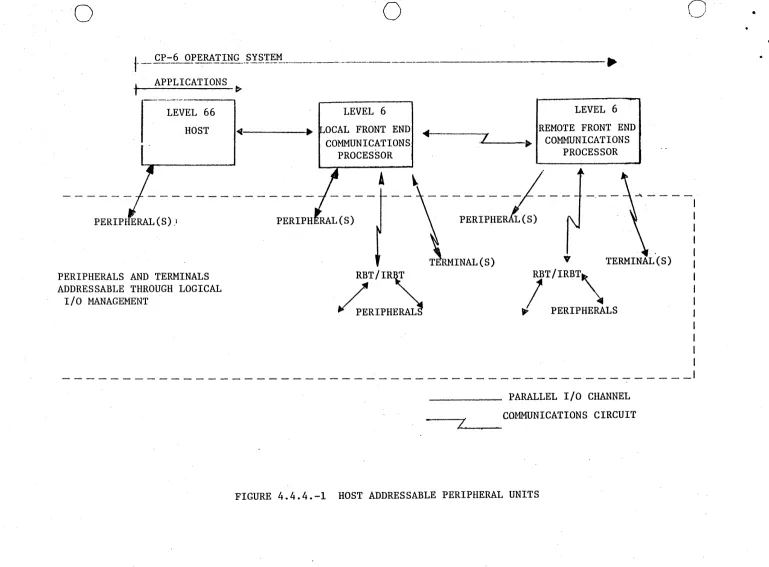
support of logically addressable peripheral units (APU) asan extension of the I/O facility (see fIgure 4.4.4-1).
Each APU corresponds to a logical device associated with a
front end communicatiQns processor (FECP), a CP-6 host or a
real-time processor (RTP).FECPs are described in section
4.4.4.2 and RTPs are described in section 4.4.8.5.1.
~ Each APU will be accessible from CP-6 applications programs
by using the APU name. Certain classes of APUos may be
accessed only from app1ications~ programs with specific
authorization or privilege to do so. An integral part of
this concept is the capability of applications programs to
converse with local/remote terminals/peripherals and other
applications programs in different Level 66 host systems or
RTPs without being aware of physical characteristics and
protocols for peripherals or communication circuits.
J
An APU is allocated to an applications program or a CP-6system function by CP-6 resource management. The
resource-management function shall allow the existence of a pool of
APUs, out of which individual logical units may be assigned
to different CP-6 host systems.
Front End Communications Processors
CP-6 will support both local and remote front end
communications processors (FEeps). The function ~f a FECP
is to distribute the communications processing to smaller
systems (Level 6/43 or larger) which can operate
independently 'of Level 66 hosts. This will result in a
reduction of software overhead on the host system and
improve the availability _of CP-6 systems. This will also
reduce the net ~ommunications cost for the user. The FEep
will also provide connections between the native CP-6
communication facility and IBM SNA networks and HDNA
networks.
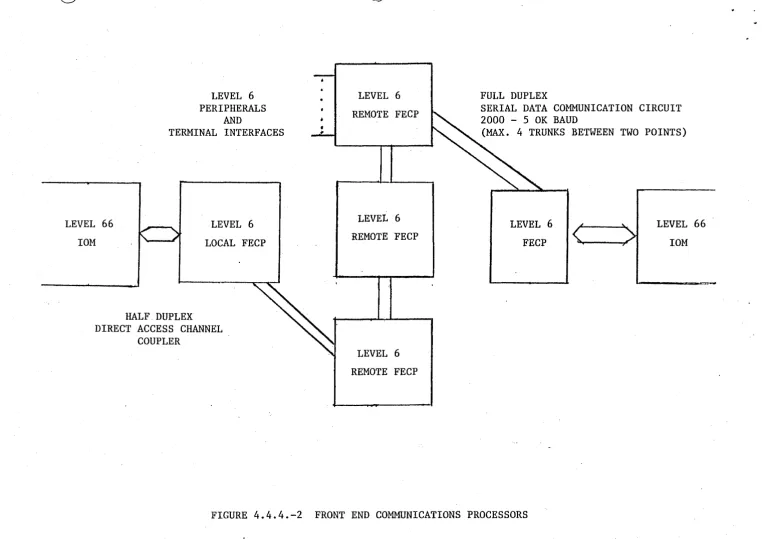
The main difference between a local and a remote FECP will
be the hardware connection to the host. The local FEep will
communi~ate to the host via a Level 66 DIA channel facility.
The remote FECP will communicate to CP-6 host systems via a
serial data communication circuit through a local FECP or
another remote FEep. At least four local FECPs may be
o
o
f- -
CP-_6 . OP_ERAl'J~~G _~I§''!:~__ ._ .. _____ . __ ._. ____ "
______ _
---.
APPLICATIONS
---~----~ LEVEL 66
HOST
PERIPltERAL(S)}
PERIPHERALS AND TERMINALS ADDRESSABLE THROUGH LOGICAL
I/O MANAGEMENT
I>
LEVEL 6
~ ~ ~OCAL FRONT END COMMUNICATIONS
PROCESSOR
A
PERIPHfRAL (S)
..JI
....
n---~-7 ~LEVEL 6
REMOTE FRONT END COMMUNICATIONS
PROCESSOR
~
-- ______ I __
~
__
-PERIPHELcS)
TERMINAL(S) V TERMINAL"( S)
RBT/I~
~RIPHE~
I
RBT/IRBT\ PERIPHERALSPARALLEL I/O CHANNEL
COMMUNICATIONS CIRCUIT
[image:32.793.0.770.16.583.2]Z
FIGURE 4.4.4.-1 HOST ADDRESSABLE PERIPHERAL UNITS
.,
.
-•
o
o
---~---.---remote FECPs will be supported. A FECP which is local to
one host system may be remote ~o other CP-6 hosts. A remote
FECP may be concurrently connected to more than one host. A
terminal connected to a FECP may logon to any of the hosts
to which the FECP is connected. Figure 4.4.4-2 illustrates
FECP connectability.
The communications software for the FECP will be designed
such that CP-6 real-time programs executing in a real-time
processor (RTP) can use a subset of the communications
functions to exchange data with programs residing in the
Level 66 host systems.
FECPs will provide the following-_f~cilities:
Autobaud detection.
Input and output message formatting similar to the
transaction format descriptor (TFD) facility
provided in CP-V. TFDs will be applicable to all
interactive terminals and all processing modes.
Reserve devices/dial-up line positions for host
initiated applications or specific accounts.
Interrogate status on any specific or of all APUs in the system.
Reassign logical device
functionally compatible APUs.
addresses between
Report traffic load (peaks
communications circuit.
and averages) by
Interrogate status
counts of a line.
and display cumulative error
Permit broadcast of messages from an operator. The
broadcast may be directed to all terminals connected
to a specific host or to a specified group of
terminals.
Produce accounting information enabling communication circuit used.
billing by
Permit an operator at
remote
terminal.-a host system to log .off terminal.-a
o
LEVEL 6
PERIPHERALS
AND
TERMINAL INTERFACES
LEVEL 66
10M
LEVEL 6
LOCAL FECP
HALF. DUPLEX DIRECT ACCESS CHANNEL
COUPLER
o
LEVEL 6
REMOTE FECP
LEVEL 6
REMOTE FECP
LEVEL 6
REMOTE FECP
o
FULL DUPLEX
SERIAL DATA COMMUNICATION CIRCUIT 2000 - 5 OK BAUD
(MAX. 4 TRUNKS BETWEEN TWO POINTS)
LEVEL 6
FECP
LEVEL 66
[image:34.794.16.778.34.572.2]10M
4.4.4.3
o
o
Device Support
Communicati6ns management will support a range of different
terminal and peripheral types through specialized software
handlers. Different classes of terminals or peripherals may
have different priorities on serv'ice and resources in the
FECP. The pri'ority. scheme will be set up to deliver best
service to interactive devices.
The terminals supported will include:
1) Teletype 33, 35 and 37.
/
2) Dataspeed 40 terminals (Models 1, 2, and 4).
3) IBM 3270
protocols support).
and compatible
(multi-drop
terminals using BISYNC
line. polled terminal
4) Tektronix 4010 and 4013 (or other suitable graphics
term in a l) •
5) IBM 2780 and 3780 or compatible terminal~.
6) HASP multileavin2 360/20 mode compatible devices
including other CP-6 system~, CP-V systems, the
Level 6 HASP IRBT package and XEROX 530 XSP systema.
(n
Honeywell VIP series model 7100, 7105, 7200, 7205,7700,7705, 7760 and 7800 display terminals.
8) Terminals compatible with the above.
The FECP software will be desi~ned to allow easy user
implementation of new terminal handlers.
The peripherals supported on the FECP will include the
following peripherals or their successor/replacements:
1) CRT keyboard console (DKU 9101/9102).
2) Keyboard typewriter console (TWU 9104/9106).
3) Diskette
(DIU
9101/9102).4) Serial character printer (PRU 9101/9102).
5) Line printer (PRU 9103/9104/9105/9106).
6) 9-track magnetic tape (MTU 9104 and HTU 9105 plus
eQuivalent phase-encoded devices when announced).
4.4.4.4
o
.. -.. --_ .. _ . _
-7) Cartridge disk unit (enu 9101/9102/9103/9104).
8 ) Card reader (CRU 9101/9102/9103/9104).
The nature of the terminal/peripheral (hereafter called
device) support will~ where possible~ be such as to allow
CP-6 applications programs to access the devices without
recognizing the physical char~cteristics of the device.
However, an option will exist to allow programs to obtain
physical device characteristics and drive the device at the
physical level (transparent data exchange).
Network Support
The local/remoteFECPs in the C~-6 system will use a common
II nat i v e mod e 11 C P -6 p r <> toe 0 I t o e x,c han g e d a t a • Th i s pro t 0 col
will accommodate the reQuireme~ts outlined in section
4.4.4.1. It also will allow a common message fo-rmat which
is independent of the physical devices involved at the end
points in the communications oath.
-~he
CP-6 protocol will allow support of IBM SNA and"Honeywell HDNA protocols without affecting performance of
CP-6 interact~ve terminal support. The following functions
must be provided for supportin2 SNA:
It
w"'ma y
1) Allow a CP-6 connected terminal to have interactive
processing performed on a SNA host system.
2)
3)
4)
5 )
6)
7)
is be
1 )
Allow a terminal connected
have interactive processing
host.
to the SNA network to
o e r form e d i n a C P - 6 ,.
Submit a batch job from CP-6 to an IBM host in a SNA network.
Accept a batch job into CP-6 from the SNA network. •
Exchan~e output print files, with the SNA netwo.rk. Exchange data files with the SNA network.
Exchange records of a data
network.
file with the SNA·
anticipated that the following additional protocols
required to be supported in the future:
Telenet (X.25)
o
4.4.4.54.4.4.6
o
4.4.5
4.4.5.1
o
2) Datapac (Bell of Canada, X.Is)
Recovery/Back-Up/Redundancv
A design goal for the Level 6 FECP interconnect sc~eme will
be to minimize the effect on overall svstem oneration when a
Level 6 mainframe is inoperative. To meet this goal.
options will be provided to support multiple local FECPs and multiple trunk lines (communication circuits) between remote
and local FECPs.
A FEep will be capable of responding to a terminal dial-in
activity even if its host is not operational. The minimum
response will be a notification of the host condition. An
installation option will be to ~et the FECP 102 appropriate
.input transactions (Level 6 peripheral reauired) for
processing when the host becomes availabl~.
CP-6 communication management will have access
journaling facility which will store selected messa~es
reprocessing in case of hardware/sbftware failure.
Performance
to a
for
A local FECP will be connected to its CP-6 host system via a
half-duplex DIA channel coupler supporting data transfers of
up to 1 MB/second. At least four local FEeps may be
connected' to a Level 66 host.
Remote FECPs may be connected to local FECPs or other remote
FEeps via communication circuits supporting SOl baud full
duplex transmission.
The FECP will support asynchronous transmission speeds of up
to 19.2K baud and synchronous transmis·sion up to sOK baud.
A FEep will be able to sustain character throughput rates of
at least 15K bytes/second (worst case circumstances'
including logging of communications traffic)~
System Service Processors
Accounting
CP-6 accounting will
accounting capability. described below.
provide a superset of the
Enhancements to CP-V accounting CP-I) are