Journal of Chemical and Pharmaceutical Research
__________________________________________________
ISSN No: 0975-7384 CODEN(USA): JCPRC5
J. Chem. Pharm. Res., 2011, 3(2):863-869
863
Development of a simple colorimetric determination of Ramipril
from pharmaceutical formulations
B. Kalyanaramu*, K. Raghubabu and Y. Vamsikumar
Department of Engineering Chemistry, AU College of Engineering (A), Andhra University, Visakhapatnam, A.P.(India)
______________________________________________________________________________
ABSTRACT
A simple, sensitive and cost effective colorimetric method was developed for the estimation of Ramipril in bulk and dosage forms. The method is based on the formation of purple red colored species with sodium nitroprusside –acetaldehyde reagent exhibiting maximum absorption at 560 nm. Beer’s law obeyed in the concentration range of 4 - 20 µg/ml. commercially available tablets were analyzed, the results obtained by the proposed method were in good agreement with the labeled amounts. The method offers the advantages of rapidity, simplicity, sensitivity and low cost and can be easily applied to resource-poor settings without the need for expensive instrumentation and reagents.
Keywords: Ramipril, Sodium nitroprusside, Acetaldehyde, Assay, Colorimetric method.
______________________________________________________________________________
INTRODUCTION
Ramipril (RAM) (Fig.1) is highly lipophilic, long acting angiotensin-converting enzyme (ACE) inhibitor and chemically it is (2S, 3aS, 6aS)-1[(S)-N-[(S)-1-carboxy-3-phenylpropyl] alanyl] octa hydro cyclopenta [b]pyrrole-2-carboxylic acid-1-ethyl ester [1].
864 NH
H
C2H5O
O
CH3
H
O
N COOH
C
C
Fig.1: Showing the chemical structure of RAM
RAM is official in USP and BP [2-3] which describes HPLC and potentiometric titration method for its assay in tablets. Literature survey revealed that several analytical techniques which include HPLC [4-12], HPTLC [13-14], LC-MS [15], GC [16-17], Voltametry [18], Radioimmunoassay [19], Capillary electrophoresis [20], ion selective electrode potentiometry [21-22], atomic absorption Spectrophotometry [23-24], Spectro fluorometry [25-26], visible spectrophotometric [27-32] and UV [33] have been reported for quantitative determination of RAM in biological fluids and pharmaceutical formulations.
The main purpose of the present study was to establish relatively simple, sensitive, validated and inexpensive extraction free visible spectrophotometric method for the determination of RAM in pure form and in pharmaceutical preparations, since most of the previous methods involve critical reaction conditions or tedious sample preparations and less specificity. So the authors have made some attempts in this direction and succeeded in developing a method based on the reaction between the drug and sodium nitro prusside- acetaldehyde reagent [34]. The method can be extended for the routine quality control analysis of pharmaceutical products containing RAM.
EXPERIMENTAL SECTION
Systronics UV/Visible spectrophotometer model -2203 with10mm matched quartz cells was used for all spectral measurements. Systronics model-362 pH meter was used for all the pH measurements. All the chemicals used were of analytical grade. Aqueous solutions of sodium nitro prusside (SNP, E. Merck, 1.0%, 3.35x10⁻²M), acetaldehyde (10%), phosphate buffer of pH 8.0 (prepared by mixing 30 ml of 0.067M potassium hydrogen phosphate and 970 ml of 0.067M disodium hydrogen phosphate and pH adjusted to 8.0) were prepared.
Preparation of Standard drug solution:
The standard stock solution (1mg/ml) of RAM was prepared by dissolving 100mg of RAM in 10 ml 0.1M sodium hydroxide and the volume was brought to 100 ml with distilled water. The working standard solution of RAM (200µg/ml) was obtained by appropriately diluting the standard stock solution by using the same solvent.
Preparation of Sample solution: About 20 tablets or capsules were weighted to get the average
865
weighed, dispersed in 25ml of Isopropyl alcohol, sonicated for 30 minutes and filtered through Whatman filter paper No 41. The filtrate was evaporated to dryness and the residue was dissolved as under standard solution preparation.
Determination of wavelength maximum (λmax):
The 2.5 ml of working standard solution (200µg/ml) was taken in 25 ml calibrated tubes containing 15ml of buffer pH 8.0. To this, 1.0 ml each of SNP solution and acetaldehyde were added successively and shaken for 2 minutes and kept aside for 5 minutes at room temperature and made up to the mark with distilled water and sonicated for 1 min, to get a concentration of 20µg/ml. In order to investigate the wavelength maximum, the colored solution was scanned in the range of 400-700nm by UV-Visible spectrophotometer. From the UV spectra (Fig.2), it was concluded that 560nm is the most appropriate wavelength for analyzing RAM with suitable sensitivity.
Preparation of calibration curve:
Aliquots of working standard RAM drug solution (200µg/ml) such as 0.5, 1.0, 1.5, 2.0 and 2.5
ml were taken separately in a series of 25ml calibrated tubes containing 15ml of buffer pH 8.0. Then 1.0ml each of SNP solution and acetaldehyde were added successively and shaken for 2 minutes and kept aside for 5 minutes at room temperature and made up to the mark with distilled water and sonicated for 1 min. The purple colored species was obtained and it was stable for 1 hour. The absorbance of the colored species was measured at 560 nm against the reagent blank. The calibration graph was constructed by plotting the drug concentration versus absorbance (Fig.3).
Fig.2. Showing Absorption spectra Fig.3.Showing Beer’s law Plot
RESULTS AND DISCUSSION
In developing this method, a systematic study of the effects of various parameters were
undertaken by varying one parameter at a time and controlling all others fixed. The effect of
0 0.05 0.1 0.15 0.2 0.25 0.3 0.35 0.4 0.45
440 480 520 560 600 640 680
A b so rb a n ce
Wave Length (nm)
RAM=1.9207X10⁻⁵M
SNP=0.134X10⁻²M
pH=8 RAM blank 0 0.1 0.2 0.3 0.4 0.5 0.6
0 10 20 30
866
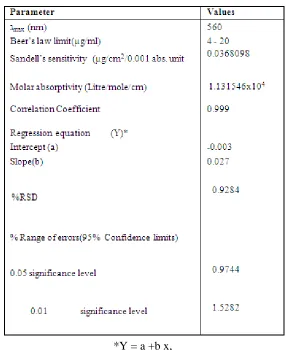
various parameters such as time, volume and strength of sodium nitro prusside, acetaldehyde, pH buffer solution, stability of colored species and solvent for final dilution of the colored species were studied and the optimum conditions were established. The optical characteristics such as Beer’s law limit, Sandell‘s sensitivity, molar absorptivity, percent relative standard deviation, (calculated from the six measurements containing 3/4th of the amount of the upper Beer’s law limits ) were calculated and the results are summarized in table-1. Regression characteristics like standard deviation of slope (Sb), standard deviation of intercept (Sa), standard error of estimation
(Se) and % range of error (0.05 and 0.01 confidence limits) were calculated and are shown in
[image:4.595.155.441.260.610.2]Table-1.
Table 1: Optical characteristics, precision and accuracy of proposed method
*Y = a +b x,
where Y is the absorbance and x is the concentration of Ramipril in µg/ml
867
Table-2 Analysis of Ramipril in pharmaceutical formulations
* Different batches from two different companies.
**Average ± Standard deviation of six determinations, # Recovery of 10mg added to the pre analyzed sample (average of three determinations). Reference method (reported UV method) using methanol (גּmax=218nm). R R1 CHO R R1
CHOH CH3
R R1 CH=CH2 R R1 CH=CH2 R R1
CH2=CH
NH
RAM
+
CH3ACD
N
N
[Fe(CN)5NO]2- (Na+)
2
Alkali
[Fe(CN)5H2O]
3-Fe(CN)5H2O]
3-[
+
N Fe(CN)5--- N3-H EtOOC N COOH c=o H CH3 R= R1= Fig.4: Scheme
Method *Formulations Labeled Amount (mg)
Found by Proposed Methods Found by Reference Method ± SD
#% Recovery by Proposed Method ± SD **Amount
found ± SD
t f
SNP-ACD
Batch-1 5 4.934 ±
0.061
1.524 1.845 4.913 ±0.082
98.681 ± 1.21
Batch-2 5 4.946 ±
0.032
2.087 4.518 4.916 ± 0.015
868
Chemistry of colored species:
Cullies and Waddington [35] found that many secondary but not primary or tertiary amines react with sodium nitro prusside and acetaldehyde under mild alkaline conditions. Wolfe and Swine hart [36]have reported the formation of [Fe (CN) 5 H2O] 3- in aqueous solution of sodium nitro
prusside. The proposed method exploits structural features aliphatic secondary amine of the RAM molecule. The nature of colored species formation with sodium nitro prusside-acetaldehyde reagent is initial N-alkyl vinyl amine formation with prusside-acetaldehyde then followed by formation of colored inner molecular complex with sodium nitro prusside has been assumed in the scheme (Fig.4).
CONCLUSION
The reagents utilized in the proposed method are cheap, readily available and the procedure does not involve any critical reaction conditions or tedious sample preparation. The proposed colorimetric method possesses reasonable precision, accuracy, and is simple, sensitive and can be used as alternative method to the reported ones for the routine determination of RAM depending on the need and situation.
Acknowledgement
The authors (B.K. Ramu & Y.V. Kumar) are grateful to University Grants Commission, New Delhi, for providing financial assistance under the award of Teacher Fellowship. The authors are very much thankful to the m/s Aurobindo pharma Ltd, Hyderabad (India) for providing gift sample of the drug. Convey their respectable thanks to retired Prof CSP Sastry, Analysis of foods drugs laboratories, Andhra University, for his advice and suggestions given in this work.
REFERENCES
[1] D.N Franz; Cardiovascular Drugs (Ed: A. R. Gennaro), in Remington, The Science and Practice of Pharmacy, 19th ed., Vol. II, Mack Publishing Company, Pennsylvania, 1995, 951. [2] Royal Pharmaceutical Society, British Pharmacopoeia, vol. II, H. M. Stationery Office, Royal Pharmaceutical Society, London, UK, 2000, 1331-1333.
[3]The united States Pharmacopoeia 29, NF 24, Asian Edition, Rockville, MD; United States Pharmacopoeial Convention, Inc; 2006, 1890.
[4] F Belal; IA Al-Zaagi; EA Gadkarien; MA Abounassif, J. Pharm. Biomed Anal., 2001, Vol.24, 335-42.
[5] R Bhushan; D Gupta; SK Singh, Biomedical Chromatography, 2005, Vol. 20(2), 217-24. [6] Bilal Yilmaz, Inter. J. of Pharm. Sci. Review and Res., 2010, Vol. 1(1), 39-42.
[7] HY Aboul-Enein; C Thiffault, Anal Lett., 1991, Vol.24 (12), 2217-2224.
[8] I Motofumi; K Takeo; G Junichi; N Toshio, J. Liquid Chromatogr., 1990, Vol.13 (5), 991-1000.
[9] K.V Rao; K Vijaya kumara; I Bhanuprakash; G Prabhakar; J Begum, Asian J Chemistry
2006, Vol. 18, 788-92.
[10] BL Hogan; Mark Williams; Anna Idiculla; Tarik Veysoglu and Ernest Parente, J. Pharm.
Biomed Anal.,.2000, Vol. 23(4),637-651.
[11] SS Zarapakar and SH Rane, Indian Drugs, 2000, vol. 37, 589-593.
869
[13] VA Patel; PG Patel; BG Chaudhary; NB Rajgor; SG Rathi, International Journal on
Pharmaceutical and Biological Research, 2010, Vol. 1(1), 18-24.
[14] O Jadranka; S Diljana; A Mirjana; MO Dusanka; T Zivoslav, J. Serbian Chem. Soc.,
2006,71, 621-8.
[15] Z Zhimeng; V Andre and N Len, J. Chromatography B., 2002, vol. 779(2), 297-306. [16] H.H Maurer; T Kramer; J.W Arlt, Drug Monitor, 1998, 20, 706-713.
[17] K.M Sereda; T.C Hardman; M.R Dilloway; A.F Lant, Anal Proc., 1993, 30(9), 371-372. [18] AA Al-Majed; F Belal; A. Abadi; AM Al- Obaid, Farmaco II, 2000, 55(3), 233-238.
[19] HG Eckert; G Muenscher; R Ockonomopulos; H Strecker; J Urbach; H Wissman, Arzenein,
Forsch. / Drug Research, 1985, Vol. 35(8), 1251-1256.
[20] S Hillaer; K .De Grauwe and W. Van den Bossche, J. Chromatography -A 2001, vol. 924, 439- 449.
[21] H.Y Aboul-Enein; R.I Stefen and J.F Van Staden, Anal Lett., 1999, vol. 32, 623-632. [22] H.Y Aboul-Enein; A.A Bunaciu; C Bala; S Fleischin, Anal Lett.1997, vol. 30, 1999-2008. [23] H.E Abdellatef; M.M Ayad and E.A Taha, J. Pharm. Biomed. Anal., 1999, Vol. 18, 1021-1027.
[24] M.M Ayad; A.A Shalaby; H.E Abdellatef and M.M,Hosny, J. Pharm. Biomed. Anal., 2002, vol. 28, 311-321.
[25] A.A Al-Majed and J Al-Zehouri, Farmco II, 2001, Vol. 56, 291-296.
[26] Hisham E. Abdellatel, Spectro chimica Acta part A: Molecular and Bimolecular
spectroscopy, 2007, Vol. 66(3), 701-706.
[27] N Rahman; Y Ahmed and S.N.H Azmi, A.A.P.S. Pharm. SciTech., 2005, Vol. 6, 543-551. [28] S.M Blaih; H.H Abdine; FA El-Yazbi and RA Shaalan, Spectroscope Lett., 2000, vol. 33, 91-102.
[29] F.M Salama; O.I.A El-Sattar; N.M El-Aba Sawy and M.M Fuad, Al Azhar J. Pharm Sci.,
2001, vol. 27, 121- 132.
[30] A.A Al-Majed; F Belal and A.A Al-Warthan, Spectroscope Lett., 2001, Vol. 34, 211-220. [31] N Rahman; H Rahman and S.N.H Azmi, International Journal of Biological and Medical
Sciences, 2007, vol.2 (1), 52-54.
[32] I Singhvi and SC Chaturvedi, Indian J Pharm. Sci., 2001, Vol. 1, 69-72.
[33] S Bankey; GG Papdiy; S Saboo S.S,Bindaiya; Deepti Jain; SS Khadbadi, International
Journal of Chem. Tech Research, 2009, Vol. 1(2), 183-188.
[34] CSN Sarma; C.Kamala sastri and CSP Sastry, Asian J. Chem., 2002, Vol.14 (2), 691-698. [35] CP.Cullis and B.J.Waddington, Anal.Chem.Acta, 1956, 15, 158.