Prosiding Seminar Kebangsaan Aplikasi Sains dan Matematik 2013 (SKASM2013) Batu Pahat, Johor, 29 - 30 Oktober 2013
DEVELOPMENT OF EDGE DETECTION ALGORITHM FOR
BLOCKY COMPRESSED IMAGE
Suhaila sari', Mohammad Idris sapuan2, Hazli ~oslan', Zarina ~ukiran~, Tasiransurini Ab
ahm man^,
Nik Shahidah Afifi Md ~aujuddin~, Siti Idzura yusuf7Department of Computer Engineering Faculty of Electrical and Electronic Engineering
Universiti Tun Hussein Onn Malaysia (UTHM) 86400 Parit Raja, Batu Pahat, Johor
su hailas@uthm. edu.my
Nowadays, compressed image is a very useful way to transfer or store data because of its smaller size in comparison to the original image. However, if the compression ratio is high, the produced image may be corrupted by blocky artifacts. In many applications that require only the detection of the image edges, it is difficult to distinguish the edges, fine details and noise. This task is more difficult in compressed image, since the generated blocky artifacts have almost the same properties as the true edges. Therefore, in this study we develop an algorithm that could detect only the edges from a compressed image. For horizontal direction, two variables are calculated for every pixel in the odd-numbered rows of the image. The two variables are the discontinuities in horizontal pixel intensity gradient at the neighbouring pixels, which will be compared with a threshold value. If both values are higher than the threshold value, the corresponding pixel is classified as edge. Detection in vertical direction is performed in the same manner. The detection results for horizontal and vertical directions are generated in two new black and white images, respectively. The generated new images are then combined to produce the final detected image. From our simulation, we found that this detection method has successfidly detected edges without including the blocky artifacts and fine details.
Keywords: Blocky artifacts; compressed image; edge detection; pixel discontinuities;
threshold.
1. INTRODUCTION
Digital image processing was developed in year 1960s at Jet Propulsion Laboratory, Massachusetts Institute of Technology, Bell Laboratories, University of Maryland, and a few other research facilities. Then there is growing demand on image processing like detection and reduction of blocky image. In the modern generation, many user need to save compressed image with a low bit rate. The purpose of data compression with a low bit rate is to reduce the storage while maintaining image quality. Therefore, many efficient image coding techniques have been developed for various applications, and some of them are used as international standards for image communication.
system and throws away some information which people anyways would not easily see. This way we acheve better compression, but the original and the decompressed files are no longer the same. Lossless image compression attempts to retain absolutely all the information present in the original image but sometimes the distortions, which referred as blocky artifacts, are striking enough to be visible. The ratio of compression will determine the average of the blocky artifacts level in the image. Blocky artifacts commonly occur in format such as the JPEG, MP3, MPEG files or compact disc. Blocky artifacts will degrade the visual quality of image.
Detection can be used either to detect from boundary block or edge detection. The task of edge detection requires neighborhood operators that are sensitive to changes and block of constant gray values. This method will form feature image in which those parts of the image appear bright where changes occur, while all other parts remain dark, which sometimes referred to as edgemap. The objective of edge detection is to find out the properties of the edge contained in the image that need to be analyzed.
In many applications that require only the detection of the image edges, it is difficult to distinguish the edges, fine details and noise. This task is more difficult in compressed image, since the generated blocky artifacts have almost the same properties as the true edges. However, many developed detection method for compressed image introduced detection for blocky artifacts and/or reduction of blocky artifacts (deblocking) [I] - [9], rather than proposing effective direct edge detection technique which does not include the blocky artifact in the detected edgernap.
For example, authors in [I] proposed use the usage of Dual Tree Complex Wavelet , Transform (DT CWT). The DT CWT provides approximate shift invariance and directional selectivity to reduce blocky artifact. It is performed separably, with two trees for rows and two trees for columns. This method maintains the image crispness by estimating the actual pixel fiom the decoded image. In [2], the Mean Squared Difference of Slopes (MSDS) is used to measure the blocking artifacts. Then, the visibility functions of the blocking artifacts for horizontal and vertical directions are defined. In order to reduce blocking artifacts, the 2-D step blocks are replaced with a 2-D linear block in the shifted block. Visual inspection clearly inhcates that the proposed method produces visually pleasing result, and it is effective at removing the block discontinuities in a smooth region while preserving the sharpness of the texture region.
Different technique like contourlet~based deblocking algorithm has been proposed in [3]. With scale space-edge detector, blocking map (BM) and edge map (EM) of the compressed image are extracted at the same time. The compressed image is filtered in contourlet domain with adaptive thresholds that are obtained based on BM.
Linfeng Xu in [4] proposed to create training images and then test the images. For the
-
training set, it is generated fiom training images. While the tested blocking image is generated after Discrete Cosine Transform (DCT) transformation, quantization and inverse transform. To relieve the blockiness of the block image, the image must undergo the patch division. Then, Markov network model then is used to solve the deblocking problem. For the result, this method is able to preserve sharp edges, learn fine details and overcome shortcomings of fuzzy in problem traditional methods.One of the examples of blocky artifacts detection is by using DCT Laplacian model in the subband-like domain [ 5 ] . We need to separate pixels, which contain visible artifacts from pixels that belong to object edges or texture. This separation is achieved by detecting a block grid position in the decoded image and analyzing local visibility of block edges [6].
Prosiding Seminar Kebangsaan Aplikasi Sains da n Matematik 20 13 (SKASM2013) Batu Pahat, Johor, 29 - 30 Oktober 2013 In [7], G . A.Triantafylidis et. a1 proposed a novel frequency-domain technique for image blocking artifact detection and reduction. The algorithm first detects the regions of the image which present visible blocking artifacts. This detection is performed in the frequency domain and uses the estimated relative quantization error calculated when the discrete cosine transform (DCT) coefficients are modeled by a Laplacian probability function. Then, for each block affected by blocking artifacts, its dc and ac coefficients are recalculated for artifact reduction. However, the proposed method can be complex and long operation due to its high precision step.
Therefore, in this study we propose a detection method that could detect only the edges from a compressed image. The paper is organized as follows. We begin with the introduction in Section 1, and then describe the proposed detection method in Section 2. In Section 3, we discuss the simulation results of our method. Finally, in Section 4, we draw concluding remarks.
2. PROPOSED METHOD
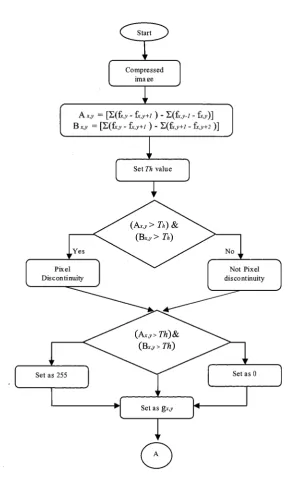
In order to detect the pixel discontinuities, we need to specify particular image location (x, y) with fiy. where x and y was the row and column index respectively. The edge detection is performed along a direction at a time. Due to this, it will provide a more precise distinction between edges and noise in noisy environments because isolated pixels can be detected easier. The edge detection is performed in two directions, horizontal and vertical directions. For horizontal direction, two variables are calculated for every pixel in the odd-numbered rows of the image. The two variables are the discontinuities in horizontal pixel intensity gradient at the neighbouring pixels, which will be compared with a threshold value. If both values are higher than the threshold value, the corresponding pixel is classified as edge. Detection in vertical direction is performed in the same manner.
For every pixel fi,y in the odd-numbered rows of the image two variables are calculated:
where x is odd-numbered row. The variables Ax,y and Bx,y are the discontinuities in horizontal luminance gradient at the pixel location (x,y) and (x,y+l) respectively. Then variables Ax,y and Bx,y are checked for the following condition:
(A X,Y > Th) & (B x,y > Th) (3)
where Th is to determined threshold. If condition (3) is observed, then the boundary between the pixels fi,y and fi,y+l is considered as pixel discontinuity. The detection result for horizontal direction is generated in a new image, gx,y based on
255 if (Ax,y > Th) and & (Bx,y >Th)
0 i f ( A x , y O ) a n d (Bx,y<Th) (4)
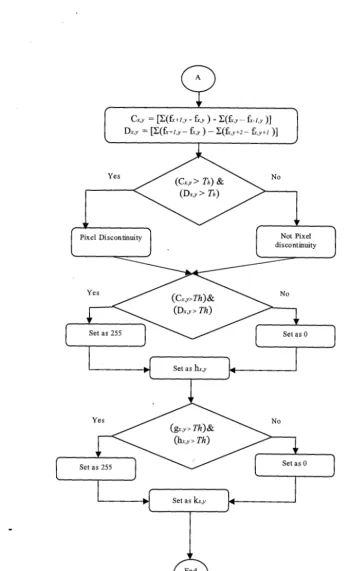
Then variables Cx,y and Dx,y are checked for the following condition:
(CX,Y > Th) & (Dx,y > Th)
The detection results for vertical direction is generated in a new image, hx,y based on
255 if (Cx,y > >)and (Dx,y >Th) "Y = I 0 if (CXJ
<
Th)and (Dxy5
Th)The detection results are then combined in a final detection image, k(x,y).
255 if g y = 255 or hxy = 255
=[o i f g , y = o or b , y = o
Fig. land Fig. 2 show the flow of our proposed method.
3. RESULTS ANALYSIS AND DISCUSSON
Detection method needs to be performed in vertical and horizontal detection separately. This is because by summing the luminance gradient values we perform low pass filtering of the horizontal luminance gradient in vertical direction in order to avoid detection of small image details as pixels dscontinuity.
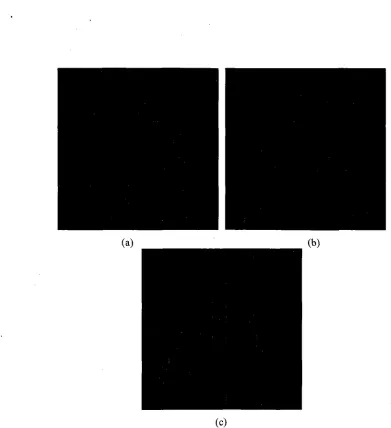
From Fig. 4(a) and Fig. 4(b), the significant pixel discontinuity have been detected along the odd number pixels in horizontal and vertical direction respectively. From Fig. 4(c), the significant pixel discontinuity in the entire image has been detected successfully without including the fine details and textures.
We have performed simulation for different threshold value, Th to find the optimal threshold value for this method. We have considered the threshold value range from 1 to 10. For simplicity to compare, we have demonstrate the result for Th= 1, 5 and 10 in Fig. 5. To detect more precise fine details and edges, the suitable threshold value for this method is Th =
Prosiding Seminar Kebangsaan Aplikasi Sains dan Matematik 2013 (SKASM2013) Bath Pahat, Johor, 29 - 30 Oktober 2013
Compressed
Set Th value
v l
[image:5.538.114.405.119.608.2]Fig.
Prosiding Seminar Kebangsaan Aplikasi Sains dan Matematik2013 (SKASM Batu Pahat, Johor, 29 - 30 Oktober
(c)
(c>
Fig. 5. Result of detection by using different threshold,
Th.
(a) Th = 1. (b) Th = 5. (c) Th = 10.We have compared our detection method to the conventional denoising methods: the Prewitt detection method and Sobel detection method by using edge function (default settings) in
MATLAB. The Prewitt method finds edges using the Prewitt approximation to the derivative.
[image:8.538.77.468.48.476.2]Prosiding Seminar Kebaagsaan Aplikasi Sains dan Matematik2013 (SKASM201 Baku Pahat, Johor, 29 - 30 Oktober 20
Fig.
(c)
6. Constructed edgemap by using (a) Prewitt detection method. (b) Sobel detection method. (c) proposed detection method (Th = 5).
4. CONCLUSION
We have proposed an edge detection method for compressed digital image. From our simulation, we found that this detection method has successfully detected edges without including the blocky artifacts and fine details.
Acknowledgments
References
Kirenko, I. 0.; Muijs, R.; and Shao, L. ( 2006). Coding Artifacts Reduction Using Non-Reference Block Grid Visibility Measure. Proceeding of International Conference on Multimedia and Expo, :469-472.
Triantafyllidis, G. A.; Tzovaras, D.; and Strintzis, M. G. (2002). Blocking Artifact Detection and Reduction in Compressed Data. IEEE Transactions on Circuits and Systems for Video Technology, 12(10): 877-890.
Nallaperumal, IS.; Ranjani, J. J.; and Varghese, J. (2006). A New Algorithm for Removing Blocking Artifacts in JPEG Compressed Images. Proceeding of IEEE International Conference on Industrial Electronics and Applications, : 1-5.
Shi, M.; Yi, Q.; and Gong J. (2006). Blocking Effect Reduction Based on Human Visual System for Highly Compressed Images. Canadian Conference on Electrical and Computer Engineering, : 1948- 195 1.
Song, H.; Yu, S.; Wang, C.; Song, L.; and Xiong, H. (2006). A New Deblocking Algorithm Based on Adjusted Contourlet Transform. IEEE International Conference on Multimedia and Expo, :449-452.
Xu, L. (2010). A New Learning-Based Deblocking Algorithm for DCT Coded Images. International Symposium on Intelligent Signal Processing and Communication Systems (ISPACS), : 1-2.
Triantafyllidis, G. A.; Tzovaras, D.; and Strintzis M. G. (2002). Blocking Artifact Detection and Reduction in Compressed Data. IEEE Trans. Circuits System Video Technology, 12(10): 877-890.
Petrov, A.; Kartalov, T.; and Ivanovski, Z. (2009). Blocking Effect Reduction in Low Bitrate Video on a Mobile Platform. IEEE International Conference on Image Processing (ICIP), :3937-3940.
Tai, S. C.; Chen, Y. Y.; and Sheu, S. F. (2005). Deblocking Filter for Low Bit Rate MPEG-4 Video. IEEE Transactions on Circuits and System for Video Technology,