Blind Channel Equalization by Adaptive
Filter Algorithms
S. Elkassimi
1,*, S. Safi
1, B. Manaut
21Department of Mathematics and Informatics, Polydisciplinary Faculty, Sultan Moulay Slimane University, Morocco 2Department of Physics, Polydisciplinary Faculty, Sultan Moulay Slimane University, Morocco
Copyright©2017 by authors, all rights reserved. Authors agree that this article remains permanently open access under the terms of the Creative Commons Attribution License 4.0 International License
Abstract
This paper propose an algorithm based on ZF and MMSE methods for blind channel equalization, which is compared with adaptive filter algorithms which are Constant Modulus Algorithm (CMA), Fractional Space CMA (FSCMA) and Sign Kurtosis Maximization Adaptive Algorithm (SKMAA). The simulations show that the proposed algorithm gives satisfied result versus CMA, FSCMA and SKMAA algorithms. The study is done under certain conditions, it is implemented in noisy environment, for different number of symbols and different SNR values with QPSK modulation. Equalization of channel is more performing if we use the proposed algorithms.Keywords
Blind Equalization, CMA, FSCMA,SKMAA, ZF, MMSE, SER
1. Introduction
Conventional equalization and carrier recovery algorithms for Minimizing Mean Square Error (MMSE) in digital communication systems generally require an initial training period during which a known data sequence is transmitted and properly synchronized at the receiver [1, 2]. On the other side the blind channel equalization allows to retrieve the unknown input sequence symbol to the remote channel without the use of training bits. In addition blind channel equalization has become an important topic in digital communications [3]. Blind methods use the received signal sequence and some a prioriknowledge of the input sequence statistics [4]. Non-minimum phase channel equalization was performed using the high-order statistics methods [5-8] or other nonlinearities that are effective only with non-Gaussian distribution input sequences [9]. In this paper, we study the most popular adaptive blind equalization Bussgang algorithm (the Godard algorithm [10]) or constant modulus (CMA) [11] and Fraction Spaced CMA algorithms [10,12], thus another algorithm based on Kurtosis Maximization method called Sign Kurtosis Maximization Adaptive
algorithm (SKMAA) [13]. In telecommunication, equalization means filtering the noise which is in a signal transmitted through a channel. Conventional channel equalization uses an initial training phase, while blind channel equalization does not use this phase. According to the study, there are some well know algorithm for blind channel equalization, these algorithms, like CMA, FSCMA and SKMAA, are based on adaptive filter techniques. In this paper we propose a new algorithm, which is based on ZF and MMSE methods. The result of this algorithm looks better comparatively to the CMA, FS-CMA and SKMAA algorithm.
2. Problem Statement
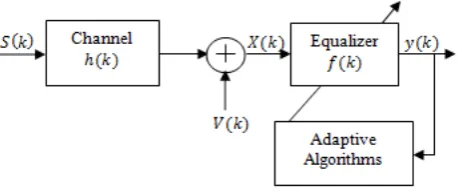
The symbols of blind equalization by adaptive filter algorithms are depicted in Fig. 1. Let us assume that the transmitted symbol sequences, 𝑆𝑆(𝑘), are independent and identically distributed (i.i.d), for 𝑆𝑆(𝑘)𝜖𝐴. Where 𝐴 is the windows character set.
The input equalizer is defined by:
𝑋𝑋(𝑘) =ℎ(𝑘).𝑆𝑆(𝑘) +𝑉(𝑘) (1)
= � ℎ(𝑖).𝑆𝑆(𝑘 − 𝑖) 𝑁
𝑖=0
+𝑉(𝑘)
Where ℎ= [ℎ(1),ℎ(2), … ,ℎ(𝑘)] represent the channel parameters, 𝑆𝑆(𝑘) is the input system and 𝑉(𝑘) is the additive colored Gaussian noise.
[image:1.595.317.546.640.736.2]The output of the equalizer can be defined by the following relationship
𝑦(𝑘) =𝑓𝑓(𝑘).𝑋𝑋(𝑘) (2) Where 𝑓𝑓(𝑘) is the tap weight vector and 𝑋𝑋(𝑘) is the input data vector of the equalizer at kth instant sampling time. At sample k, the output of the equalizer is expressed by the relationship
𝑦(𝑘) =∑𝑁 𝑓𝑓(𝑖).𝑋𝑋(𝑘 − 𝑖)
𝑖=0 (3)
In this paper, we study the blind channel equalization using the adaptive filter algorithms. In addition we represent a comparison between the proposed algorithm and the adaptive filter algorithms such as the Constant Modulus Algorithm (CMA), Fractional-Spaced-CMA, and Sign Kurtosis Maximization Adaptive Algorithm (SKMAA).
3. Blind Channel Equalization
The aim of blind channel equalization is to retrieve the unknown input sequences symbol to the remote channel. That is to say: calculate the Symbol Error Rate (SER). In this case we propose an algorithm based on ZF and MMSE equalizer, which is compared to the adaptive filter algorithms.
In the first step we describe the proposed algorithm with ZF and MMSE methods, and the second step we describe the adaptive filter algorithms such as CMA, FSCMA and SKMAA.
A. Proposed Algorithm (Said1)
The proposed algorithm (Said1) is based on ZF and MMSE equalizer, this algorithm allow to blind channel equalization,
With ZF Equalization
In order to compensate the effect of power line communication (PLC) channel, we consider the ZF equalizer, which satisfies the condition shown below (Eq. 4).
𝑓𝑓𝑍𝐹𝐻=𝐼 (4) Where 𝑓𝑓𝑍𝐹= (𝐻𝐻𝐻𝐻)−1𝐻𝐻𝐻 is the ZF decoding matrix, (. )𝐻𝐻 denotes Hermitian transpose, 𝐻 is the channel matrix and 𝐼 is the identity matrix. Given the received signal 𝑋𝑋, the receiver can obtain the estimated signal by using the ZF equalization, which is given by:
𝑆𝑆̂(𝑛𝑛) =𝑓𝑓𝑍𝐹𝑋𝑋(𝑛𝑛) (5) 𝑆𝑆̂(𝑛𝑛) =𝑓𝑓𝑍𝐹𝐻𝑆𝑆(𝑛𝑛) +𝑓𝑓𝑍𝐹𝑉(𝑛𝑛)
𝑆𝑆̂(𝑛𝑛) =𝐼𝑆𝑆(𝑛𝑛) +𝑓𝑓𝑍𝐹𝑉(𝑛𝑛)
Where 𝑆𝑆̂ is the estimated matrix of the transmitted signal. If the determinant of 𝐻 is not zero, so, the inverse matrix of 𝐻 exists and the decoding matrix can be expressed as
𝑓𝑓𝑍𝐹=𝐻−1 (6)
The ZF equalization is ideal when the channel is not affected by the noise. However, when the channel is noisy, the ZF equalization will amplify the noise greatly where the channel has small magnitude in the attempt to invert the channel completely.
With MMSE Equalization
In order to minimize the power of the noise component, we employ the MMSE equalization, which is given by:
𝑓𝑓𝑀𝑀𝑀𝑀𝑀𝑀𝑀𝑀= 𝑚𝑖𝑛𝑛� 𝑓𝑀𝑀𝑆𝐸
𝐸|‖𝑆𝑆𝑛𝑛−𝑑𝑑− 𝑓𝑓𝑀𝑀𝑀𝑀𝑀𝑀𝑀𝑀𝐻𝐻 𝑋𝑋(𝑛𝑛)‖2| (7) Where 𝑓𝑓𝑀𝑀𝑀𝑀𝑀𝑀𝑀𝑀 is the MMSE decoding matrix and ‖.‖ represent the norm of the value (𝑆𝑆𝑛𝑛−𝑑𝑑− 𝑓𝑓𝑀𝑀𝑀𝑀𝑀𝑀𝑀𝑀𝐻𝐻 𝑋𝑋(𝑛𝑛).)
Or:
𝑓𝑓𝑀𝑀𝑀𝑀𝑀𝑀𝑀𝑀=𝑅𝑅𝑋𝑋ℎ�𝑑𝑑 (8) Where 𝑅𝑅𝑋𝑋=𝐸[𝑋𝑋(𝑛𝑛)𝑋𝑋𝐻𝐻(𝑛𝑛)] and ℎ�𝑑𝑑=𝐸[𝑋𝑋(𝑛𝑛)𝑆𝑆𝑛𝑛−𝑑𝑑∗ ]. In equation 9 and 10 we represent the expression of 𝑅𝑅𝑋𝑋 and ℎ�𝑑𝑑
𝑅𝑅𝑋𝑋=1𝑘∑𝑘𝑛𝑛=1𝑋𝑋(𝑛𝑛)𝑋𝑋𝐻𝐻(𝑛𝑛) (9) ℎ�𝑑𝑑=𝑀𝑀1∑𝑀𝑀𝑛𝑛=1𝑋𝑋(𝑛𝑛)𝑆𝑆𝑛𝑛−𝑑𝑑∗ (10) The MMSE equalization can be used to estimate the channel effect with varying the decoding matrix in accordance with SNR. Besides, it prevents the noise component from being amplified.
The steps of the proposed algorithm are summarized in the following:
Transmit k symbols, the first M symbols are assumed known,
Obtain received samples 𝑋𝑋𝑛𝑛,
Construct sample vectors 𝑋𝑋(𝑛𝑛),
Calculate 𝑅𝑅𝑋𝑋 and ℎ�𝑑𝑑 ,
Calculate 𝑓𝑓𝑀𝑀𝑀𝑀𝑀𝑀𝑀𝑀=𝑅𝑅𝑋𝑋−1ℎ�𝑑𝑑 ,
Calculate the symbol error rate (SER):
Use 𝑓𝑓𝐻𝐻𝑋𝑋(𝑛𝑛) to estimate symbol 𝑆𝑆̂ 𝑛𝑛−𝑑𝑑 .
Compare 𝑆𝑆̂𝑛𝑛−𝑑𝑑 with 𝑆𝑆𝑛𝑛−𝑑𝑑 value.
B. CMA Equalizer[14-16]
The problem with blind adaptation techniques is their poor convergence property compared to traditional techniques using training sequences. Generally a gradient descent based algorithm is used with the blind adaptation schemes. The most commonly used gradient descent based blind adaptation algorithm is the Constant Modulus Algorithm (CMA). The Constant Modulus Algorithm (CMA) has gained widespread practical use as a blind adaptive equalization algorithm for digital communications systems operating over inter-symbol interference channels.
𝐽𝐶𝑀𝑀 is known as the Constant Modulus Algorithm (CMA) and is specified by [9]:
𝑓𝑓(𝑛𝑛+ 1) =𝑓𝑓(𝑛𝑛) +𝜇𝑆𝑆∗(𝑛𝑛)𝑋𝑋
𝑛𝑛(𝛾 −|𝑋𝑋𝑛𝑛|2) ���������
≜ѱ(𝑋𝑋(𝑛𝑛))
(11)
Where 𝜇 is a step-size and 𝑆𝑆∗(𝑛𝑛) is the equalizer input vector at time index n. the asterisk denotes conjugation. The function ѱ(. ) identified in (11) is referred to as the CMA error function.
C. Fractional Spaced CMA Equalizer
For a Fractionally Spaced Equalizer (FSE) [17], the tap spacing of the equalizer is a fraction of the baud spacing (in time) or the transmitted symbol period. As the output of the equalizer has the same rate as the input symbol rate, the output of the FSE needs to be calculated once in every symbol period [11]. Fractional Spaced CMA (FSCMA) algorithm uses directly the estimated coefficients of the equalizer. In fractional space the global convergences is fixed by [18]:
min 𝐽=𝐸[(|𝑓𝑓𝐻𝐻𝑋𝑋(𝑛𝑛)|2− 𝑅𝑅
𝑧)2] (12) Update rule:
𝑓𝑓𝑛𝑛+1=𝑓𝑓𝑛𝑛− 𝜇.𝐸(|𝑓𝑓𝐻𝐻𝑋𝑋(𝑛𝑛)|2− 𝑅𝑅𝑧)𝑋𝑋(𝑛𝑛)𝑋𝑋𝐻𝐻(𝑛𝑛)𝑓𝑓𝑛𝑛 (13) Algorithm:
Construct the received sample space.
Construct the sample vector 𝑋𝑋(𝑛𝑛).
For n=1, 2, …
Update function (13)
Calculate instantaneous error
Check SER.
D. SKMAA Equalizer[9]
Sign Kurtosis Maximization Adaptive Algorithm (SKMAA) is used to blind channel equalization. The SKMAA is developed based on kurtosis of stochastic signals, such as: the stochastic ascend approach, and sign algorithm for restoring the blind equalizer weight vectors [19]. Furthermore it is also necessary to calculate the output sample 𝑦(𝑛𝑛) of the equalizer filter once per algorithm update. The general idea is to maximize the chosen cost function. To assure that the SKMAA algorithm ascends, for each time step 𝑛𝑛 the following requirement is made
𝐽�𝑓𝑓(𝑛𝑛+ 1)�>𝐽(𝑓𝑓(𝑛𝑛)) (14) Or the cost function is given by
𝐽𝐾𝑀𝑀𝐴(𝑓𝑓) =|𝐾𝑢𝑟𝑡𝑜𝑠𝑖𝑠[𝑦(𝑛𝑛)]|𝑀𝑀2|𝑦(𝑛𝑛)|2 (15)
where 𝑦(𝑛𝑛) is the equalizer output and 𝐾𝑢𝑟𝑡𝑜𝑠𝑖𝑠[𝑦(𝑛𝑛)] is defined by:
𝐾𝑢𝑟𝑡𝑜𝑠𝑖𝑠[𝑦(𝑛𝑛)] =𝐸{𝑦4(𝑛𝑛)}−3𝐸2{𝑦2(𝑛𝑛)} (16) The update is then given by
𝑓𝑓(𝑛𝑛+ 1) =𝑓𝑓(𝑛𝑛) +𝜇∆𝑓𝑓𝐽𝐾𝑀𝑀𝐴(𝑓𝑓) =𝑓𝑓(𝑛𝑛) +𝜇𝐹(𝑦)[𝑆𝑆(𝑛𝑛)∗ ℎ(𝑛𝑛)]
=𝑓𝑓(𝑛𝑛) +𝜇𝐹(𝑦)𝑋𝑋(𝑛𝑛) (17) or
∆𝑓𝑓𝐽𝐾𝑀𝑀𝐴(𝑓𝑓) = 𝐹(𝑦)𝑋𝑋(𝑛𝑛) (18) where 𝐹 is the feedback function defined by:
𝐹(𝑦) =4(𝑀𝑀[𝑦2𝑀𝑀]𝑦32[𝑦−𝑀𝑀[𝑦2] 4])𝑦 (19) a sign algorithm is introduced into KMAA. So the SKMAA is written by:
𝑓𝑓(𝑛𝑛+ 1) =𝑓𝑓(𝑛𝑛) +𝛼𝑆𝑆𝑖𝑔𝑛𝑛[𝐹(𝑦)]∙[𝑋𝑋(𝑛𝑛)] (20) where Sign[. ] is a simple sign function, and 𝛼 is a forgetting factor which is used to replace the ensemble averages by empirical averages which are then adaptively updated (0 <𝛼< 1).
4. Simulation Results
A Performance of the Adaptive Filter Equalizer CMA,
FSCMA and SKMAA
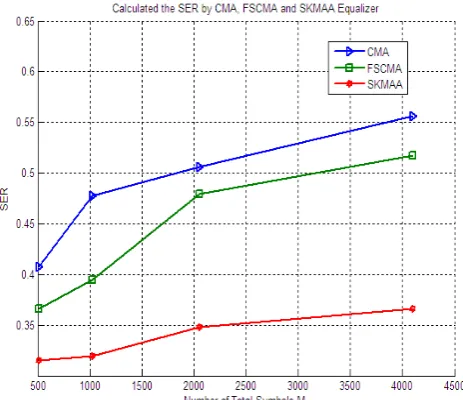
In this part, we compare between the CMA, FSCMA and SKMAA equalizer that are being studied, for testing its performance. Tables 1 and 2 represent the Symbol Error Rate (SER) for different SNR values and number of symbols M. Table 1. Comparison the Symbol Error Rate (SER) of different adaptive filter equalizer for complex channel with different SNR values
SNR Equalizer SER
0dB FSCMA CMA
SKMAA
0.4628 0.4373 0.3127
5dB FSCMA CMA
SKMAA
0.2789 0.2554 0.2278
10dB FSCMA CMA SKMAA
0.1881 0.1793 0.2061
15dB FSCMA CMA SKMAA
0.0369 0.0337 0.1745
20dB FSCMA CMA SKMAA
0.0070 0 0.1544
25dB FSCMA CMA SKMAA
Table 2. Comparison the Symbol Error Rate (SER) of different adaptive filter equalizer for complex channel with different number of symbols
Number of Symbols M Equalizer SER
512 FSCMA CMA
SKMAA
0.4076 0.3659 0.3150
1024 FSCMA CMA
SKMAA
0.4772 0.3944 0.3197
2048 FSCMA CMA
SKMAA
0.5059 0.4792 0.3481
4096 FSCMA CMA
SKMAA
0.5563 0.5177 0.3658
Figure 2. SER in function of SNR Values using CMA, FSCMA and SKMAA Equalizer
Figure 3. SER in function of number of symbols M using CMA, FSCMA and SKMAA Equalizer.
From the figure 2, we remark that the SKMAA equalizer is more performing in noisy environment (SNR<10dB) than CMA and FSCMA equalizer. But if SNR>10dB we remark that CMA and FSCMA algorithms are more performing than SKMAA algorithm. In addition SKMAA equalizer is better than CMA and FSCMA equalizer, if the number of symbols M is larger (Fig. 3).
B Performance of the proposed algorithm versus
Adaptive Filter Equalizer
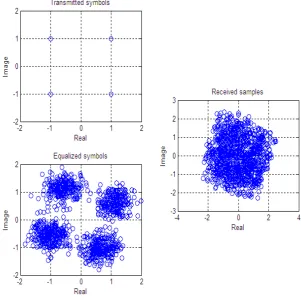
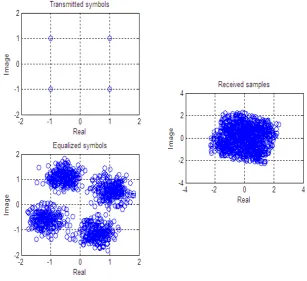
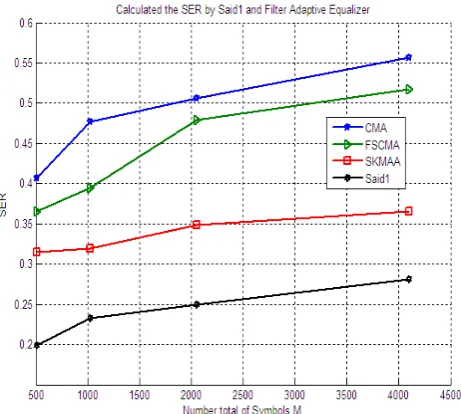
In this part we test the performance of proposed algorithm (Said1), and adaptive filter equalizer (CMA, FSCMA and SKMAA) for blind channel equalizer in the following conditions:
[image:4.595.59.297.90.460.2]Figure 4. Channel equalization by proposed algorithm (Said1) with SNR=25 dB.
[image:5.595.151.459.81.351.2] [image:5.595.153.455.385.685.2]Figure 6. Channel equalization by FSCMA equalizer with SNR=25 dB.
[image:6.595.146.457.86.377.2] [image:6.595.152.460.409.690.2]Figure 8. SER in function of SNR values using proposed algorithm (Said1), CMA, FSCMA and SKMAA equalizer
Figure 9. SER in function the number total of symbols M using proposed algorithm (Said1), CMA, FSCMA and SKMAA equalizer.
From the figure 8 and 9 we note that the proposed algorithm (Said1) gives a good channel equalization compared to CMA, FSCMA and SKMAA equalizer. In addition the SER is decrease according to SNR values and increase according to total symbols M.
5. Conclusions
In this paper we have proposed an algorithm based on ZF and MMSE methods for blind channel equalization. This algorithm was compared with three filter adaptive algorithms such as: CMA, FSCMA and SKMAA. The simulation results demonstrates that the proposed algorithm gives an efficient equalization of channel, that is to say, gives a good SER
values versus to CMA, FSCMA and SKMAA equalizer.
REFERENCES
[1] Godard, D., “Self-Recovering Equalization and Carrier Tracking in Two-Dimensional Data Communication Systems”, Communications, IEEE Transact, v.28, Issue.11, pp 1867-1875, Nov 1980.
[2] John G. Proakis, “Digital Communications”, McGraw Hill Higher Education, 4e édition, Paperback (December 1, 2000). [3] L. R. Litwin, Jr., “Blind channel equalization”, IEEE
Potentials, vol. 18, no. 4, pp. 9-12, Apr. 1999.
[4] Elisabeth de Carvalho, Member, IEEE, Dirk Slock, Member, IEEE, “Blind and Semi–Blind FIR Multichannel Estimation: (Global) Identifiability Conditions”, IEEE Trans. Signal Process, Vol. 52, 2004.
[5] O. Shalvi and E. Weinstein, “New criteria for blind deconvolution of non-minimum phase systems (channels)”, Information Theory, IEEE Transactions on, vol. 36, pp. 312-321, March 1990.
[6] B. Porat and B. Friedlander, “Blind equalization of digital communication channels using higher-order moments”, IEEE Trans. Signal Processing, vol. 39, pp. 522-526, Feb. 1991. [7] L. Tong, G. Xu and T. Kailath, “Blind identification and
equalization based on second-order statistics: A time domain approach”, IEEE Trans. Inform. Theory, vol. 40, pp. 340-349, Mar. 1994.
[8] M. Boulouird, M.M. Hassani, A. Zeroual, “Blind channel identification using higher-order statistics”, Vol. 78, No.4, pp. 325-338, April 2008.
[9] I. Fijalkow, C.E. Manlove, and C. R. Johnson, Jr,” Adaptive Fractionally Spaced Blind CMA Equalization: Excess MSE,” IEEE Trans. Signal Processing, vol. 46, no. 1, january1998. [10] Fijalkow, I., C. E. Manlove, and C. R. Johnson, Jr., “Adaptive
fractionally spaced blind CMA equalization: Excess MSE,” IEEE Trans. on Signal Processing, Vol. 46, No. 1, 227–231, 1998.
[11] J. R. Treichler and B. G. Agee, “A new approach to multipath correctionof constant modulus signals,” IEEE Trans. Acoust., Speech, Signal Processing, vol. ASSP-31, pp. 459–472, Apr. 1983.
[12] I. Fijalkow, A. Touzni, and J. Treichler, “Fractionally spaced equalization using cma: Robustness to channel noise and lack of disparity.” IEEE Trans. on Signal Proc., vol. 45, pp. 56–66, Jan. 1997.
[13] B. Siva Kumar Reddy, B. Lakshmi, “Minimizing PAPR and Synchronization Errors in OFDM for WiMAX Using Software Defined Radio”, Journal of Circuits, Systems and Computers (World Scientific), Vol. 24, No. 4, pp: 1-23, 2015.
[image:7.595.62.293.333.540.2][15] J.R. Treichler and B.G. Agee, “A new approach to multipathcorrection of constant modulus signals,” IEEE Trans. Acoust. Speech Signal Proc., vol. ASSP-31, no.2, Apr. 1983. [16] C. R. Johnson, P. Schniter and J. T. Endres, “Blind
equalization using the constant modulus criterion: a review,” Proc. of the IEEE, vol.86, no. 10, pp.1927-1949, Oct.1998. [17] Gitlin, R.D. and Weinstein, S.B., “Fractionally spaced
equalization: an improved digital transversal equalizer”, Bell Syst. Tech. J., 60:275-296, 1981.
[18] Li, Y. and Ding, Z., “Global convergence of fractionally spaced Godard adaptive equalizers”, IEEE Trans. Signal Process., SP-44:818-826, Apr., 1996.
[19] Xu, Zhengyuan and Liu, Ping, “Blind multiuser detection by kurtosis maximization/ minimization”, IEEE Signal Processing Letters 55 pp.1–4, 2004.
[20] J.-N. Lin and R. Unbehauen, “Bias-remedy least mean square equation error algorithm for IIR parameter recursive estimation,” IEEE Trans. Signal Processing, vol. 40, pp. 62–69, Jan. 1992.
[21] M. Boulouird, M.M. Hassani, A. Zeroual, “Blindchannel identification using higher-order statistics”, Vol. 78, No.4, April 2008, 325-338.
[22] J.-T. Yuan and T.-C. Lin, “Equalization and carrier phase recovery of CMA and MMA in blind adaptive receivers”, IEEE Trans. Signal Process. Vol.55, pp.3206–3217, 2010. [23] A. J. Bell and S. T. J., “An information-maximization