RESEARcH ARticlE t
Pruning reduces blister rust in sugar pine
with minimal effects on tree growth
by Kevin L. O’Hara, Lauren A. Grand and Amy A. Whitcomb
Sugar pine trees from nine stands in two California study areas were assessed to determine the effects of pruning on the incidence and growth of white pine blister rust. Lower limbs up to 8 feet high were removed on alternate trees. Six years following treatment, the number of infections in pruned trees was reduced compared to unpruned trees at one study area, but no blister rust was found at the other area. The results suggest that artificial pruning of sugar pine may be part of an effective, integrated strat-egy to maintain this species in mixed-conifer California forests.
S
ugar pine is an iconic species in the mixed-conifer forests of the Sierra Nevada and Cascade Range. Due to their massive size, individuals stand with a stately and elegant presence among and above their associates. In1894, John Muir described sugar pines
(Pinus lambertiana Dougl.) as “the priests of pines” and said they “seem ever to be addressing the surrounding forests”
(Muir 1894). The species is also fast
growing and produces valuable wood and other ecosystem amenities such as food for small mammals.
Sugar pine is a “white” or five-needle
pine and part of a subgenus of the pine group that is susceptible to white pine blister rust (Cronartium ribicola J.C. Fisch). Blister rust was introduced to western North America in British Columbia in 1910 and has spread south-ward into the sugar pine range.This invasive pathogen has sharply reduced populations of susceptible trees across North America, including sugar pine in California and Oregon.
Treatments to limit white pine blister rust have included the physical removal of understory species in the genus Ribes, which is an alternate host for the
patho-gen (Maloy 1997); chemical spraying of Ribes species; and breeding of resistant
sugar pine (Samman and Kitzmiller
1996). The tree-breeding efforts, which have been the most successful strategy to date, offer some promise of trees for reforestation that have an estimated 60% level of resistance to the pathogen.
However, the pathogen is also evolv-ing, and a more virulent strain was
rec-ognized in California in 1976 (Kinloch and Comstock 1981). There are several
mechanisms that allow some sugar pine
to be resistant to the pathogen (Kinloch
and Davis 1996). Because there is natu-ral resistance in native populations of sugar pine and the pathogen is evolv-ing, an integrated resistance strategy should maximize resistance in natural populations as a future safeguard (Millar et al. 1996; Samman et al. 2003).
Infection process
Trees are infected through a viable spore landing on a water droplet on a live needle fascicle or group of pine needles. The spore then germinates and infects the tree by growing through the fascicle into the inner bark of the branch or stem. Once in the stem or branch,
the pathogen causes canker formation and eventually girdles the branch or stem, killing anything above the point of infection (Edmonds et al. 2000). A successful pathogen attack requires a viable spore and a living needle fascicle with moisture on it.
Viable spores typically originate from Ribes species such as currants and gooseberries and occur in highest concentrations near the ground where
Artificial pruning is an
accepted means of enhancing
wood quality in forest trees.
Pruning treatments were tested for their effectiveness against white pine blister rust.
humidity is usually highest. Infections are therefore most common near the
ground. For example, 85% of branch
cankers in young sugar pine stands in Oregon were found within 12 feet of the ground and 97% within 20 feet (Hays and Stein 1957). Byler and Parmeter (1979) and Smith (1996) reported similar
findings in California. However, work -ing in environments with greater fog
in the southern Sierra Nevada, Kinloch
tABlE 1. Stand descriptions for sugar pine pruning treatments
Study site/ stand*
Age in 2000
Regeneration
harvest method Postregeneration treatments (year) years
BFRS-141 10 Clear-cut herbicide (1995)
BFRS-190 11 Group selection herbicide (1997), PcT† (1998), mastication (2005) BFRS-280 20 Shelterwood PCT (1995), herbicide (1984, 1989)
BFRS-330 9 Clear-cut PCT (1998), herbicide (1999), mastication (2003) BFRS-480 9 Clear-cut PCT (1998), herbicide (1999), mastication (2003) BFRS-501 13 Clear-cut PCT (1998), herbicide (1991)
BFRS-400 12 Group selection PCT (1998), herbicide (1992, 1997)
LA-75 25 Clear-cut None
LA-86 14 Clear-cut None
* BFRS = Blodgett Forest Research Station; La = Lake almanor. † PcT = precommercial thinning.
also occurred. These stands had been harvested previously with a range of regeneration methods including group selection, clear-cut and shelterwood, which leaves variable amounts of over-story cover (table 1). A combination of herbicide spraying and mechanical treatments were applied at Blodgett to control competing vegetation and re-duce intertree competition. Two stands were located near Lake Almanor; both was pure sugar pine plantations planted after clear-cut harvest.
Study trees and pruning. At both
sites, study trees were selected that were free of any external symptoms of white pine blister rust or any stem defects that might have been caused by animals, the formation of multiple branch leaders or photosynthetic capacity and can
ad-versely affect tree vigor. Developing a pruning regime for sugar pine involves tradeoffs between reducing tree growth and vigor, and increasing the resistance of pruned trees to blister rust.
This study explored artificial prun -ing as a potentially effective means of reducing the incidence of white pine
blister rust in sugar pine. The specific
objectives were to: (1) assess the effec-tiveness of pruning on white pine blis-ter rust incidence in sugar pine and (2) determine the consequences of pruning on sugar pine tree growth.
Sierra and cascades study sites Site selection. Two areas were
se-lected because each had relatively
young sugar pines in sufficient num -bers to develop a study. One site was at Blodgett Forest Research Station in
the central Sierra Nevada (38o52’ N, 120o40’ W), and the other was near Lake Almanor in the southern Cascades (40o19’ N, 121o07 30’ W) on land owned by Roseburg Forest Products and sold
to Sierra Pacific Industries during the
study period.
Sites were selected and all prun-ing was completed early in the 2000 growing season. Sample trees were
limited to 8 to 20 feet in height so that
they could receive a relatively sub-stantial pruning that might be typical of an operational pruning regime in a young stand. Seven stands, or manage-ment compartmanage-ments, were selected at Blodgett forest. All had been planted in harvested openings with a mix-ture of conifers including both blister rust–resistant and nonresistant sugar pine; some natural regeneration had
Artificial pruning
Artificial pruning is a potentially ef -fective means of enhancing sugar pine survival because it removes the low-ermost branches where infections are most likely to occur. Previous research with eastern white pine (Pinus strobus L.) and western white pine (Pinus mon-ticola Dougl. ex D. Don) indicated that
pruning to only an 8-foot height could significantly reduce white pine blister
rust infections (Weber 1964; Lehrer
1982; Hungerford et al. 1982; Hagle and Grasham 1988; O’Hara, Parent, et al. 1995; Hunt 1998). Although foresters
have had some success in other white
pines, and artificial pruning has been
included in integrated management programs for white pine blister rust in
western white pine (Hagle et al. 1989),
no systematic pruning trials have been undertaken in sugar pine, and previous
pruning experiments have only briefly referred to this species (Kinloch and Dulitz 1990; Kliejunas and Adams 2003).
Artificial pruning is also an accepted
means of enhancing wood quality in forest trees. A typical pruning opera-tion involves removing the lowermost live and dead branches from fast-growing trees that have straight, high-quality boles with minimal taper. After severing lower branches, trees occlude wounds, and subsequent wood forma-tion is free of knots. This “clearwood” is therefore of higher value than wood formed without pruning. Pruning younger trees is generally most desir-able as these trees can produce clear-wood over a smaller defect core than older trees (O’Hara 2007). However, pruning live branches reduces a tree’s
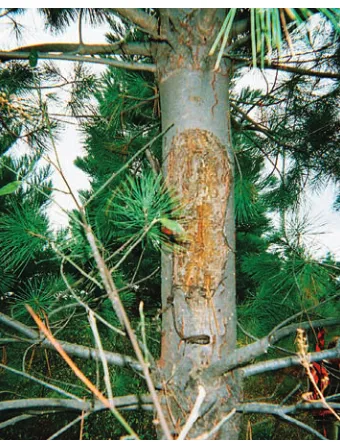
[image:2.612.412.582.464.685.2]the large canker on this sugar pine at Blodgett Forest Research Station was caused by white pine blister rust, an invasive pathogen that has reduced sugar pine populations in california and Oregon.
tABlE 2. Sample sizes and numbers of infected trees by stand, 2006
Study site/ stand*
Pruned trees Unpruned trees Total infected Total infected
BFRS-141 27 6 26 7
BFRS-190 12 2 12 6
BFRS-280 7 0 8 2
BFRS-330 12 8 13 10
BFRS-480 23 7 27 9
BFRS-501 15 6 15 12
BFRS-400 12 1 13 5
Blodgett totals 108 30 114 51
LA-75 38 0 38 0
LA-86 40 0 39 0
Lake Almanor totals
78 0 77 0
other disturbances. Both sites had active blister rust infections on nonstudy sugar pine trees in 2000 within the sampled stands. All of the study trees were tagged, and every other tree was pruned to a height equal to approximately a 50%
live-crown ratio — defined as the ratio of
the distance from the treetop to the low-est live branch to total tree height — or
no greater than 8 feet.
All needle fascicles on the stem were removed up to the pruned height to eliminate potential infection sites along the pruned stem. Branches were removed with loppers, and cuts were made as close to the stem as possible (O’Hara 2007). Pruned branches were left on the ground where they fell. Because sugar pine branches occur in whorls that can be several feet apart, pruning to a 50% live-crown ratio re-sulted in pruning immediately above or below a branch whorl in some cases. For these trees, the residual live-crown ratio may have been considerably more or less than 50%. Control trees were the al-ternating unpruned trees. Both pruned and unpruned trees were selected sys-tematically with a random start among those trees acceptable for pruning.
Measurements. After pruning, all
trees were measured for total height, pruning height, diameter at breast height (dbh), and breast-height age by counting branch whorls from the treetop. Breast height was marked on all trees. Any blister rust infections that were not seen before pruning were also noted. Trees were assessed for white pine blister rust in 2003 and again after the 2006 growing season. Trees were examined for the pres-ence of cankers on the stem or branches,
and dead or flagged branches. All trees
were remeasured for height and dbh after the 2006 growing season. The 2000-to-2006 study period included nearly seven full growing seasons.
Statistical analysis.A chi-square
test was used to assess the effect of pruning on blister rust infection for all trees. Nonparametric tests were used to assess the effectiveness of pruning because the main response is a binary variable (either presence or absence of blister rust). Logistic regression was used to assess variables such as compart-ment, tree size, percent live crown after pruning, and a binary variable indicating whether a tree was pruned or not.
Tree volume increment is a measure-ment that integrates both tree diameter and height and provides a representa-tion of tree growth and vigor. Volumes were estimated by assuming that tree sections formed geometric solids: a cylinder below breast height, and a pa-raboloid from breast height to treetop. These sections were summed to total tree stem volume. Stem volume incre-ment over the 7-year study period was the difference between volume early in the 2000 growing season and following the 2006 growing season. Tree volume was compared between pruned and unpruned trees with and without infec-tions using analysis of variance.
Effectiveness of pruning
Mortality. Average live-crown ratio
after pruning was 50.3% at Blodgett
and ranged from 32.8% to 67.1%. At
Lake Almanor, live-crown ratio aver-aged 50.6% after pruning and ranged
from 38.7% to 67.6%. Tree mortality was
noted during both the 2003 and 2006 measurements. Eleven trees died dur-ing the study period, all of which were from stands at Blodgett, and 10 of which
were pruned. Blister rust was confirmed
on only one of these trees. One tree was killed in a mastication operation, and an-other was badly damaged by a bear. The others were possibly attacked by bark beetles or stressed by the pruning. In ad-dition, three control trees were pruned in 2003 in a separate pruning operation. All of these trees were excluded from the volume-growth analysis.
There was no mortality in either of the Lake Almanor stands. However, 16 pruned trees in one stand were ap-parently attacked by bark beetles or a pitch moth shortly after pruning. These trees experienced the death of some cambium on the north side below the pruning height. None of these trees died during the study period, and all showed callus development by 2003. Four trees were not found at the Lake Almanor sites in 2006.
Blister rust infections. Blister rust–
infected trees were found in all seven stands at Blodgett, but disease inci-dence was variable among stands (table 2). Infections were located almost exclu-sively on branches. Stands 330 and 501 had the greatest proportion of infected
trees and stand 280, the lowest. In 2006,
46% of unpruned trees were infected with blister rust at Blodgett compared to only 26% of pruned trees. A chi-square test comparing the numbers of infected trees in the pruned and
un-pruned groups indicated a significantly
higher frequency of infections in the unpruned trees (P < 0.0019). During the study period, there were no visible white pine blister rust infections in ei-ther of the Lake Almanor stands.
At Blodgett, the logistic regression model to predict presence or absence of rust indicated that the percent live
crown in 2000 was a significant variable
(P < 0.0001) but neither tree size (dbh)
nor pruning height was significant.
level of significance among unpruned
trees for the proximity of live branches to the ground in affecting the
prob-ability of infection (fig. 1). The resulting
model was of the form: Pi = ezi/(1 + ezi)
where Pi is the probability of infec-tion, e is the exponent and zi = −13.697 + 0.343 × (percent live crown)
The absence of blister rust at the Lake Almanor sites precluded a similar analysis.
Tree volume. The volume increment
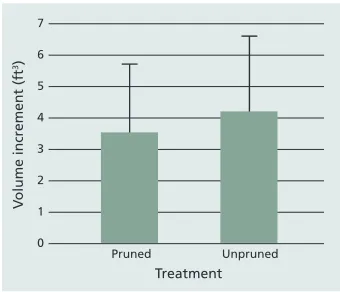
of individual trees averaged 2.9 square feet (ranging from 0.4 to 17.0 square feet) over the 7-year study period at Blodgett. At Lake Almanor, where trees were generally older, the average was 3.9 square feet (ranging from 0.7 to 13.6 square feet). The volume increment of pruned trees was slightly less than that of unpruned trees, but these differences
were not significant in either study area (figs. 2 and 3). When trees with and
without rust were compared within either pruned or unpruned groups,
dif-ferences were also not significant (fig. 4). No significant patterns between relative
growth rate and either posttreatment crown length or initial volume were evident for pruned trees.
Managing to protect sugar pine
The history of managing white pines such as sugar pine in the presence of white pine blister rust includes a vari-ety of approaches to limit the damage from this exotic pathogen. Massive ef-forts to locally eradicate species in the Ribes genus, the primary alternate hosts
6
5
4
3
2
1
0
Pruned Unpruned
V
olume increment (ft
3)
[image:4.612.411.581.55.201.2]Treatment
Fig. 2. volume increment of pruned (n = 107) and unpruned (n = 114) sugar pine trees at Blodgett Forest Research Station. Differences were not significant (P < 0.1741). Error bars show one standard deviation.
for the pathogen, were undertaken for decades in affected regions in the west-ern United States including California (Maloy 1997). These costly efforts were unsuccessful at controlling damage. There have also been efforts to excise stem cankers by severing the cambium around the canker, but this was consid-ered impractical (Hagle and Grasham
1988). Efforts to breed resistant trees
have shown more potential but have revealed the pathogen’s ability to evolve and overcome resistance in sugar pine
(Kinloch and Comstock 1981). A variety
of resistance mechanisms has also been noted, reinforcing the need for a geneti-cally diverse population of sugar pine
(Kinloch and Davis 1996; Millar et al.
1996; Samman et al. 2003).
Infection rates varied significantly
by stand at Blodgett (table 2). This was expected given the variety of regenera-tion methods used historically. This study was not designed to compare the combination of regeneration methods and pruning on infection rates, and
there was insufficient data to provide
meaningful comparisons. These stand differences suggest that future study of regeneration methods and microclimate effects on spore movement or produc-tion, or on Ribes frequency or vigor, may be warranted.
For example, the shelterwood
treat-ment (stand 280) had the lowest infec -tion rate, but the overstory trees were removed before initiation of this study. During the study period, the primary difference in stand structures between the Blodgett compartments was their size, with the group-selection unit
hav-ing smaller openhav-ings than the others.
Ironically, notes on stand 280 from the
study installation in 2000 indicate that approximately 60% of the trees had lethal infections. This may be more indicative of wavelike patterns in the temporal spread of blister rust when some years have favorable environmen-tal conditions, rather than differences attributable to stand structure.
Wavepatterns of spread have been documented in the sugar pine range since 1927 (Smith 1996). The absence of rust in the Lake Almanor sites may be explained by our study period falling between wave years. It does not indi-cate that the pruning at Lake Almanor was unsuccessful — these trees
re-ceived both the benefit of greater resis -tance to blister rust that may happen
at any time, and the benefit of greater
clearwood production.
The small but insignificant effects
of pruning on tree volume increment are a logical result of reducing the pho-tosynthetic potential of a tree. Small reductions in tree increment with low-severity pruning have been ob-served in a variety of conifers including Ponderosa pine (Pinus ponderosa P. & C.
Lawson) (Barrett 1968), coast Douglas fir (Pseudotsuga menziesii [Mirb.] Franco var menziesii) (O’Hara 1991) and western white pine (Pinus monticola Dougl. ex D. Don) (Helmers 1946). The height growth that occurs after pruning increases live-crown length and rebuilds the photosyn-thetic potential of the tree. The growth reductions following pruning are there-fore greatest immediately after pruning and become smaller with time. In seven
7
6
5
4
3
2
1
0
Pruned Unpruned
V
olume increment (ft
3)
[image:4.612.67.319.56.199.2]Treatment
Fig. 3. volume increment of pruned (n = 77) and unpruned (n = 75) sugar pine trees at lake Almanor study site. Differences were not significant (P < 0.0788). Error bars show one standard deviation.
Fig. 1. Probability of infection from white pine blister rust as a function of percent live-crown ratio, based on logistic regression. the model, based on 234 observations, was significant in 2000 at P < 0.0001.
1.0
0.8
0.6
0.4
0.2
0.0
0 20 40 60 80 100
Probability of infection
[image:4.612.234.398.59.199.2]growing seasons following pruning, this
study observed no significant growth
effects. A shorter study period may
have revealed significant differences.
However, over longer periods such as several decades or over their lifetimes, the effect of pruning on the growth of these trees will probably be negligible.
Including artificial pruning in an
integrated approach to managing sugar pine can contribute to maintaining a broad genetic base, given the success of pruning in this study and in other
white pines (Lehrer 1982; O’Hara, Parent, et al. 1995; Hunt 1998). Hagle et al. (1989) included pruning as a central
piece of their strategy to enhance the survival of western white pine in the
northern Rocky Mountains. Artificial
pruning is far from completely effec-tive, but by increasing the probability of individual trees surviving to reproduc-tive age or beyond, it promotes genetic diversity in surviving populations of sugar pine.
The trees in this study were pruned
to no greater than 8 feet, which is prob -ably less than optimal to increase the survival of trees. A higher pruning lift would remove additional branches that are prone to infection because of their proximity to the ground. At Blodgett, the study trees received an additional pruning lift up to 50% of the live crown,
or no greater than 18 feet, during 2007.
Pruning recommendations for western white pine also suggest that pruning lifts
to 18 feet will provide further increases in survival (Hagle and Grasham 1988).
6
5
4
3
2
1
0
Pruned Unpruned Pruned Unpruned
V
olume increment (ft
3)
Treatment No rust
78 62
29 52
[image:5.612.207.557.57.395.2]With rust
Fig. 4. volume increment of pruned and unpruned sugar pine within groups of trees without white pine blister rust (no rust) and trees infected with rust (with rust) at Blodgett Forest Research Station. Differences were not significant within any grouping (P < 0.2430). Error bars show one standard deviation and numbers on bars show sample sizes.
Left, at Blodgett Forest Research Station, co-author lauren Grand prepares to prune a sugar pine. Right, field assistant Zak thomas uses loppers and a ladder to remove a whorl of branches to a height of approximately 12 feet. A higher pruning, or pruning to the second lift, may increase an infected sugar pine’s chances of survival.
Pruning sugar pine to prevent blister rust
Our management recommendations include the following:
• In production forests, pruning should focus on well-spaced trees with
good form and a high likelihood of long-term survival.
• In nonproduction forests, such as on public lands, the criteria of trees
with good form may be less important than selecting trees with good prospects for long-term survival.
• Eight feet represents a reasonable target pruning height for both opera -tional reasons and blister rust control.
• Pruning should not reduce crown length by more than approximately
50% of height to maintain rapid growth rates.
• All live branches to the prescribed pruning height should be removed,
including those near the ground.
• Dead branch removal is also important for meeting wood-quality ob -jectives.
• Needle fascicles on the stem below the pruning height are potential in -fection sites and should be removed during the pruning operation.
• Branches with blister rust cankers greater than 4 inches from the main
stem can probably be removed to prevent stem infection (DeNitto 1996).
• There is no blister rust prevention value in pruning trees with stem
However, a shorter pruning lift of-fers the opportunity to prune a tree earlier in its development, thereby providing earlier removal of potential infection sites. An appropriate prun-ing regime for timber production and enhancing sugar pine tree survival may therefore involve multiple pruning
lifts and making the first lift as early
as possible in the life of a tree. Pruning
to approximately 8 feet costs about $1 per tree for sugar pine. Pruning to 18
feet may push these costs to more than $3 per tree, as costs increase exponen-tially when pruning height exceeds the height of the operator (O’Hara, Larvik, et al. 1995). A pruning regime directed toward only enhancing sugar pine sur-vival might include pruning more trees to a shorter height, since most infections occur near the ground (Hays and Stein
1957; Hunt 1982) and the per-height-unit
costs of pruning higher increase
expo-nentially above 8 feet.
integrated strategies
Our recommendations are to in-clude pruning as part of integrated strategies to maintain sugar pine in ecosystems affected by white pine blister rust. Although our results are limited to several silvicultural systems on a series of similar sites in the Sierra Nevada, the success of pruning on these sites along with suc-cess in other white pine ecosystems
(Weber 1964; Lehrer 1982; Hagle and Grasham 1988; Hunt 1998) suggests
that pruning can be an effective tool in similar situations. Pruning in these systems will not assure the survival of any given tree, but will increase the chances of that tree reaching a re-productive age or a merchantable size (see box, page 35).
Artificial pruning of young sugar
pine trees appears to be an effective integrated management tool to sus-tain this important species. Pruning reduced blister rust incidence in trials of three different regeneration meth-ods at Blodgett Forest. In conjunction with the planting of genetically resistant seedlings, thinning to favor both natural and planted sugar pine, and other activi-ties, pruning can apparently assist with sustaining sugar pine in ecosystems affected by blister rust. Additionally,
ar-tificial pruning has a negligible effect on
tree growth over the first 7 years follow -ing prun-ing, and future effects are likely to be inconsequential.
K.L. O’Hara is Professor of Silviculture, L.A. Grand is Recent Graduate, and A.A. Whitcomb is former Graduate Research Assistant, Depart-ment of EnvironDepart-mental Science, Policy and Man-agement, UC Berkeley.
References
Barrett JW. 1968. Pruning of Ponderosa Pine: Effect on Growth. USDA For Serv Res Pap PNW-68. 9 p.
Byler JW, Parmeter JR. 1979. An Evaluation of White Pine Blister Rust in the Sierra Nevada. USDA For Serv Pac Southwest Region. FPM Report 79-3. 19 p.
DeNitto GA. 1996. Silvicultural methods of limiting blister rust in sugar pine. In: Kinloch Jr BB, Morosy M, Huddleson M (eds.). Sugar Pine: Status, Values, and Roles in Ecosystems. UC ANR Pub 3362. p 179–84. Edmonds RL, Agee JK, Gara RI. 2000. Forest Health and Protection. Long Grove, IL: Waveland Pr. 630 p. Hagle SK, Grasham J. 1988. Biological and Eco-nomic Feasibility of Pruning and Excising Western White Pines for Blister Rust Control. USDA For Serv Northern Region Pest Management, Missoula, MT. Report 88-6. 14 p.
Hagle SK, McDonald GI, Norby EA. 1989. White Pine Blister Rust in Northern Idaho and Western Montana: Alternatives for Integrated Management. USDA For Serv GTR-INT-261. 35 p.
Hays GL, Stein WI. 1957. Eliminating Blister Rust Cankers From Sugar Pine by Pruning. USDA For Serv Pac Northwest Res Stat. Res Note 151. 8 p.
Helmers AE. 1946. Effect of pruning on growth of western white pine. J For 44(9):673–6.
Hungerford RD, Williams RE, Marsden, MA. 1982. Thinning and Pruning Western White Pine: A Po-tential for Reducing Mortality Due to Blister Rust. USDA For Serv Res Note INT-322. 7 p.
Hunt RS. 1982. White pine blister rust in British Columbia. I. The possibilities of control by branch removal. For Chron 59:136–8.
Hunt RS. 1998. Pruning western white pine in British Columbia to reduce white pine blister rust losses: 10-year results. West J Appl For 13(2):60–3.
Kinloch Jr BB, Comstock M. 1981. Race of Cronar-tium ribicola virulent to major gene resistance in sugar pine. Plant Dis 65:604–5.
Kinloch Jr BB, Davis D. 1996. Mechanisms and inheri-tance of resisinheri-tance to blister rust in sugar pine. In: Kinloch Jr BB, Morosy M, Huddleson M (eds.). Sugar Pine: Status, Values, and Roles in Ecosystems. UC ANR Pub 3362. p 125–32.
Kinloch Jr BB, Dulitz D. 1990. White Pine Blister Rust at Mountain Home Demonstration State Forest: A Case Study of the Epidemic and Pros-pects for Genetic Control. USDA For Serv Res Pap PSW-204. 7 p.
Kliejunas J, Adams D. 2003. White Pine Blister Rust in California. California Dept For Fire Prot. Tree Notes No 27.
Lehrer GF. 1982. Pathological pruning: A useful tool in white pine blister rust control. Plant Dis 66(12):1138–9.
Maloy OC. 1997. White pine blister rust control in North America: A case history. Ann Rev Phytopathol 35:87–109.
Millar CI, Kinloch Jr BB, Westfall RD. 1996. Conser-vation and biodiversity in sugar pine: Effects of the blister rust epidemic on genetic diversity. In: Kinloch Jr BB, Morosy M, Huddleson M (eds.). Sugar Pine: Status, Values, and Roles in Ecosystems. UC ANR Pub 3362. p 190–9.
Muir J. 1894. The Mountains of California. New York, NY: Century Co. 381 p.
O’Hara KL. 1991. A biological justification for prun-ing in coastal Douglas-fir stands. West J Appl For 6(3):59–63.
O’Hara KL. 2007. Pruning wounds and occlu-sion: A long-standing conundrum in forestry. J For 105(3):131–8.
O’Hara KL, Larvik DA, Valappil NI. 1995. Pruning costs for four northern Rocky Mountain species with three equipment combinations. West J Appl For 10(2):59–65.
O’Hara KL, Parent DR, Hagle SK. 1995. Pruning eastern Cascade and Northern Rocky Mountain spe-cies: Biological opportunities. In: Hanley DP, Oliver CD, Maguire DA, et al. (eds.). Forest Pruning and Wood Quality. Univ Washington Institute of Forest Resources. Contrib No 77. p. 216–37.
Samman S, Kitzmiller JH. 1996. The sugar pine pro-gram for development of resistance to blister rust in the Pacific Southwest region. In: Kinloch Jr BB, Morosy M, Huddleson M (eds.). Sugar Pine: Status, Values, and Roles in Ecosystems. UC ANR Pub 3362. p 162–70.
Samman S, Schwandt JW, Wilson JL. 2003. Managing for Healthy White Pine Ecosystems in the United States to Reduce the Impacts of White Pine Blister Rust. USDA For Serv Rep R1-03-118. Missoula, MT. 12 p.
Smith Jr RS. 1996. Spread and intensification of blis-ter rust in the range of sugar pine. In: Kinloch Jr BB, Morosy M, Huddleson M (eds.). Sugar Pine: Status, Values, and Roles in Ecosystems. UC ANR Pub 3362. p 112–8.
Weber R. 1964. Early Pruning Reduces Blister Rust Mortality in White Pine Plantations. USDA For Serv Lake States Forest Experiment Station. Res Note LS-38. 2 p.