O
UTFALLSD
ATABASE ANDI
NFORMATIONE
XCHANGE Tobias Bleninger (1),Gerhard Jirka (2)KEYWORDS
database, outfall, monitoring, exchange, mailing-list, online ABSTRACT
At the International Conference of Marine Waste Water Discharges 2000, held in Genoa, Italy, 27. Nov. - 2. Dec. 2000 the need for an accessible database and an exchange forum on outfalls was emphasized. This was supported by different groups like engineers, scientists, planners and decision makers, who all mentioned the lack of a general methodology in planning, designing and monitoring outfalls.
The Institute for Hydromechanics (IfH) of the University of Karlsruhe, Germany, offered its services for building up and maintaining a database, where data to existing outfall constructions is to be listed. The database and exchange forum presented here is based on information technologies accessible via the Internet. The site http://www.ifh.uni-karlsruhe.de/outfalls contains two main features: The database itself with its in- and output features and the registration page for an e-mail list.
INTRODUCTION
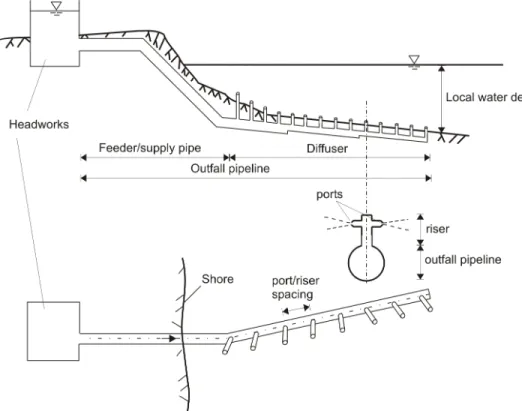
An ‘outfall’ is the entirety of all hydraulic structures between the dry land headwork and the variously allocated submerged ports. It consists of three components: the onshore headwork (e.g. gravity or pumping basin), the
feeder pipeline that conveys the effluent to the disposal area, and the diffuser section where the effluent is discharged into the ambient through ports or risers dispersing the effluent to minimize possible impairment to the quality of the receiving waters.
Worldwide there is a rapidly increasing utilization of outfalls, in form of submerged multiport diffusers, for the disposal of municipal or industrial waste and storm water discharges into the sea or coastal waters, estuaries, as well as inland waters, such as rivers, lakes or reservoirs. Due to this increasing utilization more and more environmental, operational and constructional impacts are recognized and better techniques are developed to plan, build and operate outfalls. Nevertheless the decision making on which disposal scheme should be followed, which planning tools should be used, which monitoring procedures have to be done, which construction methods are available and which are convenient, etc. is still lacking a general methodology. Such a guideline should include some manual like chapters on how to realize certain steps in outfall buildings.
There are guidelines existing, but since a recently long time there was no modification done, although environmental policy changed a lot and scientific and constructional developments have been made. Reviewing the existing materials there are a few fundamental works: Grace 78 (i), Williams 85 (ii), WRc (iii) Wood et al. 93 (iv). And there are general works not including every detail, but still important sources: National Research Council 93 (v), Telford 89 (vi), UNEP 1996 (vii).
Before a new guideline will be developed the existing information should be collected and possible contributors have to be found. The here presented outfall focused data collection accompanied by information exchange on these issues was defined to be one of the first steps in this direction during the International Conference of Marine Waste Water Discharges 2000 in Genoa. The aim of the database and information exchange is to provide support for public policy, science, engineering design and construction with background information as well as practical tools on all aspects of outfalls (from the initial decision to the final monitoring). The purpose is to know, where outfalls are used, since when they are operating, which techniques, geometries and materials have been applied for planning and building the outfalls, what are the cost-benefit relations, how regulations differ
1 Dipl.-Ing., Institute for Hydromechanics University of Karlsruhe, Karlsruhe, Germany - E-mail: [email protected]
from the coastal areas and which are monitoring aspects. The main idea was an automatized data collection and database display of planning and design aspects of existing outfalls. This relies on voluntary input without any active data collection by the provider. The data has to be entered into the online-form, then the host screens the electronic submission for omissions or inconsistencies before entering it into the database. The host will not check the validity or accuracy of data. The utility and success of this database depends on serious cooperation of all participants, who have to take good care in assembling the data before making it available to the user community. The online-form for entering the data consists of several fields for which basic information items are obligatory and additional items are voluntary input. The output page presents all the input data on a web page. If desired the database itself (Microsoft Access format) can be downloaded from this site. If the user is interested in online research different sorting schemes and search options are offered.
The second feature is an e-mail based information exchange on planning, design and construction of outfalls via the mailing list OUTFALLS-L. Instructions on how to subscribe, unsubscribe and further information on the list server are presented. Furthermore online-archives are available to search for certain topics of the e-mail discussions.
Additionally, a hyperlink collection of relevant sites in the internet is under construction. Proposals to links and / or other comments on the whole database and information exchange may be sent to [email protected].
There is a managing committee to discuss general definitions, probable changes and takes care about misuse. The committee consists of: Tobias Bleninger, Institute for Hydromechanics, University of Karlsruhe, Germany, Robert H. A. Janssen, Bechtel Water, Warrington, Great Britain, Patricia Ramos, Faculty of Engineering, University of Porto, Portugal, Carlo Avanzini - M.E.C.C.-Marine & Land Engineering and Consulting, Italy/Turkey
DATABASE ON OUTFALLS
The following rules govern the database:You must supply the complete data directly on the input page. Do not send any data in raw form (e.g. printed reports or drawings) to the host. The host (Institute for Hydromechanics, University of Karlsruhe) will screen your electronic submission for omissions or inconsistencies before entering it into the database. The host will not check the validity or accuracy of your data.
In summary, the utility and success of this database depend on your serious cooperation. Please take good care in assembling your data before making it available to the user community.
The database consists of two main pages: the input page and the output page. Furthermore one is able to download the existing database in Microsoft Access format to use the data even offline. If changes or modifications on existing data entries are necessary the changes should be send by email to the host, who is checking and changing the entries.
Database Input Page
The most complex page of the database is the input form. This is an active server page, where the entries made are checked after sending the form. The check is only done to keep input characteristics equal (i.e. data formats), check if input limitations (e.g. number of characters) are observed and if obligatory fields are completed. Dots are used for decimal separation. After the check is done and wrong input have been corrected the entries are saved into a database, where the data is usually screened by the host. The data supplier will afterwards see a confirmation, that the data entries have been send to the database. No more action is then needed from the data supplier.
In general it has to be said, that only in seldom cases all the data will be available, so please put as much information as known into the form, even if you do not know everything.
Great attendance was given to the definition of all the parameters, but nevertheless not all of them could be understood easily without further explications. There are some short descriptions and examples for the parameters given to the data supplier directly on the input page. Additionally there are links to the same page downwards, where a general glossary is located. Using these links and going the page up again, no data entry will be lost. There is also one column which defines the data format and limitations. The parameters are devided into seven parameter groups, which define the parameter in a general way. The parameter groups are: General Informations: what we can say generally about the outfall, Discharge Information: the discharged effluent and
flowrates have to be defined here, Outfall Pipeline: this pipeline conveys the effluent to the disposal area, Diffuser: where the effluent is discharged into the ambient through ports or risers dispersing the effluent to minimize possible impairment to the quality of the receiving waters., Design/Monitoring: planning and regulatory background is asked here for, Contact: if the user community is interested in further informations contact addresses are helpful to establish these, Further remarks / Sources: it is everytime important, from which source the data was taken from.
Figure 1 - General outfall definition scheme Following the definitions of the parameters: General Information
• Name of outfall: Lots of outfalls are known by a public used name, e.g. Boston Outfall.
• Location: name of the city, related power-station or industry, bay, estuary or region and states, e.g. Boston harbor, Boston Masachusetts.
• Country: There is a list of countries given in a drop-down box, where the related country has to be chosen. • Year of start-up: the year when the outfall is first available for use (there are outfalls built, which still are not
operating due to organizational or political reasons), e.g. 1989
• Owner: Who is the official owner of the construction. Owners might be official or private companies, industry or similar, e.g. City of Boston
• Designer: Which institutions or companies made the calculation and design? • Contractor: Which companies or institutions have been contracted to built the outfall?
• Total cost: The total amount of money either planned or spent for design and building of the outfall. This is a rather difficult number, because the total costs may vary often in time and depend on the sources. Nevertheless its interesting to have at least one number. It is recommended to find the exchange rate at the year of start-up (a link to a currency converter is put on the input page). The total cost have to be given in U.S. $.
Discharge Information
• Effluent: a drop-down box allows to choose the discharged effluent type of untreated Wastewater (the outfall pipeline is directly connected to the sewer-network), pretreated Wastewater (screening, grit chamber), primary treated wastewater (physical removal of floatable and settleable solids in primary clarifiers/settling tanks, sand traps, further screens, flotation), secondary treated wastewater (the biological removal of dissolved solids accomplished by living organisms in trickling filters, activated sludge tanks, sequencing batch reactors, lagoons), tertiary treated wastewater (processes to remove nutrients such as nitrogen and phosphorus, and carbon adsorption to remove chemicals or elimination of pathogens, these processes can be physical, biological, or chemical, with filtrations, disinfection), Desalination Brine (high concentrated salt water discharge from desalination plants), Industrial discharge (all kinds of industrial discharges ), Mine tailings (discharges with high concentrations of suspended materials like they are received from mines), Cooled seawater (for heating purposes water can be used for heating cold industrial equipments and they discharge cooled seawater afterwards), heated seawater (power plants need cooling water for refrigerations purposes and discharge a heated effluent afterwards), other effluent (before not mentioned effluents are summarized in this definition)
• Maximum design flowrate: the maximum discharge/flowrate for which the outfall was designed. Including drainage water if the case. In m³/s.
• Rainfall drainage-system connected to sewer?: a check-box to select whether or not the rainfall drainage water is conveyed into the outfall together with the sewage ("combined sewer overflow").
• Continuous discharge over the year?: a check-box to select whether or not the outfall is operating all the year long (e.g. never shut down for extended periods like dry seasons, where wastewater reuse might take place).
Outfall Pipeline:
The outfall pipeline connects the headworks (storage basin, outflow chamber of treatment station, pump, etc.) with the disposal construction (multiport diffuser).
• Pipe material: a drop-down box allows to choose the pipe material of the main outfall pipeline: Carbon steel, Stainless steel, Cast iron, Glass reinforced plastic (GRP), High density polyethylene (HDPE), Polypronpylene, reinforced concrete, tunnel (drilled through rocks or other materials under the ground of the sea), other material (before not mentioned effluents are summarized in this definition).
• Diameter of supply pipe/feeder pipe/outfall pipeline: the diameter has to be defined in meters
• Total (onshore and offshore) outfall length: the overall distance from the onshore headworks until the end of the off-shore diffuser. The length has to be defined in meters.
• Installation method: a drop-down box allows to choose the installation method of the main outfall pipeline: float and sink (pipe sections are joined on shore, floated on the water, towed into position and sinked), top pull (buoyancy pontoons are attached to pipe strings and pulled to the water and towed into position, then the strings are joined and sinked), bottom pull (the pipeline is pulled out segment by segment with intermediate joining works), tunneled (), other method (before not mentioned effluents are summarized in this definition).
Diffuser:
The diffuser is the end part of the outfall pipeline where the effluent is discharged into the ambient through ports or risers dispersing the effluent to minimize possible impairment to the quality of the receiving waters.
• Diffuser length: Has to be defined in meters.
• Number of ports/risers: a riser connects the buried diffuser pipe with the discharge nozzles (ports) at the discharge level above the seabed. If there are more than two ports/risers applied on one diffuser pipe position there should be put the number of port/riser positions.
• Riser height: this is the distance between the riser connection at the diffuser pipe until the discharge nozzles (port). If there are just holes in the diffuser pipe then this height reduces to zero. There are two boxes to make a minimum and maximum entry if riser heights are changing along the diffuser.
• Port riser spacing: this is the spacing along the diffuser pipe between each riser or hole in the diffuser pipe. • Discharge depth: ambient depth, where the discharge takes place through the ports. There are two boxes to
make a minimum and maximum entry if the water depth is changing along the diffuser.
• Rosette like nozzles/risers: a check box to define whether or not there is more than one opening (port) applied on one riser or at one diffuser pipe position.
• Number of ports per port/riserposition: the number of ports applied on one riser, if for example rosette like risers are applied or two ports are located at the same position along the diffuser pipe.
• Port diameter: the applied diameter of the ports, where the effluent is discharged through. There are two boxes to make a minimum and maximum entry if port diameters are varying along the diffuser.
• Duckbill valves: a check box to define whether or not variable area orifices (duckbill valves) are attached on the ports.
Figure 2 - Screenshot of database input page in a internet browser Design/Monitoring:
• Initial dilution requirements: zone of initial dilution is that area of a plume where dilution is achieved due to the combined effects of momentum and buoyancy of the effluent discharged from an orifice. Lots of regulations are demanding a defined initial dilution for discharges.
• Prediction Models used: in planning and design processes for outfall constructions and predictions of environmental impacts often models are used, which should be mentioned here.
• Applicable regulations: quantity limits given by the regulatory institution/government authority. The responsible regulator itself should be mentioned and some typical ambient standards (e.g. Federal Environmental Protection Agency, BOD<5mg/l, N<0.1mg/l, Coliforms <500/100ml, and mixing zone concepts (where ambient standards have to be reached))
• Problems occurred with outfall: known problems, like clogged ports after 3 years of accidently broken supply pipes or false prediction plume concentrations may be mentioned here.
Contact:
• Email: Thinking of the case, that someone is really interested in further information on the outfall which data you put in, than it is easy to establish contact if an email address is mentioned here. The host will not use any email data collected for any purpose.
• Homepage for further information: a URL can be put here, where information about the outfall, its construction, its planning and design or its community discussion might be found. If there is more than one hyperlink, further links should be put to the remarks/sources field.
Further remarks/sources:
It is everytime important, from which source the data was taken from. Database Output Page
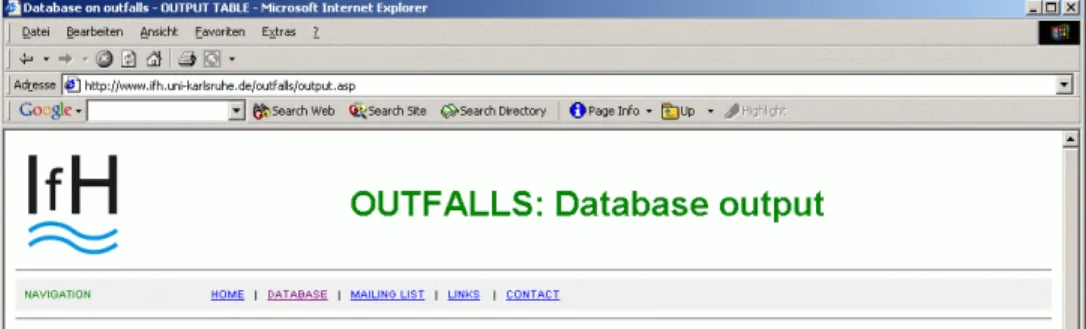
The first shown content of the output page are all parameters off the first twenty outfalls, which are sorted by the name as a default sorting. The parameters themselves are in the order of the input page. If other sort criterias for the outfalls are desired the user has to follow the hyperlink in the second line of the output page, where the parameters are defined. Still it is not possible to sort for all parameters, but this is seemed to be not necessary yet.
If one likes to search for data entries of a parameter, there is a search page offered to search for entries for location, country, name, models, regulations, monitoring, problems and remarks. One is able to search just for one entry of one parameter or even for several matches for several parameters. The search result is printed right after the search boxes.
If the online browser view is not convenient one is able to download the database a Microsoft Access file and work with it offline using the additional features of the software.
Figure 3 - Screenshot of database output page in an internet browser EXCHANGE: MAILING LIST AND ARCHIVES
Beside the database which serves as a basis for discussion there is a mailing list system implemented into the outfalls web. A mailing list is a list of email addresses. If an email is sent to the list, the list forwards this message to all subscribed addresses on the list. For that reason mailing list are used to reach a lot of people only writing one email. Which messages might you send to this mailing list?:
• Questions (e.g. technical, scientific, environmental, social or legislative aspects of outfalls). If you think that anyone of the list members might be able to help you answering a defined question, you should sent your request to the list.
• Information on new approaches, experiences, issues, problems and events. If you made experiences which you like to share with the outfall community you should sent this to the list.
• Announcements on publications (preferably with abstracts) are everytime helpful if they are related to the outfalls topics.
• Announcements on conferences, meetings, workshops. Of course face to face meetings are most important and might be established during several kinds of meetings.
The list server is a service offered and hosted by the University of Karlsruhe and is administrated by the Institute for Hydromechanics. The software used is called Listserv. You will find manuals and descriptions under: http://www.lsoft.com/manuals/1.8d/index.html . Two email addresses are important for the mailing list software: The mailing list-address, when you send your messages to all list members (pure email distribution): [email protected] . Everything what you send to this address will directly be send to ALL list members. The second address is the list server-address, when you send your commands to subscribe/unsubscribe or configure your settings (pure command interpreter):[email protected] . If you send a mail to this address the software on the server tries to interpret the commands you wrote down. Normally, all along your subscription time there are only two mails to the command interpreter necessary. The mail for the subscription and the unsubscription. Nevertheless the software offers a wide variability of using personalized functions, which you are able to change all along your subscription time.
Subscription
If you are interested in participating in the mailing list you have to subscribe to the list. You may at any time unsubscribe from the list. There are two possibilities to subscribe: You send an email to the list server address: [email protected]. You do not have to put a subject but you have to put as your text (body of mail) the command: SUBSCRIBE OUTFALLS-L Firstname Lastname. For example SUBSCRIBE OUTFALLS-L Tobias Bleninger. The list server will than have your email address and will write that into the list. After subscribing you will have to confirm your subscription to avoid that other people are subscribing for you. Therefore you will receive an email from the list server which explains how to confirm the subscription. After confirmation you will receive a mail with general technical information on mailing lists and at least a welcome message. Alternatively you can do an online-subscription on http://mailhost.rz.uni-karlsruhe.de/warc/outfalls-l.html choosing "Join the list". You should follow the instruction on the screen and the subscription will finish similarily to the email subscription.
Unsubscription
If one does not like anymore to receive the email from the outfalls list it is easy to unsubscribe immediately doing almost the same like during subscription, just the other way around. Send a mail to the list server-address [email protected] and do not put a subject but you have to put as your text the command UNSUBSCRIBE OUTFALLS-L. You do not have to specify your name, because the list server identifies you with your email address. Alternatively you can do an online-unsubscription on http://mailhost.rz.uni-karlsruhe.de/warc/outfalls-l.html choosing "leave the list".
Send a mail to the list
Send your message to the mailing-list-address: [email protected]. Please note, that for space and time saving reasons no attachments on mails should be send to the list. The best way to send detailed informations is to write a simple text without graphics and formats. You should even not use the HTML format, because lots of email program are not able to display HTML messages in the desired way. It is convenient to write links to webpages, which can be seen with web browsers and there you can have all the detailed informations available (graphics, downloads and so on). You should keep in mind that all users should be able to read the mail either they are using high-speed connections and professional mail-software or low-speed connections and simple mail-software. If you like to offer more information you can mention of course in your mail where to ask for or where to look for that information.
Mail archives
The mailing list software includes an online archive to browse ALL the messages ever sent to the list. This is interesting for new users to screen, which topics already have been discussed or for old users to search a message which they remember but did not save locally. You will find the archives under http://mailhost.rz.uni-karlsruhe.de/warc/outfalls-l.html choosing either the search option or the desired month you like to look at. ADDITIONAL FEATURES
There is a hyperlink collection in the outfalls web available, where interesting links to web pages are presented and continually collected. These links are sorted by nine topics: Decision making, Planning, Construction,
Models, Operation, Research, Conferences, Monitoring and others. If any user likes to make a contribution to this link list one should send a mail to the committee ([email protected]) and the information will be added soon.
RESULTS
Concerning the database we have to mention, that the page went online in July 2002 and only few promotion was made. So far there are only a few entries with few data available and no real statistics or evaluation can be made. It is planned to promote the database under all possible users and to evaluate the received data after a certain period of time.
The same can be stated for the exchange, where more users are needed for posting messages to the list and starting discussions. During the conference a handout will be available to write your email address on it that the committee puts it into the mailing list.
CONCLUSION
A database for outfalls was presented with all including parameters. The online voluntary input can begin from now on to build up a basis for further developments and discussion on an outfall guideline. For the discussions the presented email list can be used. There is still not enough data to evaluate, therefore the database has to be promoted under the possible user community as well as the mailing list possibility. After a certain time period a first evaluation of the available data and the related parameters has to be done and discussed.
iGrace, R.A., "Marine Outfall Systems, planning, design, and construction", Department of Civil Engineering, University of Hawaii at Manoa Honolulu, Prentice-Hall, New Jersey ISBN 0-13-556951-6, 1978
iiWilliams, B.L., "Ocean Outfall Handbook", National Water and Soil Conservation Authority, Water&Soil Miscellaneous publication number 76, ISSN 0110-4705, Wellington 1985
iiiWRc, "Design Guide for Marine Treatment Schemes", Water Research Centre plc., Swindon, 1990 ivWood I.R., Bell R.G., Wilkinson D.L., "Ocean disposal of wastewater", ISBN 981-02-0956-8, 1993 vNational Research Council, "Managing Wastewater in Coastal Urban Areas", National Academy Press, Washington D.C., 1993
viTelford. T. "Long sea outfalls", Proceedings of the conference held in Glasgow 19-21 October 1988, organized by the Institution of Civil Engineers, Co-sponsored by the Water Research Centre, ISBN 072771516 X, London, 1989
viiUNEP, United Nations Environment Programme, "Guidelines for submarine outfall structures for Mediterranean small and medium-sized coastal communities", MAP Technical Reports Series No. 112, ISBN 92-807-1618-2Athens, 1996