A Strategic Policy
Framework
for
Equality Issues
Forum Report No. 23
PUBLISHED BY THE NATIONAL ECONOMIC AND SOCIAL FORUM
Copies of the Report may be obtained from the GOVERNMENT PUBLICATIONS SALES OFFICE
Sun Alliance House, Molesworth Street, Dublin 2.
or
THE NATIONAL ECONOMIC AND SOCIAL FORUM Frederick House, South Frederick Street,
Dublin 2.
Price
€
7.60
Page
Foreword
v
Section I:
Introduction and Overview
3
Section II:
The Experience of Inequality – Setting the Scene
15
Section III:
Action on Equality
29
Section IV:
The Four Contexts of Inequality
47
Section V:
Delivering the Strategic Framework for Equality
71
Annex I
References
83
Terms of Reference and Constitution of the Forum
89
Membership of the Forum
91
The basic purpose of this latest Report from the Forum is to establish a new vision, a set of principles to underpin this and related objectives aimed at achieving a more equal and caring society. It then outlines the economic, political, socio-cultural and affective contexts where policy actions are needed to achieve these objectives. Each of these poses new challenges and demands supporting actions.
The Report establishes initial directions to guide responses to these challenges, together with detailed recommendations under each of the seven actions / dimensions of the proposed Strategic Framework for Action on Equality. Initiatives will be required at a later stage to develop and strengthen the linkages between the objectives and actions. Further consensus-building will be required in due course to shape more detailed programmes under each of the four objectives. This will not be an easy task, given the complexity and sensitivity of the issues involved and the wide range of interests that are represented on the Forum.
Action on equality is, of course, not the sole responsibility of Government and must be shared by all the various interest groups and leadership bodies in our society. The Social Partners, across and including all the Four Pillars in the social partnership model, have a special contribution to make, both collectively as well as in their own individual fields of activity. Given the changes that will be needed in our society’s culture and attitudes to equality issues, the education system, the media and the churches have also key leadership roles to play in better informing public opinion on these issues.
The Government / State sector has the greatest role of all in leading and mobilising the resources for change and this sector is, therefore, the central focus of this Report. The National Anti-Poverty Strategy, which is at present under review by the Government, has also a key role to play in advancing the equality agenda.
Section I
Rationale for this Report
1.1 Equality has been and continues to be an important focus for the work of the Forum. This has involved the preparation of reports focusing specifically on equality – ‘Equality Proofing Issues’ (February 1996), ‘The Employment Equality
Bill’ (December 1996) and ‘The Development of the Equality Provisions in Partnership 2000’ (November 1997).
1.2 Equality has also provided an important dimension to the on-going work of the Forum and in the reports that it prepares on other policy issues. In this way the Forum has sought to contribute to shaping the development of policy, practice and services provision as a basis to building a more equal society in this country.
1.3 The Forum returns to the issue of equality with this present Report. It does so to mark a new stage in our pursuit of equality issues, and with our better understanding of the experience of discrimination and its roots in the complex interactions in the public and private spheres of people’s lives. It is also a stage that is characterised by a new breadth to the equality agenda covering the nine grounds of:
Age;
Family status;
Gender;
Race;
Disability;
Religion;
Marital status;
Sexual orientation; and
Membership of the Traveller community.
The development of this nine ground agenda is the first focus of this Report.
1.4 The last few years represent a significant step forward in establishing the basis for creating a more equal society that is characterised by:
● better informed and more open public debate on equality that points to the need to establish new equality objectives, agendas and mechanisms not only for particular groups but that can also be deployed to build a more equal society.
1.5 The development of a strategic framework and the establishment of new equality objectives are the second focus of this Report. This notion of a strategic framework for action on equality dates back to commitments made in the Partnership 20001 national social partnership agreement. It finds further expression in the present Programme for Prosperity and Fairness. Given these commitments, the concept of a strategic framework now needs to be given greater clarity of definition, further analysed and to be more fully operation-alised in policy terms. Hopefully, this present initiative by the Forum will make a worthwhile contribution in this respect.
1.6 The need for further action on equality strategies arises from the new potential in this context and on how best to realise this potential. It further arises from the persistence of inequalities in our society. Economic progress has brought advances and yet exclusion across the nine grounds persists and in some instances has significantly increased. The absence up to now of a conceptual model to encompass issues of multiple discrimination, situations of hidden inequality and conditions of severe marginalisation was particularly evident at the time of devising the National Action Plan against Poverty and Social Inclusion (NAPincl) 2001-2003, the National Anti-Poverty Strategy (NAPS)2 and the review process now underway of our Equality Legislation.
Work Process in the Preparation of this Report
1.7 The preparation of this Report involved an extensive and protracted period of work over the following stages:
● A Plenary Session of the full Forum membership which was held in Dublin
Castle on 18th May 2000; one of the main purposes in holding this Plenary was to set the basis for building on the Forum’s previous work, notably in relation to the setting of Equality Objectives and Equality Proofing, as well as to provide an added impetus and focus to advancing action on a range of Equality Issues; the following papers were presented at this Plenary:
✓ Current Equality Policies and Strategies by Ms. Sylda Langford,
Assistant Secretary-General, Department of Justice, Equality and Law Reform;
1. In its Opinion entitled Partnership 2000: Development of the Equality Provisions (November, 1997) the Forum highlighted what was required in relation to legislative reforms, administrative procedures, monitoring arrangements and other institutional issues so as to progress and best achieve a strategic framework for equality.
✓ Challenges and Barriers in Moving to a Strategic Framework on Equality Issues by Mr. Niall Crowley, Chief Executive of the Equality
Authority; and
✓ Strategic Framework for Action on Equality Issues by Professor Chris
McCrudden, Lincoln College, Oxford University.
In the afternoon, the Plenary Session divided up into the following 4 Workshop Groups, under the general policy theme of Mainstreaming Equality:
✓ UK Case Study on Racial Equality in the Workplace (the facilitator was Mr. Kamalijeet Jandu of the British TUC);
✓ Gender Issues and the Social Welfare System (the facilitator was Ms Rosheen Callender of SIPTU);
✓ Travellers’ Access to the Health Services (the facilitator was Ms. Bridget Quirke from Pavee Point); and
✓ Access by the Disabled (the facilitator was Mr. Des Burke of the then National Rehabilitation Board).
Each of these Workshop Groups reported back and these were then discussed at Plenary level.
● Consultancy Study: on the basis of the discussions at the above Plenary
Session and subsequent terms-of-reference drawn up by the Forum’s Management Committee, the Equality Studies Centre in UCD (led by Professor Kathleen Lynch and including Dr. Sara Cantillon and Mr. John Baker) were employed to assist the Forum with its further work in this area.
The Consultant’s report (entitled Equality – Frameworks for Change) focused primarily on providing a conceptual framework as a basis to better under-standing and analysing equality issues in a comprehensive and integrated manner.
● Second Plenary Session: the Consultant’s report was discussed at length at
this Session which was held in Dublin Castle on 30th January 2001; this was the only time that the Forum devoted two Plenary Sessions in a row to the same topic, which of itself, testifies to the importance and priority which it attaches to equality issues.
● Management Committee: the final version of the Consultant’s report, which
Plenary Sessions were also key inputs for the Ad Hoc Group which prepared the present Report.
This latter Group comprised a balanced representation drawn from the Four Strands of the Forum’s membership and was greatly assisted in its work by Mr. Niall Crowley, CEO, of the Equality Authority as well as by Ms. Maria Hegarty (a Consultant in the equality area); following on this, the draft Report submitted by this Group was finalised and formally adopted by the Forum’s Management Committee.
Structure of the Report
1.8 The Report is structured as follows:
Section I sets out the rationale and purposes of the Report, outlines the
main legislative and institutional initiatives in the equality area since the Forum’s Report No. 10 was published in 1996, details the work process involved in the preparation of the Report and summarises its main recommendations;
Section II provides the economic and social contextual setting for the
Report and lists some of the major legislative and institutional initiatives with reference to their impact on targeted groups;
Section III defines the main elements of a Strategic Framework, involving
a vision for a more equal society, equality objectives and details the seven core dimensions or mechanisms needed to achieving these objectives; and
Section IV outlines four contexts, and correlatively, four sets of social
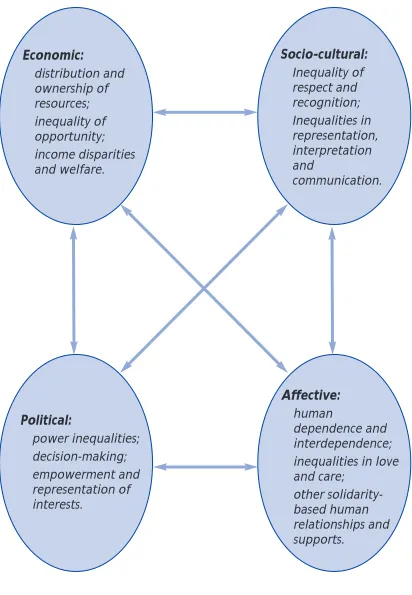
relations where inequalities can be generated, namely the economic (the distribution and ownership of resource and inequalities of opportunity), the political (power inequalities and the representation of interests), the socio-cultural (inequalities of respect and recognition) and the affective (inequalities in love, care and other forms of solidarity-related human relations); the inter-relationship between these different forms of inequality is then examined.
The framework presented in this Section provides a conceptual model to analyse and develop, on a more integrated basis, policies to combat inequality and social inclusion.
addressed across the four equality contexts in implementing the Strategic Framework.
Section V outlines a set of principles which the Forum considers should
underpin the Strategic Framework, specifies the core objectives for this Framework and details the Forum’s recommendations under each of the following proposed seven dimensions of the Framework:
● Legislation;
● Institutions;
● Mainstreaming;
● Targeting;
● Participation and Decision-Making;
● Agenda Setting; and
● Monitoring and Review.
The Report’s Recommendations
1.9 The main policy recommendations that are made in the Report are listed in Box 1 below. Action in the equality area is, of course, required by all groups in our society, not just Government alone, and all the Social Partners should both individually and collectively take a lead role in this respect.
1.10 The abbreviations used in the Box are as follows:
● D/ETE: Department of Enterprise, Trade and Employment,
● D/F: Department of Finance,
● D/FA: Department of Foreign Affairs,
● D/JELR: Department of Justice, Equality and Law Reform,
● D/SCFA: Department of Social, Community and Family Affairs, and
● D/T: Department of the Taoiseach.
Box 1
SUMMARY OF THEREPORT’SMAINRECOMMENDATIONS
(The number references beneath are to the corresponding paragraph numbers in the body of the Report)
Legislation
5.11
legislation should now be expanded to cover new grounds such as socio-economic status, trade union membership, criminal conviction and political opinion [D/JELR];
● legal powers of enforcement and remedies should be developed to allow greater access to the Courts and for the Equality Authority to intervene in cases as a third party [D/JELR];
● all relevant public bodies should be required to develop policy main-streaming and promote equality as part of their core functions [D/JELR];
● the recommendations by the 1996 Constitution Review Group on including equality, economic and social rights should be acted on [D/JELR]; and
● the implementation and development, in consultation with the Social Partners, of the provisions in the EU (Nice) Charter of Fundamental Rights [D/FA].
Institutions
5.14
● all Departments should include an equality dimension in their Strategy Statements/Business Plans under the SMI [D/T];
● the SMI should be extended in this regard to the Local Authorities, County Development Boards, Health Boards, etc. [D/T];
● an Equality Plan of Action is needed for the different strands of the SMI [D/T]; and
● adequate budgetary resources are needed to further develop equality work plans, including that of an Equality Unit, arising from the new requirements on the Civil Service under the Equal Status Act, as well as provision of equality training modules and development of analytical skills [D/F].
Mainstreaming
5.18
● the Working Group on Equality Proofing, set up under the Programme
for Prosperity and Fairness (PPR), should report by end-2003; the Group
should take into account, inter alia, the learning coming through from the gender mainstreaming under the National Development Plan [D/JELR]; and
Targeting
5.21
● the National Employment Action Plan (NEAP) and the National Action Plan against Poverty and Social Inclusion (NAPincl) should be equality-proofed to ensure that all groups covered by the equality legislation are included [D/SCFA and D/ETE];
● the Department of Finance should equality proof the Annual Budget [D/F];
● this process should entail equality outcomes, including equality indicators, under each of the 4 main equality headings for each of the target groups [D/SCFA and D/ETE];
● lessons from pilot initiatives, such as the Equal Initiative and the Equality for Women Measure, should be taken into account in policy-making and future National Plans [D/JELR, D/SCFA and D/ETE]; and
● annual reports on initiatives such as these should be submitted to the Oireachtas and the Social Partners.
Participating and Decision-Making
5.24
● a strategy is needed on how best to include and resource representation from the nine equality grounds in the social partnership model [D/T]; and
● research is needed into the barriers to participation in representative democracy, in particular those experienced by groups across the nine equality grounds [Houses of the Oireachtas and the Political Parties].
Agenda Setting
5.26
● all relevant Government Departments should set time-scales for implementation of recommendations in Task Force/Working Group reports as well as Action Plans falling within their areas of responsibility; and
● the need for similar task forces in other cases e.g. religious minorities, ethnic minorities or any new groups that will be covered under the amended equality legislation in the future should be examined [D/JELR].
Monitoring and Review
5.28
● a module on “Equality Issues“ should be included in the Quarterly National Household Survey [CSO];
● this year’s Population Census, or other periodic surveys, should address gaps such as data on disability, ethnicity, family status and sexual orientation [CSO];
● equality indicators need to be developed and time-lags in making data available also need to be addressed [CSO and Government Departments];
● the Minister for Justice, Equality and Law reform should submit an Annual Report to the Oireachtas on progress made, barriers encountered and further steps needed to advance achievement of the equality objectives set; and
● the establishment of a Consultative Forum to review progress and future policy priorities [D/JELR].
Cabinet Committee on Social Inclusion
5.29
● This Committee should play a strategic role in providing support and direction on equality issues.
Conclusions
1.11 In conclusion, the Forum wishes to highlight once again and welcome the important advances and policy changes relating to equality issues that have been introduced by successive Governments here since 1996. These involve significant movement towards greater formal rights of access, opportunity and participation for particular groups across the nine equality grounds.
1.12 In addition to the substantive legislative changes, other policy initiatives have also been significant with the introduction of gender mainstreaming, use of mechanisms to apply in equality proofing and in impact assessments, and on-going monitoring arrangements of equality policies for targeted groups.
1.13 In the economic and social spheres there has been great improvements all round in raising living standards and in providing better social services, although those who already had least have benefited least.
local levels through, for example, the reforms in the Local Authorities and the new County Development Boards.
1.15 In the affective domain, there have also been reforms with, for example, a number of legislative provisions regulating the care of children, most notably the Child Care Act, 1991, the Parental Leave Act, 1998 and the Education (Welfare) Act, 2000.
1.16 The recommendations contained in the present Report would, if acted on, represent further progress in building on the above solid achievements towards creating a more caring and more cohesive society. This process would also underpin and enhance the country’s productive potential for the future and thereby benefit all our citizens more equitably.
Section II
The Experience
of Inequality
-Setting the
– Setting the Scene
Introduction
2.1 Irish society has undergone major changes over the past decade. More traditional patterns of economic and social relationships are breaking down. Family formation has seen important changes, family size, fertility and marriage rates have gone down, while divorce and marital breakdown have increased and women’s participation in the labour force has risen significantly (Fahey and Russell, 2001). There have also been changes towards a more liberal and tolerant society. We now also have greater diversity among our population, as evidenced by inward migration3 and large numbers seeking asylum here, while emigration has dropped to its lowest level in over a decade.
2.2 However, economic and social inequalities persist despite unprecedented high levels of growth and more focused and sustained policy measures to address disadvantage and social exclusion. The nature of governance and administra-tion is also changing as concerns are raised to ensure that the policy-making, implementation and decision-making systems and processes are operated with greater transparency, accountability and inclusiveness.
Legislative and Institutional Backdrop
2.3 The Employment Equality Act, 1998, came into operation on 18 October 19994. The Act addresses discrimination in relation to employment on nine grounds, namely age, disability, family status, gender, marital status, membership of the Traveller community, race, sexual orientation and religion. The Equal Status Act, 2000 was enacted in April 20005. This latter Act deals with discrimination outside the employment context, including education, provision of goods, services, facilities, accommodation and disposal of property on the same nine grounds as those covered by the Employment Equality Act, 1998.
3. Apart from Luxembourg, the rate of inward migration here is now the highest in the European Union (The Social Situation in the European Union, European Commission/Eurostat, 2001). The number of work permits issued here last year showed an increase of nearly 50 per cent on the previous year.
4. The Act repeals and replaces the Employment Equality Act, 1977 and the Anti –Discrimination (Pay) Act, 1974.
2.4 Other major pieces of legislation included the 1998 Housing (Traveller Accommodation) Act and the Human Rights Commission Act, 2000.
2.5 Under the above legislation, a number of Agencies have been established. These include the Equality Authority that has statutory responsibility to work towards the elimination of discrimination and the promotion of equal opportunities. In addition, an Office of Director of Equality Investigations provides the main focus of legal redress in equality cases arising under both employment equality and equal status legislation. A National Disability Authority has also been set up. Finally, a Human Rights Commission has been established which offers possibilities to develop fundamental rights within this jurisdiction. These institutional developments, complemented by the CSF Equal Opportunities and Social Inclusion Co-ordinating Committee (under the National Development Plan) and other Monitoring Committees such as those on Gender, Travellers, Racism and Interculturalism now provide a context and mechanisms within which to address inequality and discrimination on a more coherent and integrated basis.
Setting the Scene
2.6 Over the last number of years, our economy has been the best performer, not only in the EU, but also in the wider OECD area. The pace of this change has also been most remarkable. For example, the relatively rapid increase in national income here over the last decade has meant that our living standards now exceed the EU average (at the beginning of the 1990s we were only at 75 per cent of this average). Unemployment reached a record low of 3.7 per cent in the first half of 2001 but, with the economic slow-down, has increased since then and is now forecasted to rise to an average of 4.0 per cent this year (Budget
2002). However, in its latest Quarterly Economic Commentary (December, 2001),
the ESRI forecasts that unemployment will exceed 5 per cent during this year.
2.7 Despite such a strong economic performance, economic inequalities not only persist but also in some cases have continued to increase further. Taking just one group, women, who have had legal protection against discrimination for nearly the past 25 years, a number of important developments are worth noting. For example, women’s participation in the labour force has increased steadily; the most recent figures indicate a participation rate of 50.1 per cent compared to that of 31.2 per cent in 1988 (National Household Survey, CSO, Third Quarter, 2001). While legislative provisions have helped to protect against discrimination and to provide increased and wider work opportunities, other issues have, however, also emerged.
improve the incentives to increase women’s labour force participation. These have included tax and social welfare changes, and more flexible work patterns. Dual-income families and single-headed households are becoming increasingly common, while shortages in childcare facilities are continuing. At the same time, advances made by women to senior-level management positions, in both the public and private sectors, have been minimal. However, the gender pay gap persists, although this has been narrowing appreciably (see the data later on in this Section of the Report).
Economic Inequality: Resources
2.9 The benefits of our economic boom in recent years are, however, not being equitably shared. Those who have least have benefited least and a scenario of a wealthier, but more unequal, society is presenting itself (NESF, 2001 and Kirby, 2002). Moreover, there is increasing inequality of outcomes, between social classes, between other marginalised and more powerful groups, between the disabled and the non-disabled and between Travellers and settled people (Nolan and Watson, 1999; Nolan et al., 2000)6. New pockets of inequality have also been created, especially among asylum seekers and refugees.
2.10 People with disabilities continue to experience high levels of exclusion, both in terms of labour market participation and also in their experience of poverty. The 3 per cent employment target within the public service has still to be reached, while people with disabilities are one of the five groups of people identified in the NAPS as being at greatest risk of poverty. Burke (2000) highlights that barriers such as segregation, administrative demarcation, lack of awareness among employers, negative attitudes and stereotyping and physical barriers such as lack of accessible transport all combine against people with disabilities getting a job.
2.11 Travellers are a small indigenous minority ethnic group, only about 0.5 per cent of the population, whose experience of health inequality was studied by Barry and Daly in ‘Travellers’ Health Status Study – Vital Statistics of the Travelling
People’. This study highlighted, for example, that Travellers had more than
double the national rate of stillbirths, infant mortality rates are 3 times higher, Traveller men live an average of 10 years less than settled men and women live an average of 12 years less. Pavee Point, a non-governmental organisation committed to human rights for Travellers, highlights that health inequality is “inextricably linked to issues regarding appropriate accommodation provision for
Travellers and further to the social and economic exclusion of this community within contemporary Irish society” (Quirke and Fay, 2000: 2). There is also an increase in
6. In the European Union, Ireland along with the UK belong to the southern grouping of Member States where the income gap between the richest and the poorest is widest (The Social Situation in the
the number of incidents of racist attacks on minority ethnic and immigrant groups in this country and of exclusion which is documented by those who are Travellers and those who are lesbian or gay7.
2.12 The complex experience of discrimination and disadvantage is connected to the experience of poverty. This requires a poverty focus within equality strategies and an equality focus within anti-poverty strategies. Without this, a coherent approach to tackling inequality will not be effective (Equality Authority, 2001). Taking the area of gender, for example, we know that women differ on the basis of age, occupation, wealth, ethnicity, marital status, sexual orientation, responsibility for dependants, disability and so forth. We also know that households headed by women are at a higher risk of poverty than those headed by men or couples and that 70 per cent of lone parents fall below the 60 per cent poverty line, the majority of whom are women. Of the households headed by women, lone parents and older women are most at risk. It is the combination of factors arising from inequalities of income and lack of services and gender discrimination that has the most detrimental impact. The most important factor leading to the increased poverty risk for female-headed households is the level of welfare payments (NESF, 2001).
2.13 Women are also more likely to be raising children alone, are more likely to be in part-time work, which is more often low paid and consequently are more likely to be poor. In addition, older women are less likely to have an occupational pension and to be reliant on social welfare. As women earn less than their male counterparts, the links between discrimination and poverty become clearer. Gender discrimination contributes to the disadvantage and poverty experienced by some women. The important task is to distinguish between those factors that compound discrimination and those that are shown to be irrelevant, and devise responses that will achieve equality outcomes accordingly.
2.14 While a person may be better off in absolute terms than they were previously, they may be poorer, however, and more marginalised relatively. As Layte et al observe: “Higher real incomes and lower deprivation levels, however welcome, would
not then mean that everyone was able to participate fully in society: they would not represent a sustained reduction in poverty” (Layte, Nolan and Whelan in Nolan et al, 2000). Measures of deprivation will need, therefore, to be developed to
assess how poverty can more accurately be recorded in a wealthier society.
2.15 In addition, and while there has been a significant reduction from 15 per cent to 8 per cent in the numbers living in consistent poverty, the numbers living
7. Reports such as that compiled and published by the Inter-Departmental Working Group on the
Integration of Refugees in Ireland for the Department of Justice, Equality and Law Reform, (O’Farrell
below relative income thresholds – such as half average income – have not fallen (Layte et al., 2001). The richest 20 per cent of the population earn 6 times as much as the poorest 20 per cent8. In the wider international community, Ireland’s inequality rating ranks 18 in a group of 25 industrialised countries (United Nations, 2001).
2.16 One of the more striking features of our taxation system, when compared to other countries, is the absence here of any property or wealth tax, while the capital gains tax has been halved and the capital acquisitions tax base has been eroded in recent years. These developments when combined leave this country with one of the most lenient capital tax regimes in Europe. Our relative expenditure on social welfare is also one of the lowest9. As a result, the level of redistribution effected through our tax/social welfare systems is also very low10. A large proportion of the population receives some form of welfare but considerable inequalities remain after these transfers. This is not because our welfare system is any less effective than elsewhere but because of the considerably greater increases in market incomes elsewhere in the economy.
2.17 Although social welfare payments have risen faster than inflation in recent years, this has been slower than other incomes so that the relative position of welfare recipients has deteriorated. For example, over the period 1994-1997 inflation rose by about 6 per cent, social welfare rates went up by around 12 per cent but average household incomes increased by over 20 per cent (Nolan et.
al. 2000a). This has been further accentuated by recent Budgets which, in the
overall, have favoured higher rather than the lower earners.
2.18 As was the case for the first time in 2001, Budget 2002 also provided a poverty-proofing analysis of the proposed income tax measures. This is welcome but should be seen as a first step and falls well short of the poverty-proofing of the
overall budgetary package that the Forum has been calling for (2000, 2001). In
this regard, and using the ESRI SWITCH Model, Professor Tim Callan et. al. of the ESRI11 have calculated that, compared to most Budgets over the past 15 years (which increased the incomes of the top 60 per cent of the population, but with no increases for the bottom 40 per cent), the impact of Budget 2002 is progressive, with the greatest gains relatively (3 to 4 per cent) going to those on
8. Forfás (Annual Competitiveness Report, 2000) found that this is twice the ratio of the best performing country, Finland, and 20 per cent worse than the EU average (2000: 5).
9. A relatively recent classification of Welfare States placed this country in the low-spending social expenditure category, reversing the situation of five years earlier when it was concluded that “the Irish
welfare effort is rather higher than might be expected on the basis of level of income per head”(Callan and Nolan,
1992). This has meant that, in terms of our “welfare effort”, we now converge more to the US, rather than to the European social model.
10. Our welfare system, rather than the tax system, carries the primary role of redistributing income. Moreover, the core trade-off in recent years between modest pay rises and tax cuts, coupled with moderate increases in welfare, have, in the overall, tended more towards widening rather narrowing income inequalities.
low incomes, while those at the top gained less than 1 per cent. However, if the current policy of setting welfare increases above inflation but below earnings growth continues, the gap between rich and poor will, of course, continue to widen further.
Interface between Economic and Other Forms of Inequality
2.19 The research available confirms that the various forms of social marginalisation tend to be coterminous. Thus, those who are working-class, lone parents, disabled, Travellers or who are children are more likely to be poor than those who are adult, middle-class, settled in dual-parent households or without an impairment (Nolan et al, op.cit.). In relation to women, the evidence here is that there has been a significant feminisation of poverty throughout the 1990s (Nolan and Watson, 1999). It also seems likely that the increased economic inequality that has been occurring in recent years has worsened the relative position of these groups.
Inequalities of Power: Political Equality
2.20 While representative democracy is the most successful system of political organisation, it does, however, have serious limitations that are well known but not necessarily accepted by everybody. It can, for example, be undermined by the alliances which develop between the political and economic elite, but also in terms of how truly democratic, representative and accountable it is in highly diverse, mobile and complex societies.
2.21 Political constituencies are drawn up on geographical lines, yet many of the major social and political divisions in our society are not regionally based, gender and social class differences being the clearest examples. One of the challenges, therefore, is how the present electoral structures are to take account of the representation of diversity within regions. Moreover, it is assumed that through the party system, men can effectively represent women, middle class people can represent the interests of working class people, settled people can represent Travellers, etc.
is the nature of those connections that is important, rather than whether they happen because of intent by some parties, because of an unintended side effect of other actions, because of a lack of information or understanding or because of a causal relationship that has not yet been established.
2.23 Whatever the reasons, the links between identity and the systems that create those conditions remain hidden and the prevailing economic, social, cultural and civil conditions that perpetuate inequalities remain largely unchanged. The Forum believes that the participation of those directly affected exposes the links more readily. Thus, the causal relationship and links between inequalities and people’s participation in civil, social, cultural and political institutions are critical.
2.24 A synergy is evolving between representative and participatory democracy, through social partnership at the national and local level and involving a wide range of civil and representative organisations as well as the statutory sector. The institutional framework for social partnership has permeated a range of political and policy-making levels and has been the most significant development in attempting to make democracy more participatory and accountable, and hence more egalitarian. Moreover, developments, such as National Social Partnerships that negotiate national agreements have all been delivered even when Governments and political representatives who had negotiated them are no longer in power.
2.25 In addition, local government reform, having long been discussed, is now being delivered with the establishment of Local Authority Strategic Policy Committees and County Development Boards that involve the Social Partners. Indeed, partnership has not only been encouraged in the area of governance, it has also been promoted in the enterprise arena, both in the private and public sectors. In this respect, another important development has been the recent establishment of the National Centre for Partnership and Performance.
2.26 Achievements in the institutional sense must, of course, not be confused with substantive change in political equality however, even if successes in increasing participation are achieved. Moreover, the extent to which social partnership has empowered those who are marginalised has come to be questioned by some commentators. Some of these suggest, for example, the limitations in terms of democratising decision-making (Hardiman, 1998, 2000); others claim that they mask the extent to which the interests of the powerful are being protected in these agreements (Allen, 1999; Lynham, 1997); while others present a more positive but qualified view of their outcomes (Sabel, 1996; O’Donnell, 1998).
2.28 One area of political equality where data are available is the extent to which gender participation outcomes have been reached. At the outset, it needs to be noted that the dramatic increase in women’s participation in the labour market is not matched by increased empowerment, as measured by involvement in politics or senior positions in employment. While Ireland now has its second consecutive female President, the representation of women in political life is still quite low, as is the case also in most other EU countries. One area where the lack of progress is most pronounced is that of women on State Boards. In 2001, 28 per cent on State Boards were women. Back in 1993 the then Government stated its intention to increase the gender balance for women to 40 per cent by 1997.
2.29 Wage differentials have narrowed (although the female wage is still only 84.5 per cent that of males) and women’s participation in higher education now exceeds that of men (Clancy and Wall, 2000, Fahey et al. 2000). Despite comprising half the population, women occupy only 13 per cent of the seats in the Dáil, 18 per cent of Senators and 15 per cent of Councillors in the Local Authorities (Galligan and Wilford, 1998; Galligan 2000). Only 9 per cent of Departmental Secretary-Generals, 3 per cent of County/City Managers, 5 per cent of third-level Professors and 6 per cent of the Defence Forces are women. Over 85 per cent of employers are men, men control most large corporations and over 90 per cent of farm holders are men (O’Connor, 1998). Men are also significantly over-represented in senior positions across different sectors of employment (Ruane and Sutherland, 1999). In contrast, over 70 per cent of part-time workers are women, and women are over-represented among low-paid workers and among those living in poverty (Nolan and Watson, 1999), situations that are also associated with powerlessness.
Inequalities of Respect and Recognition: Valuing Interdependence
2.30 The difficulty in combining paid employment, family responsibilities and participation is one of the major obstacles to the achievement of equality, especially between men and women. Because women undertake most of the responsibility for childcare and work in the home, they frequently find themselves unable to take full advantage of employment opportunities and cannot participate in civil and political decision-making. Hence, women still have barriers to achieving a sustained rise in employment during their life cycle, thereby helping to avoid poverty as well as barriers to participating in the representative and democratic structures of power.
generally low status, low power and low paid work. Both in or outside the home, women generally undertake it. The denigration of the role of care-giving could not be sustained if the work was accorded the same status as other productive work, notably by accounting for it in the national accounts and ensuing that it is possible to derive a decent income from it.
2.32 However the challenges do not end there. The fact is all people are dependent on each other in some way and interdependent in many ways, yet dependence is fraught with negative connotations in most modern societies like Ireland. The according of respect for cagiving work is, therefore, essential to re-framing our natural dependence in a positive way. The respect does not arise from equalising it with other productive work alone, but also from promoting respect for the values that inform such work.
2.33 Emotional nurturance is a fundamental prerequisite for human development. Relations of solidarity, care and love give people a basic sense of importance, value and belonging, a sense of being appreciated, cared for and wanted. Being deprived of intimate bonds of love and care inhibits the development of those emotional capabilities required for maintaining relations of companionship and solidarity with others.
2.34 The objective of equality of respect is concerned, therefore, with realising the value of paid and unpaid work, of realising the value of social solidarity and integrating dependence and interdependence into our conceptions of equality. Through setting the objective of equality of respect we can begin to understand not only the deprivation and injustices that can accrue from lack of care and mutual support, but also the inequalities that arise in doing dependency (care) work. Equality of respect is concerned with ascribing value to the interdependence and mutual support aspects of human welfare.
Inequality of Status and Recognition: Accommodating and
Celebrating Diversity
2.35 Ensuring that the existence of difference and of diversity is recognised is crucial to both reflecting the true nature of our society and to valuing all members of society equally. Feminists have long highlighted that the experiences of women living in poverty is obscured by the hidden nature of women’s poverty, which arises out of, for example, ‘gender-blind’ research practices. People with disabilities highlight that because they have typically been segregated from mainstream society, and often from each other, there are serious limitations to their sense of group belonging.
not exist as service users or that same sex couples do not want to make long-standing commitments to each other can typically mean that they are not reflected in ‘marketing’ of services or offered the same options as others. Thus, they are discriminated against in access to services and often prohibited from using public services for fear of that discrimination.
2.37 The issue of recognition places identity at the heart of a strategic framework for action on equality. It involves:
● Affirmation of diversity where value is given to difference and new
assumptions are established to underpin how we organise our society;
● Negotiation of diversity where the practical implications of identity and
diversity are named and negotiated into policy, practice and provision; and
● Accommodation of diversity where structures, systems and institutions change
to allow for different norms, values, ways of living and needs. In this way real choices are offered that reflect and have relevance across the nine grounds.
2.38 Recognition is critical. The Forum believes that the current lack of action to affirm diversity and that of institutional support also to accommodate real choice, rather than imposing a sameness of aspiration, is a significant obstacle to creating a more equal society.
Affective Inequalities
2.39 This type of inequality can have a profound and debilitating effect on people’s lives, although it is not as visible or as readily measured as resource, power or respect-related inequalities.
2.40 What we are especially concerned with here is the unequal distribution in relationships of love, care and solidarity with others. Such inequalities arise in the affective or emotional domains of human relations. These have sometimes been empirically studied, for example, in the 1972 Comparative Scandinavian Welfare Study which employed indicators of Having, Loving and Being (Allardt, 1993).
defined as private matters, in policy terms, they are publicly regulated and facilitated and are, therefore, open to policy changes and developments.
Conclusions
2.42 The Forum recommends that four equality objectives, which are directly inter-linked, should be established as the foundation pillars for the Strategic Framework for action on equality. These are:
1. Redistribution, that is, the maximisation of human welfare and the
sharing of benefits equally;
2. Recognition, that is the according of visibility and value to diversity;
3. Representation, that is the maximisation of participation of those
experiencing inequality in decision-making; and
4. Respect, that is maximising opportunities to value the interdependence
and mutual support aspects of human welfare.
Section III
The Foundations of Concerted Action on Equality
3.1 Forum Report No. 10 (1996) on Equality Proofing Issues was a ground-breaking report as it defined a conceptual framework for setting equality objectives and some of the key elements of a framework for equality were outlined. The character of a framework for equality was secured through the national agreements, Partnership 2000 and the Programme for Prosperity and Fairness. Both introduced the concept of a strategic framework for action on equality.
3.2 While elements of the framework are evident, further analysis is required, however, at this point to develop the constituent elements, both in terms of agendas and the implications for particular groups, and specifically to mould and move it forward in operational terms into a Strategic Framework for Equality.
Defining the Strategic Framework for Equality
3.3 The Forum believes that it is timely and necessary to now agree a Strategic Framework for Equality. This will be particularly important in the future, because up to now there has been an overlap and some omissions with regard to groups targeted. This Strategic Framework should comprise:
➢ a vision for a more equal society that incorporates all the nine grounds of the new equality agenda;
➢ equality objectives derived from a current analysis of equality issues; and ➢ seven core dimensions through which activity can be delivered to achieve
those equality objectives.
The seven core dimensions of the Framework for Action on Equality are:
● Legislation, enacted to protect rights and promote equality but also
legislation that is enacted to change social and economic conditions, particularly where they directly alter the rights, circumstances and opportunities of groups experiencing inequality;
● Institutions, primarily those established as part of the infrastructure
● Mainstreaming, involving a range of mechanisms to mobilise all policy, provision and practice in all public bodies behind the goal of equality, but particularly led by Government Departments and Agencies that are responsible for the design and monitoring of public policy;
● Targeting, necessitating investment of resources to address current
and past discrimination experienced by the groups across the nine grounds, to provide for needs and aspirations specific to particular groups and identities, and create the conditions for equality of outcome from mainstream provision;
● Participation and Decision-Making, entailing the inclusion of
organisations articulating the interests of those experiencing inequality in all strands of governance, mobilising the democratically elected representatives behind the achievement of equality objectives and building greater diversity within this representation;
● Agenda-Setting, involving mechanisms to develop specific agendas
for particular groups or with regard to emerging issues; and
● Monitoring and Review, entailing data gathering across the nine
grounds of the equality agenda, the development of indicators to measure progress towards equality and public reporting and other opportunities to enhance public discourse on equality issues.
3.4 In the following sub-Sections some of the achievements to date are highlighted and a number of gaps are identified so as to demonstrate the importance of progressing a Strategic Framework for Equality. This is not meant to be a comprehensive detailing of all action, but rather an outline of some significant steps that have already been taken in the emergence of a framework for action on equality and to highlight the remaining challenges that need to be addressed.
Legislation
3.5 The enactment of new legislation has been significant12. It has established new rights, created the institutional supports for accessing those rights and has enabled an approach to tackling inequalities in an integrated and
ground way. The legislation, in naming and describing nine discriminatory grounds (generally referred to as the grounds) establishes rights that had not previously existed. Thus, formally, the right to be protected from discrimina-tion has been established, and it has been conferred under each of the following nine grounds:
Age;
Family status;
Gender;
Race;
Disability;
Religion;
Marital status;
Sexual orientation; and
Membership of the Traveller community.
3.6 The scope of the Employment Equality Act, 1998 is comprehensive and covers discrimination in relation to access to employment; conditions of employment, equal pay for work of equal value, promotion, training and work experience. It covers discrimination by employers; discrimination in collective agreements; discriminatory advertising; discrimination by employment agencies; discrimin-ation in vocdiscrimin-ational training and discrimindiscrimin-ation by certain vocdiscrimin-ational bodies. The 1998 Act also defines and prohibits sexual harassment and harassment for the first time in Irish law.
3.7 The Equal Status Act, 2000 also addresses direct and indirect discrimination, sexual harassment and harassment. It further addresses discrimination by association. It covers the same nine grounds as the Employment Equality Act, 1998 and deals with discrimination in the provision of goods, services, facilities, accommodation and education and the operation of registered clubs13.
3.8 The Acts have been criticised with regard to the exclusion of some grounds and with regard to the limitations of certain provisions. Many have argued that the lack of inclusion of grounds like socio-economic status, political opinion, trade union membership and criminal record for example is regrettable but this viewpoint is not shared by everybody. People with disabilities argue strongly that the Act is limited by the provision that employers are only obliged to accommodate difference if it does not give rise to something other than a “nominal cost”14. The lack of access to interlocutory relief has also been
13. The Office of the Director of Equality Investigations confirmed recently that, contrary to original expectations, it has received three times the number of cases under the Equal Status Act, as compared to those under the Employment Equality Act.
highlighted, as has the lack of obligation on employers or public bodies to promote equality of opportunity across the grounds. Exemptions have also been a focus for criticism including that the Equal Status Act does not cover actions taken on foot of other legislation.
3.9 New legislative proposals, such as the Disabilities Bill, 2001, seek to provide for improved participation by people with disabilities in our society.
3.10 Moreover, EU proposals under Article 13 will require amendments to Irish legislation. Article 13 of the Amsterdam Treaty allows the European Commission to take appropriate action to combat discrimination based on sex, racial or ethnic origin, religion or belief, disability, age or sexual orientation. Any proposal of the Commission for legislation in this area must have the unanimous agreement of all Member States before it can take effect. In November 1999, two draft Directives were tabled. The first established a general framework for equal treatment in employment and occupation (other than sex which is dealt with separately under Article 141) and the second is concerned with implementing the principle of equal treatment between persons irrespective of racial or ethnic origin but extending beyond the workplace15.
3.11 The new EU Race Directive, the Framework Directive and the draft Equal Treatment Directive provide that Member States shall encourage dialogue with appropriate non-governmental organisations and promote dialogue with the Social Partners. The Race and Framework Directives were adopted in 2000 and are due to be implemented next year. However, in order to take account of particular conditions, Member States may, if necessary, have 3 more years (viz an additional 6 years) to implement the Framework Directive. The Department of Justice, Equality and Law Reform is at present participating in the deliberations at EU level aimed at finalising the draft Equal Treatment Directives.
3.12 The implementation of the Belfast (Good Friday) Agreement and other international commitments have implications for equality and human rights legislative provisions and for institutional arrangements and structures in both jurisdictions. The Belfast Agreement committed us to an equivalence of rights North and South, a commitment that must inform the design and development of a strategic framework for action on equality. In addition, there are possibilities for joint action, with the incorporation of the European Convention on Human Rights and Fundamental Freedoms (ECHR) in both
jurisdictions and the commitment to prepare a Charter of Rights for the Island of Ireland. The Law Reform Commission’s recommendations with regard to amending the Constitution in the South to incorporate social and economic rights should also be revisited as part of this process.
Institutions
3.13 New institutions, notably the Equality Authority (the Authority) and the Human Rights Commission have been established. A body similar to the Equality Authority has also been established in Northern Ireland – The Equality Commission for Northern Ireland. This is a significant development given that it also has a multi-ground agenda.
3.14 The Equality Authority has statutory responsibility to work towards the elimination of discrimination and the promotion of equal opportunities in employment and vocational training. The Authority provides information to the public in relation to equality legislation and is charged with keeping equality legislation under review. It is empowered to develop draft codes of practice for the approval of the Minister and to conduct equality reviews and prepare action plans to facilitate the development of a proactive equality-conscious approach to equal opportunities in the workplace.
3.15 The Authority, in its Strategic Plan 2000-2002, prioritises the commitment to realising positive change for those experiencing discrimination. It aims to do this by promoting and defending the rights established in the legislation and providing leadership in building a commitment to addressing equality issues in practice. This is an important developmental interpretation of the role of the Authority as is the commitment to creating a wider awareness of equality issues, celebrating diversity and mainstreaming equality considerations across all sectors.
3.16 The equality legislation also creates a new and challenging context for employers and service providers and for the first time focuses not only on internal human resources functions but also on external customer service functions. The multi-ground equality legislation also holds new potential in enabling integrated approaches to equality.
3.18 The experience of the Equality Authority in developing this integrated approach suggests a need to work on three levels:
● With a Single-Ground Focus
This involves activities focusing in on a single ground. The work of the Equality Authority in supporting an Anti-Racist Workplace Week and in exploring the implementation of the 3 per cent target for the employment of people with disabilities in the public sector are examples of this.
A single-ground focus is necessary where an issue assumes a particular importance over a specific period, or where a ground might remain invisible within an integrated approach or where needs that are specific to one ground must be addressed. The integration element of the single-ground focus derives from the fact that a single institution is involved in the development of each focus.
● With a Multi-Ground Focus
This involves activities that make the connections and focus on all nine equality grounds simultaneously. The work of the Equality Authority in its scheme of workplace equality reviews and action plans and its work on the equality dimension to customer services in the public sector are examples of this. This is the core of the work of the Equality Authority and it is being progressed in a manner that seeks to ensure that the salience of gender is not obscured, that all grounds have a visibility and that no false homogeneity is imposed.
● With a Cross-Ground Focus
This involves activities that reflect the multiple identities most people hold. The work of the Equality Authority in relation to gays, lesbians and bisexuals with disabilities is an example. This work provides the potential to inject new creativity, new solidarity and new commitment into the pursuit of equality. The Equality Authority is further developing this work in partnership with the Equal Opportunities Commission for Northern Ireland, the Northern Ireland Human Rights Commission, the Irish Human Rights Commission, the Equal Opportunities Commission, the Commission for Racial Equality and the Disability Rights Commission in Britain.
The Equality Authority and the Equality Commission jointly commissioned and have now published a report Charting the Equality Agenda – a Coherent
Framework for Equality Strategies North and South by Katherine Zappone. This
specifically, the report also highlights the possibility and challenges to examining the diverse equality agendas and to designing strategies to tackle the inter-related dimensions of poverty/social need and equality on an integrated basis.
3.19 The Human Rights Commission Act, 2000 made provision for the setting up of the Human Rights Commission. A similar body has been set up in Northern Ireland. Both arose from the terms of the Good Friday Agreement. Among other things, the possibility of an All Ireland Charter of Human Rights will be explored by the Joint Committee of representatives from both Commissions. These are important institutional developments when viewed within the context of a growing demand for rights-based approaches to public policy and the importance of respect for fundamental rights in the achievement of equality objectives.
3.20 The National Disability Authority (NDA) is an independent statutory body reporting to the Minister for Justice, Equality and Law Reform, whose role is to ensure that appropriate standards of service provision are adopted, and that standards and codes of practice for services are implemented. The NDA is also to assist in the development of a coherent approach to disability policy issues.
3.21 The National Consultative Committee on Racism and Interculturalism (NCCRI) was established in July 1998. The Committee is a partnership of Non-governmental Organisations, State Agencies, Social Partners and Government Departments. The objective of the Committee is to provide an on-going structure to develop programmes and actions aimed at developing an approach to tackle racism and to advise the Government on matters relating to racism and interculturalism.
3.22 The National Council on Ageing and Older People was established to advise the Minister for Health and Children on all aspects of ageing and the welfare of older people. The Council has been responsible for a wide range of research that has sought to assist policy development particularly in relation to health and social gains for older people.
3.24 Other institutional arrangements are also significant in this regard. Under the EU Community Support Framework, for example, social inclusion and gender are cross-cutting issues and the creation of the Community Support Framework Equal Opportunities and Social Inclusion Committee is an important development that has the potential to contribute to establishing the links between these issues, at operational and administrative levels. The programme of work that this Committee will deliver, including the opportunity to focus on specific themes, could prove critical to leading the equality agenda.
3.25 In addition, the Strategic Management Initiative (SMI) delivered through the different result areas is of particular importance. The published Strategy Statements, which aim to clarify the policy objectives of Government Departments and the Business Plans which translate these goals into more detailed Work Programmes are important developments. However, some limitations have been highlighted, particularly with regard to assessments of Customer needs and a tendency to list Cross-Departmental issues rather than lay down actions to be taken to redress deficiencies. These are particular challenges in the equality arena, as consultation with the groups experiencing discrimination is crucial to developing effective responses to inequality and many such responses will have Cross-Departmental implications.
3.26 To address these, and within the framework of the SMI, significant work has, however, now been undertaken in the Quality Customer Service (QCS) area, with a particular focus on equality and diversity issues. Informed by the Equal Status Act, a specific principle on equality/diversity is now included in the revised QCS Principles, that were approved by the Government in July 2000. The Customer Action Plans, mentioned above, that are published by Government Departments and Offices are based on this equality/diversity principle. To support this focus, a QCS Working Group, Chaired by the CEO of the Equality Authority, focuses on the nine grounds listed under the equality legislation. This Group has overseen the production of a “Support Pack on the
Equality/Diversity Aspects of QCS for the Civil and Public Service” and a research
report on “Equality/Diversity and QCS” as a resource for Government Departments and Offices.
3.27 Another example of an institutional development that is directed at achieving equality outcomes is the Civil Service Equality Unit. This Unit has been established within the Department of Finance and is charged with achieving human resource equality objectives for the Civil Service. Initiatives such as the gender equality policy for the Civil Service that was launched last Autumn by the Taoiseach and the Minister for Finance set out lines of responsibility and provide guidelines for achieving greater gender equality through the setting of strategic objectives, including equality goals or targets, and the development,
Mainstreaming
3.28 Mainstreaming attempts to incorporate equality and non-discrimination into official decision-making processes. As emphasised by Professor Chris McCrudden, in the Policy Paper he presented at the Forum’s Plenary Session in May 200016, the two crucial features of mainstreaming are impact assessment and participation. This encourages greater transparency in decision-making, since it necessitates defining what the impact of policies is at an earlier stage than is currently the case and, through the participation of those potentially affected, helps to ensure that policy-makers come to better decisions.
3.29 One of the dangers to mainstreaming emphasised by Professor McCrudden, however, is that it may become over-fragmented and not applied consistently across Government Departments according to common standards. A strong political commitment to mainstreaming is, therefore, crucial given the considerable cultural change demanded of Civil Servants in their decision-making procedures.
3.30 The Government has already adopted a strategy of mainstreaming equal opportunities between women and men (gender mainstreaming) in the
National Development Plan (NDP) 2000-2006. In accordance with commitments
in that Plan, a gender perspective has been incorporated across the six Operational Programmes of Economic and Social Infrastructure, Productive Investment, Employment and Human Resources, Regional (2) and Peace. This represents a new development in national policy-making, whereby equal opportunities between men and women are examined as a central policy concern in NDP spending areas17. Langford highlights that “the strategy is
applied to reinforce the effect of existing laws and positive actions in support of equal opportunity for women and is considered to be the most effective way of achieving de facto equality” (Langford op.cit.).
3.31 The strategy provides that project selection criteria must have regard to the equal opportunities objective and statistical outcomes under the Plan will be sex differentiated. Gender balance on Monitoring Committees is also an objective. An Equal Opportunities Promotion and Monitoring Unit has been established within the Department of Justice, Equality and Law Reform to support all implementing Departments and delivery agencies to meet the equal opportunity objective in their programmes, measures and initiatives. That Department and the new Unit developed common gender impact
16. op.cit.
assessment guidelines for use across the Plan, which were approved by Government and have been distributed to implementing Departments and agencies.
3.32 The implementation of the equality proofing report prepared by the Partnership 2000 Working Group is proving essential to mainstreaming. Equality Proofing is defined by the Group as involving:
“The (re) organisation, improvement, development and evaluation of all policy processes … so the equality perspective is incorporated in all policies at all levels and at all stages, by the actors normally involved in policy-making”18.
3.33 Equality mainstreaming in policy-making is characterised then by a number of features:
● establishing clear equality objectives as a dimension of all policy objectives;
● assessing the impact of policy decisions on all nine grounds and the contribution of policies to the achievement of equality objectives;
● participation by equality interests in these impact assessments; and
● collection and publication of equality data and the development of equality indicators that allow outcomes to be monitored.
3.34 Operationalising the Learning Phase of Equality Proofing, as proposed by the Partnership 2000 Working Group, is crucial to the design and implementation of a Strategic Framework for Equality. The Equality Proofing Working Group, established subsequently under the Programme for Prosperity and Fairness and convened by the Department of Justice, Equality and Law Reform, is vital to this next phase. This has involved work by the Equality Authority in the development of a template for equality proofing the work of the County Development Boards and in supporting an equality focus in the Quality Customer Service initiative under the SMI. It will also involve FÁS and the Department of Education and Science in piloting an equality proofing approach in a selected number of measures for which they are responsible.
3.35 Equality Proofing requires outcomes for groups experiencing inequality and is an integral dimension of the Strategic Framework for Equality, specifically for the role it plays in mainstreaming equality objectives and outcomes into the fabric of decision-making across all spheres of Government. Poverty proofing
has been in place now for some time and usefully it also includes a focus on inequalities leading to poverty. This highlights the importance of evolving an integrated proofing system that incorporates a focus on poverty, gender equality and the wider equality agenda. The tools for this approach need to be developed urgently. The work of the Equality Proofing Working Group is, therefore, very important in this regard.
3.36 The implementation of the statutory-based equality duty in Northern Ireland is also worth noting, particularly in the context of the commitment between the equality institutions North and South to cooperate and work closely together to achieve equality outcomes. Public authorities have been given new statutory duties to promote equality of opportunity under the Northern Ireland Act, 1998 through equality schemes. This statutory duty under Section 75 (1) of the Act requires these authorities to have due regard to the need to promote equal opportunities and to have regard also to the desirability of promoting good relations19.
3.37 Equality schemes must show how the public authority proposes to fulfil the duties imposed by Section 75 of the Act and are understood to encompass positive action. The Equality Commission for Northern Ireland (ECNI) produced a guide on the implementation of these duties for public authorities. The ECNI subsequently produced a practical guide on conducting Equality Impact Assessments that are “intended to increase participation and inclusion, to
change the culture of public decision making and to place a more proactive approach to the promotion of equality at the heart of public policy”.
3.38 Legislation (Schedule 9, paragraph 9) requires public authorities to publish the results of equality impact assessments. This ensures that the considerations and actions as to data and research information, differential policy impacts on groups, mitigating measures, consultation processes and monitoring systems are all matters for public information and are policy mainstreamed.
Targeting
3.39 The targeting of resources on groups experiencing inequality is an important accompaniment to mainstreaming. This is necessary to address current and past discrimination, to provide for the needs and aspirations specific to particular groups and to create the conditions for groups to achieve equality outcomes from mainstream provision.