Preferences and Distribution of Cloud Computing
Approaches and Types by Industry Players
Duncan Waga
1,*, Kefa Rabah
21Jaramogi Oginga Odinga University of Science and Technology, Kenya 2Kabarak University, Kenya
*Corresponding Author: [email protected]
Copyright © 2014 Horizon Research Publishing All rights reserved.
Abstract
Cloud Computing (CC), a utility mode of distribution of automation resources is fast becoming popular with industry practitioners who adopt by subscribing with cloud vendors or providers on particular approaches or “flavor”. There are many iterations that companies look to in order to actually use the technology. However, clients of cloud computing services currently have no direct means of verification as to the best or most popular flavor of cloud to adopt. This has led to users adopting expensive and less popular flavors of CC. Four approaches of cloud are considered in this paper namely private, public, hybrid and community clouds in which are three types of services i.e. Software as a Service (SaaS), Platform as a Service (PaaS) and Infrastructure as a Service (IaaS). This study groups Enterprises as small size, midsize, and large while industries as service industry, government and manufacturing. Past studies are considered and findings analyzed to achieve the objective of this paper. An attempt is made to find out the distribution of the various cloud types in various enterprises with a view to finding the most popular and reasons for the popularity thereby guiding new entrants to the cloud market.Keywords
Iaas, Paas, Saas, Cloud Market, Cloud Flavor, Cloud Environment, Cloud Type, Private Cloud, Public Cloud And Hybrid Clouds1. Introduction
Cloud computing a utility mode of leasing computing power is gradually becoming prevalent. Users are blindly adopting cloud approaches depending on what provider’s advice them and not what should serve their interests. This is aggravated by the fact that it is still a new technology yet to stabilize in the market. The situation is worsened by vendors who are more interested in selling their merchandize than delivery of service. It is worth noting that the various flavors may not all be suitable for particular businesses in terms of costs, support and elasticity. Therefore the urgent need of user awareness in terms of the available cloud servings of
flavors available in the market and their corresponding costs and popularity. This paper attempts to address this anomaly by comparative analysis of the prevailing distribution of these flavors in the market and previous related studies. However the study is limited by the newness of the technology, few previous studies and the general aggression of the vendors competing for clients.
“Cloud Computing is a model for enabling convenient, on-demand network access to a shared pool of configurable computing resources (e.g., networks, servers, storage, applications, and services) that can be rapidly provisioned and released with minimal management effort or service provider interaction”. as defined by comes from the National Institute of Standards and Technology (NIST).Cloud clarity to industry is still hazy and the European Commission is moving forward with plans to simplify the buying of cloud services for business, which it says is still confounding businesses, Nick Heath, 2013. Regardless of which flavor of cloud a company chooses, it's important to remember that the same factors apply to ensuring security whether it is cloud-based or within a traditional IT infrastructure. The key difference in the cloud model is that it includes external elements, and those elements will be managed by the cloud service provider. This means that companies need to understand the environment beyond their own data center and consider how it impacts their organization from a security standpoint. Companies should also consider the level of customer support desired from the cloud provider. The many benefits of moving to the cloud can only be realized if the operation and access is seamless. Companies need appropriate monitoring, governance and security tools to expedite the process of accessing key applications securely, anytime and anywhere says Nick Heath.
although in its early days, is already a commercial reality and the adoption rate of Cloud computing Services is growing Nick Heath, 2013. It is important that we see this global opportunity from different angles, since it is an industry is less understand. Despite the cost benefits ratios being favorable there are plenty of compliance based challenges that leaves the legal fraternity with sleepless nights as they try to safe safeguard their clients’ data. This study’s main interest is in the distribution of various cloud computing approaches and the types therein implemented in the wake of uptake, cost benefits and other prevailing concerns, KPMG, 2012.
2. Literature Review
Tsai 2010 showed that multi tenancy feature of CC can allow interoperation of various cloud types through service oriented CC architecture (SOCCA) since they noted that the fact that cloud types operate in isolation is not good for collaboration. The good news is that specialization in IT delivery often makes cloud providers better suited to delivering and securing applications, allowing midsized companies to enjoy comprehensive data protection in addition to faster and less-expensive IT provisioning.
Peng et al 2009 carried out a study that compared the various platforms available at that time and endeavoured to give respective advantages held by each as given in Figure 1. Jin et all 2009 paper on cloud types and services argued that the interest in a given CC type was motivated by factors such the prevalence of multi core processors and the low cost of system hardware as well as the increasing cost of energy to operate them. The dynamicity of CC technology made Hoefer 2010 work on taxonomy for ease of comparison. He argued that the quick changes going on is likely to bring up confusion. Cloud computing is famous for being a metaphor instead of a technology, but that metaphor is increasingly
[image:2.595.117.501.543.734.2]hard for non-technical people to understand. Many variations of cloud have emerged that have little to do with the initial vision that sparked interest— a public cloud with burst-up capability on demand. "Public cloud is not what most of our clients are talking about right now," according to Chris Wolf, analyst for Gartner Group's Burton Group consultancy. "Pretty much everything's hybrid." Public cloud (pay-for-play) services such as Amazon's EC2 and Microsoft's (MSFT) Azure were the proof-of-concept for cloud technology. Rather than shift the majority of their own IT to professionally maintained shared-resource services such as those, however, most companies are today using cloud to build on their internal virtual infrastructures, analysts say. The greatest benefit of cloud is its ability to connect otherwise incompatible infrastructures, not just one or two applications at a time, and its ability to let customers dial up more compute power when they need it, says International Data Corp. analyst Ian Song. Nevertheless, IDC's market surveys predict that spending on cloud will rise from $17 billion in 2009 to $44 billion in 2013. "It's not real clear in most people's minds what virtualization or cloud will get them," according to Roger Johnson, who evangelized both in his previous job as a senior IT manager at audio-systems reseller Crutchfield Corp., and does so now as a senior systems engineer at Richmond, Va.-based integrator SyCom Technologies. "Most people seem like they're interested in cloud but they don't want to touch it until there's more adoption and a better track record," says Johnson. Most companies take a roll-your-own approach to cloud, adding cloudlike interfaces to existing systems, building new systems on virtualized, highly interoperable systems, or hiring co-location, server hosting or online services to meet specific needs or east particular points of pain, Wolf says. There is no single model for how best to mix all the various cloud service permutations, but a few consistent models have emerged (Kevin Fogarty, 2010)
3.1. Public, Private or Hybrid Cloud
Marianne Kolding in a report sponsored by Infosys says Cloud services are often developed in one of two ways: (1) private clouds, where the services are dedicated to a single party that retains direct management oversight; and (2) public clouds, where non-related parties may reside on the same servers and are primarily managed by a third party. Hybrid clouds, as the name suggests, are combinations of these two methods. A number of governments are also exploring the concept of ‘Community Clouds’ envisioned as a rules-based environment shared by organizations with similar needs, perspectives or requirements, such as geography, industry, or supply chains.
3.1.1 Organization’s Use of Clouds
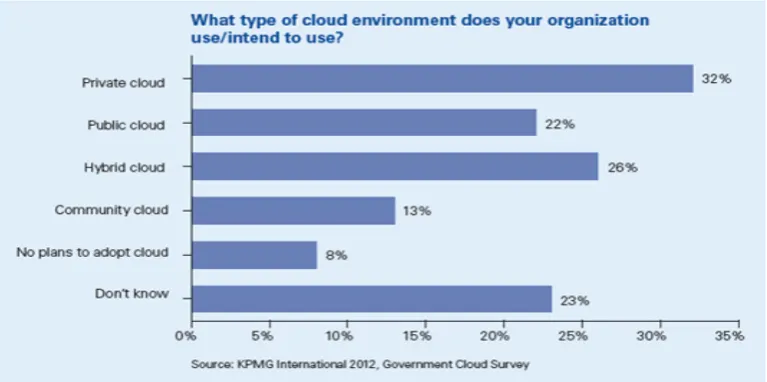
The survey results clearly show that private cloud is currently the dominant approach for most companies. Although they may not have formalized their strategies and road maps, 69% of respondents have, one way or another, embarked on the private cloud journey, while this number is around 40% when it comes to public and hybrid cloud. However, when we look at how many companies are already using the different types of clouds, there is little difference between private and public. Other studies that IDC has conducted support these findings. Organizations are "dipping their toes" into public cloud for some specific areas, but when it comes to the core IT environments, they are starting out with private cloud. Connecting the two into a hybrid model is gaining momentum. The key concerns here are how to overcome the complexities, as our survey results also imply.
3.1.2 Cloud Types
Crystal Nichols distinguishes seven different types of cloud computing Technologies
Web-based cloud services.These services let you exploit certain web service functionality, rather than using fully
developed applications. For example, it might include an API for Google Maps, or for a service such as one involving payroll or credit card processing.
3.2. Software as a Service
SaaS is the idea of providing a given application to multiple tenants, typically using the browser. SaaS solutions are common in sales, HR, and ERP.
Platform as a Service
PaaS is a variant of SaaS. You run your own applications but you do it on the cloud provider’s infrastructure.
Utility cloud services
These are virtual storage and server options that organizations can access on demand, even allowing the creation of a virtual data center.
Managed services
This is perhaps the oldest iteration of cloud solutions. In this scenario, a cloud provider utilizes an application rather than end-users. So, for example, this might include anti-spam services, or even application monitoring services.
Service commerce
These types of cloud solutions are a mix of SaaS and managed services. They provide a hub of services which the end-user interacts with. Common implementations include expense tracking, travel ordering, or even virtual assistant services.
3.3 Direction of Cloud Investment
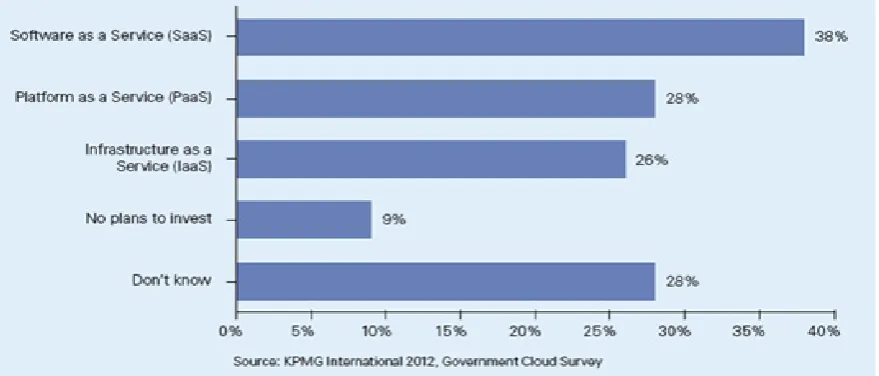
[image:3.595.88.528.543.731.2]Figure 2 shows that thirty-eight percent of government respondents say their investments will skew toward Software as a Service (SaaS), While less frequent, investments in Platform as a Service (PaaS) and Infrastructure as a Service (IaaS) were cited by more than a quarter of government respondents as shown below (KPMG).
Public clouds get a lot of publicity because of their appeal to consumers and small businesses, as well as the name-brand recognition of such public cloud providers as Amazon, Google and others. And while spending on public cloud services certainly is skyrocketing, it’s clear that midsize and large enterprises are generally eschewing public only cloud models in favor of private clouds or, increasingly, hybrid models incorporating an architecture mix of public cloud, private cloud and/or on-premises infrastructure. The reason why this is happening centers on one of the most fundamental reasons cloud computing is appealing: the flexibility to architect the delivery of IT services according to business needs, at any point in time. For instance, hybrid cloud architecture could allow an organization to use an external cloud service provider’s infrastructure to store less-critical data or information that is accessed at predetermined, less-frequent intervals, while maintaining its most essential data on premises or in a private cloud. This affords the organization maximum control to decide where the data, applications and services reside, and what can be moved either back in-house or to a cloud service provider’s infrastructure. The move to hybrid clouds, in fact, is one of the most significant trends that will affect cloud strategy through 2015, according to Gartner. It noted that “over time, hybrid cloud computing could lead to higher-value-added activities for the business, or to support business innovation and, potentially, lower risks.” In the SearchCloudComputing.com survey, respondents overwhelmingly indicated that their Organizations had adopted or plan to adopt either a private cloud environment or a hybrid solution. Public cloud, in fact, was either deployed or planned for deployment by only 7 percent of survey respondents. Why did such a preponderance of respondents opt for non-public cloud options? It seems clear that there is a strong link between concerns over security — as well as the need for a high level of confidence in cloud service providers’ security infrastructure — and the preference for either a private or hybrid cloud architecture.
David Card, GigaOM analysis show that Software-as-a-Service (SaaS) leads but fastest growth is in Infrastructure-as-a-Service (IaaS), which will give way to Platform-as-a-Service (PaaS) in five years. SaaS remains the most popular form of cloud service, used by 63% of organizations, up from 55% last year. However, the fastest growth today is in IaaS, with usage rising from 35% to 45%, a 29% increase over the prior year. Meanwhile, platform-as-a-service (PaaS) is forecast to grow the fastest in the next five years, with 72% of respondents expecting to use PaaS in their organization within that time. The top cloud companies cited are brand name, infrastructure players, including Amazon, Microsoft, Google and Rack space, but 300 companies had less than 2% of responses each, indicating that there are a large number of up and coming companies, and no single company has captured all of the momentum.
3.4. Reasons for Choosing a Cloud Flavor
David Card, Vice President of Research, GigaOM having conducted a survey deduced the following:
a) Agility and scalability are the primary drivers for cloud adoption. However, the need for cloud services to support mobility and the ability for continuous innovation to drive competitive advantage through more integrated business processes are all key drivers for the future.
b) More than half of respondents cited business agility (54.5%) and scalability (54.3%) as the main drivers c) Cost is close behind with 48% citing it as a driver d) Mobility is the next major driver with a quarter of the
respondents recognizing the that mobility is powered by cloud services
e) And innovation (22%) as delivered continuously from the cloud is ultimately leading to competitive advantage (14%)
f) Cloud APIs are also cited as important this year as users look to move beyond stove pipe applications to more integrated business services potential cost savings, and the pursuit of increased efficiency and effectiveness-if not wholesale process transformation. But expectations are modest. Only 50 percent expect potential cost savings from cloud.
3.5. Cloud Computing VS. Grid Computing
Internet) by a conventional network interface, such as Ethernet. This is in contrast to the traditional notion of a supercomputer, which has many processors connected by a local high-speed computer bus. Google, Microsoft, and Dropbox.com are just some of the major companies that are offering free space with their cloud technology. Prices differ depending on space requirements. Overall, however, Cloud does seem to be a more attractive option by being able to access your documents anywhere from the internet. Grid computing does not have a lot of luxuries since it is basically a series of computers and servers that input information into one Mainframe to produce the information you want to access. Tasks are divided into smaller ones and are sent to different servers connected to a main machine, although there are maintenance and security issues that are associated with this approach. Both Grid and Cloud computing are capable of handling multitasking and multi-tenancy. They both guaranty uptime to as much as 99%.
3.5.1 Unique Challenges for the Public Sector
While there are strong lessons to be shared between the two sectors, government decision-makers face a number of challenges that are unique to the public sector as listed below.
Embracing risk
Governments face a very different risk/reward environment in comparison to the private sector. Government enterprises have less incentive to take on the risks of new and arguably untested technologies. “Businesses get rewarded for taking on and successfully managing risk; do that well and earn a profit,” notes Iain Gravestock, partner with KPMG in the UK. “In the public sector, if you take a risk and succeed, you might get a pat on the back but not much more; but if you fail – if your pensioners don’t get their checks, or if you botch privacy protection – you will be in a world of trouble.”
Managing complexity
When it comes to size and scope of operations, government enterprises can vary substantially from the typical private sector corporation. As KPMG in Canada partner Ken Cochrane explains, “Governments are generally very large, very complex, and run literally hundreds of different programs, each equivalent to business lines in the private sector.” By comparison, “most corporations are smaller and less widely dispersed.” For example, in Ontario, Canada, there are some “1.2 million people working in the broader public sector,” says McKerlie. Meanwhile, this massive workforce is distributed across “more than 2,000 locations,” focusing on a wide array of often unrelated tasks. Overall, says Cochrane, the sheer size and scope of governments can make it a greater challenge to develop a broad ranging, government-wide cloud strategy, “which is likely why governments, on balance, are moving a bit slower than corporations.”
3.5.2 Comparison between Centralized and Regional Strategies
While government agencies often strive to maintain a wide geographic presence and employment across their jurisdiction, cloud environments tend to pull resources out of dispersed operations and into a more concentrated model. Of course, cloud also enables disperse locations and mobile employees to achieve greater connectivity to the organizational IT infrastructure, which may further enable a geographically-distributed workforce.
3.5.3 Security
Security is no longer primary inhibitor to cloud adoption as other issues arise. Although still the top inhibitor, security is declining year-over-year from 55% of respondents in 2012 to only 46% in 2013. At least as important to security, 46% described the management of IT as “more complex” with the growing use of cloud components, reflecting the immaturity of the cloud stack. Vendor lock-in (35%) and Interoperability (27%) continue to weigh on customer’s minds as they look for best of breed choices in the schism between a few large players and the long tail of alternative emerging vendors. Reliability (22.3%) and complexity (21%) were among the top inhibitors, reflecting real world obstacles to an “always-on” services infrastructure. Additional inhibitors include regulatory compliance (30%) and privacy (26%). Cost is up sharply as a perceived barrier - almost 50% year-over-year – and is now cited by 28% of respondents as all of the above factors weigh in.
3.6. Challenges to IT Present Opportunity
In response to the inhibitors to cloud adoption, a majority of respondents (55%) expect hybrid or multi-cloud providers to emerge to challenge the current cloud ecosystem in the next 2-3 years. In five years, more than three-quarters (76%) of respondents expect hybrid clouds to be the core of their cloud strategies overtaking public and private clouds. Nearly 40% of respondents expect to increase their training investment to support a cloud computing expansion in their organization. Despite the rise of cost as an inhibitor, surprisingly, more than half (53%) of respondents are neither tracking nor recording service costs
3.6.1 Other Challenges a) Availability
b) Loss of control over data with respect to customers c) Difficulty integrating cloud with existing systems d) Security
e) Response time
f) Regulatory compliance (i.e. privacy, data retention, software licensing, etc.)
g) IT governance h) Performance
i) Dissatisfaction with offerings/ pricing by vendors j) Lack of confidence in ability of cloud vendors to
perform.
l) Difficulty making a business case for adopting a cloud environment
3.6.2. Internal Clouds
In what's turning out to be the most common form of cloud computing (and convenient for virtual-server vendor VMware, (VMW)) internal, private clouds allow a company to weave layers of virtualization and management software around existing infrastructure to tie servers, storage, networks, data and applications (Fogarty,2010). The goal: Once they're interconnected and virtualized, IT can shift storage, compute power or other resources invisibly from one place to another to give all the end-user divisions all the resources they need at any time, but no more than that. What's the difference between a highly virtualized environment and an internal cloud? VMware says an internal cloud should also have a high degree of management automation and offer chargeback capabilities for business units. Private clouds should make managing both information and technology easier, but will blow apart the silos into which most IT organizations have been built over decades, Wolf says. "Right now the server people talk to the server people, not networks or support or anything else," he says. "If everything's virtualized, everything's on ever box, so your job can't be defined according to where the box you're responsible for sits."
3.6.3 External Cloud Hosting
External cloud—any IT service maintained by an external service provider and accessed through the Internet—is the best source for both cost-effective IT extensibility and of insecurity, mistrust, confusion and the potential for disaster. Among the best known U.S. providers of external cloud services are Rack space, Terramark, Equinix (EQIX), AT&T and IBM (IBM). The big worry: In a recent Portio Research survey, 68 percent of respondents say worries about security are holding them back from cloud projects; 58 percent say performance is also a drawback. "In the public cloud a lot of the fear factor is that your data is sitting on someone else's infrastructure," says Vince DiMemmo, general manager of cloud and IT services at data-center hosting and services company Equinix. "When you hire someone else your expectations for security are much higher, so most customers aren't comparing what a service provider offers compared to what they do in their own systems. They tend to be nervous about cloud, too, not for [co-location] and server-hosting that they've been doing for a long time. "There's not a lot of difference between co-location or hosting and cloud services in the platform-as-a-service market, which means any IT organization with external providers has already done most of the vetting needed for a cloud provider, says Jim Levesque, systems programmer and supervisor of the cloud-based disaster-recovery and backup system built by the Los Angeles Department of Water and Power for its 600-server business-application network. "You check the security, make sure about their finances so they're not going to disappear right away, talk to their references and make sure they've got
good provisioning on the things that are important— plenty of I/O and network access, redundant connections and power supplies, emergency plans, all that stuff," Levesque says. But many customers are also worried they'll get locked in to a single service company if the APIs, systems and interfaces their cloud provider uses don't allow them to pick up an move back to internal servers or to a different provider's infrastructure, according to Karl MacDonald, chief evangelist for cloud service provider Cloud.om.
3.6.4 Hybrid or Modular Approach
It's pretty clear that the near future of IT is the hybrid cloud model, Wolf says. Hybrid cloud computing can include a mix on internal clouds, external cloud services and traditional SaaS options. The mix of pieces that hybrid should include for a specific business will end up being as unique as the IT organizations that provide it, he says. Some small- and mid-sized companies face the same dilemma as that guy who insists he can wear the same jeans he did in high school, despite their 32-inch waist and his 42-inch belly. The CEO keeps cinching the budget a little tighter every quarter. Smaller-scale workspace on demand services can fit the bill here. Originally conceived for applications such as on-demand test and development environments (where the need for 100 virtual workstations on which to test a software distribution script wouldn't be unusual) workspace on demand companies such as CloudShare, Soonr or Microsoft Azure offer mini versions of the macro cloud. Rather than buy large-scale services with a lot of configuration and management from Amazon or other hosting companies, it makes sense to have a service you can use to get IT-on-demand for workgroups rather than enterprises, according to Steve Peltzman, CIO of New York's Museum of Modern Art. "We, like a lot of companies, have only one set of staging servers for anything, and you don't want to add a feature because you don't want to mess with the staging, so you have to put that off," Peltzman says. "There are lots of needs, strategic or tactical, we have to meet during the day without having a rack of servers to pull out to do it. We look at where it makes sense to outsource SaaS providers, SalesForce, outsourcing email to Gmail, Amazon or Cloudshare for platform. Sometimes I don't know what we're going to use a specific service or function for, but I know we're going to need it. That's what I'm looking to the cloud for.
3.6.5. Traditional SaaS
rather not pay for bulk upgrades of feature-heavy desktop applications. Companies that don't even want to have to maintain Windows can go to Desktone, ThinkGrid and a few other VDI-on-demand providers. A Five-part report compiled by current analysis, a team that provides Competitive Intelligence Solutions to organizations in the US and Europe provides in-depth analysis on what Cloud Services solutions are being bought, on what basis, and by whom, looking at Enterprise demand.
The concept of cloud services is leading to exciting new opportunities for vendors in a variety of technology disciplines. But cloud services also introduce major risks, such as disruption to existing business, exposure to new competitors, the need to develop and sell new solutions with new value propositions, and the need to target new buyers. They say Customer choices for Cloud solutions are numerous, and deep insight into successful market execution is a critical need. Only Current Analysis covers IaaS, PaaS, and SaaS, encompassing enterprise preference for not only Private and Public, but also Hybrid Cloud solutions. Current Analysis is publishing a five-part compilation of unique reports based on interviews with 550 companies. These reports provide in-depth analysis on what solutions are being bought, on what basis, and by whom, looking at Enterprise demand and trending for Cloud Services in both the U.S. and Europe.
3.6.6. Other Concerns
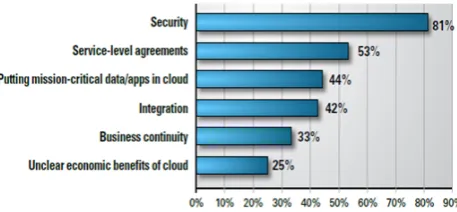
[image:7.595.64.293.457.563.2]Despite industry taking up various flavors of cloud computing, there are other concerns plaguing it with security concerns topping the list as summarized by Figure 3 below.
Figure 3. Factors affecting cloud uptake
3.6.7. Evaluating and Selecting a Cloud Solution Supplier A vast array of issues comes into play when organizations decide to migrate at least some of their applications and services to some form of a cloud computing model. Pricing, service-level agreements, track record in cloud computing, robust security, infrastructure and many other factors all weigh heavily on the minds of IT and business decision-makers. When evaluating potential partners with the technical and business expertise that can help them make the move, companies are placing significant emphasis on the ability to see, plan, implement and support the entire cloud computing vision for the organization. Among the issues a cloud services partner should help enterprises address are:
a) Determining the right cloud approach — private,
hybrid or public.
b) Architecting the right level and type of security into the cloud solution.
c) Creating the ideal mix of cloud-based services, such as SaaS, PaaS or IaaS.
d) Migrating legacy applications to a cloud environment, as well as developing new, cloud-aware applications.
e) Establishing best practices for implementation that minimize risk and create the best opportunity to fully realize business benefits.
Inevitably, architecting a cloud strategy involves an organization’s existing data Center, and cloud-engineered data center solutions help enterprises and even cloud services providers themselves fine-tune and upgrade, as necessary, the organization’s computing infrastructure. Types of companies which are most likely to adopt cloud-based ERP and CRM software services will be companies that want to cut IT staff cost. With CRM and ERP, a business can be up and running with the software quickly which less need for in-house IT staff or high levels of technical skills, and things like security and upgrades are looked after by the vendor. This is because the difference between cloud and on-premise is that cloud-computing makes your software an operational expense rather than a capital spends. There’s usually little or no financial outlay in terms of hardware and IT infrastructure, and you pay a monthly fee to use the product, which is based on the number of users you have. Some businesses prefer a capital spend and to ‘own’ the software. Others prefer an operational cost, as with the cloud. For cloud-based applications, you also need a reliable internet connection, and in some sectors there can be issues with the geography in which the data is actually held. Many mainstream business software vendors are working to transfer their traditional on-premise applications in to the cloud. From a technical point of view, it is not as straightforward as it may first appear. Once it has achieved, the results are arguably superior to applications that have been developed as purely cloud-based applications. Next, companies which might not be well-suited for this type of software are those companies from small to middle-sized companies. These companies have senior finance professionals and they concern about security and the lack of information and understanding about cloud technology which are the main reasons for organizations are staying away from cloud ERP. For the vast majority of businesses, modern commercial cloud applications provide exceptionally high levels of security, including data protection and back-up, and are usually more secure than the majority of on-premise applications.
3.7. Cloud Benefactors
done, remove it. You do not have to carry a switchboard or an adapter with you everywhere. Therefore, the switchboard becomes a ‘service’ given to you at a cost or for free (depending on the vendor). Without doubt, cloud computing is here to stay, and more and more industries are joining the vast virtual world. Let us look at ten industries that will gain from adopting the cloud.
Education
It is one of the fastest-growing industries in the world. The need and demand of education never goes down. Cloud computing in education opens avenues for better research, discussion, and collaboration. It also provides a software desktop environment, which minimizes hardware problems. Cloud computing also enables classes to be run on remote locations.
Marketing Companies
Today’s world is all about marketing and cloud computing takes marketing to a whole new level. The seller can have a marketplace without the need of investing in extra hardware, software, license fees etc.; and the buyer has more options for products.
Online Entertainment
Most people come on the internet for entertainment; therefore, cloud computing is the perfect place for reaching to a varied consumer base. Cloud-based entertainment can reach any device be it TV, mobile, set top box, or any other form. Better clarity and sound quality gets cloud entertainer more customers.
Healthcare
A better data management makes healthcare a perfect candidate for cloud computing. Both patients and doctors can access medical images, reports, records, and care management advice through cloud computing.
Information Technology
The IT industry thrives on information and cloud computing provides the perfect platform for testing of new software and techniques
Finance and Banking
As the international market grew so did the need for a more condensed and easier financial reach. Cloud computing eliminates the need for having a separate banking portal and client database for every location. This means faster and better business.
Telecommunication
Telecommunication companies can use cloud computing to provide both private and public cloud networks to customers and organizations for domestic and commercial purposes.
Hospitality Industry
Many big hotels have moved to cloud computing to get closer to customers. From reservation systems to menus, everything is available across the continents without any extra cost in infrastructure and individual training resources at every location.
Start-ups
Cloud computing has come as a boon for many start-ups. Start-ups can be built on cloud computing with little or no
investment. A wider and diverse computer base can be easily accessed on the cloud.
Security
The computer and IT industry are forever plagued by hackers and other security attacks; therefore, security business will always be very much in demand. Security on cloud computing cuts down the investment cost and also decreases the need of extra space on every system.
4. Discussion
Peng et al 2009 comparative study of various cloud environments in china gave came out with various advantages of different platforms held at that time. However the study wasn’t very comprehensively carried out since it was still early days of CC and since then various flavors have emerged and more knowledge and studies like this one too. Jin et al 2009 gave factors influencing various flavors uptake like cost of energy to operate the hardware and the latter’s’ low costs. Solar energy is fast taking over the running of data centers thereby making energy consumption not a very good factor of comparison a feat that embraces Green IT hence environmental sustainability. Bianchini, 2012 of which they built in a university. Tsai 2010 worries on disparity of cloud type has been mitigated by the CC development of advance multitenancy as I show in my work of CC in the next century being completely different. Hoefer’s 2010 taxonomy of CC services did not quite clearly remove the blur of boundaries of the various cloud flavours and more studies like these are required to make a complete distinction in the face of the dynamicity.
5. Conclusion
question isn’t whether governments will adopt cloud or not, but how far and how fast will they go?
In cloud preference Software-as-a-Service (SaaS) leads but fastest growth is in Infrastructure-as-a-Service (IaaS), which will give way to Platform-as-a-Service (PaaS) in about five years cloud tweaks, 2012. However things are changing pretty fast and more analyses and studies should be carried out to get latest updates on current flavors.
REFERENCES
[1] Cloud U-Understanding the cloud computing stack SaaS, Paas, IaaS sponsored by Rackspace hosting www.currentanalysis.com/custom/cloud Cloud types and service Jin et al 2009.
[2] Adoption of cloud : Private Clouds is current flavor but hybrid is fast becoming a reality, Marianne Kolding September 2012
[3] Cloud Computing Types: Public Cloud, Hybrid Cloud, Private Cloud Mar 06, 2009 12:12 PM PDT, Sam Johnston. [4] Cloud computing: Businesses still don't know what they're
getting into By Nick Heath | June 24, 2013
[5] Government exploring the Cloud A Global Study of Governments’ Adoption of Cloud kpmg.com
[6] Going Hybrid: Best of Both Worlds in Cloud Computing, IBM
[7] Cloud Computing: Today's Four Favorite Flavors, Explained By Kevin Fogarty Thu, July 08, 2010
[8] Government Exploring the Cloud A Global Study of
Governments’ Adoption of Cloud kpmg.com
[9] Comparison of various cloud platforms peng et al 2009 [10] Service oriented cloud computing architecture Tsai et al
2010
[11] Taxonomy of cloud computing services Hoefer 2010 [12] Six types of Cloud Computing OCT 26, 2011
[13] 10 Industries That Will Gain From Adopting The Cloud by cloud tweaks on September 12, 2012
[14] 2013 Future of Cloud Computing Survey San Franscisco, Businesswire--North Bridge Venture Partners, in conjunction with gigaom Research and 57 collaborating organizations.
[15] Crossroads in the Cloud: How IT Leaders and Business Stakeholders Make
[16] Smarter Decisions on Cloud Computing, A white paper investigating new cloud research and adoption trends whitepaper by Dell and Intel.
[17] The Case for Cloud Computing in Midsize Firms, Compelling benefits are driving adoption of cloud computing solutions by midsize companies, but some technology “myths” still need to be exploded
[18] Featuring Christopher mclallen, Senior Producer, Campfire and Tim Llewellyn, CEO, nviso IBM.
[19] Top 5 Cloud Computing Trends Of The Future, by Gregory on September 28, 2012.
[20] The white book of cloud adoption, the definitive guide of business technology revolution-shaping tomorrow with you-fujistu.