Journal of Chemical and Pharmaceutical Research, 2012, 4(8):3950-3958
Research Article
CODEN(USA) : JCPRC5
ISSN : 0975-7384
Studies of novel bis-azo group containing co-ordination polymers
Hemang M. Shukla
1*, Purvesh J. Shah
2, Yogesh K. Solanki
1, Ashish R. Shah
1and Dilipsinh S. Raj
11
Chemistry Department, M.B. Patel Science College, Managed by C. E. Society, Anand -388001
Gujarat, INDIA
2
Chemistry Department, Shri A.N. Patel P.G. Institute, Managed by C. E. Society, Anand
-388001 Gujarat, INDIA
_____________________________________________________________________________________________
ABSTRACT
Novel bis ligand namely 2,2’-(4,4’-(biphenyl-4,4’-diylbis(diazene-2,1-diyl))bis(4,1-phenylene)) bis (azanediyl) bis
(oxo methylene)dibenzoic acid (BPBA) has been prepared and characterized. The co-ordination polymers based on
this bis ligand with transition metal ions like Cu+2,Co+2,Ni+2,Mn+2and Zn+2 were prepared and studied for their metal: ligand (M/L) ratio, IR and reflectance spectroscopies, magnetic properties, number-average molecular
weight and by thermogravimetry. All the novel synthesized compounds were screened for their antibacterial and antifungal activities.
Keywords: Co-ordination polymer, bisazo ligand, magnetic properties, spectral studies and microbicidal activity.
_____________________________________________________________________________________________
INTRODUCTION
Traditionally, azo dyes are the most fundamental class of commercial dyes. The azo compounds are well colored and have been used as dyes and pigments [1, 2]. In addition, they have been studied usually because of their excellent thermal and optical properties in purposes such as toner [3, 4], ink-jet printing [5, 6] and oil-soluble lightfast dyes [7] optical recording medium [8−11]. In modern times, azo metal chelates have also paying attention due to their interesting electronic and geometrical features in link with their application for molecular memory storage, nonlinear optical elements and printing systems [9,11,12].
Recently, the study of co-ordination polymers has been made much progress [13, 14]. These polymers are known for their semiconducting catalytic properties, waste water treatment for metal recovery, in protective coating, as antifouling paints and anti fungal properties [15, 16]. Such Coordination polymers are mostly derived from bi-chelating ligands in which metal ions and bi-chelating agents are grouped alternatively. The joining segment of these two similar ligands are mainly –N=N-, SO2, -CH2 -, -O- [17-23]. Co-ordination polymers mostly derived from
bichelating ligands in which metal ions and chelating agents arrayed alternatively [24-26]. The area in which the co-ordination polymers having azo dye moiety has been reported by one of author [DSR] [27]. In extension of previous work, the present article comprises the study of co-ordination polymers based on bisazo dye with phthalamic acid segment. Though phthalamic acid also act as good metal chelating agent.
EXPERIMENTAL SECTION
Materials
Benzidine was obtained from S. D. Fine Chemical Ltd. All other chemicals used were of analytical grade.
Synthesis of (4,4’-(bisphenyl-4,4’-diylbis(diazene-2,1-diyl) dianiline :
A solution of 184.1g (0.1mole) of Benzidine in 250 ml 2N HCl was cooled in a round bottom flask, surrounded by ice and stirred with electric motor, when solution was cold, add few pieces of ice and 200 ml 1N nitrite solution was added drop wise from a dropping funnel at below 00C with stirring. After completing the addition of nitrite mixture was stirred for about 10 mins. Then tested to make sure that it gave strong blue coloration with Congo red paper and weak blue test with starch iodide paper, added distilled water in it dilute the solution & kept it into ice-bath.
A solution of dil. HCl added into aniline 18.6 gm (0.2 mole) till Congo Red Paper gave blue color, now added above diluted diazonium solution into aniline solution gradually in cold situation, stirred it well and add sodium acetate solution till the neutralization of dye. Now washed the dye with cold water. The products were obtained in the form of dark orange color, collected that dye by vacuum filtration, then wash with cold water & dry it over night, Yeild-78%, M.P.176-78°c (uncorrected).Analysis C24H20N6 (392gm/mole) (Cal: %C 73.45,% H 5.14,% N21.41) (Found:
% C 73.21, % H 5.01,% N 21.07).
IR (KBr) νcm-1: 3328 (-NH stretching of secondary amine), 1592, 1500, 1446 (C=C- stretching of aromatic ring), 1635(-N=N-stretching of azo group)
1H-NMR (400 MHz, DMSO-d
Synthesis of 2,2’(4,4’(biphenyl4,4’diylbis(diazene2,1diyl))bis(4,1phenylene)) bis(azanediyl) bis(oxomethyl -ene)dibenzoic acid (BPBA)
The solution of (4,4’-(bisphenyl-4,4’-diylbis(diazene-2,1-diyl) dianiline (0.1 mole) in acetone is cooled to 10°C.To this solution the phthalic anhydride (0.2 mole) was added with stirring. The resulting product was then filtered and air-dried. The yield of was 81%, M.P. 278-280°C (uncorrected).Analysis C40H28N6O6 (688 gm/mole)
(Cal: %C 69.76,% H 4.10,% N 12.20) (Found: % C 69.52, % H 3.96, % N 12.01).
IR(KBr) νcm-1:
3328-NH stretching of secondary amine, 1595, 1513, 1452 -C=C- stretching of aromatic ring, 3410-OH stretching of –COOH group, 1670-C=O stretching of–CONH group,
1635-N=N-stretching of azo group
1H-NMR (400 MHz, DMSO-d
6)δ (ppm):12.6-12.5(s, 2H,-COOH),9.3-9.2 (s, 2H, -CONH, D2O exchangeable),
8.0-6.(m,24H, aromatic, J=0.9,7.8Hz). 13CNMR-131.5(C-1,C-13), 130.1(C-2,C-12),128.6(C-3,C-11), 132.0
(C-4,C-9),134.0 (C-5,C-9), 123.5(C-6,C-8),167.6(C-7,C-16),173.0(C-14,C-15)124.4(C-17,C-21,C-36,C-40),140.1(C-19,C-38) ,119.3(C-18,C-20.C-37,C-39),150.9(C-22,C-35),151.6(C-23,C-32),124.5(C-24,C-28,C-31,C-33), 128.2(C-25,C-27,C-30,C-34),143.0(C-26,C-29)
The predicted structure and formation of polymeric ligand is shown in Scheme-1.
The brief account of the thermal behaviour of ligand in air is given below:
(I) Examination of the TG curves of ligand sample reveals that it degrades in two steps.
(II) The first of degradation up to 200° to 230°C of the ligand indicate the weight loss in the range at 23% percentages. This is depending up on the molecular weight of sample.
(III)The second stage at degradation of the ligand beyond 200°c is rapid and loss about 75% to 85% at 300°c depending upon the nature of ligand.
(IV)The ligand containing two –COOH groups. Hence the TGA of ligand in air may cause decarboxylation [28]. The calculated value of CO2 of ligand and % loss of first stage degradation of ligand is presented in Fig-I.
Examination of these data reveals that the decarboxylation of ligand consistent with the calculated values. All these facts confirm the structure of ligand.
Fig-I TGA Thermogram of Ligand-BPBA
Estimation of number of carboxylic (-COOH) groups in ligand BPBA
The structure of ligand was examined by estimation of number of carboxylic –COOH groups per mole of ligand. The non-aqueous conductometric nitration was employed for –COOH group estimation following the method reported in the literature [29-32]. The titrant used for this non-aqueous titration was tetra-n-butyl ammonium hydroxide (TBAH) in pyridine. The details procedure followed in titrations described here for BPBA ligand.
Non-aqueous conductometric titration. Experimental:
The solution was allowed to stand overnight for complete dissolution. This ligand solution was transferred into conductance cell and it was then stirred magnetically. The base tetra n-butyl ammonium hydroxide (TBAH) (0.1 N), in pyridine was added to the conductance cell at regular interval of 0.01 ml of titrant beyond the stage of equivalence. The conductance measurement after addition of each volume of titrant base was carried out by allowing 2-3 minutes to lapse. During the titration the temperature of solution was maintained constant about 25°C, when the point of equivalence was exceeded, there was a continuous increase in conductance on addition of every additional aliquot of tetra-n-butyl ammonium hydroxide (TBAH) indicating the stage of complete neutralization of the –COOH groups in the given amount of ligand sample. The volume of base added is converted into millimoles of tetra-n-butyl ammonium hydroxide (TBAH) required for 100 gm of ligand. A plot of conductance against millimoles of tetra-n-butyl ammonium hydroxide (TBAH) per 100 gm of ligand sample was plotted. Inspection of such plot revealed two breaks. From the plot, the millimole per 100 gm of ligand sample corresponding to the break was noted. From this value, the number of –COOH groups was estimated. Each titration was reported twice as an independent experiments using different amount of the ligand sample. The two values estimated is agreed each other with 5% variation.
(I) Thus millimoles of TBAH required for complete neutralization of –COOH groups present in the sample was found by following formula using break of the titration curve. Finally two no. of COOH group calculated by:
No. of carboxylic groups = Milimoles of TBAH X Mol. weight X 10-5 Per mole of ligand per 100gm of sample of ligand
(X) (Y) (M)
X = Y X M X 10-5
E.g. For (BPBA) X = 688 X 295 X10-5 = 2.02
RESULTS AND DISCUSSION
The typical conductometric titration curve of BPBA Ligand has been shown in Fig II Examination curves of the ligand reveal that, the two breaks observed the all curve. From the value of at second break the number of –COOH group for ligand has been calculated. It was found that the value of carboxylic group is about 2 the ligand.
Table-I Non-aqueous Conductometric titration of Estimation of – COOH groups
Solvent: Anhydrous pyridine.
Reagent: 0.1 N tetra-n-butyl ammonium hydroxide (TBAH) in pyridine
Ligand Molecular weight gm Millimoles of TBAH at break per 100 gm of sample Estimated No. of –COOH group
(BPBA) 688 295 2.02
Determination of azo group:
The number of azo group for BPBA ligand was estimated by method reported [33]. 35 mg. of sample was taken in the titration flask and dissolved in 25 ml. of diluted sulphuric acid (2:5 v/v) and carbon dioxide gas was passed into it for 5 minutes to displace air. 20 ml. of 0.10 N titaneous chloride solutions was added into this air free solution. It was boiled for 5 minutes while maintaining the current of carbon dioxide. Cool the resulting solution and add 10 ml. of ammonium thiocyanate solution. It was titrated with standard 0.10 N ferric ammonium sulphate solutions. Blank set of 20 ml. of titaneous chloride solution was also run. Number of azo group for each dye sample was estimated by this method indicates that there are two azo groups (-N=N-) present in the dye molecule. Examination of these data reveals that there are two azo groups (-N=N-) present in the dye molecules.
Preparation of Co-Ordination Polymers
Figure-II
A warm and clear solution (pH∼8) of BPBA (6.88 gm, 0.01mole) in aq. NaOH (200 ml) was added to a solution of copper acetate (1.99 gm, 0.01mole) in 50% aq. formic acid (50 ml) with constant stirring. After complete addition of metal salt solution, the pH of reaction mixture was adjusted to about 5 with dilute ammonia solution. The polymer chelate was separated out in the form of suspension, digested on a water bath for on hour and eventually filtered, washed with hot water followed by acetone, dimethyl formamide (DMF) and then dried in air at room temp. The yields of all co-ordination polymers were almost quantitative.
[image:5.595.58.536.441.602.2]Fig-IV TGA of [Cu(BPBA)(H2O)2]n
Measurements
Elemental Analysis
The metal analysis of co-ordination polymers comprised decomposition of a weighted amount of the polymer followed by EDTA titration following standard procedures [33]. C, H, N analysis of BPBA and its coordination polymers were carried out by C, H, N elemental analyzer (Italy).
IR spectra of the ligand and of each of the polymer samples were scanned in KBr on a Nicolet 760 D spectrophotometer.
The solid diffusion reflectance spectra of all co-ordination polymer samples were recorded on a Backman DU spectrophotometer with a solid reflectance attachment. MgO was employed as the reference compound.
The number average molecular weight ( Mn ) of all the coordination polymers were determined by method reported in earlier communications [34].
Magnetic Susceptibility measurements of all co-ordinate polymers were carried out at room temperature by the Gouy method, Hg[Co(NCS)] used for calibration. Molar Susceptibilities were corrected for diamagnetism of component atoms using Pascal’s constant.
Thermogravimetry of polymer samples were carried out on a “PERKIN ELMER PYRIS 1 TGA in a slow stream of air.
The diffuse reflectance spectra of the solid polymeric chelates were recorded on a Beckman DK-2A spectrophotometer with a solid reflectance attachment. MgO was employed as the reference compound.
Antibacterial Activities
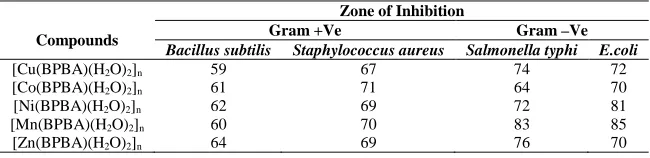
Antibacterial activity of BPBA ligand and its coordination polymers were studied against gram-positive bacteria (Bacillus subtilis and Staphylococcus aureus) and gram-negative bacteria (E.coli and Salmonella typhi) at a concentration of 50µg/ml by agar cup plate method. Methanol system was used as control in this method. The area of inhibition of zone measured in mm.
Antifungal Activities
Percentage of inhibition = 100(X-Y) / X
Where, X = Area of colony in control plate Y = Area of colony in test plate
RESULTS AND DISCUSSION
The synthesis of the novel bis 2,2’-(4,4’-(biphenyl-4,4’-diylbis(diazene-2,1-diyl))bis(4,1-phenylene)) bis(azanediyl)bis(oxomethylene)dibenzoic acid (BPBA) has not been reported previously. The ligand BPBA was
isolated in the form of a dark red crystalline powder. It was soluble in DMF, dioxane, acetone, acetic acid and dilute hydrochloric acid.
The important IR spectral features are a broad band extending from 3200-3600 cm-1 OH of COOH. The band around 1690 cm-1 may due to carbonyl group. The bands around 1660, 3400 cm-1 may bedue to amide group. The strong band at 1625 cm-1 may be due to N=N group. The others bands are at their respective positions.
The NMR data of BPBA shown in experimental part are also confirming the structure of BPBA.
The co-ordination polymers derived from BPBA were insoluble in common organic solvents. Hence, it is not possible to characterized the co-ordination polymers by molecular mass using conventional methods like osmometry, viscometry etc. These co-ordination polymers did not melt up to 360°C.Examination of the metal content in the polymers(Table-V) revealed that the 1:1 metal: ligand (M: L) stoichiometry for all the polymers.
Comparison of the IR spectrum of the ligand BPBA and those of the co-ordination polymers reveals certain characteristic differences. The broad band at 3400-3100 cm-1 for BPBA has virtually disappeared for the spectra of polymers. However the weak bands around 3200 cm-1 in the spectra of BPBA.Co2+, BPBA.Ni2+, BPBA.Mn2+ indicate the presence of water molecules which may have been strongly absorbed by the polymer sample. An indication of this aspect is made later. The weak band around 1110 cm-1 is attributed to the C-O-M stretching frequency. The band at 1430 cm-1 in the IR spectrum of BPBA is attributed to the in-plane OH deformation [35]. The band is shifted towards higher frequency in the spectra of the polymers indicating formation of metal-oxygen bond. These feature suggest that the structure of the co-ordination polymer.
Magnetic moments (µeff) of polymeric chelates are given in Table-II. The diffusion electronic spectrum of
BPBA.Cu+2 co-ordination polymers shows two broad bands around 15,550 cm-1 and 22,750 cm-1.The first bands may be due to 2T2g
2
Eg transition.While the second may be due to charge transfer. The first band shows structure
suggestion a distorted octahedral structure for the BPBA.Co2+ polymers. The higher value of µeff of the BPBA.Cu2+
polymer supports this view. The BPBA.Ni2+ and BPBA.Co2+ polymers give two absorption bands respectively at 14,780 and 22,750 cm-1 and at 15,650 and 22,110 cm-1 which can be assigned respectively to 3A2g 3T1g(P), 4
T1g 4
T1g(P) transitions. These absorption bands and the values of µeff indicate an octahedral configuration for the
BPBA.Ni2+ and BPBA.Co2+ Polymers.
The TGA data for the polymers are presented in Table-V. The weight loss of the polymer samples at different temperatures indicates that the degradation of the polymers is noticeable beyond 300°C. The rate of degradation becomes a maximum at a temperature lying between 400°C and 500°C depending upon the nature of the polymers. Each polymer lost about 55% of its weight when heated up to 600°C. Inspection of the thermograms of BPBA.Co2+, BPBA.Mn2+ and BPBA.Ni2+ samples revealed that these samples suffered appreciable weight loss in the range 150 to 280°C. This may due to the presence of water strongly absorbed by the polymers. It has also been indicated earlier that the IR spectra of these three polymer samples have OH bands at around 3200 cm-1 due to associated water.
On the basis of the relative decomposition (% wt. loss) and the nature of thermograms, the co-ordination polymers may be arranged in order in increasing stability as:
Cu < Ni < Co < Mn
This trend also coincides with the stability order already reported for the metal oxinates and for co-ordination polymers of BPBA [36] .
fungus is inhibited in the range of 63 to 85% depending upon the biospecies and coordination polymers. All the polymers have good microbicidal activity.
Table-II Analytical and Spectral Data of the Co-Ordination Polymers of BPBA
Compound Empirical Formula Formula Weight
Analyses
% Found(Calculated) (
Mn
) + 60 %Yeild
Dp
%M %C %H %N
BPBA C40H28N6O6 688.70 - (69.76) 69.52 (4.10) 3.96 (12.20) 12.01 81 -
[Cu(BPBA)(H2O)2]n Cu.C40H26N6O6.2H2O 770.24 8.11
(8.25) 62.07 (62.31) 3.51 (3.89) 10.63
(10.91) 4067 74 5
[Co(BPBA)(H2O)2]n Co.C40H26N6O6.2H2O 765.63 7.52
(7.70) 62.58 (62.69) 3.49 (3.91) 10.77
(10.97) 4888 80 6
[Ni(BPBA)(H2O)2]n Ni.C40H26N6O6.2H2O 765.39 7.44
(7.67) 62.43 (62.71) 3.59 (3.91) 10.66
(10.97) 3999 76 5
[Mn(BPBA)(H2O)2]n Mn.C40H26N6O6.2H2O 761.63 7.00
(7.21) 62.77 (63.02) 3.70 (3.94) 10.91
(11.03) 4856 77 6
[Zn(BPBA)(H2O)2]n Zn.C40H26N6O8S.2H2O 772.08 8.21
(8.47) 61.93 (62.17) 3.60 (3.88) 10.65
(10.88) 4044 82 5
Table III FT-IR data of ligand BPBA and its coordination polymers
Compounds υ(C=C) υ(CONH) υ(COOH) υ(N=N) υ(M-O)
BPBA 1591 1675 3430 1646 -
[Cu(BPBA)(H2O)2]n 1575 1669 3385 1633 595
[Co(BPBA)(H2O)2]n 1565 1641 3369 1621 591
[Ni(BPBA)(H2O)2]n 1571 1650 3375 1624 592
[Mn(BPBA)(H2O)2]n 1561 1632 3366 1608 589
[image:8.595.171.443.297.364.2][Zn(BPBA)(H2O)2]n 1590 1671 3400 1634 597
Table IV Reflectance spectral and magnetic moment data of the ligand BPBA containing coordination polymers
Coordination polymers
Absorption
band(cm-1) Transitions moment(Magnetic µeff) BM
[Cu(BPBA)(H2O)2]n 22750
15550
2Eg→2T2g
charge transfer 1.89
[Co(BPBA)(H2O)2]n 15650
22110
4T1g(F) →4A2g
4T1g(F) →4T2g(P) 2.99
[Ni(BPBA)(H2O)2]n 14780
22750
3A2g →3T1g(F)
3A2g →3T1g(P) 4.18
[Mn(BPBA)(H2O)2]n
15708 17472 22705
6 A1g→4
T1g(4G) 6A1g→4T2g(4G) 6A1g→4A1g, 4Eg
4.99
*Zn- containing polymers are diamagnetic in nature
Table V TGA data of BPBA containing coordination polymers
Co-ordination polymers % Weight loss at different temperature( OC) 100 200 300 400 500 600
[Cu(BPBA)(H2O)2]n 2.6 4.9 13.2 42.5 47.5 53.3
[Co(BPBA)(H2O)2]n 4.5 8.6 16.8 21.8 43.1 59.4
[Ni(BPBA)(H2O)2]n 4.8 8.4 14.9 27.2 45.3 59.6
[Mn(BPBA)(H2O)2]n 4.5 6.8 9.8 15.6 25.0 36.4
[Zn(BPBA)(H2O)2]n 2.2 3.4 4.8 15.4 23.6 35.5
Table: VI Antibacterial Activities of Co-Ordination Polymers
Zone of Inhibition
Compounds Gram +Ve Gram –Ve
Bacillus subtilis Staphylococcus aureus Salmonella typhi E.coli
[Cu(BPBA)(H2O)2]n 59 67 74 72
[Co(BPBA)(H2O)2]n 61 71 64 70
[Ni(BPBA)(H2O)2]n 62 69 72 81
[Mn(BPBA)(H2O)2]n 60 70 83 85
[image:8.595.172.441.391.494.2] [image:8.595.144.469.624.703.2]Table: VII Antifungal Activities of Co-Ordination Polymers
REFERENCES
[1]J Koh ; AJ Greaves. Dyes Pigments., 2001, 50 ,117.
[2]HM Shukla; AI Shah ; PJ Shah ; DS Raj , J. Chem. Pharm. Res., 2010, 2(5),169.
[3]3. K Maho; T Shintaro; K Yutaka; W Kazuo; N Toshiyuki; T Mosahiko. Jpn J Appl Phys., 2003, 42 ,1068. [4]DW Rangnekar; VR Kanetkar ; JV Malanker ; GS Shankarling. Indian J Fiber Text Res., 1999, 24 ,142 . [5]G Hallas; JH Choi. Dyes Pigments., 1999, 40, 119.
[6]P Gregory; DR Waring; G Hallos. The Chemistry and Application of Dyes, Plenum Press, London, 1999; pp.18-20.
[7]KD Patel; SC Panchani . Ulter of Phy Science., 2003, 15, 195 [8]HS Patel; RB Dixit ; TB Shah . Int J Polym Material., 2001, 49, 27.
[9]T Abe; S Mano; Y Yamada ; A. Tomotake. J Imag Sci Tech., 1999, 43 ,339 . [10]AD Patel ; RS Patel ;GR Patel . E-Journal of Chemistry., 2010, 7(3), 1023. [11]S Wang; S Shen; H Xu. Dyes Pigments., 2000,44, 195.
[12]KD Patel ; HS Patel . Der Pharmacia Lettre., 2011, 3(1),356.
[13]AI Shah; HM Shukla; PJ.Shah; DS Raj. J. Chem. Pharm. Res., 2010, 2(5),526. [15]T B Shah; HS Patel; RB Dixit. Intern J Polymeric Mater., 2001,49, 271.
[16]HM Shukla; AI Shah; PJ.Shah; DS Raj. Rasayan journal of chemistry., 2010,3(3),525. [17]DR Gosai, KS Nimavat and KB Vyas, J. Chem. Pharm. Res., 2011,3(6),490.
[18]BC Dixit ; RB Dixit ; DJ Desai . Journal of Polymer Research, 2010, 17(4), 481. [19]RD Patel; HS Patel ; SR Patel. Eur Polym J., 1987,23 ,229 .
[20]AM Karampurwala ; RP Patel ; JR Shah. Angew Makromol Chem., 1980,87,87. [21]AK Rana; NR Shah; AM Karampurwala; JR Shah . Makromol Chem., 1981, 182 , 3387. [22]N Sekar. Colourage, 1999, 46, 63.
[23]HE Katz; KD Singer; JE Sohn; CW Dirk; LA King ;HM Gordon. J Am Che Soc. 1987, 109(21) 6561.
[24]JR Patel; K S Nimavat ; K B Vyas, J. Chem. Pharm. Res.,2011, 3(6),483. [25]H Horowitz; JP Perrors . J Inorg Nucle Chem., 1964, 26 139 .
[26]AI Shah; HM Shukla; PJ Shah; DS Raj . Elixir Chem. Phys., 2012, 44, 7378.
[27]RA Sheikh; S Shreaz;LA Khan and AA Hashmi. J. Chem. Pharm. Res., 2010,2(3),274. [28] DS Raj. Research Journal Of Chemistry And Environment., 2001,5(1), 35.
[29]H Parekh. Ph.D.Thesis Veer Narmad South Gujrat University,(SURAT,INDIA,2006). [30]SK Chatterjee . Indian J Chem., 1969, 7, 605.
[31]A Singh ; J Bhanderi. Rasayan J Chem., 2009,2(4),846. [32]SK Chatterjee; PR Mitra. J Polymer Sci Part. A-1., 1970, 1299. [33]SK Chatterjee; ND Gupta, J Polymer Sci Part. A-1., 1973, 11,1261.
[34] J Bessett; RC Denny; JH Feffery ; J Mondhaus; AI Vogel . A Textbook of Quantitative Chemical Analysis Revised, ElBS, 5th Edn., London , 1996.
[35]T B Shah; HS Patel; RB Dixit; BC Dixit. Int J of Polym .Anal. and Charact., 2003, 8,369. [36]RG Charles; H Freiser; R Priedel; LE Hilliand; RD Johnston. Spectrochim Acta., 1958, 8,1. [37]DH Jani ; HS Patel ; H Keharia ; CK Modi. Appl Org Chem., 2010, 24, 99.
Compounds Penicillium expansum Nigrospora Sp. Trichothesium Sp. Rhizopus nigricum
[Cu(BPBA)(H2O)2]n 74 79 61 60
[Co(BPBA)(H2O)2]n 65 64 64 72
[Ni(BPBA)(H2O)2]n 75 72 66 70
[Mn(BPBA)(H2O)2]n 72 75 82 77
![Fig III-IR Spectrum of [Cu(BPBA)(H2O)2]n](https://thumb-us.123doks.com/thumbv2/123dok_us/8778959.903083/5.595.174.454.75.316/fig-iii-ir-spectrum-of-cu-bpba-h.webp)