THE EFFECTS OF VORTEX GATE DESIGN ON MECHANICAL STRENGTH OF THIN SECTION CASTING OF LM 25 (Al—7Si-0.3Mg) ALUMINUM
CASTING ALLOY
ZAID ALI SUBHI
A thesis submitted in full
fulfillment of the requirement for the awarding of the Degree of Master of Mechanical Engineering
Faculty of Mechanical and Manufacturing Engineering Universiti Tun Hussein Onn Malaysia
ABSTRACT
Aluminum alloy castings are being used progressively more in safety-critical applications in the automotive and aerospace industries. During the production of aluminum ingots and castings, the surface oxide on the liquid is folded in to produce crack-like defects (bifilms), porosities that are extremely thin and tiny or big, but can be extremely extensive, and so constitute seriously detrimental defects. To produce castings of sufficient quality, it is, therefore, important to understand the mechanisms of the formation of defects in aluminum melt flow through the gating system. Gating system design is an essential element in casting process which affects significantly the molten metal flow behavior, heat transfer and solidification of the melt. The good quality casting product could be achieved by using an optimum gating design. This study has employed Vortex gate design of LM25 (Al—7Si-0.3Mg) thin section casting to determine the effect of Vortex and Conventional gate design on mechanical properties and porosity distribution pattern. Numerical simulation by ADESTEFAN v.10 package was used to identify the molten metal flow behavior in the mold cavity which is physically could not be detected by unaided eye. The X-Ray Radiography test used to examine in general the distribution of defects in thin casted part. 3-Point bending test was applied to measure the flexural strength of the casted alloy material. The scattering of flexural strength has been quantified by Weibull statistics approach. The microstructure inspection was observed using both, the optical microscope micrographs and scanning electron machine (SEM) tests.
vii
ABSTRAK
Tuangan aloi aluminium digunakan secara progresif dalam aplikasi kritikal keselamatan dalam industri automotif dan aeroangkasa. Semasa pengeluaran jongkong aluminium dan tuangan, oksida permukaan cecair dan hilang lenyap dalam menghasilkan kecacatan seperti ‘crack-like-defects’ (bifilms), porosities yang sangat nipis dan kecil atau besar, tetapi boleh menjadi ‘extreme’ ekstensif, dan sebagainya merupakan ‘detrimental defects’ yang serius. Untuk menghasilkan penuangan berkualiti yang mencukupi, adalah penting untuk memahami fomasi mekanisme pembentukan kecacatan dalam aliran aluminium mencairkan melalui sistem gating. Reka bentuk sistem Gating adalah satu elemen penting dalam proses pemutus yang menjejaskan dengan ketara kelakuan aliran logam lebur, pemindahan haba dan pemejalan leburan. Penyelidikan keatas ‘Vortex gate design LM25 (AI-7Si-0.3 Mg) ‘casting’ yang nipis boleh memberi kesan keatas ‘vortex gate design’ mekanikal. Produk pemutus kualiti yang baik boleh dicapai dengan
menggunakan bentuk gating optimum. Penyelakuan simulasi berangka oleh pakej ADESTEFAN V.10 telah digunakan untuk mengenal tingkah laku aliran logam lebur dalam rongga acuan yang secara fizikal tidak dapat dikesan oleh mata kasar. Ujian Radiografi X-Ray yang digunakan untuk memeriksa asas pengagihan ‘defect’ di bahagian nipis casted, 3-Point ujian lenturan di-aplikasikan untuk mengukur kekuatan lenturan kekuatan bahan aloi casted. Penyebaran kekuatan lenturan telah dikuantitikan dengan pendekatan statistik Weibull. Pemeriksaan mikrostruktur mendapati kedua-dua, mikrograf mikroskop optik dan mesin imbasan elektron (SEM) ujian. Keputusan simulasi berangka menunjukkan aliran yang lancar dan bukan ‘turbulent flow’ reka bentuk dalam vortek. Logam cecair dalam vorteks memasuki rongga acuan adalah dibantu oleh graviti bagi suatu keadaan permukaan bebas yang baik semasa pengisian, mengurangkan bahaya perangkap filemdi mana-mana permukaan bebas. Tambahan pula, keputusan uji kaji menunjukkan bahawa pemutus produk dengan vorteks ‘gate’
CONTENTS
TITLE i
DEDICATION iv
ACKNOWLEDGMENT v
ABSTRACT vi
CONTENTS viii
LIST OF TABLES xiv
LIST OF FIGURES xv
LIST OF APPENDICES xviii
CHAPTER 1 1
1.1 Introduction 1
1.2 Sand Casting principles 2
1.3 Background of problem 3
ix
1.5 Research objectives 6
1.6 Project significance 6
1.7 Scopes of study 7
1.8 Thesis outline 8
CHAPTER 2 10
2.1 Introduction 10
2.2 Aluminum alloys 12
2.3 LM 25 (Al—7Si-0.3Mg) casting 13
2.4 Metal quality 16
2.5 Casting filling process 17
2.5.1 Fluidity 18
2.5.2 Gating system 22
2.5.3 Pouring temperature 27
2.6 Casting solidification 28
2.7.1 Porosity 28
2.7.2 Air entrapment 29
2.7.3 Inclusion 30
2.7.4 Bifilm 30
2.7.5 Shrinkage 31
2.8 Numerical simulation 31
2.8.1 Simulation of filling process and temperature
distribution 32
2.8.2 Most popular casting simulation software in the markets 33
2.9 Literature study summary 34
CHAPTER 3 36
3.1 Project outline 38
3.2 Experimental works steps 38
3.2.1 Pattern geometry design 38
3.2.2 Material selection and characteristics 39
xi
3.2.4 Flask Design 41
3.2.5 Pouring and filling process 42
3.2.6 Determination of pouring speed 43
3.2.7 Determination of pouring temperatures 44
3.2.8 Finishing and scattering process 45
3.3 Testing 47
3.3.1 X-Ray Radiography test 47
3.3.2 Three-Point Bending test 48
3.3.3 Microstructure investigation 50
3.4 Simulation of molten metal flow 52
3.4.1 Simulation validation 52
3.4.2 Project simulation steps 53
CHAPTER 4 56
4.1 Introduction 56
4.2.1 LM25 (Al—7Si-0.3Mg) grain structure 58
4.2.2 SEM results of LM25 (Al—7Si-0.3Mg) 62
4.3 Mechanical tests 65
4.3.1 X-ray Radiography 65
4.3.2 Three points flexural test results 67
4.3.3 Weibull distribution analysis and material reliability 75
4.4 Simulation results 80
4.4.1 Benchmark validation using ADESTEFAN v.10 80
4.4.2 Mold filling sequence by ADESTEFAN 84
4.5 Results compendium 94
4.6 Results discussion summary 95
CHAPTER 5 96
5.1 Conclusions 96
5.2 Project contribution 97
xiii
REFERENCES 99
APPENDICES 106
APPENDIX A 107
APPENDIX B 110
APPENDIX C 115
APPENDIX D 118
APPENDIX E 120
LIST OF TABLES
2.1 Market Simulation Software Packages 33
2.2 Summary of previous literature studies 34
3.1 The characteristic of LM25 40
3.2 Material properties of the validation work to be an input data of the simulation software.
55
4.1 (3-Point) bending test results for vertical sampling method of vortex gate design.
69
4.2 (3-Point) bending test results for vertical sampling
method of conventional gate design 70
4.3 (3-Point) bending test results for horizontal sampling method of vortex gate design.
71
4.4 (3-Point) bending test results for horizontal sampling
method of conventional gate design 72
4.5 Vortex gate calculation of Weibull distribution for vertical sampling at 720oC
77
4.6 Vortex gate calculation of Weibull distribution for horizontal sampling at 720oC.
78
4.7 Data for the velocity of molten metal calculation 86
xv
LIST OF FIGURES
2.1 LM 25 (Al—7Si-0.3Mg) aerospace and automotive thin
walled products. 11
2.2 The general three runner system designs 15
2.3 Surface turbulence 17
3.1 Overview of the project methodology 37
3.2 The assembled geometry of vortex gate and conventional
gate patterns 39
3.3 The new design of non-symmetrical overlapped flask 42
3.4 Electrical Induction Furnace and its crucible at UTHM
foundry laboratory used to melt LM25 (Al—7Si-0.3Mg) 43
3.5 The cutting methods of casting samples and the produced
specimens will subject to three-point bend test 45
3.6 The experimental work flow progress 46
3.7 X-Ray machine type BOSELLO HT industrial X-Ray
used to check the porosity distribution of the products. 47
3.8 Position and dimensions of 3-points bending test
specimen 48
3.9 AG-1 SHIMADZU Universal Testing Machine was
3.10 Samples preparation for (phenolic-plastic) mounting and
microstructure test 51
3.11 (a) Optical microscope type OLYMPUS BX60M. (b)
Scanning electron machine type JSM-6380LA. 52
3.12 Geometry and dimension descriptions of the validation
work, original geometry 53
4.1 Cause and effect diagram for casting defects (Quality
Control) 57
4.2 LM25 Grains Microstructure of (700, 720and 740) oC pouring temperature and Vortex ingate
60
4.3 LM25 Grains Microstructure of (700, 720and 740) oC pouring temperature and Conventional ingate
62
4.4 SEM micrographs show the distribution of shrinkage porosities and oxide films on the polished fracture surface of specimen from (Conventional ingate design)
63
4.5 SEM micrographs show the distribution of shrinkage porosities and oxide films on the polished fracture surface of specimen from (Vortex ingate design)
64
4.6 Porosity distribution in casting plate by X-Ray
Radiography 66
4.7 Frequency histogram plots of bending strength for
horizontal sampling 73
4.8 Frequency histogram plots of bending strength for
horizontal sampling. 74
4.9 Weibull plot of LM25 (Al—7Si-0.3Mg) for vertical
xvii
4.10 Weibull plot of LM25 (Al—7Si-0.3Mg) for horizontal
sampling 79
4.11 Benchmark validation for ADESTEFAN software with
Flow-3D and Fluent of thin section casting model. 82
4.12 Molten metal entrance velocity, (Campbell, 2003) 85
4.13 3D - Eagle eyes view of the filling stages for vortex gate
mold filling steps. 88
4.14 Front view of the filling stages for vortex gate mold
filling steps. 89
4.15 Velocity field distribution inside the vortex gate mold
during filling process running till end 90
4.16 3D - Eagle eyes view of the filling stages for conventional
gate mold filling steps. 91
4.17 Front view of the filling stages for conventional gate mold
filling steps 92
4.18 Velocity field distribution inside the conventional gate
LIST OF APPENDICES
APPENDIX TITLE PAGE
A 3D-Schematic drawing of (Vortex & Conventional) 107
B 3D-Schematic drawing of the fabricated flask 110
C ADSTEFAN function outline diagram 115
D Equilibrium diagram of Aluminum-Silicon alloys 118
E Enlarged images of vortex gate simulation 120
CHAPTER 1
INTRODUCTION
1.1 Introduction
Castings can be defined as objects obtained by allowing the molten metal to flow and solidify in a mold. The shape of the objects can be determined by the shape of the mold cavity. The procedure begins by melting the metal, blending the alloy, and pouring it into molds. As can be recognized from the definition, casting is essentially a simple, inexpensive, and versatile way of forming, so it is not surprising that it was historically the first method used. Even today, casting continues to be the most widely used method of forming. Technical advances certainly, have been made, but the principle remains the same: molten metal is poured into a mold to replicate a desired pattern.
It is not known who made the first casting, or exactly where, most historians believe that this great step forward was made in ancient Mesopotamia in the period of 4000-3000 BC. The oldest casting in existence is believed to be a copper frog cast in Mesopotamia probably around 3200 BC, and its complexity indicates clearly that it was preceded by simpler objects. It has also been claimed that cast gold objects were found in royal tombs of the first dynasty of Egypt dating back to 4000 BC (Kotzin, 1981).
techniques were constantly improved upon as the industrial revolution gained momentum (Kotzin, 1981).
The development of casting practices for aluminum and its alloys is a relatively recent accomplishment. Aluminum alloys were not available in any substantial quantity for casting purposes until long after the discovery in 1886 of the electrolytic process of reduction of aluminum oxide by Charles Martin Hall in USA and Paul Heroult in France (Institute, 2008). Although Hall’s invention provided aluminum at a greatly reduced cost, the full value of aluminum as a casting material was not established until alloys suitable for the foundry process were developed. Since about 1915, a combination of circumstances gradually decreasing cost, the expansion of air transportation, development of specific casting alloys, improved properties, and the momentum provided by two world wars has resulted in an ever increasing use of aluminum castings in recent manufacturing processes (Heine et al., 1967).
In castings process, defects (enemy of casting) in structure and microstructure determine the quality of an alloy; therefore, it is important to understand these
defects and their formation mechanisms and the factors that affect directly and indirectly of reducing it.
In the foundry world of metal casting generally and aluminum casting
particularly, the molten metal flow behavior into mold during filling process and the gating system design that feeds the main casting part, besides the cooling
characteristics of the metal during solidification process are among important factors to determine the best quality of casting process.
1.2 Sand Casting principles
3
The cavity in the sand is formed by using a pattern (an approximate duplicate of the real part), which are typically made out of wood, sometimes metal. The cavity is contained in an aggregate housed in a box called the flask. Core is a sand shape inserted into the mold to produce the internal features of the part such as holes or internal passages. Cores are placed in the cavity to form holes of the desired shapes. Core print is the region added to the pattern, core, or mold that is used to locate and support the core within the mold. A riser is an extra void created in the mold to contain excessive molten material. The purpose of this is to feed the molten metal into the mold cavity as the molten metal solidifies and shrinks, and thereby prevents voids in the main casting (efunda, 2009).
A very important feature of mold cavity is gating system (Campbell, 2003) (Esparza et al., 2005). This is the part of mold cavity which allows access to the component from the exterior of the mold. The gating system usually consists of: Pouring basin, Sprue, Runner, Gate and Riser. The gating system is the connector between the runner and the component. A good gating system should be designed properly to ensure the molten metal can completely fill into the mold before metal solidify. In addition, molten metal flow should be smooth and uniform and free of turbulence to get rid of common flow defects such as porosity, gas inclusion bubbles, cavities, oxidation etc, which can affect extremely the mechanical strength of the casted part.
1.3 Background of problem
Aluminium-silicon casting alloys within hypoeutectic (<12.7%) and eutectic (~12.7%) ranges are more commonly used due to their exceptional casting
properties. Al-Si-Mg alloys such as LM 25 (Al—7Si-0.3Mg) are widely used for sand and permanent mold castings and they were found to be particularly useful for automotive applications. Sand casting offers high versatility and it is more
economically feasible with good mechanical properties in the castings. The increasing demand and use of these aluminium foundry alloys,
particularly in those critical service environments, have prompted a more in-depth research and development to enhance the casting and mechanical properties. Besides, controlling the inclusions and gas, silicon modification, controlling the turbulence flow are achieved by selecting proper gating design. During casting process, mold filling plays very important part in casting quality control. This importance has induced the researchers to do wide-ranging studies on this field as an attempt to study the influence of gating design on the flow pattern of molten metal entering the mold (Esparuza et al., 2005; Babaei et al., 2005; Masoumi et al., 2006). On the basis of the previous research it was found that an optimum gating system design could reduce the turbulence and casting defects such as; minimize air entrapment, sand inclusion, oxide film and dross (Dai et al., 2003).
The formation of various casting defects could be directly related to molten metal flow phenomena involved in the stage of mold filling. For example, rigorous streams could cause mold erosion, high turbulent flows could result in air and inclusions entrapments, and relatively slow filling might generate cold shuts. Porosity which is common defects in the casting could also result from improper design of the gating system. The existence of porosity defects could decrease the mechanical properties of the product. Greater amount of porosity in a casting will result in the deterioration of mechanical properties (Lee et al., 2001; Katzarov, 2003).
5
(2003), also pointed out in their extensive researches on aluminum alloy that the gating system of molten metal flow has an important influence on the mechanical strength of aluminum cast alloys. Beside, plenty of researches are done and with ongoing focus on molten metal flow optimization to lead for optimum reliable mechanical strength. So, this research is aiming to determine the effect of the vortex flow (swirling of molten metal) by employing the vortex gate design to figure out the metal behavior shape and its effect on mechanical strength and porosity distribution for thin section sand casting. The mechanical strength evaluation will be measured through various mechanical tests. Detection of swirling flow inside the mold and vortex gate will be done using the numerical simulation through the filling stages.
1.4 Problem statement
Foundry researchers accept that aluminum’s casting process suffers from a lack of gating system design criteria and the understanding of it. Common and dangerous problems of producing castings are defects which especially form in thin walled components due to turbulence and high molten metal velocities inside the mold. Improper gating system design can play an important role by producing the various type of casting defects such as all types of porosities, bifilms and cracks which limit the final mechanical strength of the aluminum alloy. This research aims to answer the following question:
(i) How does the vortex gate design with gradient pouring temperature affect the reliability and the mechanical strength of LM25 (Al—7Si-0.3Mg) thin
1.5 Research objectives
The main aim of this study is simultaneously enhancing the mechanical strength of LM25 (Al—7Si-0.3Mg) using new ingate (Vortex gate) system design of thin section casting with optimum pouring temperature. The specific objectives are set based on the aims of the current study. The objectives are:
(i) To investigate the effect of vortex gate and its interactions on the mechanical strength of aluminum foundry alloy LM 25 (Al—7Si-0.3Mg).
(ii) To reduce the turbulence flow which is identified as the major reason of the casting defects and especially the porosity.
(iii) To reduce the harmful molten metal flow velocity in the ingate area to be below than the critical value 0.5 m/s found by (Campbell, 2003; Hsu et al., 2006).
(iv) To evaluate the mechanical properties of the castings produced and examine the effect of the process parameters, vortex gate and pouring temperature. (v) To identify the flow behavior of molten metal inside the mold cavity and
develop research skills in numerical modeling needed to simulate the mold filling process using commercial numerical simulation package
(ADESTEFAN v.10).
1.6 Project significance
The significance of this project consists of two parts of views:
• Particular significance
From the results of this study, correlation of vortex gate with mechanical strength and porosity distribution of LM 25 (Al—7Si-0.3Mg) alloy can be
7
enhancement of knowledge on flow characteristics in casting process. It will also develop skills in using appropriate software application to study the phenomena of molten metal flow in casting process.
• General significance
In general significance, this project is very essential in order to develop the knowledge and enhance the skills of using the numerical simulation packages especially in the foundry area and casting application as it is a very economical process and useful way in terms of time and cost. The derivation of fundamental technology behind this manufacturing method is very wide including the knowledge of fluid mechanics, metallurgy, material science and Computational knowledge. Thus the knowledge gained by completing this project could build up strong groundwork for future research especially in casting and molten metal flow.
1.7 Scopes of study
Several outlines of the project are identified as follows to ensure this project can be done successfully:
(i) Vortex gate and conventional gate are used in this study for thin section casting.
(ii) Material used in this study was aluminum alloy, LM 25 (Al-7Si-0.3Mg). (iii) The casting geometries of the conventional and vortex gate designs were
based on previous researches done by (Campbell, 2003; Campbell, 2004, Dai
et al., 2003; Hsu et al., 2006) with some required modification.
(iv) The casting was done by using sand casting method with new external fabricated wooden mold for the vortex pattern, where the green sand mold compositions were silica, clay and water.
720 C chosen as an optimum case from the agreement of experimental and virtual experimental (numerical simulation).
(vi) The range of temperature chosen based on previous study (Srinivasan et al.,
2006) when they have proposed that (710oC -720oC) is the optimum for LM25 casting. In this study the range expanded (700oC -740oC) for the reason of detecting the effects of geometry change and complication on solidification process and to put the error might happen in temp reading into consideration.
(vii) Filling time for vortex gate mold during experimental work was found to be approximately 5.4~5.9 second, where filling time in simulation was 5.16 second.
(viii) Filling time for conventional gate mold during experimental work was approximately 1.9~2.1 second, where filling time in simulation was 1.54 second.
(ix) No heat treatment or quenching was applied to the plate casting.
1.8 Thesis outline
In order to accomplish the objectives of this study, experiments were carried out at different pouring temperature with different ingate system of this section casting of LM 25 (Al—7Si-0.3Mg). Based on the volume of the experiments, the thesis is divided into five chapters. The outlines of each chapter are given as follows:
Chapter 1 covers the introduction of metal casting demand and supply concern and about the importance of LM25 as industrial resources. A brief explanation is provided concerning on the production process of this alloy and the problem background of the problem. The objectives and scopes of this study are also expressed in this chapter.
9
The differences between the current study and previous studies are also illustrated in this chapter.
Chapter 3 describes the experimental apparatus and procedures of the test involved in casting metal experiments. The specifications of casted alloy and equipment and measurement devices are shown in this chapter. Also, the detailed explanation of experimental procedure and calculation methods are expressed.
Chapter 4 explains the results of experiments, which were carried out on two different ingate system designs of thin section casting with the same aluminum alloy.
Chapter 5 presents the general conclusions of the current study based on the implementation of the objectives. Recommendations including some future
CHAPTER 2
LITERATURE REVIEW
2.1 Introduction
Casting process has often been the economical route of achieving elevated volume production of complex automotive parts. Nowadays, casting process has achieved its greatest success to date in the world of industrial manufacturing. Casting process is one of the basic important component of industrial production manufacturing processes. It allows for the creation of near-net shape or near-finished products, decreasing the amount of material removed to make a finished product. Being such an important aspect of industry, many different approaches have been developed for casting of metal. The requisite parts in automotive components such as (engine block, crank shaft, and manifold) ; in aerospace components such as turbine parts, window bezels and handle levers; in plumbing components such as valve body and pipe fitting as shown in Figure 2.1, are some examples of casting products
applications in order to manufacture the desire products (Kalpakjian & Schmid, 2001).
Although, metal casting is important nowadays and the success has been achieved to bring up to date the metal casting technologies in the world of the industrial field, still there are so many obstacles facing the foundry man in terms of casting products defects. There are several types of defects may occur during casting, considerably reducing the total output of the product line of casting besides
11
Figure 2.1: LM 25 (Al—7Si-0.3Mg) aerospace and automotive thin walled products (efunda, 2009).
As to achieve sound castings, a good control of the gating design and casting processes with the intention of producing the desired microstructures has become an utmost important task. The quality of the castings is often related to features such as silicon shape and sizes, porosity inclusions and intermetallics phases which it can be affected directly or indirectly by the molten metal flow system.
2.2 Aluminum alloys
Aluminum has been one of the most commonly utilized metals, aside from iron and steels. This should owe to the characteristics achievable from the metal itself as compared to other metals. Such characteristics are low weight, good thermal and electrical conductivity, high degree of ductility and good corrosion resistance. However, pure aluminum lacks the much-required mechanical properties for industrial applications. Pure aluminum, although has considerable lightness and ductility, it does not possess high strength. Therefore, most aluminum is used in the form of alloys for industrial purposes. Aluminum alloys can be divided into light and heavy alloys. Most light alloys contain 85% to 98% aluminum (Budgen, 1947).
There are a wide variety of elements that can be added to aluminum in order to produce alloys with increased strength and improved foundry or working
properties. Nonetheless, the addition of these elements could also influence the properties of the aluminum itself. There must always be a compromise in order to gain the desired mechanical properties without sacrificing much of its original characteristics. Basically, the highest mechanical strength is attainable only by multiple processes such as additive elements with heat treatment, but not all the aluminum alloys can be heat-treated. For extruding, rolling, forging, or other
working, an alloy will generally contain less than 5% of added constituents, whereas for casting this proportion may be more than doubled (Budgen, 1947).
Different estimates saying that, up to 20-30% of all aluminum products manufactured worldwide are used for shape casting. There are literally thousands of casting places in North America and all over the world. Aluminum castings are also manufactured by different companies that specialize in end materials/products other than aluminum (Zolotorevsky et al., 2007). There are several important properties which made aluminum alloys topmost longing to use in casting field:
(i) Good corrosion resistance. (ii) Low gravity.
13
(iv) High level of mechanical properties (such as; ultimate tensile strength, yield strength and elongation).
(v) Good castability.
(vi) High fluidity caused by the large volumes of Al-Si eutectic.
These last two properties are particularly important to the casting of aluminum alloys; it implies that solidifying metal is not prone to hot cracking, acquire excellent fluidity in molten state, and minimal shrinkage porosity. It is because of excellent castability especially Al-Si casting alloys have retained their leading role among all other compositions during last 60 years in the manufacturing domain (Zolotorevsky et al., 2007). Apart from light weight, cast aluminum alloys have relatively low melting temperatures if compared to steel and cast iron,
negligible solubility for all gases except hydrogen, good fluidity and good surface finish on the final products. The major setback for aluminum castings is the high shrinkage problem of between 3.5% to 8.5% that happens during solidification (Agrawal, 1988).
Higher mechanical properties in castings can be achieved through strict control of factors such as impurity level, melting and pouring practices, grain size and the gating system of molten aluminum flow which affect extremely the product quality and mechanical strength (Rezvani et al., 2004) the common casting processes used for aluminum alloys include sand casting, permanent mold (gravity die) casting and pressure die-casting, depending on the volume of production, size and the type of products. In this investigation, the sand casting with thin section model product is the focus of attention.
2.3 LM 25 (Al—7Si-0.3Mg) casting
automotive and aerospace industries, is becoming increasingly powerful. As LM25 suppliers and manufacturers of components strive to maintain profit margins whilst reducing cost, it is evident that the manufacturing processes involved should be more productive of higher quality. The reduction in processing involved by casting parts, rather than using forging or other techniques, has encouraged the use of cast parts in applications where previously other techniques were the only way of meeting exacting mechanical properties.
In order to achieve the required mechanical specification for the demanded requirements, the casting process should be controlled to ensure that the parts
produced are reliably free from defects. Many studies have been done in the previous years to diagnose the defects that occur during the casting of this alloy and the ways to reduce and enhance the workability as it is an excellent candidate for the high demand application nowadays.
A previous study done by Jiang et al., (1999), reported that the die-cast material of LM25 with various defects demonstrated significant effects on fatigue life, particularly the crack initiation behavior and oxide films were found to be significantly important in controlling fatigue life of LM25 as it is a function of the magnitude of the fluctuating stress, geometry of the specimen and test conditions.
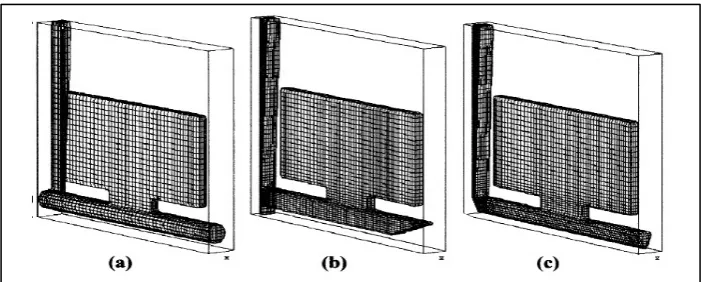
Dai et al.,( 2003), have used Computational Fluid Dynamics (CFD) simulation modeling to simulate the metal flows in different runner systems for LM25 alloy three different runner system designs, vortex runner (VR), round runner (RR) and triangular runner (TR) as shown in were chosen Figure 2.2 were chosen, where they found that the use of VR can effectively control the chaotic behavior of liquid metal flow in the runner, assist in the reduction of ingrate velocity, and the consequent reduction of casting defects such as biflim and air entrainment.
Lewis et al., (2005), drew the attention on using finite element methods by the model used in his investigation for squeeze casting of LM25. From the
15
Figure 2.2: The general three runner system designs (a) VR; (b) RR; (c) TR of (Dai et al., 2003).
Rao et al., (2006), studied about microstructure and wear behavior of grain refinement and modified alloy AL-7Si-0.3Mg (LM25). During the investigation which is combined grain refinement and modification by inculcating LM25 melt with master alloy containing Ti, C and Sr (synthesized in the author’s laboratory) at 720oC.
It is found by Kocatepe (2007) that the wear resistance of LM25 alloy improved with the addition of this master alloy containing (Ti, C and Sr) up to 0.5 wt%. Whereas, an attempts has been done to study the effect of low frequency mechanical vibration on the porosity of unmodified and metallic sodium modified (LM25) where his research was an attempt to add new elements and detect the alloy behavior (Kocatepe, 2007).
HABRIL et al., (2009), has demonstrated the melt quality of an LM25
2.4 Metal quality
One of the difficulties faced by the foundry technologist and researchers is to obtain a reliable quality. Hence, broad hard works have been made to make quality products from various alloy systems meeting the demanding mechanical behavior.
There are three important features that define metal quality: control of trace elements, reduction of porosity, and removal of non-metallic inclusions. Inclusions in the aluminum alloy act as stress-raisers, and can cause premature failure of a
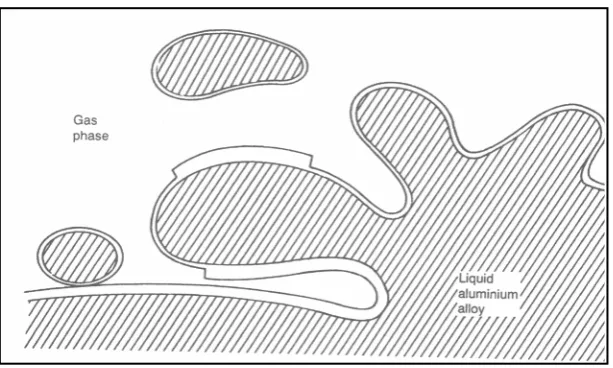
component (Makarov et al., 1990; Makarov et al., 1999; Seniw et al., 2000) . Oxide particles and films are often the most common inclusions observed within aluminum melts. The oxides arrive in the melt right from the start of melting or during the pouring of the molten metal into the mold. They arrive as oxide skins on the surface of the material to be melted as shown in Figure 2.3. When remelted in a crucible furnace, or other type of bath of molten metal, as each piece of solid charge is submerged and melts, its surface oxide floats free and becomes suspended in the melt. Such films are finally found as complete, massive, film-like or dross-like inclusions in finished castings (Campbell, 2003).The presence of these defects, as well as gas or shrinkage porosity formed during solidification, can make properties unpredictable and significantly affect the mechanical properties of aluminum castings (Green & Campbell, 1994; Caceres & Selling, 1996; Caceres, 1998), especially the ductility and fatigue properties.
17
Figure 2.3: Surface turbulence; probably the most common mechanism which introduces bifilm into the melt: The folding of the film, dry side to dry side will trap gas between the surfaces (Campbell, 2003).
2.5 Casting filling process
A group of parameters that influence and play a key role in the manufacturing of cast parts such as fluidity , gating system design, pouring temperature, grain refinement, frequency vibration, etc. Theses parameters affect directly or indirectly on the final product quality and give the final grade of the casted part. In this chapter, the filling process will be demonstrated subsequently and the focus of attention will be on the gating system and pouring temperature since it is classified as a major factor influencing the casting filling process.
During the filling process, the behavior of molten metal and it subsequent solidification determine whether the cast shape will be properly formed and
damage” . It was found that the entrapped oxide film is frequently accompanied by different casting defects such as shrinkage pore, cracks and porosity.
Barkhudarov & Hirt, (1995), also showed a good agreement with Campbell, (2003) and Kim et al., (2006) about significance of mold filling process to determine the mechanical properties of the metal casting especially the casted products that exhibit the formation of strong oxide film such as aluminum alloys. Their
inverstigation was on simulation of surface turbulence phenomena during mold filling. They demonstrated that there is a possibility of using advanced numerical methods to accurately describe three dimensional mold filling phenomena with large deformation of free metal surface. Such modeling can be useful for designing of gating system and detect the flow behaviour of molten metal through the gating passages.
Furthermore, Babaei et al., (2005) found that mold filling is very important step to determine the quality of a casting product. The fluid flow phenomena during mold filling is very closely related to the casting quality, surface finish and macro segregation of the cast part erosion. Dimensional accuracy of a casting and die life is also affected by flow in the mold cavity. In addition, the flow pattern of metal affects the temperature distribution in the mold cavity, which is an initial conditon for solidification process to occur.
2.5.1 Fluidity
The fluidity of an alloy plays a key role for the foundry and industries as it affects the quality and soundness of the cast products. Particularly, fluidity influences the reject rates, hence casting costs and the production of thin-walled parts, hence light components. The ability of molten metal to fill the mold cavity is defined as fluidity in casting field. It can be defined as the quality of liquid metal which enable it to flow through mold cavity and to fill all the interstices of the mold, providing sharp outlines and faithful reproduction of design details (Beeley, 2001).
19
water or liquefied natural gas. Molecules in liquid do not form rigid crystalloid structure and, therefore, can move easily relative to each other. This behaviour distinguishes fluids in general from solid materials. At the same time, these
molecules are packed sufficiently close to each other to experience strong forces of mutual attraction that make it hard to pull a piece of liquid apart. At the same time, it is also hard to compress a liquid to a smaller volume. Therefore, liquid, unlike gases, can be treated as essentially incompressible materials (Reikher & Barkhudrarov, 2007).
Fluid flow behaviour is characterized by density, pressure, temperature and velocity (Reikher & Barkhudrarov, 2007). In the casting field, the molten metal flow gating system (pouring basin, sprue, runner, ingate) design of casting mold is
strongly depends on knowledge of fluid flow.
The foundry man must take into account to avoid sudden changes in flow direction and trying as much as possible to reduce the molten metal velocity as it is considered one of the major factors of fluidity that effecting on turbulent flow to be below the harmful velocities (Campbell, 2003; Hsu et al., 2006).
The fluidity normally being affected by two major factors that influence the molten metal flow which are: characteristic of molten metal and casting parameter. Below are the characteristics of molten metal influencing the fluidity (Yussni, 2006):
• Viscosity
• Surface tension
A high surface tension has the effect of increasing the pressure required for liquid metal flow. A number of elements influence surface tension primarily through their effects on the surface tension of the oxide. Because of this, oxide film on the surface of the molten metal has a significant adverse effect on the fluidity.
• Inclusion
As in soluble particles, inclusion can influence the fluidity of liquid metal. This influence can be verified by observing the viscosity of a liquid such as oil with and without sand particles in it. The former has a higher viscosity.
• Metal composition
High fluidity is commonly found to be associated with pure metals and with alloys of eutectic composition, whereas alloys forming solid
solution, especially those long freezing range, tend to show poor fluidity.
The following casting parameters influence fluidity and also the molten metal flow and thermal characteristics of the system:
• Mold and gating system design
21
• Mold material and its surface characteristics
The higher thermal conductivity of the mold and the rougher the mold surface, the lower fluidity will be for the molten metal inside. Although heating the mold will improve the fluidity, it’s also degrading the solidification of the liquid metal. Thus, the casting develops coarse grains and hence has lower strength, lower hardness and low ductility.
2.5.1.1 Turbulence flow
The final quality of aluminum casting is greatly affected by the turbulent flow in the mold region. Therefore, for high strength aluminum casting, the idea is to limit the turbulent flow of the molten aluminum that break surface air entrained films formation during filling the mold. One of the main functions of gating system is to eliminate the turbulent flow and allow to oxides and slag to separate out of molten metal flow (Chastian & Stephen, 2005). Turbulence is inconsistent and irregular variations in the speed and direction of flow throughout the liquid metal as it travels through the casting. The randomness impacts caused by turbulence, amplified by the high density of liquid metal can cause mold erosion. An undesirable effect in the manufacturing process of casting, mold erosion is the wearing away of the internal surface of the mold. It is particularly detrimental if it occurs in the main cavity, since this will change the shape of the casting itself. Turbulence is also bad because it can increase the formation of metal oxides which may become entrapped creating porosity in the solid casting. Sirviö et al., (2008) reported that according to the time gained from simulation, the following direct improvements to the cast process with no turbulent flow could be gained:
a. Improvement of the casting quality by minimizing the entrapped air during the shot sleeve process.
c. Optimization of the whole casting process by controlling filling with optimal plunger movement.
As mentioned previously, manufacturing a casting, turbulence is always a factor in flow of molten metal. Turbulence is bad because it can trap gases in the casting material and cause mold erosion. Turbulence can be reduced by the design of a gating system that promotes a more laminar flow of the liquid metal. Sharp corners and abrupt changes in sections within the casting can be a leading cause of
turbulence (Campbell, 2003).
For aluminum, Campbell, (2003) mentioned that critical velocities of molten metal flow can cause the surface turbulence and the only way to maintain it is by finding a technique to control the harmful velocities of molten metal and prevent the turbulence from occurring. Campbell also mentioned that the critical velocity is precisely 0.5 m/s. This investigation aims to employ the vortex gate which has the capability of controlling the velocity to be below the critical velocity.
2.5.2 Gating system
When selecting to manufacture a part by casting one must consider the material properties and possible defects that this manufacturing process produces. The
23
Esparza et al., (2005), had performed the 3D gating design optimization. Two variables were runner depth and tail slope and a mathematical nonlinear optimization model was developed with the aim of minimizing the aluminum velocity subject to constraints which ensure there was no trapped air in the main runner when they enter the mold cavity via ingate.
Masoumi et al., (2006), studied the effect of gating on mold filling, where direct observation was employed to experimentally observe the flow pattern. The results showed that an increase in the width of gate with a constant thickness resulted in variation of mold filling. A considerable effect of the geometry of a gate with constant cross section area on flow pattern was observed, which primarily resulted from change of the metal head pressure at the entrance.
Babaei et al., (2005), improved advection algorithm of computational
modeling if free surface flow using structured grids. Computer model was developed with features with accurate convection of fluid in all directions in free surface and the mold filling was simulated in 3D. There was a good correlation between the experimental and simulated results for gray iron samples. This was due to higher momentum of melt dur ing the filling of the mold.
It’s shown that an optimum gating design could reduce the turbulence of molten metal flow inside the mold; minimize air entrapment, sand inclusion, oxide film and dross (Hu et al., 2000; Dai et al., 2003).
Hu et al., (2000), designed and optimized the runner and gating systems for the die casting of thin walled magnesium telecommunication parts. They discovered that a proper runner and gating system is very important to secure good quality die casting through providing a homogenous mold filling pattern. The preliminary design with a split gating system leads to swirling filling pattern and insufficient central flow, which prematurely closed the edges and left the last filled areas falling into inner portion of the part. The preliminary design was improved by using continuous gating system and bigger runner size. The gate area was increased and gating speed slightly reduced.
Dai et al., (2003), studied the effect of runner system design (vortex,
the chaotic behavior of liquid metal flow in the runner, assist in reduction on ingate velocity and the consequent reduction of casting defects. They discovered that for aluminum alloys casting, the decrease of mechanical properties was closely related with the area fraction of defects, such as porosity and oxide film in fracture surface of the casting sample.
Fluid flow phenomena involved in the stage of mold filling has a direct consequence to the formation of various defects, for instance, rigorous streams and highly turbulent flows will cause mold erosion and air entrapment. On the other hand, relatively slow filling will lead to premature solidification and it will prevent the molten metal from being displaced within the mold (Li et al., 2006).
Li et al., (2006), investigated experimentally the mold filling process in vertical centrifugal casting, the results from the experiment showed that the bottom filling was better than the top one, which could achieve stable filling, minimizing turbulence and avoid drastic liquid collision. Furthermore, improper design of the gating system will lead to porosity defects in casting (Lee et al., 2001; Katzarov, 2003).
Lee et al., (2001), reviewed five models in modeling micro porosity in
aluminum-silicon alloys. They discovered that each of five types of models reviewed had limitation. It was pointed out that the next generation of models should
incorporate shrinkage porosity into existing continuum stochastic, diffusion limited growth models by using Darcy’s law. The existing porosity defect would decrease the mechanical properties of the product. Generally, the greater amount in porosity of casting components will be the deterioration in mechanical properties.
Katzarov, (2003), modeled the porosity formation in casting by using finite element method. The model provided the predictive tool for micro porosity
REFERENCES
Agrawal, B.K., (1988). Introduction To Engineering Materials. New Delhi: McGraw-Hill.
Ammen, C.W., (1979). The Complete Handbook of Sand Casting. 1st ed. New York: Mc Graw-Hill.
Babaei, R., Asgari, A. & Devasmi, P., (2005). Modeling of Air pressure effect in casting moulds. Journal of Modeling And Simulation in Material Science and Engineering , 13, pp.903-917.
Barkhudarov, M.A. & Hirt, C.W., (1995). Casting Simulation: Mould Filling and Solidification –Benchmark Calculations Using FLOW-3D. Flow Science inc.
Bjana., Saydave, B., Krishna, C., (1996). Development and certification of Ti-8Al-1Mo-1V alloy for HP compressor blades for adour engine applications.
Bulletin of Materials Science, 19, pp.661-669.
Beeley, P., (2001). Foundry Technology. 2nd ed. Butterworth-Heinnman: Oxford.
Budgen, N.F., (1947). Aluminium and Its Alloys. 2nd ed. London: Pitman & Sons.
Caceres, C.A., (1998). A rationale for the quality index of Al-Si-Mg casting alloys.
International Journal of Cast Metals Research, 10, pp.293-299.
Caceres, C.H. & Selling, B.I., (1996). Casting defects and the tensile properties of an Al-Si-Mg alloy. Materials Science and Engineering, A220, pp.109-116.
Campbell, J., (2004). Casting practice : the 10 rules of casting. Butterworth-Heinemann: Elsevier.
Chastian, D. & Stephen, J., (2005). Melt Reaction. In Metal Casting: A Sand Casting Manual for The Small Foundry. 2nd ed. p.34.
Dai, X., Yang, X., Campbell, J. & Wood, J., (2003). Effects of runner system design on the mechanical strength of Al-7Si-Mg alloy castings. Materials Science and Engineering, A354, pp.315-325.
Duff, E.S., (1999). Fluid Flow Aspects of Solidification Modeling: Simulation of Low Pressure Die Casting. Ph.D Thesis. The University of Queenland.
Efunda, (2009). efunda. [Online] Available at:
[Accessed 2 jan 2010].
Esparza, C.E., Guerrero Mata, M.P. & Rios Mercdo, R.Z., 2005. Optima Design of gating system by gradient search method. Computional material Science.
Foundry, B., (2008). UK RACING CASTINGS. [Online] Available at:
Green, N.R. & Campbell, J., 1994. Influence of oxide film filling defects on the strength of Al-7Si-Mg alloy castings. AFS Transactions, 102, pp.341-347.
Guharaja, S., Haq, A.N. & Karuppannan, K.A., (2005). Optimization of green sand casting process parameters by using Taguchi's Method. International Journal of Advanced Manufacturing Technology, 134, pp.155-159.
Habril, K., Schumacher, P., Geier, G. & Georg, B., (2009). Characterization of the Melt Quality and Impurity Content. Metallurgical and Materials
101
Heine, R.W., Loper Jr, C.R. & Rosenthal, P.C., (1967). Principles of metal casting. 2nd ed. McGraw-Hill.
Higgnis, R.A., (1993). Engineering metallurgy- Part I. Eauston Road-London.
Hsu, F.U., Jolly, M.R. & Campbell, J., (2006). Vortex-gate design for gravity casting. International Journal of Cast Metals Research, 19(1), pp.38-44.
Hu, B.H., Tong, K.K., Niu, X.P. & Pinwill, I., (2000). Design and opimization of runner and gating system for die casting of thin-walled magenisium
telecommunication parts through numerical simulation. Journal of Material Processing Technology, 105, pp.123-133.
Institute, I.A., (2008). world-aluminium.org. [Online] Available at:
www.world-aluminium.org [Accessed 23 December 2009].
Jain, P.l., 2003. Principles of Foundry Technologies. New Delhi: McGraw-Hill.
Jiang, H., Bowen, J. & Knott, F., (1999). Fatique performance of a cast aluminium alloy Al-7Si-Mg with surface defects. Journal of Material Science, 34, pp.719-725.
Joseph R, D., (1993). Aluminum and aluminum alloys. 1st ed. ASM Handbook.
Kalpakjian, S. & Schmid, S.R., (2001). Manufacturing Engineering and Technology. 4th ed. Upper Saddle River: Prentice Hall.
Katzarov, I.H., (2003). Finite element modeling of porosity formation in casting.
International Journal of Heat and Mass Transfer, 46, pp.1545-1552.
Kim, K.D., Yang, D.Y. & Jeong, J.H., (2006). Adaptive refinement techniques based on tetrahedral and hexahedral grids of finite element analysis of mold filling casting process. Computer Methods in Applied Mechanics and Engineering, 13, pp. 32-43.
Kocatepe, K., (2007). Effect of Low Frequency Vibration on Porosity of LM25 and LM6. Material and Science , pp.1767-1775.
Kotzin, E.L., (1981). Metalcasting & Molding Processes. Article. Illinois: American Foundrymen's Society.
Lee, P.D., Chirazi, A. & See, D., (2001). Modeling microporosity in aluminum silicon alloy. Journal of light metal, 1, pp.15-30.
Lee, P.D. & Hunt, J.D., (2001). Hydrogen Porosity in Directionally Solidified Aluminum-Copper Alloys : A mathematical model. Journal of Material, 49, pp.1383-1398.
Lewis, R.W., Postek, E.W., Han, Z. & Gwthin, D.T., (2005). A finite element model of the squeeze casting process. International Journal of Numerical Methods for Heat & Fluid Flow, 16(5), pp.539-572.
Li, C.Y. et al., (2006). Numerical simulation and experimental investigation of two filling methods in vertical centrifugal casting. Transactions of Nonferrous Metals Society of China, 16(5), pp.1035-1040.
Makarov, S., Apelian, D. & Ludwig, R., (1990). Inclusion removal and detection in molten. AFS Transactions, p.107.
103
Manufacturing, t.l.o., (2009). Design Considerations in Metal Casting. [Online] Available at:
[Accessed 24 January 2010].
Masoumi, M., Hu, H., Hedjazi, J. & Boutorabi, M.A., (2006). Effect of Gating Design on Mold Filling. American Foundy Society.
Mirbagheri, S.M.H. et al., (2004). Modelling the effect of mold wall roughness on the melt flow simulation in casting process. Applied Mathematical Modeling, 28, pp.933-956.
Mohamed, B. & Akpan, P.P., (2007). Behavior of Aluminum Alloy Castings under Different Pouring Temperatures and Speeds. Leonardo Electronic Journal of Practices and Technologies, pp.71-80.
Pathak, N., Yadav, A. & Dutta, P., (2008). Mould Filling Simulation. Bangalore: Department of Mechanical Engineering, Indian Institute of Science.
Pathak, N., Yadav, A. & Dutta, P., (2009). Benchmark Validation using FLUENT. Indian Instiute of Science Engineering.
Polmear, I.J., (1995). Light alloys: metallurgy of the light metals. 3rd ed. Arnold.
Publications, B.S., n.d., (2009). Standard UK.com. [Online] Available at:
[Accessed 13 December 2009].
Rao, A.K.P., Dasa, K., Murty, B.S. & Chakaroborty, M., (2006). Microstructural and Wear Behavior of Hypoeutectic Al-Si Alloy(LM25) Grain Refined and Modified with Al-Ti-C-Sr Master Alloy. pp.133-166.
Reikher, A. & Barkhudrarov, M.R., (2007). fluid flow. In b. Prof Derby, ed. Casting: An Analytical Approach. 1st ed. London: Springer. p.12.
Rezvani, M., Yang, S. & Campbell, X., (1999). AFS Trans. pp.181-188.
Rezvani, M., Yang, X. & Campbell, J., (2004). Effect of ingate Design on Strength and Reliability of Al Casting. University of Brimingham, pp.185-188.
Rzychon, T. & Kielbus, A., (2007). The influence of caspouring temperature on microstructure and fluidity of AE42 alloy. 28, pp.345-348.
Seniw, M.E., James, G., Cloney & Morris, E., (2000). The effect of microscopic inclusion locations and silicon segregation on fatigue lifetimes of aluminum alloy A356 castings. Journal of Materials Science and Engineering, 285(1-2), pp.43-48.
Sirrell, B., Holliday, M. & Campbell, J., (1996). Benchmark testing flow and solidification modeling of Al castings. Journal of Materials, 48, pp.20-23.
Sirviö, M., Vapalahti, S. & Väinölä, J., (2008). Complete Simulation of High Pressure Die Casting Process. Complete Simulation of High Pressure Die Casting Process, 25, pp.1-6.
105
Tavakoli, R., Babaei, R., Varahram, N. & Davami, P., (2004). Numerical simulation of liquid/gas phase flow during mould filling. Methods Appl. Mech. Engrb, 196, pp.697-713.
Tian, C., Law, J. & Nan Der, T.J., (2002). Effect of melt cleanliness on the formation of porosity defects in automotive high pressure die casting. Journal of
Material and Processing Technology, 122, pp.82-92.
Weibull, W., (1961). Fatigue Testing and Analysis of Results. Pergamon.
Yang, X. et al., (2004). Numerical modeling of the entrainment of oxide film defects in filling of aluminum alloy casting. International Journal of Cast Metal Research.
Yang, X., Jolly, M. & Campbell, J., 2000. Minimization of surface turbulence during filling using a Vortex-flow runner. Aluminum Transactions, 2, pp. 67-80.
Yussni, H., (2006). Effect of Runner Diameter on the Mechanical Strength and porosity content of Al-12Si Alloy Casting. Universiti Tun Hussein Onn Malaysia. Master Thesis.