Broker-based Service-oriented Content Adaptation Framework
by
Mohd Farhan Md Fudzee MSc. (IT), BSc. (IT), Dip. (Comp. Sc.)
Submitted in fulfilment of the requirements for the degree of
Doctor of Philosophy
Deakin University
Abstract
Electronic documents are becoming increasingly rich in content and varied in format and structure. At the same time, user preferences vary towards the contents and their devices are getting increasingly varied in capabilities. This mismatch between rich contents and user preferences along with the end device capability presents a challenge in providing ubiquitous access to these contents. Content adaptation is primarily used to bridge the mismatch by providing users with contents that is tailored to the given contexts e.g., device capability, preferences, or network bandwidth. Existing content adaptation systems employing these approaches such as client-side, server-side or proxy-side adaptation, operate in isolation, often encounter limited adaptation functionality, get overload if too many concurrent users and open to single point of failure, thus limiting the scope and scale of their services. To move beyond these shortcomings, this thesis establishes the basis for developing content adaptation solutions that are efficient and scalable. It presents a framework to enable content adaptation to be consumed as Web services provided by third-party service providers, which is termed as “service-oriented content adaptation”. Towards this perspective, this thesis addresses five key issues – how to enable content adaptation as services (service-oriented framework); how to locate services in the network (service discovery protocol);
Table of Contents
Introduction ... 1
1.1 Motivation and Scope ... 2
1.2 Research Significance... 3
1.3 Research Problems ... 3
1.4 Research Objectives ... 4
1.5 Methodology ... 5
1.6 Research Contributions ... 5
1.7 Thesis Organization ... 6
Content Adaptation Systems ... 9
2.1 Introduction ... 9
2.2 Background ... 10
2.3 Existing Content Adaptation Systems ... 15
2.3.1 Representative Content Adaptation Systems ... 15
2.3.2 Existing Taxonomies ... 19
2.4 A Taxonomy of Content Adaptation Systems ... 20
2.4.1 Design Themes ... 20
2.4.2 Content Adaptation Strategies ... 22
2.4.3 Content Adaptation Components ... 29
2.4.4 Extended Service Oriented Architecture (SOA) ... 39
2.5 Mapping Taxonomy to Existing Systems ... 40
2.6 Positioning the Thesis ... 44
2.7 Summary ... 45
SOCA Framework ... 47
3.1 Introduction ... 47
3.2 Service-oriented Content Adaptation (SOCA) ... 49
3.2.1 Architecture ... 49
3.2.2 Interaction Protocol ... 51
3.2.3 Request Management Components ... 53
3.4 Summary ... 70
Service Discovery Protocol ... 71
4.1 Introduction ... 71
4.2 Models ... 72
4.2.1 System Model ... 72
4.2.2 Content Adaptation Request ... 73
4.2.3 Matching Request and Service ... 74
4.2.4 Problem Statement ... 76
4.2.5 Performance Metrics ... 76
4.3 Service Discovery Protocol ... 78
4.3.1 Architecture ... 78
4.3.2 Analysis of Protocol ... 85
4.4 Performance Evaluation ... 88
4.5 Results and Discussion ... 90
4.6 Summary ... 96
Path Determination ... 99
5.1 Introduction ... 99
5.1.1 Problem Statement ... 100
5.2 Adaptation Path Determination Policy (APDC) ... 101
5.2.1 Constructing Adaptation Path ... 102
5.2.2 Calculate Aggregate Score ... 104
5.2.3 Service Selection ... 107
5.2.4 Analysis of Algorithm ... 108
5.3 Performance Evaluation ... 109
5.4 Results and Discussion ... 112
5.4.1 Single Optimal Path Generation ... 112
5.4.2 APDC’s Execution Analysis ... 115
5.5 Summary ... 116
Service Level Agreement ... 119
6.1 Introduction ... 119
6.2 Requirement for SLA ... 120
6.2.1 Quality Views ... 121
6.2.3 Problem Statement ... 123
6.3 SLA Framework ... 124
6.3.1 Architectural Framework ... 124
6.4 Negotiation Strategy ... 135
6.4.1 Proposed Strategy ... 138
6.4.2 Analysis of Strategy ... 144
6.5 Performance Evaluation ... 150
6.6 Results and Discussion ... 152
6.6.1 SLA Settlement Rate ... 152
6.6.2 Rejection Rate ... 154
6.6.3 Potential SLA Violation ... 154
6.8 Summary ... 156
Conclusion and Future Directions ... 157
7.1 Conclusion ... 157
7.2 Future Directions ... 160
7.2.1 Solutions in Multimedia Content Distribution ... 160
7.2.2 Service Outsourcing ... 161
7.2.3 Web Design Requirements ... 161
7.2.4 Non-technical Issues ... 162
7.2.5 Scalability of ADTE ... 162
7.2.6 SLA Monitoring and Enforcement ... 162
7.2.7 Energy-Aware Routing ... 163
7.2.8 Failure Detection and Recovery ... 163
7.2.9 Trust Issues ... 164
List of Figures
Figure 1.1: Non technical view of content adaptation issue…..………2
Figure 2.1: Typical content adaptation layers………11
Figure 2.2: Content adaptation abstract model………...13
Figure 2.3: Content adaptation design themes taxonomy………...20
Figure 2.4: Content adaptation strategies taxonomy………...23
Figure 2.5: Classification of content types……….25
Figure 2.6: Classification of content structure models………...27
Figure 2.7: Content structure illustration………28
Figure 2.8: Content adaptation contexts taxonomy……….29
Figure 2.9: Contexts monitoring taxonomy………32
Figure 2.10: ADTE taxonomy……….………….…...32
Figure 2.11: Service discovery taxonomy………....33
Figure 2.12: Path determination taxonomy………36
Figure 2.13: [13]’s score computation illustration...……….…….37
Figure 2.14: Extended SOA [161]……….40
Figure 3.1: Service-oriented content adaptation framework………..49
Figure 3.2: Content adaptation sequence diagram……….52
Figure 3.3: Required tasks precedence graph……….56
Figure 3.4: Service discovery component...…....57
Figure 3.5: Possible adaptation paths……….59
Figure 3.6: (a) positive monotonic QoS (b) negative monotonic QoS………60
Figure 3.7: Example of paths’ score tree……….61
Figure 3.8: (a) OCM (b) SCM……….62
Figure 3.9: (a) Combining SCM with OCM (b) Combining OCM with SCM………...62
Figure 3.10: SLA management framework for service-oriented content adaptation…..64
Figure 3.11: Local proxies-Web Services interaction model………...66
Figure 3.12: Port binding operation……….67
Figure 3.13: Simultaneous service’s proxies’ interaction for content passing………...67
Figure 3.14: An example of a translation adaptation service’s definition using WSDL.68 Figure 4.1: Service discovery architecture for service-oriented content adaptation…...78
Figure 4.2: The proposed service discovery protocol………..80
Figure 4.3: Service discovery algorithm………..81
Figure 4.4: Update algorithm………...83
Figure 4.5: Algorithm discoverability towards task variations………...91
Figure 4.6: Algorithm discoverability towards service provider variations…………....92
Figure 4.7: Algorithm discoverability towards QoS variations………...93
Figure 4.8: Algorithm discoverability towards client variations……….94
Figure 5.1: Adaptation path determination scenario………101
Figure 5.2: APDC algorithm……….102
Figure 5.3: Paths’ score tree generation………104
Figure 5.4: Paths’ score tree with aggregate score………106
Figure 5.5: Content adaptation control information...…....107
Figure 5.6: Single Optimal Path Generation towards QoS………...113
Figure 5.7: Single Optimal Path Generation towards Tasks……….114
Figure 5.8: Single Optimal Path Generation towards Service Providers………..115
Figure 6.1: Execution against varied sizes for desktop and mobile devices………….123
Figure 6.2: SLA framework for service-oriented content adaptation……….…..125
Figure 6.3: Negotiation in creation phase………..128
Figure 6.4: Monitoring phase……….132
Figure 6.5: Enforcement phase………..133
Figure 6.6: Negotiation context……….136
Figure 6.7: Service provider modelled as a M/G/1 queue……….138
Figure 6.8: SLA evaluator algorithm……….142
Figure 6.9: Advertised E(W) versus new E(W) to be offered based on current load…143 Figure 6.10: SLA settlement rate versus number of requests (server load = 0.6)…….152
Figure 6.11: SLA settlement rate versus server load variations (λ = 60)………..153
Figure 6.12: Request rejection versus server load variations (λ = 60)………..154
List of Tables
Table 2.1: List of HTTP request headers……….30
Table 2.2: Mapping representative centralized systems with the taxonomy…………...41
Table 2.3: Mappingrepresentative decentralized systems to the taxonomy……..…….43
Table 3.1: Example of service registry………51
Table 3.2: Examples of criteria categorization………60
Table 4.1: Example of content adaptation types……….74
Table 4.2: List of notations………..76
Table 4.3: Example of result returned by the proposed protocol……….84
Table 5.1: List of notations………101
Table 5.2: Examples of QoS categorization………..105
Table 5.3: List of workloads………..110
Table 5.4: List of QoS used………...112
Table 5.5: APDC average service selection improvement ratio………116
Table 6.1: Example of common QoS for a service………126
Table 6.2: Example of adaptation functions including objective QoS and SLA……..126
Table 6.3: Example of an SLA tags property………129
Table 6.4: List of commonly used notation………...130
Table 6.5: Example of non-compliance attributes……….134
Table 6.6: List of commonly used notation………...139
Table 6.7: Characteristics of different priority models………..141
Chapter 1
Introduction
The rapid development of digital media technologies has enabled the emergence of
novel media content types for various domains including e-Commerce, e-Education,
and e-entertainment. As a result, there is a phenomenal growth in consumable electronic
information on subjects such as entertainment, security, education, and technical
documentation targeted to diverse users in the form of content and services.
While online documents are becoming increasingly rich in content and varied in
format and style, the original content is normally developed for a specific platform and
is naturally made-up of media objects of different types with complicated structure and
layout [1]. For instance, most of existing Web content is originally designed for desktop
displays. At the same time, client devices are getting increasingly varied in their
capabilities (e.g., processing power, input and output facilities). Therefore, direct
content delivery to handheld devices without layout adjustment often leads to
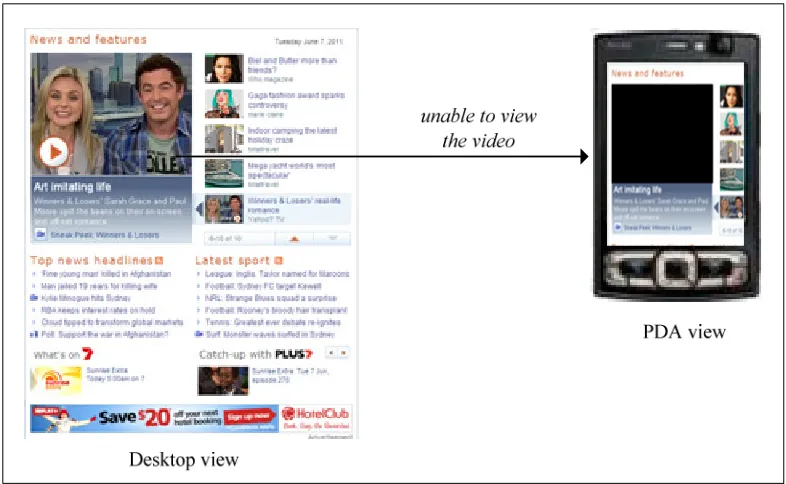
disorganization of information [2]. Moreover, as depicted in figure 1.1, not every
handheld device can play all media types. For example, a non-multimedia mobile phone
cannot play continuous video clips, while only H.264, MPEG-4 and M-JPEG formats
are currently supported for iPhone video playback. As such, some widely employed
video formats such as MKV and FLV will require format conversion or additional
player before they can be played on iPhone.
Although content providers are under constant pressure to make content available
in a variety of formats and for a variety of purposes [3], the mismatch between rich
continues to present a challenge in providing seamless and ubiquitous
device-independent access to the online electronic contents to interested users. It becomes
apparent that a mechanism for dynamically transforming the original content to suite the
[image:10.612.109.502.177.419.2]end device and user’s preference as appropriate is required.
Figure 1.1: Non technical view of content adaptation issue.
1.1 Motivation and Scope
Content adaptation has emerged as a potential mechanism to address some of the
problems arising from the content-device mismatch [2, 4, 5, 6, 7, 8, 9, 10, 11]. Although
many content adaptation approaches have been proposed, most of them tend to be fully
or partially centralized. Problems with centralized adaptation scheme such as scalability
and single-point failure are well known [12]. In order to address these problems, the
idea of establishing content adaptation as a service that allows the use of a large number
of adaptation mechanisms located in many places in the network has recently been
advocated [11, 13, 14, 15]. Thus, the in-depth exploration of service-oriented
architecture for content adaptation together with the enabling mechanisms is required to
provide flexible and scalable content adaptation services. Unfortunately, analysis of the
few rudimentary frameworks exist. Also, in order to provide an efficient
service-oriented content adaptation system, enabling mechanisms such as service discovery,
path determination and service quality assurance are essential. However, these
mechanisms have not been fully explored. The reason for this lack of progress is due to
the complexity of the technological problems that need to be addressed in the practical
context.
1.2 Research Significance
The content adaptation challenge is how to make the original contents readily available
on a wide range of access devices for interested clients. One way to address this
problem is by creating and maintaining different format of the original content suitable
to the targeted access devices. However, keeping multiple copies of the original content
will lead to tremendous overhead and places unwieldy burden on to the content authors.
Thus, what is required is a content adaptation system with the appropriate logic to
analyse the content and all aspects of the adaptation contexts and formulate the content
adaptation strategy accordingly. There are many content adaptation approaches that
generate any content version from one single original version [3, 6, 7, 8, 9, 10, 16]. A
request may require multiple content adaptation tasks that can lead to the requirement of
multiple adaptation strategies including cross-media adaptation (e.g., media conversion,
translation, summarization, and integration). None of existing standalone content
adaptation systems is able to completely serve this request. Moreover, building one
system that capable of providing various adaptation strategies is inefficient and costly.
On the other hand, there are many service providers offering a variety of content
adaptation that can be loosely coupled. Therefore, the solution for these services is to
cooperate with each other to completely serve the request that they cannot attain
individually. A platform that enables such interconnection and interoperation is
required. Thus, a greater scale as well as service quality can be achieved.
1.3 Research Problems
This thesis tackles the research challenges in relation to the development of scalable and
multiple service providers. While service-oriented content adaptation is appealing, the
challenges in adopting it include architecting a system that analyses the required content
adaptation tasks and distributes these tasks to the potential service providers. In
particular, we identify and investigate the following five research issues:
• How to enable content adaptation as services. The platform that allows content adaptation to be performed as services by external service providers. This
should include the essential mechanisms to manage client requests and service
provider advertisements.
• How to locate services in the network. The protocol used to locate potential content adaptation service from the network. Such a protocol must take into
account searching space, searching time, matching category of services and
physical location of the service providers.
• How to select best possible services. The decision making mechanism used for choosing the best possible services to serve a request, given that multiple
services can potentially perform a particular task.
• How to provide quality assurance. The framework used to manage service agreement between service providers and clients. It should formally specify the
creation, monitoring and enforcement of such an agreement.
• How to negotiate quality of service. A mechanism to negotiate QoS before the agreement being settled. Service provider should ensure that the QoS they
advertised is deliverable to avoid potential violation.
1.4 Research Objectives
To achieve the research aim, three main research objectives are identified and need to
be fulfilled:
1. To develop the taxonomy of content adaptation systems and to determine the
issue pertaining to existing content adaptation systems that have not been fully
explored.
2. To design a conceptual framework for the service-oriented content adaptation
based on the identified components and functions required for a complete
3. To design, develop and analyse the enabling mechanisms, i.e. service discovery,
path determination and service level agreement, in relation to service-oriented
content adaptation.
1.5 Methodology
The proposed work will be carried out based on the experimental computer science
method [17]. This method examines the research work to demonstrate two important
concepts: proof-of-concept and proof-of-performance.
To demonstrate the proof-of-concept, some important steps were performed. First,
the research area within content adaptation is critically reviewed to provide the
overview that leads to the formulation of valid problem statements. From this review,
the research work is justified. Then, the proposed conceptual framework of the
service-oriented content adaptation architecture is designed and analytically analysed.
Proof-of-performance is demonstrated by conducting the implementation for the
service discovery protocol, path determination and QoS negotiation using simulations.
In those simulations, various parameters and workloads were used to examine and
demonstrate the viability of the proposed solutions compared to the similar competitive
solutions. Also, analytical analysis of some proposed algorithms is performed to
evaluate the correctness.
1.6 Research Contributions
We detail the thesis contributions as the following:
1. Content adaptation taxonomy. This thesis presents a taxonomy of content adaptation systems. It investigates related concepts, describes the design themes
and identifies implementation components required. The presented taxonomy is
mapped to representative content adaptation systems to demonstrate its
applicability. Also, the mapping assists to perform a gap analysis in this research
field.
2. Broker-based service-oriented content adaptation framework. The thesis introduces an architectural model for service-oriented content adaptation. It
for enabling content adaptation as services. An analytical analysis is conducted
to demonstrate the framework applicability.
3. Service discovery protocol. The thesis investigates and presents the protocol to locate available content adaptation services from the network. Along with the
derivation of the discoverability performance metric, extensive simulations have
been conducted to study the performance of the service discovery protocol in
this regards. The proposed protocol is able to quickly terminate the search when
specified conditions are achieved. Also, the analytical analysis proved the
completeness and the accuracy of the protocol.
4. Path determination mechanism. The thesis presents the mechanism to determine the best possible services based on the single objective assignment function. The
proposed mechanism is evaluated through simulations in term of service
selection execution. The mechanism is demonstrated to meet its objective i.e.,
appropriate service QoS value assignment.
5. SLA framework. This thesis introduces a framework for managing service level agreement in relation to content adaptation. It describes the interrelated phases
and the essential mechanisms. Then within the framework, a QoS negotiation
strategy is presented. The proposed negotiation strategy is evaluated through
simulations and is shown to increase SLA settlement, and reduce request
rejection and potential SLA violation as well.
To summarize, the work presented in this thesis is in line with the current trends
that enable multitude content adaptation services without having to build a dedicated
infrastructure [5, 14]. Therefore, it is our thesis to present service-oriented content
adaptation solutions that are scalable and efficient.
1.7 Thesis Organization
The chapters of this thesis are derived from various papers published during the PhD
candidature. The remainder of the thesis is organized as the following:
• Chapter 2: Content Adaptation Systems. This chapter provides an in-depth analysis and overview of existing content adaptation systems, presented within
• Chapter 3: Service-oriented Content Adaptation. This chapter presents an architecture to enable content adaptation to be consumed as services. It
describes the key components to realize service-oriented content adaptation.
• Chapter 4: Service Discovery Protocol. This chapter presents a service discovery protocol in relation to service-oriented content adaptation. The
simulation results are discussed as well.
• Chapter 5: Path Determination. This chapter presents a path determination mechanism in relation to service-oriented content adaptation and the related
simulation results.
• Chapter 6: Service Level Agreement. This chapter presents a framework for managing service level agreement and QoS negotiation strategy in relation to
service-oriented content adaptation. The simulation results of the negotiation
strategy are discussed as well.
Chapter 2
Content Adaptation Systems
The ever-increasing amount of electronic information coupled with proliferation of
diverse and heterogeneous devices, data sources, user preferences and networks has
significantly increased the demand of content adaptation. This makes content adaptation
as a thriving research field. There are many projects focused on the content adaptation
being introduced constantly. This chapter provides an in-depth analysis of current
content adaptation technologies, organized as a comprehensive taxonomy. The
taxonomy provides a basis for categorizing related solutions and being mapped to a few
representative systems to demonstrate its applicability. Then, a “gap analysis” is
performed from the presented literature and used to position the thesis.
2.1 Introduction
Today, computing is no longer limited to a specific location using desktops devices, but
can be done on laptop computers and information appliances (e.g., PDAs, smart phones,
etc.) from anywhere at any time. This new computing platform is known as pervasive or
ubiquitous computing and has recently attracted a lot of attention. However, the
characteristics of this paradigm shift (including device heterogeneity, limited device
capability, and user’s high mobility) bring about new challenges in the delivery of
information, content and services in these environments. This makes the ability to adapt
information, content and services to a diversity of computing devices a key to pervasive
Specifically, devices, standards and software develop rapidly, but still often
independently of each other [15]. This creates problems in terms of content suitability.
Also, in pervasive environment, user and system-level applications must execute subject
to a variety of resource constraints that generally can be ignored in modern desktop
environments. Moreover, Web applications are designed with desktop platform in mind
that usually contains rich media content and authored in a single version. In order to
increase the usability of mobile Internet services, content adaptation is required. Also,
the emergence of these requirements (e.g., device heterogeneity, user preferences, rich
content) demands efficient content adaptation architecture. Designing such an
architecture that will meet these requirements is challenging due to several issues: (a)
supporting scalability, (b) meeting computational constraints, and (c) enhancing adapted
content quality.
In this chapter, we present the literature of the content adaptation field. The
research field of content adaptation have been growing rapidly during the past ten years
and this has resulted in a plethora of new concepts, models and systems. An abstract
architecture for a content adaptation system that succinctly captures the essential
components and functions of a content adaptation system is presented. The significance
of the different components and functions of the model are also discussed. A taxonomy
that classifies the approaches that form the design space and implementation
requirements of content adaptation systems is presented. The applicability of the
taxonomy is demonstrated by mapping representative existing systems. Also, this
taxonomy is used to perform “gap analysis” by revealing some of the areas that are yet
to be fully explored that can lead to creative solutions.
2.2 Background
In this section, we present a generic content adaptation architecture that outlines the
different components of content adaptation system architecture. The architecture is
important to provide a central knowledge regarding the architecture (i.e., components,
functions) choices made by existing content adaptation systems. To keep the model
compact, only the core functions of the content adaptation systems are included. The
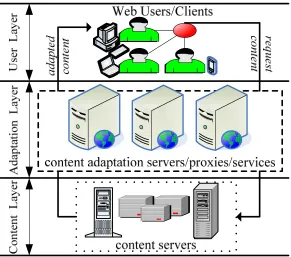
Figure 2.1: Typical content adaptation framework.
Figure 2.1 shows the outline of content adaptation extracted from [2, 6, 13, 19,
20]. Generally, a typical content adaptation contains three layers: user, adaptation and
content layers. At the user layer, user/client requests for the Web content from content
servers via different devices. The content servers are grouped at the content layer and
located in many places across the network. At adaptation layer, original Web content is
tailored to meet the contexts (e.g., device’s constraints, preferences) of each targeted
user determined by adaptation decision. This tailoring process can be performed by the
adaptation mechanism(s) at a single or several different locations (e.g., content servers,
proxies). Finally, the adapted version of the Web content is delivered to the users.
In content adaptation, several essential terms are defined as the following:
Content adaptation is a term that defines the tailoring, aligning or
customizing content into a required version [2, 6]. It is performed to tailor
with the adaptation contexts.
Context is the circumstances surrounding an entity or event [21]. This
Context is motivated by this key question: “to adapt the content to what”. It
could be a device, network, user/client or combination of them.
Client is a Web user that consumed content adaptation services to get the
required content version [12]. Clients use these services directly or through
a service broker.
A system must exist with the appropriate logic to analyse the content with all
aspects of the contexts and formulate the content adaptation strategy that will deliver a
version required by the client. Clients can benefit from the expansion of cross-media
adaptation strategies (e.g., media conversion, translation, summarization and
integration) provided by third-party service providers. This opportunity has attracted
both academic and business communities (e.g., Web services) [15].
In general, a content adaptation system is made of several core components. Some
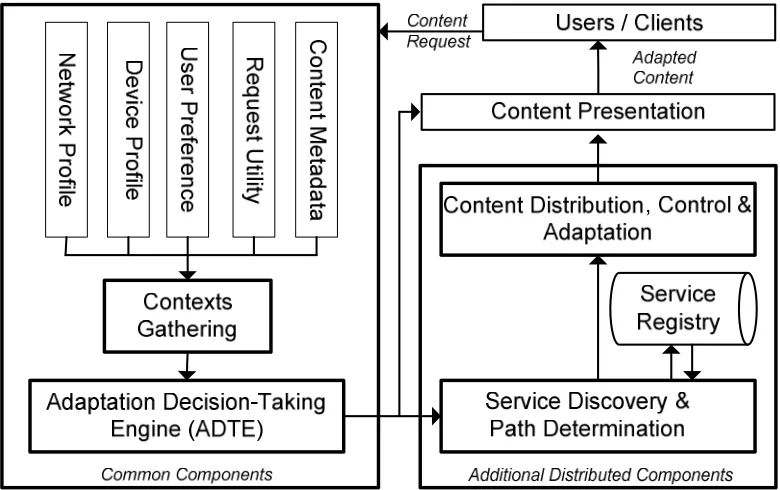
additional components are required for decentralized/distributed architecture. Figure 2.2
shows an abstract model of a content adaptation system. This model is developed by
considering existing systems surveyed. The model contains four components and
divided into two major blocks: common components and distributed components. Each
component has specific function. The abstract model complies with the work presented
in [22, 23, 24].
The common block contains two key components: contexts gathering and
adaptation decision-taking engine (ADTE). Contexts gathering function is to collect
necessary data/information (e.g., network profile, device profile, user preferences)
including the content metadata from the particular entity to be considered for adaptation
and mapping them into the semantic representation. The content metadata (e.g., Web
structure, page dimension, number of objects, links) is collected from the content server.
This metadata is produced in a process called content parser [24]. Network profile (e.g.,
UMTS/GPRS/GSM Data) is gathered on-demand as it is hard to determine the user
network environment in advance and can be gathered using a particular network
monitoring tool. Client profile (i.e., device profile and user preferences) could be
fetched from independent client registry. This registry can be maintained at client
profile server and is updated periodically. For instance, client profile can be represented
introduced by World Wide Web Consortium (W3C). This profile can be detected
through Bluetooth or ZigBee configuration, if activated. Another important function in
the context gathering component is contexts (including resources) monitoring [25]. In
fact, to ensure content adaptation can be carried out accordingly, context monitoring
[image:20.612.117.507.198.443.2]needs to be measured accurately and efficiently.
Figure 2.2: Content adaptation abstract model.
These contexts are sent to ADTE for processing. ADTE analyses these contexts
with the content metadata to produce adaptation decision for obtaining the required
content version. This decision determines the content adaptation tasks/strategies.
Example of the decision from ADTE is adaptation information (e.g., media modality
value, media fidelity value, number of column, etc). For centralized content adaptation
systems, this decision is use by the local adaptation engine to adapt the content
accordingly. That is, the ADTE and the adaptation engine is combined as one
component and located at the same location. Meanwhile, for distributed content
adaptation, the adaptation tasks are distributed to several adaptation proxies across the
Internet [13, 14, 15]. Currently, there are three kinds of ADTE model: probability-based
The second block contains two key components for distributed architecture: path
determination that includes service discovery and content distribution management. The
primary objective of the path determination component is to decide who should perform
the adaptation tasks. Establishing content adaptation as a service allows the use of a
large number of adaptation mechanisms located in many places in the network thus, a
task can be performed by multiple services. To benefit form these services, clients must
be able to locate them in the network. This makes service discovery an important
component. An efficient service discovery mechanism is essential for the success of the
distributed content adaptation systems [26]. Also, selecting appropriate services among
the many located services is necessary to increase the overall performance of the system
[13].
Content distribution management is required to manage the distribution of
content, adaptation tasks (including control information) between clients, local
proxy/broker and adaptation service proxies. Via this component, adaptation tasks
together with the content segments are distributed to several services to be adapted and
a proper control mechanism is imposed to ensure each segment is adapted accordingly.
Efficient and secure content distribution between cooperative intermediaries has been
discussed in [27]. A content distribution mechanism differs for a content delivery
system such as [28] in which the former requires content to be modified by the service
proxies along the path. On the other hand, content delivery only deal to provide client
with the original content requested from the origin content server through replicated
servers across the Internet. A fault tolerance mechanism can assist content distribution
to recover failed service(s) [1].
Content distribution can be managed using two approaches: centralized
(star-based topology) and decentralized (mesh-(star-based topology). In centralized approach, the
service providers must communicate through the local proxy or broker to get and/or to
deliver content, while decentralized approach allows direct communication between
service providers. As a result, centralized approach suffers additional overhead while
decentralized approach requires efficient distribution monitoring. Studies in [29, 1]
prove that the decentralized approach performs substantially better than centralized in
2.3 Existing Content Adaptation Systems
In this section, we will provide some descriptions of the existing content adaptation
system ranging from the late 90’s to the recent years. The example systems surveyed are
not exhaustive, but comprehensive enough to cover many of the classes in our
taxonomy.
2.3.1 Representative Content Adaptation Systems
The surveyed systems include both centralized and decentralized such as InfoPyramid,
Power Browser, PDCAS, VTP, XAdaptor, PACER, ADAPT2, DCAF, CAF, SCAP, CAIN and PUMA. In the following, we provide some description of each system.
InfoPyramid - InfoPyramid [2] is a centralized proxy-based browsing adaptation
system that adapts multimedia Web documents to optimally match the targeted device.
It is structured into two components: a multimodal content representation and a
customizer that selects the best content representation to tailor device context based on
the optimization strategy. In the first component, the content items on a Web page are
transcoded into multiple resolution and modality version, before actually analysing the
targeted device – static adaptation is implemented. The proxy is responsible for the
context monitoring. Appearance, size and format are the supported adaptation strategies.
Power Browser - Power Browser [30] is a centralized proxy-based browsing adaptation
system that adapts text display to suit mobile devices. The adaptation contexts are the
device and user preference, and being monitored by the proxy. It breaks the Web page
into text units that can be easily displayed, hidden or summarized. Each text unit is
represented by a keyword. For mobile screen, Power Browser displays this keyword list
rather than the whole text units. The full text unit will be displayed if clicked by the
user. Four main components are form processor, keyword extractor, sentence ranking
and summary generator. Device context is fetched from the profile database.
Navigational, appearance and encapsulation are the supported adaptation strategies.
PDCAS - PDCAS [6, 31] enables documents adaptation based on five quality domains:
color, downloading time, scaling, modality and segment. These domains correspond to
contexts gathered in real time, is used in score node selection algorithm to produce
desired content. The ADTE adopts optimization strategy. Device, network and user
preferences are the contexts monitored by the proxy. It is a dynamic media adaptation
system that adopted proxy-based architecture. Appearance, size and format are the
supported adaptation strategies.
VTP - Versatile transcoding proxy (VTP) [9] is a centralized proxy-based browsing
adaptation system that can accept and execute transcoding preference script provided by
the client to transform the corresponding content accordingly. That is, it can deal with
multimedia content as long as the transcoding preference is supplied. In addition, a
specific transcoding scheme is used to maintain cache objects and perform cache
replacement. The adaptation contexts are device and user preferences, which are
monitored by the proxy or a service agent. Weighted transcoding graph is used to
dynamically select the suitable version. Appearance, size and format are the supported
adaptation strategies.
XAdaptor - XAdaptor [8] is an extensible proxy-based browsing adaptation system that
classifies page objects into structure, content and pointers objects. The key idea is to
adapt based on structure object HTML table. Rule-based strategy is adopted for the
ADTE and to provide extensibility. Device and user preferences are the contexts
monitored by the proxy. Appearance, size and format are the supported adaptation
strategies.
PACER - PACER [32, 33] adapts online educational resources to suit the targeted user
with different learning style: personalization. In addition, PACER takes into account not
just the interests, but also the current knowledge and goals of their users. This is a
dynamic server-based system that can provide adaptive navigation support for
browsing-based access to open corpus resources and support information access through
adaptive information visualization. The context is monitored by the proxy. The ADTE
applies a rule-based strategy. Appearance and navigation are the supported adaptation
ADAPT2 - A similar content adaptation system to PACER is ADAPT2. The exceptional is the architecture design. It is aimed at providing personalization and adaptation
services for developers of otherwise not personalized content [35]. The system’s
components (e.g., user modelling server, ontology server, value-added service and
content server) are designed using distributed architecture. Appearance and navigation
are the supported adaptation strategies.
DCAF - Distributed content adaptation framework (DCAF) presented in [1, 5] is a
service-oriented media adaptation. It enables adaptation tasks to be performed by a third
party. In this system, content adaptation is performed in several steps. The ADTE is not
specifically discussed. The path determination is performed using a greedy single
objective assignment function. The path associated with highest score is selected as the
optimal path. Device, network, user preferences are the contexts monitored by the local
proxy. A continuity of this system is ConAMi [35]. It is customized version to support
content adaptation for Mobile Ad hoc NETwork (MANET). Size, format,
encapsulation, media conversion and translation are the supported adaptation strategies.
CAF - Co-browsing adaptation framework (CAF) presented in [36] is a partially static
proxy-based browsing adaptation system. It implements rule-based strategy to tailor
content with the device context. The original content is adapted into co-browsing
version in order to support co-browsing activity between devices with different
capabilities. It is partially static adaptation because the default co-browsing content is
adapted before the device context is monitored by the proxy, but not during the
authoring time. Appearance, size and format are the supported adaptation strategies.
SCAP - SCAP is a centralized proxy-based solution [16]. Its primary objective is to
provide mobile users with adaptive content without direct user input and to provide
value-added content. Value-added content is achieved by creating composite content,
i.e., best possible presentation of content to the user’s device together with additional
content as a result of capitalizing request’s information. For instance, if a page
containing a movie sound track is requested, SCAP will suggest and cross-sell other
capability (i.e., screen, display and supported media format) from available device
capability server. Its ADTE renders a content version suitable to be presented at
requesting device by analysing the content metadata to match the device capability. It
integrates value added content by performing any of these three methods:
content-to-content correlation, attribute-based and collaborative filtering. This value-added content-to-content
will be presented tailored to each requesting device as well.
CAIN - In this system [37, 38], the content adaptation manager provides meta-data
driven content adaptation. It allows multiple content adaptation tools (termed as CATs)
to be added in the system. The primary operation of CAIN is to increase user’s
experience in browsing content by analysing user’s context (i.e., terminal capabilities
and network characteristic) with the content. CAIN collects the descriptions of both
content and user’s context. Enabling the addition of new CATs enables a wide range of
content adaptation strategies such as transcoding, summation and transmoding. Content
and user’s context are described using MPEG-7 MDS/MPEG-21 BSD and MPEG-21
DIA, respectively. These inputs are sent to the decision module to decide which CAT is
required to provide the best adapted content. CAIN is a centralized proxy based model.
The ADTE treated content adaptation as content satisfaction problem by searching for
CAT that matched more constraints and the best option. It also provides an optimization
method to select the best CAT if more than one available by specifically compare each
constraint.
PUMA - It is a service-oriented system that distributes content adaptation to several
services along the network before the final adapted content reach the user [14, 39]. It is
made of four components: workflow preparation, validation, instantiation and
monitoring. Workflow outlines the adaptation steps in sequences; validation component
validate the interoperability of the services; instantiation component invoked the
services; and monitoring component monitoring the service execution and replaces
failing service(s). PUMA’s decision engine gets the request with the content preferences
and technical constraints through MPEG-21 DIA. It uses Pareto Preference Graph to
choose the optimal adaptation (the first option is the best possible option) in a manner
real-time constraint is possible in a service-oriented way. It has the capability to recover
from failures of individual services [40]. PUMA’s service discovery and service
selection is based on functional aspect and cost offered [41].
In the next subsection, we review some existing taxonomies pertaining to
adaptation or content adaptation.
2.3.2 Existing Taxonomies
Content adaptation research area emerged from the idea of bridging the mismatch
between requested resources (i.e., content) and the requesting device. Early researches
exploited some approaches in solving general adaptation issues. Taxonomies focusing
on issues related to adaptation in general are discussed [25, 42]. In [42], adaptation
techniques are classified into user-centred, system-centred, and mixed adaptivity. On
contrary, [25] classified adaptation techniques into laissez-faire, application-transparent
and application-aware. However, both [25] and [42] emphasize on adapting resources,
not specifically content per say.
Several taxonomies with specific aspects of content adaptation have been
discussed in the literature. An early classification of adaptive hypermedia systems is
presented in [22]. However, it only covers basic adaptation strategies that deal with
layout rearrangement. Moreover, it does not consider different adaptation contexts such
as device and network heterogeneity.
A taxonomy that is specifically dedicated to mobile application is discussed in
[43]. Another taxonomy focusing on locality of content adaptation is presented in [5].
The taxonomy breaks content adaptation locality into two groups: centralized and
decentralized. Also, a taxonomy that solely focuses on content delivery network (CDN)
is presented in [28]. A recent taxonomy in [44] explores QoS issues in customizing
content.
As research on content adaptation is quite extensive and the landscape is changing
fast, new research issues have been raised. However, the established taxonomies no
longer include many of the recent new concepts and developments. Unlike these
taxonomies, we present a taxonomy that focuses on design themes and the
implementation details of the recent content adaptation systems. This taxonomy is
2.4 A Taxonomy of Content Adaptation Systems
In this section, the taxonomy of content adaptation is presented. The taxonomy
classifies content adaptation by characterizing different components. The intent of the
different components and functions is to differentiate content adaptation
implementations.
2.4.1 Design Themes
The design objectives for content adaptation motivate the architecture of the content
adaptation application. It is important for the application designer to identify the
underlying components of content adaptation architecture. We classify the design
objectives into two themes: (a) enhancing user’s browsing experience and (b) enhancing
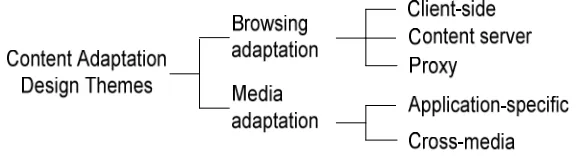
scalability and media adaptability. Using these themes, content adaptation systems are
[image:27.612.143.432.340.418.2]placed into two categories as shown in figure 2.3.
Figure 2.3: Content adaptation design themes taxonomy.
Before the design themes are elaborated, we discuss two different ways on how
different content versions can be prepared. One way is by creating and maintaining
different format of the original content suitable for the targeted access devices. This
approach is used in InfoPyramid [2]. In this case, content is formatted differently for
displays that have different capabilities, and is also delivered differently for devices that
have a different connectivity [3]. Although the pre-adapted version (i.e., static
adaptation) is simple to implement, it suffers from a number of serious drawbacks. To
create a pre-adapted content version, a human designer can be involved to hand-tailor a
version for some specific rendering requirement [3]. Keeping multiple copies of the
original content will lead to tremendous overhead and places unwieldy burden on to the
device may require a new format. Clearly, this is neither practical nor feasible for
providers of large volumes of content.
An alternative content adaptation approach is to automatically generate any
content version from one single original version such that the content is adapted to the
device and the user preferences (i.e., dynamic adaptation). This requires a content
adaptation system with the appropriate logic to analyse the content and all aspects of the
delivery context and formulate the content adaptation strategy that will deliver the
required content version. Dynamic adaptation provides suitable adapted version to each
device or client and no multiple versions is created at the authoring time. [3, 6, 7, 8, 9,
10, 16] are some examples of content adaptation systems performing dynamic
adaptation.
2.4.1.1 Browsing Adaptation
The browsing adaptation (also known as general purpose) category denotes systems that
focus on adapting content to enhance user’s browsing experience. It concerns with
tailoring Web properties (e.g., layout, table, text column) and objects properties (e.g.,
size, format) to the diversity and heterogeneity of users devices. Most of the earlier
systems such as InfoPyramid [2], Power Browser [30], and Odyssey [45] belong to this
category. These systems can further be subdivided into client-side and server-side
adaptation approaches.
In client-side approach, the client itself (e.g., netbook, PDA, smart phone) needs
to perform the adaptation, and then send the adapted Web to the user’s display. For
example, after downloading the Web page requested by the user, the adaptation is
performed to suit device’s capabilities at the client, immediately before the adapted
page viewed by the user. [36] is one of the example that used this approach. The main
advantage of this approach is that the device capabilities can be determined directly.
However, some requirements (at client side) of the adaptation (such as processing,
encoder) may not be available and insufficient.
In server-side approach, adaptation is performed at the origin server, where the
original Web page resides. For example, while the user requests to browse a particular
Web content, the server automatically collects the related contexts (device’s profile,
user preferences, and network constraints) and adapts accordingly. [45, 46] are among
performs very well for relatively small number of users, but will suffer overload if too
many simultaneous requests.
Alternatively, content adaptation can be performed by a middleware i.e.,
proxy-based approach. [2, 8, 9] are some browsing adaptation systems that implemented this
approach. Content adaptation and contexts monitoring is managed by external server
called proxy. Some of these browsing category systems [2, 30, 45] implement fixed and
hard-coded algorithms to easily and securely control the adaptation process, however
leads to the difficulty to adapt changes especially when the new browsing requirements
is introduced. More recent projects such as VTP [9] and Xadaptor [8] used scripts and
agents to facilitate the server with extensibility and flexibility capabilities.
2.4.1.2 Media Adaptation
The media adaptation category is for systems that provide specific media adaptation.
This category is further subdivided as application-specific and cross-media.
Application-specific proxy is designed to handle a specific media adaptation. For
instance, an image type adaptation proxy only caters image adaptation. In
application-specific, adaptation is managed by varying fidelity; the qualities or formats of the
specific media. For example, an image may have different colour scheme, format or
size. The adaptation engine computes for the best version to suit the contexts. One
example system is Portable Document Format Content Adaptation System-PDCAS [6,
31]. It tailors portable document format into suitable version (e.g., WBMP, WML or
PDF, with 2, 16 or 256 colours) based on user preferences, device profiles and network
environment.
On the other hand, cross-media is performed by transforming one media type into
another [47]. For instance, the video data can be transformed into a series of images.
Also, we can convert text into audio file to assist users to read text message or important
email while driving.
2.4.2 Content Adaptation Strategies
Both browsing adaptation and media adaptation have to perform a particular strategy(s)
to provide the user with the required content version. Specifically, content adaptation
strategies are important to classify the action required to adapt the content according to
content to the targeted contexts. It answers the question “how to adapt the content”. As
shown in figure 2.4, content can be adapted using several strategies: size adaptation,
appearance adaptation, format adaptation, encapsulation adaptation, summarization,
translation, media conversation and navigational adaptation.
Content Adaptation
Strategies
Format adaptation Appearance adaptation Size adaptation
Encapsulation adaptation Media conversion
Translation
Navigational adaptation
[image:30.612.194.433.169.261.2]
Figure 2.4: Content adaptation strategies taxonomy.
Most of the new Web sites designed with a fixed width and have a centred column
where the main text resides. To read overall text, user needs to scroll horizontally and
vertically. One way to deal with this is through the appearance adaptation. A real life
example of appearance adaptation is the Opera’s Small Screen Rendering™ technology
[48]. Basically, in this strategy, only the Web layout is adjusted while preserving the
content and functionality. In [10], a multi column Web is altered into a single column
while preserving the content. Both examples eliminate horizontal scrolling.
Web authors often include objects such as images and video to attract users.
Those objects’ sizes are relatively normal for desktop viewing. But for mobile display,
this is intolerable. This requires size adaptation and can be done by resizing or scaling
the object’s dimension. [49] proposed an attention model to adapt the image according
to the particular display’s size.
A media can be represented by different format. For instance, an image can be
displayed using different colour scheme (black & white, 2-bits) and different format
(e.g., jpeg, bitmap). Format adaptation is performed by changing incompatible content
into a more suitable format in the same media. It is widely use in the area of mobile
application, due to the devices diversity. For instance, considers Multimedia Messaging
Service (MMS) communication over the network. Today embedded phone’s camera
usually provides user with high quality image. During delivery, this higher quality
better fit the targeted device. In [6, 31], the most suitable document format is generated
to suit the targeted device. For example, a HTML document will be transformed to a
compact format version (cHTML) that more suitable for small screen.
When a user looks for shorter version of the original content, summarization
adaptation can be used. The key idea is to extract the most important aspect of the
content that enough to convey the overall content. This practice is similar to executive
summary in an annual report, which allows reader to grasp the gist. Through this
strategy, [46] proposed Unit of Information concept to represent the Web content
structure. It compromises of a set of segments and media objects to be presented
together. When summarization is required, the most important content set is selected. In
[30], an approach that breaks each web page into text units that can easily be displayed,
hidden, visible or summarized, is presented, while [50] proposed a block-based content
decomposition structure, where a HTML page is factorized into blocks with assigned
scoring value. Content block with the highest score will be displayed. For a Web with a
long text, instead of changing the column layout, the text itself also can be adapted by
summarizing it into a shorter version.
Media conversion is concerned with adapting one content media from one type
into another. It is more complicated if compared to other strategies. It can be done by
converting or transforming the media type. For instance, if a client device cannot
support video content, it can be transformed into a series of images. This enables some
information to be conveyed to the user. Media-Convert [51] is an online service that
enables audio visual media file to be converted, separated and integrated.
When dealing with language barrier, translation adaptation can be implemented.
For instance, a user could request for a specific English audio file. However, only the
Spanish version is currently available. Using translation, the Spanish audio can be
converted into English audio. WebServiceX.Net [52] is an example of Web Services
that provide language translation service.
Navigational adaptation strategy is used to guide user to access content based on
their knowledge and interest. That is content is tailored to provide the user with content
keyword(s) rather than the whole content segment. When the keyword is clicked, it will
navigate the user to the desired content. [30, 32, 33, 34] are the examples of systems
References
[1] Y. Fawaz, G. Berhe, L. Brunie, V-M. Scuturici and D. Coquil (2008). Efficient execution of service composition for content adaptation in pervasive computing. Int. Journal of Digital Multimedia Broadcasting, 1-10.
[2] R. Mohan, S. John and C-S. Li (1999). Adapting multimedia Internet content for universal access. IEEE Trans. on Multimedia, 1(1), 104-114.
[3] S. Ihde, P. Maglio, J. Meyer and R. Barrett (2001). Intermediary-based transcoding framework, IBM Systems Journal 40 (1), 179-192.
[4] S. Ardon, P. Gunningberg, B. Landfeldt, Y. Ismailov, M. Portmann, and A. Seneviratne (2003). MARCH: A distributed content adaptation architecture.
Int. Journal of Communication Systems 16 (1), 97-115.
[5] G. Berhe, L. Brunie, and J.-M. Pierson (2005). Content adaptation in distributed multimedia systems. Journal of Digital Information Management 3 (2), 96-100.
[6] W. Lum and F. Lau (2003). User-centric content negotiation for effective adaptation service in mobile computing. IEEE Trans. on Software Engineering
29 (12), 1100-1111.
[7] M. Prangl, T. Szkalicki, and H. Hellwagner (2007). A framework for utility-based multimedia adaptation. IEEE Trans. on Circuits and Systems for Video Technology 17(6), 719-728.
[8] J. He, T. Gao, W. Hao, I-L. Yen and F. Bastani (2007). A flexible content adaptation system using a rule-based approach. IEEE Trans. on Knowledge and Data Engineering 19 (1), 127-140.
[9] J-L. Hsiao, H-P. Hung and M-S. Chen (2008). Versatile transcoding proxy for Internet content Adaptation. IEEE Trans. on Multimedia 10 (4), 646-658. [10] S. Yang and N. Shao (2007). Enhancing pervasive web accessibility with
rule-based adaptation strategy. Journal of Expert Systems with Applications 32 (4), 1154-1167.
[11] K. El-Khatib, G. Bochmann and A. El-Saddik (2004). A QoS-based framework for distributed content adaptation. Proceedings of 1st International Conference on Quality of Services in Heterogeneous Wired/Wireless Networks, pp. 308-312. IEEE Press: New York.
[12] M-F. Md-Fudzee and J. Abawajy (2011). QoS based service selection broker.
Future Generation Computer Systems 27 (3), 256-264.
[14] S. Tonnies, B. Kohncke, P. Hennig and W-T. Balke (2009). A service oriented architecture for personalized rich media delivery. Proceedings of IEEE International Conference on Service Computing, pp. 340-347. IEEE Press: New York.
[15] M-F. Md-Fudzee and J. Abawajy (2011). Request-driven cross-media content adaptation technique. In Developing Advanced Web Services through P2P Computing and Autonomous Agents: Trends and Innovation, Khaled Ragab, Tarek Helmy and Aboul-Ella Hassanien (eds.), pp. 91-113. IGI Global: USA.
[16] N. Nordin, W. Shin, K. Ghauth and M. Mohd (2007). Using service-based content adaptation platform to enhance mobile user experience. Proceedings of the 4th International Conference on Mobile Technology and Applications, pp. 552-557. ACM Press: New York.
[17] L. Snyder, F. Baskett, M. Caroll, D. Colemanm, D., Estrin, M. Furst, J. Hennessy, H. Kung, K. Maly and B. Reid (1994). Academic Careers for Experimental Computer Scientists and Engineers. National Academy Press: Washington.
[18] M. Forte, W. de Souza and A. do Prado (2008). Using ontologies and Web services for content adaptation in ubiquitous computing. Journal of Systems and Software 81(3), 368-381.
[19] M-F. Md-Fudzee and J. Abawajy (2008). Classification of content adaptation system. Proceedings of 10th International Conference on Information Integration and Web-based Application and Services, pp. 426-429. ACM Press: New York.
[20] D. Zhang (2007). Web content adaptation for mobile handheld devices.
Communications of ACM 50(2), 75-79.
[21] G. Chen and D. Kotz (2000). A survey of context-aware mobile computing research. Computer Science Technical Report TR2000-381. Dartmouth College: Hanover NH.
[22] P. Brusilovsky (1996). Methods and techniques of adaptive hypermedia.
Journal User Modeling and User-Adapted Interaction 6(2-3), 87-129.
[23] P. Brusilovsky, A. Kobsa and W. Nejdl (2007). The Adaptive Web. Springer: Berlin.
[24] R. Virgilio, R. Torlane and G-J. Houben (2007). Rule-based adaptation of Web information systems. Journal of World Wide Web 10 (4), 443-470.
[25] F. Adelstein, S. Gupta, G. Richard and L. Schwiebert (2005). Fundamentals of mobile and pervasive computing- 1st edition. McGraw-Hill: USA.
[26] S. Banerjee, S. Basu, S. Garg, S. Garg, S-J. Lee, P. Mullan and P. Sharma (2005). Scalable grid service discovery-based on UDDI. Proceedings of 3rd International Workshop on Middleware for Grid Computing, pp. 1-6. ACM Press: New York.
[28] R. Buyya, M. Pathan, and A. Vakali (eds.) (2008). Content delivery network. Springer-Verlag Press: Berlin.
[29] C. Canali, V. Cardellini, M. Colajanni and R. Lancellotti (2005). Performance comparison of distributed architectures for content adaptation and delivery of web resources. Proceedings of 25th IEEE International Conference on Distributed Computing Workshops, pp. 331-337. New York: IEEE Press. [30] O. Buyukkokten, O. Kaljuvee, H-G. Molina, A. Paepcke and T. Winograd
(2002). Efficient web browsing on handheld devices using page and form summarization. ACM Trans. on Information System 20 (1) 82-115.
[31] W. Lum and F. Lau (2002). A context-aware decision engine for content adaptation. IEEE Pervasive Computing 1 (3) 41-49.
[32] R. Farzan and P. Brusilovsky (2005). Social navigation support through annotation-based group modeling. Proceedings of 10th International User Modeling Conference, pp. 463-472. Springer-Verlag: Berlin.
[33] P. Brusilovsky, R. Farzan and J. Ahn (2005). Comprehensive personalized information access in an educational digital library. Proceedings of 5th ACM/IEEE-CS Joint Conference on Digital Libraries, pp. 9-18. ACM Press: New York.
[34] P. Brusilovsky, S. Sosnovsky and M. Yudelson (2005). Ontology-based framework for user model interoperability in distributed learning environments. Proceedings of World Conference on E-Learning in Corporate, Government, Healthcare and Higher Education, pp. 2851-2855. AACE: Canada.
[35] Y. Fawaz, A. Negash, L. Brunie and V-M. Scuturici (2007). ConAMi: Collaboration based content adaptation middleware for pervasive computing environment. Proceedings of IEEE International Conference on Pervasive
Services, pp. 189-192. IEEE Press: New York.
[36] H-N. Chua, S. Scott, Y. Choi and P. Blanchfield (2005). Web-page adaptation framework for PC & mobile device collaboration. Proceedings of 19th International Conference on Advanced Information Networking and Applications, pp. 727-732. IEEE Press: New York.
[37] F. Lopez, J. Martinez and V. Valdes (2007). Multimedia content adaptation within the CAIN framework via constraints satisfaction and optimization.
Lecture Notes on Computer System 4398, 149-163.
[38] J. Martinez, V. Valdes, J. Bescos and L. Herranz (2005). Introducing CAIN: A metadata-driven content adaptation manager integrating heterogeneous content adaptation tools. Workshop on Image Analysis for Multimedia Interactive Services, pp. 1-5.