Geosciences Theses
Department of Geosciences
8-7-2018
The Volcanism Ontology (VO): Semantic
Modeling of Volcanic Eruptions and Volcanoes
John Myer
Follow this and additional works at:
https://scholarworks.gsu.edu/geosciences_theses
This Thesis is brought to you for free and open access by the Department of Geosciences at ScholarWorks @ Georgia State University. It has been accepted for inclusion in Geosciences Theses by an authorized administrator of ScholarWorks @ Georgia State University. For more information, please [email protected].
Recommended Citation
Myer, John, "The Volcanism Ontology (VO): Semantic Modeling of Volcanic Eruptions and Volcanoes." Thesis, Georgia State University, 2018.
AND VOLCANOES
By
JOHN MYER
Under the Direction of Hassan Babaie, PhD
ABSTRACT
We have modeled the complex material and process entities and properties of volcanic eruptions
and structures in the Volcanism Ontology (VO) applying several top-level ontologies such as Basic
Formal Ontology (BFO), SWEET, and Ontology of Physics for Biology (OPB) within a single
framework. The upper level framework separates the entities into investigative and volcanism entities,
and each further separated into their own BFO framework. This allows for VO to be one of the best steps
towards a domain ontology to cover the complexity found in volcanology. When deployed on the web,
VO will be used to explicitly and formally annotate data and information collected by volcanologists
based on domain knowledge. This will enable the integration of global volcanic data and improve the
interoperability of software that deal with such data.
AND VOLCANOES
by
JOHN MYER
A Thesis Submitted in Partial Fulfillment of the Requirements for the Degree of
Master of Science
in the College of Arts and Sciences
Georgia State University
Copyright by John Ownby Myer
AND VOLCANOES
by
JOHN MYER
Committee Chair: Hassan Babaie
Committee: Brian Meyer
Raj Sunderraman
Electronic Version Approved:
Office of Graduate Studies
College of Arts and Sciences
Georgia State University
DEDICATION
With love and appreciation to my family, parents Deborah McCarty and John Rea Myer, and
brothers, Peter, Benjamin, and Patrick. Additional appreciation to friends, both within and outside the
ACKNOWLEDGEMENTS
I would like to thank Dr. Hassan Babaie for acting as my faculty advisor, whose assistance,
guidance, and expertise in his field allowed for this research to be as possible and as thoroughly complete
as it currently stands. This thesis would not have been completed without his continued support.
I would also like to thank the members of my thesis committee, Dr. Rajshekhar Sunderraman and
Dr. Brian Meyer, for their guidance and assistance toward the completion of this thesis and the
completion of my Master’s Degree
Special thanks also to the Department of Geosciences at Georgia State University for providing
the opportunity to pursue this research and creating an environment where learning and critical thinking
may thrive.
This work was conducted using the Protégé resource, which is supported by grant GM10331601
TABLE OF CONTENTS
DEDICATION... V
ACKNOWLEDGEMENTS ... VI
LIST OF TABLES ... IX
LIST OF FIGURES ... X
CHAPTER 1
INTRODUCTION ... 1
CHAPTER 2
LITERATURE REVIEW ... 2
2.1
Introduction to Ontology ... 2
2.2
Types of Ontologies and the Semantic Web... 2
2.3
Geoinformatics Ontology Development ... 4
2.4
Volcanology and Knowledge Engineering ... 5
2.5
Basic Formal Ontology ... 7
2.6
Terminology ... 10
CHAPTER 3
METHODOLOGY ... 12
CHAPTER 4
ONTOLOGY FRAMEWORK DEVELOPMENT ... 16
4.1
Ontology workflow ... 16
4.2
Concept development ... 16
4.2.1
Continuant concepts ... 17
4.2.2
Occurrent concepts ... 21
5.1
Classes ... 23
5.2
Object Properties... 24
5.3
Data Properties ... 25
5.4
OWL Reasoner assessment ... 27
CHAPTER 6
DISCUSSION, CONCLUSIONS AND FUTURE WORK ... 29
6.1
Discussion ... 29
6.2
Conclusions ... 33
6.2.1
Future Work ... 34
REFERENCES ... 35
LIST OF TABLES
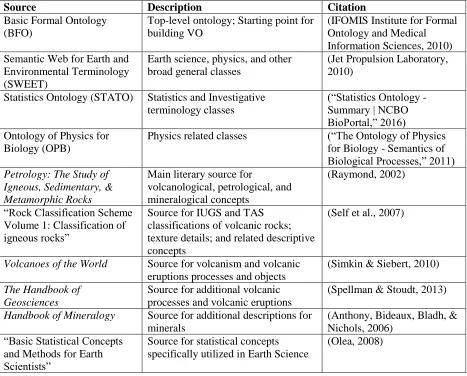
Table 4-1: List of ontologies and other resources utilized for developing classes for Volcanism Ontology
(VO). ... 15
LIST OF FIGURES
Figure 2-1: Class hierarchy showing the relationships between Basalt, IgneousRock, and Rock through
the isA relation. ... 3
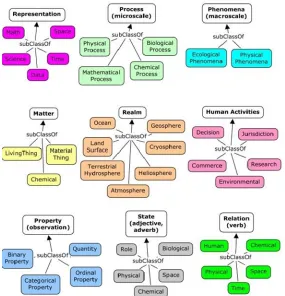
Figure 2-2: Various domains within the upper-level SWEET ontology (from Jet Propulsion Laboratory, 2010). ... 3
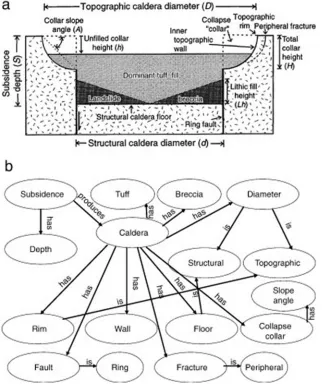
Figure 2-3: (a): Conceptual drawing of a caldera setting; (b): semantic graphic network of the same setting (from Pshenichny, 2014). ... 6
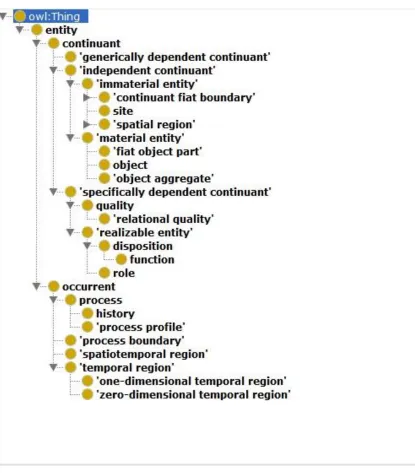
Figure 2-4: Class hierarchy of Basic Formal Ontology (BFO). ... 8
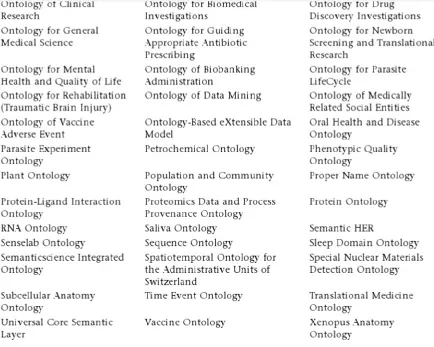
Figure 2-5: A sample of the ontologies developed using BFO (from Arp et al., 2015). ... 9
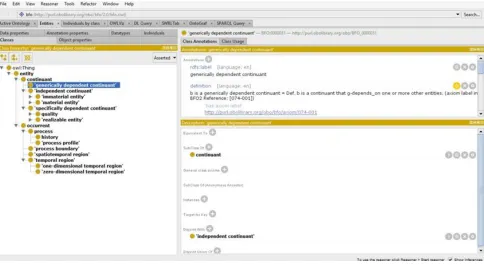
Figure 3-1: Screenshot of the Protégé software window showing the BFO class hierarchy. ... 13
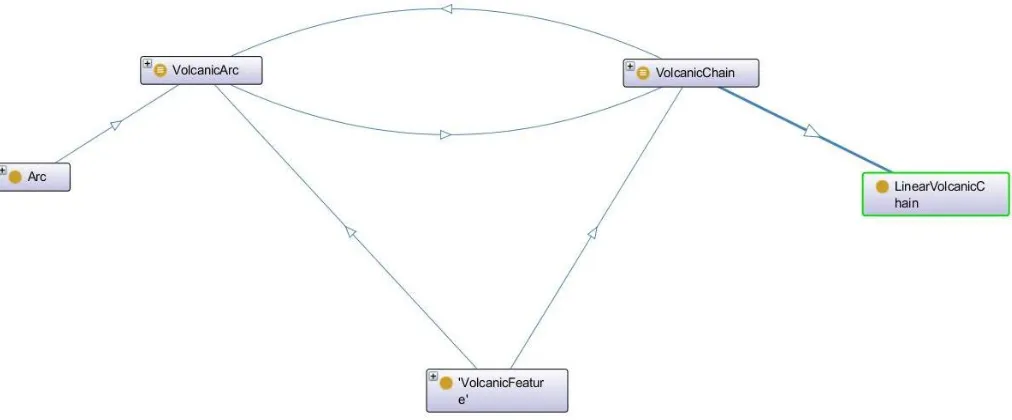
Figure 3-2: Screenshot of VolcanicArc and VolcanicChain classes, showcasing the OWL equivalence classes, visualized here as a pair of circular blue lines, which represent isA object properties, as well as the small golden equal symbol next to the term . ... 14
Figure 4-1: Volcanism Ontology showcasing split between ‘InvestigativeEntity’ and ‘VolcanismEntity’, each with their own continuant and occurrent entities. Solid blue lines indicate isA object property. Dashed tan line indicates ‘hasInvestigativeEntity’ object property with Range set for ‘InvestigativeEntity,’ while dashed brown line represents ‘hasVolcanismEntity’ with Range set for ‘VolcanismEntity.’ ... 17
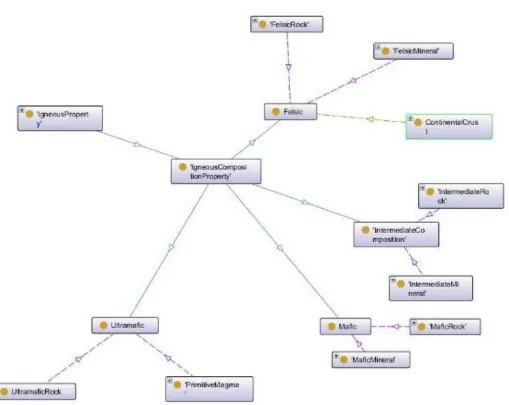
Figure 4-3:Classes related to the specifically dependent ‘IgneousCompositionProperty’ class. Solid blue
lines indicate isA object property. Purple dashed lines indicate the hasProperty object property, while
dashed yellow line represents hasRock object property. ... 19
Figure 4-4: Classes related to the class ‘Seismometer.’ Solid blue lines indicate isA object property.
Purple dashed line represents measures property, while pink lines represent "has function" property.
The dotted light blue line with equal symbol indicates that ‘measurement device’ is equivalent to
device class that connects to ‘measure function’ by ‘has function’ object property. ... 21
Figure 4-5: Classes related to VolcanicEruption. Yellow dashed lines represent the processOf property,
while green dashed line represents hasTransport property, and the dashed orange line indicates
‘associatedWith’ property. ... 22
Figure 5-1: Screenshot of the class hierarchy of Basalt in Protégé. The class Basalt is imported from
SWEET, while classes such as ‘AlkaliBasalt,’ ‘ColumnarBasalt,’ and ‘SubalkaliBasalt’ the new classes
to the right created for the Volcanism Ontology, and therefore, marked with ' ' within the name of the
class. ... 23
Figure 5-2: Screenshot of the object property ‘createdFrom,’ showing that this is a subproperty of
‘derives from’ object property and the inverse property of ‘creates’ property. ‘VolObject’ is the domain
for the property, representing the “subject” of RDF triple, while the range of the property, ‘VolProcess,’
represents the “object of the RDF triple. ... 24
Figure 5-3: Hierarchy of a few of the VolOnt subproperties structured under BFO’s ‘has part’ property.
Note that ‘hasConstituent,’‘hasMineral,’ are newly created properties for VO, while hasRock comes
from SWEET, and the others are native subproperties from BFO... 25
Figure 5-4: Screenshot of the ‘collectedBy’ data property with the domain connected to the class
‘SampleName’ and range to a string-based class (xsd:string), allowing user input. ... 26
Figure 5-5: Instances of the use of the data properties of represent the limits of minerals using the QAPF
classification of rock schemes. In these instances, each rock indicates the numerical limits of percentage
representing the lower limit for percentage of plagioclase feldspar, while
‘QAPFPlagioclaseLessThanOrEqual’ representing the upper limit for plagioclase feldspar. ... 26
Figure 5-6: Screenshot of reasoners available through Protégé. ... 27
Figure 5-7: Screenshot of the SPARQL Query for Volcanism Ontology within Protégé, using RDF triple
(subject-predicate-object) format to find relationships between subject and object. Object classes without
a yellow circle are direct isA relationship. Those with yellow circles indicate a special predicate
connecting the object class to the subject class. ... 28
Figure 6-1: the continuant investigative object class 'Seismometer' is related to the occurrent volcanism
process class SeismicPhenomena by the object property measures. ... 29
Figure 6-2: The class 'data item,’ which is imported from STATO ontology is set as an equivalent class
to the class Data, which is imported from SWEET Ontology. ... 29
Figure 6-3: The classes 'OrthoclaseFeldspar' and 'Sanidine' and their associated element individuals.
Note the construction of the chemical formula instance 'KAlSi3O8,' which utilizes an approach from
SWEET ontology and uses object properties (hasChemical_1, hasChemical_2, hasChemical_3,
hasChemical_4) to connect to other elemental and molecular individuals. Solid blue line represents isA
object property, solid purple lines indicate hasIndividual object property, dashed green line represents
‘formOf’ object property, and the remaining dashed lines indicate the previously mentioned
hasChemical object properties. ... 30
Figure 6-5: Detail on some of the relations for the class Basalt. Note several data properties used to
indicate the percentage limits for minerals used in QAPF and TAS rock classification schemes. (The data
properties ‘silicaPercentage…’ represent the silica aspect of the TAS classification) ... 31
Figure 6-4: The class ‘BowensReactionSeries,’ broken down into subclasses
‘BowensDiscontinuousSeries’ and ‘BowensContinuousSeries’ and their associated mineral classes.
Note that the minerals ‘Muscovite,’ ‘OrthoclaseFeldspar,’ and ‘Quartz’ are found in both series, since
Figure 6-7: Classes related to the class 'VolcanicExplosivityIndex.' Solid blue line indicates isA object
property, dashed orange line indicates measures object property, dashed brown line represents
‘measureOf’ object property, and dashed yellow line indicates the range class for the object property
‘hasVEIValue.’ ... 32
Figure 6-6: Classes connected to class 'FelsicRock' with the subclasses being different felsic rocks. The
blue solid lines represent isA object property, dashed yellow lines indicate hasProperty object property,
and green dashed line represents ‘hasMineral’ object property. ... 32
Figure 6-8: Detail on the relations of the class PeleanEruption. Note the appropriate VEI classes listed
with the relation ‘hasVEIValue.’ ... 33
CHAPTER 1 INTRODUCTION
The collection of observations and measurements known as data is one of the major foundational
components of science. The collection, size, storage, and processing of data have expanded with new
technology, leading to the concept of big data. The size, rate of production, and type of data have become
so large and diverse that the ability to efficiently interpret data into new, useful knowledge is potentially
beyond the limits of human capabilities (Sinha et al., 2010). To develop new knowledge, an agreed-upon
semantics for terminology needs to be established so that the processing of data into information may be
streamlined utilizing digital and network processing and interpretation. Inspired by its philosophical
metaphysical counterpart, ontologies fulfill the role of defining terminology and inferring the connections
between concepts that make up reality (Arp et al., 2015).
The goal of this thesis is the development of Volcanism Ontology (VO) that would include both
material and process concepts utilizing the framework from Basic Formal Ontology as the foundation.
The resulting framework is designed to be open-source and non-proprietary. The goal of building this
CHAPTER 2 LITERATURE REVIEW 2.1 Introduction to Ontology
Ontologies are computer-based artifacts that are designed to model a domain of knowledge in an
attempt to represent reality. Ontologies are organized into a hierarchal taxonomy design with nodes of
clearly defined concepts, known as classes, connected by relationships to other classes (Arp et al., 2015;
Smith & Ceusters, 2010). Classes or “entities” (hereafter, all classes and properties mentioned in this
thesis shall be marked as Class and hasProperty) are the representations of concepts within ontologies.
Top-level concepts are the most generalized entities and terms (e.g., Rock, Lava) from which more
specialized entities extend (e.g. IgneousRock, RhyoliticLava). Classes are the abstract ideas that are
fundamental to the understanding of scientific knowledge and assumptions within the domain of
knowledge, without which other terms could not be properly described (Smith, 2004). More specialized
concepts and terms are typically broken down into subclasses (Arp et al., 2015) (e.g., the class Olivine is
a subclass of the class Mineral). This may include tangible instances (objects) of the entities that may be
described through observation and experimentation (e.g. Mt. St. Helens, a specific hand sample) (Smith &
Ceusters, 2010). Association and relationships between entities are represented within ontologies as
properties and subproperties. The most common relationship found in ontologies is the isA relation,
which bridges classes, but many properties and relationships can be created to be used for all sorts of
connections (Arp et al., 2015). For example, basalt is a type of igneous rock, which is a type of rock, so in
the ontology, the class Basalt is related to the class IgneousRock and the IgneousRock class is related
to the Rock class through the isA property (Figure 2.1).
2.2 Types of Ontologies and the Semantic Web
Since domains have few limits in terms of expansiveness and complexity of their nature,
well-designed ontologies can serve as effective representations of the world (Horrocks, 2008). What’s more,
ontologies can be built upon one another, creating extensible ontology libraries that may function together
Figure 2-1: Class hierarchy showing the relationships between
Basalt
,
IgneousRock
,
and
Rock
through the
isA
relation.
Figure 2-2: Various domains within the upper-level SWEET ontology (from Jet
Propulsion Laboratory, 2010).
Ontologies are often broken down based on the broadness of their knowledge base. Upper-level
ontologies cover broad terms and concepts, with less detail given to specific terms and concepts. An
Basalt IgneousRock
Rock
isA
example of an upper-level ontology would be the Semantic Web for Earth and Environmental
Terminology (SWEET), upper level ontology, designed to cover a large range of terminology and
concepts utilized within earth and environmental science disciplines (Figure 2.2) (Raskin & Pan, 2005).
Given its broad basis, many of the concepts are undefined and have only basic relationships setup, often
leading SWEET acting as a starting point for the creation of more specialized domain ontologies
(Tripathi & Babaie, 2008). Domain ontologies cover a specific realm of knowledge, and are more detailed
and thorough in their description than upper-level ontologies (Arp et al., 2015). An example of a more
specialized domain is the hydrogeology ontology created by Tripathi & Babaie, which originally
developed from SWEET and focusing specifically within the domain of hydrogeography (Tripathi &
Babaie, 2008)
The most utilized ontologies are designed to be open-sourced and non-proprietary, allowing
usage by developers and researchers to suit their needs, with the ability to work with other ontologies. In
an effort to ensure that these knowledge bases are easily accessible, most of them are stored and
manipulated online through the Semantic Web, a continually developing extension of the World Wide
Web, where concepts are stored, accessed and shared with other computer systems and scientists,
providing either new data or integrating with other geoinformatic systems (Berners-Lee, Hendler, &
Lassila, 2001). The inference capabilities of ontologies and other knowledge bases make them efficient
and reliable query systems that may provide important reasoning checks that can find inconsistencies, or
reveal new connections between concepts that remained undiscovered (Horrocks, 2008).
2.3 Geoinformatics Ontology Development
Geoinformatics, the geoscience-branch of informatics, is the use of computer-aided knowledge
engineering and schemas to create a truthful representation of reality related to Earth. The main concepts
involved in the discipline include utilizing new digital tools and methods to collect data and developing
web-assessable portals collecting wide range and variety of data points for easy access and sharing of
serve as the main way of collecting, sharing, and discovering knowledge, acting as a template for
knowledge bases in specific domains (Sinha et al., 2010).
Within the span of several years, many disciplines in geosciences have developed or are in the
process of developing their own ontologies, representing broad and narrow fields and domains (Babaie et
al., 2013; DiGiuseppe et al., 2014; Scheuer et al., 2013; Tripathi & Babaie, 2008). Many of these are
domain ontologies, focusing within a particular discipline or subdiscipline in sufficient detail (Arp et al.,
2015). Projects such as San Andreas Fault Observatory at Depth (SAFOD) present brittle microstructural
and rock mechanics data collected from cores of samples across the San Andreas Fault (Babaie et al.,
2013). Utilizing their ability to define relations between ideas and terms, some ontologies have been
developed solely for searching and finding GI services and related data catalogues across multiple brokers
and heterogeneous datasets (Klien et al., 2006). As mentioned previously, SWEET has become the
de-facto ontology library within the realm of geoinformatics given its broad range of topics and sufficient
detail in concepts and relations (DiGiuseppe et al., 2014). Overall, Earth science has a strictly low number
of ontologies developed compared to other fields, such as biomedicine (Arp et al., 2015).
2.4 Volcanology and Knowledge Engineering
Volcanology, like the rest of the geosciences, has just begun to make its knowledge represented
into ontologies (Figure 2-3) (Pshenichny, 2014). Even with its early start, there have already been several
developmental ontologies created for the field. McGuinness and colleagues have already established the
groundwork for a reference ontology for volcano systems as one of the first detailed branches designed
off of the Semantically-Enabled Scientific Data Integration (SESDI), one of the larger Earth science
ontology libraries (Fox et al., 2006; McGuinness et al., 2007). Other ontologies have been done solely
focusing on the volcanic hazards (Faaziati & Wantanabe, 2010).
One of the unique challenges developing ontologies and knowledge engineering of volcanology is
the focus on events as well as objects. By their nature, ontologies are generally designed to describe
knowledge, changing events that occur periodically or concurrently leading or preceding other events. To
be useful, ontologies need to model both static material and structures as well as varied dynamic volcanic
processes that occur during eruptions (Pshenichny, 2014). Given the larger focus on the development of
static object-based ontologies, work is being done to develop classifications and methods that better
describe dynamic event-based ontologies (Pshenichny & Mouromtsev, 2015). Opportunities to develop
ontologies to cover static and dynamic knowledge (Babaie, 2011) are present and have a wide range of
[image:20.612.165.487.253.640.2]potential uses within volcanology, as well as other disciplines of science (Pshenichny, 2014).
2.5
Basic Formal Ontology
Basic Formal Ontology (BFO) is an upper-level ontology created as a starting point for
developing more specialized domain ontologies (IFOMIS, 2010). Being small and undescriptive, BFO
provides the beginning framework for expressing knowledge within the specialists’ domain of interest
(Figure 2-4). One of the unique aspects of BFO is that the ontology starts by dividing entities into
“continuants” and “occurrents.” Continuants cover entities that continue to exist as a whole through time,
while occurrents cover entities which unfold over time, whether by occurrence or happening. Like other
ontologies, terminology from an upper level ontology can be referenced and extended into other domain
specific ontologies, allowing compatibility across multi disciplines and subdisciplines (Arp et al., 2015).
BFO has been used extensively as a framework among many domains of science, both for upper-level
ontologies and domain-specific (Figure 2-5). BFO is used extensively in bioinformatics, for example in
upper level Ontology for General Medical Science (OGMS), that model continuant and occurrent
concepts for the medical field (Scheuermann et al., 2009). From OGMS, many domain specific
ontologies have been built as extensions, in particular the Infection Disease Ontology (IDO) that covers
2.6 Terminology
The following are definitions for terms that are used throughout this paper as related to this
ontology.
Basic Formal Ontology (BFO): A top-level ontology based on the continuants and occurrents concepts.
Class: A term to describe the type of an entity within an ontology.
Continuant: an entity that persists (or continues) through time without changing into another entity. One
of the main categories of BFO.
Domain: An area of knowledge within a scientific discipline that is modeled in an ontology.
Entity: Anything that exists; represented as a class within an ontology.
Individual: Instance of a universal entity. Within an ontology, they are related to a particular class.
Occurrent: an entity that changes (or occurs) over time. One of the main categories of BFO.
Ontology: A computer-based representation of knowledge, using a taxonomy of universals, defined
classes, and relations between said classes to provide a model of reality.
Particular: A instance of a particular universal entity, e.g., Amazon river.
Property: representation of a relation within the ontology framework. Connects two or more classes
together (Arp et al., 2015) (Amazon rivers drains water from South America to Atlantic Ocean).
Protégé: the main editing software program utilized to build and test ontology frameworks (Musen,
2015).
Relation: the manner for how two or more entities are connected.
Resource Description Framework (RDF): A programming language that allows relationships between
entities to exist through a subject-predicate-object “triple” structure.
RDF Schema: (RDFS): An enhanced version of RDF that allows for properties to exist as the main
relations between entities.
Semantic Web: an interconnected system that makes up the content of data and information form World
Term: the word used to describe any concept that will be represented as classes within an ontology.
Top-level ontology: An ontology of highly general categories that are build more for specific domain
ontologies.
Universal: A independent repeatable feature of reality (i.e. rock, olivine). A particular is an instance of a
universal (a sample of rock, a sample of olivine).
Web Ontology Language (OWL): the major family of languages used for the Semantic Web; the main
CHAPTER 3 METHODOLOGY
The Volcanism Ontology (VO) was primarily developed utilizing the Protégé ontology
development software, version 5.2.0 (Musen, 2015). The open-source software is the standard integrated
development environment (IDE) used for developing domain ontologies, allowing other similar
ontologies built with the program to be able to incorporate with this ontology (Figure 3-1) (Arp et al.,
2015).
The resulting ontologies are designed based on Extensible Markup Language (XML), Resource
Description Framework (RDF), RDF Schema (RDFS), and the Semantic Web’s Web Ontology Language
(OWL). These ontology languages are the formal languages for developing ontologies. XML is a basic
machine readable format that has gained wide usage on the World Wide Web (WWW) and offers a basic
schema and tagging system that is utilized in ontologies (W3C, 2016). RDF was created as a unifying
language that could merge and create metadata regardless of the schema. Written in XML, RDF consists
of a basic structure of subject-predicate-object (SPO), each of which is assigned a unique
Internationalized Resource Identifier (IRI) (W3C Consortium, 2014a). The subject may be a concept or
entity with an IRI (e.g., Andesite) or a blank node (an entity with no label). The object may be another
entity, a blank node, or an actual instance or value (e.g. ExtrusiveIgneousRock). The subject is
connected to the object through the predicate, representing the property sought to model (e.g., the
‘isAnIntermediate’ in the ‘Andesite isAnIntermediate ExtrusiveIgneousRock’ statement) (Horrocks,
2008). As another example, the subject, predicate, and object in the “Volcano erupts Lava” SPO
statement are Volcano, erupts, and Lava, respectively. RDF Schema is a more vocabulary-focused
extension of RDF that allows for more hierarchal structure of classes found in ontologies (W3C
Consortium, 2014b). The Web Ontology Language (OWL) was developed as the standard for ontologies,
focusing on processing the information content without the need to present information for human
consumption (W3C Consortium, 2009). OWL achieves this by integrating similar frameworks and
languages, including RDF and RDFS, and building upon them with its own framework (W3C OWL
more flexibility by providing more information on concepts compared to languages like RDF and RDFS.
This allows OWL to express universal and existential statements, cardinality, Boolean operators,
equivalence assertions, and relational properties. An example of this in use are the equivalent classes
VolcanicArc and VolcanicChain, which are both terms use to describe the same concept just within
slightly different circumstances, with VolcanicArc being a subclass of Arc, and VolcanicChain being the
more general class under ‘VolcanicFeature,’ although both are subclasses of ‘VolcanicFeature’ (Figure
3-2). Ontologies built in OWL have the advantages of being untethered to specific data or assumptions,
and can run complex queries and inferences much easier than general relational databases (Arp et al.,
[image:27.612.75.559.299.564.2]2015).
Table 4-1: List of ontologies and other resources utilized for developing classes for
Volcanism Ontology (VO).
Source Description Citation
Basic Formal Ontology (BFO)
Top-level ontology; Starting point for building VO
(IFOMIS Institute for Formal Ontology and Medical Information Sciences, 2010) Semantic Web for Earth and
Environmental Terminology (SWEET)
Earth science, physics, and other broad general classes
(Jet Propulsion Laboratory, 2010)
Statistics Ontology (STATO) Statistics and Investigative terminology classes
(“Statistics Ontology - Summary | NCBO BioPortal,” 2016) Ontology of Physics for
Biology (OPB)
Physics related classes (“The Ontology of Physics
for Biology - Semantics of Biological Processes,” 2011) Petrology: The Study of
Igneous, Sedimentary, & Metamorphic Rocks
Main literary source for
volcanological, petrological, and mineralogical concepts
(Raymond, 2002)
“Rock Classification Scheme Volume 1: Classification of igneous rocks”
Source for IUGS and TAS classifications of volcanic rocks; texture details; and related descriptive concepts
(Self et al., 2007)
Volcanoes of the World Source for volcanism and volcanic eruptions processes and objects
(Simkin & Siebert, 2010)
The Handbook of Geosciences
Source for additional volcanic processes and volcanic eruptions
(Spellman & Stoudt, 2013)
Handbook of Mineralogy Source for additional descriptions for minerals
(Anthony, Bideaux, Bladh, & Nichols, 2006)
“Basic Statistical Concepts and Methods for Earth Scientists”
Source for statistical concepts specifically utilized in Earth Science
CHAPTER 4 ONTOLOGY FRAMEWORK DEVELOPMENT 4.1 Ontology workflow
The framework development for the volcanism ontology follows the guidelines set out by Arp
and others (2015) applying BFO. The first step involved the determination of the most general terms and
relationships that are essential for representation. To ease initial development and acquisition, already
established concepts from existing ontologies were reused; a practice common in the ontology
development community (Arp et al., 2015). For Earth, atmospheric, and other related sciences, concepts
from SWEET Ontology version 2.3 were reused (Raskin & Pan, 2005). Statistical concepts were derived
from the Statistics Ontology (STATO), a BFO-based ontology (“Statistics Ontology - Summary | NCBO
BioPortal,” 2016). Physics concepts were brought in from the Ontology of Physics for Biology (OPB),
another ontology based on BFO (Cook, Bookstein, & Gennari, 2011). Supplementing the existing
concepts, any remaining undescribed but essential terms and relationships were gathered from textbooks
within the field of volcanology and igneous petrology (Neuendorf et al., 2011; Raymond, 2002; Simkin &
Siebert, 2010; Spellman & Stoudt, 2013) (Table 4-1). Classes imported from other ontologies that have
no description are provided with correct and domain-specific descriptions, following the example of
SWEET (Jet Propulsion Laboratory, 2010), using Wikipedia as a source for descriptions.
4.2 Concept development
Classes irrelevant to the knowledge domain were removed to streamline the development process.
With terms and relationships collected, the regimentation of these terms using BFO began by organizing
types as classes, and relationships as properties, using Protégé. As a best practice, the entities were
hierarchically organized under the BFO’s orthogonal occurrents and continuant types, split between
4.2.1
Continuant concepts
The continuant classes; entities that persist through time as wholes, include volcano types,
deposits, structures, measurements, rocks, and composition, among others. The continuants are broken
down into further subcategories into Independent and Dependent entities (Arp et al., 2015). Dependent
categories have classes that are dependent or reliant on other classes. This is further broken down into
[image:31.612.59.580.87.274.2]generically dependent entities and specifically dependent entities.
Figure 4-1: Volcanism Ontology showcasing split between
‘
InvestigativeEntity’
and
‘
VolcanismEntity’
, each with their own continuant and occurrent entities. Solid blue lines indicate
isA
object property. Dashed tan line indicates
‘hasInvestigativeEntity’
object property with Range set for
‘InvestigativeEntity,’
while dashed brown line represents
‘hasVolcanismEntity’
with Range set for
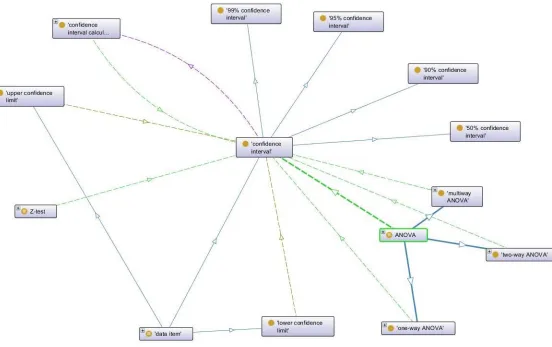
Generically dependent entities are those classes that are wholly dependent on other independent
classes. In the case of the Volcanism Ontology, they are primarily useful for providing classes for
statistics and investigative classes. This includes scientific investigative concepts such as hypothesis, and
conclusions, presentation concepts such as graphs and figures, as well as statistical concepts such as mean
[image:33.612.51.560.247.652.2]standard deviation, and confidence intervals (Figure 4-2). Specifically dependent entities are those that
describe or adhere to other classes. This includes qualitative entities such as properties for describing
rocks by silica content and the roles and functions taken by some investigators (Figure 4-3).
Independent entities are entities that are reliant into and of themselves, that can be independent of
other entities. This is where we find most of the classes for rocks, volcanic features as well as
investigative devices such as seismometers (Figure 4-4). This also includes spatial regions such as the
4.2.2
Occurrent concepts
Entities that require a change over an extent of time are categorized under BFO’s occurrent class.
Occurrent classes include those that are related to eruption processes such as lava flow, ejection of ash,
debris flow, and cooling of lava, and data collection, among others. Process is the main category for
occurrents, ranging from numerous physical processes such as volcanic eruptions themselves to the
processes related to research and data transformation (Figure 4-5). Occurrent entities also include
temporal and historical entities such as TimeInterval and classes representing a range of time (Arp et al.,
[image:35.612.42.550.91.438.2]2015).
Figure 4-4: Classes related to the class
‘Seismometer.’
Solid blue lines indicate isA object
property. Purple dashed line represents
measures
property, while pink lines represent
"has function"
property. The dotted light blue line with equal symbol indicates that
‘measurement device’
is
Figure 4-5: Classes related to
VolcanicEruption.
Yellow dashed lines represent the
processOf
property, while green dashed line represents
hasTransport
property, and the dashed orange line indicates
CHAPTER 5 RESULTS: VOLCANISM ONTOLOGY (VO) 5.1 Classes
To help distinguish classes, and all other new entries created just for the Volcanism Ontology, the
names of new classes are given in single quotation marks and notated as such in this thesis. Between the
single quotation marks, nomenclature for Volcanism Ontology entries follows similar nomenclature
pattern found in the SWEET Ontology, which labels classes with no spaces between words and proper
capitalization (Jet Propulsion Laboratory, 2010). Examples of VO’s nomenclature are as follows:
‘ExampleName’ an example of a class in VO; ‘hasExampleProperty’ an example of a property in VO.
While imported SWEET classes and properties Imported classes and properties from other ontologies
such as BFO, STATO, and OPB ontologies do have single quotation marks in their nomenclature, but
[image:37.612.147.468.358.602.2]have lower case letters, and have spaces or dashes between words (Figure 5-1). Definitions were sourced
Figure 5-1: Screenshot of the class hierarchy of
Basalt
in Protégé. The class
Basalt
is
imported from SWEET, while classes such as
‘AlkaliBasalt,’ ‘ColumnarBasalt,’
and
‘SubalkaliBasalt’
the new classes to the right created for the Volcanism Ontology, and
mainly from Wikipedia, following the schema utilized in SWEET’s classes, with additional definitions
provided by Raymond (2002) as needed (Jet Propulsion Laboratory, 2010).
.
[image:38.612.58.564.187.441.2]5.2 Object Properties
Figure 5-2: Screenshot of the object property
‘createdFrom,
’
showing that this is a
subproperty of
‘derives from’
object property and the inverse property of
‘creates’
property
.
‘
VolObject’
is the domain for the property, representing the “subject” of RDF triple, while the
range of the property,
‘VolProcess,’
represents the “object of the RDF triple.
Object properties allow for classes of concepts to bridge (relate to) one another. Object
relationships are established for both occurrent and continuant classes. For example, instances of the
continuant ‘VolObject’ class can be created by the ‘VolProcess’ occurrent class, through the
‘createdFrom’ object property (Figure 5-2). Some object properties were utilized from other ontologies,
often modified to include new subproperties or to create inverse properties of existing properties (Figure
Figure 5-3: Hierarchy of a few of the VolOnt subproperties structured under BFO’s
‘has
part’
property. Note that
‘hasConstituent,’
‘hasMineral,’
are newly created properties for VO,
while
hasRock
comes from SWEET, and the others are native subproperties from BFO.
5.3 Data Properties
Data properties work with classes that required data or input information
.
For example, in Figure5-4, samples are typically listed with people collected them. The property ‘collectedBy’ therefore would
have a domain of ‘SampleName’ and a range of xsd:string, which allows the user to input the name of
the person. Additionally, when considering classifications based on numerical ranges, such as QAPF
(Quartz, Alkali Feldspar, Plagioclase, Feldspathoid) and TAS (Total Alkali Silica) percentage
classifications schemes for rock names, data properties were utilized to provide the proper percentage
Figure 5-5: Instances of the use of the data properties of represent the limits of minerals
using the QAPF classification of rock schemes. In these instances, each rock indicates the
numerical limits of percentage of plagioclase based on QAPF classification, with
‘
QAPFPlagioclaseGreaterThanOrEqual'
representing the lower limit for percentage of
[image:40.612.95.459.69.327.2]plagioclase feldspar, while
‘QAPFPlagioclaseLessThanOrEqual’
representing the upper limit
for plagioclase feldspar.
5.4 OWL Reasoner assessment
Figure 5-6: Screenshot of reasoners available through Protégé.
For ensuring that the completed ontology will cover the knowledge of the domain effectively and
thoroughly, a reasoner software will be utilized. Reasoners are software designed to look at the inferences
created by the established assertions (Arp et al., 2015). Protégé 5.2.0 comes preinstalled with HermiT
OWL Reasoner, a reasoner implemented with Java (Iformation Sysem Group, 2016). Other reasoners,
including Pellet and FaCT++ that are downloaded and installed automatically through Protégé installation
(Figure 5-6). Pellet, like HermiT is another Java-based OWL Reasoner (W3C Consortium, 2011).
FaCT++, unlike Pellet, and HermiT, was implemented using C++ (Tsarkov, 2014). After each test, the
inferred relations were compared to the actual relations. Once this is completed, simple querying tests
were done using the SPARQL Query software, already integrated within Protégé (Figure 5-7) (W3C
CHAPTER 6 DISCUSSION, CONCLUSIONS AND FUTURE WORK 6.1 Discussion
Initial versions of the Volcanism Ontology had all classes organized under the single base
framework of BFO. Continued development showed that the initial organization was too convoluted and
confusing to be able to easily navigate and understand how the entities relate. Taking inspiration from
other ontological development, the decision was made to separate the investigative entities and the
volcanism entities into their own frameworks, each still organized using BFO (Babaie et al., 2013). This
change reduced the confusion and allowed for easier organization of entities. Properties were utilized to
connect investigative entities with volcanism entities, such as the continuant object class ‘Seismometer’
found under the ‘InvestigativeEntity’ framework, connects to the occurrent process class
SeismicPhenomena in the ‘VolcanismEntity’ framework, by the property measures (Figure 6-1).
Figure 6-1: the continuant investigative object class
'Seismometer'
is
related to the occurrent volcanism process class
SeismicPhenomena
by the
object property
measures
.
Given that multiple ontologies were imported, identical entities were connected between these
entities via equivalence relations (Figure 6-2). For assistance in mineral classification, instances of those
minerals and their chemical formulas were created (Figure 6-3). These chemical formulas followed
similar formula construction found in SWEET ontology utilizing object and data properties (Jet
Propulsion Laboratory, 2010). Classes of minerals were modeled in mineral reaction series such as
Bowen’s Reaction Series (Figure 6-4). As mentioned previously, classification of rocks was assisted by
data properties to provide mineral percentage ranges based on TAS and QAPF rock classifications (Figure
6-5). Minerals and rocks were further organized by silica content with property classes referring to
[image:44.612.94.514.76.263.2]Felsic, ‘IntermediateComposition,’ Mafic, and Ultramafic (Figure 6-6).
Figure 6-3: The classes
'OrthoclaseFeldspar'
and
'Sanidine'
and their associated
element individuals. Note the construction of the chemical formula instance
'KAlSi3O8,'
which utilizes an approach from SWEET ontology and uses object properties
(
hasChemical_1, hasChemical_2, hasChemical_3, hasChemical_4
) to connect to
other elemental and molecular individuals. Solid blue line represents
isA
object property,
solid purple lines indicate
hasIndividual
object property, dashed green line represents
‘formOf’
object property, and the remaining dashed lines indicate the previously mentioned
Similar approaches were done also when it comes to occurrent entities. A notable example being
the class ‘VolcanicExplosivityIndex,’ an index used to measure the explosiveness of volcanic eruptions
(Neuendorf et al., 2011). Classes were created for each classification of VEI with their volume limits
included as part of data properties (Figure 6-7). These VEI level classes were connected to eruption type
[image:45.612.68.533.76.259.2]classes using the object property ‘hasVEIValue’ (Figure 6-8).
[image:45.612.57.558.358.530.2]Figure 6-4: Detail on some of the relations for the class
Basalt.
Note several data properties
used to indicate the percentage limits for minerals used in QAPF and TAS rock classification schemes.
(The data properties
‘silicaPercentage…’
represent the silica aspect of the TAS classification)
Figure 6-5: The class
‘BowensReactionSeries,’
broken down into subclasses
‘BowensDiscontinuousSeries’
and
‘BowensContinuousSeries’
and their associated mineral
Figure 6-7: Classes connected to class
'FelsicRock'
with the subclasses being different
felsic rocks. The blue solid lines represent
isA
object property, dashed yellow lines indicate
hasProperty
object property, and green dashed line represents
‘hasMineral’
object property.
[image:46.612.87.498.320.594.2]6.2 Conclusions
As previously mentioned, work within the realm of geosciences is fast growing, leading to the use
of ontologies and the semantic integration of data processing, filtering, and long-term knowledge
management (Sinha et al., 2010). Much of this work in the field has been focused more on the
development of top-level domain ontologies such as SWEET and SESDI, with less work on more
specialized domain ontologies (Barahmand et al., 2010; McGuinness et al., 2007). Within the domain of
volcanology, the need for knowledge representation has been noted (C. A. Pshenichny, 2014).
The Volcanism Ontology (VO) is the first major attempt to consolidate and cover the continuant
and occurrent entities found within volcanology within a single framework thanks to BFO (Arp et al.,
2015). Thanks to BFO, VO has been demonstrated to be a potential domain ontology needed for
volcanologists (C. A. Pshenichny, 2014). The ontology may be of practical use, for example, for volcanic
hazard assessments. Given the high-intensity environments during any geological hazard, including
volcanic eruption, clear communication, familiarity with the terminology, and sharing of accurate
information and data is key for successful management and mitigation (Sinha et al., 2010). The works of
ontologies such as IDO within the realm of bioinformatics show that these same capabilities could be
applied for volcanic hazards mitigation, particularly given the need for the communication of accurate
[image:47.612.66.521.75.207.2]information in a short period of time (Arp et al., 2015; C. A. Pshenichny, 2014).
With the work created here within of BFO, there forgoes the need of using more ontologies for
proper filtering and analyzing of data to commence. Given that the work also utilizes concepts from other
existing level ontologies, this allows this ontology framework to work as extension of other
upper-level ontologies (DiGiuseppe et al., 2014). This allows the integration of other ontologies developed to
create a much larger, more precise filtering and analysis of data as needed, given that the ontology would
eventually be stored on the Semantic Web for use by any researcher needing its capabilities (Horrocks,
2008).
6.2.1
Future Work
This thesis focuses only on the development of the ontology, and not on the building of the web
user interface for data input into its knowledge base. Future work would focus on helping those to ensure
that this framework can work easily with a web interface. Further work would need to help the ontology
better provide straightforward and clear connections to assist in making sure web interface development is
smooth and with few major issues of compatibility. Once connected to a web interface, efforts can be
made to ensure that there is proper connections with the Semantic Web and allow recognition and usage
of the ontology (Horrocks, 2008). More work can also be done into looking into the refining and finding
the blind spots in the ontology and including more rare minerals and rock varieties as sample are provided
into a database. Areas of particular refinement would be the development of volcaniclastic deposits and
the realm of petrogenesis of certain magmas of the rare variety such as calc-alkaline volcanism
(Raymond, 2002). As the domain of volcanology is a complex tapestry of continuant and occurrent
concepts intertwining with one another, the Volcanism Ontology will continue to grow in its own
REFERENCES
Anthony, J. W., Bideaux, R. A., Bladh, K. W., & Nichols, M. C. (2006). Handbook of
Mineralogy. https://doi.org/10.2741/1918
Arp, R., Smith, B., & Spear, A. D. (2015).
Building Ontologies With Basic Formal Ontology
.
The MIT Press. https://doi.org/10.7551/mitpress/9780262527811.001.0001
Babaie, H. A. (2011). Modeling geodynamic processes with ontologies. In
Geoinformatics:
Cyberinfrastructure for the Solid Earth Sciences
(Vol. 9780521897, pp. 166–190).
https://doi.org/10.1017/CBO9780511976308.012
Babaie, H. A., Broda Cindi, M., Hadizadeh, J., & Kumar, A. (2013). SAFOD Brittle
Microstructure and Mechanics Knowledge Base (BM2KB).
Computers and Geosciences
,
56
, 83–91. https://doi.org/10.1016/j.cageo.2013.03.004
Barahmand, S., Taheryian, M., Ashri, S. A.-, & Upadhyay, B. (2010).
A Survey on SWEET
Ontologies and their Applications
. Los Angeles. Retrieved from
http://www-scf.usc.edu/~taheriya/reports/csci586-report.pdf
Berners-Lee, T., Hendler, J., & Lassila, O. (2001). The Semantic Web. A new form of Web
content that is meaningful to computers will unleash a revolution of new possibilities.
Scientific American
,
284
(5), 34–43. https://doi.org/10.1038/scientificamerican0501-34
Cook, D. L., Bookstein, F. L., & Gennari, J. H. (2011). Physical properties of biological entities:
An introduction to the ontology of physics for biology.
PLoS ONE
,
6
(12), e28708.
https://doi.org/10.1371/journal.pone.0028708
DiGiuseppe, N., Pouchard, L. C., & Noy, N. F. (2014). SWEET ontology coverage for earth
system sciences.
Earth Science Informatics
,
7
(4), 249–264.
https://doi.org/10.1007/s12145-013-0143-1
Faaziati, S., & Wantanabe, K. (2010). Ontology of volcano system and volcanic hazards
assessment.
International Journal of Geoinformatics
,
6
(4), 49–62.
Fox, P., McGuinness, D., Raskin, R., & Sinha, A. K. (2006). Semantically-Enabled Scientific
Data Integration. In
American Geophysical Union, Fall Meeting 2007,
.
Horrocks, I. (2008). Ontologies and the semantic web.
Communications of the ACM
,
51
(12), 58.
https://doi.org/10.1145/1409360.1409377
IFOMIS Institute for Formal Ontology and Medical Information Sciences. (2010). Basic Formal
Ontology (BFO) | Home. Retrieved February 26, 2017, from
http://ifomis.uni-saarland.de/bfo/
Jet Propulsion Laboratory. (2010). SWEET Overview | SWEET. Retrieved February 27, 2017,
from https://sweet.jpl.nasa.gov/
Klien, E., Lutz, M., & Kuhn, W. (2006). Ontology-based discovery of geographic information
services - An application in disaster management.
Computers, Environment and Urban
Systems
,
30
(1), 102–123. https://doi.org/10.1016/j.compenvurbsys.2005.04.002
McGuinness, D. L., Sinha, A. K., Fox, P., Raskin, R., Heiken, G., Barnes, C. G., … Lin, K.
(2007). Towards a reference volcano ontology for semantic scientific data integration. In
the
2007 American Geophysical Union Joint Assembly
(pp. 1–16). Retrieved from
http://sesdi.hao.ucar.edu/docs/AGUTowardsAVolcanoReferenceOntologyMay252006.pdf
Musen, M. A. (2015). The Protégé Project: A Look Back and a Look Forward.
AI MATTERS
,
1
(4), 4–12. https://doi.org/10.1145/2757001.2757003
Neuendorf, K., Mehl Jr., J., & Jackson, J. (2011).
Glossary of Geology
(Fifth). American
Geosciences Institute.
Olea, R. A. (2008).
Basic Statistical Concepts and Methods for Earth Scientists
.
U.S. Geological
Survey, Open-File Report 2008-1017
.
Pshenichny, C. A. (2014). Knowledge engineering in volcanology: Practical claims and general
approach.
Journal of Volcanology and Geothermal Research
,
286
, 78–92.
https://doi.org/10.1016/j.jvolgeores.2014.07.012
Pshenichny, C., & Mouromtsev, D. (2015). Grammar of Dynamic Knowledge for Collaborative
Knowledge Engineering and Representation. In P. Diviacco, P. Fox, C. Pshenichny, & A.
Leadbetter (Eds.),
Collaborative Knowledge in Scientific Research Networks
(pp. 326–353).
Hershey, PA: IGI Global. https://doi.org/10.4018/978-1-4666-6567-5.ch016
Raskin, R. G., & Pan, M. J. (2005). Knowledge representation in the semantic web for Earth and
environmental terminology (SWEET).
Computers and Geosciences
,
31
(9), 1119–1125.
https://doi.org/10.1016/j.cageo.2004.12.004
Raymond, L. A. (2002).
Petrology: the study of igneous, sedimentary, and metamorphic rocks
(2nd ed.). New York, NY: McGraw-Hill.
Scheuer, S., Haase, D., & Meyer, V. (2013). Towards a flood risk assessment ontology -
Knowledge integration into a multi-criteria risk assessment approach.
Computers,
Environment and Urban Systems
,
37
(1), 82–94.
https://doi.org/10.1016/j.compenvurbsys.2012.07.007
Self, S., Ogg, J., Gradstein, F., Breitkreuz, C., Charbonnier, S., Alfaro, C., … Planchas, Y.
(2007). Rock Classification Scheme Volume 1: Classification of igneous rocks (BGS).
Journal of Volcanology and Geothermal Research
,
54
(1–2), 155–179.
Simkin, T., & Siebert, L. (2010).
Volcanoes of the World
.
Geological Magazine
(Third, Vol.
134). University of California Press. https://doi.org/10.5479/si.GVP.VOTW4-2013
Sinha, A. K., Malik, Z., Rezgui, A., Barnes, C. G., Lin, K., Heiken, G., … Zimmerman, H.
(2010). Geoinformatics: Transforming data to knowledge for geosciences.
GSA Today
,
20
(12), 4–10. https://doi.org/10.1130/GSATG85A.1
Smith, B. (2004). Beyond Concepts : Ontology as Reality Representation. In A. C. Varci & L.
Vieu (Eds.),
Formal Ontology in Information Systems: Proceedings of the Fourth
International Conference (FOIS 2004)
(pp. 31–42). Amsterdam: IOS Press. Retrieved from
https://philpapers.org/archive/SMIBCO
Smith, B., & Ceusters, W. (2010). Ontological realism: A methodology for coordinated evolution
of scientific ontologies.
Applied Ontology
,
5
(3–4), 139–188.
https://doi.org/10.3233/AO-2010-0079
Spellman, F. R., & Stoudt, M. L. (2013).
The handbook of geoscience
. Scarecrow Press.
https://doi.org/10.1039/9781782621836
Statistics Ontology - Summary | NCBO BioPortal. (2016). Retrieved March 7, 2017, from
https://bioportal.bioontology.org/ontologies/STATO
The Ontology of Physics for Biology - Semantics of Biological Processes. (2011). Retrieved
March 7, 2017, from
http://sbp.bhi.washington.edu/projects/the-ontology-of-physics-for-biology-opb
Tripathi, A., & Babaie, H. A. (2008). Developing a modular hydrogeology ontology by
extending the SWEET upper-level ontologies.
Computers and Geosciences
,
34
(9), 1022–
1033. https://doi.org/10.1016/j.cageo.2007.08.009
Tsarkov, D. (2014). OWL : FaCT++. Retrieved April 18, 2017, from
http://owl.man.ac.uk/factplusplus/
W3C Consortium. (2009). OWL 2 Web Ontology Language: Document Overview. Retrieved
March 11, 2017, from https://www.w3.org/TR/owl-overview/
W3C Consortium. (2011). Pellet - Semantic Web Standards. Retrieved April 18, 2017, from
https://www.w3.org/2001/sw/wiki/Pellet
W3C Consortium. (2014a). RDF 1.1 XML Syntax. Retrieved April 9, 2017, from
https://www.w3.org/TR/2014/REC-rdf-syntax-grammar-20140225/
W3C Consortium. (2016). Extensible Markup Language (XML). Retrieved from
https://www.w3.org/XML/
W3C OWL Working Group. (2012). OWL 2 Web Ontology Language Document Overview.
OWL 2 Web Ontology Language
, (December), 1–7. Retrieved from
https://www.w3.org/2012/pdf/REC-owl2-overview-20121211.pdf
APPENDIX A: OWL CODE
<?xml version="1.0"?>
<Ontology xmlns="http://www.w3.org/2002/07/owl#"
xml:base="http://www.semanticweb.org/jom32/ontologies/2018/1/VolOnt" xmlns:rdf="http://www.w3.org/1999/02/22-rdf-syntax-ns#"
xmlns:xml="http://www.w3.org/XML/1998/namespace" xmlns:xsd="http://www.w3.org/2001/XMLSchema#" xmlns:rdfs="http://www.w3.org/2000/01/rdf-schema#"
ontologyIRI="http://www.semanticweb.org/jom32/ontologies/2018/1/VolOnt">
<Prefix name="" IRI="http://www.semanticweb.org/jom32/ontologies/2018/1/VolOnt"/> <Prefix name="owl" IRI="http://www.w3.org/2002/07/owl#"/>
<Prefix name="rdf" IRI="http://www.w3.org/1999/02/22-rdf-syntax-ns#"/> <Prefix name="xml" IRI="http://www.w3.org/XML/1998/namespace"/> <Prefix name="xsd" IRI="http://www.w3.org/2001/XMLSchema#"/> <Prefix name="rdfs" IRI="http://www.w3.org/2000/01/rdf-schema#"/> <Annotation>
<AnnotationProperty IRI="http://purl.org/dc/elements/1.1/rights"/>
<Literal datatypeIRI="http://www.w3.org/2001/XMLSchema#anyURI">STATO Ontology is distributed under a Creative Commons Attribution License</Literal>
</Annotation> <Annotation>
<AnnotationProperty IRI="http://purl.obolibrary.org/obo/IAO_0000412"/>
<Literal datatypeIRI="http://www.w3.org/1999/02/22-rdf-syntax-ns#PlainLiteral">OPB: Ontology for Physics in Biology</Literal>
</Annotation> <Annotation>
<AnnotationProperty abbreviatedIRI="rdfs:comment"/>
<Literal datatypeIRI="http://www.w3.org/1999/02/22-rdf-syntax-ns#PlainLiteral">STATO is the statistical methods ontology. It contains concepts and properties related to statistical methods, probability distributions and other concepts related to statistical analysis, including relationships to study designs and plots.</Literal>
</Annotation> <Annotation>
<AnnotationProperty IRI="http://purl.obolibrary.org/obo/IAO_0000412"/>
<Literal datatypeIRI="http://www.w3.org/1999/02/22-rdf-syntax-ns#PlainLiteral">BFO: Basic Formal Ontology</Literal>
</Annotation> <Annotation>
<AnnotationProperty IRI="http://purl.org/dc/elements/1.1/description"/>
<Literal datatypeIRI="http://www.w3.org/1999/02/22-rdf-syntax-ns#PlainLiteral">Ontology for modelling Volcanism and Volcanic Activities within the same framework.</Literal>
</Annotation> <Annotation>
<AnnotationProperty IRI="http://purl.obolibrary.org/obo/IAO_0000412"/> <Literal datatypeIRI="http://www.w3.org/2001/XMLSchema#anyURI">SWEET Ontology</Literal>
</Annotation> <Annotation>
<Literal datatypeIRI="http://www.w3.org/1999/02/22-rdf-syntax-ns#PlainLiteral">STATO: the statistical methods ontology</Literal>
</Annotation> <Annotation>
<AnnotationProperty IRI="http://purl.org/dc/elements/1.1/creator"/>
<Literal datatypeIRI="http://www.w3.org/1999/02/22-rdf-syntax-ns#PlainLiteral">John O Myer</Literal>
</Annotation> <Declaration>
<Class IRI="http://sweet.jpl.nasa.gov/2.3/reprSciComponent.owl#Output"/> </Declaration>
<Declaration>
<Class IRI="http://sweet.jpl.nasa.gov/2.3/propSpaceHeight.owl#SignificantHeight"/> </Declaration>
<Declaration>
<NamedIndividual IRI="#'CaNa'"/> </Declaration>
<Declaration>
<Class IRI="http://sweet.jpl.nasa.gov/2.3/realmAtmo.owl#Mesosphere"/> </Declaration>
<Declaration>
<NamedIndividual IRI="http://sweet.jpl.nasa.gov/2.3/stateSpaceConfiguration.owl#Fretted"/> </Declaration>
<Declaration>
<Class IRI="http://sweet.jpl.nasa.gov/2.3/matrElement.owl#Nonmetal"/> </Declaration>
<Declaration>
<NamedIndividual IRI="#'Po210/Pb210'"/> </Declaration>
<Declaration>
<NamedIndividual IRI="http://sweet.jpl.nasa.gov/2.3/matrIsotope.owl#C14"/> </Declaration>
<Declaration>
<Class IRI="http://sweet.jpl.nasa.gov/2.3/propMass.owl#Dosage"/> </Declaration>
<Declaration>
<Class IRI="http://purl.obolibrary.org/obo/STATO_0000037"/> </Declaration>
<Declaration>
<Class IRI="http://sweet.jpl.nasa.gov/2.3/humanResearch.owl#WeightOfEvidence"/> </Declaration>
<Declaration>
<Class IRI="http://sweet.jpl.nasa.gov/2.3/procPhysical.owl#Contracting"/> </Declaration>
<Declaration>
<NamedIndividual IRI="http://sweet.jpl.nasa.gov/2.3/matrIsotope.owl#N15"/> </Declaration>
<Declaration>
<Class IRI="http://sweet.jpl.nasa.gov/2.3/matrRock.owl#RockBody"/> </Declaration>
<Class IRI="http://sweet.jpl.nasa.gov/2.3/reprMathGraph.owl#Path"/> </Declaration>
<Declaration>
<NamedIndividual IRI="http://sweet.jpl.nasa.gov/2.3/stateTime.owl#2week"/> </Declaration>
<Declaration>
<Class IRI="http://sweet.jpl.nasa.gov/2.3/propSpace.owl#SpatialConfiguration"/> </Declaration>
<Declaration>
<Class IRI="http://sweet.jpl.nasa.gov/2.3/matrRockIgneous.owl#Basalt"/> </Declaration>
<Declaration>
<ObjectProperty IRI="http://sweet.jpl.nasa.gov/2.3/relaSci.owl#increaseIn"/> </Declaration>
<Declaration>
<Class IRI="http://sweet.jpl.nasa.gov/2.3/propSpaceMultidimensional.owl#Capacity"/> </Declaration>
<Declaration>
<NamedIndividual IRI="http://sweet.jpl.nasa.gov/2.3/realmRegion.owl#Extratropics"/> </Declaration>
<Declaration>
<ObjectProperty IRI="http://sweet.jpl.nasa.gov/2.3/relaSpace.owl#hasGeometricalObject"/> </Declaration>
<Declaration>
<Class IRI="http://sweet.jpl.nasa.gov/2.3/matrElement.owl#Lithophile"/> </Declaration>
<Declaration>
<ObjectProperty IRI="http://sweet.jpl.nasa.gov/2.3/relaPhysical.owl#hasAstronomicalBody"/> </Declaration>
<Declaration>
<NamedIndividual IRI="#'FineGrained'"/> </Declaration>
<Declaration> <Class
IRI="http://www.semanticweb.org/jom32/ontologies/2018/1/bfo.owl#'CrystallineProperty'"/ >
</Declaration> <Declaration>
<NamedIndividual IRI="http://sweet.jpl.nasa.gov/2.3/stateSpaceConfiguration.owl#Contained"/> </Declaration>
<Declaration>
<NamedIndividual IRI="http://sweet.jpl.nasa.gov/2.3/stateTimeFrequency.owl#Spasmodic"/> </Declaration>
<Declaration>
<Class IRI="http://sweet.jpl.nasa.gov/2.3/realmLandTectonic.owl#RiftValley"/> </Declaration>
<Declaration>
<NamedIndividual IRI="http://sweet.jpl.nasa.gov/2.3/stateTime.owl#1week"/> </Declaration>
<Declaration>