Political Science Dissertations Department of Political Science
12-10-2018
Elite Influence and Social Cohesion in Northern
Ireland: An Individual Level Theory
Elizabeth A. O'Callaghan Georgia State University
Follow this and additional works at:https://scholarworks.gsu.edu/political_science_diss
This Dissertation is brought to you for free and open access by the Department of Political Science at ScholarWorks @ Georgia State University. It has been accepted for inclusion in Political Science Dissertations by an authorized administrator of ScholarWorks @ Georgia State University. For more information, please [email protected].
Recommended Citation
O'Callaghan, Elizabeth A., "Elite Influence and Social Cohesion in Northern Ireland: An Individual Level Theory." Dissertation, Georgia State University, 2018.
AN INDIVIDUAL LEVEL THEORY
by
ELIZABETH A. O’CALLAGHAN
Under the Direction of Ryan Carlin, PhD
ABSTRACT
Social cohesion is an assessment of the functional nature of a polity, particularly how a society
perceives, assesses, and interacts with the political system and others in society. This dissertation
sets out to clarify our understanding of social cohesion within the field of political science. As a
discipline we have diverging definitions and conceptualizations of the term. By laying out a
comprehensive individual level theory of social cohesion this dissertation aims to open up the
black box of social cohesion, moving beyond the aggregate level analyses that largely occupy the
academic and policy literature. I set out a new theory of how three components of social
cohesion interact and influence the way that a society produces and maintains or degrades social
individual level attitudes and behaviors I examine original data collected from student sample
from Queen’s University Belfast from 2014-2015. An online survey including a trust game and
priming experiment were conducted to test several hypotheses about the relationship between
elite behaviors and the three areas of social cohesion. Evidence and findings in this study should
be taken as preliminary and a jumping off point for future research. I find preliminary evidence
in support of behaviors of elected officials influencing attitudes about certain institutions.
Attitudes about actors and institutions are associated with social trust and reciprocity as well as
preferences of interacting with the outgroup. Lastly, I argue that legitimacy and social capital
will have an interactive effect on when and how individuals participate in politics. I find limited
evidence of this relationship. Ultimately there is mixed initial evidence for my individual level
theory with the given data. I provide several prescriptions for how research in this area and
further tests of social cohesion at the individual level should move forward.
AN INDIVIDUAL LEVEL THEORY
by
ELIZABETH A. O’CALLAGHAN
A Dissertation Submitted in Partial Fulfillment of the Requirements for the Degree of
Doctor of Philosophy
in the College of Arts and Sciences
Georgia State University
Copyright by
AN INDIVIDUAL LEVEL THEORY
by
ELIZABETH A. O’CALLAGHAN
Committee Chair: Ryan Carlin
Committee: Carrie Manning
Jennifer McCoy
Electronic Version Approved:
Office of Graduate Studies
College of Arts and Sciences
Georgia State University
DEDICATION
ACKNOWLEDGEMENTS
Thank you to the many people who have supported me during the graduate school and
dissertation journey.
Thanks to my dissertation committee, Ryan Carlin, Carrie Manning, and Jennifer McCoy,
for their continued support, feedback, and encouragement during this project.
Also, Rhiannon Turner, the School of Psychology at Queen’s University Belfast, and
Queen’s University Belfast for allowing me to conduct interviews and survey experimental
research in Northern Ireland as a Visiting Researcher.
I would also like to thank the Faculty and Staff of the Department of Political Science at
Georgia State University for their support in this endeavor. Several individuals have given their
guidance, support, expertise, and time at various stages of this project including: William
Downs, Sarah Gershon, Greg Love, Amy Steigerwalt, Greg Lewis, Mike Fix, Susanne Schorpp,
Holly Teresi, Ryan Yonk, Ben Taylor, Jason Rifler, Sean Richey, Jeff Glas, Betsy Smith, Ian
Smith, Aries Arugay, Chipo Dendere, Mario Feit, Jeannie Grussendorf, Charles Hankla, Bob
Howard, Jeffrey Lazarus, Rashid Naim, Kim Reimann, Adnan Rasool, Bailey Fairbanks, Liam
Hayes, Gulcan Saglam, Alex Wishart, and Kristina LaPlant.
Additionally, I could not have finished this without the endless support of my family and
TABLE OF CONTENTS
ACKNOWLEDGEMENTS ... V
LIST OF TABLES ... IX
LIST OF FIGURES ... XI
LIST OF ABBREVIATIONS ... XIII
1 INTRODUCTION... 1
1.1 Road Map ... 6
2 SOCIAL COHESION AN INDIVIDUAL LEVEL THEORY ... 7
2.1 Defining Social Cohesion ... 8
2.2 Other Definitions ... 11
2.3 Social Cohesion’s Three Dimensions ... 15
2.3.1 Legitimacy ... 16
2.3.2 Social Capital ... 17
2.3.3 Political Participation ... 20
2.4 A Top-Down Theory of Social Cohesion ... 21
2.4.1 Elite Conflict and Legitimacy Attitudes ... 23
2.4.2 Moving from Elite Behavior to Individual Attitudes ... 27
2.4.3 Social Identity and Social Capital ... 29
3 THE NORTHERN IRELAND CASE AND METHODOLOGY ... 39
3.1 Northern Ireland Background and Justification ... 39
3.2 Methodology ... 43
3.2.1 Online Survey ... 44
3.2.2 MLA Interviews ... 45
4 LEGITIMACY ... 46
4.1 Assembly Member Perceptions of Institutional Inclusion ... 47
4.2 Legitimacy Expectations Revisited ... 52
4.3 Individual Level Legitimacy Measures ... 53
4.3.1 Trust and Satisfaction ... 56
4.3.2 Trust in Political Parties ... 56
4.3.3 Confidence in Institutions ... 61
4.4 Discussion ... 64
5 SOCIAL CAPITAL ... 66
5.1 Introduction ... 66
5.2 Trust, Reciprocity, and Willingness to Integrate Hypotheses... 68
5.3 Experimental Procedures and Trust Game ... 71
5.3.1 Trust and Reciprocity Measures ... 74
5.4 Findings on Reciprocity ... 89
5.5 Willingness to Integrate ... 99
5.5.1 Findings on Willingness to Integrate ... 102
5.5.2 Elite Trust and Social Trust – Survey Question Analysis ... 111
5.6 Discussion ... 112
6 POLITICAL PARTICIPATION ... 114
6.1 Gauging Participation ... 115
6.2 The Interaction of Legitimacy and Social Capital ... 121
6.2.1 Participation Hypotheses ... 123
6.2.2 Additional Concepts to Consider ... 125
6.3 Analysis Political Participation and Legitimacy ... 126
6.3.1 Analysis – Predictors of Political Participation ... 129
6.4 Discussion ... 134
7 CONCLUSIONS ... 135
WORKS CITED... 144
APPENDICES ... 154
Appendix A: Chapter 5 Additional Models and Predicted Probabilities ... 154
LIST OF TABLES
Table 2.1 “Typology of the Dimensions of Social Cohesion” ... 12
Table 2.2 Measuring Social Cohesion: a two-by-two framework ... 13
Table 2.3 Dimensions of Social Cohesion ... 14
Table 4.1 Elected Representatives ... 56
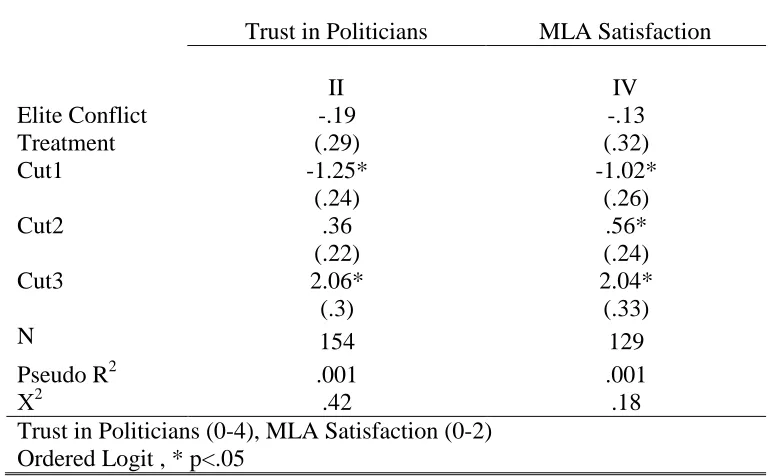
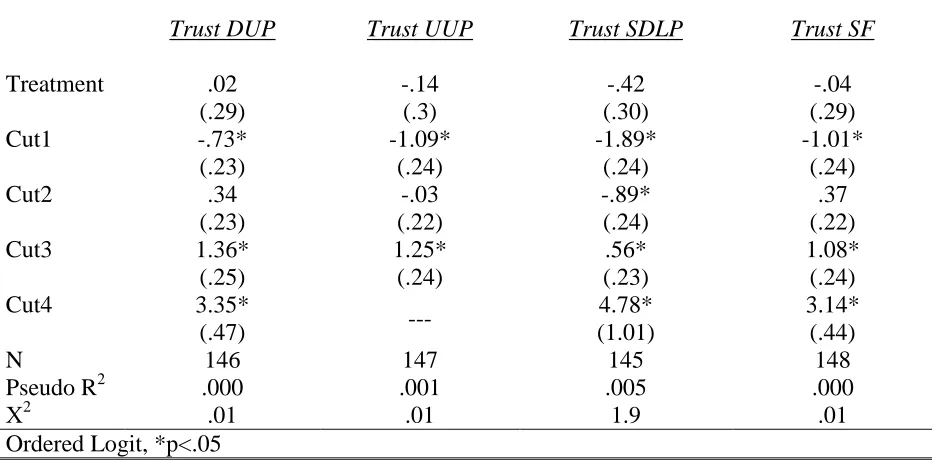
Table 4.2 Elite Conflict and Trust in Main Parties’ Members ... 57
Table 4.3 Sectarian Identity and Trust in Main Parties’ Members ... 59
Table 4.4 Predicted Probabilities for Table 4.3 ... 60
Table 4.5 Confidence in Institutions ... 61
Table 4.6 Confidence in Institutions Predicted Probabilities for Table 4.5 ... 62
Table 4.7 Legitimacy Factors ... 64
Table 5.1 Participant Random Assignment ... 71
Table 5.2 Sectarian and Anonymous Trust Gap – ... 82
Table 5.3 Player 1 Trust Game Panel Analysis of Ingroup, Outgroup, and Anonymous Trust ... 84
Table 5.4 Elite Behavior Treatment and Trust ... 86
Table 5.5 Reciprocity – Player 2 Tickets Returned ... 94
Table 5.6 Reciprocity-Tickets and Elite Behavior ... 95
Table 5.7 Reciprocity-Percent and Elite Behavior - Player 2 ... 98
Table 5.8 Four Areas of Mixing Comprising Willingness to Integrate with Treatment ... 103
Table 5.9 Four Areas of Mixing and Elite Trust Gap ... 105
Table 5.10 Predicted Probabilities for Elite Trust Gap and Treatment Assignment (Table 5.9) 105 Table 5.11 Willingness to Integrate ... 108
Table 5.13 Willingness to Integrate and Legitimacy Indexes ... 110
Table 5.14 Predicted Probabilities for Table 5.13 ... 110
Table 5.15 Elite Cross Community Trust and Cross Community Social Trust ... 111
Table 5.16 Predicted Probabilities for Table 5.15 ... 112
Table 6.1 Legitimacy, Social Capital, and Political Participation ... 132
Table 6.2 Legitimacy, and Bridging and Bonding Social Capital on Participation ... 133
LIST OF FIGURES
Figure 2.1 Cross-Community Elite Behavior and Social Cohesion ... 26
Figure 2.2 The Interaction of Legitimacy and Social Capital on Participation ... 38
Figure 5.1 Average amount Player 1 gave to Player 2 across three political identity conditions 78
Figure 5.2 Treatment and Control Groups Number of tickets given ... 78
Figure 5.3 Average amount Player 1 gave to Player 2 across three political identity conditioned
games by Player1’s political Identity ... 79
Figure 5.4 Average amount Player 1 gave to Player 2 across three political identity conditioned
games by Player1’s political Identity (Control Group Sub Sample N = 45; 11 Unionists, 7
Nationalists, 27 Neither/Other/Don’t Know) ... 80
Figure 5.5 Average amount Player 1 gave to Player 2 across three political identity conditioned
games by Player1’s political Identity (Treatment Group Sub Sample N = 37; 7 Unionists,
11 Nationalists, 19 Neither/Other/Don’t Know) ... 80
Figure 5.6 Number of Tickets Given by Player 1and Trust Interaction from Table 5.3 Model II.
Adjusted Margin Plots with 95% Confidence Intervals. ... 88
Figure 5.7 Percent of Tickets Returned in each game by Player 2’s Political Identity. ... 91
Figure 5.8 Number of Tickets Returned by Player 2 and Trust Interaction by Identity Context of
Game Play from Table 5.6 Model IV. (Adjusted Margin Plots with 95% Confidence
Intervals) ... 96
Figure 5.9 Percent of Available Tickets Returned by Player 2 and Trust Interaction by Identity
Context of Game Play from Table 5.7 Model VIII. (Adjusted Margin Plots with 95%
Confidence Interval) ... 99
Figure 6.1 Past Participation – Percent of Respondents that “Have done” ... 119
Figure 6.2 Future Participation - Percent of Respondents that “would” or “might” participate in the future. ... 119
Figure 6.3 Past Political Participation by Political Attachment ... 120
Figure 6.4 Future Political Participation by Political Attachment (respondents who would or might participate) ... 120
Figure 6.5 Petitioning and Boycotting by Assembly Legitimacy ... 127
Figure 6.6: Petitioning and Boycotting by Justice Legitimacy ... 127
Figure 6.7 Voting and Peacefully Demonstrating by Assembly Legitimacy ... 128
Figure 6.8 Voting and Peacefully Demonstrating by Justice Legitimacy ... 128
LIST OF ABBREVIATIONS
AP Alliance Party
CFA Confirmatory Factor Analysis
DETI Department of Enterprise, Trade and Investment
DK Don’t Know (Survey Response)
DUP Democratic Unionist Party
EVS European Values Survey
FPTP First Past the Post
GFA Good Friday Agreement
IRA Irish Republican Army
MLA Member of the Legislative Assembly
NILT Northern Ireland Life and Times Survey
OLS Ordinary Least Squares
P1 Player 1 (in trust game interaction)
P2 Player 2 (in trust game interaction)
PCA Principal Component Analysis
PIRA Provisional Irish Republican Army
PR-STV Proportional Representation Single Transferable Vote
QUB Queen’s University Belfast
RHI Renewable Heat Incentive
RIRA Real Irish Republican Army
SDLP Social Democratic Labor Party
SF Sinn Féin
1 INTRODUCTION
Often we see societies breaking down along social or cultural fault lines. These divisions can
manifest into violent conflict and political upheaval. In the most severe cases domestic and
international actors try to manage peace in societies through institutions of inclusion (i.e. power
sharing mechanisms), and through programs and policies that aim to foster positive interactions
and cohesiveness within a society. Unfortunately, studies attempting to measure the success of
efforts at managed peace focus disproportionately on aggregate data -- namely, macro-level
economic indicators, distribution of attitudes and behaviors at the country level, and even
number of years that a relative level of peace has been sustained. These macro-indicators can
mask important variation and explanatory power of citizen groups’ and individuals’ progress, or
lack of progress, towards social cohesiveness. There are three central questions that this
dissertation takes on. First, what is social cohesion? Second, how does social cohesion operate at
the individual level? Third, in societies with embedded cleavages and histories of violent
conflict, how might elite behaviors affect social cohesion? This dissertation sets out a
comprehensive definition of polity social cohesions, describes an individual level theory, and
details a preliminary plausibility test of the theory with original data from Northern Ireland.
Many scholars have constrained the definition of social cohesion by equating it to social
capital (e.g. Hollenbaugh & Ferris 2014; Chowdhrey 2018; Meer & Tolsma 2014; Easterly
&Woolcock 2006). This limited conceptualization is inconsistent with large scale empirical tests
that validate aggregate level measures of social cohesion (e.g. Dickes et al. 2010; Acket et al.
2011). I argue that social cohesion encompasses a broader conceptual framework than social
capital alone. Definitions must incorporate attitudes and behaviors that capture the context of the
any society, and even more crucial in post conflict societies due to the fragile state of political
and social stability.
I define social cohesion as a stable environment of positive horizontal and vertical
interaction between individuals producing positive ideas about groups and individuals within
one’s society, and actions that are productive in maintaining social and political norms. This is
not to say that stable environments do not experience political conflict, but the political conflict
in a cohesive society is successfully limited so that it does not threaten the stability of that polity.
Social Cohesion is produced through an iterative process where individuals process information
about political leaders, institutions, and events, then interpret the information within the context
of existing socio-political divisions (identity structures), and form attitudes about other
individuals and the political system. An individual’s attitudes then inform behavioral decisions
about interacting with others, and engaging with the political system.
At the aggregate level social cohesion is a conglomeration of individual level attitudes
and behaviors. At the highest levels of social cohesion we see attitudes and behaviors supporting
the current political system through support of institutions, high levels of trust in elected officials
and in others in society, and high levels of conventional political participation. Participation in a
highly cohesive society supports the current system even when we see alternation in individual
representatives or political parties themselves. At the individual level, social cohesion operates
as an iterative decision making process. Essentially social cohesion can be broken down into
three areas of socio-political attitudes and behaviors: 1) attitudes about actors and institutions, 2)
attitudes about others in society, and 3) political behaviors. The breakdown and importance of
these three components of social cohesion is discussed in greater detail when I unpack the theory
Societies that have experienced civil wars and other violent conflicts are particularly
susceptible to erosions or a full corruption of social cohesion. During violent conflict the
perception of threat between groups within a society grows with duration and severity of a
conflict. Threat, perceived or real, promotes group isolation that again feeds the perception of
threat. Once resolutions to violence and agreements are set legacies of conflict and threat create
obstacles to the buildup of social cohesion. Uncivil and intolerant attitudes can linger for decades
after official ceasefires and political agreements are struck.1 Individual defections from social
cohesion can range from small flare-ups of violent protests by those dissatisfied with the new
status-quo to large-scale attempts at destabilizing institutions and reversing those post-conflict
policies meant to ease integration. These defections can affect day-to-day relations and sustain a
long- term buildup of tensions along cleavage lines. Undetected by conventional macro-level
indicators, they nevertheless harbor the cumulative potential to slow, halt or even reverse
post-conflict social reconciliation.
Consociational institutions, while debated in their viability for producing long term
stability in post conflict societies, have been used to create the political systems in several post
conflict polities.2 There is a great deal of evidence supporting the use of these institutions in
divided societies where groups have not been able to come together naturally, or one group has
dominated the political and societal institutions and refuses admittance to another group. The
main tenants of consociational institutions lay the ground work for required inclusion of a
minority group(s) within the political system.3
1
See Anna Jarstad’s (2008) explanation of “legacies of war”
2 e.g. “Northern Ireland (1998), Bosnia (1995), and Cyprus (1960)” (Horowitz 2007, 1237). See Horowitz (2007) for
discussion of these agreements and criticisms of consociationalism.
3
There are four main requirements of consociationalism: 1) a parliamentary executive that includes all relevant and identified groups within that society (in Northern Ireland this is Unionists and Nationalists, in Bosnia the two groups identified are Bosniac, Croat, and “other groups” (Kaspović 2005), 2) proportional representation within the
There is also an assumption of a top down nature to consociationalism. Leaders from
each community come together and make decisions and form working institutions and ultimately
deliver their followers, the general population, to the peace process. Where there is limited to no
social cohesion these institutions can facilitate a functional and inclusive political system and
develop the space for future social reconciliation.
In a consociational system political parties and individual representatives identify along
the salient divide(s) (e.g language, ethnicity, or religion) within the newly structured parliament.
The overt group designation along cleavage lines is used to ensure inclusion in the government.
The idea being that one must clearly identify the excluded group(s) to include the group(s) in the
political process. Critics argue, however, that the necessity of identification along ethnic lines
re-enforces group differences and propagates the division long into the future.4 Despite this
problem, many believe that while the divisions dominate in the political discourse and political
violence has made it impossible for a stable and inclusive government to exist, consociational
agreements and governments are necessary to mitigating violence and building a working
governance structure. A question that remains is if consociational institutions, in post conflict
societies, provide sufficient stability to grow and maintain social cohesion.
Political elites, comprised of parties and individuals who negotiate peace deals and hold
offices in the new government, can have an important influence on these individual level
attitudes and behaviors. The political will exhibited by actors to cooperate by building peace and
within a consociational political system provides cues to citizens about relationships across
the minority group in the legislature (see McGarry and O’Leary (2004) for indepth discussion of consociational
mechanism and defense of consociationalist institutions and power sharing mechanisms in post-conflict societies, particularly Northern Ireland).
4 See works by Donald Horowitz (e.g. 1985, 2014) for detailed criticisms of consociationalism. Horowitz highlights
community groups and the health of the political system itself. Indeed consociationalism is a
top-down theory of peace building, meaning there is an expectation that elites are leading the way by
creating an initial peace and building institutions and a structure of political space of operation.
When elites continue to cooperate with each other within the consociational institutions these
group leaders are facilitating stability that will be echoed by the population and generate a
durable peace.
Northern Ireland illustrates notable examples of the destructive potential of a post conflict
society, including political conflict and stagnant assembly proceedings, sectarian marches
turning into street violence against others and police, and protests which turned violent over the
decision to limit the number of days that the Unionist flag will fly over the capital.5 Clearly, in
societies with embedded cleavages and histories of violent conflict, it is imperative that we better
understand the mechanisms by which elite interactions can bias and inform individual citizen
attitudes and behaviors as they adapt to new institutional realities.
Discerning how specific individual attitudes and behaviors are formed and changed will
shed light on how social cohesion manifests within a polity. I argue that three attitudinal and
behavioral areas comprise social cohesion: legitimacy, social capital, and political capital. Other
studies look at one of the three areas, but scholars rarely examine the interactions between and
among these core components. The extant literature has, moreover, focused too restrictively on
aggregate country-level analyses and too frequently overlooked vertical elite-mass linkages. I
investigate the complex nature of social cohesion at the individual level and the influence that
political elites have on individual-level components of social cohesion.
This dissertation advances an original theoretical framework that connects the disparate
components of social cohesion within a single dynamic model. The model generates a set of
5
testable hypotheses to explain how attitudes and behaviors manifest and how elite interactions
shape these individual-level attitudes and behaviors in predictable ways. In particular, this
dissertation argues that political elite interactions across established cleavage lines, through
cooperation or conflict, will increase or decrease, respectively, individuals’ feelings of
legitimacy, levels of social capital, and frequency and form of participation. Beyond advancing
an original theoretical framework, this dissertation makes important new contributions to the
literature through its use of experimental methods and its application to the case of Northern
Ireland. Although tested within the confines of a single case, the arguments advanced and tested
here provide the basis for subsequent comparative analysis in other societal contexts.
1.1 Road Map
The dissertation is organized as follows. Chapter 2 details the ways different academic
disciplines and policy studies have utilized social cohesion to date. Exploring how social
cohesion has been used in the past, I clarify a definition of social cohesion for this project and
explain its three distinct components: legitimacy, social capital, and political participation. I then
set out a theoretical model of how political eliete behaviors influence the components, and how
each area interacts with the others. Next, in Chapter 3, I introduce the Northern Ireland case used
to test the theory at hand, and detail the methods of research used. I detail the historical political
context of the Northern Ireland case and the current structure of regional government that makes
it optimal for testing this theory of social cohesion. I will then discuss the two primary sources of
original data for this project; an online survey that includes an elite prime and social trust game,
and interviews with elected members of the Northern Ireland Assembly.
The following three chapters include empirical studies using one of the three components
legitimacy, and looks at an experiment that tests the influence of political conflict between the
most successful political parties in the Northern Ireland Assembly on individuals’ attitudes.
Chapter 5 unpacks how elite behaviors and legitimacy attitudes indirectly and directly impact
social capital. Elite actor behavior has the potential to impact social capital directly and
indirectly impact social capital when it is filtered through attitudes about actors and institutions,
while legitimacy attitudes have direct impacts on social capital. I utilize a social trust game and
revisit the elite conflict experiment to better understand trust and reciprocity between community
members and preferences for interaction across community lines. I focus on the importance of
contextualizing social capital indicators according to ingroup and outgroup relationships.
Chapter 6 moves on to the third component of social cohesion: political participation Using
original survey data I investigate how individuals make decisions about voicing political
preferences through voting and other modes of participation. I test the interactive effect of
attitudes about institutions and political actors, and social capital. Chapter 7 concludes this
dissertation, summarizing findings from the empirical chapters, discussing implications, and
outlining future research that this study lays the ground work for.
2 SOCIAL COHESION AN INDIVIDUAL LEVEL THEORY
Social cohesion is identified as an important factor for supporting democratic regimes (e.g. Mann
1970; Forrest and Kearns 2001; Labonte 2004; Frayha 2003; Heyneman 2003; Manole 2012).
Social cohesion has been discussed and studied broadly across many disciplines but with little
consistency in conceptualization; therefore this dissertation aims to consolidate a workable
definition and working theory of social cohesion. Social cohesion is usually measured at the
understood in its internal workings. This study will go beyond existing methods to extend our
understanding of social cohesion by unpacking the concept at the individual level.
Investigating social cohesion at the individual level allows for exploration of a greater
level of nuance into what might drive or deter the building of social cohesion within a society.
Focusing only on macro level or aggregated society level neglects understanding the individual
level causal factors discussed in social psychology, communication, and political behavior
literatures. Obviously how social cohesion is defined and especially how it is measured will
impact the outcome of our assessments within the discipline of political science and of the
expected influence of social cohesion on a polity. Therefore determining a suitable scope of the
term, appropriately measuring the component parts at the individual level, and testing the
relationships between the individual level components are the aims of this dissertation. This
chapter will outline a broad theoretical framework for defining and assessing social cohesion at
the individual level, propose theoretical expectations for the role of elite behavior in influencing
social cohesion, and propose expectations for how the component parts may interact at the
individual level.
2.1 Defining Social Cohesion
Social cohesion is defined various ways depending on the field of study and if the work is
written for policy purposes or academic ones. Many times, however, the term is used without any
sort of definition attached. Hence writers expect readers to understand social cohesion, perhaps
based on some preexisting, approximately unified or consistent idea about what a “society” that
is “cohesive” looks like. This implicitly assumes readers can imagine a “society” that lacks
“cohesiveness”. However, the assumption that we are all picturing the same conditions and
cohesion within the field of political science and preferably across policy and in a
multi-disciplinary context would serve well for conducting research and determining policy processes.
I define social cohesion as a stable environment of positive horizontal and vertical interaction
between individuals that generate 1) positive ideas about groups and individuals within one’s
society, and 2) actions that maintain social and political inclusivity, and policy productivity.
Social cohesion is thus, at the individual level, comprised of legitimacy, social capital, and
political participation. This definition and conceptualization is an improvement on other
definitions of social cohesion because it encompasses the full range of the concept. Social
cohesion as I define the term captures the horizontal and vertical nature of social and political
cohesion of a polity. Rather than narrowing the term to social capital alone, as is the most
common practice. Some may argue still that social capital is the dominant area or measure of
social cohesion and that legitimacy attitudes and participation are lesser parts of the cohesion
picture. It is possible that these areas of social cohesion could be weighted differently when
measuring at the aggregate level. While this question is outside of the scope of this project the
iterative nature of social cohesion should be remembered when making determinations about
weighting the three components more heavily or lightly.
Social cohesion is an attitudinal and behavioral element of societies. Societies have high
levels of social cohesion when individuals hold positive preferences and attitudes about others in
society and those who have political power, and when individuals behave positively towards the
political system and towards others through interactions. Low levels of social cohesion,
attitudes and behaviors.6 These attitudinal and behavioral orientations exist horizontally, towards
fellow citizens, and vertically with relation to the government.
Social cohesion has many moving parts and is the conglomeration of three interrelated
dimensions for the individual: legitimacy, social capital, and political participation. Legitimacy
exists when citizens view the current political institutions and those who have power within the
system as right and proper (Lipset, 1959; Easton 1975). A sufficient level of support for the
government, institutions, and actors is critical to sustaining a stable socio-political environment
in a polity. Social capital is the second component accounting for attitudinal and behavioral
patterns of trust and reciprocity of individuals within the context of the existing socio-political
structures (e.g. Putnam 1993, 1995). A society with a great deal of social capital, especially
bridging social capital is the foundation for social stability and can undercut the viability of
political discord shoring up the endurance of a polity. Finally, political participation allows
individuals to reaffirm or reject the political system and social structures supported by the
politics of the day by taking some action. The actions or behaviors that individuals choose to
engage in, or not, are incredibly important to the stability of a polity, as voting and violent
protest have very different implications for a society.
In the next sections I will discuss other conceptualizations and measurement schemas that
have been used and why I argue that these three component concepts are the most appropriate
way to define, measure, and analyze social cohesion.
6 This definition of social cohesion and social capital is the reason tolerance is not included within the
conceptualization or operationalization here. Tolerance is not positive preference or attitude toward a group or other. To the contrary tolerance is negative association or preference with allowance for inclusion in the political or social system (see Sullivan et al. 1982 for discussion of the definition and measurement of tolerance). While
2.2 Other Definitions
Scholars have employed a variety of definitions for social cohesion, most of which locate the
unit of analysis at the societal level rather than the individual level. Modern attempts have been
made to consolidate a definition and measurement of social cohesion. I build off of definitions
and measurements used by Bernard (1999) and Chan, To, and Chan (2006) to conceptualize
social cohesion for this study. Both works advanced the consolidation of the concept of social
cohesion by defining specific domains and measures that encompass the term. Bernard (1999)
and Chan et al. (2006) propose similar conceptualizations of social cohesion with a focus on
social and political attitudes and behaviors. The two differ where Bernard includes economic
indicators which focus on economic inclusion, equality of opportunity and equality of condition.
Chan et al. alternatively argue that the economic factors (i.e. inclusion or exclusion of
individuals or groups in the labor market, and other conditions for economic equality and
opportunity) are predictors of social cohesion but not measurement component of the concept.7
Bernard’s argument focuses largely on the role of economic equality in producing social order
and social cohesion. Bernard in some ways conflates social order and cohesion, which are not
equivalent terms. Beauvis and Jenson (2002) use social order as a component of social cohesion
as an update to Jenson’s (1998) five dimension conceptualization of social cohesion, discussed
below.
Bernard states that social cohesion is a “quasi” concept that remains ambiguous. He does
not state a clear definition but instead makes an argument for six dimensions of social cohesion
specifying two axes “character of the relation” (Formal and Substantial), and “sphere of activity”
(Economic, Political, and Sociocultural). Bernard generates the two axes in an effort to create a
typology of Jenson’s (1998) five dimensions of social cohesion. Jenson’s (1998) five dimensions
of social cohesion in sum are: 1) A feeling of belonging or shared values, 2) Inclusion or
exclusion from the labor market via employment, 3) Participation in or abstention from Politics,
4) Tolerating or rejecting differences in others, and 5) the Recognition or Rejection of
Institutions. Through these overlapping typologies Bernard argues that he discovers a “sixth
type”, 6) social justice and equality. Table 2.1 a recreation of a Bernard’s typology table (1999,
19) shows how his two axes overlap with Jenson’s five dimensions of social cohesion.
Table 2.1 “Typology of the Dimensions of Social Cohesion”
Character of the Relation
Formal Substantial
S
phe
re
of A
cti
vit
y Economic (2) Insertion/Exclusion (6) Equality/Inequality
Political (5) Legitimacy/Illegitimacy (3) Participation/Passivity
Sociocultural (4) Recognition/Rejection (1) Belonging/Isolation
Table recreated from Bernard (1999, 19)
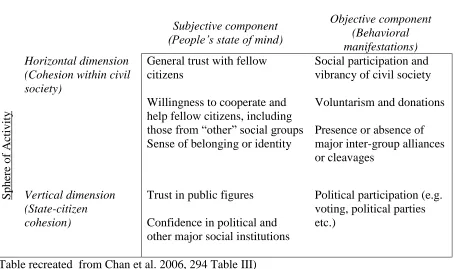
Chan et al. have a more deliberate definition for social cohesion. They state that “Social
cohesion is a state of affairs concerning both the vertical and the horizontal interactions among
members of society as characterized by a set of attitudes and norms that includes trust, a sense of
belonging and the willingness to participate and help, as well as their behavioral manifestations”
(290; bolded in original). Chan et al. argue for a concise and sensible definition; they create a
two by two framework rather than the three by two organization of Bernard by excluding the
one side, and subjective and objective on the other. Table 2.2, a recreation from Chan et al.
depicts how the subjective, objective, horizontal, and vertical overlap in their conceptualization.
Table 2.2 Measuring Social Cohesion: a two-by-two framework
Subjective component (People’s state of mind)
Objective component (Behavioral manifestations) S phe re of A cti vit y Horizontal dimension (Cohesion within civil society)
General trust with fellow citizens
Willingness to cooperate and help fellow citizens, including those from “other” social groups Sense of belonging or identity
Social participation and vibrancy of civil society
Voluntarism and donations
Presence or absence of major inter-group alliances or cleavages
Vertical dimension (State-citizen cohesion)
Trust in public figures
Confidence in political and other major social institutions
[image:29.612.79.534.171.440.2]Political participation (e.g. voting, political parties etc.)
Table recreated from Chan et al. 2006, 294 Table III)
Dickes et al. (2010) and Acket et al. (2011) test the empirical validity of a range of social
cohesion dimensions for which Bernard and Chan et al. argue. Dickes et al. use individual level
data from 33 countries in the European Values Survey (EVS) and confirmatory factor analysis
(CFA) to validate that the expected survey questions are relevant component measures. Acket et
al. use first use individual level measures from 47 EVS countries to construct a two dimensional
metric, the VALCOS Index, for measuring social cohesion along attitudinal/formal and
Table 2.3 Dimensions of Social Cohesion
Dickes et al.
CASE Formal (Bernard) / Attitudinal (Chan et al.)
A
Formal/Economic
Insertion/Exclusion in Economy (particularly in the labor market)
not included as part of
social cohesion n/a
Legitimacy
B
Formal /Political Legitimacy/Illegitimacy of public and private institutions
Subjective Vertical Trust in public Figures. Confidence in institutions
Social
Capital C
Formal/Sociocultural
Acceptance/Rejection of pluralism; Tolerance of Other groups
Subjective Horizontal
“General trust in others, Willingness to cooperate intra and inter group, Feelings of belonging shared identity”
Substantial (Bernard) / Behavioral (Chan et al.)
D Substantial/Economic
Equality/Inequality of Economic conditions and opportunity
none n/a
Political
Participation E
Substantial/Political Participation/passivity in the Political System
Objective/Vertical Political Participation (e.g. voting, political parties…)
Social
Capital F
Substantial/Sociocultural
Affiliation/Isolation in/from the community, feeling of
belonging, Shared values
Objective/Horizontal
Social Participation, i.e. Voluntarism/donations, Presence of intergroup cleavage
While Acket et al. and Dickes et al. use individual level, Acket et al. go on to using macro
comparisons at the country level and Dickes et al. do not go beyond validating the measures.
Both studies find support for the components of social cohesion except for Bernard’s economic
sphere which is not verified due to insufficient existing data to measure economic indicators.
Neither of these studies delves into theorizing or testing predictive or causal models at the
individual level. This study aims to understand the individual level factors that may promote or
restrict social cohesion.
The conceptualization of social cohesion laid out by the various works discussed above
overlap greatly with concepts that are already prevalent in political science literature. I argue that
the array of social cohesion components tested by Dickes et al. and Acket et al. align with the
political concepts of legitimacy, social capital, and political participation (electoral and
non-electoral). These concepts measured and understood at the individual level will contribute to the
overall understanding of why we see variation in social cohesion. Table 2.3 shows how the
component parts outlined by Bernard, and Chan et al. overlap with each other and cases
identified by Dikes et al. Table 2.3 also depicts how the political science concepts of legitimacy,
social capital, and political participation align with existing domains. The next section will take a
deeper look at these three terms, how they overlap with existing spheres of social cohesion, and
why they are important components of social cohesion.
2.3 Social Cohesion’s Three Dimensions
I conceptualize social cohesion in this dissertation as a socio-political phenomenon comprised of
three attitudinal and behavioral areas: legitimacy, social capital, and political participation.
Before turning to my theory that will discuss how these components are associated and might
an eye to prior research in each area as well as to my research question. Then I will elaborate my
top-down theory of social cohesion.
2.3.1 Legitimacy
Legitimacy deals with how citizens and individuals perceive the institutions, individuals, groups,
and ideals that construct a government. Legitimacy is a critical component of social cohesion
because the political environment and contexts shape the way that individuals interact with each
other. Legitimacy of the government captures the political and vertical components of a society.
Exclusion of these factors would prevent a full understanding of how individuals and groups
feel and behave within a society. The political environment and actions taken by various political
actors filters through what political scientists call legitimacy, which are the perceptions about the
governmental structures that exist and operate the day to day politics and business of the state.
Political scientists often measure legitimacy by gauging confidence or trust in specific actors,
specific institutions such as the parliament, the president, the judiciary, and of specific regime
norms such as democracy. High levels of legitimacy exist when citizens are confident in and
have high levels of trust in the government, its actors, and its institutions.
Many scholars have grappled with how to define political legitimacy and argue about the
role of legitimacy on “system stability” (Booth and Seligson 2009). Booth and Seligson (2009)
deliberate over the concept of legitimacy in great depth, empirically validating a variety of
individual survey measures. Booth and Seligson define six areas of support for measuring the
structure of legitimacy: 1) “existence of political community”, 2) “support for core regime
principles”, 3) “support for regime institutions” , 4) “evaluation of regime performance”,8 5)
“support for local government”, and 6) “support for political actors or authorities” (49-55).
8 In Booth and Seligson’s study and others, economic evaluations are the basis of measurement for regime
Mishler and Rose emphasize the role of political trust as being an especially important part of
legitimacy. They find support for institutional theories for trust which underscore the ability to
nurture and grow trust in newly developed democratic institutions (2001, 33). Norris (2011)
makes the argument that voter turnout is an insufficient measure for legitimacy and a deeper
understanding of the attitudes and behaviors is necessary and now possible with growing
individual level survey data.
Additionally, I argue that voter turnout falls under the scope of political participation
rather than a direct measure of legitimacy. Legitimacy in my conceptualization is only an
attitudinal measure, not behavioral. The attitudes about a government eventually lead to actions
taken by individuals, but these are conceptually different aspects of social cohesion. Looking at
the social cohesion literature legitimacy overlaps with Dickes et al. “Case B”, Bernard’s
“Formal/Political” cell, and Chan et al.’s “Subjective Horizontal” area (see Table 2.3). Bernard’s
and Chan et al.’s (2006) “spheres of social cohesion,” the component of legitimacy includes trust
in public figures, and confidence in or feelings of legitimacy towards political institutions. I
constrain the measures of legitimacy to the attitudes framed by Bernard and Chan et al.
including, support of public institutions, trust in elected officials, and confidence in institutions.
These three areas are particularly relevant to the political legitimacy which focuses on the
vertical attitudes of an individual’s support of governmental institutions and representatives, the
first of three components that comprise the overarching concept of social cohesion.
2.3.2 Social Capital
Political science and sociology scholars have long studied social capital. Social capital links the
role of individual and group relationships and actions to economic success and social and
between individuals or other actors (Coleman 1988; Putnam 2000). In its original conception,
social capital was defined in relation to other forms of capital, economic or “physical capital”
and human capital (Coleman 1988). Social capital was considered to be the third important form
of capital that could, through its presence within a society, produce positive conditions for
growing economic capital. I define social capital in the tradition of Coleman (1988) and Putnam
(1993, 2000). Social capital exists when actors believe that commitments by other actors will be
upheld. The accumulation of trust and reciprocity9 between actors within a social structure,
establishment of norms to constrain behaviors, and formation of viable networks of actors can
create and reinforce this belief in the credibility of commitments (Putnam 1993, 164-67).10
Putnam (2000) further tested the viability of social capital in its relation to the success of
democracy and extended the conceptualization to include two sub-categories: bonding social
capital and bridging social capital. Bonding and bridging social capital were argued to be
important distinctions in type and in outcome. Bonding social capital occurs within an existing
group structure while bridging social capital occurs between individuals or group actors outside
of the group or of two separate groups. Levi (1996) discusses the dynamic roles bridging and
bonding social capital play. Levi disagrees with Putnam that both bonding and bridging social
capital will contribute to generalized trust, and states that neighborhood associations in West
Belfast, Northern Ireland, “…promote trust of those you know and distrust of those you do not,
those not in the neighborhood or outside the networks” (50). Bonding social capital thus
strengthening social ties and trust within existing groups but perhaps prevents the growth of
9
Trust and reciprocity here fall within this transactional definition of social capital. One trusts when they believe that another person is committed to a transaction and that the other will return favor. A trustor believes that a trustee is trustworthy. Reciprocity is an act of returning the favor by upholding the commitment themselves once trust has been put in them by a trustor. A trustor forms an attitude (a belief) and then takes action based on that attitude. A trustee receives some action, this action is moderated by preexisting attitudes (knowledge and beliefs), the trustee then takes action based on this information (the trustor’s action and preexisting attitudes).
10 Putnam uses the term “credible commitments” in his explanation of social capital and linking the concept of
these ties and trust outside of the bounds of that group and thusly limiting broader bridging social
capital.11
Social capital captures the horizontal relationships that exist within a socio-political
system, when individuals believe that other individuals will hold up their end of any given
agreement. The horizontal social trust and reciprocity that exists (or is absent) within a society
between individuals can play a part in how political participation manifests. Social capital can be
reinforcing to higher levels of cohesion or divisions that exist depending on if we see bridging or
bonding social capital, respectively.
Newton (1999) argues that interpersonal trust is a distinct concept from political trust,
and therefore always must be distinguished between when discussing trust. Political trust refers
to a vertical trust and reciprocity relationship between citizens and their representatives and in
some cases other community leaders. Interpersonal trust at the societal level encompasses the
horizontal relationships captured in the concept of social capital. Additionally, Newton speaks to
the likely causal direction of influence between the two forms of trust. He states that political
factors rather than social ones influence political trust, and that political capital likely influences
social capital in a top-down manner (186). Sønderskov & Dinesen (2016) also find support for
institutional trust having a causal effect on social trust.12 This is important to my theory of social
cohesion in terms of how legitimacy is likely to influence social capital. Social capital is widely
discussed in its importance for, and role within, democracies (Putnam 1993, 2001; Fukuyama
2001; Levi 1996; Brehm and Rahn 1997). Areas that fall under social capital within the social
11 Social psychology literature also contributes heartily to our understanding of how group identities and
interactions shape attitudinal outcomes with three dominant areas of research: intergroup contact theory (see Allport 1954), extended contact hypothesis (Wright et al 1997; Turner et al. 2007), and social identity theory (Tajfel generally e.g. 1974; Tajfel and Turner 1979).
12
cohesion conceptualizations as discussed earlier include: general trust, out-group trust, tolerance,
norms of reciprocity, cooperation, feeling of belonging, and participation in social organizations
(see Table 2.3). Each of these areas of social capital, when we see high levels, contribute to the
belief that commitments by others are being upheld. Additional contextualization between
bonding and bridging social capital must be taken into consideration. High levels of bonding
social capital have been found to reinforce in-group trust and reciprocity while high levels of
bridging social capital have been found to grow outgroup trust, tolerance and so on. Of the
indicators that comprise social capital, interpersonal trust is considered to be the most formidable
and informative to the likelihood of increased social participation and positive social opinions.13
2.3.3 Political Participation
Political participation is the final constituent part of social cohesion. Political participation is a
set of bottom up vertical of actions that an individual might take to voice their preferences about
the state of the socio-political system and their support or rejection of the current government.
Bernard, Chan et al., Dickes et al., and Acket et al. all include political participation in their
measures of social cohesion. Electoral participation and various forms of non-electoral
participation are of concern for social cohesion. Electoral participation refers to the act of an
individual voting in representative election, arguably the most formal form of political voice.
Non-electoral participation includes acts of political voice outside of or beyond voting. Voting is
an important indicator of engagement with politics, however protesting and signing a petition are
other methods of engagement and voicing political preferences. Additionally, non-electoral
participation may feel like a more viable and vocal option for some individuals and groups,
13While interpersonal trust can exist at various levels depending on the context, for the purposes of this study,
either when discontent with the electoral options or when groups are disenfranchised in some
way. It is important to include both electoral and non-electoral participation because the
motivations for using one over another or both will likely vary. Political participation is relevant
and important to social cohesion because it closes the loop between the political and the societal
spheres of a polity. Citizen voice, either through formal or informal channels is important to the
full picture of representative governance.
Now that I have briefly defined the component parts of social cohesion; legitimacy, social
capital, and political participation, I will explain in greater detail the expected relationships
between these three spheres. I will also discuss the role of elected representatives on social
cohesion. Following from Newton’s argument that political trust impacts interpersonal trust I
expect a top-down relationship to exist between political actor behaviors and individual level
citizen behavior. The next section makes the argument for why political actions matter for social
cohesion and how the component parts of social cohesion matter to each other at the individual
level.
2.4 A Top-Down Theory of Social Cohesion
The actions and policy decisions of political elites have the potential to influence individual
perceptions and behaviors in political and social spheres (cf. Zaller 1992). Therefore, I argue, the
role of political elites is incredibly important when trying to understand the individual attitudes
and behaviors that foster social cohesion. This is particularly true where consociational
institutions exist and have been established to mitigate group conflict. This study focuses on
political elites within a society, because the absence or presence of cooperation at the elite level
has the potential to drive divisions or unify the political as well as the social sphere. Namely,
of political participation, and interpersonal behaviors that stabilize a cohesive regime-citizen
equilibrium in society. As explained below, this question of political elite influence is
particularly important in, but not limited to, societies that have strongly defined reinforcing
ethno-political cleavages, such as Northern Ireland.
While I argue that elites are vital to propagating social cohesion, we first need to
understand how identity at the individual level may impact interpretations of elites, as well as
attitudes about and actions towards others. The structure of society and where an individual finds
themselves within that structure can impact their perceptions and actions. Social identity is
important to understanding the full scope of social cohesion in any given polity. Social identity
theories (e.g. Tajfel & Turner 1979; Levin & Sidanius 1999; Abrams 1984; Kelly 1988; Hinkle
& Brown 1990), social distance (Bogardus 1959), and group threat and conflict theories (e.g.
Tajfel 1974; Tajfel and Turner 1979; Levin and Sidanius 1999; Crighton and McIver 1991; Bobo
1999) posit that societies are broken into groups, individuals identifying with one or more social
groups affects how an individual understands the world and interacts with others in this social
structure. That is, when individuals identify with a subgroup of a society, whether it is political,
ethnic, class, linguistic, or otherwise, the individual’s identity will moderate perceptions and
behaviors. The embedded cleavage structure and categorization of cleavage will vary across
different societies. The degree to which these cleavages polarize a citizenry will also vary. The
context of socio-political structure must be taken into account to fully understand how social
cohesion functions.
General political trust and social trust is usually measured to gauge aspects of social
cohesion, but salient cleavages are an important context that must be accounted for. General trust
embedded cleavages can help researchers to understand how individuals’ perceptions and
decision making is informed. At both the social and political level the context of salient
socio-political or ethno-socio-political cleavage context must be included in the trust calculous. Transue
(2007) uses a survey experiment to determine the varying effects of superordinate and subgroup
(racial) identities on support for particularized educational (to a particular race group) and
general educational funding in the United States. Transue (2007) found that the “salient identity
of the respondents” matters for their preferences (88). This and other studies (e.g. Carlin and
Love 2018) highlight the importance of the identity context within the larger question of social
cohesion and political processes generally. Additionally, recent studies dealing with polarization
are highlighting the importance of identifying relevant partisan cleavages beyond the traditional
left-right divide to better understand the ways division arise and become entrenched within
different societal and polity contexts (e.g. Somer and McCoy 2018; Lauka et al. 2018). This
study focuses on these the role of subgroup identity by investigating the impact of elite behaviors
across socio-political cleavages on the three areas of social cohesion.
2.4.1 Elite Conflict and Legitimacy Attitudes
Reik et al. (2008) lay the groundwork for elite influence on public social preferences (e.g. trust
towards members of a social outgroups). Reik et al. building on extended contact
hypothesis/theory (see Wilner et al. 1952; Wright et al. 1997; Turner et al. 2007) that establishes
the idea that an individual knowing another ingroup member has had contact with an outgroup
member increases favorable attitudes towards that outgroup. Essentially you do not need direct
contact with an outgroup member, rather a friend that is part of your ingroup having outgroup
contact can affect your attitudes and behaviors about the outgroup. Like direct contact, extended
Pettigrew & Tropp 2006, and Turner et al. 2007), but we still see reductions of bias even when
these most favorable conditions are not present. Extended contact hypothesis was originated at
the horizontal or mass level, where individuals interacting making friends with outgroup
members.
Riek et al. expand the idea to a vertical or top down exchange whereby witnessing
cross-national elite interaction might influence citizen adoption of positive attitudes towards foreign
countries. Here the country identity is isolated as the salient ingroup and the elites (e.g. Prime
Ministers, Presidents, notable diplomats) interacting work as an ingroup member in contact with
an outgroup member, the other countries elite. Reik et al. find that when state leaders interact in
cooperative ways with other state leaders, citizens from those countries are more trusting of the
other country (State A Leader and State B Leader cooperate State A citizens are more trusting
of State B, and State B citizens are more trusting of State A). The elite behavior acts as a signal
to individuals that the other state is trustworthy.
I argue that this extended contact theory, or top-down elite behavioral influence on the
general public can be adapted to a fully domestic context. Societies that have experienced violent
conflict based on an ethno-political cleavage and have political systems that remain divided
along these lines will also have political elites that can be easily identifiable as attached to a
specific group. Cooperation or conflict between elites of different groups can therefore be easily
interpreted by the public as such and ultimately influence societal level attitudes. If this is the
case, divided societies should benefit from increases in overall social cohesion following elite
cooperation.
Therefore fully understanding how domestic political elites can inform the attitudes and
Looking at the three spheres of social cohesion individually, links between elite behavior and the
three areas (legitimacy,14 social capital,15 and political participation16) have been made in the
past, but clarity about the relationship and influence of cross-community interactions at the elite
level have not been investigated. Elite-to-citizen influence is often referred to as a top-down
relationship, this emphasizes the connection between elite behaviors and individual perceptions
of government and institutions. Booth and Seligson (2009) and Mishler and Rose (2001) both
discuss this direction of influence. The top-down flow of information about elite behaviors has
the potential to greatly influence attitudes and behaviors within and across existing
socio-political cleavages.
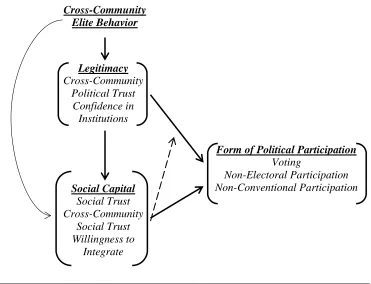
This new model of social cohesion at the individual level takes into account the social
cleavages that are present within a society. Figure 2.1 illustrates the relationship between elite
behaviors and the three components of social cohesion. A brief description follows and a more
exact and detailed explanation of the mechanisms behind these expected relationships is
discussed in the next section and tested in the following empirical chapters. I will also state
specific expectations that will inform hypotheses stated and tested in later chapters of this
dissertation (see Chapters 4, 5, and 6).
Elite interaction across community lines, either through cooperation or conflict, is the
starting place in this model. Elites behave in ways that signal conflict (not working together for
common goals), or cooperation (working together successfully through compromise or
agreement). Citizens become aware of this cross-community elite behavior through the news
14 e.g. Seligson’s (2006) study on corruption and government legitimacy, and Svolik (2013) who points to “good
performance” of individual politicians as important to support for democracy and the consolidation of new democracies.
15 e.g. Fox (1996) uses a “political construction” approach for investigating how social capital is built in Mexico
where he argues elite political conflict may affects the developing social capital.
media or other sources. Cross-community trust or mistrust is signaled to individuals in society.
These signals should directly impact individuals’ feelings about the government and those
political leaders and political parties that are interacting. Hence, I expect elite behavior to
influence individual attitudes about the government (legitimacy component).
Cross-Community Elite Behavior
Legitimacy
Cross-Community Political Trust
Confidence in Institutions
Form of Political Participation
Voting
Non-Electoral Participation Non-Conventional Participation
Social Capital
Social Trust Cross-Community
Social Trust Willingness to
Integrate
[image:42.612.126.497.212.496.2]Note: Dotted line indicates expected interaction between social capital measures and legitimacy measures.
Figure 2.1 Cross-Community Elite Behavior and Social Cohesion
Legitimacy, in this model, then impacts the formation of social capital and political
participation. Social capital is encouraged (or stifled) by support for (or rejection of) the actors
and institutions that comprise the government. The social identity context is overlaid here, where
trusting ingroup and outgroup political elites impacts social level (horizontal) attitudes and