Philosophy Theses Department of Philosophy
8-7-2018
Reining In The Passions: The Role Of Emotions In
Understanding Self-Control
Mara McGuire
Georgia State University
Follow this and additional works at:https://scholarworks.gsu.edu/philosophy_theses
This Thesis is brought to you for free and open access by the Department of Philosophy at ScholarWorks @ Georgia State University. It has been accepted for inclusion in Philosophy Theses by an authorized administrator of ScholarWorks @ Georgia State University. For more information, please [email protected].
Recommended Citation
McGuire, Mara, "Reining In The Passions: The Role Of Emotions In Understanding Self-Control." Thesis, Georgia State University, 2018.
SELF-CONTROL
by
MARA MCGUIRE
Under the Direction of Eddy Nahmias, PhD and Andrea Scarantino, PhD
ABSTRACT
In this paper, I consider a philosophical model of self-control recently developed by Chandra
Sripada (2010, 2012) and inspired by current dual-process models in both the sciences of the mind
and philosophy. Sripada argues that the mind is bifurcated into two motivational systems that
correspond to Emotion and Reason and that to exercise self-control is to act in accordance with
reason when it comes into conflict with emotion. I argue that Sripada’s model rests on two false
assumptions, that emotions are cognitively impenetrable and that self-control is always about taming
our emotions. Based on these arguments, I conclude that our capacity for self-control cannot be
understood in terms of a divided-mind and consider a structural model of self-control recently
developed by Kentaro Fujita (2016).
SELF-CONTROL
by
MARA MCGUIRE
A Thesis Submitted in Partial Fulfillment of the Requirements for the Degree of
Master of Arts
in the College of Arts and Sciences
Georgia State University
Copyright by Mara Rose McGuire
SELF-CONTROL
by
MARA MCGUIRE
Committee Chair: Eddy Nahimas
Andrea Scarantino
Committee:
Electronic Version Approved:
Office of Graduate Studies
College of Arts and Sciences
Georgia State University
DEDICATION
For David, Theresa, Helen & Barak, thank you for your endless love and support; For
Schuler & Yuan, thank you for turning an interest into a passion; And for Mary-Ann &
ACKNOWLEDGEMENTS
I want to especially thank Eddy Nahmias and Andrea Scarantino for their guidance over the
course of the paper’s development and during my time at Georgia State University, for discussing
these ideas with me on countless occasions, and for their valuable and detailed feedback on multiple
previous drafts of this paper. I am also grateful to Sandra Dwyer, Adrian Pecotic, Mercer Gary,
TABLE OF CONTENTS
ACKNOWLEDGEMENTS ... V
LIST OF TABLES ... ERROR! BOOKMARK NOT DEFINED.
LIST OF FIGURES ... VII
1 INTRODUCTION ... 1
2 SRIPADA’S SOLUTION TO THE PUZZLE OF SELF-CONTROL ... 3
3 TWO OBJECTIONS TO SRIPADA’S MODEL OF SELF-CONTROL ... 14
3.1 Are Emotions Truly Recalcitrant to Reason? ... 14
3.2 Is Self-Control Always About Taming One’s Emotions? ... 20
4 AN ALTERNATIVE APPROACH? FUJITA’S STRUCTURL MODEL OF SELF-CONTROL 31 5 HOW TO SOLVE THE PUZZLE OF SELF-CONTROL: THREE DESIDERATA ... 41
6 CONCLUSIONS ... 44
LIST OF FIGURES
Figure 1. Sripada’s Divided-Mind Model of Self-Control ... 12
1 INTRODUCTION
Kicking an addiction, writing a thesis, and being a faithful partner are, at least for many of us,
challenging goals to achieve. Even when we greatly desire to give up smoking for good, to finish
the final draft of our thesis, and to live up to the promises we made to our partner, desires to the
contrary often stand in our way. We may still crave the cigarette, want to spend the night at a bar
with friends rather than alone in the library, and desire the attractive stranger who just moved in
next door. Some of us never beat our addiction, complete our thesis, or manage to be faithful, but
many of us do. The difference between successful and failed attempts to achieve such goals is
likely the result of many interacting factors, both personal and social, over which we may have
varying degrees of control (Kennett 2013). When we do succeed in resisting our goal-defeating
desires, however, the most proximate cause of our success is oftentimes attributed to self-control.1
A question that has attracted philosophers and scientists of the mind for decades is: how should
we understand the capacity for control? In this paper, I consider a philosophical model of
self-control recently developed by Chandra Sripada (2010, 2012) and inspired by current dual-process
models in both the sciences of the mind and philosophy ( e.g. Hofmann et al. 2009; Holton, 1999,
2009; Levy 20112; Masicampo & Baumeister 2008; Metcalfe & Mischel 1999). Sripada argues
that the mind is bifurcated into two motivational systems that correspond to Emotion and Reason.
The outputs of these two systems can conflict and, when they do, we need to exercise self-control
in order to act in accordance with reason. To exercise self-control, the reasoning system engages
1
There is now a substantial body of empirical literature whose findings corroborate the idea that our capacity for self-control plays a decisive role in determining our ability to meet and maintain desired life-goals, whether they be academic, financial, or health related (Duckworth & Seligman 2005; Mischel, Shoda & Rodriquez 1989; Moffitt et al. 2011).
2
Levy’s (2011) divided-mind model is technically focused on weakness of the will or akrasia rather than self-control. While some (e.g. Mele 1987) claim that self-control and akrasia are opposing sides of the same coin, others (e.g. Holton
1999, 2003) claim that it is “strength of will” that stands in opposition to weakness of will. As my focus is exclusively on
a system of executive processes that are capable of reining in the passions, even if they are stronger
than our desire to act in accord with reason.
I will develop two objections against Sripada’s model. First, I will argue that it
mischaracterizes the nature of emotions in assuming that emotions are typically recalcitrant, that
reason and practical-judgments cannot shape or alter an emotion once elicited. Second, I will argue
that, in defining self-control problems in terms of conflict between Emotion and Reason, Sripada’s
model fails to capture a large portion of cases in which the motivational conflict is not between
emotion and reason, but rather is between conflicting emotions or even conflicting higher-order
cognitive processes. Based on these arguments, I conclude that we should abandon the idea that a
“divided-mind” is at the heart of understanding the capacity for self-control. I then consider
whether Kentaro Fujita’s recently developed structural model of self-control is a promising
alternative to dual-process based accounts, arguing that, while it solves some of the problems
facing divided-mind accounts, it cannot make sense of the capacity for self-control. In light of the
problems facing both Sripada Fujita’s models, I outline a series of desiderata that future attempts
to understand self-control should aim to meet.
I first provide an overview of Sripada’s model and the relevant philosophical problems
motivating his theory (Section 2). After this groundwork is in place, I will develop my first
objection that emotions are not recalcitrant, and consider the implications of the cognitive
penetrability of emotions. I then raise my second objection, that self-control conflicts do not
necessarily involve a conflict between emotion and reason (Section 3). I then proceed to argue that
we should shift our way of conceptualizing self-control away from divided-mind models and
consider the viability of Fujita’s alternative understanding of self-control (Section 4). Finally, I
2 SRIPADA’S SOLUTION TO THE PUZZLE OF SELF-CONTROL
In an attempt to home in on the ways in which people may exercise self-control, philosophers have
differentiated between two broad classes of self-control, which they call synchronic and diachronic
self-control (Kennett & Smith 1997; Sripada 2012; Mele 2014). To illustrate the distinction,
imagine the following scenarios:3
Scenario (1): Theresa, a long-time smoker who is trying to quit, is at the bar with her friend
Dave, who offers Theresa a cigarette. Theresa has a strong craving to smoke but judges
that, all-things-considered, she should not smoke the cigarette. Theresa exercises
self-control to act in accordance with her judgment and does not accept the smoke.
Scenario (2): Theresa*, a long-time smoker who is trying to quit, does not currently have
a craving for a cigarette but knows that if she were to pass by a smoke shop that she would
develop a strong craving to smoke and would likely be overwhelmed by it. As such, on her
way home from work, Theresa* takes a route home that does not pass by the shop where
she used to buy cigarettes.
The general consensus in the literature is that both Theresa and Theresa* exercise self-control,
albeit different types of self-control. In Scenario (1), Theresa must resolve an occurrent
motivational conflict. At the same time, Theresa is motivated both by her craving to smoke a
cigarette and by her judgment not to smoke, but manages to resist her craving and act on her
judgment not to smoke. This is an instance of synchronic self-control. In Scenario (2), Theresa* is
anticipating a motivational conflict. Theresa* anticipates that, if she were in the position to easily
buy cigarettes, that she would be overwhelmed by a craving to smoke and would likely give into
that craving. In taking measures to prevent such a sequence of events from happening, Theresa*
3
exercises diachronic self-control. The difference, then, between these two types of self-control has
to do with whether the agent exercises self-control to resolve a motivational conflict she is
currently experiencing – synchronic self-control – or if she exercises self-control to resolve an
anticipated, future motivational conflict – diachronic self-control.
In what follows, my primary focus will be on synchronic self-control, as it is this type of
self-control that Sripada is attempting to model (hereafter, I will drop the qualifier and will refer
to ‘synchronic self-control’ simply as ‘self-control’).4 While it may seem obvious that people are
capable of exercising self-control, some philosophers have found the exercise of self-control
puzzling. The starting point for the puzzle, as identified and framed by Alfred Mele (1987), is the
relationship between desire and intentional action5 which is expressed in the ‘Law of Desire’
(Clarke, 1994; Davidson, 1980) stated below:
If a person most desires to perform some action A, and if she believes herself free to A,
then she will A, if she does anything at all intentionally.6
Given the Law of Desire, Mele notes that the exercise of self-control appears to either be
impossible or unnecessary. If Theresa most desires to smoke, and believes herself free to smoke,
then she will smoke if she does anything at all intentionally. In this case, then, it does not seem
possible for Theresa to intentionally exercise self-control. If, however, Theresa most desires to not
smoke and believes herself free to not smoke, then – given the Law of Desire – she will not smoke
and, thus, will not need to exercise self-control.
4
The reader should be aware that, unless otherwise noted, the following discussion is referring exclusively to synchronic self-control and not diachronic self-control.
5
Sripada does not explicitly adopt any particular theory of intentional action.
6
This particular formulation of the Law of Desire comes from Davidson (1980). Both Sripada (2012) and Mele (2003, 2014) note that this formulation of the Law of Desire is false. For instance, Mele writes “a soccer player who most desires to score a goal on his penalty kick and believes himself free to do so may intentionally kick the ball and unintentionally
kick it too far to the right” (Mele 2014, 363). Despite such counter-examples, Sripada claims that, even though it is false,
How can we explain why self-control is both possible and necessary in many cases? In this
paper, I will consider Chandra Sripada’s (2012) proposed solution, which is based on a
dual-process model of self-control. Generally speaking, dual-dual-process models posit that the brain is
capable of processing information in – at least – two qualitatively different ways (e.g. fast, low
effort, and high processing capacity vs. slow, high effort, and “limited” processing capacity) and
that these two types of information processing map onto different systems in the brain (Evans
2007, 2010; Kahneman 2011; Stanovich 2004, 2011).7
On Sripada’s model, as mentioned above, these two systems correspond roughly to the folk
notions of Passion and Reason and he calls them the Emotional Motivational System and the
Deliberative Motivational System (hereafter, simply the emotional system and the deliberative
system). Conflict between the outputs of the emotional and deliberative systems define the
conditions under which self-control is needed, and acting in accordance with the output of the
deliberative system is to successfully exercise self-control. That is, self-control problems are
defined exclusively in terms of a motivational conflict between the outputs of the emotional system
and the deliberative system. To solve the puzzle of self-control, Sripada argues that there is a third
system at play, the Regulatory System, that can be engaged by the deliberative system and whose
function is to regulate the emotional system.
While past attempts to solve the puzzle of self-control have assumed that the Law of Desire
– outlined above – is true (e.g. Kennett & Smith, 1996, 1997; Mele 1997, 1998, 2003), Sripada
breaks with this tradition and argues that the Law of Desire is not universally operative. He claims
7
that there are cases in which a person can act on the weaker of two, conflicting desires. Sripada
calls cases in which the Law of Desire does not apply “Full-Blooded Willpower” (hereafter, FBW).
To explicate what Sripada means by FBW, I will first re-state his formal definition and
then provide an illustrative example. Sripada defines the conditions for FBW as follows:
(1) During some (arbitrarily long) interval I extending over t1…tn, S’s [practical-desire] is
opposed by his wayward desire D to A straightaway, and throughout I, D is S’s strongest
desire.
(2) At t2, even while D remains S’s strongest desire, S undertakes an active intentional
exercise of willpower that prevents him from acting on D.
(3) At no time during I does S perform any actions that promote D, or start to perform any
actions that promote D. (Sripada 2012, 10; brackets are mine)
To better illustrate how Sripada envisions FBW, imagine the earlier example with the types of
desire now specified:
Scenario (3): Theresa and Dave are at the bar and Dave, always the enabler, offers Theresa
a cigarette. Theresa’s practical-desire to not smoke the cigarette is opposed by her
emotional-desire to smoke. Even though Theresa’s strongest desire is her emotional-desire
to smoke, she exercises willpower and thus prevents herself from taking any actions that
support her emotional-desire.
Sripada’s goal, then, is to construct a model of self-control that can account for FBW. In order to
understand Sripada’s account of FBW it will be necessary to first go into a bit more detail on his
model.
Emotional-desires are the primary output of the emotional system. Sripada defines
(2012, 12). In particular, Sripada focuses on two features of emotions, passivity and recalcitrance.
By passivity, Sripada means that emotions are typically triggered “automatically,” without any
need for “attention or supervision” (2012, 12). For example, if a large animal starts to charge you,
then you will likely experience fear automatically, without having to engage in any sort of
voluntary or conscious evaluation of the situation. By recalcitrance, Sripada means that triggered
emotions typically persist, and motivate us to act, even if the agent “has made a sincere judgment
that the emotion is not apt or warranted” (2012, 12). A commonly used, illustrative example is a
person who has a fear of flying even though she knows that traveling by airplane is safer than by
car. That is, even though the person sincerely judges that she should not be afraid, she continues
to experience fear.
Practical-desires are the output of the deliberative system. The deliberative system “refers
to the collection of processes that implement practical reasoning” (Sripada 2012, 11). Practical
reasoning or deliberation can be understood in two ways. The first is when a person runs through
reasons for and against performing some action. For example, if you are deciding whether to buy
a particular house, you would likely weigh reasons for and against the purchase. The second is
when a person has a desired outcome and evaluates the probability of achieving that outcome given
a set of possible actions.
Emotional-desires and practical-desires are what Sripada, following Mele (2003), calls
action-desires. Action-desires are a type of “essentially motivation-encompassing attitude” which
Sripada defines as follows: “[Person] S’s essentially motivation-encompassing A attitude is…an
attitude that represents S’s A-ing as part of its content, and that non-deviantly contributes to S’s
A-ing in all possible scenarios in which S has this attitude” (2012, 34; brackets are mine). Having
that attitude. Or, to put it differently, a satisfactory causal explanation of why person S intentionally
performed action A could appeal to S having a motivation-encompassing attitude to A as a
proximate cause. For example, the first thing Matt does every morning is go for a run. In order to
explain why Matt performs this action (i.e. going for a run), one could say that Matt has an
essentially motivation-encompassing attitude, in this case an action-desire, that represents Matt
going for a run as part of its content and contributes to Matt’s going for a run every time he has
that action-desire.
Thus far, I have given an overview of the central tenet of Sripada’s theory, namely, that
the mind is bifurcated into two, separate motivational systems. Sripada views his use of
dual-process theory in constructing his model of self-control as an argument in favor of his view and
writes:
An…argument in favor of the divided mind account of willpower is that the divided
motivational architecture being proposed is an instance of a more general kind of
architecture, called a dual-process architecture, that is now well accepted across many
domains in cognitive science. It thus helps the divided mind approach that it has empirical
support that arises independently of its being adduced as a solution to the puzzle of
synchronic self-control. (Sripada 2012, 31)
Before I turn to outlining how Sripada uses the divided-mind model to solve of puzzle of
self-control, however, I need to discuss the notion of strength of desire.
Sripada begins to flesh out the idea of strength of desire by claiming that “desires are
dispositions to act” and that what determines the extent to which a person is disposed to act in a
Sripada relies on two concepts, “motivational-bases” (see Mele 2003) and “causal-powers,” to
explicate the notion of motivational strength.
The motivational-base for an attitude, an action-desire in our case, can be positive or
negative. Sripada defines the positive motivational-base of an attitude A as “the set of
motivation-encompassing attitudes that contribute to the motivational strength of A” (2012, 13). For example,
Matt’s desire to go for a run is strengthened by his practical judgment that running is good for his
health. Conversely, Sripada defines the negative motivational-base of an attitude A as “the set of
motivation encompassing attitudes that weaken the motivational strength of A” (2012, 13). For
example, Matt’s desire to go for a run is weakened by his practical judgment that excessive running
is bad for his joints. For any given action-desire, the larger the positive motivational-base relative
to the negative motivational-base, the stronger the person’s action-desire. Importantly, Sripada
claims that the motivational-bases for the outputs of the deliberative system and the emotional
system are separate. That is, the motivation-encompassing attitudes of the emotional system
neither strengthen nor weaken the motivation-encompassing attitudes of the deliberative system
and vice versa. For example, Matt’s emotional-desire to stay in bed is not weakened by the
practical judgment that running is good for his health.
The idea of motivational-bases helps to explain the notion of a desire’s strength but it does
not explain the relationship between strength of desire and action. In order to explain this latter
relationship, Sripada employs the idea of “causal-powers.” Desires, according to Sripada, have
causal powers. The stronger the desire, which is determined by the strength of its motivational
base as outlined above, the stronger its causal-powers and the more disposed a person is to act on
(2012, 18). On the direct route, desires dispose us to act through affecting action selection and
production systems. Sripada writes:
For example, on one plausible and empirically well-supported view, desires are associated
with number-like representations that induce an ordering over the relevant set of active
desires, and action systems are configured to favor as inputs desires associated with the
highest numbers. (Sripada 2012, 18)
On the indirect route, desires dispose us to act through drawing “one’s attention towards
desire-relevant situations and prospects,” and enhancing “certain hedonic attributes of prospects, such as
their expected pleasure, pleasantness, or appeal” (Sripada 2012, 18). Returning to the example of
Matt, the stronger the causal-powers of Matt’s desire to go for a run the more this desire will grab
his attention or enhance the appeal of going for a run and, as a result, the more likely Matt will be
disposed to go for a run. Sripada labels the causal-powers of emotional-desires and
practical-desires as “D-powers” (2012, 20).
Carving out separate motivational systems in the mind can make sense of the idea of
conflicting desires. That is, since the emotional system and the deliberative system operate
independently and rely on different types of information processing, their outputs can diverge
without causing internal consistencies within either system. However, this bifurcation of the mind,
on its own, does not explain how FBW is possible. Given the Law of Desire, it seems as if a person
will act on whichever output, either the emotional-desire or the practical-desire, is stronger.
In order to model FBW, Sripada posits a third system, which he calls the regulatory system.
The regulatory system is separate from both the emotional and deliberative systems and has its
own causal powers which Sripada labels “R-powers” (2012, 19).8 The R-powers of the regulatory
8
system are comprised of the “mental processes that serve to regulate (i.e., attenuate, suppress,
block, or otherwise modify the motivational properties of) one’s own desires and other
motivation-encompassing attitudes” (Sripada, 2012, 3). More specifically, these processes make up the
category of emotion regulation and can be divided into antecedent- and response-focused
strategies. The former “alter the appraisal or interpretation of the environmental cues that elicit or
sustain the wayward desire” while the latter “involve either direct inhibition of motivation or the
prevention of action” (Sripada 2012, 3).9 Importantly, while the emotional, deliberative and
regulatory systems are separate from one another, the D-powers of the deliberative system (but not
the emotional system) can actively initiate the R-powers of the regulatory system, which, in turn,
can regulate the outputs of the emotional system (Sripada (2012, 13) calls this “Thesis (M)”). The
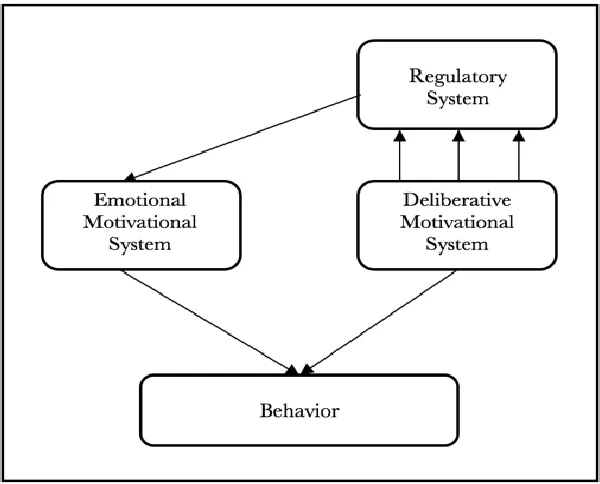
relationship among these systems is outlined in Figure 1 below.
Baumeister et al. 1998; Gailliot & Baumeister 2007; Masicampo & Baumeister 2008). On this model, self-regulatory processes, of which willpower is a sub-type, draw on a central resource of limited capacity. The central tenant of this model is that, when an agent exercises self-control, some of this limited resource is “consumed,” leaving the agent in an “ego-depleted” state in which she is less likely to be able to successfully exercise self-control. For recent critiques of the strength model of self-control, see: Inzlicht & Berkman (2015); Lange & Eggert (2014); Job, Walton, Bernecker & Dweck (2013); Beedie & Lane (2012); Shimmack, (2012); Kurzban (2010, 2014)
9
Figure 1. Sripada’s Divided-Mind Model of Self-Control
This figure outlines the proposed relationship between the emotional, deliberative, and regulatory systems. As shown, the outputs of both the emotional and deliberative systems can directly lead to behavior. In cases where the outputs of the emotional and deliberative systems are in conflict, however, the deliberative system can engage the regulatory system which can regulate the output of the emotional system.
Now that we have discussed all the components of Sripada’s solution to the puzzle of
self-control, let us apply them to an example. Matt’s emotional-desire to stay in bed is stronger than
his practical-desire to go for a run. Even though Matt’s practical-desire is weaker than his
emotional-desire, it is the strongest desire within his deliberative system. Therefore, this
practical-desire can initiate the R-powers of the regulatory system which can then regulate (e.g. attenuate)
the strength of his emotional-desire. As such, Matt is able to act on his weaker practical-desire
rather than his stronger emotional-desire. What does this mean for the Law of Desire? Sripada
Overall then, the Law of Desire is not shown to be false, but rather its domain is restricted.
In the type of contest between desires that interests us, i.e., contests involving the exercise
of willpower, the Law of Desire fails to apply. (Sripada 2012, 22)
That is, in cases where a person’s practical-desire, even if it is weaker than their emotional-desire,
actionally initiates the regulatory system, it is possible, contrary to the Law of Desire, for that
person to intentionally act contrary to their strongest-desire. Why then, does Sripada say that the
Law of Desire is not false? The Law of Desire is not false because it still applies within both the
emotional and deliberative systems and in cases where the regulatory system is not engaged.
In sum, Sripada is arguing that self-control involves a conflict between emotion and reason.
Even though our emotions may sometimes be stronger than desire to do what reason dictates, we
are still capable of acting in accordance with reason, of exercising self-control. The fundamental
reason why we are capable of exercising self-control in this way is because our minds are divided.
3 TWO OBJECTIONS TO SRIPADA’S MODEL OF SELF-CONTROL
In this section, I develop two objections to the role emotions play in Sripada’s model, the
conclusion being that Sripada has not solved the puzzle of self-control and we should look to other
models to approach the puzzle.10 First, Sripada’s solution hinges on the three-fold division among
the emotional, deliberative, and regulatory systems, a division, I argue, that is only justified if
emotions are recalcitrant to reason, that is, if emotions cannot be directly influenced by the
deliberative system. I then proceed to argue that emotions are not typically recalcitrant to reason,
that the deliberative system can directly influence emotions and emotional-desires, thereby
challenging Sripada’s solution to the puzzle of control. Second, I argue that synchronic
self-control is not always about regulating our emotions, that there are genuine instances of synchronic
self-control in which the motivational conflict is not between emotion and reason. If I am right,
then Sripada’s model fails to explain how we exercise self-control in these other cases, as his
model is based on the assumption that exercising self-control is about taming our emotions and
the behavior they motivate.
3.1 Are Emotions Truly Recalcitrant to Reason?
As I emphasized at the conclusion of Section 2, whether Sripada’s model is a viable solution to
the puzzle of self-control rests on the three-fold division he draws between the emotional,
deliberative, and regulatory systems; if these divisions are unjustified, his solution falls apart.
Claiming that emotions are typically recalcitrant is a way to justify carving the mind into these
10
separate systems.11 To illustrate the justificatory role recalcitrance plays on this model, consider
the following example:
Scenario (4): While Susan is waiting to board a plane, she stumbles upon a news article
recounting a recent plane crash. When it is time for her group to board, Susan feels afraid,
resulting in a strong desire not to board the plane. She then begins to deliberate as to what
she should do, considering reasons for and against boarding the plane. The process of
deliberation culminates in the practical-judgment that she should not be afraid, that she
should exercise self-control and board her flight. Susan successfully exercises self-control
and boards the airplane.
To use Sripada’s language, Susan has an emotional-desire not to board the plane (i.e. a fear of
flying; the output of the emotional system) and a practical-judgment that she should board the
plane (the output of the deliberative system), which results in Susan successfully exercising
self-control and boarding the plane (via the processes of the regulatory system which attenuate,
suppress or modify her emotional-desire).
If Susan’s fear or emotional-desire not to board the plane is recalcitrant, then the process
of deliberation, culminating in the judgment that she should board the plane, cannot influence (i.e.
attenuate, suppress etc.) the motivational-strength of her fear. Why does this matter? First, if the
processes and output of the deliberative system cannot influence the output of the emotional
system, then this provides some evidence for Sripada’s claim that they are separate systems.12
Second, and perhaps more importantly, Sripada needs to draw a principled distinction between the
11 The question is not whether emotions can be recalcitrant but whether they are typically recalcitrant. Sripada could
easily maintain that emotions are typically recalcitrant and accept that there are instances where emotions fail to exhibit this feature. Likewise, while I will argue that emotions are not typically recalcitrant, I am not denying that emotions are ever recalcitrant, the most notable case being phobias.
12
deliberative system and the regulatory system in order to solve the puzzle of self-control.That is,
if the regulatory and deliberative systems are not separate, then we may argue that the
causal-powers of the deliberative and regulatory systems should be considered together. And, when we
look at the combined causal-powers of these two systems, they are actually stronger than the
causal-powers of the emotional-desire. In that case, when a person exercises self-control, they are
simply acting on their strongest desire and the Law of Desires applies once more. To illustrate,
when we look at the combined causal-powers of Susan’s practical-desire and the processes of the
regulatory system, they are stronger than her emotional-desire to not board the plane. In boarding
the plane then, Susan is simply acting on her strongest desire.
What does recalcitrance have to do with the present discussion? If emotions are recalcitrant
to deliberation and practical-judgments then Sripada has a principled way to distinguish the
processes of the regulatory system, which are capable of influencing the strength of our emotions,
from those of the deliberative system. That is, it is a way to justify the distinction between these
two systems. If emotions are not recalcitrant, however, then the processes and output of the
deliberative system can directly influence the motivational properties of emotions, thereby doing
the job that the regulatory system is supposed to perform on Sripada’s model. And, if the processes
and output of the deliberative system can do what the regulatory system is supposed to do, then it
seems as if the causal-powers of the deliberative and regulatory systems should be combined,
thereby vindicating the Law of Desire. In sum, recalcitrance supports both the division between
the emotional system and the deliberative system and between the deliberative system and the
regulatory system. Emotions, however, are not typically recalcitrant. To make this argument I will
have to say a bit more about the elicitation of emotions as well as the mental processes involved
A dominant view in the scientific literature is that emotion episodes, which are taken to
include physiological, phenomenological, motivational, and behavioral components, are elicited
by an “appraisal” of a given object, event or state of affairs (e.g. Arnold 1960; Clore & Ortony
2000; Ellsworth 2013; Frijda 1986, 2001, 2007; Lazarus 1991, 2001; Scherer 1984, 2001, 2009,
2013; Smith & Ellsworth 1985). The project of defining what is meant by “appraisal” is ongoing,
but it is roughly taken to refer to “a process that detects and assesses the significance of the
environment for well-being” (Moors et al. 2013, 120) or “an evaluation of the personal significance
of what is happening in an encounter with the environment” (Lazarus 2001, 40). While the details
of appraisal theories vary, they all involve a number of variables along which appraisals are made
and which also serve to differentiate among types of emotions (Moors et al. 2013, 120). A few
examples of appraisal variables, from Lazarus’ (2001) appraisal theory, include “goal-relevance,”
whether the event is relevant to the person’s well-being, “goal-congruence,” whether the event
assists or frustrates a person’s desires or needs, and “future expectations,” whether the person’s
relationship to the environment will be improved or worsened (Lazarus 2001, 55-57; Moors et al.
2013, 120). Different appraisals, then, result in different emotions. The last aspect of emotion
elicitation to highlight before turning to emotion-regulation is the mechanism underlying the
process of appraisal. Again, the details vary among theories, but Moors writes:
Appraisal theorist generally agree that various mechanisms can underlie appraisal and that
they can operate on a wide range of representations: conceptual and/or propositional versus
perceptual and/or embodied; symbolic versus sub-symbolic; locationist versus distributed.
They believe that appraisal often proceeds automatically…but can also sometimes proceed
That is, while an appraisal can be a conscious, non-automatic process, usually it is an
automatic process that does not require conscious awareness. Importantly for the present purposes,
Sripada adopts some version of appraisal theory and writes “the appraisal process by which an
emotion is triggered typically unfolds automatically, and does not require conscious attention or
supervision” (Sripada 2012, 12). Though Sripada does not go into greater detail, it is clear that he
views emotions as being elicited by an appraisal.
Now that I have homed in on the view of emotion elicitation under discussion, I want to
say a bit more about emotion-regulation, which “refers to shaping which emotions one has, when
one has them, and how one experiences or expresses these emotions” (Gross 2014, 10). James
Gross (1998, 2014) discusses different families of emotion regulation strategies which intervene
on different points in an emotions episode. The emotion regulation strategy that I want to focus on
is “cognitive change,” which “refers to modifying how one appraises a situation so as to alter its
emotional significance, either by changing how one thinks about a situation or about one’s capacity
to manage the demands it poses” (Gross 2014, 10; italics are mine).13 One type of cognitive change
strategy is reappraisal, in which a person tries to alter the way they interpret a given object or
situation that is eliciting an emotion.
To illustrate, let us return to the example of Susan who is afraid of flying and has an
emotional-desire not to board the plane. In support of her practical-desire to board the plane, Susan
exercises self-control and let us suppose that the willpower strategy Susan employs is reappraisal,
in which she changes how she interprets flying in an airplane. As a result of reappraising the
situation, the motivational-strength of Susan’s fear dissipates.
13
Sripada views reappraisal as an effective form of emotion-regulation, that is, a process
whereby the motivational strength of an emotional-desire may be weakened. The problem,
however, is that Sripada both accepts that emotion regulation strategies such as reappraisal can
alter the motivational strength of emotions and wants to maintain that emotions are recalcitrant to
reason. Such a position is not viable, since the process of deliberation, generating reasons for or
against some course of action is simply to reappraise one’s initial response to the situation. If
reappraisal can alter the motivational-strength of emotional-desires, then the process of reasoning
and deliberation should also be able to do so, because the process of generating reasons – the
culmination of which is a practical-judgment – appears to be functionally the same as reappraising
a situation so as to determine the appropriate emotional response. And, if it is the case that the
process of reasoning and deliberation can influence the motivational properties of emotions, then
emotions, contra Sripada, are not recalcitrant to reason.
To illustrate, let us once more return to the example of Susan. Now, however, I want to
focus on the process of reasoning or deliberation whereby Susan comes to the practical-judgment
that she should board the plane. In coming to this practical-judgment, Susan considers a number
reasons, which include that flying is comparatively much safer than other forms of transportation,
such as driving a car and that the flight is not a threat to her well-being but is simply the means
whereby she is arriving at her vacation destination. In generating the reasons that support the
practical-judgment that she should board the plane, Susan is reappraising her initial emotional
response. If Sripada accepts that reappraisal is a process whereby we can attenuate the strength of
an emotional-desire, then he must also accept that emotions are not recalcitrant, that the process
Now that my argument is on the table, I want to remind the reader of the implications that
follow if emotions are cognitively penetrable. First, if the process of deliberation can directly
influence the motivational properties of emotions, then the idea that the deliberative and emotional
systems are separate is called into question. The deliberative system can directly influence the
emotional system rather than simply being able to indirectly influence the emotional system
through engaging the regulatory system, as Sripada claims. Second, the cognitive penetrability of
emotions challenges the idea that the deliberative and regulatory systems are separate. If they are
not separate, then the causal powers of the regulatory processes should be incorporated into the
causal powers of the deliberative system. And, if we combine these causal powers, Sripada’s model
no longer solves the puzzle of self-control. Whether or not we act on our emotional-desire or our
practical-desire will be determined by whichever of these two desires is strongest.
3.2 Is Self-Control Always About Taming One’s Emotions?
I concluded the preceding section by arguing that paradigm emotions are not typically recalcitrant,
that the process of reasoning or deliberation directly influences the motivational properties of
emotions. Now I will argue that self-control is not always about taming one’s emotions. To make
this point, I will first argue that emotions can motivate exercises of self-control. I will then argue
that we sometimes exercise self-control to resist desires that are not driven by emotions.
On Sripada’s divided-mind model, emotions play a single role in self-control problems;
they motivate actions we struggle to resist. The strength of the emotional-desire certainly
the less likely self-control will be successful and vice versa)14, but emotions can never directly
motivate an exercise of self-control. Sripada calls this Thesis (M) and spells it out as follows:
(M) The motivational base, both positive and negative, for the exercise of willpower
consists exclusively of motivation-encompassing attitudes within the deliberative
motivational system. (Sripada 2012, 13)
What Thesis (M) prohibits is that any motivation-encompassing attitude within the emotional
system (i.e. emotions, drives and cravings) play a direct role in engaging the regulatory system;
emotions neither strengthen nor weaken the motivational strength of a practical-desire to exercise
self-control. As with recalcitrance, discussed above, Thesis (M) is intended to preserve the division
that Sripada draws between the emotional and deliberative systems and upon which his solution
to the puzzle of self-control rests.
I will argue that thesis (M), however, is false. Emotions can motivate the exercise of
self-control. To use Sripada’s terminology, emotions can be part of the motivational-base for the
practical-desire to exercise self-control. Consider the following:
Scenario (5): Mercer and John have been in a monogamous relationship for years and take
their sexuality fidelity very seriously. Recently, Mercer has been spending a great deal of
time with her business partner and good friend Sam and, while traveling for work, finds
herself alone in a hotel bar with him. At that moment, Mercer greatly desires Sam and the
thought of cheating on John enters her mind. Considering what to do, Mercer generates
reasons for and against sleeping with Sam, most of which are in favor of the act: John
would never find out, it would only be once, she has never cheated on him before etc. While
the majority of reasons are in favor of sleeping with Sam, Mercer starts to feel very guilty
14
at the thought of cheating on her partner. This sense of guilt is so strong that Mercer comes
to the practical-judgment that she should not sleep with Sam. Mercer exercises self-control,
says goodnight, and heads to her room alone.
Mercer is resisting an emotional-desire, the desire or, perhaps, drive to sleep with Sam. The
conflicting motivation, however, cannot be characterized as being based purely on “reasons,” since
it seems to be driven by an emotion, namely, guilt. The guilt that Mercer feels is part of the positive
motivational-base in her deliberative system; it is one of the motivational attitudes, even the
primary motivational attitude, that supports the exercise of self-control which, in this case, happens
to be successful.
Is such a scenario plausible? Yes. While the idea that emotions can contribute positively to
exercises of self-control has not been extensively explored in the empirical literature, some have
suggested that certain social or self-conscious emotions, such as guilt or regret, may contribute
positively to exercises of self-control (Baumeister et al. 2007; DeSterno 2009; Giner-Sorolla 2001;
Katzier et al. 2010).15 If the scenario above is plausible, however, then there is some reason to
think emotions, or at least certain emotions, can help rather than hinder our capacity to exercise
self-control.16 If this is indeed the case, then Thesis (M) – which, again, claims that emotions
cannot directly influence whether or not we exercise of self-control – appears to be false.
Before moving on I want to consider two objections. First, it could be objected that, in the
scenario above, guilt is not part of the motivational-base for Mercer’s practical-judgment that she
should not sleep with Sam but, rather, is still part of the motivational-base for her emotional-desire
to sleep with Sam. The argument would be cashed out as follows: The motivational-base for a
15
The evidence, however, is mixed. Some previous empirical work has suggested that self-conscious emotions play a disinhibitory role (Herman & Mack 1975; Polivy et al. 1988)
16
desire, at least on Sripada’s account, is both positive and negative. There are some
motivation-encompassing attitudes that can strengthen the desire – these form the positive motivational base
for that desire – while there are other motivation-encompassing attitudes that weaken the desire –
these form the negative motivational-base for that desire. Returning to the scenario, guilt is not
part of the positive motivational-base for the practical-judgment that sleeping with Sam is not the
thing to do – which then motivates the exercise of self-control. Rather, guilt is part of the negative
motivational-base for the emotional-desire to sleep with Sam. That is, these emotions are
weakening the emotional-desire to sleep with Sam rather than strengthening the practical-desire
not to sleep with Sam and to exercise self-control. In this sense, guilt is making a successful
exercise of self-control more likely, but Sripada’s theory does not rule out the possibility of
emotions playing this role; he explicitly states that the weaker the emotional-desire the more likely
we are to successfully exercise self-control. And, more importantly, emotions can play this role
and not contradict Thesis (M).
Such a defense on behalf of Thesis (M) seems implausible. First, Sripada does explain how
there are both positive and negative motivational-bases for emotional-desires as he does for
practical-judgments. For the latter, he claims that reasons in favor of some action comprise the
positive motivational-base while reasons not in favor of some action form the negative
motivational base for the practical-judgment. How does this process work for emotional-desires?
The answer is unclear. Presumably, it would require an account of how emotions, drives and
cravings impact, both positively and negatively, the strength of an emotional-desire. Sripada does
not offer such an account. Of course, this does not rule out the possibility of constructing a theory
of how emotions, drives and cravings impact the strength of an emotional-desire in some way, but
responding that guilt is part of the negative motivational base for an emotional-desire does not
straightforwardly save Thesis (M).
Second, in the current formulation of the scenario, most of the reasons that Mercer
considers as to whether she should indeed sleep with Sam are actually in favor of the act. That is,
either because her reasoning is being motivated by her lust for Sam or because there just happen
to be very good reasons to sleep with Sam, most of the reasons that immediately come to mind
support the act. Rather than being implausible, the idea that Mercer would generate reasons in
favor of her emotional-desire is empirically well supported. That is, in self-control dilemmas, and
instances of self-regulation more generally, people will often generate reasons that are in favor of
acting on their emotional-desire or come up with external justifications for this choice (Huberts et
al. 2014; Kivetz & Zheng 2006; Weber et al. 2007). It seems plausible, then, that Mercer may think
of more reasons that are in favor of sleeping with Sam than are in favor of not sleeping with Sam,
as is stated in the scenario. If Mercer generates more reasons for, rather than against, sleeping with
Sam, then we can say that the negative motivational base outweighs the positive motivational base
supporting the practical-judgment that she should not sleep with Sam, in the sense that there are
more reasons in favor of the act. Guilt, then, cannot be part of the negative motivational-base of
her emotional-desire. If guilt were part of the negative motivational-base of her emotional desire,
then there would not be sufficient motivation for the exercise of self-control. In the present case,
as Mercer generates more reasons in favor of sleeping with Sam, the result should be the
practical-judgment that sleeping with Sam is the thing to do; some other motivation-encompassing attitude
is needed to make Mercer’s positive motivational base stronger than her negative motivational
base. That is, guilt must be motivating the practical-judgment otherwise Mercer would not be
would try to exercise self-control and, as stated, even succeeds. As such, the claim that these
emotions are simply weakening her desire to have sex with Sam rather than motivating the exercise
of self-control is not a viable option.
A second objection that could be raised has to do with the specific types of emotions that
are motivating the conflict in this scenario. Sripada could amend his position slightly and
differentiate among the classes of emotions, arguing that some are the outputs of the emotional
system which others are the outputs of the deliberative system. For instance, he may suggest that
the so-called “basic emotions,” which often include happiness, fear, anger, surprise, disgust, and
sadness (Ekman 1992), are the output of the emotional system while other, more “complex”
emotions, such as pride, guilt, or shame, are the output of the deliberative system. Furthermore, in
support of this idea, Sripada could draw on recent dual-process accounts which posit a division
along these lines (Evans 2010). In light of this slight amendment to his theory, Sripada could then
posit a modified version of Thesis (M):
(M*) The motivational base, both positive and negative, for the exercise of willpower
consists exclusively of motivation-encompassing attitudes within the deliberative
motivational system, which includes reasons, practical-judgments and certain emotions
such as pride, guilt, shame and regret.
With Thesis (M*) in hand, Sripada could still maintain that there is a motivational division between
the emotional and deliberative systems and that certain emotions, such as anger or fear, cannot
motivate the exercise of self-control. Other emotions, however, such as guilt, could motivate the
exercise of self-control without contradicting Thesis (M*).
Even if we assume that the class of emotions can be divided along the lines suggested
the emotions that Sripada would likely argue are the output of the deliberative system (i.e. pride,
shame guilt etc.), and thus capable of being part of the motivational base for an exercise of
self-control, also seem to be capable of motivating behavior that we need to exercise self-control in
order to overcome. Consider the following:
Scenario (6): Paulina has been spreading a nasty rumor, which she believed to be true,
about her co-worker Rose throughout the office. It turns out, however, that the rumor was
false and, over the weekend, Paulina comes to the conclusion that she should apologize to
Rose. At work on Monday, Paulina sees Rose in the breakroom and realizes this would be
as good a time as any to apologize for her behavior. At that moment, however, Paulina
doesn’t want to admit she was wrong; she is a very proud person and the thought of going
up to Rose and asking for forgiveness seems too humiliating. While her pride is motivating
her to just walk away, Paulina exercises self-control, overcomes her pride and apologizes
to Rose.
In this scenario, Paulina exercises self-control to overcome her pride and apologize to Rose. While,
as mentioned above, there is some evidence that pride may, in instances, aid an exercise of
self-control, it also seems that it is capable of motivating behavior that needs to be controlled. The
implication being that Thesis (M*) also appears to be false. That is, an attempt to preserve the
motivational division by bifurcating the class of emotions into two groups, those that are bad for
self-control and those that are good for self-control, fails. Of course, Sripada could respond by
shuffling around the division between these two groups of emotions, this time placing pride within
the emotional system. Such an approach, however, will not work; similar scenarios can likely be
Furthermore, there are cases in which those emotions thought to be “basic” also motivate
an exercise of self-control. Consider anger, an emotion that is typically included among the basic
emotions:
Scenario (7): Helen is walking home one evening when she sees a group of teenagers
tormenting a stray dog. Afraid that they may turn their attention to her, Helen is about to
move to the other side of the street. Before she does so, however, she turns and looks again
at the poor dog once more and is suddenly angry at the kids for abusing the dog and at
herself for not stepping in. Motivated by this anger, Helen judges that she should intervene.
While she is still very much afraid, Helen exercises self-control and approaches the group
of teenagers to tell them to stop.
The motivational conflict here is, again, between two emotions. Fear is motivating Helen to run
away while anger is motivating Helen to intervene. Anger, as mentioned above, is a prototypical
basic emotion and, as such, would presumably belong to the emotional system on Sripada’s
modified account. While anger can certainly motivate behavior we need to inhibit it also, as in this
scenario, seems able to motivate us to exercise self-control.
If I am right, then Thesis (M*), the modified version of Sripada’s original claim that
emotions cannot motivate the exercise of self-control, is also false. That is, it doesn’t seem possible
to divide the class of emotions into those that only motivate our wayward desires and those that
motivate exercises of self-control. The conclusion: Emotions often play the role that the processes
and outputs of the deliberative system are supposed to perform on Sripada’s model.
All of the cases consider thus far, however, do corroborate one of Sripada’s central claims,
that self-control is about regulating or inhibiting actions motivated by emotions, drives and
self-control, I have not considered any cases in which we are resisting an action that is not motivated
by emotions, drives or cravings. As such, even if Sripada’s model cannot explain our capacity for
self-control, he is still right insofar as self-control is about resisting emotional-desires.
However, I will conclude this section by suggesting that, contra Sripada, self-control is not
solely exercised over emotional-desires. To make this argument, I will draw on two recent
discussions of self-control by Thomas Connor (2014)17 and Noa Latham (2016)18. Connor is
primarily interested in cases where we exercise self-control to overcome a lack of motivation. For
instance, he argues that sometimes it takes an exercise of self-control to work up the motivation to
drag oneself out of bed on a cold morning to go for a run. Latham is interested in the role
self-control plays in regulating our mental actions. In particular, he argues that we oftentimes exercise
self-control when practicing two forms of meditation, namely, concentration meditation, in which
a person focuses all of their attention on a single object, such as an image or their breathing, and
mindfulness meditation in which one pays attention to “whatever mental states occupy the focus
of one’s consciousness” (Latham 2016). The central ideas that I want to take from both of these
treatments are as follows. First, at times the exercise of self-control is not so much about forcing
ourselves to resist an intense emotion, drive, or craving as it is about forcing ourselves to perform
some action. Second, the exercise of self-control is sometimes about controlling our higher-order
cognitive processes or, more specifically, what we keep at the forefront of our working memory.
Combining these two insights, I believe, generates cases in which the exercise of
self-control is not concerned with the regulation of an emotion-driven action. Consider the following:
17
Connor (2014) uses these cases to argue that we need to adopt a non-actional account of self-control, along the lines of that originally proposed by Kennett and Smith (1987), in order to solve the puzzle of self-control. While I agree with
Connor insofar as he argues that Sripada’s divided-mind model cannot explain the exercise of self-control to overcome diminished motivation, I am not following him in arguing for a non-actional account of self-control.
18
Scenario (8): Rose is on the subway headed to teach her introductory philosophy class.
Though she is usually fully prepared to lecture, as she genuinely enjoys teaching and takes
her responsibility to her students very seriously, today is an exception; Rose barely had
time to glance at the topic for today’s lecture and needs to use the train-ride to construct
some examples to use in class. While Rose is sitting there, trying to think through an
example, her mind keeps on wandering to other things: She stares out the window at the
trees that look so nice this time of year, thinks about her weekend, various menial tasks she
has to do this coming week, where to eat for dinner, what to eat for dinner, etc. Knowing
that she is not fully prepared for her lecture, however, Rose judges that she should keep
her thoughts focused on the task at hand. While it is a struggle to stay focused, Rose is
ultimately successful and manages to come up with an illustrative example as the train pulls
into the station.
This case is different from the scenarios considered thus far in two respects. First, it
involves the regulation of mental-actions rather than overt behavior. Second, it is not plausibly
about regulating some emotional-desire but is concerned with keeping focused on a current task.
That is, it is appropriate to say that a smoker trying to quit craves a cigarette, that a famished
person has a drive to eat, or that an enraged person in a bar-fight is driven by their emotions to
drunkenly attack their perceived adversary. It is not appropriate to say that Rose has a drive to
think about the upcoming weekend, a craving to decide between ‘Restaurant A’ and ‘Restaurant
B’ for dinner, or an emotion (e.g. anger, fear, etc.) that is motivating her to stare mindlessly at the
trees. Rose is not so much having to resist a particular action as she is having to force herself to
Is Rose exercising self-control? I believe she is. Rose has arrived at the practical-judgment
that she should prepare for lecture, which leads to the formation of a practical-desire to perform
this action. At the same time, however, Rose is struggling to act in accordance with her
practical-desire. While she is not resisting the desire to perform any one action in particular, she is resisting
the desire to not focus her attention on a cognitively demanding task. Such a desire is certainly
different from the emotional-desires that have been the focus of discussion thus far. On a
phenomenological level, it lacks the intensity that is characteristic of emotional-desires, such as
craving a cigarette or being motivated to strike someone out of anger. Furthermore, it lacks the
specificity of emotional-desires, which tend to be focused on some particular object or performing
some particular action. Despite these differences, there still seems to be a motivational conflict
that Rose needs to resolve in order to act in accordance with her practical-desire. And, in order to
do so, Rose has to exercise self-control. If I am right and Rose has to exercise self-control in order
to act in accordance with her practical-desire to prepare for lecture, then, contrary to what Sripada
assumes, self-control is not always about resisting our emotions, drives and cravings.
In sum, self-control does not necessarily involve a conflict between emotion and reason as
Sripada claims. There are instances in which the motivational conflict is driven by competing
emotions and, more tentatively, there may be instances in which emotions play very little role at
4 AN ALTERNATIVE APPROACH? FUJITA’S STRUCTURL MODEL OF SELF-CONTROL
In the preceding section, I raised two arguments against Sripada’s divided-mind solution to the
puzzle of self-control: first, that emotions are cognitively penetrable and, second, that self-control
is not always about taming our emotions. If my arguments are sound, then Sripada’s model is not
a viable solution to the puzzle of self-control, because the division between the emotional and
deliberative systems, as well as the latter, but not the former’s, access to the regulatory system
hinges on the assumptions that emotions are recalcitrant and hinder our capacity for self-control.
Where do we go from here?
There are, I believe, two options. The first would be to construct a modified, divided-mind
model that utilizes a more plausible understanding of emotions and has the flexibility to account
for the various roles emotions play in exercises of self-control. Sripada writes:
It bears emphasis however that the more important point being made in what follows is
that dividing the mind into motivational compartments in some way or other is a necessary
condition for the existence of full-blooded exertions of willpower. Thus even if the
particulars for my own favored account of the divided motivational structure of the mind
turn out to be partially or even entirely wrong, the more general point that motivational
division is required for full-blooded willpower should nonetheless survive. (Sripada 2012,
11)
In light of my objections in the preceding section, however, such an approach does not seem
promising. To reiterate, a divided-mind model in which some emotions help self-control needs to
somehow divide the classes of emotions; the same type of emotion cannot both hinder and help
whether emotions can plausibly be divided between the self-conscious or social emotions (e.g.
guilt, pride) and the basic emotions (e.g. anger, fear), the former helping and the latter hindering
the exercise of self-control. Such an approach, however, runs into problems as self-conscious
emotions and basic emotions both seem to help and hinder self-control in different circumstances.
Sometimes pride may help motivate control while, at other times, we have to exercise
self-control to overcome our pride. Likewise, sometimes we have to exercise self-self-control to overcome
our anger while, at other times, anger may help motivate self-control. While divided-mind models
can say that some emotions are good for self-control, they cannot say that the same emotion is both
sometimes good and sometimes bad for self-control, assuming that the emotion is triggered by the
same type of information processing in both cases.
Even if we bracket the issue of the role emotions play in our capacity for self-control,
divided-mind models face a number of additional challenges, as Kentaro Fujita and his colleagues
(2016) have recently suggested. As I briefly mentioned in the preceding section, engaging in
deliberative reasoning (i.e. the deliberative system) is oftentimes used to justify our initial impulse
(i.e. emotional desire). Imagine a smoker, who is trying to quit, is offered a cigarette. If she
deliberates as to whether she should accept the cigarette or not, it is very likely that she will actually
come up reasons for why she should accept the smoke. Fujita writes:
One reason that people fail at self-control is that they focus first on articulating reasons
why they should indulge in temptation, only after which do they articulate reasons why
they should not. Due to cognitive interference in memory retrieval, people’s ability to
engage in the latter is limited. Thus, even when asked to think carefully and deliberately,
people are better able to generate reasons to indulge than not to indulge – prompting