Influence of Social Media Marketing On Consumer
Behavior in Karachi
Shaista Arshad
ILMA UNIVERSITY
DOI: 10.29322/IJSRP.9.02.2019.p8670 http://dx.doi.org/10.29322/IJSRP.9.02.2019.p8670
Abstract
As the usage practices of Social Media have been witnessed as growing continuously from the past years, it always looks as if there is a conclusive necessity to execute the ways that how social media marketers can gain from loads of opportunities they are having from this climbing popularity. To identify the behavior of social media marketing, particularly Facebook and Twitter, the study tries to identify the influence of different predictors that can control consumer behaviour. These predictors or variables include Information Satisfaction, Vividness and Entertaining Content. A quantitative research methodology was employed. The primary source of data collection was questionnaire with 250 respondents using convenient sampling method, which shows that all these variables put a very positive and conclusive impact on consumer behaviour. The impact of Information satisfaction and Entertaining Content is found to be quite strong while vividness of social media marketing content is also having a significant impact but at a lesser level than others i.e. Information Satisfaction and Entertaining Content. The study proposes a prodigious scope for social media marketers and suggests to keep their social media posts as much as interesting, colourful, entertaining and providing required information properly rather than only casual and plain content.
Keywords: Social Media Marketing, Information Satisfaction, Vividness, Entertaining Content.
Introduction
Social media is counted in one of the most popular online services (Zúñiga & Jung, 2012) and has become a best opportunity for any brand to bond with the potential consumers. (Neti, 2011).
In the existing largely growing environment and globalization age, many things have switched to online platforms because everyone has a necessity to effectively manage time. A large number of individuals, business are having their investments in internet based technologies and social networking. One of the key benefits carried by the internet is that businesses get an opportunity to reach the population of potential customers all around the world. (Kailani & Kumar, 2011). It enables them to run their business online and enlarge the scope to access more customers. Every time, millions of different people are there on the internet from all over the world. According to online statistics (internetworldstats, 2017), around 3.73 billion people are using internet worldwide.
Social media communication puts its profound impacts on the decision making of consumers. Social media and mainly the social networking websites deliver the consumers with a virtual space to interconnect which also could be a vital mediator of the consumer socialization. (Vinerean et al. 2013).
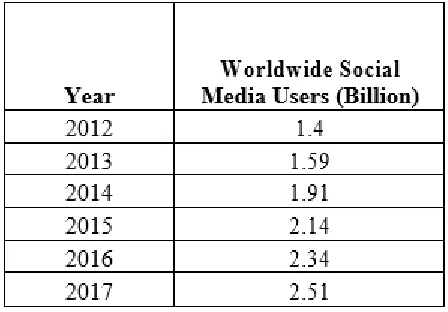
Figures by a statistics providing online portal Statista update that social media users were estimated 2.34 billion worldwide in 2016 while in 2017, the figure is estimated as 2.51 billion.
Furthermore, the most popular social sites according to the same source are Facebook, WhatsApp, YouTube, Facebook Messenger and WeChat.
Social media marketing companies need to align their strategies with global strategies of marketing in order to avoid the potential risks of damaging their brand name. (Saravanakumar & akshmi, 2012). The aim of this relative study is to detect how businesses can operate in the social media marketing in higher effective manner for reaching a large total of consumers anywhere worldwide.
Literature Review
The detailed and comprehensive analysis of various publications and articles by a number of researchers has been done from all around the world. It covers the area of this study and shows an association with the work done in this research with previous studies in the same field.
Internet has strongly reformed the user experience. Users employ websites to explore information, sell and purchase, online streaming, find their friends and for entertainment purpose. Moreover they take part in political discussions. Furthermore it is used for having connections. Users nowadays quite repeatedly use internet for the purpose to become social and enlarge the friend circle. (Correa et al., 2011).
Referring to Zafarani and Liu (2013), the social media is being utilized by people for diverse objectives. When the corresponding ways of information are joined, there can be healthier user profiles constructed in order to develop online services like validating information there online.
Neti (2011) found two key benefits that social media enables users to gain. First it reduces staff time by cost saving and secondly it improves the chances for higher generation of profits. Moreover, social media makes organizations to enable their customers assist other customers and share information. Consequently the advantages include brand awareness, referrals, brand scope etc.
Instead of purchasing something with having a little information about it, users their-self have become explorer and researching about the products (Loanăs & Stoica, 2014). The study examined the association between social media with the behavior of consumers and found that before buying something, consumers like to go through the available information and study about others’ opinions as well. Mangold and Faulds (2009) argued that aimed at the promotion mix, social media is combination of various hybrid components. Users are most probably to discuss about companies if they have a feeling to know much about that company or the product. The content of social media discussions between the consumers are managed by outside managers straight through. The research also suggests to utilize the traditional ways as promotion with the online tools to market.
Taylor and Strutton (2012) presented self enhancement as an influence towards sharing online marketing, or advertisement. Focusing on the entertaining kind of ads, the research proposed that users perform sharing these ads to show their hedonic experience. Moreover they also do this to show the intellect of identity. Furthermore, self-image impacts the ads online which are considered quite entertaining by the consumers.
Hanna et al. (2011) mentions that where companies are vigorously switching towards social marketing platforms and having workout to access consumers online, there are a high number of those facing troubles and challenges. The challenge is that though they identify the requirements to be present and active there on the various social sites but they do not actually recognize how to effectively use opportunities for them offered by the custom of activity on social media.
Trusov et al. (2009) while studying on social networking sites, performed an analysis between word of mouth and old ways of marketing or traditional type of techniques to market. Based on the generated incomes from the impressions of marketing offered to a new participant, the financial worth of word of mouth can be found as the research explored.
Labrecque (2014) mentions that as the brands had made their positions strong using the social media platforms, the expectations made by the consumer are gone higher and that’s why they are encouraging the establishment of technologies to help with the process of making users engaged. Social media enables marketers to hold a direct contact with consumers.
Chu and Kim (2011) carried out an investigation on factors which determine consumer commitment in word of mouth in sites offering social networking. Social networking sites’ possibility for the users to collect useful data related to products from information kept by others may not influence the word of mouth as the research found. That could be due to the reason that users may switch to other information sources for example review sites in order to get a more trustworthy way of knowledge about that product or service when going to have decision.
With the in depth evaluation of the literature, the study found a number of elements and essential attributes of social media marketing which might have sizeable impression on consumer behavior though they might be either positively or negatively related to that behavior.
The research picks three considerable elements or independent variables here: ‘Information satisfaction’ offered by social media marketing content, ‘Vividness’ of content as well as ‘Entertaining content’. The impact of these variables has been analyzed on consumer behavior towards social media marketing.
Problem Statement
Internet usage all around the world is climbing continuously and so the use of social media marketing. The endorsement by its users for Social media has transformed the way organization use to advertise their products and/ or the services. However still some companies struggle to be successful through social media marketing. The challenge is that they are unable to recognize how to effectively use social media opportunities for them. (Hanna et al., 2011).
Objectives
Significance
Findings of study will be valuable for various businesses utilizing social media promotional tool to provide them an insight of consumer behavior and attributes which are correlated positively or negatively to their purchasing attitude in social media marketing perspective. The research will also benefit any future researchers in the same field.
Hypotheses
H1: There is a significant relationship between Information Satisfaction of social media and consumer behavior H2: There is a significant relationship between Vividness of social media and consumer behavior
H3: There is a significant relationship between Entertaining Content on social media and consumer behavior
Research Methods
The gathered data for analysis is mainly primary. A questionnaire was designed to collect the data. Each research variable includes four questions of it and making sixteen questions in total.
Sampling type chosen is ‘convenient sampling’. Sample includes mostly higher education students or employees who are presently working in varied companies there in Karachi.
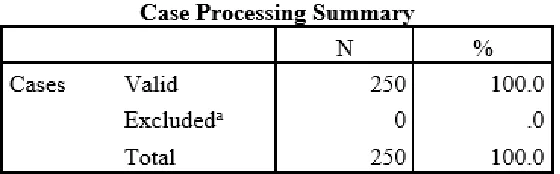
Overall 250 questionnaire were circulated to collect the data and all of them responded, the majority of respondents are students of higher education institutions or employees of various organization of Karachi city.
Validity and Reliability Test
Its results have been shown here for all the independent and dependent variables. The value of Cronbach’s Alpha of every taken variables is higher than 0.5 so the data is proved to be reliable.
Information Satisfaction
Reliability statistics for Information Satisfaction as indicated in Table 3.1 is 0.723 which shows that the data gathered is ample reliable.
Vividness
Reliability statistics for second independent variable Vividness as indicated in below Table 3.2 is 0.832 which shows that the data gathered for this variable is reliable as well.
Entertaining Content
Reliability statistics for third independent variable Entertaining Content as indicated in above Table 3.3 is 0.838 which shows that the data gathered for this variable is reliable.
Consumer Behavior
Reliability statistics for dependent variable Consumer behavior as indicated in above Table 3.4 is 0.804 which shows that the data gathered for this variable is also reliable.
Overall reliability statistics have been indicated below.
Statistical Model
Model of regression is taken to find out results
i i i
i
i
IS
VV
EC
CB
=
β
0+
β
1+
β
2+
β
3+
µ
After running regression in chapter 4, following is the achieved model
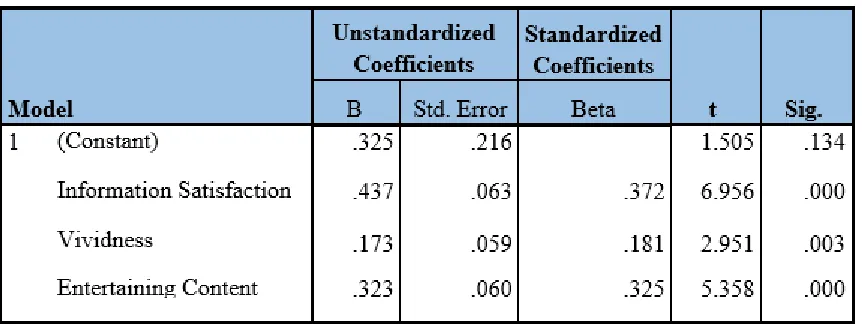
CBi = 0.325 + 0.437(ISi) + 0.173(VVi) + 0.323(ECi)
Where,
CB is Consumer behavior (Dependent Variable) is a constant
β1 is coefficient of information satisfaction, β2 is the coefficient of vividness, β3 is the coefficient of entertaining contentand μ is the Error term.
Statistical Techniques
As per the nature of research linear regression method has been applied using the software SPSS. Results
The data has been collected from 38.4% females and 61.6% male respondents and regression results are displayed below.
Findings and Interpretation
Regression test selected to show an interconnection between dependent and independent variables. The dependent variable of the research as mentioned before is ‘Consumer Behavior’ while independent variables are, ‘Information Satisfaction‘, Vividness’ and ‘Entertaining Content’. Table 4.1 above is representing the results of model summary and as the value of R-Square is 0.581 that is proving that the research model is fit enough and 58% variance is there in dependent variable Consumer Behavior is enlightened by independent variables Information Satisfaction, Vividness and Entertaining content.
Furthermore, the above table 4.2 ANOVA shows Sig’s value =0.000 and F =113.565. This shows that research model is amply significant. Moreover, it mentions the acceptance of alternate hypotheses while null hypotheses of this study are rejected.
Table 4.3 above, results of regression test have been displayed and independent variables and hypotheses are interpreted below.
1. Information Satisfaction: This variable got the sig = 0.000 so proves that there is a significant relationship between Information Satisfaction and consumer buying behavior as this is less than 0.05. While β = 0.437 is showing its extent to impact dependent varianle.
2. Vividness: This independent variable got the sig = 0.003 so also verifies that there is a significant relationship between vividness and consumer buying behavior. While β = 0.173 is showing its extent to impact dependent varianle Consumer Behavior.
3. Entertaining Content: This independent variable also got the sig = 0.000 so verifies that there is a significant relationship between Entertaining Content and consumer buying behavior. While β = 0.173 shows its extent to impact the variable Consumer Behavior.
Thus, the results prove that all the alternate hypotheses in this relative study are accepted and null hypotheses are simply rejected. Following is the retrieved regresion model.
CBi = .325 + .437 ISi + .173VVi + .323ECi
Discussions
The results exhibit that Social Media including Facebook and Twitter are pretty much prevalent among the people of Karachi, specially the students or professionals. Consequently this is a constructive try to pinpoint the stimulation caused by social media marketing on its users; behavior.
Though there have been a plenty of studies earlier on the subject executed but the current research tried to bring out different type of predictors which in the past have not been covered for researches on Social Media Marketing in Karachi or somewhere else in Pakistan. The predictors taken in this study are different from those that have been selected in Pakistan by the former researchers, but seemed to have a very strong impact on consumer behavior.
Conclusion
0
Social media such as Facebook and Twitter notification, information, news and entertainment related posts put a momentous influence on consumer behavior as the research found as 82.4% respondents are agreed that they like to receive social media notifications in their PC/ mobile and 88% are agreed that they like to have information through social media about their friends/ family’s activities, events, current affairs and news.
The importance of vividness content for social media marketing has also been witnessed where a majority i.e. 74.8% agrees that colorful, bright and vibrant social media posts attract them and 80.8% of them agree that they share vivid (colorful, glowing, lively) posts on their Facebook/ Twitter page.
Similarly, towards social media entertainment related posts, there are 75.2% respondents who are agreed that they are attracted towards such posts and 72.8% are agreed that the share such posts therefore the importance and influence of entertaining content on consumer behavior has also been witnessed in the research.
Policy Implications
The consumers of social media in Karachi are found to be greatly attracted towards social media notifications, information, current affairs, news and entertainment related posts while agreeing that the content should be vivid i.e. colorful, glowing, lively. Thus for the social media marketers, it is recommended to keep their social media activates or posts as much as interesting, colorful, entertaining and providing required information properly rather than only casual and plain content.
Future Research
The study, in its narrow scope has been carried out in Karachi only and there is a great scope to execute the same in other cities, towns or villages in Pakistan. Moreover as the respondents involve mostly highly educated people, either students or professionals, it would be interesting to see that how the social media marketing can influence less educated people who make use of it or school students. Thus the future researchers have loads of opportunities to explore this subject further.
References
Al Kailani, M., & Kumar, R. (2011). Investigating Uncertainty Avoidance and Perceived Risk for Impacting Internet Buying: A Study in Three National Cultures. International Journal of Business and Management, 6(5), 76-92.
Ashley, C., & Tuten, T. (2015). Creative strategies in social media marketing: An exploratory study of branded social content and consumer engagement. Psychology & Marketing, 32(1), 15-27.
Chen, L. (2014). The influence of social media on consumer behavior: An empirical study on factors influencing consumer purchase.
Chen, Y., Fay, S., & Wang, Q. (2011). The role of marketing in social media: How online consumer reviews evolve. Journal of Interactive Marketing, 25(2), 85-94.
Chi, H. H. (2011). Interactive digital advertising vs. virtual brand community: Exploratory study of user motivation and social media marketing responses in Taiwan. Journal of Interactive Advertising, 12(1), 44-61.
Chu, S. C., & Kim, Y. (2011). Determinants of consumer engagement in electronic word- of-mouth (eWOM) in social networking sites. International journal
of Advertising, 30(1), 47-75.
Correa, T., Hinsley, A. W., & De Zuniga, H. G. (2010). Who interacts on the Web?: The intersection of users’ personality and social media use. Computers in Human Behavior, 26(2), 247-253
De Vries, L., Gensler, S., & Leeflang, P. S. (2012). Popularity of brand posts on brand fan pages: An investigation of the effects of social media marketing. Journal of Interactive Marketing, 26(2), 83-91.
Felix, R., Rauschnabel, P. A., & Hinsch, C. (2017). Elements of strategic social media marketing: A holistic framework. Journal of Business Research, 70, 118-126.
Hanna, R., Rohm, A., & Crittenden, V. L. (2011). We’re all connected: The power of the social media ecosystem. Business horizons, 54(3), 265-273.
Hollebeek, L. D., Glynn, M. S., & Brodie, R. J. (2014). Consumer brand engagement in social media: Conceptualization, scale development and validation. Journal of interactive marketing, 28(2), 149-165.
Internet World Stats (March, 25, 2017) Internet Users in the world by regions Retrieved from
(http://www.internetworldstats.com/stats.htm
Ioanăs, E., & Stoica, I. (2014). Social media and its impact on consumers behavior.
International Journal of Economic Practices and Theories, 4(2), 295-303.
Kaur, G. (2016). Social Media Marketing. Asian Journal of Multidisciplinary Studies, 4(7).
Kim, A. J., & Ko, E. (2012). Do social media marketing activities enhance customer equity? An empirical study of luxury fashion brand. Journal of Business Research, 65(10), 1480-1486.
Labrecque, L. I. (2014). Fostering consumer–brand relationships in social media environments: The role of parasocial interaction. Journal of Interactive Marketing, 28(2), 134-148.
Laroche, M., Habibi, M. R., & Richard, M. O. (2013). To be or not to be in social media: How brand loyalty is affected by social media?. International Journal of Information Management, 33(1), 76-82.
Leung, X. Y., Bai, B., & Stahura, K. A. (2015). The marketing effectiveness of social media in the hotel industry: A comparison of Facebook and Twitter. Journal of Hospitality & Tourism Research, 39(2), 147-169
Lovejoy, K., & Saxton, G. D. (2012). Information, community, and action: How nonprofit organizations use social media. Journal of Computer‐ Mediated Communication, 17(3), 337-353.
Mangold, W. G., & Faulds, D. J. (2009). Social media: The new hybrid element of the promotion mix. Business horizons, 52(4), 357-365.
Michaelidou, N., Siamagka, N. T., & Christodoulides, G. (2011). Usage, barriers and measurement of social media marketing: An exploratory investigation of small and medium B2B brands. Industrial marketing management, 40(7), 1153-1159.
Neti, S. (2011). Social media and its role in marketing. International Journal of Enterprise Computing and Business Systems, 1(2), 1-15.
Park, C. H., & Kim, Y. G. (2003). Identifying key factors affecting consumer purchase behavior in an online shopping context. International Journal of Retail & Distribution Management, 31(1), 16-29.
Saravanakumar, M., & SuganthaLakshmi, T. (2012). Social media marketing. Life Science Journal, 9(4), 4444-4451.
Statista (n.d.) Most famous social network sites worldwide as of April 2017, ranked by number of active users (in millions) Retrieved from https://www.statista.com/statistics/272014/global-social-networks-ranked-by-number-of-users/
Statista (n.d.) “Number of social media users worldwide. 2010 to 2020 (in billions)” Reproduced from
https://www.statista.com/statistics/278414/number-of-worldwide-social-network-users/
Taylor, D. G., Strutton, D., & Thompson, K. (2012). Self-enhancement as a motivation for sharing online advertising. Journal of Interactive Advertising, 12(2), 13-28.
Trusov, M., Bucklin, R. E., & Pauwels, K. (2009). Effects of word-of-mouth versus traditional marketing: findings from an internet social networking site. Journal of marketing, 73(5), 90-102.
Vinerean, S., Cetina, I., Dumitrescu, L., & Tichindelean, M. (2013). The effects of social media marketing on online consumer behavior. International Journal of Business and Management, 8(14), 66.
Table 3.1 (a)
Reliability Statistics for Information Satisfaction
Table 3.1 (b)
[image:8.612.37.261.134.290.2]Table 3.1 (c)
Reliability Statistics for Entertaining Content (EC)
Table 3.1 (d)
[image:9.612.38.318.55.142.2] [image:9.612.38.319.516.605.2]Table 4.4
Hypotheses Assessment Summary
S. No. Hypothesis t β Sig
Empirical Conclusion
H1
There is a significant relationship
between Information Satisfaction of social media and consumer behavior
6.956 0.437 .000 Accepted
H2
There is a significant relationship between Vividness of social media and consumer behavior
2.951 0.173 .003 Accepted
H3
There is a significant relationship between Entertaining Content on social media and consumer behavior
5.358 0.323 .000 Accepted