ISSN 2250-3153
Direct Product of B-Algebra Using Some Cycles of Aunu
Permutation Pattern; Application in Graph Theory
* M. A. Mungadi 1 A.A. Haliru.1 S. Abdulrahman.2 and M. S. Magami 3
1Department of Mathematics Kebbi State University of Science and Technology, Aliero P.M.B. 1144 Aliero, Kebbi State. 2Department of Mathematics Federal University Birnin Kebbi , Kebbi State.
3Department of Mathematics,Usmanu Danfodiyo University,P.M.B. 2346 Sokoto, Nigeria.
*Corresponding Author: [email protected]
DOI: 10.29322/IJSRP.9.01.2019.p8592
http://dx.doi.org/10.29322/IJSRP.9.01.2019.p8592
Abstract
In this paper we provide another method of constructions of direct product of B-algebra using a class of AUNU Permutation Pattern, were we used cycles of AUNU permutation pattern for the construction of direct product of B-algebra which yield some result, the pattern was also applied in graph theory.
Keywords: AUNU Groups, AUNU Patterns, B-Algebra, direct product of B-algebra, Graph. 1. Introduction
Algebra is a very wide area of study and it has so many classes such as BF and B –Algebra, in this research we limited our work on B-
Algebra.
B-algebra is non-empty set 𝑋𝑋 with a binary operation “∗” and a constant 0 that satisfied the following axioms.
i. 𝑥𝑥 ∗0 =𝑥𝑥 ii. 𝑥𝑥 ∗ 𝑥𝑥= 0
iii. (𝑥𝑥 ∗ 𝑦𝑦)∗ 𝑧𝑧=𝑥𝑥 ∗(𝑧𝑧 ∗(0∗ 𝑦𝑦))
⍱𝑥𝑥,𝑦𝑦and 𝑧𝑧 in 𝑋𝑋 (Negger and Kim, 2002)
Another proof of the relationship of B-algebra with Group using the observation that the zero adjoint mapping is subjective, moreover
a condition for an algebra defined on real numbers to a B-algebra using analytical method was found and in addition certain other
facts about commutative B-algebra was reported by Allen et al, (2003). The direct product of B-Algebra was investigated by Angeline and Endam (2016), in which they introduced some properties. The detailed application of this algebra can be found in Park and Kim,
(2001); Cho and Kim, (2001) Angeline et al (2016); introduced two canonical mapping of the direct product of B-algebra and obtained some of their properties.
ISSN 2250-3153
In order to make reader a friendly reading and provide good understanding of the method and results of the paper, some basic
notations are briefly discussed in the section following.
2.1. B-algebra-: A B-algebra is a non empty set 𝑥𝑥 with constant 0 and binary operation “*” satisfying the following axioms.
B1 𝑥𝑥 ∗ 𝑥𝑥= 0
B2 𝑥𝑥 ∗0 =𝑥𝑥
B3 (𝑥𝑥 ∗ 𝑦𝑦)∗ 𝑧𝑧=𝑥𝑥 ∗ �𝑧𝑧 ∗(0∗ 𝑦𝑦)�
For all 𝑥𝑥,𝑦𝑦 and 𝑧𝑧 in 𝑋𝑋
2.2. Sub Algebra: - Let (𝑋𝑋,∗,0) be a B-algebra. A non empty subset N of X is said to be sub algebra if 𝑥𝑥 ∗ 𝑦𝑦 ∈ 𝑋𝑋 ∀ 𝑥𝑥,𝑦𝑦 ∈ 𝑁𝑁
2.3. Direct product of B-algebra: - let 𝐴𝐴= (𝐴𝐴,∗, 0𝐴𝐴, ) and 𝐵𝐵= (𝐵𝐵,∗, 0𝐵𝐵) be two B-algebra, define the direct product of A
and B to be the structure 𝐴𝐴×𝐵𝐵= (𝐴𝐴×𝐵𝐵 ∗(0𝐴𝐴× 0𝐵𝐵)) where 𝐴𝐴×𝐵𝐵 is the set {(𝑎𝑎,𝑏𝑏):𝑎𝑎 ∈ 𝐴𝐴,𝑏𝑏 ∈ 𝐵𝐵} whose binary
operation * is given by(𝑎𝑎1,𝑏𝑏1)∗(𝑎𝑎2,𝑏𝑏2) =𝑎𝑎1∗ 𝑎𝑎2,𝑏𝑏1𝑏𝑏2.
2.4. Aunu Numbers: There are two types of Aunu Numbers; The (123)-avoiding class obtained from a recursion relation
(Ibrahim and Audu 2005) as follows:
1
(
(123))
2
n n
P
N A
=
−
Give rise to: 2, 3, 5, 6, 8, 9, 11, 14,
Corresponding to the length of 5, 7,11,13,17, 19,
The sequence in (2) is called the Aunu numbers correspond to the (123)-avoiding class of permutation.
Where
N A
(
n(123))
is the number of the class of numbers expressed as permutations, that avoid (123) patterns whileP
n is then
thprime number n ≥ 5.
On the other hand the (132)-avoiding class of Aunu permutation patterns is obtained from a relation (Ibrahim 2006, Ibrahim 2004) as
follows:
N A
(
n(132)
)
=
n + (m − 1), m ≤ n.Give rise to: 5,7,9,11,13,…,
Corresponding to the length of 3, 4, 5, 6, 7,
The sequence in (5) is called the Aunu numbers corresponding to the (132)-avoiding class of permutation.
ISSN 2250-3153
Let 𝐴𝐴= (𝐴𝐴,∗, 0𝐴𝐴)𝑎𝑎𝑎𝑎𝑎𝑎 𝐵𝐵= (𝐵𝐵,∗, 0𝐵𝐵) be B-algebra. Defined the direct product of A and B to be the structure 𝐴𝐴×𝐵𝐵=�𝐴𝐴×
𝐵𝐵(0𝐴𝐴; 0𝐵𝐵)�, were
𝐴𝐴×𝐵𝐵 Is the set {(𝑎𝑎,𝑏𝑏):𝑎𝑎 ∈ 𝐴𝐴 𝑎𝑎𝑎𝑎𝑎𝑎 𝑏𝑏 ∈ 𝐵𝐵} whose binary operation* is given by (𝑎𝑎1,𝑏𝑏1)∗(𝑎𝑎2,𝑏𝑏2) = (𝑎𝑎1∗ 𝑎𝑎2,𝑏𝑏1∗ 𝑏𝑏2).note that the
binary operation is componentwise. Thus, the properties (I),(II) and (III) of 𝐴𝐴×𝐵𝐵 from those of A and B. Angeline, J. V & Endam,
C. E (2016). Direct Product of B-Algebra.
Hence the construction easily follows.
(123)-avoiding Pattern
Proposition.
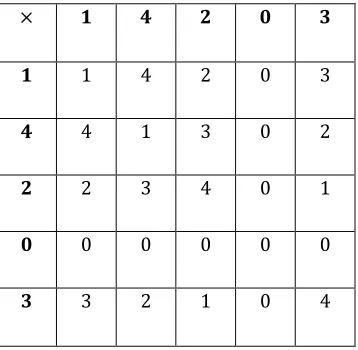
Let Ω= {1,4,2,0,3}⊂ 𝑍𝑍5 be a first cycle of B-algebra of order𝑝𝑝= 5, were 𝑝𝑝 ≥5 under binary operation “×” then Ω×Ω is a direct
product of B-Algebra under ×.
Proof
For a Ω ×Ω to be a direct product of B-Algebra
[image:3.612.79.258.382.557.2]Then, regarding {1,4,2,0,3} as elements to construct a table of direct product of B-Algebra
Table 1: Operation table of 𝑍𝑍5 of direct product (123)
× 𝟏𝟏 𝟒𝟒 𝟐𝟐 𝟎𝟎 𝟑𝟑
𝟏𝟏 1 4 2 0 3
𝟒𝟒 4 1 3 0 2
𝟐𝟐 2 3 4 0 1
𝟎𝟎 0 0 0 0 0
𝟑𝟑 3 2 1 0 4
Theorem
If Ω1and Ω2 are two different AUNU numbers that are B-algebra then the direct product of two B-algebra is also a B-algebra.
Proof
Suppose Ω𝑖𝑖be a family of the product of a finite B-algebra then Ω𝑖𝑖, {𝑖𝑖= 1,2,3, …𝑎𝑎} for 𝑖𝑖= 1,2, …𝑎𝑎 then the direct product of
ISSN 2250-3153
(𝑎𝑎1𝑎𝑎2 𝑎𝑎3…𝑎𝑎𝑛𝑛)∈ Ω1 and (𝑏𝑏1,𝑏𝑏2,𝑏𝑏3, …𝑏𝑏𝑛𝑛)∈ Ω2 then ∏2𝑖𝑖=1Ω𝑖𝑖=(𝑎𝑎1𝑎𝑎2 𝑎𝑎3…𝑎𝑎𝑛𝑛) × (𝑏𝑏1,𝑏𝑏2,𝑏𝑏3, …𝑏𝑏𝑛𝑛)∈ Ω2) were × is the binary
operation on ∏ Ω𝑛𝑛𝑖𝑖=1 𝑖𝑖
(𝑎𝑎1×𝑏𝑏1),(𝑎𝑎2×𝑏𝑏2),…(𝑎𝑎𝑛𝑛×𝑏𝑏𝑛𝑛)
= (𝑎𝑎1𝑎𝑎2 𝑎𝑎3…𝑎𝑎𝑛𝑛) × (𝑏𝑏1,𝑏𝑏2,𝑏𝑏3, …𝑏𝑏𝑛𝑛)
=Ω1×Ω2
Then the results follow
4. Application to Graph Theory
Example 1. Suppose a function 𝑔𝑔 is defined on B-algebraΩ, that is Ω= {1,4,2,0,3} by 𝑔𝑔(𝑥𝑥) = 3𝑥𝑥+ 2∀𝑥𝑥 ∈ Ω. then the following
pairs of point were obtained from the function 𝑉𝑉(𝐺𝐺) = {(1,0), (4,4), (2,3), (0,2), (3,1)}
Adjency matrix
𝐵𝐵=
⎣ ⎢ ⎢ ⎢
⎡0 0 1 0 01 0 0 0 0 0 0 1 0 0 0 1 0 0 0 0 0 0 0 1⎦⎥
⎥ ⎥ ⎤
Fig 1
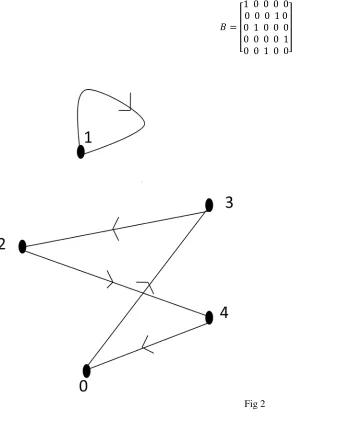
Example 2. Suppose a function 𝑔𝑔 is defined on B-algebraΩ, that is Ω= {1,4,2,0,3} by 𝑔𝑔(𝑥𝑥) = 3𝑥𝑥 −2∀𝑥𝑥 ∈ Ω. then the following
pairs of point were obtained from the function 𝑉𝑉(𝐺𝐺) = {(1,1), (4,0), (2,4), (0,3), (3,2)}
ISSN 2250-3153
𝐵𝐵=
⎣ ⎢ ⎢ ⎢
⎡1 0 0 0 00 0 0 1 0 0 1 0 0 0 0 0 0 0 1 0 0 1 0 0⎦⎥
⎥ ⎥ ⎤
Fig 2
Conclusion
We have used (132)-avoiding pattern of AUNU Permutation Pattern to construct a direct product of B-algebra. This has been
achieved by considering the direct product on sequence of the (132)-avoiding pattern of AUNU Permutation Pattern which gives a
Square table see operation table; the product of two B-Algebra will give another B-Algebra.
References
Angeline, J. V & Endam, C. E (2016). Direct Product of B-Algebra. International Journal of Algebra; 10(1), 33-40
Allen, et al (2003).B-Algebra & Group. Scientiae Mathematicae Japanicae Online; Vol 9, 159- 165
[image:5.612.50.391.55.503.2]ISSN 2250-3153
Cho, J. R. & Kim, H. S. (2001). On B-Algebra and Qausi-Groups, Qausi-Groups and Related Systems 8,1-6 Negger, J. & Kim, H. S. (2002). On B-Algebra, Qausi-Group and Related System. 8, 21-29