Art and Design Theses Ernest G. Welch School of Art and Design
5-3-2017
The Feeling of Being Ok
Benjamin B. LeeGeorgia State University
Follow this and additional works at:https://scholarworks.gsu.edu/art_design_theses
This Thesis is brought to you for free and open access by the Ernest G. Welch School of Art and Design at ScholarWorks @ Georgia State University. It has been accepted for inclusion in Art and Design Theses by an authorized administrator of ScholarWorks @ Georgia State University. For more information, please [email protected].
Recommended Citation
by
BEN LEE
Under the Direction of Nancy Floyd, MFA
ABSTRACT
The Feeling of Being OK is an exhibition of appropriated imagery from unknown
abandoned collections. Using the tension found in the enigmatic aspects of these materials, I
investigate the fragility of the photograph and its capacity to fabricate memory and narrative.
Designed to be a meditation on William Faulkner’s 1930 novel As I Lay Dying, this series
focuses on themes including empathy and indifference, instability of identity, and life’s
inevitable fate. By incorporating found materials such as vernacular objects and text into the
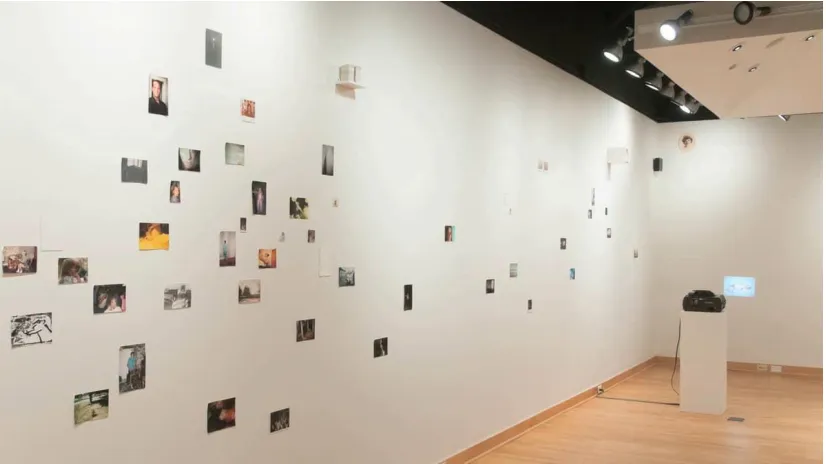
installation, the potential for meaning is broadened. The work is installed in constellations or
vignettes, allowing for metaphorical and poetic readings of the newly recontextualized material.
INDEX WORDS: Photography, William Faulkner, Death, Empathy, Fate, Identity, Family
by
BEN LEE
A Thesis Submitted in Partial Fulfillment of the Requirements for the Degree of
Master of Fine Arts
in the College of Arts and Sciences
Georgia State University
Copyright by Ben Lee
by
BEN LEE
Committee Chair: Nancy Floyd
Committee: Constance Thalken
Jill Frank
Matthew Sugarman
Electronic Version Approved:
Office of Graduate Studies
College of Arts and Sciences
Georgia State University
DEDICATION
To my mother and father, Rebecca and Ronald Lee, whose advice has saved me more
than once: life is always to be taken one day at a time. To my siblings, Sarah, Ryan, and Suzie,
their friendship made sure that I never felt alone. To my Anna, I’ve loved you since the first day
we met and I always will, thank you for standing by my side. To my oldest friends, Steve,
Stephen, Luke, Travis, and TJ, I’m glad we were never arrested. And to my grandfather, the late
ACKNOWLEDGEMENTS
From the bottom of my heart, thank you to those teachers, faculty, and artists that made
this exhibition and thesis possible. Thank you Nancy, Conne, Jill, Matthew, Rylan, Craig,
Michael, Keisha, Adrienne, Susan, Maria, William, Tim, and Dave, as well as all the graduate
students who were right beside me in galleries and critiques. Thank you for supporting me,
TABLE OF CONTENTS
ACKNOWLEDGEMENTS ... v
LIST OF FIGURES ... vii
1 INTRODUCTION... 1
1.1 Family and Funerals ... 1
1.2 Death Comes in Threes ... 3
2 THE FEELING OF BEING OK ... 5
2.1 The Gold Cigar Box ... 5
2.2 The Bundrens ... 8
2.3 Empathy and Indifference ... 9
2.4 Instability of Identity ... 12
2.5 Life’s Inevitable Fates ... 17
3 A SHAPE TO FILL A LACK ... 22
3.1 Bargaining and Acceptance ... 22
3.2 Violence and Tenderness ... 31
3.3 Fragmented Narrative ... 40
4 CONCLUSION ... 45
LIST OF FIGURES
Figure 2.1 Ben Lee, Selections from Grandfather's Girlfriends, 2016 ... 6
Figure 2.2 Ben Lee, 8x10 (Solid Oak), 2016 ... 15
Figure 2.3 Ben Lee, Children Graveside, 2015 ... 21
Figure 3.1 Daniel Gordon, Portrait in Orange and Blue, 2010 ... 24
Figure 3.2 Ben Lee, Ex-Aunt Jennifer, 2015 ... 25
Figure 3.3 Ben Lee, Darl's Epiphany, 2016 ... 26
Figure 3.4 Jason Lazarus, Too Hard To Keep (Syracuse), 2013 ... 28
Figure 3.5 Aby Warburg replica via OSA Archivum Budapest, Selections from Mnemosyne Atlas, 2008 ... 29
Figure 3.6 Jason Lazarus, Selection from Too Hard To Keep, 2013... 30
Figure 3.7 John Stezaker, Betrayal XVIII, 2012 ... 32
Figure 3.8 Ben Lee, Salvation by Fire, 2017 ... 35
Figure 3.9 Marlo Pascual, Untitled, 2011 ... 37
Figure 3.10 Ben Lee, Detail of Up For Air, 2017 ... 39
Figure 3.11 Jared Ragland, Untitled (Phantom of the Opera), 2016 ... 42
Figure 3.12 Ben Lee, Vulture I & II, 2017 ... 44
Figure 4.1 Ben Lee, Installation Shot #1, 2017 ... 46
Figure 4.2 Ben Lee, Installation Shot #2, 2017 ... 47
Figure 4.3 Installation Shot #3, 2017 ... 48
Figure 4.4 Ben Lee, Installation Shot #4, 2017 ... 49
Figure 4.5 Ben Lee, Installation Shot #5, 2017 ... 50
1 INTRODUCTION
“… Whether or not the subject is already dead, every photograph is this catastrophe.” - Roland Barthes, Camera Lucida: Reflections on Photography 1
1.1 Family and Funerals
My family began somewhere between the small towns of Texarkana, TX, a city split in
two on the border of Texas and Arkansas, and Atlanta, TX, not to be confused with the much
more notable “Dogwood City” capital in Georgia. I was born in the prior, December 1, 1990, to a
family of now six. My father, Ronald Lee, was in the funeral home business, working as a
director, servicing families in their times of need. He was not the first of my family to be in the
business of death. My mother’s father, Robert Bowden, and his father before him, Benjamin
Bowden, of whom I was named, lived and operated their funeral home in East Texas not far from
Texarkana. My grandfather would tell me stories of how he and his siblings would play hide and
seek throughout the visitation rooms when services weren’t being held, hiding in the unused
caskets ensuring they wouldn’t be found.
As the youngest in my family I was privileged with the gift of observation, seeing what
my oldest siblings did from a distance and whether it was right or wrong in the eyes of our
parents. One of my earliest memories of death goes back to when I was a young child, seeing my
mother through the swinging café doors of our kitchen, leaning against the sink with one hand
holding the crème colored, dial-tone phone with the knotted cord shakily to her ear and the other
covering her mouth. I did not understand what it meant when she told me “Mamaw has passed
away” nor did I understand the tears and isolation I saw in her for weeks after. That was my first
funeral, Jo Bowden my grandmother, Texarkana, TX 1996. My father told me “Jesus had called
her home”, “it was her time”, and “that this was God’s plan”. The way he explained death to me
wasn’t something sad or abysmal, but something to be celebrated. Now as I look back on it, I can
tell he said the same things to me he must have told countless families in need. Things that help
smooth our sudden collision with reality, with the inevitable. He tried to instill in me the spiritual
support of our Savior, not just in times of grief but also in our day-to-day lives. Raised under the
fire and brimstone sermons of the Southern Baptist church, salvation from sin was the only true
concern in life, eternal life or eternal damnation, that was our choice. It was a way for us to cope
and understand the things that are so much bigger than ourselves, things beyond our control.
Since death was a constant in family conversation, either in God’s Word or in the passing
events at my father’s work, it was no surprise to those within my family that it would often be
brought up in the most casual of circumstances. At the dinner table my father would bring little
things up like “Did you know that kid from Northside High School? He was drunk and hit a tree
last night, his family came in today” or “You know it’s not that uncommon to see the wife,
ex-wife, and mistress of a CEO sitting in the front row at the service”. The solemn nature of the
cemetery often escaped me. It was the place where I could visit my father for lunch, work odd
jobs in the summer, and learn to drive. My dad told me “Don’t worry about crashing, you’re
already in the graveyard.” As I grew older I thought that after the first funeral and my exposure
to the inner workings of a place most people avoid, I’d be immune to the effects of loss, like
1.2 Death Comes in Threes
When visiting my grandparent’s home off Pine Street in Texarkana, I would explore the
empty rooms and offices. Flipping through books and photo albums, asking Mamaw and Papaw
Bowden a litany of questions of this and that. To keep me busy, or to avoid unintended damage
to the house, my grandfather would play a game with me. He would place a stack of paper and
markers on the kitchen table, which was set off in the corner by itself like a booth at a diner. I’d
sit there quietly, watching him shift his eyes from me to the paper, tapping the marker until a
smirk emerged and he’d make a mark. Nothing in particular but a shape or line or pattern of dots,
then he’d slide the paper and marker towards me and say “Now your turn”. He wanted me to
make something from nothing, to take whatever he drew and recreate it into some exquisite
corpse. I’d sit and think until I could morph the drawing into anything new and creative: a
squiggle into a hairdo, a triangle into a cheese, dots into a freckled face, etc. Then I’d make a
new mark and slide it to him to see if he could be stumped, we called it “Stump the Artist”.
There was no point system, winner, or loser. Just stacks and stacks of paper marked up and
down, saturated in solvent inks of every color imaginable, bleeding together and through the
fibrous surface.
Some time after my grandmother passed, my grandfather remarried. Her name was Merle
and she was not my grandmother, but we’d play the part because we knew he must’ve been
lonely. It’s difficult to tell when exactly Alzheimer’s began to wreak havoc on my grandfather
because it made itself known with a whisper not a boom. Short-term memory seemed to be the
beginning of his struggle, little things we all blew off as benign happenstance. However, the
diagnosis was just a formality of confirmation to what we already felt in our gut. He often didn’t
the facts given. After some time catching up during a visit I asked if he’d like to play Stump the
Artist with me like we used to, but it was not the same. Trudging through the performance we
worked our way through a single sheet of paper, reminding him of the way we should play after
each pass until he said he was tired and wanted to stop. I don’t know what I was trying to prove,
or disprove, by getting him to play, I just wanted it to last a little bit longer.
They say death comes in threes, but I don’t believe in hokey superstitions. In the fall of
2011, I lost two friends to suicide, exactly one month apart from each other. I felt a strange
presence amongst my friends, many fearing it would happen again. But I don’t believe in things
like that. The first death had a private family service. Friends and classmates were asked to
respect their privacy and a school memorial was held. The second funeral I did not attend. Later
that summer, my mother left for Texas to be with her father during what she felt to be his final
days. July 23, 2011 he passed away at his home. This was the suspended death of Robert
Bowden, beginning long before when his mind faded and all that was left behind was a ghost.
2 THE FEELING OF BEING OK
“Memory believes before knowing remembers. Believes longer than recollects, longer than knowing even wonders.”
- William Faulkner, Light in August 2
2.1 The Gold Cigar Box
A couple of years after my grandfather had passed, and a feeling of normalcy began to set
in, my mother handed me a small golden cigar box, pulled from a collection of things she had put
away since the funeral. “Here, you’d probably get a kick out of these,” she told me as we
continued to dig. She knew I was a pack rat, especially for things photographic in nature. Inside
the box was a small collection of photographs, postcards, and negatives crammed and folded to
fit inside. They were of my grandfather, a younger man in the pictures than I was. There he was,
before the war, before he had married my grandmother, and before his brother Travis crashed his
Italian sports car in the Alps while on leave. One thing that became apparent relatively quickly
was the amount of posed women, risqué for the time, dressed in anything from pseudo sailor
outfits to nothing at all paired with slightly suggestive notes written on the back: “With Love”,
“Two in the tub is better than one”, and “This side up”. The last one wasn’t explaining the
frame’s orientation but rather describing the woman in the two-piece outfit with her ass in the
air. (Figure 2.1)
These women, and friends, and places, all of them foreign and familiar. We spent hours
trying to decipher handwriting and locations to stitch together the story left behind. Our best
guess was that these were just pieces of evidence from my grandfather’s wild years. How would
I ever know the truth anyway? My grandfather, my grandmother, and great aunts and uncles had
all passed on by the time we found these family relics. Even Merle, my not-grandmother whose
funeral I skipped, was no longer around to put through the ringer. Even if I somehow had access
to the truth, I think I’d rather let that sleeping dog lie.
I was fascinated by the stories and mysteries of the unknown that rose to the surface as I
gazed deeper and deeper into a past tangentially connected to my own. It wasn’t just with these
photographs, but other snapshots, books, and objects people left behind that I rescued from some
dust-covered oblivion. All of these held some kind of connection to the past that intrigued and
inspired me. The act of repurposing and recontextualizing these materials into my work became
a cathartic experience. I felt these things had value and deserved to be reconsidered for their
inherent worth.
During a critique with Nancy Floyd, we discussed an early iteration of my work set up as
a large-scale installation. The wall was pinned with photographs, illustrations, and lines of
literature. Nancy pointed out a single torn page, a colorful illustration from the self-help book
titled Staying in Love with a childish cartoon man stamping the word “OK” onto his forehead, it
read: “The Feeling of being O.K. does not imply that the person has risen above all his faults
and emotional problems. It merely implies that he refuses to be paralyzed by them.” She pointed
out that the phrase “The feeling of being ok” summed up an overall mood and theme to my
work. A sense that I was concerned with the physical and emotional pain we as individuals and
existence. Another page present on the wall was used as parenthesis for the installation, the same
page from two of the exact same books. It simply read: “My mother is a fish.” This short
statement, void of any build up or conclusion, was from William Faulkner’s As I Lay Dying. It
comes from a young boy named Vardaman, who despite his young age, has come to realize the
significance of his mother’s death when looking at the fish he has just caught for supper. This
novel, which discusses the various ways a family deals with death and fate, became a guiding
force of inspiration in the evolution of my graduate work.
2.2 The Bundrens
The main plot of Faulkner’s tragic tale depicts the events leading up to and surrounding
the eventual death of Addie Bundren, the matriarchal center of the clan, and her family who
dwell in the fictional town of Yoknapatawpha, Mississippi. As she lies on her deathbed, the
reader is shown how her passing affects each character and how they try to cope with a
household on the brink of collapse.3
Written from the perspective of multiple characters, including family members and
neighbors, each subsequent chapter takes on a new character’s voice. As the novel progresses,
we gain access to the inner thoughts and feelings of each character, filling in the story piece by
piece. However, this multiplicity of viewpoints does not guarantee honest portrayals of the
characters or recollections of the events. The reader is left to decipher whether or not the
character is embellishing aspects of themselves in attempts to avoid admitting to personal flaws.
Faulkner used a stream of consciousness technique while writing the story, allowing for
moments of conflicting viewpoints, flashbacks, and imagination to merge into a composite
image. This shaky foothold on reality places the element of truth on a precarious ledge. He even
allows for alternative narrative structures, opting for chapters being made up of single sentences
or numbered lists. While unconventional at the time it was written, this variety allows for the
reader to gain useful insight to the characters’ individual psychological states.4
Faulkner mirrors the overall mood and lack of morale felt during the Great Depression through
the pain and failure of this poor, Southern family. Their attempts to fulfill Addie’s dying wish to
be buried in the town of Jefferson forty miles away proves to be an odyssey of doom and despair.
As the family moves closer to their dark conclusion, Faulkner builds on three key themes:
empathy and indifference in the face of tragedy, instability of identity, and life’s inevitable fates.
I have emulated these themes in my own work, striving to use the influential text as a means for
creation.
2.3 Empathy and Indifference
One would assume that the Bundrens would gain strength and support through each other
during their time of grief. However, their dysfunctional nature prevents any true healing to occur.
Instead, a series of indifferent acts and misguided empathy drives the family further apart.
Empathy can be defined as the ability of setting ego aside and deeply understanding someone
else’s emotions, and indifference being the apathetic lack of care towards the condition of others.
As Addie slips away from this world, so does the gravitational power she had that kept the
family together, as Eric Sundquist put it: she is “the center that no longer holds”.5
Misguided empathy can be seen in the actions of the three sons of the Bundren family,
while not intentional, their actions cause more harm than good. Cash tirelessly builds his
mother’s casket, repressing his pain and grief through methodical building. These efforts keep
him from communicating and bonding with Addie during her final moments. Darl sets fire to the
barn housing Addie’s body while en route to Jefferson. Intending to save her from a continued
humiliation, his efforts destroy the neighbor’s barn and gets him admitted to an insane asylum.
Vardaman, the youngest of the family, drills holes into the casket’s lid in order for his mother to
breathe while being buried, unaware he has damaged her face in the process. While his actions
could be overlooked due to his age and recent trauma, they nonetheless add to the number of
violations done to the defenseless body of Addie Bundren.6
While the lack of empathy, can be seen in the sons of the family, the indifference
exhibited by father and daughter, Anse and Dewey Dell, make for some of the more deplorable
acts in the novel. Dewey Dell fans Addie as she clings to life, but her thoughts are not on her
mother, but on her love affair with a local boy named Lafe. Darl, who was hated for being the
most insightful member of the family, reveals Dewey Dell’s inner feelings towards Addie, “You
want her to die so you can get to town … why wont you say it, even to yourself?”7 Dewey Dell’s
affair with Lafe has gotten her pregnant, and in order to maintain some type of youth and
independence she seeks an abortion. Dewey Dell is understandably scared, but her lack of
5Darryl Hattenhauer, “The Geometric Design of As I Lay Dying,” Colby Quarterly 30, no.2 (1994), 146. 6Faulkner, As I Lay Dying.
honesty forms rifts in her relationships with other family members8. Anse on the other hand has
less of an excuse for the cruel indifference he displays towards the family. Relying on the work
of others: he takes Dewey Dell’s abortion money, sells Jewel’s horse, neglects to pay for proper
medical care for Cash’s leg, and remarries the new Mrs. Bundren all on the day of Addie’s
funeral.9 Faulkner’s use of internalized narrative vignettes allows the readers to judge for
themselves any empathy felt for the characters. In my own work empathy plays a vital role not
only in subject matter but in decision making as well.
Utilizing deserted photographs, text, and objects found during my searches, I am
constantly peering into the lives of others. While their original context and meaning have been
lost, I still find value in them. This empathy connects with the concept of Punctum developed by
Roland Barthes in his book Camera Lucida. Barthes defined it as, “[…] that accident which
pricks me but also bruises me, is poignant to me.”10 He explains that small details contained
within an image can deeply affect the viewer. Acting as the more subjective side of the
photograph’s ability to communicate, Punctum keeps the viewer’s attraction fixed on the image.
For me, the act of finding a picture or object isn’t necessarily an immediate knowing, but rather
the image speaks louder and louder until I understand its new purpose. Sometimes, the Punctum
and the decisive moment emerge in the act of the search, sometimes through the interactions with
other pictures or objects. When considering the very personal nature of Punctum, one must
understand that what is for me may not be for you.
The identification of that which is poignant to me is crucial for the image to evoke some
kind of empathetic response. Some would argue the photograph is incapable of true empathy,
8Spavento, “Exploring the Individual Identity in Faulkner’s As I Lay Dying and Ware’s Jimmy Corrigan: The Smartest Kid on Earth,” 87.
9Jordan Call, “Make or Break: The Effects of Traumatic Experience on Sympathy in As I Lay Dying,” Criterion: A Journal of Literary Criticism 6, no.1, Article 3 (2013), 21.
Ow-Yeong states that the photograph distances the viewer from reality, viewing a fragmented,
mediated form of representation, “a neat slice of time”, as Susan Sontag put it.11 I would argue
that the devil is in the details. This would be true when considering magazines saturated with a
multitude of ads and photojournalism, blurring our perception on reality. I find it significantly
different when considering a family snapshot or hand written note. Even when looking at an
individual slice of time, even a time not of your own, it’s possible for one to touch the past and
form an emotional bond with a photographic relic. That being said: there will always be a
photograph that I find and rescue from oblivion that in all honesty I have no connection with at
all. This does not discourage my practice, but rather fuels my desire to discover the next
photographic gem. When the story is lost, and the only thing left is what can be seen in the
image, my imagination takes over, filling the void of the object’s lost identity.
2.4 Instability of Identity
Identity in As I Lay Dying is not set in stone. Throughout the traumatic events, each
character goes through at least one small crisis of identity as they try to escape fate. A character
can have their identity transform internally through self-discovery as well as externally by a shift
in their perceived identity by others. One of the most poetic identity shifts comes in the form of
Vardaman stating, “My mother is a fish”12, which can be read either as a child confusing the
dead animal for his actual mother, or metaphorically as a child understanding his mother’s body
as now being lifeless, like the fish. And like his cut up pieces of not-fish prepared for supper
Vardaman now sees his mother’s body as no longer being his mother. This perceived identity
11Wai-Kit Ow-Yeong, “‘Our Failure of Empathy’: Kevin Carter, Susan Sontag, and the Problems of Photography” (MA Thesis, University College London, 2013) 3-5.
shifts back and forth throughout the book. The true tragedy for Vardaman is not that his mother
has passed, but that in his time of grief he is often over looked by his family as they become
increasingly concerned with personal issues.13 Another overlooked identity shift comes from
Darl, who we see as the highly intuitive Bundren capable of reading the inner thoughts of others.
As the novel reaches its climax, when he sets the barn ablaze, his speech become dissociative
and switches to third-person as men carry him off to the asylum. This internal struggle is
hypothesized as spurring from some form of PTSD during World War 1 where he was exposed
to the carnage of death and destruction.14 Lastly, the coup de grâce is when Anse introduces his new “Mrs. Bundren” just moments after the funeral and Darl’s capture. Without explanation, Faulkner ends the novel on the phrase “Meet Mrs. Bundren.”15 This subtle shift from Addie
being known as Mrs. Bundren to the unnamed woman is a complete 180 in identity. The woman whom the book was dedicated, suffered, and fought over is suddenly a new individual, leaving the family little time to grieve. Faulkner’s use of fragile or fluid identities in his characters emphasizes the effect of death on the family. “Death” can be seen as the literal death of Addie or as the changing of times, a progression from one stage of life to the next.
Identity’s role in my own work comes into play when considering the origin of my
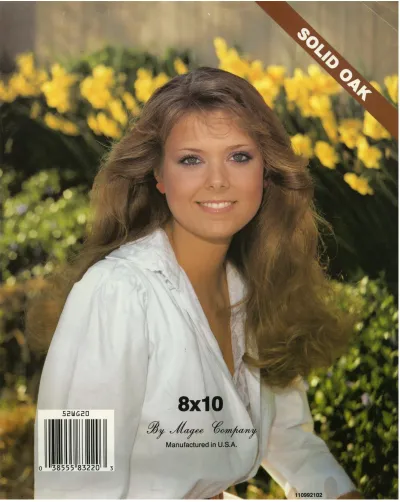
materials and the function they gain as Art. Since the materials I use have been salvaged from oblivion, their original meaning and purpose have been lost from lack of available information. The ‘before’ and ‘after’ is obscured in the picture. If the characters of the novel experience transformation through traumatic events, the abandonment of my found materials permits a transformation of identity or purpose. For example: the piece titled 8x10 (Solid Oak) is a
13Taylor Lemaire, “‘My Mother is a Fish’: All Encompassing Inadequacy in William Faulkner’s As I Lay Dying,” Verso (2015): 22-25.
14Neal Hallgarth, “‘The worry that you are yourself’: Darl’s unforgiveable neurodiversity in As I Lay Dying” (MA Thesis, Eastern Washington University, 2013) 12-14.
advertisement photograph of a woman that is was placed inside a frame for sale, used to act as a placeholder for one’s own image. (Fig. 2.2) Its original purpose is to allow the customer to
project his or her own image or desires into the frame, replacing any true purpose of the already existing image. For me, I was drawn to this picture for its connection to Vardaman and Addie’s relationship as well as a humorously cruel moment from my own childhood. I see Vardaman’s reaction to his mother’s death by stating she is a fish as a poetic understanding that what once was is no more. Witnessing the death of the fish and the death of his mother helps Vardaman understand the finite nature of life; the body of his mother is now his not-mother. The other reason I was drawn to this image is from a moment when I was a 5 years old, walking through Target with my oldest sister, Sarah. As we passed the photo frames, she points out a boy in the placeholder picture. “That’s your twin brother who was sent to Mexico for being bad … you better watch out.” Needless to say I was gullible enough to fear for my life from that point
If the original purpose of 8x10 (Solid Oak)’s placeholder photograph was doomed from
the start, the traumatic event of discarding it allows for it to become more than just informational advertisement. I see it as the idea of a “not-portrait”, of a “not-woman” to paraphrase
Vardaman’s linguistic understanding of his “fish” “not-fish” mother. When enlarged to 24x36”
and assessed for its visual value, the image becomes something more. The woman’s smile, the beautiful flowers, and everything about the image is hollow, fabricated to be used and consumed, it becomes less inviting and more despondent. A certain ambiguity exists as it represents the potential of a happy moment or a happy life that is not present. For art critic John Berger, ambiguity is present in every photograph, as explained in his essay Appearances:
No meaning, however, comes out of computers [a series of facts
without meaning], for when we give meaning to an event, that meaning is a
purpose, not only to the known, but also to the unknown: meaning and
mystery are inseparable, and neither can exist without the passing of time.16
Within my work, the images and objects I use are never exactly as they appear. They ride a thin
line between meaning and mystery, but through the process of recontexualization their meanings
shift, identities change, and purposes are reborn.
2.5 Life’s Inevitable Fates
The final theme of As I Lay Dying is the idea of the inevitable fates we as humans
must face during our lives. If one were inclined to believe in Fate as a supernatural force,
guiding us through a pre-determined series of events, then one would feel as if their life
had meaning and was crucial to the big picture. However, if one were to believe in
something more secular, then they would see life as somewhat meaningless and only they
would have sole responsibility over their own destiny. Putting aside the major debate
over the existence of God or some higher power, one must recognize that there are indeed
some inevitable fates tied to any and all living things. While most experiences in life are
plentiful, things like: love, friendship, joy, success, and purpose, are not guaranteed. To
paraphrase Benjamin Franklin: the only two things certain in life are death and taxes.
Faulkner recognized death as an inevitability. Addie’s physical death is the most obvious,
but the resulting tragedies that follow depict the cruel nature of existence with death seen
in many forms.
Death, beyond the literal understanding, can be seen as the end of one thing and
the beginning of something new. Throughout As I Lay Dying, each character experienced
a shared death, the death of the mother, as well as a personal and figurative death. For
example, Dewey Dell experienced the death of her youth as she faced pregnancy and the
fear of becoming the caretaker to her family en lieu of independence and freedom.17
Symbolically, death followed the family members, alive or otherwise, as their funereal
caravan headed towards Jefferson, illustrated by the circling vultures looming above,
foreshadowing the tragedies yet to come.18 In fact, Berger describes storytelling as being
intrinsically tied to death, that a storyteller is the ‘secretary of death’, being that when we
think of narratives as taking place in the past, it is a time and place that no longer exists.19
However, this is a linear viewpoint, a start and stop of one story (or life in this case)
butting up against an entirely separate start and stop. Another way of understanding this
is through a cyclical viewpoint. Seeing the beginning and end of something as essentially
looping as they push and pull one another in an everlasting cohesive bond. Darl reveals
his epiphany and understanding of life as being cyclical in nature through his
observations: “Life was created in the valleys. It blew up onto the hills on the old terrors,
the old lusts, the old despairs. That's why you must walk up the hills so you can ride
down”.20 His realization of life being repetitive, pointless, and inevitable troubles him
throughout the story. His sense that past events are perpetually linked to future events is
where fate comes into play, a bootstrap paradox of sorts, generating an unending chain of
cause and effect.21 In this theory, Darl sees the pain and suffering of his family as yet
another set of actions and reactions, a Purgatory of human destruction and desecration. In
order for him to break the cycle, and hopefully end the suffering of his family, he
unsuccessfully attempts to burn the barn along with Addie’s body. However, unable to
erase the evidence of death and pain, he is caught and locked away physically and
psychologically, fulfilling his own inevitable fate.
18 Faulkner, As I Lay Dying.
19 Voices. “To Tell A Story.” Directed by Mike Lloyd. Written by John Berger and Susan
Sontag. BBC, February 9, 1983.
20 Faulkner, As I Lay Dying, 131.
21 Michiel Helvensteijn, “Towards a Formal Foundation for Time Travel in Stories and Games,”
The inescapable force of fate, especially death, has captivated the imaginations of
humans since the beginning. In Barthe’s Camera Lucida, he speaks extensively about his
mother’s death; in an ironic twist of fate his own death happened just after the book was
published. In Camera Lucida he describes the ways she would appear as being both the
past version of herself as well as the present version. He searched for a photograph of her
that would provide him “truth of the face I had loved” and he found it in a portrait he
called the Winter Garden. He describes her, as she was, young and gentle, which is how
he wanted to remember her. An important detail in his discovery is that he dared not
show the reader the image, because “It exists only for me. For you, it would be nothing
but an indifferent picture.”22 Barthe’s wished to control her fate, her death, by keeping
the image to himself, and in a way try to turn back the hands of time if only for a
moment. Similar to Burger’s response about storytellers being the ‘secretaries of death’,
Barthes describes photographers (and their photographs) as being ‘agents of death’,
showing us only what once was and shall never be again, a memento mori. He provides a
somber, yet touching account of how a photograph can remind us of the inevitable while
also comforting us.
A project by writer Michael Lesy provides a much more disturbing viewpoint. In
his 1973 book, Wisconsin Death Trip, Lesy depicts the haunting photographs, from local
photographer Charles Van Schaick, with news reports of Jackson County, Wisconsin
during the 1890’s. They do not romanticize the past, but show the harshness of frontier
life. Focusing on accounts of crime sprees, insanity, witchcraft, sickness, and death, the
portraits include photographs of the recently deceased, institutionalized, or accused. The
images, despite the newspaper accounts, give very little information and haunt the viewer
with the tragedies and mysteries of broken narratives from the past. In his series
sequenced imagery we are reminded of the seemingly repetitive, looping history of
violence and tragedy cursed upon humanity. Lesy’s interests in the macabre fascinated
me in my early iterations of my work, providing an affirmation of sorts to explore subject
matters like death and tragedy, despite its uneasy tone. His work demonstrates that some
of these “indifferent” pictures of funerals or individuals can completely shift in tone and
atmosphere when attached to new context like the newspaper clippings. While my own
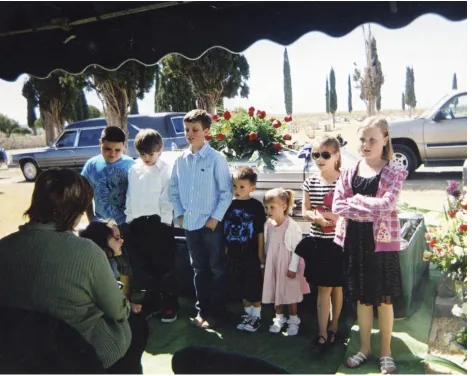
work does not always depict death directly, one image illustrates its indirect effects. As
part of a larger vignette, Children Graveside is a found snapshot of young children
gathering by a flower-covered casket at a funeral for a group portrait. The absurdity of
the scene provides a tinge of sadness and dark humor. (Fig. 2.3) Unlike the postmortem
portraits from Lesy’s Death Trip, there were no corpses propped up for the camera’s
documentation. Still, the meaning of this picture to the original owner is lost to me. I only
have a sliver of their pain and experience, and while Barthe’s refuses to show his Winter
Garden, I give some kind of life back to found photographs, so they can live to see
3 A SHAPE TO FILL A LACK
“ The past is never dead. It’s not even past.” - William Faulkner, Requiem for a Nun23
3.1 Bargaining and Acceptance
“You really shouldn’t do that Benjamin, you know good and well what could happen!
What if there were drugged up homeless people in there? Or worse, the police saw you carrying
stuff out of that house? You never know!” During my teenage years, much to my mother’s
dismay, I would go into abandoned buildings and houses to take pictures or find interesting
things left behind. Sometimes they’d be empty, and other times it felt as if the owners just up and
left. I loved feeling like a ghost walking up and down the halls, moving through another time or
place. When I was really young, I would just walk into houses where my friends lived, even if
they weren’t home, since nobody locked their doors in that neighborhood. I’d wait for them to
come back and play with their toys and stuff in the meantime, either to see how the other half
lived or to just be alone for a while. If they were gone for too long I’d get up and go back home,
and they were never the wiser. Now that I’m older it’s becoming less and less of good idea to
make breaking and entering a hobby, but my lust for discovering dust-covered relics burns just as
bright.
My obsession with the “found” laid dormant in my artistic practice until graduate school
when I began using my old family pictures to “digitally paint”, spurred by seeing the
manipulated works of Lucas Blalock or Daniel Gordon and thinking about how photography
could be used differently, become something new. (Fig. 3.1) I had made a series of
“manipulations” by distorting them with Photoshop overlays as a way to visually represent
failing memories, like with my favorite of the series Ex-Aunt Jennifer. (Fig. 3.2) My interests in
photographic manipulation and intervention began to quickly fade when looking at the works of
Joachim Schmid and Jason Lazarus. They utilized found photography in ways that seemed so
simple and poignant, so hands off yet emotionally touching. Something changed the way I
thought about photography when I saw Schmid’s 1989 proclamation: “No new photographs until
the old ones are used up.”24
At first it seemed too bold, too militant, but if every photograph takes place in the past
and no photograph offers any real sense of truth, why not use up the old ones? Why are they
deemed less important than the new? Using various means to obtain his images, Schmid’s work
has evolved from dumpster diving to scouring the treasure trove of the Internet. He has made
series after series using pictures made by others, some seemingly random; others tightly grouped
in smartly categorized vignettes. These groupings of direct and indirect connections fascinated
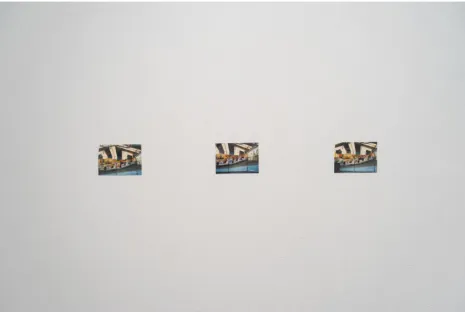
and inspired me to make my own uncut collages of grouped or sequenced images, such as the
triptych Darl’s Epiphany. (Fig. 3.3) Here I explored Darl’s frustration with repetitive, cyclical
living represented in a group of found photographs taken of a carousel at some unknown
amusement park. The people riding simply go round and round, much to the camera’s irritation
in trying to capture whoever the subject might be. Schmid usually has a sense of humor
throughout his work, maybe a slight middle finger as well, and I felt that the simplicity seen in
the carousel pictures would carry a tinge of lighthearted humor before the bitter truth could set
in.
24 Martha Langford, Suspended Conversations: The Afterlife of Memory in Photographic
Another artist that inspired me to seek out the photographic moments of others was Jason
Lazarus, whose last name seems quite fitting, since he brings back to life painful memories from
the past. His series Too Hard To Keep consists of voluntarily submitted photographs from people
near and far. Asking them to mail in photographs that for one reason or another are too hard to
keep. This subjectivity allows for things like jilted lovers, painful teenage awkwardness, to
images that embody loss so strong the original owner would rather let go of the reminder.25 This
cathartic social practice allows people to willingly give a piece of their pain for the world to see,
without giving specific or personal details, a confessional not necessarily of sins but of
heartache. The arrangement seems like its formed in constellations, floating in tight clusters or
lonesome voids, rhythmic in approach and grand in scale. (Fig. 3.4) They are reminiscent of Aby
Warburg’s Mnemosyne Atlas, a series of black panels covered in disparate images, texts, maps,
and artifacts all in varied arrangement used to study art and history beyond linguistic means.
(Fig. 3.5) The loose associations of Warburg’s images required meditation and thought, but the
clues were hidden in plain sight. As it is with Too Hard To Keep, the feeling of discovery that
takes place as you suddenly find someone else’s photograph, someone else’s memory that hits
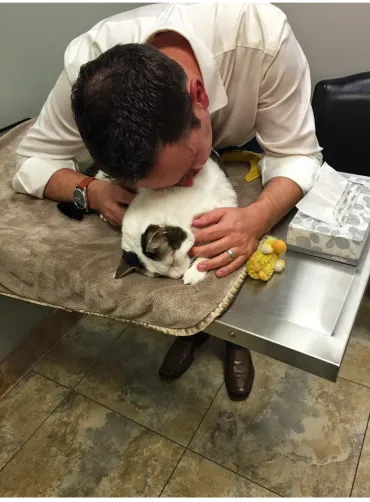
you like a Mack truck. For me, that picture was one of a man holding his cat who seems to be
asleep. The cat is obviously in a vet’s office and is surrounded by comfort items like a bed and
toy duckling. I couldn’t see the man’s face, but the box of tissues made it clear he had just put his
beloved cat down. There is something inherently sad about looking into the past through
photographs, but not even the gruesome pictures of Lesy’s Death Trip could have made me tear
up as much that damn picture. (Fig. 3.6)
25 Jason Lazarus and Abigail Solomon-Godeau, THTK (2010-Present) (San Francisco: San
I do not need to know the person in the photograph for me to keep it. I don’t need to know
their story or their names, although sometimes I find out. The photograph or object speaks to me
visually, in ways that move beyond language, even when I use text or hand written notes, I am
not so much looking at what is on the surface but buried beneath the emulsion. In one of my
favorite movies, No Country for Old Men, the sociopathic villain Anton Chigurh, terrorizes a
store clerk by asking what’s the most he’s ever lost in a coin toss. After a tense moment he flips
and calls heads, the store clerk is awarded the coin and his life, Chigurh then tells him: “Don’t
put it in your pocket, its your lucky coin … Anywhere but your pocket. Where it’ll get mixed in
with the others and become just a coin. Which it is.” 26 The old man stares confused and terrified
as Chigurh leaves. Sometimes the photograph is just a photograph, mixed in with the rest, and
other times it means the world to someone, it’s his or her entire world cropped into a 4x6 frame.
I like to believe that emotional power, that aura if I’d go that far, can linger long enough to speak
to someone new, becomes something more than just a photograph. Which it is.
3.2 Violence and Tenderness
As my practice moved away from my own family’s pictures into the pictures and objects
of unknown people, I began to question why such a shift. Was it because thinking of my
grandfather in his final days was too much for me to linger on? Or perhaps there is an inherent
violence to photography that I could not enact on my own family. John Stezaker, a collage artist
26Joel Coen and Ethan Coen. No Country for Old Men. Directed by Joel Coen and Ethan Coen.
who uses found photographic materials like headshots and postcards, once said, “There is
something very odd, even unnerving about cutting through a photograph … It sometimes feels
like I am cutting through flesh.” 27 In his practice he will use simple cuts to dissect portraits and
piece them together in a Dada style composite, creating strange surreal images. (Fig. 3.6)
Figure 3.7 John Stezaker, Betrayal XVIII, 2012
27 Sean O’Hagan, “John Stezaker: ‘Cutting a photograph can feel like cutting through flesh’,”
These images come across as funny, aggressive, funhouse, and nightmare. While his
physical intervention with the photographic object shows a literal violence, the simple act of
taking pictures in of itself is violent, as Sontag stated:
Like a car, a camera is sold as a predatory weapon – one that’s as
automated as possible, ready to spring. Popular taste expects an easy, an invisible
technology. Manufacturers reassure their customers that taking pictures demands
no skill or expert knowledge, that the machine is all-knowing, and responds to the
slightest pressure of the will. It’s as simple as turning the ignition key or pulling
the trigger. Like guns and cars, cameras are fantasy-machines whose use is
addictive.28
Even the use of words like aim, focus, shoot, take, capture, etc. give a sense of violence
and aggression, like using shooting a gun. Evidence of this addiction can be seen all
around us, you see it on walls, billboards, magazines, social media, and all over the
Internet. We take picture after picture, surrounding and insolating ourselves in images
like birds building nests. It gives us comfort and entertainment, educates us and cures our
boredom. I see myself as rescuing the photographs from oblivion, saving them from their
demise. However, it is possible that my pack rat mentality, my savior complex, is just a
way to try and escape death. By saving the images from demise, I in turn hope for
something to prolong my own existence. On the other hand, I do not fully return the
images back to life, since their context and original stories are still lost in time. Instead I
resurrect them into strange new creations that no longer resemble their former selves
once they are recontextualized and put into a new narrative. One particular artist that
appropriates and recontextualizes photographs is the equally hated, equally loved Richard
Prince.
Before he threw his hat into the ring of galleries and art critics, Prince was
working with magazine companies, collating articles and removing advertisements. In
doing this, he began seeing Marlboro ads over and over, specifically, the Cowboy ads. As
an artist he was interested in not just stealing someone else’s image, which I would argue
he did not do, but re-presenting the images that we as a culture consumed already and
place it in the gallery setting for us to reconsider intellectually. Prince stated, “It wasn’t
important who took the photograph. I took the photograph. I literally took it.”29 Much to
the anger and disgust from the original photographers, Prince’s work changed the
paradigm of how we as a culture understand art and how photography functions in
society.
For me, his work becomes more than just a copy, the enlargement and the
re-presentation of the image changes it completely. When the advertisement was selling a
product that in turn was selling an experience, the rugged American West cowboy
experience, Prince took that pre-existing urge, that dormant desire for freedom and put it
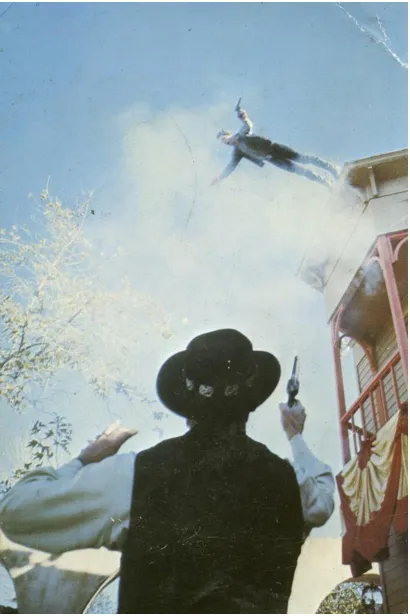
right in our face. As homage of sort, Salvation by Fire from my exhibition contains a
scene of two cowboys from a Hollywood set. (Fig. 3.8) In its original form, it was the
front facing photograph on a postcard.
29 100 Photos, “Untitled (Cowboy): Behind Richard Prince’s Photographs & Appropriation,”
It depicts the back of one cowboy shooting another off the roof of a nearby saloon. In
relation to As I Lay Dying, Addie said that her son Jewel would be her savior: “He is my
cross and he will be my salvation. He will save me from the water and from the fire. Even
though I have laid down my life, he will save me.” 30 The cowboy is Jewel, and the fire is
from the pistol that shot down the other cowboy. Salvation to Addie is just words, like
most things, so any salvation the dying cowboy finds is salvation from life’s pains. Like
the works of Prince, I have made my materials known; I do not try to hide anything from
the viewer. Prince’s works attempted to mask some of the moiré effect of the CMYK
processing, but he was very clear where the pictures came from. As part of my process I
fully embrace the flaws and conditions of the object as they were found. In the case of
Salvation by Fire, there are scratches, color fades, marks, stains, dog-eared corners and
overall damage to the emulsion. During the scanning and enlarging process, these
become highlighted and hyper-visible, pointing to its origin.
Another appropriation artist influential to the final evolution of my work is that of
Marlo Pascual. In her practice, she finds objects and images to combine into
thought-provoking ways, as a method to explore the image-object relationship. It has a dada feel
mixed with some of Prince’s attitude. When asked about a large photograph of a cat seen
in her collection of works, Pascual stated: “Iliked the cat’s gaze, and I just bought it off
eBay, scanned it, and had it enlarged and mounted to plexi.”31 Her cool, hands off
approach could be credited to those who came before her, like Richard Prince, Andy
Warhol, and Sherrie Levine, but in the age of the internet, “stealing” has become less of a
30 Faulkner, As I Lay Dying, 97.
31 Christopher Bollen, “Marlo Pascual Shatters Images,” Interview Magazine, February 16,
dirty word, often rephrased as borrowed, found, pirated, or even just “Copy-and-Paste”.
When it comes to her object-image pieces though there is something more going on. She
is making the photograph into an object, mimicking Minimalism’s approach of having to
physically interact with the object and the space it takes up. In her piece, Untitled, as
many are named, she has the photograph of a man with two lit candles physically jutting
off the image. (Fig. 3.9)
When seen at the right angle, one can see the flames line up with his eyes, creating an
“Ah Ha!” moment for the viewer. This playful game of Discovery-Reward inspired me to
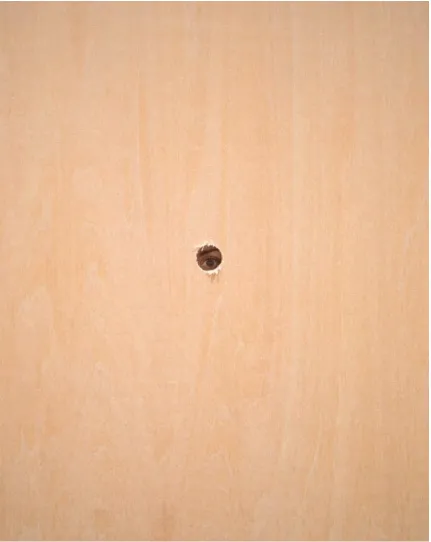
make Up for Air, a piece about Addie’s coffin being drilled into by Vardaman to provide
air holes. (Fig. 3.10) In my piece I left a wooden panel blank with the exception of a
single drilled hole. When the viewer approaches the hole, the eye of a woman peeks back
out at towards the gallery. This is essentially a photograph fixed behind the panel, but the
claustrophobic figure plays peek-a-boo with the audience, a little dark humor to mix in
with the death and misery seen in the rest of the show. The transformation of this piece
from just image is when the wooden panel, which was used to mount the rest of the 2D
works, is used for its materiality, thus becoming an object, a meta reference to its own
construction and a literary reference to the violation of Addie’s coffin.
The beauty of the appropriation approaches of Prince and Pascual is that it opens
the image or object up to new meanings and purposes. While the photographs that I find
or objects that I use may have at one point meant one thing, through my
recontexualization and setting in the gallery, they take on a whole new set of meanings.
And like some mad scientist tinkering and experimenting for sake of discovery, the
3.3 Fragmented Narrative
According to William Faulkner, he wrote As I Lay Dying by dividing the work into
nightly sessions, working tirelessly from 12:00 AM to 4:00 AM for over a month, not changing a
single word.32 His use of stream of consciousness and character driven chapters broke the story
up into tiny pieces, each offering a taste of possible truth. I found his writing style to be
dreamlike, cerebral, and enchanting. I thought that this open-ended form of writing could be
applied to art making as well. It would allow me to move freely from snapshots, to illustrations,
to text, or even to 3D objects. The connecting thread to all of these elements would be that I
could use what was necessary to make the piece; I was longer limited by medium or style.
A particularly interesting artist and outlier of sorts, Melissa Cantanese, created a series
called Dive Dark Dream Slow as a collaborative effort with Peter Cohen and his extensive
collection of found photographs, ranging from photography’s inception to now. In this series,
Cantanese wanted to create a new narrative through the sequencing and editing of the varied
images.33 However, because the work consists of disassociated images that are fused together
through the working process, the viewer does not get a clean, easily read narrative. Instead what
is presented is what I like to call a broken narrative, a story or story-like sequence of images that
contain many independent narrative functions acting for the larger, arching narrative. Her images
could include a woman’s dress, lighting bolt streaking across the sky, and then someone doing a
handstand underwater at night. Individually, each vernacular image is somewhat banal, but
together or seen in a series becomes fascinating. One gets an overall sense of subject or mood but
32 A. Nicholas Fargnoli, Michael Golay, and Robert W. Hamblin, Critical Companion to William
Faulkner: A Literary Reference to His Life and Work, 1st ed. (New York: Facts on File, 2008)
43-56.
33 Jörg Colberg, “A Conversation with Melissa Cantanese,” Conscientious Photo Magazine,
is left in a perpetual Presque Vu, or tip of the tongue, feeling. This method seems to mirror
Faulkner’s stream of consciousness, in that one chapter could be about faith and religion while
the next is about the fear of pregnancy. Each operates fine on their own, but becomes infinitely
more intriguing as the layers add up. Dive Dark Dream Slow hints at a particular theme or story,
but offers no direct characters or setting. It seems to be built off feeling instead of tangible
content. In my own series, I have tried to use a particular novel as a vertebrate, as some type of
traction for the images and themes to grip. I found my method of cohesion when driving down to
Birmingham for a studio visit.
In my last year of graduate school, one of my seminar classes took a trip to the University
of Alabama Birmingham to visit Jared Ragland and to see his recent body of work Everything is
Going to be All Right. And right off the bat I felt as if I walked into an alternate universe where
someone had a concept and title eerily similar to The Feeling of Being OK, but as he explained
how narrative acted as his visual glue my brain began to fire on all cylinders. For his project
Ragland used a combination of self made images as well as found photographs from online. In it
everything revolves around Percy Walker’s The Moviegoer, in which a man tries to get over a
mid-life crisis through watching movies. For Ragland, there is a universal theme of “the search”
being the existential desire to know what our purpose in life is. He makes all the images
black-and-white to create a sense of unity amongst the varied subjects. While each image comes from
independent sources, they pertain to the novel.Footnote What comes out of it is mysterious, dark,
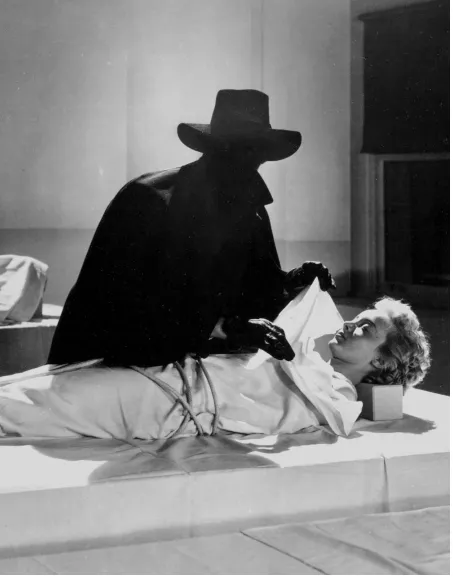
and tantalizing. One image in particular, Untitled (Phantom of the Opera), is an on stage
photograph of the Phantom reaching out to a young woman. Using stories within stories to build
Ragland’s sense of narrative is better structured, or more apparent than with Cantanese,
but with Ragland too there is a strange sense of disorientation as we jump from time to time and
place to place. Both of their works feels like a waking dream, caught between worlds, and the
pieces come together after you’ve been jolted awake. I think that Ragland’s movie themed
images fits perfect with the novel he focuses on, but also for investigating broken narratives. In
movies there is no fidelity to time or place as the camera shots jump from scene to scene, only a
loose understanding of continuity. In my own work I use cinematic styled images to convey the
sense of theatrical storytelling. In one vignettes, Vulture I, Vulture II, and The Feeling of Being
OK, I pair together an 8x10 black-and-white photograph of woman looking out in terror at an
unknown force with a larger 16x20 illustrated page of a vulture peering down from a tree. (Fig.
3.12) Next to these is a small torn page, with text containing the show’s title. The three pieces
together represent the foreshadowed terror and death that will eventually doom the Bundrens
with a friendly warning of sorts to the viewer to never let one’s own faults get in the way of life.
In a similar method as Ragland, I began searching for images to fit the role of the vulture
character of the novel. While there is no specific vulture, the idea of death from above lingers
throughout the pages. In a strange twist of fate I found a book on Southern birds and a 1960’s
B-rated science fiction movie called The Vulture. Thematically tied with the bird of death, the two
images worked well enough formally that I kept both. I found this playful staring contest to be
reminiscent of Cantanese’s images as well as techniques used by Ragland in his series. Each
piece offers unique, stand-alone narratives that sparked when combined. That’s the beauty of
4 CONCLUSION
“Now your turn.” My grandfather would say as he slid the newly marked sheet of paper
towards me. I started this series of work thinking about him, thinking about how his death
affected my family, my mother, even my own views on life. And even though death has always
been on my mind in one way or another, the making of this series put things into perspective.
And as I said before, I do not believe in superstitions like fate, but rather the endlessly wonderful
coincidences of the universe. While making The Feeling of Being OK I felt as if the universe
made a thousand small yet incredibly wonderful things fall into my lap over and over. The
journey I took in finding all of these photographs, torn pages, hand written notes, knick-knacks,
and oddities changed me. Changed me in ways I’m not sure that I yet fully understand. I feel as
if I’ve shared memories and moments with people I’ve never met, as if by some spectral means I
walked in and out of their lives. The smell of dust and the slightly scratched surfaces of all my
relics made the work feel more and more real the longer I stayed with them. When I put the final
piece on the gallery wall, I felt as if I bumped into someone on the street I hadn’t seen in years.
All the features and details seemed familiar, but instead of being in my imagination or scribbled
on a sketchpad, it was right there in front of me.
I learned a lot about the work and myself as an artist during this final year. I realized the
characters in As I Lay Dying are tragic not only because of their actions or choices or place in the
world, they are tragic because they are human. And all of the intricate parts to my installation
had their share of imperfections, making them seem almost human. I found that pieces came and
went, orientations and arrangement shifted to fit into the space, but I knew that once I was in the
gallery with everything it would somehow work out. I learned that patience and dedication pays
something that makes me feel incredibly proud and accomplished, but if it wasn’t for my fellow
grads and professors helping me along the way, I don’t think I could’ve gotten as far as I did. As
I was putting up the vinyl lettering for the show’s title, I couldn’t help but think of my
grandfather. We always started playing Stump the Artist with a blank white sheet of paper, blank
as the walls in the gallery, blank as an endless void. I’m not sure what the next blank sheet will
be or exactly what direction my art will take me from here, but I know that I’ll be able to make
[image:55.612.80.505.349.633.2]something out of seemingly nothing, that there will be a solution somewhere out in the void.
BIBLIOGRAPHY
Barthes, Roland. Camera Lucida: Reflections on Photography. New York: Hill and Wang, 1982.
Batchen, Geoffrey. Forget Me Not: Photography and Remembrance. Princeton: Princeton Architectural Press, 2004.
Berger, John. “Apperances.” In Another Way of Telling (New York: Vintage, 1995) 89.
Berger, John. Understanding a Photograph. London: Penguin Books, 2013.
Bollen, Christopher. “Marlo Pascual Shatters Images.” Interview Magazine, February 16, 2012. ART.
Busch, Dennis, Robert Klanten, Hendrik Hellige, Silke Krohn, and Steven Lindberg. The Age of Collage: Contemporary Collage in Modern Art. Berlin: Gestalten, 2013.
Call, Jordan. “Make or Break: The Effects of Traumatic Experience on Sympathy in As I Lay Dying.” Criterion: A Journal of Literary Criticism 6, no.1, Article 3 (2013): 21.
Chan, Sewell. "Making Sense of Other People’s Memories." New York Times, March 10, 2008.
Coen, Joel and Ethan Coen. No Country for Old Men. Directed by Joel Coen and Ethan Coen.
Performed by Javier Bardem. 2007. United States: Miramax Films and Paramount Vantage. Film.
Colberg, Jörg. “A Conversation with Melissa Cantanese.” Conscientious Photo Magazine. March 16, 2015.
Cotton, Charlotte. The Photograph as Contemporary Art. 3rd Ed. London: Thames & Hudson, 2014.
Dillon, Brian. "Collected Works: Aby Warburg's Mnemosyne Atlas." Frieze Magazine. Januarary. 2004.
Elkins, James. What Photography Is. New York: Routledge, 2011.
Fargnoli, A. Nicholas, Michael Golay, and Robert W. Hamblin, Critical Companion to William Faulkner: A Literary Reference to His Life and Work, 1st ed. (New York: Facts on File,
2008) 43-56.
Farr, Ian. Memory. Documents of Contemporary Art. Cambridge, MA: MIT, 2010.
Faulkner, William. As I Lay Dying. New York: W.W. Norton & Company, 2010.
Faulkner, William. Light in August. New York: Vintage Books, 1972.
Faulkner, William. Requiem for a Nun. New York: Vintage Books, 2012.
Hallgarth, Neal. “‘The worry that you are yourself’: Darl’s unforgiveable neurodiversity in As I Lay Dying.” MA Thesis, Eastern Washington University, 2013.
Hattenhauer, Darryl. “The Geometric Design of As I Lay Dying.” Colby Quarterly 30, no.2 (1994): 146.
Helvensteijn, Michiel. “Towards a Formal Foundation for Time Travel in Stories and Games.” Theory and Practice of Formal Methods 9660, Lecture Notes in Computer Science (2016): 261-276.
Hirsch, Marianne. Family Frames: Photography, Narrative, and Postmemory. Cambridge, MA: Harvard University Press, 1997.
Hirsch, Marianne. The Familial Gaze. Hanover, NH: Dartmouth College, 1999.
Johnson, Claudia Durst. Family Dysfunction in William Faulkner’s As I Lay Dying. Detroit: Greenhaven Press, 2013.
Klein, Alex, André Rottmann, Kaja Silverman, and Tim Griffin. How Soon Is Now?. Arles, France: LUMA Foundation, 2011.
Langford, Martha. Scissors, Paper, Stone: Expressions of Memory in Contemporary Photography. Montreal: McGill-Queen’s University Press, 2007.
Langford, Martha. Suspended Conversations: The Afterlife of Memory in Photographic Albums. Montreal: McGill-Queen’s Press, 2001.
Lazarus, Jason and Abigail Solomon-Godeau, THTK (2010-Present). San Francisco: San Francisco Camerwork, 2013.
Lemaire, Taylor. “‘My Mother is a Fish’: All Encompassing Inadequacy in William Faulkner’s As I Lay Dying.” Verso (2015): 22-25.
Lesy, Michael. Wisconsin Death Trip. Albuquerque: University of New Mexico Press, 2000.
Morin, Roc. "The People Who Collect Strangers' Memories." The Atlantic. September 26, 2016. Accessed October 10, 2016.
O’Hagan, Sean. “John Stezaker: ‘Cutting a photograph can feel like cutting through flesh’.” The Guardian, March 27, 2014.
Ow-Yeong, Wai-Kit. “‘Our Failure of Empathy’: Kevin Carter, Susan Sontag, and the Problems of Photography.” MA Thesis, University College London, 2013.
Sontag, Susan. On Photography. New York: Farrar, Straus &Giroux, 1973.
Spavento, Elizabeth. “Exploring the Individual Identity in Faulkner’s As I Lay Dying and Ware’s Jimmy Corrigan: The Smartest Kid on Earth.” The Oswald Review: An International Journal of Undergraduate Research and Criticism in the Discipline of English 9, no.1, Article 5 (2013): 88-89.
Stern, Sara. “Still Moving.” Frieze. August 13, 2013. Accessed September 03, 2016. https://frieze.com/article/still-moving.
Sutton, Damian. Photography, Cinema, Memory: The Crystal Image of Time. Minneapolis: University of Minnesota, 2009.
Wall, Jeff. Between Times: Instants, Intervals, Durations. Madrid: La Fabrica Editorial, 2010.
Zeeberg, Amos. "Why Photographs Are Vital to Cultivating Empathy: How Images Trigger Empathy." The Atlantic. January 16, 2016. Accessed September 27, 2016.
http://www.theatlantic.com/science/archive/2016/01/cultivate-empathy-photograph/422793/.
100 Photos. “Untitled (Cowboy): Behind Richard Prince’s Photographs & Appropriation.” Produced by Kira Pollack and Paul Moakley. Time and Red Border Films.
Voices. “To Tell A Story.” Directed by Mike Lloyd. Written by John Berger and Susan Sontag. BBC, February 9, 1983.