A Study on Effectiveness of the Internal Control System
in the Private Banks of Trincomalee
Mrs.S.Kumuthinidevi, Senior Lecturer GII
Department of Business and Management Studies, Faculty of Communication and Business Studies, Trincomalee Campus, Eastern University Sri Lanka
Abstract- This study is about the Effectiveness of Internal
Control System in the Private Banks of Trincomalee. There was found through observation and discussion that there are some deviations in the internal control system in the daily banking activities. Based on this problem the researcher was intended to do this research on the objectives of evaluate the bank’s control environment and internal control system in the bank, to identify the bank’s risk assessment process and the internal control in the bank, to evaluate bank’s accounting, information and communication system relevant to financial reporting and the internal control in the bank, to find out bank’s control activities affect the internal control in the bank and to find out bank’s self assessment affect the internal control in the bank. This study is based on the dependent variable; effective internal control and five independent variables; control environment, risk assessment,accounting,information and communication, control activities and self assessment.
In this study, data were collected through primary as well as secondary to measure the relationship between two variables. The main tool of primary data is questionnaires. The questionnaires distributed among permanent staff of ten banks. And in the case of data analysis and evaluation, univariate as well as bivariate analysis methods were used. Under the univariate analyses mean, standard deviation, percentages were used to evaluate the data
According to the data evaluation, all the independent variables are moderately supportive in the effectiveness of internal control system. And in the consideration of all independent variables as overall they were moderately supportive in the effectiveness of internal control system. In the discussion part, presented data discussed in qualitatively. And under the conclusion and recommendations researcher have been given summary on the data analysis and recommended some suggestions to implement in the bank to enhance the internal control system in the bank.
I. INTRODUCTION
nternal control is a broad term with a wide coverage. It covers the control of the whole management system in order to carry on the business of the enterprise in an orderly and efficient way by having an automatic check and balance overall the transaction. The control may be financial and or non-financial. It has become one of the basic and essential factors for efficient and effective management.
Effective internal controls are the foundation of safe and sound banking. A properly designed and consistently enforced
system of operational and financial internal control helps a bank’s board of directors and management to safeguard the bank’s resources, produces reliable financial reports, and complies with laws and regulations. Effective internal controls also reduce the possibility of significant errors and irregularities and assist in their timely detection frauds and error. The internal control system is equally important to the management and the auditor concerned. It helps to the organization to meet its own goals more effectively. (Internal Control Comptroller’s Hand Book January 2001)
The need for the internal control systems in the organizations, especially banks, cannot be undermined due to the fact that the banking sector which has crucial role to play in the economic development of the nation is now being characterized by macro economic instability, slow growth in real economic activities, corruption and the risk of frauds.
Internal control includes internal check, internal audit and other devices of control. Although internal control and internal audit are closely related, they are distinct from each other. Internal control is the systems, policies, procedures, and processes affected by the board of directors, management and other personnel to safeguard the bank assets, limit or control risks, and achieve a bank’s objectives. Internal audit provides an objective, independent review of bank activities, internal controls, and management information systems to help the board and management monitor and evaluate internal control adequacy and effectiveness.
1.1 Problem Statement
Thus researcher intends from this study to find out the effectiveness of the internal control system in the Private Banks of Trincomalee.
1.2 Research Questions
• Does the bank’s control environment affect the effectiveness of the bank’s internal control?
• Does the bank’s risk assessment process affect the effectiveness of the bank’s internal control?
• Does the bank’s accounting, information and communication system relevant to financial reporting affect the effectiveness of the bank’s internal control?
• Does the bank’s control activity affect the effectiveness of the bank’s internal control?
• Does the bank’s self assessment affect the effectiveness of the bank’s internal control?
1.3 Objectives of the Study
• To evaluate the bank’s control environment and internal control system in the bank.
• To identify the bank’s risk assessment process and the internal control in the bank.
• To evaluate bank’s accounting, information and communication system relevant to financial reporting and the internal control in the bank.
• To find out bank’s control activities affect the internal control in the bank.
• To find out bank’s self assessment affect the internal control in the bank.
1.4 Significance of the Study
System of Internal control is very important factor affecting the effective and efficient working condition in the bank. A successful internal control system can reach its goals. This study,
• Will identify the failures over the internal control system and it will help to management to overcome the deficiencies.
• The system of Internal control prevailing in the bank.
• This will provide suggestions and recommendations success the internal control system.
1.5 Assumptions of the study
• There is no change in the internal control systems within the study period.
• There is no change in the banking policies within the study period.
1.6 Limitations of the study
• This study will be conducted within a limited geographical area.
• The confidentiality of the bank to provide relevant data is high.
II. LITERATUREREVIEW
What is Internal Control?
Internal Control implies the whole system of control employed by the management in order to carry on the business of the enterprise in an orderly and efficient way by having an automatic check and balance overall the transactions. It includes internal check, internal audit and other devices of control. Internal control system assures the management that the information it receives is both reliable and accurate. The system also helps to ensure that assets are secure and management policy is being followed properly. Its efficient working not only guarantees management as to the reliability of accounting information, independent auditors also rely on system of internal control in determining the timing,nature,and extent of the audit work.(Ravinder Kumar, Virender Sharma, 2005)
As part of its on-going efforts to address bank supervisory issues and enhance supervision through guidance that encourages sound risk management practices, the Basle Committee on Banking Supervision is issuing framework for the evaluation of internal control systems. A system of effective internal controls
is a critical component of bank management and a foundation for the safe and sound operation of banking organizations.
A system of strong internal controls can help to ensure that the goals and objectives of a banking organization meets, that the bank achieves long-term profitability targets, and maintain reliable financial and managerial reporting. Such a system can also help to ensure that the bank complies with laws and regulations as well as policies, plans, internal rules and procedures, and decrease the risk of unexpected losses or damage to the bank’s reputation. (Basle Committee for banking supervision, September 1998)
Internal control is a company’s system, defined and implemented under its responsibility.
It comprises a set of resources, patterns of conduct, procedures and actions adapted to the individual characteristics of each company which contributes to the control over its activities, to the efficiency of its operations and to the efficient utilization of its resources, and enables it to take into consideration, in an appropriate manner, all major risks, be they operational, financial or compliance. The system more particularly designed to ensure that:
a) Laws and regulations are complied with
b) The instructions and directional guidelines fixed by Executive Management or the Management Board are applied. c) The bank’s internal processes are functioning correctly, particularly those implicating the security of its assets.
d) Financial information are reliable.
Internal control is therefore not limited to a set of procedures it simply to accounting and financial processes. It embrace all of the initiatives taken by the executive bodies or by management, such as defining company strategy, fixing objectives, and management decisions, and dealing with the risks or monitoring performance.[Internal control reference, AMF 2004]
Distinction among Internal Audit, Internal Check and Internal Control
The expressions internal audit, internal check and internal control can be differentiated from one another in the following manner.
1) Internal Audit-It is an independent appraisal activity within an organization to review the operations and records as to service for management and is done by specially assigned staff.
2) Internal Check-It means a system under which the work relating to carrying out and recording of transactions is arranged in such a manner that the work of one staff member is automatically checked by another. Thus under this system possibilities of fraud and error or irregularities are minimized, if not completely eliminated.
internal audit besides other forms of control.(Ravinder
Kumar, Virender Sharma 2005)
Objectives of Internal Control
Internal control is a process affected by the board of directors, senior management and all levels of personnel. It is not solely a procedure or policy that is performed at a certain point in time, but rather it is continually operating at all levels within the bank. The board of directors and senior management are responsible for establishing the appropriate culture to facilitate an effective internal control process and for monitoring its effectiveness on an ongoing basis; however, each individual within an organization must participate in the process. The main objectives of the internal control process can be categorized as follows,
1. Efficiency and effectiveness of activities (performance objectives)
2. Reliability, completeness and timeliness of financial and management information
(Information objectives) and
3. Compliance with applicable laws and regulations (compliance objectives).
Performance objectives for internal controls pertain to the effectiveness and efficiency of the bank in using its assets and other resources and protecting the bank from loss. The internal control process seeks to ensure that personnel throughout the organization are working to achieve its goals with efficiency and integrity, without unintended or excessive cost or placing other interests (such as an employee’s, vendor’s or customer’s interest) before those of the bank.
Information objectives address the preparation of timely, reliable, relevant reports needed for decision-making within the banking organization. They also address the need for reliable annual accounts, other financial statements and other financial-related disclosures and reports to shareholders, supervisors, and other external parties. The information received by management, the board of directors, shareholders and supervisors should be of sufficient quality and integrity that recipients can rely on the information in making decisions. The term reliable, as it relates to financial statements, refers to the preparation of statements that are presented fairly and based on comprehensive and well-defined accounting principles and rules. (Basle Committee for banking supervision, September 1998)
The reliability of financial information can only be obtained through the implementation of internal control procedures which are capable of faithfully recording all the operations performed by the bank. The quality of this internal control system can be targeted by means of: segregation of duties, enabling a clear distinction to be made between recording duties, operational duties and retention duties; function descriptions which should enable the origins of the information prepared to be identified, together with its recipients; an accounting internal control system enabling to check that the operations have been performed in accordance with general and specific instructions, and that they have been accounted for so as to produce financial information which complies with generally accepted accounting principles.
Compliance objectives ensure that all banking business complies with applicable laws and regulations, supervisory
requirements, and the organization’s policies and procedures. This objective must be met in order to protect the bank’s franchise and reputation. . (Basle Committee for banking supervision, September 1998)
This refers to the laws and regulations to which the bank is subject. The laws and regulations in force determine the behavioral standards that the company incorporates into its compliance objectives. Given the large number of areas that exist (company law, commercial law, security, environment, social, etc.), the bank. Bank needs to be structured in such a way so that bank is aware of the various rules that applied. [Internal control reference, AMF 2004]
Advantages of Internal Control System
The existence of an efficient system of internal control can be of great help to the management as well as to the auditor because it offers the following advantages,
1. Assures a high degree of accuracy and reliability of all the financial and operating information management receives.
2. Minimizes occurrence frauds and errors or any other irregularity, if not eliminates completely.
3. Safeguard assets against any misuse.
4. Promotes operational efficiency and prevent wastages. 5. Judges operating efficiency and highlights weaknesses. 6. Above all encourages adherence to the established
managerial policies.
Forms of Internal Control
The definition of internal control given by the American Institute of Certified Public Accountants (AICPA), mentioned earlier, indicates that internal control goes beyond the accounting functions of the organization and incorporates both accounting and administrative controls.
i. Accounting Controls-According to the first part of the said definition, accounting control concerns the controls related to the accounting system that is checking transactions as per the prescribed procedures and safeguarding the assets. Accounting control comprises the followings;
a. Budgeting Control.
b. Standard control and deviation analysis. c. Internal check.
d. Internal Audit. e. Bank reconciliation. f. Self-balancing ledgers etc.
ii. Administrative Control-The last phrase of the definition “Operational efficiency and encourage adherence to prescribe managerial policies”, indicates towards Administrative Control. Administrative Control comprises the following;
a.Time Studies. b.Motion Studies. c.Quality Control. d.Performance Appraisal. e.Statistical Analysis etc.
I. A well-designed accounting system should be in operation. Financial and accounting operations must be separated, that is, handling of cash and the recording of the movement thereof should be done by different persons.
II. Responsibility for the performance of the job must be clearly stated so that there remains no room for doubt or confusion subsequently. To achieve this clear-cut and well-conceived organization structure should be established.
III. Too much confidence should not be pinned in one individual. Nearly all frauds are committed by ‘trusted’ officials are employees. It is interesting to note that frauds have acquired owing to their being trusted. IV. Rotation principle relating to transfer of an employee
from one job to another should be the inflexible guiding rule. This is effective safeguard against collusion and is recognized as an important canon of sound organization. V. Mechanization of the work wherever feasible and
practicable, should be resorted to. Mechanical devices such as cash register, recording time clocks, calculation machines, etc should be introduced.
VI. The work should be so arranged that work done by one employee could be promptly checked by another independent employee such continuous and constant checking stimulates moral control and also the error and the frauds cannot go undetected.
VII.The arrangement of the work should be in such a manner that written record of the role played by each employee should be maintained and the work should pass through several hands in a well-defined manner. VIII. Clear and well-defined rules should be laid
down and practically followed relating to dealing of the cash, ordering, receiving and issuing goods etc.Instructions should be in writing in the form of accounting manuals.
IX. Employees must be in bond so that the tempted employee will be deterred from committing fraud and employer being protected.
X. Although not a substitute for protective financial internal control, yet existence of an efficient internal auditing staff is an important element of an effective internal control system. .(Ravinder Kumar, Virender Sharma, 2005)
The Components of Internal Control System
The internal control system consists of five closely related components. Although these components apply to all companies, the way they are implemented will vary depending on the size and the business sector of companies. They are; control environment, risk assessment, control activities, information and communication, monitoring of controls. [Internal control reference, AMF 2004]
Control environment-This element is the underlying foundation for all of the other elements of an internal control system. The control environment is indicative of the overall awareness of both a bank's board and management - and their attitude as well - in assigning an adequate level of importance to the control activities. The control environment reflects the
overall contributions by a bank's board and management towards the necessary discipline and the appropriate structure for ensuring proper internal controls over a bank's operations. The essential components of an effective control environment include.
i. Personnel integrity and ethical values.
ii. Dedication to staff competence and skill enhancement. iii. Participation of Board Members and Board Committees. iv. Positive influence of Management's commitment.
v. Organizational structure that enables the management of the bank.
vi. Authority and responsibility that is clearly defined. vii. Effective policies and practices for human resources(A
Guide for Directors and Managers of Liberian Banks, March 2005)
An organization comprising a clear definition of responsibilities, with suitable resources and competencies and supported by appropriate information systems, procedures or operating methods, tools and practices. The implementation of an internal control system must be based on fundamental principles but also on:
i. a suitable organization which provides the framework in which the activities implicit in meeting the objectives are planned, carried out, followed up and controlled; ii. Clearly defined responsibilities and powers which are
granted to the right people depending on the bank’s objectives. Bank can be formalized and communicated by means of task or job descriptions, operating and functional line organization charts, delegation of powers, and should respect the principle of the
iii. a human resource management policy which should enable people to be recruited with the appropriate knowledge and competencies required to carry out responsibility and to meet the current and future objectives of the company;
iv. Operating procedures or methods which specify the way I which an action or process should be carried out (objectives to be achieved within a given time frame, defintion of function and operating/reporting lines, policy framework, decision- making and assessment tools, control frequency, person responsible for the control,..) regardless of their format and type of support aid.
v. Tools or work facilities (office automation, IT) which are adapted to everyone’s needs and which every user should be suitably trained.
vi. Practice which are commonly accepted within the company.[internal control reference AMF 2004]
• A change in a bank's operating environment.
• A change in staffing, either through reassignments or new employees.
• A new or a revised information system.
• A change in a bank's growth pattern and / or rate. • An introduction of new technology.
• An introduction of new or expanded business lines, products or activities.
• A merger or other corporate restructuring.
• A change in accounting requirements. (A Guide for Directors and Managers of Liberian Banks, March 2005)
A system for identifying and analyzing the main identifiable risks in relation to the company’s objectives and for ensuring that procedures exist for managing those risks. Given the ever-changing environment and regulatory context, bank’s implement methods to identify, analyze and manage the risks, both internal and external, with which may be confronted and which could reduce the likelihood of meeting business objectives.
i. Risk identification The bank identifies the main identifiable risks, both internal and external, which could have an impact on the likelihood of it meeting the objectives it has fixed for bank. This identification process, which is on-going, should cover those risks which could have a significant impact on its situation.
ii. Risk analysis This involves taking into consideration the likelihood of the risks occurring and their potential seriousness, as well as considering the environment and existing control measures.
iii. Risk management procedures Executive Management or the Management Board, supported by a risk management function, if there is one, should define risk management procedures. [internal control-internal control reference AMF 2004]
Control Activities Control activities are all of the policies and procedures that have been instituted by the bank to direct bank staff in carrying out the directives of both board and management. All of these activities help the board and management control risks that could adversely affect the bank's operations and results. The policies that direct these control activities should also provide that the bank personnel who are responsible for thesecontrol activities do not evaluate their own work in these areas. Control activities are engaged in at various levels within the bank'sorganizational structure which include,
i. Operational Performance - Control activities in this
area include the review of risk in the actual financial performance compared against the budgeted forecasts. Any significant variances are then analyzed to determine whether any specific bank activity should be revised.
ii. Information Processing - Control activities in this area
include the verification of the accuracy and completeness of bank transactions to determine whether they had been properly authorized. Control activities in the information area are broadly measured through two approaches general controls and application controls. General controls are oversight over data center operations, including mainframes and servers, and
system software procurement, maintenance and access. Application controls are the oversight for the programs that the bank utilizes to process and monitor transactions.
iii. Physical Controls - Control activities in this area
generally refer to the physical
iv. Segregation of Duties - Control activities in this area
refer to the assignment of the various duties involved in a transaction, or any bank activity, to different persons. This approach is intended to prevent a bank employee from being in a position to effect and conceal an irregular or illegal activity in the course of that person's normal duties.(A Guide for Directors and Managers of Liberian Banks, March 2005)
Control activities proportionate to the implications of each individual process and designed to ensure that the appropriate measures are taken in order to control the risks that could affect the bank’s ability to achieve its objectives.
Control activities can be found everywhere in the organization, at every level, and in every function, whether controls focusing on prevention or detection, manual or computerized controls, or controls by virtue of the reporting structure.
In any event, control activities are determined in the light of the nature of the objectives with which controls are associated and are proportionate to the implications of each process. In this context, particular attention should be paid to the controls over the processes involved in designing and running information systems.[Internal control reference, AMF 2004]
Information and Communication-capture and impart pertinent and timely information in a form that enables the board, management, and employees to carry out their responsibilities. Accounting systems are the methods and records that identify, assemble, analyze, classify, record, and report a bank’s transactions. Information and communication systems enable all personnel to understand their roles in the control system, how their roles relate to others, and their accountability. Information systems produce reports on operations, finance, and compliance that enable management and the board to run the bank. (Internal
control Comptroller’s Handbook, January 2001)
Information systems which are adapted to the current objectives of the organization and designed to be able to respond to its future objectives. The IT systems on which these information systems depend must be effectively protected, both in terms of physical and logical security, thereby ensuring that there is no loss of the information stored. Bank operational continuity is guaranteed by back-up procedures. The information on the analyses, the programming and processing functionalities must be documented. [Internal control reference, AMF 2004]
The following processes must be used to control the components of the accounting information production tool:
a. The use of computerized accounting systems calls for a clear and formalized organizational structure, and measures to ensure the physical security of computer systems and data integrity;
availability and relevance of accounting and financial information;
c. Overall information system organization and operations must be governed by specific rules on system access, validation of processing, cut-off procedures, record keeping and verification;
d. Procedures and controls must be established for quality assurance and operational security, for maintenance and development (or parameterization) of accounting and management systems5,along with other systems that provide data directly or indirectly to accounting and management systems;
e. Critical information system controls must be established (preventing duplicate entries, thresholds for entries, limited access for critical transactions, automated reconciliations, etc.);
f. The company must be capable of meeting the specific requirements of the tax authorities:
i. Storage of data processed by computer applications that prepare accounting records or substantiate transactions recorded in the documents filed with the tax administration; ii. Documentation: Data and file management
rules implemented by computer programs that contribute to the determination of book income, taxable income and tax returns must be described;
In this case, management systems that contributes to the preparation and processing of published accounting and financial information.The in-house dissemination of relevant and reliable information, the awareness of which enables everyone to exercise their responsibilities. The company should employ processes which ensure that all relevant and reliable information is communicated in a timely manner to all relevant players within the company, thereby enabling them to exercise their responsibilities.[Internal control reference AMF, 2004]
Monitoring-Self-assessment or monitoring is intended to provide an oversight function in assessing the performance of the bank's control systems. Bank directors and management constantly review internal controls for their proper functioning and for modifications to the internal control systems when deemed necessary. Self-assessment is only one approach to a basic review of these internal control activities; however, self-assessment cannot the only approach to self-assessment of the effectiveness of a bank's internal control systems. Internal and external audits provide a more independent approach to the assessment of the bank's internal control function. Supervisory examinations additionally provide another layer of assessment of these controls. (A Guide for Directors and Managers of Liberian Banks, March 2005)
On-going monitoring of the internal control system together with a regular review of the way it is operating. As for any system, the internal control system requires on-going monitoring. The aim is to check its relevance and appropriateness to the bank’s objectives implemented by management and steered by the Executive Management or the Management Board. This monitoring principally comprises the analysis of the main incidents that have been recorded, the result of the controls
performed, together with the work carried out by the internal audit team, when there is one. This monitoring also takes in to consideration the observations made by the statutory auditors and by regulatory oversight bodies. Another useful complement to the monitoring tools can be to keep an active watch on internal control best practices. Monitoring, together with the best practices watch, culminate, where required, in the implementation of corrective actions and adjustments to the internal control system.
The objectives of the monitoring processes for the accounting and financial reporting structure are to define and implement accounting policies and to manage resources and constraints in order to meet senior management s objectives. Monitoring of the accounting and financial reporting structure is based on the principles and key analytical points discussed in detail below. This monitoring is the task of the Accounts and Financial Reporting Departments, as well as senior management.
[Internal control reference AMF, 2004]
These five components are linked together, thus forming an integrated system that can react dynamically to changing conditions. The internal control system is intertwined with the organizations operating activities, and is most effective when controls are built in to the organizations infrastructure, becoming part of the very essence of the organization.[American Institute Committee of Public Accountants (AICPA), 2005]
What Internal Control Cannot Do
As important as internal control structure is to an organizational effective system is not a guarantee that the organization is successful. An effective internal control structure keeps the right people informed about the organization’s progress (or lack of progress) in achieving its objectives, but it cannot turn a poor manager in to a good one. Internal control cannot ensure success, or even survival.
Internal control is not an absolute assurance to management and the board about he organization’s achievement of its objectives. It can only provide reasonable assurance, due to limitations inherent in all internal control systems. For example, breakdown in the internal control structure can occur due to simple error or mistake, as well as faulty judgments that could be made at any level of management. In addition, controls can be circumvented by collusion or by management override. Finally; the design of the internal control system is a function of the resources available, meaning that there must be a cost-benefit analysis I the design of the system.
Roles and Responsibility
Everyone in the organization has some role to play in the organization’s internal control system
Chief Executive Officer (CEO)-the CEO has ultimate responsibility and ownership of the internal control system. The individual in this role sets the tone at the top that affects the integrity and ethics and other factors that create the positive control environment needed for the internal control system to thrive. Aside from setting the tone at the top, much of the day-to-day operation of the control system is delegated to other senior managers in the company, under the leadership of CEO.
organization under the leadership of the CFO.In particular, controls over financial reporting fall within the domain of the chief financial officer. The audit committee should use interactions with the CFO, and others, as a basis for their comfort level on the internal control over financial reporting.
Controller/director of accounting or finance-Much of the basics of the control system comes under the domain of this position. It is key that the controller understands the need for the internal control system, is committed to the system, and communicates the importance of the system to all people in the accounting organization. Further, the controller must demonstrate respect for the system though his or her actions.
Internal audit-The main role for the internal audit team is to evaluate the effectiveness of the internal control system and contribute to its ongoing effectiveness. With the internal audit team reporting directly to the audit committee of the board of directors and/or the most senior levels of management, it is often this function that plays a significant role in monitoring the internal control system. It is important to note that many not-for-profits are not large enough to employ an internal audit team. Each organization should assess the need for this team, and employ one as necessary.
Board of director/audit committee-A strong, active board is necessary. This is particularly important when the organization is controlled by an executive or management team with tight reins over the organization and the people within the organization. The board should recognize that its scope of oversight of the internal control system applies to all the three major areas of control: over operations, over compliance with laws and regulations, and over financial reporting. The audit committee is the board’s first line of defense with respect to the system of internal control over financial reporting.
It is important to realize that both the design and compliance with the internal control system so important. The audit committee should be tuned-in to the tone- at-the-top of the organization as the first indicator of the functioning of the internal control system.
In addition, audit committees should realized that the system of internal control should be scaled too the organization. Some organization will be so small, for example, that they will not be able to have appropriate segregation of duties. The message here is that the lack of segregation of duties is not automatically a material weakness, or even a reportable condition, depending on the compensating controls that are in place.
For example, suppose an organization’s accounting department is so small that it is not possible to segregate duties between the person who does the accounts payable and the person who reconciles the bank statements. In this case, it is one and the same person, so the implication is that there are no checks and balances on the accounts payable person, who could be writing checks to a personal account, then passing on them during the bank reconciliation process (that is there is no one to raise the red flag that personal checks are being written on the company account). Compensating controls could make up for this apparent breach in the internal control system. Here are some examples of compensating controls in this situation:
1. All checks are hand signed by an officer of the company, rather than using a signature plate that is in the control of the person that prepared the checks. 2. The bank reconciliation may be reviewed by the
person’s manager.
3. A periodic report of all checks that are cleared at the bank could prepare by the bank and forwarded to an officer of the company for review.
Audit committees should be aware of situations like this and be prepared to ask questions and evaluate the answers when an obvious breach in internal control is surfaced.
All other personnel-The internal control system is only as effective as the employees throughout the organization that must comply with it. Employees throughout the organization should understand their role in internal control and the importance of supporting the system through their own actions and encouraging respect for the system by their colleagues throughout the organization.
Management Override of Controls
Another area that an audit committee needs to focus on is the ability of management to override internal controls over financial reporting to perpetrate a fraud. Examples of techniques used by management in overriding internal controls over the financial reporting function include:
a. Back dating or forward dating documents to a different period.
b. Making adjusting entries during the financial reporting closing process.
c. Reclassifying items improperly between the statement of activity and the statement of financial condition. Some of these override techniques were used in some of the recent scandals and have gained substantial notoriety.
An audit committee has the responsibility to help prevent or detect a management override of controls. It is important for the audit committee to understand that there is system to uncover an override, as well as to follow-up to determine its appropriateness. Question about management override, and the controls over management override, as well as audit steps to detect if a management override has occurred, should be address to the CEO.CFO,and independent auditor during the respective executive sessions with the audit committee.[AICPA Audit Committee Toolkit, 2005]
Need for evaluation Of Internal Control
The auditors are increasingly recognized the importance of evaluating internal controls before undertaking specific audit tests. This may be attributed to many factors.
In view of the enormous growth in their size and complexities, proper management of modern business undertaking is not possible unless they have an effective system of internal control. Hence, sophisticated system of management information and control have been introduced in many organizations. An auditor should, therefore, evaluate these systems as a part of his audit assignments.
transactions of an organizations. Within the constraints of the resources available. Actually auditor can conducted a more effective audit if he concentrates on intelligently selected areas. Another development which makes it imperative for an auditor to evaluate the internal control system is the increasing use of computers on maintaining accounts. Electronic data-processing devices have considerably changed the flow of documents and transactions and the auditor may not now have the intermediary documents and links which are useful in detailed vouch-and-post audit. In such a situation, the auditor has to rely a great deal on the in-built controls in the system.
Various professional accounting bodies now recognize the fact that the evaluation of internal control system helps in formulating a programme of detailed verification. In the context of an audit of financial information, basic Principles Governing an Audit, states: “The auditor should gain an understanding of
the accounting systems and related internal controls and should study and evaluate the operation of those internal controls upon which he wishes to rely in determining nature, timing and extent of other audit procedures. Where the auditor concludes that he can rely on certain internal controls, his substantive procedures would normally be less extensive than would otherwise be required and may also differ as to their nature and timing”. If an auditor finds that internal controls in certain areas are inadequate, he may decide to apply more effective substantive tests, or change the timing of the test to be applied, or extend his audit test to carry out a more detailed examination of the unsatisfactory aspects of the system.
III. CONCEPTUALIZATIONFRAMEWORKAND METHODOLOGY
Conceptualization Framework.
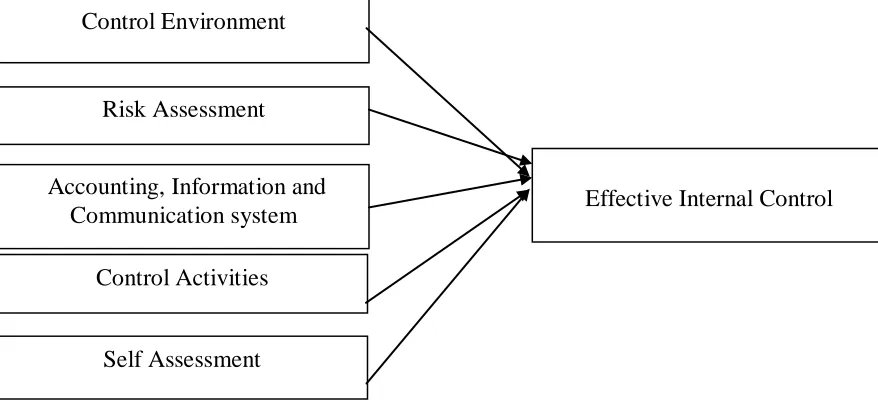
Figure 3.1: Conceptualization Framework
(Source: Developed for the Research purpose)
Operationalization of Variable
Table.3.1 (Operationalization Of variable)
Concept Variable Indicator Measurement
Effectiveness of Internal control
Control Environment
Effective policies and practices for human resources.
Authority and responsibility that is clearly defined.
Organizational structure that enables the management of the bank.
Questionnaire 5 Point Scale
An introduction of new or expanded business lines, product activities. An introduction of new technologies. New or a revised information system. A change in staffing either through reassignment or new employees.
A change in a bank’s operating Questionnaire
Control Environment
Risk Assessment
Accounting, Information and
Communication system
Control Activities
Self Assessment
[image:8.612.53.492.268.468.2]Risk Assessment environment. 5 Point Scale Accounting, Information
and Communication system
Accounting.
Information systems.
Communication systems.
Questionnaire 5 Point Scale
Control Activities
Operational performance.
Information processing.
Physical controls.
Segregation of duties.
Questionnaire 5 Point Scale
Self assessment
Continuous assessments. Documentation.
Verification.
Questionnaire 5 Point Scale
Effectiveness of internal control
Scope of responsibilities of the accounting and financial reporting.
Accounting rules and procedures.
Reliable accounting and financial information.
Questionnaire 5 Point Scale
(Source: Developed for the research Purpose)
Research Design
This study is based on measure the effectiveness of internal control system. Research design concern with the followings,
I. Sampling criteria & size of sample. II. Data collection instruments. III. Measure for all variables. IV. Data analysis techniques.
Sample.
The sample for this study is consisting the list of permanent employees, namely, District Manager, Manager, Assistant manager, Executive Officer, Junior Executive Officer and Staff Assistant in the Private Banks of Trincomalee in which researcher intends to select the sample.
Sample Selection.
The researcher was selected private banks in Trincomalee. These selected banks are Hatton National Banks, Commercial bank, Seylon bank, Pan Asia, DFCC, Housing Development Bank, Union Bank, National Development Bank , Nations Trust
Bank and Sampath Banks include 130 permanent employees and it is taken as same as the sample size. Sample size for each bank will be illustrated in the figure bellow.
Table: Sample
Name of the Bank No of Employees(population)
Hatton National Banks
27
Commercial bank 16
Seylon bank 11
Pan Asia 11
DFCC 16
Housing
Development Bank
Union Bank 08
National
Development Bank
08
Nations Trust Bank 11
Sampath Bank 10 Total 130
(Source: Develop for the research purpose)
Methods of Data Analysis and Evaluation.
• Five point Likert Scale
In this research one of the ordinal measures called “Five Point Likert Scale” was used. A likert scale consist of a series of evaluative statements concerning an attitude object; respondents are asked to rate the object on each statements using a five point as follows.
Strongly agree 1
Agree 2
Neutral 3
Disagree 4
Strongly disagree 5
By using this scale, it will be easy to find out which factors affect for Effectiveness of the internal control system.
Based on the values indicated in the questionnaire a mean value for each question is calculated.
XI= Mean value of variable. I=1, 2, 3, 4, 5
X1 = Mean value Control Environment. X2 = Mean value Risk Assessment.
X3 = Mean value Accounting, information and Communication systems.
X4 = Mean value Control Activities. X5= Mean value self assessment.
The value of each respondent for a variable is compared with the mean value. Therefore the decision rule can be formulated as follows.
Decision Criteria Decision Rule
1) 1 ≤ Xi ≤ 2.5 Factors highly supportive to Internal Control Systems.
2) 2.5 < Xi ≤ 3.5 Factors moderately supportive to Internal Control System.
3) 3.5 < Xi ≤ 5 Factors low supportive to Internal Control System.
• Univariate Analysis
Univariate analysis is the simplest form of quantitative (statistical) analysis. The analysis is carried out with the description of a single variable and its attributes of the applicable unit of analysis. Univariate Analysis describes the pattern of response to the variable and describes each variable on its own. Univariate descriptive statistics can summarize large quantities of numerical data and reveal patterns in the raw data.
IV. DISCUSSION
Research Information Discussion
Under this study, researcher has analyzed effectiveness of the internal control system of Private bank based on the independent variables; such as control environment, risk assessment, accounting, information and communication, control activities and self assessment. These variables are analyzed based on the univariate analysis such as standard deviation, mean, charts and percentages.
Discussion on control environment
In discussion on control environment variable, it has 2.96 mean value that is moderately supportive to effectiveness of internal control system in private bank. It can be conclude that the control environment within private bank is in moderate level of effectiveness as there are 90 employees fallen under moderately supportive level. On the whole this can be concluded that the overall awareness of management to build appropriate environment within the bank to implement control activities is in moderate level including implementing policies and practices for human resource management and giving authority and responsibilities to the right persons at right time to carry out the banking activities.
This says that bank circulars may not be properly reviewed and not be made available to the employees for the regular exposure. The internal control policies do not promptly communicate to all the employees and their subsequent changes. As there is lack of staff organizational structure may not clearly define the responsibilities and authorities to be carried out by the each staff.
Discussion on Risk Assessment
In the discussion on the risk assessment variable it is observed that it has a mean value of 3.05 and 100 respondents have given their responses moderately. That means evaluating the risk when planning and approving new products or activities, using of new technologies such as laser lamps, cash counter machines, security system for computers, adequate training programmes to the employees and job rotation procedure among employees would be in the moderate level of effectiveness. That cannot say that those procedures have not been implemented fully within the bank but there may be some deviations in the implementation. According to the discussions held with management, it can be concluded that although there are some risks in assessing the procedures when introducing new products or services those are not controlled by the bank and implemented regularly within the bank. Through observation by researcher, it can be said that there is no sufficient trend in using new technological measures such as laser lamps, cash counting machines etc and bank is not tend to give training programmes on their own to the employees except other common programmes.
Discussion on Accounting, information and communication
that accounting, information and communication procedure is in moderate level of effectiveness. This implies that accounting procedure within the bank, technological measure adopting in the bank security such as alarm bell on safes, technological failures prevention, convenience of communication method implementation around the bank such as weekly meetings, memos, intercom system etc, and line management accountability are in moderate level of effectiveness.
Through observation and discussion with managers by the researcher it can be said that, information and communication system is in lower level since these banks still look forward to adopt new technological measures on information and communication system. These banks are not profit oriented and they try to involve in contributing the development in the country and they are not much concern with competitiveness in the banking sector.
Discussion on Control Activities
When considering control activities variable it has 2.97 mean value and 87% of respondents have accepted that control activities within the bank is in moderate level of effectiveness. This refers to the moderate level of effectiveness in the aspects of employees’ performance review and documentation, policies and procedures for approvals and authorization of transactions, internal audit procedure, segregation of duties and physical controls.
Through survey data, observation and discussions held by the researcher, it can be said that although there are segregation of duties, operational performances, physical controls and information processing within the bank, it has some deviation in implementing the regular performance such as engaging in periodical external and internal auditing procedures and ammending the errors at the time of regular review.
Thus according to the survey data it can be said that existing control activities within the bank is not in a satisfying effective level that is to say that all the personnels are not aware of all the banking activities, existing proper policies and procedures to conduct activities.
Discussion on Self assessment
In discussion of self assessment variable in the Univariate analysis it has 3.12 of mean value and 95% of respondents have accepted that self assessment procedure within the bank is in moderate level of effectiveness. In other words continuous assessment, documentation and verification are in moderate level of effectiveness. The reason for this condition the training programmes for employees, proper checking procedure on all vouchers and other documents, proper key handling procedure, pass word renewals systems are not properly practiced.
They are not giving prominent concern on pass-word usage in computers and proper key control system in the bank and to have continuous check on them. To achieve higher effectiveness of self assessment, the necessity of employees training should be taken in to the consideration, proper documentation, bottom level management should go under the supervision of top level management regularly etc.Self assessment is review by themselves on their system and take corrective actions, it should be a proper procedure as it will be more helpful in achieve an effective internal control system.
Discussion on overall variables
Overall discussion on independent variables means that concerning the all independent variable as whole. The overall analysis has 3.05 mean value and 100% of respondents are accepting that all variables support moderately in effectiveness of internal control system. That refers that all independent variables as one variable and support moderately in the effectiveness of internal control system.
In this case it should concern on all independent variables same at once. For example it cannot achieve good internal control system only having good control environment within the bank but it should concern on accounting procedures, communication process within the bank and should implement good self assessment process etc to achieve good internal control system in the bank.
V. CONCLUSIONANDRECOMMENDATIONS The main purpose of this chapter, Conclusion and Recommendation is giving summary of entire findings on the research based on the chapter Data Analysis and Presentation. And further, researcher will suggest recommendation to implement in the bank to enhance the effectiveness of the internal control system in the Private Bank at Trincomalee District.
Conclusion
The Study on effectiveness of the internal control system in Private Bank was based on the independent variables; control environment, risk assessment, accounting, information and communication, control activities and self assessment. In the univariate analysis of data, control environment that is organizational structures, policies and practices for human resources, authority and responsibility of private bank is in moderate level of effectiveness.
Then concerning the risk assessment, that means introducing new product lines or services, introducing new technologies, new or revised information system, change in bank operating environment and change in staffing etc are in moderate supportive in effectiveness of internal control system. Risk assessment refers to give attention on present, past as well as future banking activities to evaluate their results and take necessary steps to correct them if there is any deviations and prevent to occur them again and should build a bank environment which can be faced competition well.
Accounting, information and communication variable is moderately supportive in the effectiveness of internal control system. This variable indicates the accounting, information system and communication system within the bank. That means bank has proper, timely reporting accounting method, sound information system over the bank to prevent frauds and errors, convenient communication system which enable to communicate over the bank immediately to overcome problems.
it includes operational performances, information processing, physical controls and segregation of duties
In the consideration of self assessment variable, it is fallen under moderately supportive in the effectiveness of internal control system. There 95% of respondents have accepted that self assessment is in the moderately supportive category. Self assessment is a review of banking activities it includes continuous assessment, documentation and verification.
In the overall analysis, all variables are moderately supportive in the effectiveness of internal control. That is five independent variables are moderately supportive in the effectiveness of internal control. And all respondents have accepted that independent variables are in the moderate level. This study “Effectiveness of Internal Control system in Private Bank” was based on the independent variables; control environment, risk assessment, accounting, information and communication, control activities and self assessment but the effectiveness of internal control system affected by some other unexplained factors such as time framework that is minimum time taken by the bank to correct the errors or frauds occurred in the bank, effectiveness of the resource utilization within the bank that is utilize resources by minimizing wastages and optimally use resources etc.
Recommendations
Control environment mainly focus on policies and procedures on human resources, authority and responsibility and organizational structure. Following recommendations are suggesting enhancing the effectiveness of internal control.
Private bank consist of three commercial bank branches, two Hatton national bank branches , two Seylan bank branches and one nation trust bank branch. Thus these all banks could establish an internal control council to act upon internal control of these banks and they should revise and approve periodically at least per year. All the policies and procedure on each and every activity such as loans, pawning, deposits, human resources management etc implemented. It should be approved by the council on internal control of the Regional Development bank. Internal control policies should be changed frequently base on changing business environment especially for human resources such as for employees’ recruitment, socialization programme, probationary period, training programmes etc and there should be a separate section for dealing with this. That section should be have continuous evaluation of existing policies and procedures. It should be taken corrective actions if there are any deviations and they should be approved by the council. According to the changes in internal control policies, it needs to evaluate the employees that how they adopted the changes, what are the problems they are facing with changes and should take solutions to correct them.
From the survey data and discussion, the researcher has found out that there is no proper method to communicate internal control procedures to employees. If it is possible to publish a manual which could be used to every employee at any time including short and long term objectives and strategic within the bank, internal regulations are providing detailed description of functions, obligation and responsibilities of employees, flow of reporting and communication, procedure for accounting at least
annually. It will help to functioning the banking activities to the employees specially newly recruited ones.
Risk assessment is a process to identify and analyze various risks, which can prevent bank to realize them. Following suggestions that bank is not familiar with, are making to prevent risk that might be occurred. The researcher has found out that there is no frequent and regular review policies and procedures established on loans and other banking activities. Thus it is need to be appointing a committee or a person to evaluate and verify the deposits, loans and lending with the view of timely identify the problems. According to observation two people share one cash machine and printer or in some banks all the counters have one cash machine. Therefore it needs to give cash machine and printer to each and every teller.
Scanned /lesser signature should be checked every withdrawal and in the case of change in the signature it needs to verify. No cameras could be found and it needs to fix the cameras to observe the daily entrances and exits of the customers. According to observations, it is found out that securities are appointing by outside companies in contract basis. But it needs to appoint securities recruited by bank under some training on banking activities. Training programmes, workshops need to plan for employees, based on the internal control policy changes and changes in business environment. Job rotation should be proceeding in specific period in same management level effectively under the top level management supervision. Accounting, information and communication are the systems that can be used bank personnel to perform their tasks. Following are some suggestions which made by researcher to implement in the bank. Researcher found out that some banks are not operated emergency alarm bell and those operated alarm bells are not inspecting their operations. Therefore it need to fixed emergency alarm bell and already fixed should be inspected their operations.
Technical officer should appoint to every branch to evaluate the technical condition of whole system to prevent the technical failures. It needs to provide intercom phones to Assistant manager, Executive officers and staff assistants for efficient communication. The researcher has found through observation that some banks are not exhibit name boards to all relevant places except Manager’s office. Therefore it should exhibit relevant name board in the bank for the convenience of customers. And if it is possible to assign a person to direct customers at their entrance it will more helpful for customers. Control activities are policies and procedures those institute in the bank to direct bank personnel established under the control environment. Following recommendations are made by researcher base on the data collected to enhance their effectiveness of internal control system.
the progress. Divisional level management should review standard performance reports daily or weekly such as pawning section, loan section.
Employees should have proper knowledge on each and every person’s responsibilities and authorities. For example, in the authorization and approval procedure when manager is not available employee should have proper knowledge who is the second officer he/she can be reached.
In some banks, they do not have extra backup files except computerized files and manuals for every transaction. Thus it is necessary to keep backup files for every section’s transaction outside the bank to protect bank’s information from disasters. In my view internal audit procedure should function in specific time period as ongoing monitoring procedure in every branch. Through discussions researcher found out that internal control procedure done only by the necessity of Board of Directors (BOD) under the supervision of Head of internal audit in Regional offices. It is done annually or quarterly but only under the decision of BODs and internal audit. It is directly responsible for the top level management, but external audit is done annually by independent party. The specimen signature should maintain in a book for all officers by management in every branch to use in the case of verification of inter branch documents.
Self assessment is the process which intends to provide an oversight function in assessing the performance of bank’s control system. There are some suggestions made by the researcher to self assessment process based on the collected data. According to the survey data, researcher found out that counter officers not go under supervision when they are balancing their teller. Thus
counter officers should be gone under the supervision of senior management.
Not only the cash payments and receipts but also it should be gone under the supervision of physical aspects such as daily passbooks, assets, pawning documents etc and they should be incorporated with daily reports. Through the discussion the researcher found that pass-words for computers not frequently change in every branch such as front office, pawning section, loan section. Thus it needs to change frequently and different pass-words used in different sections. And it should be reviewed the key control procedure within the bank and should be changed the keys using in the bank, safes. Board of directors should active in approving and monitoring loan policies and practices, especially private bank is giving prominent place to give loans to Small and Medium Entrepreneurs. And in the loan review procedure it should consider on maturity limits, rate structure, and security requirements and also the adequacy of the loan documentation in the loan procedure and should monitor the borrower frequently after loan originated.
Current Status:
Currently the study has been successfully completed and awaiting for the publication in any Business and Management magazine or conference.
AUTHORS