Georgia State University
ScholarWorks @ Georgia State University
Women's, Gender, and Sexuality Studies Theses Institute for Women's, Gender, and Sexuality Studies
1-6-2017
"I Wanna Know Where the Rule Book Is": YouTube
as a Site of Counternarratives to Transnormativity
Jordan Forrest MillerGeorgia State University
Follow this and additional works at:https://scholarworks.gsu.edu/wsi_theses
This Thesis is brought to you for free and open access by the Institute for Women's, Gender, and Sexuality Studies at ScholarWorks @ Georgia State University. It has been accepted for inclusion in Women's, Gender, and Sexuality Studies Theses by an authorized administrator of ScholarWorks @ Georgia State University. For more information, please [email protected].
Recommended Citation
Miller, Jordan Forrest, ""I Wanna Know Where the Rule Book Is": YouTube as a Site of Counternarratives to Transnormativity." Thesis, Georgia State University, 2017.
“I WANNA KNOW WHERE THE RULE BOOK IS”: YOUTUBE AS A SITE OF
COUNTERNARRATIVES TO TRANSNORMATIVITY
by
JORDAN FORREST MILLER
Under the Direction of Megan Sinnott, PhD
ABSTRACT
In June 2015, Caitlyn Jenner created waves of excitement with her coming out
announcement on the cover of Vanity Fair: “Call me Caitlyn.” From the perspective of critical
trans politics, however, the heightened visibility of trans people in mainstream media does not
call for unequivocal celebration. Though trans women of color, such as Laverne Cox and Janet Mock, are more visible in mainstream media than ever before, mainstream media still largely depicts trans people through white constructs of what it means to be trans, namely medicalized
binary transitions. Many trans people who deviate from mainstream media’s depiction of trans
people are creating their own media on YouTube to voice their lived experiences. I argue that
while YouTube is a particularly accessible platform for trans people to challenge
transnormativity, the reach of trans YouTubers’ messages are highly limited by the medium’s design and genre conventions.
“I WANNA KNOW WHERE THE RULE BOOK IS”: YOUTUBE AS A SITE OF
COUNTERNARRATIVES TO TRANSNORMATIVITY
by
JORDAN FORREST MILLER
A Thesis Submitted in Partial Fulfillment of the Requirements for the Degree of
Master of Arts
in the College of Arts and Sciences
Georgia State University
Copyright by Jordan Forrest Miller
“I WANNA KNOW WHERE THE RULE BOOK IS”: YOUTUBE AS A SITE OF
COUNTERNARRATIVES TO TRANSNORMATIVITY
by
JORDAN FORREST MILLER
Committee Chair: Megan Sinnott
Committee: Amira Jarmakani
Julie Kubala
Electronic Version Approved:
Office of Graduate Studies
College of Arts and Sciences
Georgia State University
iv
ACKNOWLEDGEMENTS
Thank you to my thesis chair, Dr. Megan Sinnott, and committee members, Dr. Amira
Jarmakani and Dr. Julie Kubala, for their critiques, insightful questions, and humor.
Thank you to Dr. Peter Cava, who has provided encouragement, resources on developing
my ideas and organizing my writing, and input on early drafts of this thesis.
Thank you to my interviewees Ariel, Darnelle, Love Is Vulnerability, Melvin, Milo, and
Shaetanica for sharing your stories and experiences with me. I am thoroughly grateful for our
conversations and how each of you are willing to share your truths with the world. An extra
shout out goes out to Melvin for being so patient with my technical difficulties.
Thank you to Rebecca Finson for being there for reassurance and suggestions during my
final stretch toward completion of this thesis.
Thank you to the many lovely souls in my life who have provided me with invaluable
support over the past few years, including Candice Merritt, Charlie Clifton, Chris Kase, Christine
Copelan, Cinnamon Greer, Dandy Prinsloo, Jess Hurd, JoBeth Miller, Laci Lee Adams, LaTisha
Raulston-Sloderbeck, and September Noussé. Of course, I must also recognize my Mama,
Rebecca Wilson, for unconditionally loving me through all of my major life changes.
Lastly, thank you to my cat, Sirius, for making me laugh, especially when I need it the
v
TABLE OF CONTENTS
ACKNOWLEDGEMENTS ... iv
LIST OF FIGURES ... viii
LIST OF ABBREVIATIONS ... ix
1 CHAPTER 1: INTRODUCTION ... 2
1.1 “The Transgender Tipping Point” ... 2
1.2 Transnormativity ... 4
1.2.1 Transnormativity and The Political Economy of Trans YouTube ... 7
1.2.2 “The Danger of a Single Story” ... 10
1.3 Literature Review ... 15
1.3.1 Trans Studies: Who is Transnormativity Good for?... 15
1.3.1.1 The Medicalization of Trans Bodies ... 15
1.3.1.2 The Dangers of Overgeneralization and LGBT Rights Discourse ... 19
1.3.2 YouTube Studies: Making Sense of an Unstable Archive... 22
1.3.3 At the Intersection of Trans and YouTube ... 25
1.4 Methodologies and Methods ... 29
2 CHAPTER 2: FINDINGS ... 36
2.1 Strategies for Challenging Transnormativity ... 36
2.1.1 Broadening Scope ... 36
2.1.2 Broadening Use of Language ... 52
2.2 Obstacles to Challenging Transnormativity ... 61
2.2.1 Segmented Audiences ... 62
2.2.2 Tensions Between Gender and Sexual Minority Communities ... 67
2.3 Authenticity ... 76
3 CHAPTER 3: CONCLUSIONS ... 79
3.1 Significance ... 79
vi
3.3 Contribution ... 85
BIBLIOGRAPHY ... 86
vii
LIST OF TABLES
viii
LIST OF FIGURES
Figure 1: Caitlyn Jenner on cover of Vanity Fair ... 1
Figure 2: “5 Reasons Why Gay is NOT the New Black” ... 40
Figure 3: “Week 24 on T: Invisibility/Hypervisibility” ... 44
Figure 4: “MY SNAPCHAT MISTAKE!!!! THEY ALL KNOW IM TRANSGENDER NOW IF THEY DIDNT BEFORE” ... 47
Figure 5: “What To Say To A Transgendered Person feat. Davey Wavey | Darnelle Scott” ... 49
Figure 6: “All Cis People are Transphobic (And you’re probably racist, too!)” ... 53
Figure 7: “You don’t have to prove your gender!” ... 55
Figure 8: “I’m non-binary! What does it mean? (MTF Transgender)” ... 57
Figure 9: “Misgendering and/or Unfairly Dismissing People as Cisgender” ... 69
Figure 10: “Before and After MTF Transgender Veteran Transition Timeline 2015” ... 70
Figure 11: “Trans Issues w/ Milo Stewart, Blaire White & Shayrah” ... 72
ix
LIST OF ABBREVIATIONS
cis cisgender
DSM Diagnostic and Statistical Manual of Mental Disorders
F to M female-to-male
FTM female-to-male
GCS gender confirmation surgeries
HRT hormone replacement therapy
LGB lesbian, gay, and bisexual
LGBT lesbian, gay, bisexual, and transgender
LGBTQ lesbian, gay, bisexual, transgender, and queer
LGBTQ+ lesbian, gay, bisexual, transgender, queer, and other gender and sexual minorities
MTF male-to-female
POC people of color
SEO Search Engine Optimization
SNS social networking sites
trans transgender
UK United Kingdom
US United States
vlog video blog
1
2
1 CHAPTER 1: INTRODUCTION
1.1 “The Transgender Tipping Point”
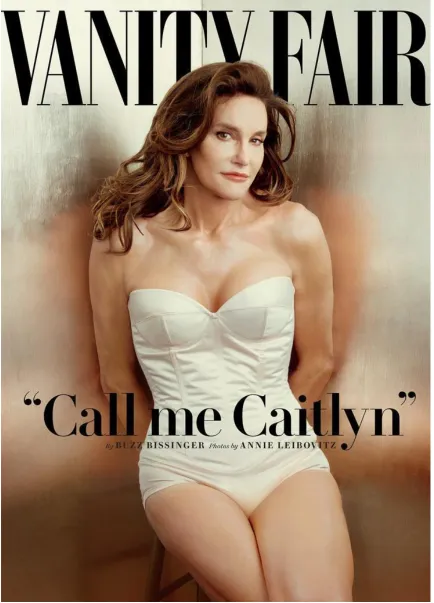
In June 2015, Caitlyn Jenner created waves of excitement with her coming out
announcement on the cover of Vanity Fair (Figure 1): “Call me Caitlyn.” From the perspective
of critical trans politics, however, the heightened visibility of trans people in mainstream media
does not call for unequivocal celebration. Mainstream trans visibility reinforces what could be
called transnormativity. Though trans women of color, such as Laverne Cox and Janet Mock, are more visible in mainstream media than ever before, mainstream media still largely depicts trans people through white constructs of what it means to be trans, namely medicalized binary
transitions.1Many trans people who deviate from mainstream media’s depiction of trans people are creating their own media on YouTube to voice their lived experiences.
YouTube’s capability for self-proclaimed expert, first-person, direct-address narratives
allows for audiences to view trans people expressing their own lived experiences and
perspectives, largely unfiltered by publishers, production agencies, and other gatekeepers. Trans
video blogs (vlogs) are predominantly recorded in private settings using a familiar “talking
torso” format, creating an intimate relationship between the creator and audience.2 Trans
YouTube users connect instantly through video posts, comments, likes, video replies, and
subscriptions to user channels and get involved with YouTube for a variety of reasons: to
1. Bernadette Barker-Piummer, “Fixing Gwen: News and the Mediation of
(Trans)gender Challenges,” Feminist Media Studies 13, no. 4 (September 2013): 710– 724, accessed August 14, 2016, http://dx.doi.Org/l 0.1080/14680777.2012.679289; Gordene Olga MacKenzie, Transgender Nation (Bowling Green, OH: Bowling Green State University Press, 1994), 103–39.
3
document the changing body, to offer advice/support, to be involved in queer/trans politics, as a
social activity, as a therapeutic tool, for recognition as trans, for knowledge sharing, for trans
community, and for the economic and career opportunities created by YouTube’s platform.3
Trans YouTubers’ experiences are recorded with one’s phone or webcam throughout one’s
day-to-day life and made readily available to viewers who previously may have been lacking in
access to positive trans representation. These videos have the potential to both provide support
for people questioning their gender identities as well as educate non-trans people on trans
realities beyond the physical; however, because white, binary, and medically transitioning trans
YouTubers remain the most popular within trans YouTube, it can be difficult for other narratives
to be heard.4
Through qualitative interviews with six non-white and/or non-binary trans YouTubers,
this thesis explores the value, and difficulty, of using the medium of YouTube to challenge
transnormativity. I argue that while YouTube is a particularly accessible platform for trans people to challenge transnormativity, the reach of trans YouTubers’ messages are highly limited by the medium’s design and genre conventions. Some of the limiting factors include the
privileged status of transnormative content, resistance to evolving language, divisions between trans communities, and how the visual medium of YouTube facilitates the scrutiny of trans bodies.
I will first elaborate on some key terms and concepts used throughout this thesis and then
demonstrate how this project fits within emerging trans YouTube scholarship.
4
1.2 Transnormativity
While the term trans is a fairly recent concept that, on the surface, tells us little about an
individual person’s understanding of their identity, life, or gender, trans as an umbrella term can
be politically useful in our fight to end “all discrimination based on sex/gender variance.”5 The
language trans people use to describe ourselves is widely contested within trans communities.
There are virtually limitless ways of experiencing gender and being trans, although not all of
these ways are validated by our culture at large.
If we break down the word transnormativity we have trans-, which leading scholar in
transgender studies Susan Stryker refers to as “people who move away from the gender they
were assigned as birth, people who cross over (trans-) the boundaries constructed by their culture
to define and contain that gender”6; normative, which is defined as “based on what is considered
to be the usual or correct way of doing something”7; and the suffix –ity, meaning “quality, state,
or degree.”8 Using these definitions, I consider transnormativity to be the quality, state, or degree
of being considered the usual or correct way of moving away from, or crossing the boundaries
of, the culturally defined gender one was assigned at birth.
The term transnormativity derives from concepts frequently discussed within queer and
feminist theory. Stemming from Adrienne Rich’s concept of compulsory heterosexuality in
5. Julia Serano, Whipping Girl: A Transsexual Woman on Sexism and the Scapegoating of Femininity (Emeryville, CA: Seal Press, 2007), 26.
6. Susan Stryker, Transgender History (Berkeley, CA: Seal Press, 2008), 1. 7. “Normative,” Merriam-Webster Online, accessed March 4, 2016,
http://www.merriam-webster.com/dictionary/normative.
5
19809 and Gayle Rubin’s distinction between sex and gender in 1984,10 Michael Warner
popularized the term heteronormativity in 1991 to describe the process by which heterosexuality
is normalized.11 Lisa Duggan then popularized homonormativity: “a politics that does not contest
dominant heteronormative assumptions and institutions, but upholds and sustains them, while
promising the possibility of a demobilized gay culture anchored in domesticity and
consumption.”12 As a political strategy for acceptance within dominant discourse,
homonormativity enforces normative notions of coupledom, race, class, gender, and ability for
the homosexual or queer subject.
Aspects of transnormativity having to do with both the trans individual and trans politics
have been studied. Evan Vipond explained that “to be transnormative” is to be trans and be
placed into “hierarchal categories based on social definitions of ‘normal,’” namely “white,
middle class, mentally and physically able, heterosexual, and… normative notions of gender
(masculine man and feminine woman).”13 Currah and Moore used the term trans-normative to
describe “a transgender rights framework demanding inclusion and recognition within the
9. See Adrienne Rich, “Compulsory Heterosexuality and Lesbian Existence,” Signs: Journal of Women in Culture and Society 5, no. 4, Women: Sex and Sexuality (Summer 1980): 631–60.
10. See Gayle Rubin, “Thinking Sex: Notes for a Radical Theory of the Politics of Sexuality,” in Culture, Society, and Sexuality, 2nd ed., ed. Richard Parker and Peter Aggleton (New York: Routledge, 2007), 150–87.
11. See Michael Warner, “Introduction: Fear of a Queer Planet,” Social Text, no. 29 (1991): 3–17, accessed March 7, 2016, http://www.jstor.org/stable/466295.
12. Lisa Duggan, “The New Homonormativity: The Sexual Politics of Neoliberalism,” in Materializing Democracy: Toward a Revitalized Cultural Politics, ed. Russ
Castronovo and Dana D. Nelson (Durham, NC: Duke University Press, 2002), 179. 13. Evan Vipond, “Resisting Transnormativity: Challenging the Medicalization and
6
institutions, norms, and arrangements structured around gender.”14 Similarly, Vipond defined
transnormativity as “the normalization of trans bodies and identities through the adoption of
cisgender institutions by trans persons.”15 I believe transnormativity to be a systemic process by
which a hegemonic trans narrative is created and then used to inform trans people of the correct
ways we should look, think, and behave. To better understand how the visual medium of
YouTube functions, I have focused on aspects of transnormativity having to do with trans
embodiment in relation to the norm, as well as transnormativity as a politics of inclusion.
Regardless of which aspects of transnormativity one analyzes, it is clear that trans individuals
who fit the most within accepted transnormative narratives have privileged status within US
culture.
We as individuals hold varying degrees of power with which we can create, reinforce,
and disrupt transnormativity through our language and actions. Transnormativity is the result of
the stigmatization of those who deviate from societal norms. The negative consequences of
deviating from transnormativity can include social estrangement, religious condemnation, an
increased risk of violent hate crimes and street harassment, police violence, loss of familial and
community support, and institutionalized discrimination in health care facilities, prisons,
housing, and the workplace.16 Another negative result of transnormativity is the perception that
14. Paisley Currah and Lisa Jean Moore, “‘We Won’t Know Who You Are’: Contesting Sex Designations in New York City Birth Certificates,” in The Transgender Studies Reader 2, ed. Susan Stryker and Aren Z. Aizura (New York: Routledge, 2013), 609. 15. Vipond, “Resisting Transnormativity,” 24.
16. Judith Butler, Undoing Gender (New York: Routledge, 2004), 3; Stryker,
7
there are acceptable and non-acceptable ways of being trans, thus privileging any one kind of
trans person over other ways of being trans. The oppressive systems, including racism and
misogyny, underlying transnormativity need to be dismantled. YouTube is one such medium
where trans people are challenging their audiences’ preconceived notion that the presumed usual
way of being trans equates to there being a correct way of being trans.
1.2.1 Transnormativity and The Political Economy of Trans YouTube
After the Google enterprise purchased YouTube for $1.65 billion dollars in November
2006, the site quickly became popular in the US, Britain, and before long, on a global scale.
Primarily branded as “Your Digital Video Repository,” YouTube distinctively, as compared to
earlier but similar sites that were unsuccessful, allowed for viewing, sharing, and finding video.
Now advertised as a site to “Broadcast Yourself,” YouTube offers social networking features
that encourage auditory, textual, and visual viewer participation.17 In part because of the intimate
capability of YouTube, trans YouTube vlogs are particularly relevant cultural artifacts for
studying how new media “have been sites for the construction and deconstruction of gendered
and racialized narratives.”18
Based on the relationships between personal motivations and the practicality of being
active and visible on YouTube expressed by the participants in this study, it is clear that trans
YouTubers are entangled with various aspects of and relationships to economics, power, and
17. Jean Burgess and Joshua Green, YouTube: Online Video and Participatory Culture, (Cambridge, UK: Polity Press, 2009), 1–10; Paul Soukup, “Looking at, with, and through YouTube,” Communication Research Trends 33, no. 3 (September 2014): 3. 18. Peter Cava with David Jacobsen, “‘Our Lives Are Normal Now’: Contemporary
Trans Documentary Film and the Feminist Classroom,” Films for the Feminist
Classroom 5, no. 1 (Spring 2014), accessed December 6, 2015,
8
oppression.19 Trans YouTube interestingly comprises a “social hybrid economy” of content
produced by major media corporations and user-generated content.20 As opposed to studying
mainstream media (where consumers have little say regarding the production), it seems that the
trans YouTuber has power over their own cultural productions, as producers do, in theory, retain
ownership over their content. 21 However, user-generated content still must function within the
larger media system of YouTube, whose ultimate aim is to monetize content.22
While YouTube is advertised as a democratic platform to “Broadcast Yourself,” the
rhetoric of platform is directed toward advertisers, major media producers, and policymakers as a
strategy to generate profit.23 Videos that generate the most profit are the most visible. For
example, when searching transgender on YouTube, one must sift through pages of videos from
Buzzfeed, ABC News, Entertainment Tonight, National Geographic, Cosmopolitan, and other
major media publications before one reaches the majority of user-generated trans content, most
of which does not generate revenue for YouTube. Narratives that enforce the idea that all trans
people feel like they were “born in the wrong body” are popular in mainstream discourse
regarding trans people and rarely interrogate or provoke further conversation about one’s
19. Nicholas Garnham, “Political Economy and Cultural Studies: Reconciliation or Divorce?” Critical Studies in Mass Communication 12, no. 1 (March 1995): 62–71; Kellner, “Cultural Studies,” 9–20.
20. Wasko and Erickson, “The Political Economy of YouTube,” 378. 21. See YouTube’s “Terms of Service,” https://www.youtube.com/t/terms.
22. Eggo Müller, “Where Quality Matters: Discourses on the Art of Making a YouTube Video,” in The YouTube Reader, ed. Pelle Snickars and Patrick Volderau (Stockholm: National Library of Sweden, 2009), 136; Kellner, “Cultural Studies,” 7; Wasko and Erickson, “The Political Economy of YouTube,” 377.
23. Tarleton Gillespie, “The Politics of ‘Platforms,’” New Media & Society, 12, no. 3 (May 2010): 352–55, accessed January 9, 2016,
9
preconceived notions of gender, sex, and sexuality or one’s relationship to power, privilege, and
oppression.
One key way YouTube’s design limits the reach of one’s messages is through its Search
Engine Optimization (SEO). Because of the design and functionality of YouTube’s search
parameters, users gravitate toward transnormative content. YouTube’s SEO is based on a
complicated algorithm of audience retention, views, likes and dislikes, subscriptions after
watching, comments, shares, favorites, and description, tags, and title.24 While some strategies
like consistently tagging terms, such as “non-binary” or “black ftm,” can help users seeking
specific resources, the likelihood of greater visibility is connected to one’s monetary
compensation for videos, available free time to create videos, and access to technology that
enhances the sound and picture quality of one’s videos.
Though it fairly uncommon, many trans people have successfully supplemented or
supplied their income through YouTube partnerships and affiliation donation sites. YouTube in
often used in conjunction with sites like Patreon, where patrons can pledge donations in
exchange for exclusive content and other creative projects or Society 6, where YouTuber’s
commission their artwork. Due to the fact that she does not “put enough energy into that
direction,” Patreon donations to one of the participants in this study, Shaetanica, have been few;
however, they have afforded her a new webcam for making YouTube videos. One trans
YouTuber, Kat Blaque, receives $857 a month from Patreon donations in addition to the funding
she receives directly from her YouTube partnership, which allows her to continue to create
illustrations and collaboration videos. Additionally, many trans YouTubers have successfully
10
used YouTube in conjunction with YouCare, GoFundMe, Kickstarter, or Indigogo to crowdfund
for their medical transition.25
While many trans people have utilized YouTube to benefit themselves financially in some
way, maintaining a YouTube channel is, for most, unpaid work. Thus, popularity is in many
ways connected to one’s class privilege. Consequently, many trans YouTubers must find a fine
balance between their desire to be active on YouTube while still preserving their life offline.
Depending on the content of one’s video, vlogs may require more or less time and energy for
preparation and editing. Many of the participants in this study noted that although novice skills
are needed to maintain a largely unedited vlog where one essentially records zirself discussing a
certain issue or sharing aspects of hir life for hir audience, audience retention seems to increase
for more heavily edited videos recorded with more expensive equipment and viewership seems
to increase when one is able to upload more videos. These practical matters work against many
YouTubers who deviate from transnormative narratives.
1.2.2 “The Danger of a Single Story”
While trans YouTube videos created by white binary trans people on the topic of medical
transition have been a great resource for many medically transitioning trans people, the lived
experiences of trans people show that this single trans narrative is an unfair generalization that
creates unrealistic and often damaging expectations. Laura Horak, professor of Film Studies at
Carleton University, described the temporality of many trans YouTube vlogs as operating in
“hormone time,” where time begins the day one’s medical transition begins and is “measured
11
against that date, even years afterward.”26 Trans people often employ a common script—it
begins with an expression of knowing they were trans from an early age, of being unhappy about
being trans, of feeling they were “born in the wrong body,” of suppressing their beliefs about
zirselves, and then it evolves to an eventual coming out and deciding to medically transition to
the “other gender.” This medical intervention is more often than not expressed as a life-or-death
step to achieving happiness. For example, one female-to-male (FTM) trans YouTuber expressed
being disappointed because he felt the medical community had “sold to him” the idea that once
he starting taking testosterone, he would immediately “find congruence” and his body would “do
this song and dance.”27 Other trans YouTubers have expressed that they do not feel their
transition is happening fast enough or well enough compared to other trans vloggers’ transitions.
These sorts of pressures and harmful comparisons to other trans people both create and reinforce
a transnormative narrative that says to be “properly trans,” one must medically transition.
In her TEDTalk titled, “The danger of a single story,” novelist Chimamanda Ngozi
Adichie spoke about the unintended consequences of reading only British and American
children’s books as a young child in Nigeria. Before she realized that literature could, in fact,
contain characters that reflected her skin tone, her hair texture, and her life experiences, she
believed that “books by their very nature had to have foreigners in them and had to be about
things with which [she] could not personally identify.” Adichie named several other single story
narratives given to groups of people: the poverty-stricken family of her family’s domestic helper,
the African in need of a kind, white foreign savior, the abject immigrant, the abusive nature of
Nigerian men. As Adichie explained, “[t]he single story creates stereotypes, and the problem
26. Horak, “Trans on YouTube,” 579.
12
with stereotypes is not that they are untrue, but that they are incomplete. They make one story
become the only story.”28 Many trans people, such as my interviewee Darnelle, do relate to the
common “transsexual narrative” or “born in the wrong body” expression on some level;
however, these ways of understanding trans identities should not be seen as the one, true, or
correct way of being trans, as there is no one, true, or correct way of being trans.
Contrasting mainstream media’s limited coverage of trans lives, trans people’s stories are
readily available on YouTube to anyone with internet access. YouTube is a user-friendly
medium where trans people who deviate from transnormativity can both fill the void of
trans-produced media and find personal enjoyment and empowerment in doing so. By sharing intimate
details of their personal experiences and struggles, both directly and indirectly related to their
trans identity, trans people who choose to be visible on such an accessible medium are “paying it
forward” to the other trans and queer people who can benefit from seeing possibility models who
they can relate to and can aid in their self-understanding.
The platform of YouTube restricts deviations from transnormativity, as transnormativity
on YouTube is rewarded with popularity and more outward signs of support. Non-white and
non-binary YouTubers often challenge popular trans discourse with their attempts to broaden the
ways we understand issues affecting trans lives. While many non-binary trans YouTubers use
their channel to broaden the language we use around gender, trans YouTubers of color are
educating audiences on trans issues by expressing their lived experiences within a culture of
white supremacy. In an age of increasing use of social media as a news source, these
28. Chimamanda Ngozi Adichie, “The Danger of a Single Story,” TedGlobal 2009, July 2009, accessed May 5, 2016,
13
conversations are especially valuable.29 That being said, the visibility that comes with having a
YouTube channel devoted to sharing one’s personal experiences being trans can be a quite
vulnerable position to put oneself in. For instance, attempts to discuss alternate ways of
understanding the concept of trans have been met with hostility. These sorts of reactions can be
especially disheartening when coming from other people who identify with a gender or sexual
minority. Several of the participants in this study highlighted the difficulty of mentally sustaining
a YouTube channel in which one challenges transnormativity and is met with personal attacks or
complete dismissal of one’s intended message.
Many trans YouTubers who are not white, do not identify within a male/female binary, or
are not currently undergoing medically transition cannot readily see their experiences being
represented in mainstream media, so some begin their YouTube channels as a way to find
connection in community. Based on my interviews, it seems many trans YouTubers outside of
the categories of white, binary, and medically transitioning actually facilitate in the creation of
the very communities they sought to be a part of. There seems to be little communication
between different kinds of trans people, likely because trans people are seeking support from
other trans people who reflect themselves. In other words, trans YouTube audiences are largely
segmented into different niches, much like the offline “trans community” comprises an
29. Jeffrey Gottfried and Elisa Shearer, “News Across Social Media Platforms 2016,” Pew Research Center: Journalism & Media, May 26, 2016, accessed August 16, 2016,
14
immeasurable number of smaller trans communities.30 The segmentation of trans YouTube
audiences is reinforced by YouTube’s suggested videos, leading one to continue to find videos
within one’s own niche unless one is specifically seeking to find alternate narratives. This
segmentation can be useful for locating relevant resources; however, because these non-white,
non-binary, and non-medically transitioning trans narratives often become lost within trans
YouTube as a whole, it is less useful for YouTubers aiming to challenge transnormativity for a
broad audience.
Trans YouTube vlogs, specifically, emphasize the physical body of the YouTuber.
Consequently, many viewers overly fixate on physical appearance and are unwilling or unable to
engage in deeper discussions around transness. This is not always a malicious act; many viewers
have genuine interest or concern about the physical aspects of being trans or transitioning.
Others, however, take advantage of the visual image YouTube provides and choose to scrutinize
the YouTuber.
Though it is not yet commonplace, there is an increasing trend of collaborations within
trans YouTube across race, gender identity, sexuality, disability status, and geographical
locations. For instance, Milo, a participant in this study, has collaborated or live-streamed with
vloggers who identify as transfeminine, non-binary, gay, visually impaired, and indigenous.
Likewise, another participant, Darnelle, has collaborated with a white, cis gay man.
Collaborations such as these foster coalition building between trans communities and other
15
marginalized groups of people. As trans representation on YouTube provides a rich source of
insight into the study of trans cultural production, new media, and the future of trans advocacy,
this thesis can be of especial use to trans activists, trans YouTubers, sociologists, and scholars of
gender and media studies.
To better situate my argument about transnormativity, I have reviewed the relevant
literature in the fields of transgender studies, YouTube studies, and at the intersection of these
two fields.
1.3 Literature Review
1.3.1 Trans Studies: Who is Transnormativity Good for?
To best understand how transnormativity in the United States has been created, it is
useful to first have a better understanding of the general conversations around transnormativity
within the rapidly growing field of transgender studies. Theorists such as Sandy Stone, Dean
Spade, Dan Irving, Susan Stryker, and Evan Vipond have argued against transnormativity in
medical discourse. Many trans activists and scholars, such as Morgan Bassichis, Alexander Lee,
Dean Spade, and Micah Bazant have proposed strategies to resist transnormativity and recognize
the effects of white privilege within activist movements.
1.3.1.1 The Medicalization of Trans Bodies
Transnormativity within medical discourse gains power primarily from non-trans service
providers who not only create obstacles to achieving desired bodily modification but do not yet,
as Spade articulately stated, have “a commitment to gender self-determination and respect for all
expressions of gender.”31 Many trans people, often for fear of being denied access, choose to
adopt the pre-scripted “transsexual narrative” in order to be granted approval for “treatment.”32
16
Trans people, if they desire to change their secondary sex characteristics and/or identification
records to match their desired gender identity and presentation, must navigate a highly restrictive
medical and legal system in order to achieve their aims. In the United States, the decision to
transition hormonally or surgically is controlled through the gatekeeping of therapists,
psychiatrists, doctors, and surgeons.33 The gatekeeping of county lawyers, local government
offices, and the state similarly constrains name and gender marker changes on driver’s licenses,
passports, birth certificates, and other forms of personal identification. Many insurance
companies deem surgeries for trans people “cosmetic” or “elective,” even if one sufficiently
demonstrates the Diagnostic and Statistical Manual of Mental Disorders’ (DSM-V) criteria for
gender dysphoria.34 The medical and psychological establishment presents a double-bind for
trans people desiring access to medical technologies. Through the repetitive acts of both trans
people reciting an often untruthful or oversimplified narrative of their experience to medical
professionals and medical professionals pathologizing transsexuality as an illness in need of a
cure, normative gender and gender expression is further defined based on perception and thus
able to be regulated.
Through its limited medicalized binary portrayal of trans people, mainstream media
disseminates messages that reflect the medical gatekeeping model within which trans people
must function as fact. Transnormativity in mainstream media perpetuates the pathologization and
medicalization of trans bodies, the notion that to be transgender is to be “sick” and thus in need
33. Spade, “Mutilating Gender,” 319.
34.American Psychiatric Association, Diagnostic and Statistical Manual of Mental
Disorders, 5th ed. (Washington, DC: American Psychiatric Publishing, 2013);
Stryker, Transgender History, 6–7, 112; Dean Spade, “Resisting Medicine,
Re/modeling Gender,” Berkeley Women’s Law Journal 18, no. 1 (September 2013): 16–26, accessed October 5, 2015,
17
of treatment. As Vipond has explained, “this model relies on medical practitioners being deemed
‘experts’ in the field of transsexuality, while trans persons zirselves are seen as uninformed
patients.”35 As trans people are already in a vulnerable position within institutions which strictly
enforce binary ways of thinking about gender, this transnormative script especially affects the
most marginalized trans people who are always already othered and seen as deviant: people of
color, androgynous people, those with illnesses or disabilities, indigenous people, sex workers,
poor and impoverished people, immigrants, those incarcerated or in mental institutions, homeless
people, and youth.36
In “The Empire Strikes Back: A Posttranssexual Manifesto,” Sandy Stone critiqued early
male-to-female (MTF) transsexual autobiographies for invoking problematic elements of
medical discourse about transsexuality in order for their histories to be read as plausible, for their
bodies to be read as culturally intelligible, or for acceptance as “natural” members of the gender
they identify with. Dean Spade, similarly, has considered how the medical approach to gender
variance and the creation of transsexuality work to maintain normative notions of gender and
gender expression. The existence of a monolithic transsexual narrative, in part due to trans
people strategically describing transness as being “born in the wrong body,” has prevented a
deeper analysis of the often contradictory “ambiguities and polyvocalities” of trans lived
experiences, ultimately limiting the ways gender variant people can express their desires and
identities.37
35. Vipond, “Resisting Transnormativity,” 33.
36. Spade, Normal Life, 13; Irving, “Normalized Transgressions,” 24.
18
Ensuing from the work of Stone and Spade, Canadian political scientist Dan Irving
analyzed how the construction of transsexual subjectivities by early medical experts, early trans
theory, as well as contemporary trans activism has not only reinforced dominant and exploitative
class relations but has constructed the “transgender working body” as an assimilationist tool for
gaining civil rights. Irving stated, “to move toward achieving social recognition, the transsexual
body must constitute a productive working body, that is, it must be capable of participating in
capitalist production processes.”38 The transsexuals’ worth, consequently, is determined by their
capacity to be a “transgender working body,” which is largely decided by one’s class privilege,
or lack thereof.39 In Season 1 Episode 3 of I Am Cait, Caitlyn Jenner illustrated Irving’s concept
of the “transgender working body” well. She stated, “Blossom [a Black trans woman featured on
her show] just wants to make this world a better place, and with help from friends, you can kind
of conquer the world. You can go out in to the world and be accepted and be understood and be a
productive citizen.”40 Through her repeated insistence that what hinders trans people from
acceptance into society is seeing trans people as “normal human beings,” Jenner represents one
example of how the rhetorical use of wanting to be seen as “normal citizens” is heavily informed
by one’s privilege within society. This sort of tactic (largely used by privileged trans people),
Irving argued, has only further excluded those on the margins.
While insufficient consideration has been given to the gatekeeping role of non-trans book
publishers and audiences in the processes behind which trans stories are able to be published as
autobiographies and which remain unspoken,41 I am particularly interested in further challenging
38. Irving, “Normalized Transgressions,” 17. 39. Irving, “Normalized Transgressions,” 19.
40. I Am Cait, season 1, episode 3, “The Road Trip Part Two,” aired August 9, 2015, on E! Entertainment Television.
19
the role that gender and sexual minorities play in the creation and continuation of harmful
transnormative narratives.
1.3.1.2 The Dangers of Overgeneralization and LGBT Rights Discourse
By focusing their activism solely on a single issue (the oppression of homosexuals by
heterosexuals), the mainstream LGBT rights movement has largely oversimplified the
underlying causes of discrimination and prejudice affecting people of color and trans people.
This single-issue focus has ultimately created a more disparate hierarchy between gender and
sexual minorities with wealthy, able-bodied, neurotypical, white, cis, gay men maintaining the
most privileged position.42
Under the guise of buzzwords like “equality,” “multiculturalism,” and “diversity,”
mainstream LGBT activism has adhered to progress narratives whose goals have primarily been
to achieve hate crime legislation, marriage equality, representation, and visibility. Legislation
reform, such as the Matthew Shepard and James Byrd Jr. Hate Crimes Prevention Act of 2009,
the repeal of Don’t Ask Don’t Tell in 2011, the federal legalization of same-sex marriage in
2015, the 2016 repeal of the transgender military service ban, and the existing local and state
non-discrimination laws for sexual orientation and/or gender identity are a result of LGBT
activism. That being said, changes to the legislative system meant to benefit LGBTQ+ people as
a whole are highly limiting and do little to transform oppressive systems for queer and trans
communities, communities of color, and poor communities.43 Campaigns such as “It Gets
42. Serano, Whipping Girl, 108.
20
Better” and the Human Rights Campaign, while perhaps well-intentioned, are often misdirected
and lacking in a critical examination of whiteness, cisgenderism, and class.44
In addition to mainstream LGBT movements who marginalize trans people are queer and
trans communities that, instead of destabilizing the notion that there is a correct or true way to be
queer or trans, direct their energy toward shunning other queer and trans people’s gender
identities, gender expressions, or sexualities as inauthentic, inappropriate, fake, reinforcing
binaries, or not being queer, radical, or subversive enough.45 Julia Serano has named one aspect
of trans exclusion by other trans people subversivism, “the practice of extolling certain gender
and sexual expressions and identities simply because they are unconventional or
noncomforming.”46 This tactic is largely counterproductive. Instead of non-binary gender
identities and expressions revealing the polyvocalities of human experience and opening up ways
of existing safely, many non-binary trans people essentially cast aside trans men and women who
do identify within a male/female gender binary.
Running parallel to this rhetoric, some transsexual people, who have come to be known
as truscum or transmedicalists in online communities, have been criticized for claiming that one
must experience dysphoria and want to transition medically in order to be trans. Some trans
people who do not have immediate plans to medically transition, such as Milo, are pejoratively
named transtrenders or social justice warriors (SJWs) and are said to only be claiming to be
44. Richard Kim, “Against ‘Bullying’ or On Loving Queer Kids,” The Nation, October 6, 2010, accessed December 15, 2015,
http://www.thenation.com/article/against-bullying-or-loving-queer-kids/; Jasbir Puar, “In the wake of It Gets Better,” The Guardian, November 16, 2010, accessed December 15, 2015,
http://www.theguardian.com/commentisfree/cifamerica/2010/nov/16/wake-it-gets-better-campaign.
21
trans in order to gain popularity and “social justice points.” Instead of disrupting
transnormativity by engaging in conversations around linguistic understandings of concepts like
trans, non-binary, or dysphoria, many YouTube comment sections are spaces of insults and
threats stemming from differing personal beliefs. We have never been a monolith, and thus trans
people, especially, should not continue to create artificial divisions within our own communities
based on such factors as one’s experiences with dysphoria or one’s desire, choice, or ability to
transition socially, medically, or otherwise.
Many trans and queer activists, such as Bassichis, Lee, and Spade, propose that instead of
creating false dichotomies between people facing similar kinds of discrimination, we embrace a
radical trans and abolitionist social justice movement. This movement is one in which our
overarching goals include putting an end to the logic of “deserving” victims in the prison
industrial complex, supporting movements that “weaken oppressive institutions,” working to
combat transphobic, sexist, and racist exploitation in our workplaces, and ending “all forms of
militarization, criminalization, and warfare” as part of our larger struggle for “racial, economic,
gender, and social justice.”47 Trans activists, like Micah Bazant, use their art to express
“biodiversity in terms of ability and gender as part of what we need to survive” and recognize
that “there’s also a seed of white supremacy and colonization even in the word trans.” The
progress narrative that has been created about trans people by mainstream media works to erase
the long history of gender variance in various cultures.48 YouTube is increasingly bringing
47. Bassichis, Lee, and Spade, “Building an Abolitionist Trans and Queer Movement,” 653–67.
48. Micah Bazant, “Claiming the Non-Normative in Your Gender & Body,” interview by Elizabeth Cooper, The Queer Body Love Series, June 18, 2016, accessed June 20, 2016,
22
visibility to radical trans political strategies, such as those described by Bassichis, Lee, and
Spade.49
To better contextualize where my project fits within trans YouTube scholarship, it is
important to understand the preceding scholarship in YouTube studies.
1.3.2 YouTube Studies: Making Sense of an Unstable Archive
Since the site is a fairly recent invention and is constantly evolving as users add new
videos and delete others, and since it has no real means of categorization, YouTube is an
unstable archive endlessly full of new videos to discover.50 Because of its broad functionality,
YouTube differs from the way users connect through other mediums, though often users’
YouTube channels are embedded and supplemental to profiles on their various other social
networking sites (SNS).51 For instance, some trans YouTubers will share their YouTube videos
on their Tumblr and Facebook accounts. Except for the occasional music copyright issue, none
of my interviewees have experienced any significant technical difficulties, attesting to the
technical functionality of the site. However, there is a debate about whether YouTube truly does
promote democracy and free expression. Scholars such as Burgess, Green, and Jenkins have
argued for YouTube’s democratic potential, though others such as Wasko, Erickson, Gillespie,
and Juhasz have challenged the assumption that YouTube provides the opportunity for all voices
to be heard equally.
49. See Barnard Center for Research on Women, “Dean Spade: Impossibility Now,” YouTube, August 12, 2013, accessed August 16, 2016,
https://www.youtube.com/watch?v=OU8D343qpdE.
50. Thank you to Dr. Julie Kubala for the phrase “Unstable Archive.”
23
As widely cited sociologists who have argued for YouTube’s value as a site of cultural
production, Burgess and Green were among the first scholars to extensively map dominant
patterns of YouTube usage. Using coded information deriving from over 4,000 videos within
four of YouTube’s categories of popularity, Burgess and Green concluded that YouTube is a site
of participatory culture, encouraging engagement from all types of users.52 This research
specifically countered popular critiques of YouTube as merely a site for copyright infringement,
corporate media, cyberbullying, and validation of “banal forms of cultural production.”53
Drawing on the work of Henry Jenkins, Burgess and Green defined participation that
functions from the top down, as corporate-driven, and from the bottom up, as consumer-driven.54
User-generated trans videos addressing political issues are one example of a “bottom-up” trans
activist strategy. The definitive traits of participatory culture include “relatively low barriers to
artistic expression and civic engagement,” “strong support for creating and sharing one’s
creations,” “some type of informal mentorship whereby what is known by the most experienced
is passed along to novices,” “members believe that their contributions matter,” and “members
feel some degree of social connection with one another.”55 User-generated trans YouTube
content, in many instances, exhibits characteristics of participatory culture; however, due to the
fact that transnormative narratives are more easily locatable on YouTube, principles of
participatory culture are likely more applicable to YouTubers whose content does not deviate
from transnormativity.
52. Burgess and Green, YouTube, 57.
53. Daniel Chamberlain, review of YouTube: Online Video and Participatory Culture, Popular Communication 8 (2010): 96, accessed May 12, 2016,
http://dx.doi.org/10.1080/15405700903502312. 54. Burgess and Green, YouTube, 6.
24
The political and profit driven aims of YouTube as a corporation should not be ignored in
conversations about the democratic potential of YouTube as a platform for participatory culture.
Wasko and Erickson have argued that YouTube has commodified labor and exhibits a strong
preference for videos that will “make a profit for media companies and for Google, but certainly
not for the individual user.”56 Tarleton Gillespie, a Principal Researcher at Microsoft Research,
has analyzed how YouTube strategically employs the term platform toward advertisers, major
media producers, policymakers, and users. To the latter, YouTube is marketed as a platform for
free expression, yet to advertisers and major media producers, platform is employed to generate
profit.57 The fact that the YouTube/Google enterprise uses platform in these various ways
captures the contradiction of how despite a monetary bottom-line, they are trying to make it seem
egalitarian and democratic to users.58
It is necessary to tease apart the many nuances of participatory culture in relation to
YouTube as a site of trans people offering counternarratives to transnormativity. While the
participatory culture of YouTube, in theory, aims to build connections and promote, support, and
value all expression and engagement, YouTube is not a utopian space. Another nuance of
YouTube’s participatory culture can be found in Alexandra Juhasz’s attempt to use YouTube as
the medium for her course “Learning from YouTube.” She quickly became frustrated and found,
due in part to its corporate intentions, that “YouTube is not democratic… the more controversial
your ideas or methods, the quicker your demise [emphasis added].”59 While marginalized
56. Janet Wasko and Mary Erickson, “The Political Economy of YouTube,” in The YouTube Reader, ed. Pelle Snickars and Patrick Vonderau (Stockholm: National Library of Sweden, 2009), 383.
57. Gillespie, “The politics of ‘platforms,’” 352–55. 58. Gillespie, “The politics of ‘platforms,’” 352.
25
political expression could be (and has been) seen on YouTube, these videos are widely ignored
or lost to low viewership in what Juhasz has referred to as “NicheTube,”60 meaning that unless
someone is specifically seeking out videos that counter transnormativity, they are unlikely to find
any.61 Next, I have reviewed the literature at the intersection of transgender and YouTube
studies.
1.3.3 At the Intersection of Trans and YouTube
At the intersection of transgender studies and YouTube studies lies a new and
interdisciplinary area of study: trans YouTube studies. This area of study encompasses many
theories deriving from gender studies, media studies, and cultural studies. Tobias Raun, Avery
Dame, Laura Horak, and Matthew O’Neill have analyzed several aspects of trans YouTube: its
potential for knowledge sharing and community building for transsexual people, the “expert”
role hailed by trans male vloggers, how trans people take advantage of YouTube’s affinity for
“personal” and “spectacular” vlogs through “generating impressions of authenticity and
intimacy” through their displays of the body, and how trans youth are using YouTube as a
platform for self-expression and identity formation, respectively.
Tobias Raun, a professor of Communication Studies in Denmark, has most extensively
researched trans YouTube. Raun’s work in “Out Online” focused on eight Anglo-American
transsexual vloggers, four of whom are trans men and four of whom are trans women. Raun used
the follow criteria to select his focused case-studies: 1) the vlog appeared when searching for
transgender, 2) the vlogger had at least thirty vlogs uploaded to their personal channel, 3) the
YouTuber regularly updated and had uploaded within the past two months, 4) the vlogger was at
26
least eighteen years old, 5) the vlogger openly self-identified as trans, 6) the vlogger was
medically transitioning by hormones and/or surgeries, and 7) the vlog’s inception began in
conjunction with the vloggers transition by medical means. In addition to this original criteria,
Raun added the following criterion: a selection of what Raun perceives as “typical” vloggers
(who you would likely find first in a keyword search). Raun’s study did, to his
acknowledgement, contain an overrepresentation of white American binary-identified trans
people. Mason, a lesser-known vlogger, was chosen to highlight “a more alternative gender
expression,” and Diamond, one of the trans women Raun interviewed, was the only person of
color in Raun’s sample. Because of Raun’s focus on medically transitioning vloggers, he has
encountered several critiques of his selection process. Several non-trans critics believe Raun’s
data selection reproduces (hetero)normativity and has a lack of “radical enough,” “subversive
enough,” and “queer enough” representation.62 While I do not agree with the language of
“enough” employed by these critics desiring less normative trans representation, a more nuanced
understanding of why white, binary, medically-transitioning trans people maintain the privileged
status of “typical” trans vloggers is critical for deconstructing the various axes of privilege that
underlie transnormativity.
Nevertheless, Raun’s findings highlight several ways in which media and medical
technologies mediate trans subjectivity. Raun posited YouTube as a transformative site where
transsexual people, specifically through their creation of vlogs, are born or born again. The
camera itself plays many key roles in trans vlogging, most importantly, Raun argued, as the role
of a “vehicle of transubstantiation.” For example, as Wheeler, an 18-year-old FTM trans person,
became more comfortable filming himself in front of the camera he “learn[ed] and relearn[ed]
27
culturally located bodily practices that define gender.”63 The camera simultaneously documented
and facilitated Wheeler’s transition into the man he defined himself as.64
In a similar way that the camera is a powerful mediating media technology for trans
vloggers, so are advancing medical transitioning technologies. Testosterone is “the
transformative technology” for trans men. The masculinizing effects of testosterone, therefore,
are a primary topic of conversation in trans male vlogs.65 While trans male vlogs are one site for
exploring how trans men “could look,” they also have the potential to reinforce ideal
transmasculinity and transmasculine transition.66 Because estrogen does not function as quickly
or evidently as testosterone, trans female vlogs, on the other hand, feature vastly different
conversations around the topic of hormone replacement therapy (HRT).
While Raun has studied several popular vloggers within trans YouTube, Avery Dame, a
doctoral candidate in Women’s Studies at the University of Maryland, has more specifically
explored the authoritarian “expert” role hailed by trans male vloggers. As a result of his
rhetorical analysis, Dame concluded that dialogue has begun to shift transness from being a
considered a condition to being a category of self-identification. Where expertise about
transgender was once held only by medical authorities, now trans youth are positioning zirselves
as experts, via the creation of YouTube videos, inherently contesting the authority of medical
63. Raun, “Screen-Births,” 119; Raun, “Out Online,” 219.
64. Tobias Raun, “Screen-Births: Exploring the Transformative Potential in Trans Video Blogs on YouTube,” Graduate Journal of Social Science 7, no. 2 (December 2010): 119, accessed November 11, 2015,
http://gjss.org/sites/default/files/issues/chapters/papers/Journal-07-02--07-Raun.pdf. 65. Tobias Raun, “Archiving the Wonders of Testosterone via YouTube,” Transgender
Studies Quarterly 2, no. 4 (2015): 201, 239–40.
28
professionals.67 Trans vloggers, as opposed to medical authorities, give advice rather than
diagnoses. Dame drew data from five “highly visible” and “information-rich” vlogs produced by
trans males. Each of these vlogs had at least 1,000 views, the most popular of which had over
800,000 views. Each of the selected vloggers “self-identified as white, [was] under 30 years old,
spoke American English, and had undergone some level of medical transition.” One of the five
held Canadian citizenship; the other four were US citizens. In addition, each selected vlogger
reported having stable family support.68
Horak’s research has revolved around how the nature of the medium of YouTube
highlights the “personal” and the “spectacular.” In her work, she mentioned how the popularity
of “hyperattractive, predominantly white vloggers institutes hormone time, beauty, gender
cohesion, and whiteness as uncomfortable norms.”69 While I agree with Horak that “criticizing
hormone time for not being ‘queer enough’ misses the life-saving work that these vlogs do,” I
believe that, if our goal is trans liberation, our time and attention would be well spent analyzing
how videos created by trans people who do not inhabit these norms are also “saving trans
lives.”70
Lastly, Matthew O’Neill, a graduate student at Queens University Belfast, has located
five identifiable narratives within popular trans youth YouTube culture: transitional videos,
do-it-yourself (DIY) gender, trans vlogging, trans anti-bullying videos, and celebrity trans vlogging.71
67. Ze/zir/zirs and Ze/hir/hirs are gender-neutral pronouns. Dame, “I’m Your Hero? Like Me?,” 44.
68. Dame, “I’m Your Hero? Like Me?,” 42–47. 69. Horak, “Trans on YouTube,” 582.
70. Horak, “Trans on YouTube,” 581.
29
Using this categorization, O’Neill explored how “trans youth are potentially empowered through
engaging with a platform such as YouTube, offering as it does the possibility of a global
audience that previous individuals could only dream of.”72 O’Neill noted that “in contextualizing
trans youth representation on YouTube, there is the possibility of a fixed identity that can lead to
an expectation for trans youth identity to perform in a dominant way,” though O’Neill makes it
clear that these five narratives are not meant to be definitive.73 YouTube is a major site for trans
identity formation. While I have not chosen to focus on trans youth in this project, it is important
to note some of the ways trans youth are potentially using YouTube to challenge
transnormativity.
Now that I have provided a better understanding of the fields into which my study fits, I
present the methodologies informing this project and the methods I have used to obtain my
findings.
1.4 Methodologies and Methods
The genre convention of trans vlogs is transition videos documenting the changing body
during the early stages of HRT or after various gender confirmation surgeries (GCS).74 Given
that many trans people must learn to navigate their transition without the help of a culturally
competent medical provider, these videos focused on the physical aspects of medical transition
serve as valuable resources for many trans people. Topics often discussed by medically
transitioning transmasculine people include having dysphoria, the physical effects of testosterone
such as increased muscle mass and hair growth, the desire for or results of top surgery, passing
72. O’Neill, “Transgender Youth,” 44. 73. O’Neill, “Transgender Youth,” 38.
30
tips, and the use of various binders, STPs, pumps, and packers. Common topics discussed by
medically transitioning transfeminine people, on the other hand, include the bodily effects of
estrogen, progestogens, and antiandrogens such as fat redistribution and skin changes, makeup
tutorials, voice exercises, vaginal dilation, and tucking.75 Although many trans people of color
and non-binary trans people do use their channels to document the physical aspects of their
medical transitions, these narratives are predominantly white and binary.76 With this study, I aim
to fill a gap in trans YouTube literature by instead focusing my case studies on channels outside
of one or both of these categories of YouTube vlogs: vlogs created by white trans people and
vlogs created by binary-identified trans people.
Based on the existing literature on trans YouTube, three main methodological factors
influenced this decision. First, the key focal point for each mentioned trans YouTube researcher
has been the most popular videos within the narrower topic they are exploring of trans YouTube.
Having popularity be a standard criterion for scholarship largely limits research to white
YouTube. Second, scholarship on trans YouTube has excessively focused on transsexual people
who identify within a male/female binary gender system. Having this focus prevents one from
hearing the experiences of people who may relate to or discuss the concept of gender differently.
Lastly, the physical aspects of medical transition are well-documented. By focusing primarily on
medically transitioning trans people in trans research, importance is inherently placed on medical
transition. Raun, for example, attempted to broaden the scope of his research by including one
75. Transmaculine: male/masculine but assigned female at birth. Passing, in this context, is commonly understood as a trans person’s ability to be read as cisgender. An STP is a stand-to-pee device commonly used by transmasculine people. Many doubly
function for packing, creating the look/feel of a bulge in one’s crotch. Transfeminine: female/feminine but assigned male at birth.
31
trans person of color and one person who does not identify exclusively with a binary gender.
Choosing my dataset based on factors outside of popularity, however, has allowed me to partake
in a different conversation about how trans people are using YouTube. Thus, I narrowed my
dataset using the following criteria:
1) the YouTuber self-identified as a trans person of color and/or a non-binary trans
person;
2) the YouTuber’s channel had not exclusively or primarily focused on the physical
aspects of transition;
3) the YouTuber, at the time of interview, resided in the United States;
4) the YouTuber spoke English, and
5) the YouTuber, at the time of interview, was at least 18 years old.
Using this criteria, I recruited six trans YouTubers for this Georgia State University Institutional
Review Board approved study. I contacted the interviewees through YouTube messaging service
or through the YouTuber’s personal contact information provided on their YouTube channel. I
contacted a total of 31 trans YouTubers, 13 of whom initially responded. One person expressed
that they did not have the capacity to assist with this project at this time but provided a list of
others who may be interested, one person was turning 18 in January and thus did not meet the
age requirement, and five people expressed interest but did not respond to my follow-up
messages. I interviewed participants between May and June of 2016. Each interview lasted from
20 minutes to an hour, was conducted via Skype, video recorded using ECamm Call Recorder,
and then personally transcribed. Participants chose whether or not their name, YouTube channel,
32
I have provided some demographic information about my interviewees in Table 1 below.
I choose this demographic information to express the diversity of ways in which my interviewees
self-identify.
Table 1: Participant Demographics
Name YouTube
Channel
Age Gender Identities Racial/Ethnic
Identities
Sexual
Identities
Ariel Ariel Violet 21 Genderqueer,
Non-binary, Trans
White Pansexual
Darnelle Darnelle Scott 21 Trans woman, MTF Mixed race,
Black
Heterosexual
Melvin itsGOTtobegroovy 33 Trans man, FTM,
Transgender, Man
Black Gay
Love Is
Vulnerability
34 Non-binary, Trans Mixed
Chinese-American
Queer
Milo Milo Stewart 18 Non-binary, Trans White Aromantic,
Asexual
Shaetanica Shaetanica
Sanguine
33 Non-binary,
Demi-femme, Trans
White QAF (Queer
As Fuck)
Foundational in the field of cultural studies, Stuart Hall described encoding as the process