
ISSN 2250-3153
Computational
Calculation of Binding Energy of
Methane with [Mn(4-Picoline)
2
]
2+
Dication Complex ion
in the Gas Phase: Theory and Experiment.
Joseph K. Koka
1, 21School of Chemistry, University of Nottingham, University Park, Nottingham NG7 2RD, United Kingdom. 2School of Physical Science, Department of Chemistry, University of Cape Coast, Ghana.
DOI: 10.29322/IJSRP.9.08.2019.p9204 http://dx.doi.org/10.29322/IJSRP.9.08.2019.p9204
ABSTRACT
Across the globe the search for ways of a more resourceful convention of the abundant, untapped reserves of over 1850.5 ppb of methane gas. The UV photofragment spectrum of the dication complex ion [Mn(4-Picoline)3]2+ had been recorded in the gas phase for theoretical and experimental analysis using a quadrupole ion trap mass spectrometer.Using a combination of the pick-up technique and high energy electron impact the [Mn(4-Picoline)3]
2+
ions were prepared and then held in a cold ion trap where they were excited with tuneable UV radiation and effectively activated further with methane.From the DFT calculations, the optimised C1 conformer of [Mn(4-Picoline)3]2+ was confirmed.
Methane activation with manganese 4 methyl dication complex ion resulted inthe formation [Mn(4-Picoline)3H2O]2+, [Mn(4-Picoline)3(H2O)2]
2+
, [Mn(4-Picoline)3N2] 2+
[Mn(4-Pico)3CO2] 2+
, [Mn(4-Picoline)3(CH3)2] 2+
and [Mn 4-Picoline (CH4)] +
were recorded. The calculated charge on the metal centre was reduced by approximately 20% in the optimised geometry [Mn(4-Picoline)3 CH4]2+ of as compared to the charge of +2 assumed on Mn metal in the potential energy curve, (PEC) calculation. The DFT
calculated result revealed that the
binding energy of methane to the metal dication complex ion was that overestimated on the PEC model by 32%.
KEY WORDS: Manganese, Binding energy, 4- Picoline, Methane, DFT, PEC, Gas Phase.
INTRODUCTION
Methanol is the simplest alcohol molecule and is emerging as a clean, sustainable transportation fuel of the future across the world [1]. Methanex is working with partners worldwide to promote methanol as a clean, sustainable road fuel. Currently methanol is blended with gasoline in high-proportion such as M85-M100 in flex-fuel or in low-quantities and used in existing road vehicles or dedicated methanol-fuelled vehicles. In recent times technology is also being commercialized to use methanol as a diesel substitute. [2].
China currently leads the world in methanol fuel blending. In 2017, China consumed as much as 12 million metric tons (4 billion gallons) of methanol to fuel various cars, trucks and buses. China’s fuel pool consists of 8% methanol and Chinese drivers have covered more than 200 million miles in methanol fuelled cars [2]. Statistics reveal that in more than a dozen provinces blends such as M15 (15% methanol and 85% gasoline) are sold as 95 and 97 octane fuels for use in existing passenger cars. The central government of China considers methanol as a strategic transportation fuel and in an attempt to develop national standards for methanol-fuelled vehicles, the government has launched a demonstration of light-and heavy-duty vehicles running on M85 (85% methanol and 15% gasoline) and M100 (100% methanol) in Shanxi, Shaanxi provinces and in the city of Shanghai [2].
ISSN 2250-3153
With the aim to develop a cost efficient and environmentally friendly vehicle with zero harmful emissions and an exhaust that is as clean as the air surrounding, the Danish methanol fuel cell manufacturer SerEnergy has launched a commercial reformed methanol fuel cell vehicle with a driving range up to 800 km on a tank of methanol [3].
Currently global methane concentrations have reached 1850.5 ppb in July 2018 [4].This very large reserves of methane, could serve as a feedstock for the production of chemicals and as a source of energy well. Both methane and carbon dioxide are similarly problematic however, methane retains, roughly 30 times more heat than CO2 in the atmosphere even though CO2 is five times more than methane [5].The future global task is to trap methane and convert it into the best efficient use and other valuable and/or environmentally friendly chemical compounds [4].
This research sought to form doubly charged manganese dication complexes [Mn(4- methyl Pyridine)3]2+ ions and activate them with methane follow by the calculation of the binding energy of methane to the metal complexes in the gas phase [6]. Imagine an industry that has methane as feed stock for the production of chemicals and as a source of energy where methane is converted to much more efficient and environmentally friendly methanol. For example, fractional oxidation of methane offers a distinct road of direct converting of methane to liquid methanol as reveal by the equation CH4 +
1
2O2 → CH3OH [8].
2.0 Experimental Procedure
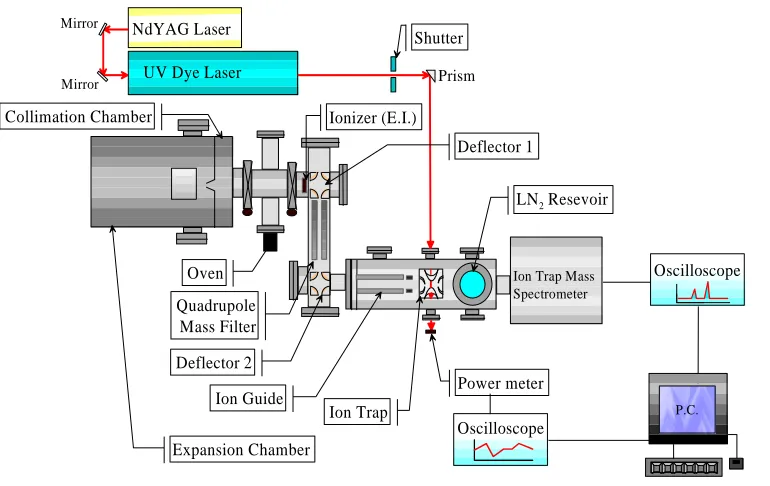
The apparatus shown schematically in Fig. 1 detailed the experimental procedure for the formation of [Mn(4-Picoline)3] 2+
dication complex ions . The systematic description of the entire instrument was given by the author in his previous publication [9]. In summary the instrument has five differentially pumped vacuum chambers namely supersonic expansion, beam collimation, metal vaporization and pick-up (oven), quadrupole mass selection and ion trapping.
Ion Trap Mass Spectrometer
Oscilloscope
Expansion Chamber Collimation Chamber
Ion Trap
Power meter Quadrupole
Mass Filter Oven
Ion Guide
Ionizer (E.I.)
Deflector 1
Deflector 2 UV Dye Laser
Oscilloscope NdYAG Laser
Prism Shutter
Mirror
Mirror
P.C.
[image:2.612.40.425.364.607.2]LN2 Resevoir
ISSN 2250-3153
RESULTS AND DISCUSSION
The appearance of discrete structured sharp mass spectrum of [Mn(4-Picoline)3] 2+
[image:3.612.53.340.191.380.2]at 167 amu and a minuscule hydrated complex of [Mn(4-Picoline)3H2O]2+ at 176 amu (Figure 2 ) similar to what was observed in the ethane activation [9] indicates that the working conditions in the experiment set up remained the same in both methane and ethane activation with [Mn(4-Picoline)3]2+ metal dication complex ion.
Figure 2: Mass spectrum of [Mn(4-Picoline)3]2+ [9]
ACTIVATE OF [Mn(4-PICOLINE)3]2+ WITH METHANE
Figure 3 represents the photofragmentation pattern of the manganese dication complex ion [Mn(4-Picoline)3]2+ with methane. As revealed distinct ion peaks namely the isolated parent fragment of [Mn(4-Picoline)3]2+ at 167 amu the hydrated parent dication complex ions of [Mn(4-Picoline)3H2O]2+at 176 amu and the dihydrated parent dication complex ions [Mn(4-Picoline)3(H2O)2]2+ at 185 amu, the metal dication nitro parent complex ion [Mn(4-Picoline)3N2]2+ at 181 amu, the carbonated parent fragment, [Mn(4-Pico)3CO2]
2+
at 189 amu were observed. The ability of the [Mn(4-Picoline)3] 2+
to pick methyl under laser power was observed in the formation of [Mn(4-Picoline)3(CH3)2]2+ at 182 amu. The photofragmentation path with the loss of a picoline ion was observed resulting in the formation of a main daughter fragment peak corresponding to coordinatively unsaturated [Mn(4-Picoline)]+at 148 amu. The ability of this daughter fragment to pick methane to form manganese 4-picoline monovalent complex ion of [Mn 4-Picoline (CH4)]
+
at 164 amu was recorded.
0 50 100 150 200 250 300
0.0 0.4 0.8 1.2 1.6 2.0
R
el
at
ive
in
te
nsi
ty(a
b.
un
its)
Mass/charge Mn(4-Pico)3]2+
ISSN 2250-3153
Figure 3: Photofragment mass spectrum of [Mn(4-Picoline)3CH4]2+ (44000cm-1)
CALCULATION OF THE STRUCTURE AND BINDING ENERGY OF METHANE WITH MANGANESE 4-PICOLINE COMPLEX DICATION IONS.
The optimised geometry conformer of [Mn(4-Picoline)3CH4] 2+
was observed to be C1 symmetry Figure 4 and the shortest manganese-methane (Mn-C) distance of 2.0 Ǻ.
Figure 4: The Optimized geometry of [Mn(4-Pico)3CH4]2+ with C1 Symmetry
100 150 200 250 300
0.0 0.2 0.4 0.6 0.8 1.0
B
2turn Methane
[Mn(Pico)3CO2]2+
Mn(Pico)3(CH3)2]2+
[Mn(Pico)3]2+
[Mn(Pico)3H2O]2+
[Mn(Pico)3(H2O)2]2+
151
[image:4.612.36.353.424.690.2]ISSN 2250-3153
Table 1: Binding Energies of Methane withMn[4-Picoline]32+ Complex Ion Calculated using both BVP86/6311++G(d, p) and
TPSSh/6311++G(d, p)
Reaction BVP86/kJ/mol TPSSh/kJ/mol
[Mn(4-Picoline) 3]2+ → Mn2+ + 3(4-Picoline) 1617.31 1617.31 [Mn(4-Picoline)3Me]2+ → [Mn(4-Picoline)3]2+ + Me 13.15 13.14 [Mn(4-Picoline)2Me]2+ → [Mn(4-Picoline)2]2+ + Me 35.71 35.72 Mn(4-Picoline)Me]2+ → [Mn(4-Picoline)]2+ + Me 120.17 120.10 [Mn(4-Picoline)2]2+ → Mn2+ + 2(4-Picoline) 1371.14 1371.14
[Mn4-Picoline+ → Mn+ + 4-Picoline 110.86 110.84
For Mn(4-Picoline)3CH4]2+ complex ion the binding energy was maximised at the optimised structure. The one-third the binding energy of[Mn(4-Picoline)3]
2+→ Mn2+
+ 4-Picoline calculated at different levels of theory of zero point energy are in realistic agreement: BP86/6-311++G(d, p) and TPSSh/6-311++G(d, p) at the same levels of theory gave and 527.18 kJ/mol. This theoretical calculated binding energy corresponds to 44068.80 cm-1 per molecule whichperfectly falls within the experimental photon energy range of 35000 to 45000 cm-1 over which the photofragmentation spectra were recorded.
THE ONE DIMENTIONAL POTENTIAL ENERGY CURVE OF [Mn(4-PICOLINE)3CH4]2+
In order to picture the observed charge separation reactions qualitatively a one dimensional potential energy curve model of [Mn(4-Picoline)3CH4]2+ was plotted (Figure 5). From the curves, it was observed that the H transfer separation giving [Mn(4-Picoline)3CH3]2++ H from [Mn(4-Picoline)3CH4]2+ (green line) was located closer to the stable curve (red line). The photoinduced charge transfer to give Mn(4-Picoline)3+ and CH4+ of [Mn(4-Picoline)3CH4]2+ was not observed in the photofragmentation because this reaction is endothermic as evidenced by observing that the potential energy curve (blue) lies above the attractive curve. At the optimised geometry of [Mn(4-Picoline)3CH4]
2+
(Figure 4) the manganese-methane distance (Mn-C) is 2.0 Ǻ which corresponds to 0.18 eV (17.36 kJ/mol in photon energy) on the PEC. Comparing with the calculated DFT of 13.15 kJ/mol it is clear that the PE C calculated value was overestimated by 4.21 kJ/mol which is due to fact that the actual charge on the Mn in the optimised geometry was 1.61 while the charge of Mn=2 was assumed in the PEC calculation.
0 2 4 6 8 10
-12 -9 -6 -3 0 3 6 9 12
Poten
ti
a
l
Ene
rg
yx
1
0
-1 /e
V
r/A [Mn(4-Picoline)
3]
2+
+ CH
4
[Mn(4-Picoline)3CH4]2+
[Mn(4-Picoline)
3CH3]
2+
+ H
[Mn(4-Picoline)
3]
+
+ CH
4 +
[image:5.612.60.403.462.675.2]ISSN 2250-3153
CONCLUSION
The average binding energy per molecule of Picoline calculated for [Mn(4-Picoline)3)2+,lies within the photon energy range over which the photofragmentation spectra were recorded. C1 symmetry optimised geometry of the methane manganese 4-picoline dication complex ions was observed. The calculated charge on the manganese metal centre was 1.61 on the DFT optimised geometry while the charge assumed for the PEC calculation was +2. The interaction of methane with the Mn(4-Picoline)3]2+ resulted in the overestimation of binding energy on the PEC model by 32% as compared to DFT calculation.
Acknowledgement
The author is grateful to Prof. Anthony Stace of University of Nottingham School of Chemistry, UK for all the sacrifice, contributions and support to see this research through, Dr Lifu Ma formerly of University of Nottingham School of Chemistry for his contributions Prof Hazel Cox of the University of Sussex UK, Computational chemistry Department for the Software and the computer time.
FUNDING
The author is obligated to British government for granting him ‘International Excellence Research Award’ which made the financial assistance for this research in the Nottingham University possible.
REFERENCE
[1]. https://www.methanex.com/about-methanol/methanol-vehicle-fuel.
[2]. https://methanolfuels.org/on-the-road/demonstration-projects/
[3]. https://serenergy.com/next-generation-of-methanol-fuel-cell-vehicles-sees-the-light-of-day/
[4] J. Felcher, U. Schurath, R. Xeliner, Chem. Unserer Zeit 2007,41,138
[5]. ScienceDaily ‘A more potent greenhouse gas than carbon dioxide, methane emissions will leap as Earth warms’. https://www.sciencedaily.com/releases/2014/03/140327111724.htm
[6]. Joseph K. Koka (2018) Activation of Methanes by Doubly Charged Metal Dication Complexes in the Gas Phase
[7].| Joseph K. Koka (2019) Binding energy of Methane with Metal Dication Complex ion [Mn(benzene)2] 2+
in the Gas Phase, Elixir Appl. Chem. 126 52487-52494.
[8].Joseph K. Koka (2019)Comparison of Binding Energy of Methane with Calcium Benzene Dication Complex ion [Ca(Benzene)2]2+on DFT and PEC in the Gas Phase. Elixir Appl. Chem. 126Chem. 126 52469-52473
![Figure 2: Mass spectrum of [Mn(4-Picoline)3]2+ [9]](https://thumb-us.123doks.com/thumbv2/123dok_us/9048902.976296/3.612.53.340.191.380/figure-mass-spectrum-of-mn-picoline.webp)
![Figure 3: Photofragment mass spectrum of [Mn(4-Picoline)3CH4]2+ (44000cm-1)](https://thumb-us.123doks.com/thumbv2/123dok_us/9048902.976296/4.612.36.353.424.690/figure-photofragment-mass-spectrum-mn-picoline-ch-cm.webp)
![Table 1: Binding Energies of Methane withMn[4-Picoline]32+ Complex Ion Calculated using both BVP86/6311++G(d, p) and TPSSh/6311++G(d, p)](https://thumb-us.123doks.com/thumbv2/123dok_us/9048902.976296/5.612.60.403.462.675/table-binding-energies-methane-withmn-picoline-complex-calculated.webp)
