
Partial wave analysis
EberhardKlempt1,,Andrey V.Sarantsev1,2,, andUlrikeThoma1,
1Helmholtz–Institut für Strahlen– und Kernphysik, Universität Bonn, 53115 Bonn, Germany
2National Research Centre "Kurchatov Institute", Petersburg Nuclear Physics Institute, Gatchina, Russia
Abstract.The project A.2 of the SFB/TR16 “Subnuclear Structure of Matter” aimed at a combined multichan-nel partial wave analysis of all or of most data on pion and photo-induced reactions for invariant masses from theΔ(1232) region to 2300 MeV. In this review the most important results are presented. It is shown that the data and their partial wave analysis have improved our understanding of the dynamics of excited light-quark baryons significantly.
1 Introduction
“Why baryons?” asked Nathan Isgur [1] at NSTAR2000, and gave three answers: Because nucleons are the stuff of which our world is made, because they are the sim-plest system in which the non-abelian character of QCD is manifest, and because their complexity - compared to mesons - may reveal physics hidden from us in mesons. And he predicted that baryon spectroscopy will be one of the most interesting and fruitful areas for at least thirty years. Recent reviews of baryon spectroscopy by Klempt and Richard [2] and Crede and Roberts [3] underline the interest in the field.
Isgur’s high expectations were based on severe dis-crepancies between the experimental findings and the spectrum of nucleon excitations predicted in quark mod-els (e.g. [4–9]) or in recent calculations within lat-tice QCD [10] (even though these calculations still use quark masses corresponding to a large pion mass, mπ=396 MeV).
In 2000, the knowledge of the excitation spectrum of the nucleon stemmed essentially from data onπNelastic scattering [11–13]. In quark models, the predicted spec-trum is organized in excitation shells, and a shell structure is clearly seen in the experimental spectrum. However, the resonance spectrum which emerged exhibited two severe problems:
A) The number of states expected for a system with three constituent quarks exceeded by far the number of observed states.
The authors of, e.g., ref. [6] list 66 N∗ and 35 Δ∗ reso-nances predicted to have masses below 2.5 GeV. However, the Review of Particle Properties of 2000 [14] quotes only 19 N∗ and 19 Δ∗ in this mass range. And, even worse,
e-mail: [email protected] e-mail: [email protected] e-mail: [email protected]
Arndt and his collaborators [15] found only 8N∗ and 10 Δ∗-states. This latter analysis included high precision data from the meson factories at LAMPF, PSI, and TRIUMF. A strong argument in favor of the Arndtet al.analysis was the correct prediction of spin rotation parameters [16–18] and of the backward asymmetry [19] in the elastic pion-proton scattering from ITEP/PNPI; the predictions from [11, 12] show clear discrepancies with the data.
Clearly, not all 101 resonances expected below 2500 MeV need to be found to reach a good unterstanding of the spectrum. In the first excitation shell 5 negative-parity N∗’s and 2 Δ∗’s are predicted and experimentally established. In the second shell, 14 positive-parity N∗’s and 8Δ∗’s are predicted; their calculated masses fall be-low 2100 MeV. Based on [11, 12] (or [15]), only 8 (or 4) positive-parity N∗’s and 6 (or 5) Δ∗’s are actually ob-served. Only 4 (instead of 14) positive-parity N∗’s are safe: this small number casts into doubt if models based on constituent quarks with some residual interactions are the right degrees of freedom to describe the nucleon exci-tation spectrum.
The problem of missing baryon resonances is ag-gravated by the prediction of additional states, hybrid baryons, in which the gluonic string mediating the interac-tion between the quarks is itself excited. Hybrid baryons carry the same quantum numbers asqqqbaryons,qqqand hybrid configurations can mix and are thus difficult to es-tablish. In a quark model [20], the baryon hybrid spec-trum (with no mixing with qqqbaryons) is calculated to intrude the spectrum of baryon resonances at 2 GeV and above. In lattice calculations [21], most baryons with a dominant hybrid content show up above 2500 MeV, except for JP =1/2+whereN(1440)1/2+andN(1710)1/2+are
predicted to acquire a significant hybrid component. A well-known solution of the problem of themissing
resonancesis the conjecture that baryon excitations could
rel-evance of the diquark concept (see e.g. [22–25]). This hypothesis decreases the number of expected resonances very significantly and helps to solve the problem of the
missing baryon resonances. Santopinto, e.g., calculated
theN∗andΔ∗ excitation spectrum [26] with the assump-tion that the baryon is made up from a point-like diquark and a quark. The results match data perfectly, provided N∗- andΔ∗-resonances are omitted that had an one- or two-star ranking only in PDG2004 [27].
Alternatively, the missing resonances may have es-caped detection due to their small coupling to theπN chan-nel [28]. The question arizes: are there baryon resonances with smallπNcouplings which can be produced by elec-tromagnetic excitation and which decay into other final states?
A further point of concern is the observation that
B) the pattern of observed states is neither compatible with quark model calculations nor with present lat-tice calculations.
In particular the low mass of the Roper resonance N(1440)1/2+ has led to vivid discussions in the litera-ture. Inconsistencies in different data sets led Morsch and Zupranski [29] to conjecture that the 1400 MeV region might even house two resonances, a hypothesis which we ruled out in [30]. Most papers on the Roper resonance address the question if it is a “normal” qqq resonance, a low-mass hybrid baryon [31, 32], or if it is dynami-cally generated from meson-baryon interactions [33]. If the Roper resonance would be exotic,N(1710)1/2+would be the true first radial excitation of the nucleon. However, electroexcitation of the Roper resonance provides strong evidence for this state as a predominantly radial excitation of a 3-quark ground state [34]. Note, that any exotic in-terpretation of the Roper resonance should explain the low masses of the corresponding states in theΛ,Σ, andΞ spec-tra. Likewise, the Λ(1405)1/2− resonance has attracted intense interest since Dalitz proposed it to be generated dynamically [35]. This topic is treated in project B.3.
The generation of baryon resonances from the inter-action of mesons and baryons is a highly attractive ap-proach to understand the dynamics of baryon resonances. At present, however, the number of expected resonances is unknown, and the relation between quark model states and dynamically generated resonances is not understood. It is hence important to measure the decay modes of all major decay modes.
At higher energies, the masses of Δ(1900)1/2−, Δ(1940)3/2−, Δ(1930)5/2− are incompatible with quark model predictions (e.g. [6]). They belong to the third excitation shell, and their masses should fall into the 2100 - 2300 MeV range. Instead, they are approximately mass degenerate with the positive-parity Δ(1910)1/2+, Δ(1920)3/2+, Δ(1905)5/2+, Δ(1950)5/2+. Such parity doublets occur frequently in hadron spectra [36]; Fig. 1 shows parity doublets in theN∗spectrum. Parity doublets are observed undoubtedly. Similar observations in the me-son [37] and baryon [38] sector have led to the idea that chiral symmetry might be effectively restored in highly
(+)
3/2 3/2(−) 5/2(+)5/2(−)7/2(+)7/2(−)9/2(+)9/2(−)
(+)
1/2 1/2(−)
Mass/MeV
1600 1700 1800 1900 2000 2100 2200 2300
N(1650) N(1680) N(1700)
N(1710)
N(1720)
N(1675) N(1895)
N(1880) N(1875)
N(2190)
N(2220)N(2250)
N(1900)
N(2060) N(1990) N(1990)
N(2000)
alternative solution
: Lines indicate pole postion masses within the BnGa−PWA
Figure 1. Examples of nucleon resonances organized as parity doublets. The lines indicate the masses of BnGa pole position of the respective states. For the 7/2+-state two alternative solutions exist: one close to the N(2190)7/2−, the other one at a lower mass, both are shown. The pole masses of N(1720)3/2+and N(1700)3/2−are found 110 MeV apart, all other parity doublets indicated have a significantly smaller mass splitting.
excited hadrons. If this would indeed be the case chiral partners were expected to exist for all high-mass states. In-dependently of the idea of chiral symmetry restoration, the question whether or not parity partners exist for all high-mass states is an interesting question to be answered ex-perimentally.
Photoproduction of baryon resonances is hence stud-ied to find answers to the following questions:
1. Is the number of observed resonances compatible with diquark models?
2. Is their evidence for three-quark dynamics in excited baryon states?
3. What is the dynamical reason for the existence of parity doublets?
4. Which resonances are seen in the third excitation shell?
5. Can baryon resonances be assigned to specific S U(6)⊗O(3) multiplets?
Based on the new data taken during the SFB/TR16 funding period, further questions arose:
6. Is photoproduction of ω mesons governed by diffraction, or play resonances a significant role? 7. Is the narrow peak seen in the reactionγn → ηna
resonance?
8. What is the relation between quark-model reso-nances and dynamically generated resoreso-nances? 9. Do the new photoproduction data with polarized
photon beams and polarized targets lead to consis-tent multipoles when analyzed with different PWA methods?
10. Can photoproduction multipoles be determined in slices of fixed masses?
other laboratories provide important information used in the comprehensive analysis of photo- and pion-induced re-actions performed within the Bonn-Gatchina partial wave analysis (BnGa-PWA) (project A.2 within the SFB/TR16) presented here. The importance of the recent single and double polarization observables becoming available from ELSA, JLab, and MAMI cannot be overestimated. They provide very important constraints for the PWA.
2 The Bonn-Gatchina PWA, data base and
method
As composite systems, nucleons exhibit a rich spectrum of radial and orbital excitations. The excitation levels of the nucleon are extremely short-lived and decay in a variety of different decay modes. Many states are predicted which overlap and are very difficult to resolve. Hence the aim to identify all N∗ andΔ∗resonances contributing to pho-toproduction and to measure all important decay modes requires a simultaneous fit to a large body of data in a multi-channel partial wave analysis. The following data were included in the analysis:
1. Data on the photoproduction offprotons and off neu-trons obtained at ELSA and at other laboratories. This includes data on single as well as on double meson photoproduction. The latter data are fitted in terms of an event-based maximum likelihood fit to take all the correlations between the variables the event depends on properly into account.
2. Real and imaginary part of the partial wave ampli-tudes forπNelastic scattering either from Höhler’s group or from Arndt’s group.
3. Pion-induced inelastic reactions.
The latter data (2) and (3) ensure consistency with theπN -scattering data and allow the extraction of theπNcoupling strength of baryon resonances. Fits to photoproduction data alone would provide only access to the product of the photon helicity amplitudes A1/2, A3/2 and the square root of the decay branching ratio into the specific final state,A1/2or3/2·
BRf inal iwithBRf inal i= Γf inal i/Γtot(with
Γf inal i being the partial decay width into the final state i
andΓtotthe total width of the resonance).
The following reactions are presently included in the BnGa-PWA. (Most data can be found via the web page of the GWU PWA group [39]):
Photoproduction πN-scattering
γp→π0p, π+n π−p→π−p(elastic)-partial waves
γp→ηp, ηp π−p→ηn
γp→ωp,K∗+Λ
γp→K+Λ π−p→K0Λ,K+Σ−,K0Σ0, K−Σ+ γp→K+/0Σ0/+ π+p→K+Σ+
γp→pπ0π0, pπ+π− π−p→nπ0π0,nπ+π−
γp→pπ0η
γn→π0n, π−p
γn→ηn
This data base has been extended continuously over the last 12 years. In particular the new polarization data were included in the fits whenever they became available. Very recently also (so far unpublished) data on photoproduction of two charged pions (CLAS) were added.
A multi-channel analysis of a large body of data has a large advantage; in contrast to an analysis ofπN → πN elastic scattering alone, the simultaneously fitted photo-production data provide access to resonances which might have escaped detection inπNscattering due to their insuf-ficientπN-coupling. At the same time the photoproduction data constrain the elastic amplitudes by fixing the structure of the otherwise unknown inelasticities. Polarization ob-servables measured in photoproduction reactions provide sensitive information on the interferences of different par-tial waves. This helps to extract even small resonance con-tributions from the data. Simultaneous fits to different sin-gle and double polarization observables exploit different interference effects and are hence very sensitive to small amplitudes.
The fit method has been documented in a series of pa-pers [40–43]. Here we just mention that the amplitudes for pion- and photo-induced reactions are represented by a sum of K-matrix partial wave amplitudes and by back-ground amplitudes describingu- andt-channel exchanges. The corresponding exchange amplitudes are written in the form of the exchange of Regge trajectories. The K-matrix amplitudes contain poles and simple functions of s to model additional background. Methods for the decompo-sition of the background amplitudes fromt- andu-channel exchanges into partial waves have been developed and im-plemented. These allow the direct comparison of our par-tial waves (or multipoles) with those of other analyses as discussed, e.g., in section 3.9.
Due to the so far still incomplete data base, different solutions are found which describe the data with similar quality. We always quote errors which cover all solutions or we discuss different classes of solutions in which the number and the properties of some resonances may dif-fer [44–49].
It should also be mentioned, that within the BnGa-approach, we do not attempt to provide a microscopical description of the background starting from a Lagrangian like it is done by other groups like Argonne-Osaka [50], Jülich-Bonn [51–56], Dubna-Mainz-Taipeh [57], EBAC-Jlab [58], Valencia [59], or within the Gießen Coupled Channel analysis [60, 61] (see also contribution of project B.7 “Coupled channels approach to photo-meson produc-tion on the nucleon” to these proceedings). These models have the advantage that the number of free parameters for the background is minimized while problems might occur if the dynamical model is incomplete and the fit is con-strained to it.
in our fitting [62]. Studies on baryons indicate that the ef-fects on the amplitudes are mostly small, and that changes in the resonance parameters are covered by the errors we have quoted in our analyses based on the K-matrix formal-ism.
3 Results
3.1 Can we rule out diquark models?
The Particle Data Group (PDG) summarizes biannually the status of particle physics. Their Review of Particle Physics (RPP) contains a listing of known baryon reso-nances and their properties. Before the 2007 issue, the information on nucleon andΔexcitations came nearly en-tirely from the groups led by Höhler [11], Cutkosky [12], and Arndt [15] analyzing data on πN elastic and charge exchange scattering, with a few additions from Man-ley [63]. However, the GWU group reduced continuously the number of observed resonances required in their fits [13, 15, 64]. Before 2006, data on photoproduction added information on the helicity couplings of resonances listed in the RPP, but the resonances were introduced into the respective analyses with fixed masses and widths. Early results of the BnGa group using data on photoproduction from the CB-ELSA experiment [65–68] were not yet in-cluded in the RPP [44, 69] or not yet used to define particle properties [30, 70]
The BnGa group was the first one which combined pion and photoproduced reactions in a coupled channel fit, fitted masses and widths freely and searched systemati-cally for new resonances [46–49]. In this way, the baryon resonances dismissed in the Arndt et al. analysis [15] could be re-established [46]. In [49], we have reported the observation of 21N∗and of 10 Δ∗resonances and deter-mined their masses, width, and a number of decay modes. Six nucleon resonances werenew in the sense that they had no own PDG entry before (even though earlier exper-iments may also have found evidence for their existence). These results entered the RPP2012 [71].
Table 1 lists the resonances found in the BnGa analysis which werenewor for which the star rating was increased.
Table 1.New states found by the BnGa PWA, which have been introduced in the new PDG’2012, or states in which the BnGa PWA improved the star rating of the resonance. “no evidence” in the GWU Arndt’06 analysis indicates states given in PDG’2010
which were not confirmed in the GWU Arndt’06-analysis.
RPP our RPP GWU’06
2010 analyses 2012
N(1860)5/2+
*
**
N(1875)3/2−
***
***
N(1880)1/2+
**
**
N(1895)1/2−
**
**
N(1900)3/2+ ** *** *** no evidence
N(2060)5/2−
***
**
N(2150)3/2−
**
**
Δ(1940)3/2− * ** ** no evidence
Cx, Cz
-1 0 1
1889 1939
-1 0 1
2035 2081
-1 0 1
2169 2212
0
-0.5 0.5 -0.5 0 0.5 cos K
1889 1939
2035 2081
2169 2212
0 -0.5 0.5
cos K -1
0 1
-1 0 1
-1 0 1
0 -0.5 0.5 Cx, Cz
Figure 2. Double polarization observablesCx(red points) and
Cz (open blue circles) forγp→ K+Λ[72]. The solid (Cx) and
dashed (Cz) curves are our result obtained without (left panel)
and with theN(1900)3/2+state (right panel) included in the fit.
When comparing RPP’2000 with RPP’2010, we notice that not a single new baryon resonance entered the RPP during these 10 years. With the new high-quality photo-production data, including single and double polarization observables, the situation has now changed dramatically.
The evidence for one of the states,N(1900)3/2+, can be seen in Fig. 2. The figure shows the CLAS beam-recoil polarization data (Cx,Cz) for the reactionγp→K+Λ
(se-lected bins only) [72] in comparison to the best fit obtained without and withN(1900)3/2+included in the PWA [73]. The improvement due to theN(1900)3/2+is clearly visi-ble.
The number of observed states is now definitely larger than expected from diquark models and supports symmet-ric quark models in which three constituent quarks partic-ipate in the dynamics of excited states.
3.2 Baryon cascade decays reveal three-quark dynamics
Three-body decays of baryon resonances give access to sequential decays of baryon resonances via intermediate baryon or meson resonances. The photoproduction reac-tions γp → π0π0p [74] and γp → π0ηp [75, 76] were included in the PWA using an event-based maximum like-lihood fit to properly consider all the correlations the re-action depends on in the given 5-dimensional phase space. The data were taken at ELSA with the CBELSA/TAPS ex-periment within project A.1. Data from GRAAL [77] and MAMI [78] onγp→π0π0pwere included in the analysis, the MAMI data onγp→π0ηp[79] were added to the data base later.
0.4 0.5 0.6 ) 2 ) (GeV 0 π (p 2 M 1.1 1.2 1.3 1.4 0 5 10 15 20 25 30 35 1000
0.4 0.6 0.8
1.2 1.4 1.6 0 10 20 30 40 50 60 70 80 1200 (1232) Δ
0.4 0.6 0.8 1 1.5 2 0 5 10 15 20 25 30 35 40 1400 (1232) Δ 0.5 1 1.5 2 0 2 4 6 8 10 12 14 16 18 1600 a0(980)
(1232) Δ ) 2 ) (GeV η 0 π ( 2 M
0.5 1 1.5
) 2 ) (GeV 0 π (p 2 M 1.5 2 2.5 0 2 4 6 8 10 12 14 1800 a0(980)
(1232) Δ 0 2 4 6 8 10 ) 2 ) (GeV η 0 π ( 2 M
0.5 1 1.5
1.5 2 2.5 3
2000 a0(980)
(1232) Δ
2 2.2 2.4
) 2 ) (GeV 0 π (p 2 M 1.1 1.2 1.3 1.4 0 2 4 6 8 10 12 14 16 18 20 1000 2 2.5 1.2 1.4 1.6 10 20 30 40 50 60 1200 N(1535)
2 2.5 3
1.5 2 0 5 10 15 20 25 30 35 1400 N(1535) (1232) Δ
2 2.5 3 3.5
1.5 2 0 2 4 6 8 10 12 14 16 18 1600 N(1535) (1232) Δ ) 2 ) (GeV η (p 2 M
2 3 4
) 2 ) (GeV 0 π (p 2 M 1.5 2 2.5 0 2 4 6 8 10 12 14 1800 N(1535) (1232) Δ ) 2 ) (GeV η (p 2 M
2 3 4
1.5 2 2.5 3 0 1 2 3 4 5 6 7 8 2000 N(1535) (1232) Δ 0 1 2 3 4 5 6 ) 2 ) (GeV η (p 2 M
2 3 4
2 3 2200 N(1535) (1232) Δ
Figure 3. Dalitz plots (taken from [76]) for the reactionγp→
π0ηpfor the mass range 2000±100 MeV and 2200±100 MeV
(CBELSA/TAPS-data). Evidence is seen for the intermediate statesΔ(1232)η,p a0(980), andN(1535)1/2−π.
0 100 200 300 400 500 ) 2 ) (GeV 0 π (p 2 M
1 2 3
) 2 ) (GeV 0 π (p 2 M 1 2 3 (1232) Δ N(1520) N(1680) =1500-1700 γ E 0 50 100 150 200 250 300 350 400 450 ) 2 ) (GeV 0 π (p 2 M
1 2 3 4
) 2 ) (GeV 0 π (p 2 M 1 2 3 4 (1232) Δ N(1520) N(1680) =1800-2200 γ E
Figure 4. Dalitz plots for the reaction γp → pπ0π0
(CBELSA/TAPS) [74]. Shown are examples from two energy bins. the pictures are taken from [74], which also provides firther details).
this observation, the PDG upgraded theΔ(1940)3/2− res-onance from one star to two stars.
Fig. 4 shows two Dalitz plots on γp → π0π0p. Sev-eral isobars are seen. Higher-mass baryon resonances seemingly prefer to decay into other high-mass resonances with a low decay momentum, instead of choosing a high-momentum decay into a low-mass meson and a nucleon: Apparently, the intrinsic wave functions of resonances do not contain large components with high momenta. QCD likes to invest into mass and not only into momentum.
The analysis of the data allows us to extract branch-ing ratios for the decays of resonances into Δπ, Δη, N(ππ)S, N(1440)1/2+π, N(1520)3/2−π, N(1535)1/2−π,
andN(1680)5/2+π. In total, more than 400 properties of
2300<E<2400
M(p), GeV 0
2 4 6
1 1.5 2
0
1900<E<2000
2.5 5 7.5
M(p), GeV
1 1.5 2
1500<E<1600
5 10 15
0
M(p), GeV
1 1.5 2
Figure 5. dσ/dM(pπ0) forγp → pπ0π0: examples for three
pπ0-invariant mass bins. The blue an red data points show two
different CBELSA/TAPS data sets. The systematic uncertainty of the data is shown as grey band. In addition, there is a normal-ization uncertainty of 10% [74]. The result of the BnGa-PWA is shown as black curve.
baryon resonances were determined, many of them were obtained for the first time. They will be listed in the 2016 edition of the RPP. Fig. 5 shows invariant masses in com-parison to the BnGa fit.
In the 1900 MeV region, for 1300<Eγ <1650 MeV, the cascade N∗ → N(1520)π0 → pπ0π0 is dominated by the JP =3/2+partial wave. This can be seen by plotting
the variablesIs,Icdefined by
dσ dΩ =
dσ dΩ
0
{1+Pl[Issin(2φ)+Iccos(2φ)]}. (1)
Is,Iccarry information on the spin density matrix of the N(1520)3/2−isobar. The variables can be plotted as func-tions of φ∗ [74, 80] and are shown repeatedly in Fig. 6. Superimposed are two-parameter fits assuming different partial waves in the initial state. The coupling strength and the fractional contribution of the higher partial-wave contribution are varied in the fits. Only one fit gives a rea-sonable fit to the data; it assumesJP =3/2+in the initial
state. This is an important result. It is shown that in this cascade, one partial wave is dominant. The result is fully model independent and has been achieved without any par-tial wave analysis just calculating the respective angular distributions!
The decays of the N∗ and Δ∗-resonances re-veal evidence for the three-particle dynamics of ex-cited nucleon resonances. Δ(1910)1/2+, Δ(1920)3/2+, Δ(1905)5/2+, and Δ(1950)7/2+ show rather small
de--0.5 0
0.5 Is
p
3/2+→N(1520)+π0(S+D)
Icp Isπ Icπ
-0.5 0 0.5
3/2−→N(1520)+π0(P+F)
-0.5 0 0.5
5/2−→N(1520)+π0(P+F)
-0.5 0 0.5
5/2+→N(1520)+π0(D+G)
-0.5 0 0.5
0 200
Φ*, deg 7/2+→N(1520)+π0(D+G)
0 200
Φ*, deg
0 200
Φ*, deg
0 200
Φ*, deg
Figure 6. Isand Icfor events with a protonπ0invariant mass
above the Δ(1232) mass for 1300 < Eγ < 1650 MeV. Solid
symbols: extracted directly from the data, open symbols: mirror points due to symmetry. The grey areas represent the systematic errors. The data are shown repeatedly and compared to simulated distributions for the reaction chains (JP) →N(1520)3/2−+π0.
Distributions for (1/2±)→N(1520)3/2−+π0vanish and are not
cay fractions into the intermediate orbitally ( = 1) excited baryon resonances N(1520)3/2−, N(1535)1/2−, N(1680)5/2+and a pion. At the same timeN(1880)1/2+, N(1900)3/2+,N(2000)5/2+, andN(1990)7/2+decay into N(1520)3/2−π,N(1535)1/2−π,N(1680)5/2+π,Nσwith a significant fraction. Since the individual branching ratios have large error bars [81]: the data were re-fitted using two assumptions:
1. Decays of the fourΔ∗’s intoN(1440)π,N(1520)π, N(1535)π, andN(1680)πwere forbidden. This has little effect on the fit and theχ2deteriorated by 692 units. We consider this to be at the border of becom-ing statistically significant. Of course, these decays are not forbidden but obviously, the branching ratios for these decay modes from the fourΔ∗’s are small. 2. If decay modes into orbitally excited states were
for-bidden for the four N∗ resonances, theχ2 change became 3880 units and the fit quality deteriorated visibly. The fourN∗resonances decay via orbitally excited intermediate states with a significant decay fraction.
Why are the decays of the fourN∗resonances into orbitally excited intermediate resonances so frequent (≈23%), and why are these decay modes suppressed for the fourΔ∗ res-onances [81]?
These phenomena can be understood inspecting their wave functions. If one neglects mixing, the four positive-parityΔ∗-resonances andN∗-resonances could both be as-signed to a spin-quartet with intrinsic orbital and spin an-gular momentaL = 2 and S = 3/2. The four positive-parityΔ∗ resonances have a spin and a flavor wave func-tion which is symmetric with respect to the exchange of any pair of quarks. The color wave function is completely antisymmetric, hence the spatial wave functionφn,l must
be symmetric as well:
S= √1
2 φ
0s(ρ)×φ0d(λ)
+φ0d(ρ)×φ0s(λ)(L=2), (2)
withρandλbeing the oscillators which can be excited in the 3-quark-system. For the nucleon states a mixed sym-metry spatial wave function is required: For L = 2 the wave functions have equal admixtures of
MS = √1
2 φ
0s(ρ)×φ0d(λ)
−φ0d(ρ)×φ0s(λ)(L=2) (3)
MA = φ0p(ρ)×φ0p(λ) (L=2)
, (4)
and both parts need to be present to fulfill the Pauli prin-ciple. The partMA describes a component in which the
ρand theλoscillator are both excited simultaneously. We now assume that theMA-part can only de-excite in a two-step process: In the first two-step one of the intrinsic oscilla-tors is de-excited, and the intermediate state still carries an intrinsic excitation, an intermediate resonance is created. The latter excitation requires a second decay, from the in-termediate resonance to the ground state. The large con-tribution of cascade decays to decays ofN∗ in the fourth resonance region and their smallness inΔ∗decays provide evidence that two independent oscillators are excited in high-mass baryon resonances.
Table 2.Branching ratios BR forN∗→Nηdecays and the photon helicity amplitudesA1/2,A3/2for four of the contributing
nucleon resonances (taken from [82]). The helicity amplitudes are given in units of GeV−1/2. Small numbers below the BRs or
below the helicity amplitudes give either the RPP [87] estimate or the entries reported in [49].
Res. BR(N∗→Nη) Res. BR(N∗→Nη)
A1/2 A3/2 A1/2 A3/2
N(1535) 0.42±0.04 N(1710) 0.25±0.09 1/2− 0.42±0.10 1/2+ 0.10 - 0.30 0.093±0.009 - 0.040±0.020
-0.115±0.015 - 0.035±0.012
-N(1650) 0.32±0.04 N(1720) 0.03±0.02 1/2− 0.05 - 0.15 3/2+ 0.021±0.014 0.032±0.006 - 0.115±0.045 0.135±0.040
0.045±0.010 - 0.100±0.020 0.150±0.030
3.3 Negative-parity resonances
3.3.1 Negative-parity resonances below 1800 MeV
The five negative-parity nucleon and the twoΔexcitations in the first excitation shell are well established and their properties well defined. However, this does not exclude surprises when new data become available.
New single and double polarization data for the
γp → pη final state were reported recently. The ob-servables E,G,T,P, and H have been measured with the CBELSA/TAPS experiment ([82], see project A.1) at ELSA. A few bins of the newly measured double polar-ization observablesT andEare shown in Fig. 7. Data on T andF[83] were obtained in Mainz and data onEhave been published recently by CLAS [84]. The latter data are consistent with our CBELSA/TAPS-data but were not yet included in our fits.
The predictions for the newly measured observables E and T from the different PWAs are also shown in Fig. 7. None of the predictions comes close to the data, even though they do describe reasonably well all
η-photoproduction data (dσ/dΩ, Σ) which existed be-fore. This clearly shows thatη-photoproduction was less constrained by existing data thanπ-photoproduction. Of course, this was to be expected since πN-elastic scatter-ing does already provide significant information on theπN coupling of resonances, while comparable data are miss-ing for theηN-final state: data onπN→ηNare scare.
Table 2 presents theN∗→Nηbranching ratios of four resonances used in the fit. There are a few interesting ob-servations:
While theN(1535)1/2−→Nηbranching ratio is found to be 0.42 ± 0.04 (most recent PDG value: (0.42 ± 0.10) GeV−1/2), there is a very significant change in the N(1650)1/2−→ Nηbranching ratio observed. It changes from 0.05−0.15 (RPP) to 0.32±0.04 in our fit. The N(1710)1/2+ → Nηbranching ratio settles at 0.27±0.09, in the higher half of its previous range 0.10 − 0.30, while N(1720)3/2+contributes little [82]. These results clearly show the power of polarization observables to con-strain PWAs; an earlier PWA [65, 85] indicated a large N(1720)3/2+contributions.
dif-1823 MeV < W < 1875 MeV 0.5
− 0 0.5
1622 MeV < W < 1660 MeV
2171 MeV < W < 2403 MeV 0.5
− 0 0.5
η
θ cos
1531 MeV < W < 1553 MeV 0.2
− 0 0.2 0.4 0.6
T
0.5
− 0 0.5
1660 MeV < W < 1716 MeV 1770 MeV < W < 1822 MeV
1 − 0.5 −
0 0.5 0.5 −
0 0.5 1
2018 MeV < W < 2109 MeV 0.5
− 0 0.5
E
2196 MeV < W < 2280 MeV 0.5
− 0 0.5
η
θ cos
Figure 7.The polarization observableT (left) andE(right) as function of cosθηfor a few selected W-bins [82] (CBELSA/TAPS-data
(black), from [82]). Very recent data from CLAS [84] are shown for comparison as blue open points (due to different binning, the energies differ by up to half of the bin size). The curves represent different models. Black: BnGa fit with (solid) and without (dashed) N(2200)5/2−; red solid (dashed): BnGa2011-01 (-02); green: MAID, dark blue (dotted): SAID (GE09); magenta (dotted): Gießen , light blue: JüBo 2015 (dashed) and JüBo 2015-3 [84] (solid).
ference in the Nηbranching ratios of the N(1535)1/2−/ N(1650)1/2− nucleon-resonance pair which was exten-sively discussed in literature (see [86]). In the standard quark model, this has been taken as evidence for a large mixing of SU(6)×O(3) states (see Review on Quark Mod-els in the RPP2014 [87]). A further intriguing result is the inversion of the relative sign of the electromagnetic cou-plings of theN(1535)1/2−and theN(1650)1/2−state for photoproduction offthe proton and the neutron [88].
These results refer to properties of the resonances de-rived at the pole position. To calculate branching ra-tios (or Breit-Wigner parameters) from the multi-channel multi-pole K-matrix parameterization we first calculated the couplings of the resonance to the different channels as residues at the pole position. The Breit-Wigner/Flatte couplings were then introduced to be proportional to these couplings with one common factor f. The factor f as well as the Breit-Wigner mass are then adjusted until they match exactly the pole position obtained from the full amplitude resulting from the K-matrix-fit to the data. Then, the helicity Breit-Wigner/Flatte couplings were de-termined making again sure that they reproduce the helic-ity residues of the full amplitude at the pole position. The resulting branching ratios for four of the contributing res-onances are given in Table 2.
It is interesting to note that the K-matrix couplings main-tain a smallN(1650)1/2−→Nηcoupling in the fits and do not show the inversion of the relative sign ofN(1535)1/2− andN(1650)1/2−electromagnetic couplings.
3.3.2 Negative-parity resonances above 1800 MeV
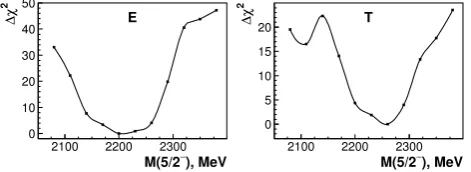
We continue the discussion of fits to the double polar-ization data on γp → ηp. The fit did not reproduce well the high-mass range; hence we tried to improve the description by adding one further resonance with spin-parityJP =1/2±,· · ·,9/2±. The best result was achieved
0 10 20 30 40 50
2100 2200 2300 E
M(5/2−), MeV
Δχ
2
0 5 10 15 20
2100 2200 2300 T
M(5/2−), MeV
Δχ
2
Figure 8. Mass scan for a resonance withJP=5/2−. Shown is
theχ2-change forEandT of the fit as a function of the imposed
mass. In the mass scan, starting from the best fit solution, a Breit-Wigner amplitude is added with its mass fixed while all other parameters are fitted freely. The curves are included to guide the eye. The figure is taken from [82].
by introducing a resonance with JP=5/2−, M=(2200
±50) MeV, Γ =(260±50) MeV. Figure 8 shows the χ2 -minimum for the two observablesEandT if a scan of the 5/2−-resonance mass is performed. In the scan, the mass of the 5/2−-resonance was set to prefixed values while all other parameters were fitted freely. Significant minima are observed. However, no convincing evidence was ob-served in other reactions. Hence one must consider the
-1 -0.5 0 0.5 1
-1 -0.5 0 0.5 1 W=2200MeV
cos θη
-1 -0.5 0 0.5 1 W=2260MeV
cos θη
F
Table 3.Masses and widths of selected negative-parity resonances. The mass values are from [49]. The second column gives the PDG [96] star rating for resonances known in 2010.†: in 2010, this entry summarized observations ranging from 1900 to 2240 MeV and
was removed from the RPP in 2012.
N(1895)1/2−: new MBW=1895±15 ΓBW=90+−3015 [MeV ]
N(1875)3/2−: new MBW=1880±20 ΓBW=200±25 [MeV ]
N(2150)3/2−: new MBW=2150±60 ΓBW=330±45 [MeV ]
N(2060)5/2−: new MBW=2060±15 ΓBW=375±25 [MeV ]
N(2200)5/2−: † MBW=2200±50 ΓBW=260±50 [MeV ]
N(2190)7/2−: 4* MBW=2180±20 ΓBW=335±40 [MeV ]
N(2250)9/2−: 4* MBW=2200±40 ΓBW=480±60 [MeV ]
evidence for this new resonance with some caution. Based on the PWA-solutions with and without theN(2200)5/2− -resonance, the double polarization observableFhas been predicted. Fig. 9 shows the sensitivity of this observable. Measuring F would definitely help to settle the question whether or not a 5/2−-resonance exists in a mass range around 2200 MeV. Of course also improved statistics on the already measured observables can be expected to lead to an improved sensitivity.
New high-mass negative-parity resonances were re-ported in [90]. N(1875)3/2− proved to be particularly sensitive to the reactionγp → Σ+K0
S [91–93] studied in
project B.1. Also, the data on the beam asymmetry onπ0 andη have to be mentioned [94, 95]. Evidence for the new resonances can be seen in the mass scans shown in Fig. 10. The masses of high-mass negative-parity reso-nances as obtained within the BnGa multichannel PWA are collected in Table 3.
Figure 10.a) Mass scan for aN1/2−resonance; change of the
to-talχ2of the fit as a function of the assumed mass; b,c) Mass scan
for aN3/2−resonance;χ2of the fit as a function of the assumed
mass for an assumed width of 100 MeV. b) totalχ2, c)χ2
con-tribution fromγp→Σ+K0
S [92, 93]. d) Mass scan for a fourth
N3/2−resonance whenN(1875)3/2−is included in the K-matrix.
The figure is taken from [90].
3.4 Assignment to SU(6)xO(3)-multiplets
An assignment of resonances to SU(6)xO(3) multiplets is discussed by Klempt and Metsch in [97]. Figure 11 shows the resonances which have at least 2 stars in the RPP and their assignment to SU(6)xO(3) multiplets. Resonances where the RPP’2014 states “Latest GWU analysis [15] finds no evidence for the resonance” are indicated by blue /light blue crosses. All states marked by blue, red, or ma-genta boxes have been identified by the BnGa-PWA.
3.4.1 Negative parity resonances
The first excitation shell (1ω) is (since long) complete. The high-mass negative-parity resonances are collected in Table 4. If the three Δ∗ resonances Δ(1900)1/2−, Δ(1940)3/2−, Δ(1930)5/2− are interpreted as a spin triplet, they have a fully symmetric spin and flavor wave function; hence their spatial wave function must be sym-metric, too. Thus, they belong to a 56 representation, and there must be a doublet of negative-parity nucleon resonances close in mass. These are identified with N(1895)1/2− and N(1875)3/2−. These five resonances can be assigned to the third excitation shell withL3q =1.
They have one unit of radial excitationN=Nρ+Nλ=1). There are five negative-parity nucleon resonances N(2150)3/2−;N(2200)5/2−;N(2060)5/2−;N(2190)7/2−; N(2250)9/2−in the mass range from 2050 to 2250 MeV. It is tempting to organize these resonances in the same way as those in the first excitation shell, as quartet with an in-trinsic quark spinS =3/2, and aS =1/2 doublet. In this interpretation, one resonance with JP =7/2−is missing. We have added to Table 4Δ(2223)5/2−[15], a very wide resonance which did not enter the RPP. It would combine withΔ(2200)7/2−to the expected spin doublet.
3.4.2 Positive parity resonances
h
ω
1
2
h
ω
3
h
ω
h
ω
0
3qL
N
1
0
2
3
(56,0+)
3/2 1/2
Lowest Baryon Supermultiplets
SU(6)xO(3) Symmetry
1/2 3/2 5/2
(70,1−)
(56,0+) (70,2+) (56,2+)
1/2 3/2 5/2 7/2
(56,1−)(70,1−)
(70,3−)(20,3−)
(70,1−)(20,1−) (70,2−)
(20,1+)
(70,0+)
9/2 7/2 5/2 3/2
(56,3−) RPP−resonances confirmed in the BnGa−PWA
RPP−resonances
new resonances observed by the BnGa−PWA (included in the RPP since 2012)
indications in recent BnGa−PWA fits
ρ λ
1520 1535
1675 1700 1650 1700
1620 18751895
1930 1940 1900
Λ
Λ
A M S
? 2060
2250 2190 2200 2150
1950 1905 1920 1910
1680 1720
Δ
1990 2000 1960 1880 1860 1900
Δ Δ
Δ
Δ
Δ Δ
Δ Δ
Δ
2000
1232 938
1600
1440 1710
?
2200
= 2n+L = 2n_1 + 2n_2 + l_1 + l_2
2 4 2 2 4 2
56 = 10 + 8
2 4
20 = 8 + 1
70 = 10 + 8 + 8 + 1
x
x
xx x
x
x x
x
x
x
Figure 11. N∗- andΔ∗-resonances assigned to SU(6)xO(3)-multiplets. The assignments are not unambiguous and, likely, mixing occurs. Only resonances which have at least a 2-star-assignment in the RPP2014 are shown. The numbers given at the left, right or below the multiplets correspond to the masses of the states. Above the multiplets, the SU(6) multiplet is given together with the total orbital angular momentumLbetween the quarks and the parity of the multiplet (D,LP
N, whereDis the SU(6) dimensionality,Lis the
intrinsic orbital angular momentum,Pthe parity and N the shell number of the harmonic oscillator). The light blue or blue crosses indicate the states where the RPP2014 states “Latest GWU analysis [15] finds no evidence for the resonance”.
Table 4.Nucleon andΔresonances assigned to the third excitation shell. The masses of nucleon resonances are from our work, most Δresonances from [96], one from [15].N(2190)7/2−could belong to theS =3/2 quartet or to aS =1/2 doublet.N(2190)7/2−may
both consist of two unresolved resonances, one belonging to the quartet, the other one to the doublet.
L=1,N=1 S=
1
2 N(1895)1/2− N(1875)3/2−
S=32 Δ(1900)1/2− Δ(1940)3/2− Δ(1930)5/2−
L=3,N=0
S=32 N(2150)3/2− N(2220)5/2−
N(2190)7/2− N(2250)9/2 −
S=12 N(2060)5/2−
S=1
2 Δ(2223)5/2− Δ(2200)7/2−
were already known since long, even though reported mass values scattered wildly.
In the 3/2+-sector, a much better fit is achieved in the BnGa analysis when a secondN3/2+resonance is as-sumed to exist in addition to theN(1900)3/2+-resonance. Its mass is not well defined, the most likely value is 1960 MeV. Clearly, quark models have ample possibilities to house twoN3/2+resonance at this mass. Expected is, e.g., a 70-plet which contains a quark-spin quartet and a
doublet. These six expected states could be the six reso-nances seen in the BnGa PWA.
Table 5.The ratio of the electric and magnetic multipole amplitudesE/Mfor resonances in the fourth resonance region. For resonances withJP=1/2±E/Mratio cannot be determined
since they are excited by magnetic quadrupole or electric dipole amplitudes only.
N(1960)3/2+ N(2000)5/2+ N(1990)7/2+
E/M 0.15±0.12 0.4+0.5
−0.4 0.23±0.17
N(1900)3/2+ N(1860)5/2+
E/M 3.2±1.9 undefined
the ratio is not well defined. Often, the electric multipole amplitude is larger than the magnetic one: E > M holds for many resonances. But there are a few cases where the magnetic multipole prevails over the electric one. A well known example is, of course, Δ(1232) where a spin flip is required to go from the nucleon to the Δ(1232) reso-nance. TheE/Mratio is also small forN(1960)3/2+, for N(1990)7/2+, and, perhaps, forN(2000)5/2+. Hence we conjecture that these three resonances belong to a spin-quartet whileN(1900)3/2+belongs to a spin-doublet. For N(1860)5/2+, theE/Mratio cannot yet be defined.
These findings are supported by Montagne and Stancu [105] who analyze the nucleon excitation spectrum in an 1/Ncexpansion scheme. They expect a spin quartet in the
SU(6) multiplet4N[70,2+] with masses
2080±39 2042±41 1955±32 1878±34
N(1990)7/2+ N(2000)5/2+N(xxx)3/2+ N(1880)1/2+.
The calculated mass values are used to identify candidates which are observed experimentally. These are listed in the second line. For the 3/2+state, Montagne and Stancu predict 1955 MeV, and we identify this missing resonance withN(1960)3/2+.
Likewise, the SU(6) multiplet2N[70,2+] is expected with masses
1959±29 1902±22
N(1860)5/2+ N(1900)3/2+
and the identification in [105] with known states is again listed in the second line.
In the second excitation shell, a large fraction of the predicted resonances has been found. Missing are a sec-ond Δ∗ with spin-parity JP = 3/2+ at about 1900
-2000 MeV, the doublet partner of Δ∗(2000)5/2+ (2-star-state, not confirmed by the BnGa-PWA) and the 3/2+ com-panion ofN(1710)1/2+. Also the one-starΔ(1750)1/2+is not shown, the evidence for its existence is poor only.
Summarizing the discussion of the multiplet struc-ture, we can conclude that the number of resonances is well predicted by the quark model based on SU(6)xO(3)-symmetry. Of course significant deficiencies are present if quark model predictions of masses or decay widths are compared to the experimental findings. A few entries are missing in the second excitation shell but the resonances found so far provide a reasonable coverage of the expected spectrum. Empty are, however, the entries for the (20,1+) multiplet. Possible reasons for their absence will be dis-cussed in the Outlook (Section 4).
3.5 What is the dynamical reason for the existence of parity doublets?
Quark models use constituent light-quark masses of about 350 MeV to reproduce the masses of ground-state baryons. However, low-energy approximations of QCD [106] lead to the Gell-Mann-Oakes-Renner relation [107] which as-signs a mass of a few MeV to light (current) quarks. The mass gap between current and constituent quarks is in-terpreted by spontaneous breaking of the chiral symme-try expected for nearly massless quarks [108, 109]. With no spontaneous symmetry breaking, the masses of posi-tive and negaposi-tive-parity hadrons would be degenerate in mass when they have the same total angular momentum: the nucleon and its chiral partnerN(1535)1/2−would have the same mass.
In the higher mass region, parity doublets are observed and often, nucleon andΔresonances of given spin and par-ity form a quartet of almost mass-degenerate states. (One particular case is studied in [110, 111]). This observation has led to the conjecture that chiral symmetry might be re-stored effectively in highly excited baryons [38]. The mass generation mechanism in excited hadrons is, according to Glozman [112], very different compared to the mechanism in the lower-mass states. In the latter states, the mass is supposed to be driven by chiral symmetry breaking in the vacuum. For highly excited states, the quark condensate is believed to be almost irrelevant and the mass of resonances within a parity doublet could have a chirally symmetric origin.
This idea is best tested in baryons. In meson spec-troscopy, resonances falling onto a leading Regge trajec-tory (with J = L+S) have no mass-degenerate parity partner (see Fig. 55 in the review of Klempt and Zaitsev [113]). However, in ¯ppformation of, e.g., f4(2050),L=3 is required; formation of its (unobserved or non-existing) mass-degenerate parity partner η4 requires L = 4. The non-observation of a mass-degenerateη4might be due to a suppression by the angular-momentum barrier. In πN scattering,Δ(1950)7/2+formation requiresL=3 and for-mation of its 7/2−parity partnerL=4.
This is different in photoproduction of baryons. In photoproduction, a 7/2+ resonance needs an electric or magnetic E+4 / M4+ amplitude (with L = 4 between pho-ton and nucleon); a 7/2− resonance needs a E3− or M−3 amplitude. Photoproduction hence provides the best and possibly the only chance to find a decisive support or an experimental argument against the hypothesized restora-tion of chiral symmetry.
Slightly above 1900 MeV, four positive-parity and three negative-parityΔ∗resonances have been observed:
Δ(1910)1/2+ Δ(1920)3/2+ Δ(1905)5/2+ Δ(1950)7/2+ Δ(1900)1/2− Δ(1940)3/2− Δ(1930)5/2− ?
0 20000
Δχ2 total
7/2+ 7/2−
0 10000
Δχ2 π0p
0 2000
4000 Δχ
2 π+n
0 1000
Δχ2 KΣ
0
1000 Δχ
2 π0π0p
0 200
1800 1900 2000 2100 2200 2300
Δχ2 π0ηp
M, MeV
0 500 1000
0 200 400
0 100 200
0 25 50
0 100 200
0 10
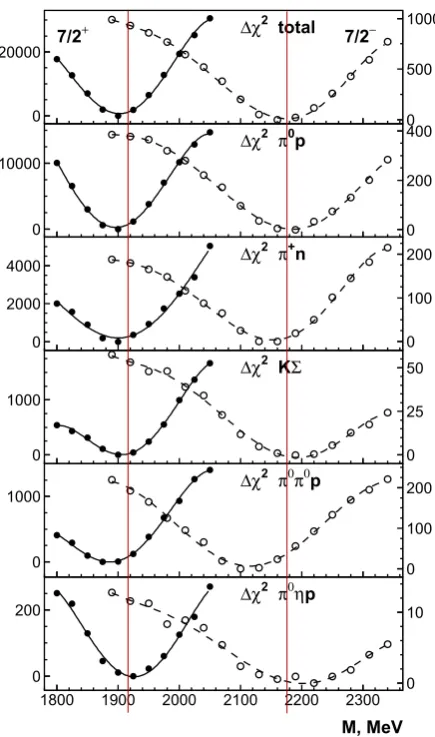
Figure 12. The increase in pseudo-χ2 of the fit to a large
body of pion- and photo-produced reactions when the mass ofΔ(1950)7/2+(solid points) orΔ(2200)7/2−(open circles) is scanned. The scale on the left (right) abscissa refers to the 7/2+ (7/2−) partial wave. The curves are to guide the eye [121]. The red line indicate the mass as obtained by the fit as given in Ta-ble 6.
shows a scan in the JP = 7/2+ and JP = 7/2− partial
waves. In the mass scans, theJP =7/2+andJP = 7/2−
partial waves are described by multichannel Breit-Wigner amplitudes rather than by K-matrix amplitudes. Hence the optimal parameters in the scan for mass and width can dif-fer from the optimal values from the main fit. Figure 12 (top) shows the change of the resulting pseudo-χ2 as a function of the imposed mass of the JP = 7/2+ or the
JP =7/2−resonance. The total pseudo-χ2has clear min-ima at a mass of about 1900 MeV for JP = 7/2+ and
somewhat below 2200 MeV for JP = 7/2−. The scans demonstrate clearly that the masses ofΔ(1950)7/2+ and Δ(2200)7/2−are different. Both resonances are seen with compatible masses inπN, KΣ,π0π0p, and even inπ0ηp. The properties of the resonances as derived in these fits are listed in Table 6. A 7/2−-state mass degenerate with Δ(1950)7/2+has been found in none of the reactions. The Δ(2200)7/2−observed confirms a 1-star-state given in the
Table 6.Properties ofΔ(1950)7/2+andΔ(2200)7/2−: Breit-Wigner masses, widths, helicity amplitudes and branching
ratios. The RPP estimates are given as small numbers. The helicity couplingsA1/2,A3/2are given in units of 10−3GeV−1/2
(see [121]).
Δ(1950)7/2+ **** Δ(2200)7/2− *
M=1917±4 Γ=251±8 MeV M=2176±40 Γ=210±70 MeV 1915 - 1950 235 - 335
A1/2=-67±5 A3/2=-94±4 A1/2=60±20 A3/2=20±8
-76±12 -97±10
Nπ46±2% ΣK0.6±0.2% Nπ3.5±1.5% ΣK 4±3% 35 - 45 seen
Δπ 5±3% Δπ - Δπ70±15% Δπ15±10% 20 - 30 seen
Δη0.3±0.3% Δη - Δη∼1% Δη
--0.5 0 0.5
W=2040
-0.5 0 0.5
-1 -0.5 0 0.5 1
W=2085
T(γp→pπ0) (CB-ELSA)
cos θ
-0.5 0 0.5
W=2109
-0.5 0 0.5
W=2191
-0.5 0 0.5
-1 -0.5 0 0.5 1
W=2227
E(γp→nπ+) (CLAS)
cos θ
Figure 13. Selected data and fits. Data: Target asymmetry T [115, 116]; helicity dependenceE[119]. Best fit: solid curve, fit withoutΔ(2200)7/2−: dotted curve. The fit deteriorated by Δχ2=597 whenΔ(2200)7/2−was removed.
RPP. The PDG decided to upgrade Δ(2200)7/2−to a 3* resonance [120].
The resonances withJP =1/2±,3/2±,5/2±are nearly
mass-degenerate. The ideas of Glozman require
necessar-ily aΔ7/2−resonance at about the same mass [114]. For such a resonance, there is no evidence at all!
Fig. 13 shows examples for data bins in comparison to the best fit achieved with or without including a negative parityJ=7/2,Δ(2200)-state. The data description clearly improves if the 7/2−-state is included in the fit. Further examples for polarization observables and more analysis details can be found in [121].
L+N M2 (GeV2)
N=1 N=0
0 1 2 3 4 5 6
0 2 4 6 8
Δ3/2+(1232)
Δ3/2+(1600)
Δ1/2+(1750)
Δ3/2−(1700)
Δ1/2−(1620)
Δ5/2−(1930)
Δ3/2−(1940)
Δ1/2−(1900)
Δ7/2+(1950)
Δ5/2+(1905)
Δ3/2+(1920)
Δ1/2+(1910)
7/2+
Δ5/2+(2200)
3/2+
1/2+
Δ7/2−(2200)
Δ5/2−(2223)
Δ9/2−(2400)
7/2−
Δ5/2−(2350)
3/2−
Δ11/2+(2420)
Δ9/2+(2300)
Δ7/2+(2390)
5/2+
11/2+
9/2+
7/2+
5/2+
11/2−
9/2−
Δ13/2−(2750)
11/2−
9/2−
7/2−
Δ15/2+(2950)
13/2+
11/2+
9/2+
Figure 14. Mass ofΔresonances as a function of the leading intrinsic orbital angular momentumL and the radial excitation quantum numberN(corresponding tonρ+nλin quark models).
Resonances assigned toN = 0 andN =1 are listed above or below the trajectory. The solid line represent a linear trajectory. Figure taken from [126]
interaction. His empirical mass formula [122] was derived in AdS/QCD [123], and was shown to be, compared to quark models requiring a much larger number of parame-ters, at least twice as precise in calculating baryon masses, using just two parameters [124]. In Ref. [125], Klempt pointed out that theΔ7/2−mass is decisive for the inter-pretation. In string models, the mass increases withL+N instead of the harmonic oscillator which suggestsL+2N (L=lρ+lλ,N=nρ+nλ). Evidence for the string like be-havior was presented in [126] from which we take Fig. 14 to demonstrate theL+N dependence of baryon masses. The future will tell us whether the next-generation lattice calculations performed at lower pion masses will provide results closer to the experimental findings: will there be parity doublets for most resonances, except for those on the leading Regge trajectories?
3.6 Photoproduction ofωmesons
At high energies, real or virtual photons interact with pro-tons by diffraction [127]. The photon converts into a vec-tor meson (ρ0, φ, ω) and scatters off the proton by the exchange of Pomerons carrying the quantum numbers of the vacuum [128, 129]. Close to theωproduction thresh-old,N∗resonances are likely to contribute to the reaction [130, 131]. The Gießen group pioneered the PWAs of the reactionsπ−p→ωnandγp→ωp[60], see project B.7.
The CLAS collaboration reported a high-statistics study ofω photoproduction [133, 134] and claimed ev-idence for several N∗s decaying into Nω. The A2-collaboration at MAMI reported differential cross sections from threshold to Eγ = 1.4 GeV with a 15 MeV binning and full angular coverage [135]. No resonant contribu-tions were discussed. The CBELSA/TAPS collaboration measureddσ/dΩand spin density matrix elements [136], the beam asymmetryΣ[132], the helicity differenceE, and the correlationGbetween linear photon and longitudinal target polarization [137]. Photoproduction of ω mesons offneutrons was studied in [138].
-1 -0.5 0 0.5 1
1745 E
1796 1847 1898
-1 -0.5 0 0.5 1
1946 1994 2041 2086
-1 -0.5 0 0.5 1
2131
0 0.5 -0.5
2174
0 0.5 -0.5
2217
0 0.5 -0.5
2259
0 0.5 -0.5
cos θω
Figure 15. The helicity asymmetryEin bins of the photon en-ergy, taken from [137].
Table 7.Branching ratios (B.R. in %) forN∗→Nωdecays from the BnGa PWA, see [62]. Small numbers were reported in [60]. Theδ(χ2) values give the change inχ2when theNωdecay
mode is excluded.
Resonance B.R. δ(χ2) Resonance B.R. δ(χ2)
N(1700)3/2− 22±12 100 N(1900)3/2+ 15±8 70 13±9
N(1710)1/2+ 2±2 26 N(2000)5/2+ 18±8 42 8±5 1±1
N(1720)3/2+ 26±14 105 N(2060)5/2− 4±3 37
N(1875)3/2− 13±7 98 N(2100)1/2+ 15±10 78 20±4
N(1880)1/2+ 20±8 33 N(2150)3/2− 12±8 99
N(1895)1/2− 28±12 100 N(2190)7/2− 14±6 131
[GeV] γ E
1.5 2 2.5
b]
μ
[
σ
0 5 10
W [GeV]
1.8 2 2.2
Figure 16. Total cross section for γp → pω from the CBELSA/TAPS experiment (•) as a function of the initial pho-ton (Eγ) and center-of-mass (W) energy, see [62, 136]. The error bars represent the statistical, the grey band the systematic un-certainty. The Bonn-Gatchina fit is represented by a solid black line. The largest contributions are Pomeron-exchange (red), res-onant production of theJp=3/2+partial wave (blue), 3/2−
Figure 17. Left: The total cross section forγn→ηn(multiplied by 3/2),γp→ηp, and their ratio (as inset) [150] . The solid curves represent our fit [88] folded with the experimental resolution (thickηn, thin ηp), the dashed curves the contributions from theS11
waves. Right: Selected differential cross section bins forγn→ηnin the region of the narrow structure.
The data were included in the BnGa data base. Fig-ure 15 shows the helicity differenceE with the BnGa fit. The PWA identified twelve N∗ → Nω branching ratios (see Table 7); most of these were determined for the first time. The total cross section, shown in Fig. 16, is obtained by integration of the differential cross sections. Fig. 16 also shows the dominant partial wave contributions.
Only N∗ contribute to γp → ωp. Δ∗ decays can be studied in the process γp → π0ωp to which the isobar
Δ(1232)ω makes the most significant contribution [139].
Similarly, the reaction γp → K∗Λ has no Δ∗ contribu-tions [140]. Instead, the BnGa PWA finds contribucontribu-tions fromN(1895)1/2−,N(1880)1/2+,N(2100)1/2+, and two or three higher-mass N∗’s with ill-defined quantum num-bers. N∗andΔ∗both contribute toγp→K∗Σ[141] but a PWA has not been attempted.
3.7 Is the narrow peak seen in the reaction
γn→ηna resonance?
The “discovery” in 2003 of Θ+(1540), an exotic baryon with positive strangeness stimulated further studies [142– 145] and the search for its non-strange partner. Indeed, a narrow structure was observed in the reaction γn →
ηn studied at GRAAL [146]. Its properties, mass of 1685 MeV, its narrow width, the production offneutrons but not off protons, and its preference to decay into ηn would be consistent with predictions for the nonstrange member of a multiplet of pentaquarks with spin-parity JP =1/2+[142]. The observation attracted considerable interest, and the structure was listed in the RPP as one–star resonanceN(1685) [71].
The evidence for the existence of Θ+(1540) faded away in a number of precision experiments (even though further evidence is reported in several more recent ex-periments, see [147] for a recent review. In contrast to Θ+(1540), the peak at about 1685 MeV became
increas-ingly significant with better experiments at ELSA and MAMI [148–150], its existence is beyond doubt. But the interpretation as a resonance is unclear.
The Gießen group explained the narrow peak in the η photoproduction on the neutron in terms of coupled-channel effects due to N(1650)1/2− and N(1710)1/2+ [151]; Shyam and Scholten interprete the peak by interference effects between the N(1650)1/2−, N(1710)1/2+, andN(1720)3/2+ resonances [152] within a coupled-hannel analysis; Döring and Nakayama ascribe the peak to effects from strangeness threshold openings [153]. The Bonn-Gatchina group [154, 155] and Zhong and Zhao [156] demonstrated that the narrow peak can be explained naturally by interference effects in theJP = 1/2−wave, even though - according to [154, 155] - solu-tions with a narrow resonance were not yet excluded by the data.
Fig. 17 shows the total cross section forγp → ηp, for γn → ηn and - as insert - the ratioσn/σp from the most recent experiment [150]. The new data exceed the earlier data both in quality and in statistics. In the new experiment, the hit proton or neutron was detected, and hence the Nη invariant mass was reconstructed without smearing due to the Fermi motion. These experimental achievements greatly enhanced the visibility of the narrow structure. The contributions fromη photoproduction off neutrons were determined by two different methods; the differences were used to estimate the systematic error.
In [150], the narrow structure was tentatively inter-preted as a narrow nucleon resonance at W = (1670± 5) MeV mass and Γ = (30±5) MeV width. The prod-uct coupling of the hypothesized resonance given by its helicity amplitude An
1/2 and the branching ratio for its
neutron-ηdecaybηwas determined to bηAn
1/2 =(12.3±
The data were fitted within the Bonn-Gatchina partial-wave analysis [88]. Masses, widths, decay couplings of resonances were all frozen by a fit toπN elastic and in-elastic reactions and to data on photoproduction off pro-tons (see [49, 159] for the data included). Here, only the helicity amplitudes for the photoproduction of nucleon resonances offneutrons and contributions fromt- andu -channel exchange were used as free parameters. To con-strain the data onγn → ηnfurther, we included GRAAL data on the beam asymmetry for this reaction [157] and data onγn → πN[158]. These additional data were de-scribed well and have no impact on the conclusions; hence we retain from a more detailed discussion of those data.
The new and precise data are well described by the interference within the S11 wave and are now definitely incompatible with the existence of a nucleon resonance with the reported properties. If a narrow resonance with the properties reported in [150] is imposed in the fit, the
χ2 of the fit deteriorates very significantly. The reason for the peak structure inηn and dip structure inηp lies in the opposite relative sign of the helicity amplitudes for the two resonancesN(1535)S11andN(1650)S11. The nar-row structure observed in photoproduction ofηmesons off neutrons does not support the existence of a nucleon reso-nance with exotic properties. We mention that data onη production offneutrons [89] do not show a similar struc-ture.
3.8 What is the relation between quark-model resonances and dynamically generated resonances?
A significant number of nucleon resonances can be gener-ated dynamically from the interaction of their decay prod-ucts. In coupled-channel dynamical approaches, some baryon resonances need to be put in “by hand”, others are generated by the unitarization of the background ampli-tude. Some of the dynamically generated poles can be identified with quark-model states. But there are poles which do not correspond to quark mode states, and there are resonances which are not (yet?) dynamically gener-ated. The relation between quark-model resonances and dynamically generated resonances remains an unsolved problem in hadron spectroscopy.
3.9 Photoproduction multipoles from different PWA groups
Amplitudes are more sensitive when different models are to be compared. In [160] we have reported transition am-plitudes toΛK,ΣK, andNηfor pion and photo-produced reactions. Fig. 18 shows, as example, the BnGa-E0+ and the E2− multipoles for π0 photoproduction before (2011, red) and after (2014, blue, for further multipoles see [115, 116]) the inclusion of the new double polariza-tion data onE,G,T,P, andH.
The error bands for the BnGa2011 solutions (red) were derived from the (1σ) spread of 12 different solutions with different assumptions on the ingredients: the number of
poles in theJP =3/2+wave was 3 or 4, in theJP =5/2+
wave 2 or 3, theN(1700)3/2−width of the pole converged to a wide (∼600 MeV) or a narrow (∼250 MeV) value, a K-matrix formalism was used or, alternatively, aN/D-based parametrization [62]. The χ2 ranged from its minimum
χ2 min toχ
2
min +800. (Note that the absolute χ
2 value is
meaningless since part of the data are multiparticle final states and fitted in an event-based likelihood fit. The log likelihood value is then converted into a pseudo-χ2[49].)
In the new fits including the new polarization data, the fits started from the same solutions, then all parameters were re-optimized. All fits converged, but 6 fits resulted in aχ2larger than the newχ2-minimum (χ2
new min) by 1000 units or more. These fits, mostly those with only 3 poles in theI=1/2,JP =3/2+wave, were then removed from
the error analysis. The resulting error bands for all remain-ing solutions within the sameχ2-boundaries as for the old solutions are also shown in Fig. 18.
The new error bands (blue) are significantly smaller than the previous ones. Averaged over all multipoles and energies, the errors are reduced by a factor of 2.25.
Fig. 19 shows the new double-polarization data from JLab and Bonn with fits from MAID , SAID, JüBo, and BnGa, for fits which were made before the data were avail-able (left) and with the new data included (right). Large deviations are observed even at lower photon energies, where one might have expected that π0-photoproduction is well understood. After a refit, all PWAs are capable to describe the new data.
In Fig. 20 (left) the E0+-multipoles from MAID,
SAID, JüBo, and BnGa are shown (for further multipoles see [161]). It is striking that even at low energies, large differences between all four solutions are seen. Obviously, the data that existed prior to the double polarization
mea--8 -6 -4 -2 0 2 4
1200 1400 1600 1800 2000 2200 2400
Re π0p[mfm]
Wcm[MeV] E0+
-2 0 2 4 6 8 10 12
1200 1400 1600 1800 2000 2200 2400
Imπ0p[mfm]
Wcm[MeV] E0+
-8 -6 -4 -2 0 2
1200 1400 1600 1800 2000 2200 2400
Re π0p[mfm]
Wcm[MeV] E2−
-4 -2 0 2 4 6
1200 1400 1600 1800 2000 2200 2400
Imπ0p[mfm]
Wcm[MeV] E2−
Figure 18. Multipole decomposition of theγp → pπ0

![Figure 3. Dalitz plots (taken from [76]) for the reactionstates(CBELSAπ γp →0ηp for the mass range 2000 ± 100 MeV and 2200 ± 100 MeV/TAPS-data)](https://thumb-us.123doks.com/thumbv2/123dok_us/8150226.1359061/5.595.54.285.83.203/figure-dalitz-plots-taken-reactionstates-cbelsap-range-taps.webp)
![Table 2. Branching ratios BR forphoton helicity amplitudesare given in units of GeVbelow the helicity amplitudes give either the RPP [87] estimatenucleon resonances (taken from [82])](https://thumb-us.123doks.com/thumbv2/123dok_us/8150226.1359061/6.595.318.527.150.254/branching-forphoton-helicity-amplitudesare-gevbelow-amplitudes-estimatenucleon-resonances.webp)

![Table 4. resonances assigned to the third excitation shell. The masses of nucleon resonances are from our work, most Δ Nucleon and Δ resonances from [96], one from [15]](https://thumb-us.123doks.com/thumbv2/123dok_us/8150226.1359061/9.595.66.533.77.429/table-resonances-assigned-excitation-nucleon-resonances-nucleon-resonances.webp)


![Figure 17. Left: The total cross section forwaves. Right: Selected di γn → ηn (multiplied by 3/2), γp → ηp, and their ratio (as inset) [150]](https://thumb-us.123doks.com/thumbv2/123dok_us/8150226.1359061/13.595.109.488.80.276/figure-total-section-forwaves-right-selected-multiplied-inset.webp)
