Factors Affecting the Performance of Construction
Projects: A Survey of Construction Projects in the
Coastal Region of Kenya
Peter Orero Nyangwara *, Evelyn Datche **
*
Jomo Kenyatta University of Agriculture and Technology Mombasa CBD, P.O BOX 81310-80100 Mombasa
**
Jomo Kenyatta University of Agriculture and Technology Mombasa CBD, P.O BOX 81310-80100 Mombasa
Abstract- Project performance is a critical issue for the construction industry. Project deliverables such as timely completion and client satisfaction are often used as yardsticks to determine success. More often than not, the success of a construction project hinges on the ability of the construction project manager to effectively perform his job functions with the intended efficacy. Because the industry has complexity in its nature because it contains large number of parties as clients, contractors, consultants, stakeholders, shareholders, regulators and others. Construction projects in the Coastal region of Kenya suffer from many problems and complex issues in performance some of which includes cost, time and safety. As such this research evaluated firstly evaluate the factors affecting the performance of construction projects in order to assist owners, consultants and contractors to overcome performance problem and to improve performance of their construction projects secondly to determine the influence to which the external environment affects performance of construction projects thirdly to identify the most significant project procedures that affect performance of projects and lastly to evaluate project management actions project performance. Respondents comprising of project managers clients, contractors and consultants in construction firms throughout the coastal region of Kenya were selected as the sample population. Questionnaires were then distributed and collected from the sampled population respondents. Gathered data was analyzed to identify those factors that affect the performance of construction projects in the Coastal region of Kenya.
A questionnaire survey was conducted and 40 factors were identified, categorized into 8 groups, evaluated and ranked from owners, consultants and constructors perspectives. 180 questionnaires were distributed to owners, consultants and contractors. 132 questionnaires were received. The most important factors agreed by the owners, consultants and contractors were: average delay because of closures and materials shortage; availability of resources as planned through project duration; leadership skills for project manager; escalation of material prices; availability of personals with high experience and qualification; and quality of equipment and raw materials in project.
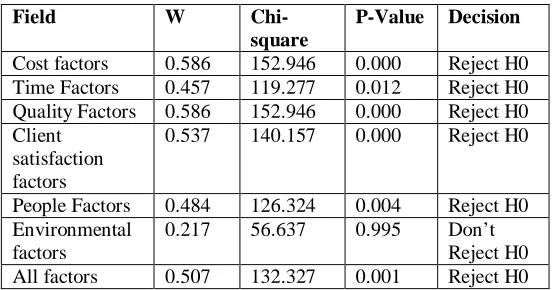
The degree of agreement between parties regarding the ranking of factors was determined according to Kendall's Coefficient of Concordance. For Cost, Time, Quality, Productivity, Client Satisfaction, People, Innovation and learning factors, and all groups together, there is a significant degree of agreement among the owners, consultants and contractors. On
the other hand, for Regular and community satisfaction, and Environment factors, there is disagreement of agreement among the owners, consultants and contractors.
The practices concerning with the Project performance such as time, cost, project owner satisfaction and people were analyzed in order to know the main practical problems of projects performance in the coastal region of Kenya and then to formulate recommendations to improve performance of construction projects in the coastal region of Kenya. It was concluded that projects were delayed and the actual cost of projects was more than the estimated cost because of coastal region of Kenya political conditions and delayed payments which results to unavailability of materials. Overall project safety factors had been moderately implemented in construction organizations.
It is recommended for construction organizations to have a clear mission and vision to formulate, implement and evaluate their performance. A structured methodology and technique should be identified to overcome the effect of economic situations on the performance of construction projects in the coastal region of Kenya. In addition, it is recommended to develop human resources in the construction industry through proper and continuous training programs about construction projects performance. It is necessary for construction organizations in Coastal region of Kenya to evaluate both of market share and liquidity before implementation of any construction project because of difficult economic situation. All of that will assist organizations to perform projects successfully and strongly.
Index Terms- Project planning, project performance indicators, construction projects project performance
I. INTRODUCTION
supplied mainly by the business services industry in the service sector; most of the funds required for construction are supplied by the financial services industry in the service sector; and a significant part of the output supplied by the construction sector is delivered to the real estate industry in the service sector” (Bon 1992).
Construction industry plays a major role in development and achievement the goals of society. Construction is one of the largest industries and contributes to about 10% of the gross national product (GNP) in industrialized countries (Navon, 2005).Construction industry has complexity in its nature because it contains large number of parties as clients, contractors, consultants, stakeholders, shareholders and regulators. The performance of the construction industry is affected by national economies. Output from the construction industry is a major and integral part of the national output, accounting for a sizeable proportion in the Gross Domestic Product (GDP) of both developed and underdeveloped countries (Crosthwaite, 2000). Lowe (2003) further stated that the value added of construction is in the range of 7% to 10% for highly developed economies and around 3% to 6% for underdeveloped economies
Worldwide Construction Industry
The construction industry is the sector involved with erection, repair and demolition of buildings and civil engineering structures in an economy. A definition typical of national income accounts in use in most advanced industrialized countries is as follows: the construction industry entails “the assembly of building materials and/or components on site; the materials and components are supplied by a variety of industries in the manufacturing sector; they are delivered to the site by the transportation and trade sectors; the assembly proceeds in accordance with plans, designs, and management procedures supplied mainly by the business services industry in the service sector; most of the funds required for construction are supplied by the financial services industry in the service sector; and a significant part of the output supplied by the construction sector is delivered to the real estate industry in the service sector” (Bon 1992: 120).
The role of the construction industry in the socio-economic development of a country cannot be overemphasized. The industry provides constructed physical facilities which provide space where other activities may take place (Hillebrandt 2000). The monetary value of all the buildings and civil engineering works produced by the industry in a given period of time - normally a year – is referred to as the gross output of the construction industry. In the world as a whole, this output is probably about 10% of the Gross National Product (GNP), on average (Hillebrandt 2000). Although the percentage contribution of construction output to GNP varies considerably amongst various economies and geographical locations, this overall average contribution is large enough to justify a rigorous investigation of the dynamics of workload in the global construction industry. The trend of the relative volume of construction output (i.e. relative to the Gross Domestic Product [GDP] in a country evolves as the country develops from being a less developed country (LDC), through being a newly industrialized country (NIC), and into being an advanced industrialized country (AIC).
Excessive fluctuations in construction output, and by implication, demand have very adverse effects on the reputation of the industry as a whole, the business performance of construction firms and the employment of the industry’s production resources.
Construction Industry of Kenya
Kenya lies across the equator on the East coast of Africa. From the map, it can be observed that it borders Somalia, Ethiopia, and Sudan to the North, Uganda to the West, Tanzania to the South and the Indian Ocean to the East. Kenya's current development status could be viewed in light of its post independence history. Kenya used to have one of the most prosperous economies in East Africa but due to government mismanagement and corruption this has led to an erosion of it's former pre-eminence (www.worldbank.org1kenya 2007). Since 2003, the new government's reform efforts have brought a return to economic growth and have made some inroads against corruption (www.worldbank.orglkenya 2007), however, recent events have caused much of the Kenyan public, and the international community to question the depth of progress made. From independence in 1964 to 1980, the average GDP growth rates of six point five percent reflected the pragmatic policies of Kenya's founding President Jomo Kenyatta. During much of this period, the Kenyan public witnessed a buoyant economy, international community support, investor confidence thrived and communities contributed in cash and the co-operative movement allowed small-scale farmers to participate in the formal economy. The results were impressive. Agriculture thrived through a relatively open and export oriented trading system that also gave ``1pre-eminence to the development of a smallholder sector that produced both food crops and major export commodities.
Kenya is a developing country in East Africa, with a population of about 40 Million people, a Gross Domestic Product (GDP - purchasing power parity) of US Dollar 40.77 Billion and a GDP growth rate of 5.5% (CIA2007). Historically, Kenya’s economy was mainly agricultural – with agriculture contributing over 50% of the GDP and providing employment of over 80% of the working population (Mbaya 1984) - up to early this decade. Today, though agriculture employs 75% of the country’s labour force, its contribution to the GDP is 16.3%, and is lower than contributions of industry or services, which are 18.8% and 65%, respectively (CIA 2007).
Infrastructural support for the country’s economy is provided by the construction industry by way of buildings (housing, office space, retail space, factories, etc) roads, railways, irrigation schemes, water supply schemes etc.
Central Bureau of Statistics, the construction industry in Kenya contributes 7 percent of the gross domestic product (GDP). Similar to the case with other developing countries, the Kenyan construction industry shares many of the problems and challenges the industry is facing in other developing countries, perhaps with greater severity. Given the critical role the construction industry plays in Kenya and other developing countries, and the poor level of performance of the industry in those countries, improving the performance of the industry ought to be a priority action. As contractors are one of the key players in the industry and the makers of the final product, any development and improvement initiatives in the industry has to consider ways of improving the capacity and capability of the contractors.
Previous, research works by [Adams, (Long (2004) and others] have indicated poor managerial capability of contractors to be one of the critical problems of the construction industry in developing countries. Thus, improving the managerial capability of contractors need be one of the priority considerations for improvement of capability of contractors in developing countries. Researches by (Dlungwana & Rwelamila, 2004), and others have also strongly emphasized the importance of improving the management skills of contractors. As most of the works of contractors is managed as a project, improving the contractors‟ project management capability can significantly contribute to the overall improvement of contractors‟ capability to deliver successful project. There are many realistic reasons such as closures, amendment of drawings and amendment of the design. In addition, there are other different reasons affecting construction projects performance in Coastal region of Kenya such as poor management and leadership; inappropriate participants; poor relations and coordination; absence of motivation, control, monitor or decision making systems; inadequate infrastructure, political problems; cultural problems and economic conditions (The United Nations Relief and Works Agency, UNRWA, 2000).
While individual organizations have been measuring their performance for many years, there has been little consistency in the data, and the way it has been published. The performance can be measured by key indicators for evaluation. The purpose of Key performance indicators (KPIs) is that clients want their projects delivered: on time, on budget, free from defects, efficiently, right first time, safely, by profitable companies. So, Regular clients expect continuous improvement from their construction team to achieve year-on-year: reductions in project costs and time. In addition, the Key Performance Indicators (KPIs) can be used for benchmarking purposes, and will be a key component of any organization move towards achieving best practice. Clients, for instance, assess the suitability of potential suppliers or contractors for a project, by asking them to provide information about how they response to a range of indicators. Some information will also be available through the industry benchmarking initiatives, so clients observe how potential suppliers compare with the rest of industry in a number of different areas. Construction supply chain companies will be able to benchmark their performance to enable them to identify strengths and weaknesses, and assess their ability to improve over time. The KPIs framework consists of seven main groups:
time, cost, quality, client satisfaction, client changes, business Performance, health and safety (DETR, 2000)
In Coastal region, there are many construction projects that are failing in performance. In addition, performance measurement systems are not effective or efficient to overcome this problem. Construction projects performance problem appears in many aspects in the Coastal region. There are many constructed projects fail in time performance, others fail in cost performance and others fail in other performance indicators.
Statement of the Problem
It is shown from previous studies (KPI Report),2000; Lehtonen, 2001; Samson and Lema, 2002; Kuprenas, 2003; Cheung, 2004; Iyer and Jha, 2005; Navon, 2005; Ugwa and Haupt, 2007) that the failure of any project is mainly related to the problems and failure in performance. Moreover, there are many reasons and factors which attribute to such this problem. In the Coastal region of Kenya, there are many construction projects which are failing in performance. In addition, performance measurement systems are not effective or efficient to overcome such this problem.
Despite the construction industry’s significant contribution to the economy of developing countries and the critical role it plays in those countries’ development, the performance of the industry still remains generally low. As Idoko, (2008) noted, many projects in developing countries encounter considerable time and cost overruns, fail to realize their intended benefit oreven totally terminated and abandoned before or after their completion Moreover, the development of the construction industry in developing countries generally lags far behind from other industries in those countries and their counter parts in developed nations. Generally, as [Ofori, (2006) & Jekale, (2004)] concluded, The construction industry in developing countries failed to meet expectations of governments, clients and society as a whole.
Similar to the case with other developing countries, the Kenyan construction industry shares many of the problems and challenges the industry is facing in other developing countries, perhaps with greater severity. Given the critical role the construction industry plays in Kenya and other developing countries, and the poor level of performance of the industry in those countries, improving the performance of the industry ought to be a priority action. As contractors are one of the key players in the industry and the makers of the final product, any development and improvement initiatives in the industry has to consider ways of improving the capacity and capability of the contractors.
overall improvement of contractors’ capability to deliver successful projects.
In the Coastal region of Kenya, construction projects performance problem appears through different directions. There are many constructed projects fail in time performance, others fail in cost performance and others fail in other performance indicators. In the recent past there has been many projects which are finished with poor performance because of many evidential reasons such as: obstacles by client, non-availability of materials, roads closure, amendment of the design and drawing, additional works, waiting the decision, handing over, variation order, amendments in Bill of Quantity and delay of receiving drawings (The United Nations Relief and Works Agency, UNRWA, 2007). In addition there are other indicators of performance in the Coastal region of Kenya such as project managers, coordination between participants, monitoring, feedback and leadership skills. However, there are three important issues related to failures and problems of performance in the Coastal region of Kenya which are political, economic and cultural issues. Therefore, this research will evaluate the factors affecting the performance of construction projects in the Coastal region of Kenya in order to assist owners, consultants and contractors to overcome performance problem and to improve performance of their construction projects. Hence, performance of any construction projects can be evaluated according to key performance indicators.
Research Objectives General Objective
The aim of this research is to analyze the local factors affecting the performance of construction projects in the Coastal region of Kenya.
Specific Objective
1. To determine the influence to which the external environment affects the performance of construction projects in the Coastal region of Kenya
2. To identify the most significant project procedures that affect performance of construction projects in the Coastal region of Kenya
3. To evaluate the project management actions that affect project performance in the Coastal region of Kenya.
4. To determine the influence to which the project related factors affects the performance of construction projects in the Coastal region of Kenya
II. LITERATUREREVIEW
Theoretical Framework for Factors Affecting Project performance
The various variables affecting the factors are identified in this section. Variables within each group are interrelated and intra-related. A variable in one group can influence a variable in the others, and vice versa. To study how these factors affect project performance separately and collectively, it is hypothesized that Project performance is a function of project-related factors, project procedures, project management actions, human-related factors and external environment
and they are interrelated and intra-related.
Figure: 2.1 (sources: Albert P. C. Chan; David Scott; and Ada P. L. Chan) Human Related Factors
• Client’s experience
• Nature of client-private or public
• Client’s emphasis on high quality of construction
• Client’s emphasis on quickly construction
• Client ability to brief
• Client’s ability to make decision
• Client’s to make roles
• Client’s contribution to design
• Client’s contribution to construction
• Project team leader’s experience
• Technical skills of project team leaders
• Organizing skills of project team leaders
• Coordinating skills of project team
• Motivating skills of project team leader
•
PROJECT
PERFOMANCE
Project related factors
• Type of project
• Nature of project
• Complexity of project
• Size of project
roject Management Actions
• Communication systems
• Control mechanisms
• Feedback capabilities
• Planning effort
• Implication an effective quality assurance
• Overall managerial actions
• Control sub contractors works
• Developing appropriate
• organizational structure
• Implementing effective safety system
Project procedures
• Procurement process
• Tendering process
External Environment
• Economic environment
• Social Environment
• Physical environment
• Industrial relations
Empirical Literature
Brown and Adams (2000) presented a new approach to the measurement of the effect of Building Project Management (BPM) on cost, time and quality performance outputs using 15 cases' derived from UK data and by developing a path model in order to achieve that. Chan (2001) studied the cost time relationships in public sectors in Malaysia. Time and cost data were collected from 51 public sector projects. Regression analysis was used to identify the relations between time and cost performance. Kuprenas (2003) studied over 270 completed municipal facilities, storm water, sewer, and street projects within the city of Los Angeles as a case study in order to assess the impact of the use of a project management based organizational structure, project manager training, frequency of design meetings, and frequency of design reports on design phase cost performance.
Iyer and Jha (2005) studied that the factors affecting cost performance by considering a questionnaire survey approach. Love et al (2005) examined project time-cost performance relationships by using project scope factors for 161 construction projects that were completed in various Australian States and using multiple regression technique of weighted lest squares. Ugwu and Haupt (2007) studied the key performance indicators and proposed an analytical decision model and a structured methodology for sustainability appraisal in infrastructure projects in a developing country like South Africa. The research was conducted using a combination of structured interviews with industry professionals, case study project data, existing government guidelines on environmental impact assessments and sustainable construction environment, literature on sustainability research, and question naire based survey for indicator validation. It is used the .weighted sum model. Technique in multi-criteria decision analysis (MCDA) and the .additive utility model. In analytical hierarchical process (AHP) for multi- criteria decision.
Dissanayaka and Kumaraswamy (1999) developed a comprehensive model to incorporate all significant procurement sub-systems variables with non procurement variables based on time and cost performance. The multiple regression technique was applied to analyze the data from 32 Hong-Kong building projects and the results were compared with reality. Lehtonen (2001) proposed new framework for measuring construction logistics. Two-dimensional model are grouped by the use of measures and by the focus of measures. The first dimension (use of measures) contains two kinds of measures. One of them is called improvement measures and the other kind is called monitoring measures. The second dimension of the framework is the focus of measures. It clarifies at which organizational level measures can be used.
2002; Kuprenas, 2003; Cheung, 2004; Iyer and Jha, 2005; Navon, 2005; Love et al, 2005; Ugwa and Haupt, 2007) to identify the factors affecting the performance of construction projects. In addition, there are other local factors that have been
added as recommended by local experts such as escalation of material prices, differentiation of shilling prices against the dollar, average delay because of closures and material shortage, neighbors and site condition problems, belonging to work and location of project. 63 factors affecting performance of construction projects are selected. These factors are grouped into 10 groups based on literature review. These groups can give a comprehensive summary of the main key performance indicators. The factors, which are considered in the questionnaire, are summarized and collected according to previous studies and other factors are added as recommended by local experts as shown in Table 3.1.
(Omar Osman, 2006). The success of a project is a very critical issue in the industry. Research has been vigorously done on successful projects in the hopes to discover the factors that contribute towards achieving project success. Sayles and Chandler (1971) have listed five critical success factors for construction projects, which are namely, the efficiency of the project manager, the appropriate scheduling of activities, a systematic responsibility and monitoring approach, project supervision and finally continuous project involvement. Martin (1976) on the other hand has identified eight success factors of a project, entailing comprehension of objective, the organizational philosophy, management support, apt job delegation and scope, selection of project team members, sufficient allocation of resources, a practical information mechanism and a review of project planning.
Morris and Hough (1987) through their study have come up with nine project success factors. These factors include a clear project objective, innovativeness towards technological change, community participation, priority based scheduling, finance, legal requisites, contractual ties and problem solving. It is clear that there are numerous factors that can be attributed to project success with a few factors that are mutually emphasized by various researches. These common factors are task and activity scheduling as well as the clear comprehension of a project’s objectives. What this study intends to do is to extend these factors to include a vital cog in the implementation of any construction project, i.e., the project manager.
Fryer (1985) has listed skills that a project manager should possess in influencing the success of project, namely skills pertaining to social interaction, decision-making, problem handling, adeptness in identifying opportunities and the ability to adopt managerial change. But the fact remains, a majority of projects still report poor performance even with the presence of capable project manager. This leads to the notion that individual capacity and inherent skills of the project manager alone is insufficient to guarantee project success.
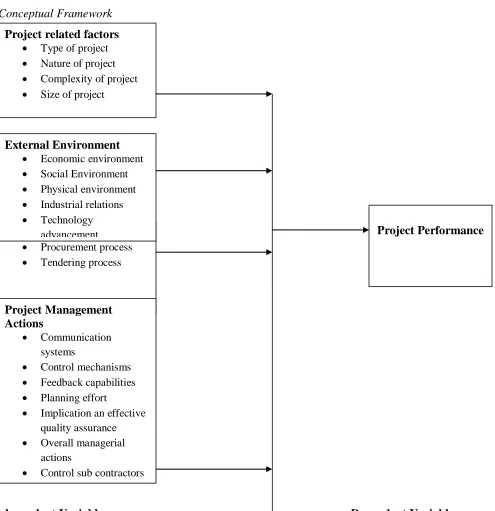
Conceptual Framework
[image:7.612.45.540.80.591.2]Independent Variable
Dependent Variable
Figure 2.2: Factors affecting performance of construction project.
A new conceptual framework that includes and regroups the identified variables affecting project performance will be developed. It can be used as a base for further detailed investigation on general construction projects, as well as a specific project, such as hospital or hotel. A more systematic way of determining project performance is established. This paper focuses on the CSFs and not on the measurement of project success, i.e., the key performance indicators~KPIs Further study
should be directed to identify the KPIs, so that the causal relationships between CSFs and KPIs can be identified. The causal relationships, once identified, will be a useful piece of information to implement a project successfully. It can help in selecting project team members, identifying the development needs of the project team members, and most important for forecasting the performance level of a construction project before it commences
Project related factors
• Type of project
• Nature of project
• Complexity of project
• Size of project
Project Performance
Project procedures
• Procurement process
• Tendering process
External Environment
• Economic environment
• Social Environment
• Physical environment
• Industrial relations
• Technology advancement
Project Management
Actions
• Communication systems
• Control mechanisms
• Feedback capabilities
• Planning effort
• Implication an effective quality assurance
• Overall managerial actions
• Control sub contractors
Project Related Factors Project-Related Factors
A general description of success factors is defined as personal characteristics that is necessary to perform the job, such as knowledge, skills and attitude (Nguyen et al., 2004). Lim and Mohamed (1999) define a factor as any circumstance, fact, or influence which contribute to a result” and further describe factors for project success as influential forces which either facilitate or impede project success. While success criteria is the set of conditions necessary to make a judgment of project success, success factors are something that contribute to the project success (Lim and Mohamed, 1999). The relation between success factors, success criteria and project success described by Lim and Mohamed. In a like manner as Pinto and Prescott (1988), Lim and Mohamed suggest that there are sets of factors relevant for each phase of the project life cycle. From the macro viewpoint of success, the conceptual and operational phases form the basis for success factors. Since, it is in these phases that the project gets conceptualized and tested. From the micro point of view, it is the construction phase and the contractual parties’ goals as time, cost, quality and safety that form the basis (Lim and Mohamed, 1999)
External Environment that Influence Performance
Walker and Vines 2000). further described ‘‘environment’’ as all external influences on the construction process, including social, political, and technical systems. The attributes used to measure this factor are economic environment, social environment, political environment, physical environment, industrial relation environment, and level of technology advanced
External Factors
Various researchers support ‘‘environment’’ as a factor affecting the project success (Walker and Vines 2000). further described ‘‘environment’’ as all external influences on the construction process, including social, political, and technical systems. The attributes used to measure this factor are economic environment, social environment, political environment, physical environment, industrial relation environment, and level of technology advanced. Development needs of the project team members, and most important for forecasting the performance level of a construction project before it commences.
According to a research done by Mustapha and Noaum (1997), there are basically five main categories of factors that will influence or affect the overall performance of a project manager. These five categories are as follows:
Factors related to individual and personal characteristics Factors related to work conditions
Factors pertaining to nature of the project and its characteristics Factors concerning the environment
Organizational factors
For the purpose of this study, focus will be given towards the factors of work conditions, nature of project and organizational factors. The second group of factors concerning the nature of project consists of variables pertaining to project environment,
project size, available project duration, project complexity, project team relationships as well as materials and resources. Factors within the organization are made up of variables concerning company size, level of power/authority and type of client.
Project Procedures
Procurement Related Factors that Influence Project Performance
A number of researchers identified the importance of procurement factors(Walker and Vines 2000). defined the scope of procurement as the framework within which construction is brought about, acquired or obtained. Therefore, two attributes are used to measure this factor; they are procurement method (selection of the organization for the design and construction of the project) and tendering method (procedures adopted for the selection of the project team and in particular the main contract Previous studies of Rasid (2006), Eriksson and Westerberg (2009) and Eriksson and Vennstrom (2009) suggest different
procurement related factors that can affect projectperformance. These studies considered different procurement related factors without an area ofcommonalities. reconstruction time, control of project design and cost and client’s control of construction projects are procurement related factors whose influences were found on procurement methods of Traditional, Design and Build and Management Contracting in Malaysia construction industry. Studies of Rasid (2006) also in Malaysia concentrated on allocation of responsibilities, activities sequencing, process and procedure and organizational approach as procurement related factors that affect project performance. Eriksson and Westerberg (2012) indicates important procurement related factors considered at the design stage as bid invitation, bid evaluation, subcontracting. Subcontracting selection, compensation factors and performance evaluation which were termed collaborative procurement procedures were found to have effects on project performance. Eriksson and Vennstrom (2012) also postulate that cooperative procurement procedures of joint specification, limited bid invitation, soft evaluation parameters, joint sub-contractor selection, incentives, collaborative tools, sub-contractor self control and collaboration on project all have various effects on project performance. Procurement related factors identified from these previous studies are also related to selection criteria, tendering methods and variation orders that are considered in this study. Some of these procurement related factors are in ambit of what has been considered in previous studies and hence they are discussed as follows:
Procurement Selection criteria
requirements were measured under cost, time and quality related factors. Project characteristics factors also include project type, size, cost, flexibility, complexity, site risk factors and degree of innovative technology. External environment factors considered are market competitiveness, availability of materials, natural disasters, industrial actions amongst other variables. Client characteristics, project requirements and external factors are considered with general needs for investigating the procurement related factors that affect project performance in this study. Cost related factors of capital cost of the project, maintenance cost, prequalification cost, financial risk amongst other variables can influence a client to select a particular procurement method that meets all these client requirements. Time related factors of planning and design time, construction time, early start of project, speed of construction and time overrun can help client to select an appropriate procurement method. Quality related factors of design reliability, aesthetic appearance of the building, workmanship amongst other variables are considered in this study. General needs factors of involvement of parties, their transparency, accountability, safety requirements and flexibility of the procurement process to client charges are also considered in the study. Project characteristics factors considered in this study are project type, size, cost, degree of flexibility, complexity, time constraints, payment method, finding methods and innovative technology. Moreover, external environment factors considered also include nature of the market, government policies, government as major client, regulating feasibility, technology feasibility amongst other variables. All these above factors can influence the selection of an appropriate procurement method that can also affect project performance.
Tendering Method Related Factors
Tendering is the administrative procedure of sending out drawings and bill of quantities or specification to contractors with the intention to submit a price for the construction of the project.
Besides the price for this project other consideration such as contractor’s competence,financial capability, technical competence and other factors are used in selecting a contractor for executing a construction project. Different tendering methods have been used in construction projects for inviting tenders. According to Ramus (1981), Manthosi and Thawala (2012) and Ganderton (2012) there are various methods such as open selective, negotiation, competitive, openselective, design and build tendering approaches that have been used in construction projects. In addition, serial and two-stage tendering methods have been significantly used also in construction projects. According to Mathonsi and Thawala (2012) the use of open tendering method involves placing an advertisement in a widely read newspaper to invite prospective contractors to tender and it is strongly criticized for its increased cost of processing. Selective tendering in the views of Ramus (1981) involves considering 5-8 competent contractors to be invited to tender for a project. Criteria used in drawing up these competent contractors can include standard of workmanship required, equipment base of the firm, previous business records and financial standing amongst other factors. Selection of contractor through this approach may overcome the deficiencies in open tendering but may lead to higher quotations. Negotiation
approach is used when a firm or client has previous satisfaction association with a contractor and the client is prepared to give the contract to this contractor on bases of reasonable price for the project. Such an arrangement is also used if the project is of specialist nature. This approach is known to save time but may lead to higher prices for the quotation (Ramus, 1981; Ganderton, 2012). Competitive tendering approach is used where various contractors of all categories are welcomed to submit tenders. According to Chinyio (2011) competitive tendering must have three stages of pre-qualification, tender documentation and bidding.
As indicated by Public Procurement Act (2007) competitive tendering in Nigeria is to encourage due process, accountability and transparency but this involves high bidding cost, conflicts of interest as it is not guaranteed that the lowest tender wins the project. Open-selective tendering approach is used as a hybrid of open and selective methods. The Traditional procurement method utilizes open, selective and negotiated tendering approaches to obtain its tenders (Mathonsi and Thawala, 2012). Design and build procurement method utilizes selective tendering method for obtaining tenders from Design-build contractors. According to Chinyio (2011) selective tendering method can be sub-divided into single stage and two-stage tendering methods. Single stage tendering is an approach where one stage of tendering is used while a two-stage tendering method involves a two-stage process of competitive selection of contractor on basis of price and negotiation of contract details and firm price with the contractor appointed at the first stage. On the first stage contractors will be assessed on basis of construction programmes, method statements, pricing of preliminaries, overheads and profits. In the second stage negotiation between the client and the contractor on price is undertaken. If agreed it becomes the contract price (Chinyio, 2011). This approach is advantageous in that it facilitates early appointment of a contractor and it combines strengths of competition and negotiation while its disadvantage is that the preferred contractor may fail to negotiate for the competitive price and negotiation may drag-on and compound the complexity of the process. All these discussed tendering approaches in this section are exploited for this study. Tendering approaches that are used for selecting a contractor for a project can affect project performance. If the tendering procedure used is such that focuses on low tender price, this may result in increased risk of cost overrun on the project due to high cost of variation orders (Assaf and Al-Heiji, 2006). As stretched by Iyer and Jha (2005) as cited in Soyombo and Ogunsanmi (2011) there is a need to be careful of contractor selection on projects as to reduce cost growths.
Project Management Actions
A project can be characterized by a few elements such as objectivity as it is definable with result, output or product, complexity with normally interrelated activities and large number of different tasks, unique where it is usually a “one-off” assignment, uncertainty as it has element of risk, temporary with its well defined beginning and end and lastly operate in a life cycle as emphasis and resource needs change during the life of the project. In contrary, project management is defined as the process of controlling the achievement of the project objectives, using the existing organizational structures and resources and manage the project by applying a collection of tools and techniques without interrupting the routine operation of a company (Munns & Bjeirmi, 1996). Some of the functions of project management are defining the work requirement, allocating resource needs, planning the execution of work required, monitoring the progress of the work and taking action to unexpected events that took place (Munns & Bjerimi, 1996). According to Kerzner (2009), most individuals recognize the quantitative tools for planning, scheduling, and controlling work. It is essential that project managers comprehend completely the operations of each department. The only way to minimize risk is for organizations to plan better. Since organizations now exist in turbulent environment where competition, uncertainty and unprecedented complexity of new task has become the order of the day, One will unarguable recommend project management as one of the best methodology to foster better planning. These have become one of the reasons why more organizations are integrating project management as a way of life in their endeavor.
Nevertheless, Jeffrey K. Pinto (2010) in his publication motivated that, Project management is one of most prevalent tools for attaining competitive advantage over rivals in public and private business, use to improve internal operations, react quickly to external opportunities, achieve technological innovations, and more significantly robustly cope with the challenges arising from various business acumen. Project management serves as a brilliant technical tool to train future executives in most entities such as budget selection, resource allocation, planning, scheduling and fast tracking their project. A number of attributes will affect this factor, including the communication system, control mechanism, feedback capabilities, planning effort, organization structure, safety and quality assurance program, control of subcontractors’ works, and finally the overall managerial actions.
Problem of Performance in Construction Industry
The failure of any construction project is mainly related to the problems and failure in performance. Moreover, there are many reasons and factors which attribute to such problem. Ogunlana et al, (1996) stated that the construction industry performance problems in developing economies can be classified in three layers: problems of shortages or inadequacies in industry infrastructure (mainly supply of resources), problems caused by clients and consultants and problems caused by contractor incompetence/inadequacies. Okuwoga (1998) identified that the performance problem is related to poor budgetary and time control. Long et al (2004) remarked that performance problems arise in large construction projects due to many reasons such as: incompetent designers/contractors, poor estimation and change
management, social and technological issues, site related issues and improper techniques and tools. Navon (2005) state that the main performance problem can be divided into two groups: (a) unrealistic target setting (i.e., planning) or (b) causes originating from the actual construction (in many cases the causes for deviation originate from both sources).
Samson and Lema (2002) found that the traditional performance measurement systems have problems because of large and complex amount of information with absence of approaches to assist decision maker understand, organize and use such information to manage organizational performance. Navon (2005) remarked that traditional project performance control is usually generic (e.g., cost control techniques). It relies on manual data collection, which means that it is done at low frequency (normally once a month) and quite some time after the controlled event occurred (i.e., not in real-time). Moreover, manual data collection normally gives low quality data.
Ling et al (2007) remarked that architectural, engineering and construction (AEC) firms may face difficulties managing construction projects performance in China because they are unfamiliar with this new operating environment. Kim et al (2008) stated that international construction projects performance is affected by more complex and dynamic factors than domestic projects; frequently being exposed to serious external uncertainties such as political, economical, social, and cultural risks, as well as internal risks from within the project.
Construction Management and Performance
There is a strong relation between project management and project performance. Management in construction industry is considered as one of the most important factors affecting performance of works. Brown and Adams (2000) studied a new approach to the measurement of the effect of Building Project Management (BPM) on time, cost and quality outputs using 15 `cases' derived from UK data. The evaluation undertaken demonstrates that BPM as it is presently implemented in the UK fails to perform as expected in relation to the three predominant performance evaluation criteria; time, cost and quality. Lehtonen (2001) obtained a model for performance measurement which assist both firms' top management and operational managers for continuous feedback on operational activities. Thomas (2002) stated that documenting and archiving performance data could be useful for future reference, such as for settling disputes on claims, and in maintenance and repair works. Kuprenas (2003) remarked that quantification of the impacts of the project management processes are identified through three steps of analysis: comparison of summary statistics of design performance, proof of statistical significance of any differences and calculation of a least squares regression line of a plot of design performance measurement versus amount/application of project management as a means to quantify management influence to design phase cost performance.
(2006) stated that while project management is only one of the many criteria upon which project performance is contingent, it is also arguably the most significant as people formulating the processes and systems who deliver the projects. Ugwu and Haupt (2007) stated that an adequate understanding and knowledge of performance are desirable for archiving managerial goals such as improvement of institutional transformations, and efficient decision making in design, specification and construction, at various project-level interfaces, using appropriate decision-support tools. Ling et al (2007) investigated project management (PM) practices adopted by Singaporean construction firms. It was determined the performance level of their projects in China; identifies PM practices that led to better performance; and recommended key PM practices that could be adopted by foreign construction firms in China to improve project performance.
Construction Projects and Performance
Success of construction projects depends mainly on success of performance. Many previous researches had been studied performance of construction projects. Dissanayaka and Kumaraswamy (1999) remarked that one of the principle reasons for the construction industry's poor performance has been attributed to the inappropriateness of the chosen procurement system. Reichelt and Lyneis (1999) remarked three important structures underlying the dynamic of a project performance which are: the work accomplishment structure, feedback effects on productivity and work quality and effects from upstream phases to downstream phases. Thomas (2002) identified the main performance criteria of construction projects as financial stability, progress of work, standard of quality, health and safety, resources, relationship with clients, relationship with consultants, management capabilities, claim and contractual disputes, relationship with subcontractors, reputation and amount of subcontracting. Chan and Kumaraswamy (2002) stated that construction time is increasingly important because it often serves as a crucial benchmarking for assessing the performance of a project and the efficiency of the project organization.
Cheung et al (2004) identified project performance categories such as people, cost, time, quality, safety and health, environment, client satisfaction, and communication. It is obtained by Navon (2005) that a control system is an important element to identify factors affecting construction project effort. For each of the project goals, one or more Project Performance Indicators (PPI) is needed. Pheng and Chuan (2006) obtained that human factors played an important role in determining the performance of a project. Ugwu and Haupt (2007) remarked that both early contractor involvement (ECI) and early supplier involvement (ESI) would minimize constructability-related performance problems including costs associated with delays, claims, wastages and rework, etc. Ling et al (2007) obtained that the most important of practices relating to scope management are controlling the quality of the contract document, quality of response to perceived variations and extent of changes to the contract. It was recommended for foreign firms to adopt some of the project management practices highlighted to help them to achieve better project performance in China.
Factors Affecting Performance of Managers
Ogunlana et al, (1996) recommended the need for focused effort by economy managers and construction industry associations to provide the infrastructure needed for efficient project management and performance. Chan and Kumaraswamy (2002) remarked that effective communication and fast information transfer between managers and participants help to accelerate the building construction process and performance. Kuprenas (2003) studied the impact of the use of a project management based organizational structure, project manager training, frequency of design meetings, and frequency of design reports on design phase cost performance. The process of a design team meeting frequency and the process of written reporting of design phase progress were found to be statistically significant in reducing design phase costs.
Navon (2005) stated that data are collected and used for construction managers as a basis to evaluate the project performance indicator's (PPI) actual value to compare it with the planned value and forecast its future value based on past performance. Pheng and Chuan (2006) identified the importance of the working environment variables for the performance of a project manager in the private and public sectors according to three main groups which are job condition, project characteristic and organizational related categories. The result revealed that working hours, physical condition of project site, complexity of project, material and supplies, project size, duration of project and time availability were viewed differently in terms of importance by the contractors and consultants groups. Team relationship was ranked as the most important variable affecting the performance of a project manager. It is obtained that project managers experiences do not have much effect on how they perceive their working environment.
Measurement of Project Performance
Brown and Adams (2000) obtained an evaluation framework to measure the efficiency of building project management (BPM) by using conventional economic analysis tools such as time, cost and quality. Lehtonen (2001) stated that performance measurement systems are imminent in the construction firms. Samson and Lema (2002) stated that effective and efficient management of contractors' organizational performance requires commitment to effective performance measurement in order to evaluate, control, and improve performance today and in the future.
Tangen (2004) obtained that performance measurement is a complex issue that normally incorporates at least three different disciplines: economics, management and accounting. Measurement of performance has garnered significant interest recently among both academics and practitioners. Tangen (2004) remarked the choice of a suitable measurement technique depends on a number of factors, including the purpose of the measurement; the level of detail required; the time available for the measurement; the existence of available predetermined data; and the cost of measurement.
Navon (2005) defined performance measurement as a comparison between the desired and the actual performances. For example, when a deviation is detected, the construction management analyzes the reasons for it. The reasons for deviation can be schematically divided into two groups:
(b) causes originating from the actual construction (in many cases the causes for deviation originate from both sources).
Navon (2005) stated that performance measurement is needed not only to control current projects but also to update the historic database. Such updates enable better planning of future projects in terms of costs, schedules, labor allocation, etc. Pheng and Chuan (2006) stated that the measurement of project performance can no longer be restricted to the traditional criteria, which consist of time, cost and quality. There are other measurement criteria such as project management and products. Cheung et al (2004) stated that New South Wales Public Works Department in Australia launched a Project Performance Evaluation (PPE) framework, which covers a wide range of performance parameters. PPE parameters are communication, time, cost, quality, safety, claims and issues resolution, environment, contract relations. The main purpose of PPE is to extend project performance measures to cover soft parameters also, such as communication and dispute resolution. In the UK, a project performance measurement tool referred to as the Key Performance Indicators (KPIs) was developed by the KPI working group under the UK Construction Industry Best Practice Programme to include time, cost, quality, client satisfaction, change orders, business performance, health and safety. The three major steps in implementing KPIs are as follows: Decide what to measure, Collect data and Calculate the KPIs. However, both the PPE and KPIs are valuable tools for measuring project performance over a period of time. Anyway, it is obtained from previous study that both methods PPE and KPIs can be used for measuring of performance as the indicators are similar in two methods. In this study KPIs method will be used to measure performance.
Iyer and Jha (2005) stated that measuring the performance of any construction project is a very complex process because modern construction projects are generally multidisciplinary in nature and they involve participation of designers, contractors, subcontractors, specialists, construction managers, and consultants. With the increasing size of the project, number of participants in the project also increases. The objectives or goals of all participants need not be same even in a given project. Hence to measure performance of a project without specifying the participant and without specifying the criteria for judging the performance holds no meaning. Past researchers have employed different criteria such as compliance to schedule, cost and quality to judge the project performance.
Lehtonen (2001) proposed new framework for measuring construction logistics by using two-dimensions in order to improve productivity. The first dimension (use of measures) contains two kinds of measures. One of these kinds is called improvement measures which help construction industry to find out the problems with current practices. These measures are mainly used during development projects. Another kind is called monitoring measures which are used for continuous monitoring of operations. The second dimension of the framework is the focus of measures. It clarifies at which organizational level measures can be used. There should be information available at the company and project level, as well as at the specific supplier or subcontractor level.
Samson and Lema (2002) proposed performance measurement system. The system comprises of construction business perspective including innovation and learning, processes, project, stakeholders, and financial perspective. The indicators developed from perspectives are categorized into three main groups which are drivers' indicators, process indicators and results indicators. The key to the success or failure of the measurement system are leadership commitment; employees' involvement and empowerment; and information coordination and management. Shen et al (2005) presented a method for measuring the environmental performance of construction activities committed by a contractor through calculating the contractor.s environmental performance score (EPS). The level of EPS serves as a simple indicator for measuring and communicating the level of a contractor environmental performance.
Cost performance can be measured through a cost performance index (CPI) computed
as (Kuprenas, 2003):
CPI=BCWP/ACWP Where:
BCWP = budgeted cost of the work performed ACWP = actual cost of the work performed.
From previous equation:
If CPI value of one means, the cost was as planned (at the budget Value)
If CPI value above one means, the project was below its budget If CPI of less than one means, the project exceeded its budget. Based on previous equation, time performance is measured through a schedule
performance index (SPI) computed as: SPI=BCWP/BCWS
Where:
BCWP = budgeted cost of the work performed BCWS = budgeted cost of the work scheduled.
From previous equation:
If SPI value of one means, the time was as planned (at the time Value)
If SPI value above one means, the project was ahead of schedule If SPI of less than one means, the project was behind schedule
Key Performance Indicators
organizations should lay the foundations for an IT performance measurement and management culture, by actively seeking to quantify the value IT generates.
Cheung et al (2004) remarked seven main key indicators for performance which are: time, cost, quality, client satisfaction, client changes, business performance, and safety and health. Navon (2005) stated that a number of research efforts to fully automate project performance control of various project performance indicators have been carried out in recent years. These are also briefly described together with the concept of measuring indirect parameters and converting them into the sought indicators. These are (1) labor and earthmoving productivity based on measuring the location of workers or earthmoving equipment at regular time intervals; (2) progress based on the above data; (3) a comprehensive control of construction materials starting by monitoring orders and purchasing up to the movement of the materials on site.
Pheng and Chuan (2006) stated that project performance can be determined by two common sets of indicators. The first set is related to the owner, users, stakeholders and the general public which are the groups of people who will look at project performance from the macro viewpoint. The second are the developer, a non-operator, and the contractor which are the groups of people who will look at project performance from the micro viewpoint. Jin et al (2006) studied the relationship-based factors that affect performance of general building projects in China. Thirteen performance metrics was used to measure the success level of construction projects. These factors were categorized into four groups namely cost, schedule, quality and relationship performance. It was recommended that foreign firms that have entered or are going to enter the Chinese construction industry should learn how to build cooperative and harmonious relationships with Chinese partners and finally achieve satisfactory project performance by paying sufficient attention to the aforementioned factors.
Ugwu and Haupt (2007) developed and validated key performance indicators (KPI) for sustainability appraisal using South Africa as a case study. It is used four main levels in a questionnaire to identify the relative importance of KPI. The main indicators were: economy, environment, society, resource utilization, health and safety and project management and administration. Luu et al (2007) provided nine key performance indicators (KPIs) which can be applied to measure project management performance PMP and evaluate potential contractors as well as their capacity by requesting these indices.
Project Success and Project Performance
Al-Momani (2000) stated that the success of any project is related to two important features, which are service quality in construction delivered by contractors and the project owner's expectations. Managing the construction so that all the participants perceive equity of benefits can be crucial to project success. It is obtained that the complete lack of attention devoted to owner's satisfaction contributes to poor performance. Declining market shares, low efficiency and productivity, and the rapid construction cost escalation also lead to poor performance. Nitithamyong et al (2004) remarked that the success of construction projects depends up on technology, process, people,
procurement, legal issues, and knowledge management which must be considered equally.
Pheng and Chuan (2006) defined project success as the completion of a project within acceptable time, cost and quality and achieving client's satisfaction. Project success can be achieved through the good performance of indicators of the project. So, success refers to project success and performance refers to performance of indicators such as project managers. Wang and Huang (2006) stated that Project success has been widely discussed in the project management (PM) literature. The focus of most studies of project success is on dimensions of project success (how to measure it) and factors influencing project success. Wang and Huang (2006) studied that how the engineers evaluate project success and to what extent key project stakeholders' performance correlates with project success. It is obtained that project owners play the most important role in determining project success, and project management organizations' performance as the single point of project responsibility
III. METHODOLOGY
automated PPI measurement is that the values of some indirect parameters are measured automatically and converted into the sought value of the PPI by special algorithms.
Research Design
According to Ghauri and Grønhaug (2005), a research design is the overall plan for relating the conceptual research problem to relevant and practicable empirical research. In order words, the research design provided a plan or framework for data collection and its analysis. The aim for a researcher was give as a correct picture of reality as possible by combining and analysing empirical data in relation to theory. Different approaches exist and the approach most suitable for the research depends on the desired starting point of the researcher in relation to present theories.
For this study it adopted a cross sectional survey design questionnaire survey, interviewing, case studies and modeling. Since the research study is meant to test rather than generate theory, it adopted a quantitative approach which focused on describing and drawing inferences from the findings on the relationships between construction project performance, local factors affecting performance, Project related factors, external environmental factors, project procedure factors and project management actions Correlation and Regression approaches was used to investigate the relationships between the variables and the extent to which the independent variables explained effects of project performance.
Study Population
The targeted population for the study were Consultants, Contractors and Owners of construction projects within the Coastal region members from the construction industry sector in Coastal Kenya. The sample was project leaders and members from construction firms in Coast, Kenya. This is due to the readily availability of construction firms in Coastal region of Kenya and due to the element of time constraints, about a total population of 4230 with the breakdown of its composition as shown in table 3.1 below.
Sampling Procedure and Target Sample Size
A sample the representative part of the total population chosen for analysis during a research (Bryman and Bell, 2007). The importance of the sampling process was crucial. The characteristic of the interest sample of the population were Consultants, Contractors and Owners of construction projects. Hence the sample size was purposively and conveniently distributed among the sample frame as shown in table 3.1, based upon those who are directly or directly involved in projects and have expertise in that field.
The unit of analysis will comprise of the Construction projects. Simple random sampling method was used. The study used an interview guide of cross sectional survey, questionnaire survey, interviewing, case studies and modeling as the data collection tool to collect views on the factors affecting Construction Projects performance at the Coastal region of Kenya.
This research study collected a sample size of about 180 using purposive sampling as the targeted sample needed to have an exposure to project management. A questionnaire was used to collect feedback from the potential respondents. The questionnaire was divided into 3 sections. The first section is aimed to collect personal details and organization information, followed by second section which aimed to assess in the respondents’ experience in project management. The third section aimed to investigate the criteria used in measuring the project success and followed by the most important section which aims to find out what the factors that influence the success implementation of a project, which has been adopted from Pinto’s Project management Profile (PIP). The last section was to identify if project life cycle act as a moderating variable to project success.
Sample size of 180 will be taken from the total list of workers made up of Executive directors/managers, Senior Staff, owners as shown in table 3.1 and conforms to the advice for statistical analyses, stating that the number 30 is useful rule of thumb when deciding on a suitable sample size (Stutely, 2003). Also this sample size was chosen due the sampling technique chosen which was mainly purposive and by convenient and targeted workers who are directly or indirectly involved in projects and have knowledge and expertise in the area of the study.
Sample Frame Population size Sample Frame
Executive Directors Managers 30 9
Senior Staff 600 78
Owners 3000 93
Total 4230 180
Source: Author’s Field Work.
Data Processing, Analysis and Presentation
After collecting the data using a pre-coded questionnaire, it was edited for inconsistencies.
Statistical package for social scientists (SPSS) version 21.0 was used for data entry and analysis. Correlation analysis tools
there was more than one study variable affecting perceived project performance. The study findings have been presented in a report.
The multiple regression analysis was used to help estimate a linear equation of the form:
Y = a + b1*X1 + b2*X2 + ... + bp*Xp
In this equation, the regression coefficients (or B
coefficients) represented the independent contributions of each independent variable to the prediction of the dependent variable. Another i.e variable X1 will be correlated with the Y variable,
after controlling for all other independent variables.
IV. RESULTSANDANALYSIS Factors Affecting the Performance of Construction Projects
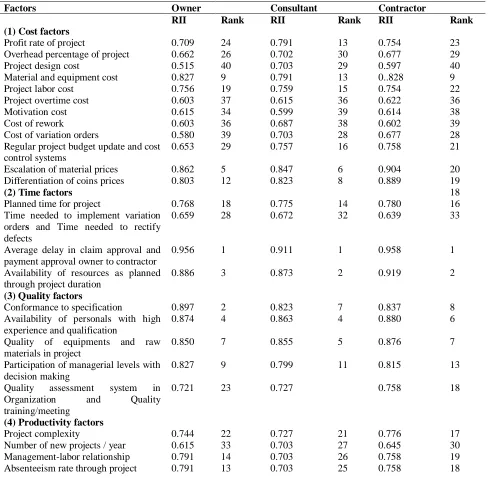
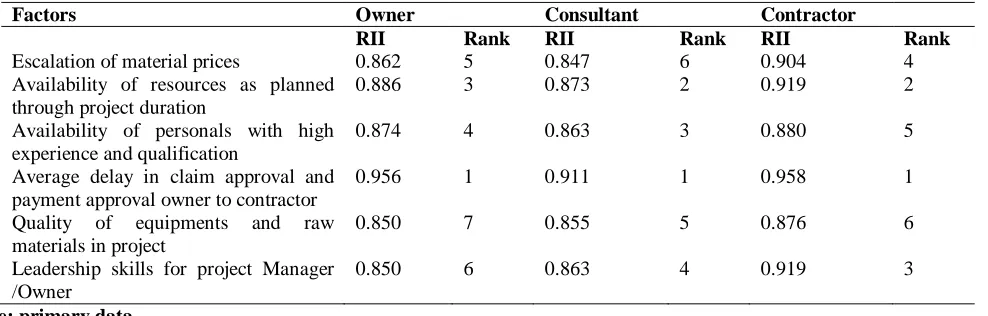
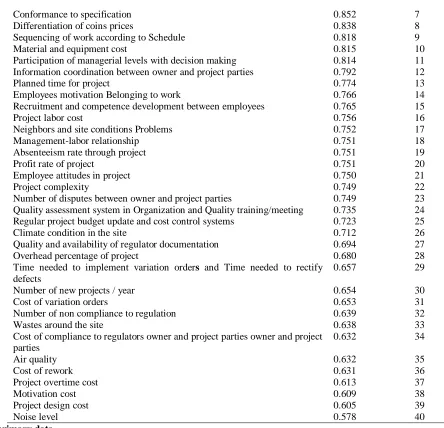
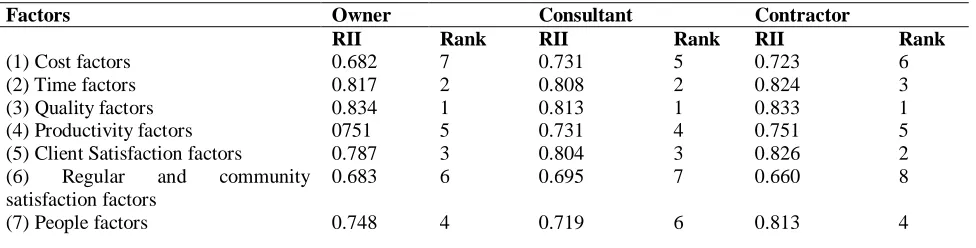
The results of this part of study provide an indication of the relative importance index and rank of factors affecting the performance of construction projects in the Coastal Region of Kenya.
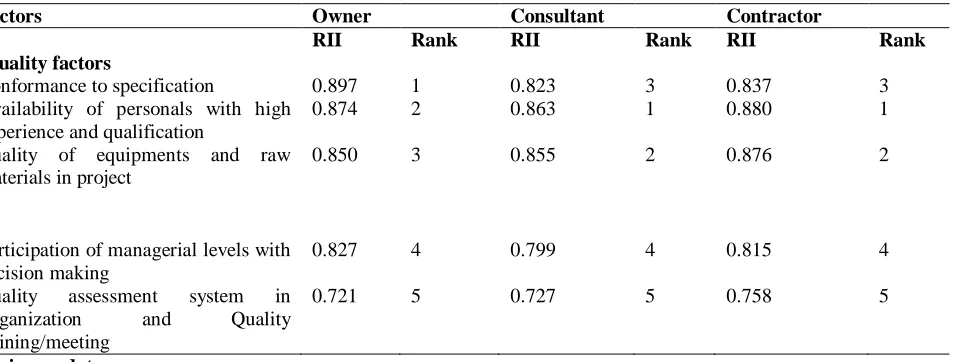
Table (4.6) The relative importance index (RII) and rank of factors affecting the performance of construction projects in the Coastal Region of Kenya according to each category.
Factors Owner Consultant Contractor
RII Rank RII Rank RII Rank
(1) Cost factors
Profit rate of project 0.709 24 0.791 13 0.754 23
Overhead percentage of project 0.662 26 0.702 30 0.677 29
Project design cost 0.515 40 0.703 29 0.597 40
Material and equipment cost 0.827 9 0.791 13 0..828 9
Project labor cost 0.756 19 0.759 15 0.754 22
Project overtime cost 0.603 37 0.615 36 0.622 36
Motivation cost 0.615 34 0.599 39 0.614 38
Cost of rework 0.603 36 0.687 38 0.602 39
Cost of variation orders 0.580 39 0.703 28 0.677 28
Regular project budget update and cost control systems
0.653 29 0.757 16 0.758 21
Escalation of material prices 0.862 5 0.847 6 0.904 20
Differentiation of coins prices 0.803 12 0.823 8 0.889 19
(2) Time factors 18
Planned time for project 0.768 18 0.775 14 0.780 16
Time needed to implement variation orders and Time needed to rectify defects
0.659 28 0.672 32 0.639 33
Average delay in claim approval and payment approval owner to contractor
0.956 1 0.911 1 0.958 1
Availability of resources as planned through project duration
0.886 3 0.873 2 0.919 2
(3) Quality factors
Conformance to specification 0.897 2 0.823 7 0.837 8
Availability of personals with high experience and qualification
0.874 4 0.863 4 0.880 6
Quality of equipments and raw materials in project
0.850 7 0.855 5 0.876 7
Participation of managerial levels with decision making
0.827 9 0.799 11 0.815 13
Quality assessment system in Organization and Quality training/meeting
0.721 23 0.727 0.758 18
(4) Productivity factors
Project complexity 0.744 22 0.727 21 0.776 17
Number of new projects / year 0.615 33 0.703 27 0.645 30
Management-labor relationship 0.791 14 0.703 26 0.758 19
[image:15.612.64.552.263.741.2]