Enhancing Communication Skills through Mini Projects
in Engineering Education Using Audio-Visual Aids -A
Study
S. M. Jyothirmayee
*, Dr. P. Eliah
**, Dr. K. Madhavi Reddy
***
Sr. Asst. Professor of English, Vardhaman College of Engineering, Hyderabad **
Retd. Professor, Academic Advisor, DAP, JNTUH, Hyderabad **
Asst. Professor of English, NIT, Warangal.
Abstract- “What you learn today determines what you become tomorrow”- Anonymous
English has gained the status of an international language, with its intercontinental proliferation. In the present context of teaching English to engineering students it was observed that students have basic communication skills. However, these skills are inadequate to meet the changing educational trends. To get an edge over the competitors, students are left with hardly any choice but to add values to their communication skills to exhibit their true potential. But the importance to these communication skills at times are downplayed in engineering programmes in favour of an over emphasis on the technical skills.
This attitude and practice can be dwindled with the help of audio and visual aids.
As Lenin quote:
“Theory without practice is impotent.
Practice without theory is blind.”
This paper is an attempt to explore the various possibilities of developing competence in English language learning. It focuses on how audio and visual aids like English music, animated English movies, news paper articles, advertisements, and English conversations serves as the important inputs in the context of teaching English as a second language. An attempt has also been made in this study by designing the mini projects
which are intrinsically motivating and compatible with a learner-centered educational philosophy.
Index Terms- Audio-visual aids, Communication Skills,
Engineering education, Mini projects, Activities.
I. INTRODUCTION
nglish is an important tool for today’s international communication. With its global spread, English has gained the status of an international language. The demands of the 21st century calls for the abilities to think critically, listen, speak, collaborate and communicate effectively (ASCD, 2008
Association for Supervision and Curriculum Development). In the present scenario of engineering education, students developed
and enhanced basic communication skills like reading, writing, speaking and listening. These skills build a necessary foundation that influences and shapes the types of engineers. But with the changing educational trends, availability of qualified personnel, the competition for job acquisition and job sustainability is becoming more strenuous. To get an edge over the competitors, students are left with hardly any choice but to add values to their communication skills to exhibit their true potential. But the importance to these communication skills at times are downplayed in engineering programmes in favour of an over emphasis on the technical skills.
This attitude and practice can be dwindled gradually with the help of modern audio -visual aids like English music, animated English movies, news paper articles, advertisements, English conversations both in audio and video and so on, which serves as the important inputs in the context of teaching/learning English as a second language. This motivates the students to absorb the body language, voice modulation, vocabulary from the audio and video source of information effectively. An attempt has also been made in this paper by designing the mini projects which are intrinsically motivating and compatible with a learner-centered educational philosophy.
II. RATIONALEFORTHESTUDY/CONTEXTOFTHE STUDY
According to Kozma (1994) learning is an active, constructive, cognitive and social process by which the learner strategically manages available cognitive, physical, and social resources to create new knowledge by interacting with information in the environment and integrating it with information already in memory. Audio –Visual based educational system today provides an opportunity to coordinate multiple possibilities for influencing the way information is presented and processed like improvement in self-concept , mastery of basic skills, student-centered learning and engagement in the learning process, more active processing resulting in higher-order thinking skills and better recall, gain confidence in directing their own learning. It has been largely observed that listening, speaking, reading and writing skills are not exploited optimally to meet the current market demands of the professionals arising in various jobs related settings. It is also observed that students appearing for various competitive exams such as IELTS, TOEFL, etc despite making common errors exhibit certain
typical, speech habits, expressions, mannerisms owing to dialectical influences of their respective regions. Hence, the present study proposes to fill in the gaps by equipping the students with all the necessary skills, catering to the professional needs.
III. PROBLEMSINTHECURRENTSCENARIOIN TEACHINGENGLISH
Since traditional educational methods and tools, such as chalkboard lectures and textbooks do not satisfy some of the needs of the students. Research in second language in the teaching/learning over the decades has proved that integration of LSRW develops the proficiency of L2 learners. Hence the revised JNTUH-Andhra Pradesh syllabus aims to improve the language proficiency of the students in English with an emphasis on LSRW skills. It aims to equip the students with necessary training in listening so that they can comprehend the speech of people of different backgrounds and regions and be able to mark stress and recognize and use the right intonation in sentences and also aims to develop an awareness in the students about the significance of screen reading and enables them to guess the meanings of words from context and grasp the overall message of the text, draw inferences etc. It also aims to develop speaking skills through speaking activities along with writing exercises, but largely it is observed that most of the English classes do not pay conscious attention to these skills equally because most often these activities are confined to the text due to
Institutional constraints related to infrastructure, and timely completion of syllabus.
Teachers’ limited awareness in bringing authentic texts to enhance effective listening
Socio economic background of the students etc.
Teaching English in the present scenario is a challenge that demands both the teacher’s and the learner’s attention. Since, it plays a critical role not only in communication, but also in the acquisition of language. Therefore, it is necessary for teachers to weave these activities into the curriculum to create a balance that mirrors the real-world integration of listening with speaking, reading, and writing.
IV. OBJECTIVESOFTHESTUDY
How speaking can be practiced with the help of audio-visual aids by introducing the learner to the native speakers accent, intonation ,rhythm etc;
How a reading text can be exploited using audio-visual aids /multimedia in improving learners L2 proficiency.
To expose the learners to genre specific texts.
To suggest some of the tasks and mini projects designed with the help of multimedia authentic texts to improve the learners’ L2 proficiency.
To expose the learners to micro –macro level listening exercises to enhance comprehension and develop other listening skills and writing skills in the form of exercises.
V. AUDIO–VISUALBASEDEDUCATIONALSYSTEM The teaching profession is filled with countless opportunities to enrich the academic lives of students. While some concepts and educational objectives will be easy for students to grasp, others will require thinking creatively to ensure that important learning objectives are met. Using audio/visual aids in teaching, is one way to enhance lesson plans and give students additional ways to process subject information. “A picture is worth a
thousand words”.
Audio-visual technology has an important role to play in the modern classroom. Teachers can annotate on the images shown on the screen or the board, zoom in and out, get different views and angles and capture still shots with the help of the visual aids in teaching. Schooling the students with audio-visual aids is essential in the technological age. Teachers must use various types of audio-visual aids to interact with students. The teacher has to identify the key points of the contents so that student can retain the information easily without any confusion. Thus, audio-visual aids in teaching boost school, colleges and universities to enhance teaching methodology.
Audiovisual aids are defined as any device used to aid in the communication of an idea. From this definition, virtually anything can be used as an aid, providing it successfully communicates the idea or information for which it is designed. Even though early aids, such as maps and drawings, are still in use, advances in the audiovisual field have opened up new methods of presenting these aids, such as videotapes and multimedia equipment which allow more professional and entertaining presentations to be presented.
According to the current research, the more sensory modes in which mental representation is stored, the more likely they will be remembered (Borsook. Higginbotham &Wheat, 1992) Bagget (1989) posits that images are stored in memory. These images contain more information because they have more cognitive pegs that can be used to make associative and referential connections between visual representations and information held in long term memory. The use of audio-visual aids has always been an integral part of education from traditional devices to modern technological devices like movies, radio, tape-recorders and television.
Audio-visual aids in the classroom can enhance teaching methods and improve student comprehension. Auditory learners focus more on the spoken word rather than the written one. Taped recordings of lectures or movies are helpful to auditory learners because they pick up on speech nuances such as tone and pitch. Today's technology offers many choices to the informed educator who wishes to capitalize on a new generation's appetite for multimedia presentations.
There are numerous web sites on the World Wide Web that have been created specifically for ESL/EFL learners as well as for native speakers of English. There are
websites provides interactive quizzes on Current News, Geography, Grammar, History, Idioms, Slang, Words, People, Reading Comprehension, Science, Vocabulary, World Culture, and Writing.
websites for the selection of English reading comprehension exercises, many of which are based on ESL examination questions including Cambridge ESOL, TOEFL, IELTS and other major exams for the beginner, intermediate or
advanced level students.
provides online grammar exercises, vocabulary videos,
pronunciation, quizzes for beginners, intermediate &
advanced level English Learners.
Websites for Video and audio resources for learning English.
websites to teach English through English movies like Cast Away, Titanic, ELF etc; this site provides movie guides which are available in PDF, HTML and WORD formats with print options.
Below are some of the informative websites developed specifically for ESL students. It would be useful for the student as well as the facilitator.
*(Note: (URLs) are subject to change.)
Table: 1 Important websites for ESL learners
www.learnenglish.british
www.nonstopenglish.com
www.englishclub.com
www.english-zone.com
www.rong-chang.com
www.english-at-home.com
www.world-english.org
www.learn-english-today.com
eslnotes.com/index.html
www.englishmedialab.com
www.usingenglish.com
VI. METHODOLOGY
Over the past decade, views regarding English as a second language instruction have changed significantly. Several previously held assumptions have changed and new methods have emerged for helping learner’s proficiency in ESL. There are two types of audio-visual aids. Firstly, Non-Projected Display Materials like
Chalkboard and Whiteboard
Flannel board and Magnet board
Flip board, Charts and Wall-Charts
Handouts, Posters and Pictorial Materials
Real objects and Models
Secondly, Projected Display Materials like
Overhead Projector / Slide Projector
Tape Recorder /Video Recorder
DVD/CD player
However, these aids have varying degrees of complexity and more than one type can be combined to create a sophisticated presentation. Generally speaking, the greater the complexity of the audio-visual aid, the more time and effort it will take to prepare. Therefore a variety of factors will need to consider like what are the characteristic features of the aids, how large is the target group of students, how many times will the presentations being staged and so on.
For example Handouts is Simple, very easy to use, no audibility/visibility problems, can depict lots of information, lasting reference.
Flipcharts & Whiteboards are - Simple, easy to use, can be pre-prepared; can be annotated via discussion,
Digital Whiteboards are– very flexible, use as a whiteboard, a projection surface for PC presentations, interactive flipchart. Slide Shows are professional, good at getting attention, retains interest, can have high impact.
OHP – Overhead Projectors are - Very common equipment, easy to use, easy to interact with, can be prepared quickly, transparencies can be stored. PC/Computer based presentations are – professional, flexible and impactful, most popular method of presentation, equipment widespread and increasingly affordable.
Audio Tapes are - Very effective in specialist role, inexpensive broadcast equipment.
Videos are - Very high impact, common broadcast equipment.
Physical Models gives- Very high impact, good attention getter, makes a concept tangible.
The audio-visual aids further provide the opportunity for natural integration of the four language skills (reading, writing, speaking, and listening) In fact all the communication skills are interrelated. It is common knowledge that one who listen well can speak well, and one who reads well can write well.
As Francis Bacon observed,
“Reading maketh a full man, conference a ready man, and writing an exact man.”.
VII. MINIPROJECTS
An attempt has been made in this paper to design mini projects which would focus and highlight all the four necessary skills which are intrinsically motivating and compatible with a learner-centered educational philosophy.
I Project with Music: (Duration: Two Weeks) Procedure:
1. Students are formed into groups. Each student in the group has to select one song.
2. Write the reason for selecting the song in 100 words and write the theme and inner meaning of the song.
3. Write the lyrics of the song (including chorus)
4. Substitute the content/main lyrics with synonyms and rewrite the lyrics of the song (without losing the meaning of the song).
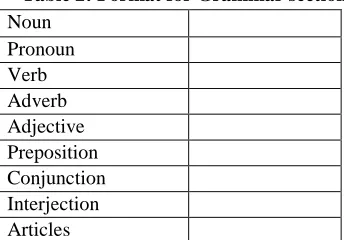
[image:4.612.320.532.388.504.2]5. Vocabulary: Identify parts of speech in the lyrics of your selected song including articles and list them in the given format.
Table 2: Format for Grammar section
6. Write the meanings/synonyms and antonyms for difficult words/lyrics in the song.
7. Identify idiomatic phrases/phrasal verbs/homophones in the lyrics of the selected song and list them in the given format.
Table 3: Format for vocabulary section
8. Speaking Activity: Assume that you (student) are a band singer, and gather your team members and give the title for your album. Now each one of you assume that you are lyricist and singer of your selected song and release your album by promoting your song individually in front of the press reporters.
9. Writing Exercise: Write a letter to your favourite channel requesting to play your album songs in their programmes (Hint: mention name of the programme, duration of the song, timings, and request them to mention the amount they charge for that promos)
10. Mock Interview: Assume that your album hit the box office and your favourite channel anchor is interviewing your band .Now enact and write dialogues of your interview. At the end of the interview sing any selected song from your album.
II Project with News paper: (Duration: Two Weeks) Procedure:
1. Select any 5common topics (news like sports, education, celebrity, Health, Politics etc; ) from the below mentioned daily news papers and file all the titles with respective photographs.
2. Now write the titles of the selected topic/news and write the content/gist of the news in your own words in the given format.
Table 4: Format for writing
3. Now assume that you are the writer and editor of your own firm. Give your title of the selected topic /news and write the article in your own words.
Table 5: Format for writing
4. Vocabulary: Identify minimum 10 verbs and 10 adjectives per day and write its meanings and rewrite those identified words in your own sentences
5. Speaking Activity:News Bulletin: Assume that you are the news reader in your favourite channel and it is your turn to read news. (Two readers for 1 week)
III Collage Project: (Duration: Two Weeks)
Noun Pronoun Verb Adverb Adjective Preposition Conjunction Interjection Articles
Idiomatic phrases Phrasal verbs Homophones
Title of the selected news Gist The Times Of India
The Hindu
The Indian Express The Deccan Chronicle
[image:4.612.75.247.462.582.2]Procedure:
1. Select a topic
(Hint: Current social topics like poverty/child labour/traffic/terrorism/ragging…) write the reason for selecting the topic in 100 words.
2. Collect and file the pictures related to the selected topic and arrange them in the chart in an artistic way. Note: You can collect and file as many pictures/photographs as you can related to the selected topic, there is no size limit for the collage)
3. Now describe every picture in your own words/give your own title to the picture.
4. Write an imaginary short story for any 10 pictures/photographs.
5. Provide the current statistics/graphs related to your topic. 6. Speaking Activity: Assume that you are the member of
some committee, present your views in front of the public with the help of your collage by referring to the statistics/graphs with your own possible precautions to control or eradicate the problem.
VIII. LIMITATIONSINIMPLEMENTINGAUDIO– VISUALBASED EDUCATIONALSYSTEM Despite its educational benefits in language learning contexts, a task in itself does not necessarily guarantee its successful implementation unless the teacher, the facilitator and controller of the task performance, understands how tasks actually work in the classroom. More importantly, the teacher, who wants to try implementing Audio –Visual based educational system successfully, is required to have sufficient knowledge about the instructional framework related to its plan, procedure, and assessment.
But most of the time, teachers believed that this system will give teachers an undue psychological burden as a facilitator and that it would require much more preparation time. Some teachers are reluctant to implement Audio –Visual based educational system as their self-perceived inability to use the target.
Most EFL teachers still use the traditional lecture-oriented methods, which they are accustomed to, and more than that, they have the psychological pressure of facing some new disciplinary problems in using this system. In relation to task participants' roles and classroom arrangements, it might be true that EFL teachers have become accustomed to working in teacher-centered classrooms, thus adopting a one-way instruction method rather than two-way interaction.
A major problem that EFL teachers generally face in carrying out this type of approach is how to design appropriate tasks. But a teacher, however, needs to be flexible and dynamic in controlling the language learning environment, because the nature of language learning substantially demands that learners actively participate in language use activities. An attempt should be made to link the classroom language learning with language activation outside the classroom
IX. CONCLUSION
It is anticipated that incorporating Audio –Visual based educational system educational techniques relative to conventional educational tools would significantly increase a student’s learning curve. It will also improve student’s motivation to learn, promotes a deeper level of understanding. In other words it offers a change from the traditional teaching routines though which many learners have previously failed to communicate.
It encourages learners to experiment with whatever literary pieces they can recall, to try things out without fear of failure, to express themselves with basic fluency and accuracy. Different colleges will use different Audio –Visual teaching materials, at the same time, the level of the students’ linguistic competence are also different, so the teachers should analyze their courses and their learners, and then design tasks based on their courses and their learners.
ACKNOWLEDGMENT
This paper was orally presented by the author in the National Seminar on “Teaching of General and Technical English” held on 5th and 6th February, 2010- Anna University, Chennai, Tamil Nadu, India.
REFERENCES
[1] Brown, H. D. (1987) Principles of Language Learning and Teaching. MA: Addison-Wesley Publishing Company.
[2] Brumfit, C. and Johnson, K. (1979) (ed.) The Communicative Approach to Language Teaching. New York: Oxford University Press.
[3] Ramji Dass Wadhwa.Audio-Visual Aids for Teaching English.
[4] How to Use Audio/Visual Aids in Teaching- http://www.ehow.com/how_4601500_use-audiovisual-aids-teaching.html. [5] Teaching English with Audio Visual Technology-
(http://www.eric.ed.gov/ERICWebPortal/custom/portlets/recordDetails/deta ilmini.jsp?_nfpb=true&_&ERICExtSearch_SearchValue_0=ED122838&E RICExtSearch_SearchType_0=no&accno=ED122838)
[6] C. Paul Verghese-Teaching English as a Second Language- (http://books.google.co.in/books?id=JJ6txwGhgAwC&printsec=frontcover# v=onepage&q=&f=false)
[7] http://www.telt.um.edu.my/6aids.html#6.1- 6- use of Audio-Visual Aids [8] http://iteslj.org/Articles/Kitao-Materials.html
[9] http://www.telt.um.edu.my/6-2nonprojected.html#top
AUTHORS
First Author – S. M. Jyothirmayee. Sr. Asst. Professor of English, Vardhaman College of Engineering, Hyderabad, Andhra Pradesh, India. [email protected]
Second Author – Dr. P. Eliah. Academic Advisor, DAP, JNTUH, Hyderabad, Andhra Pradesh, India.
Third Author – Dr. K. Madhavi Reddy, Asst. Professor of English, NIT Warangal. Andhra Pradesh, India.
Correspondence Author – S. M. Jyothirmayee, Sr. Asst.
Professor of English, Vardhaman College of Engineering, Hyderabad, Andhra Pradesh, India.