Middle and Secondary Education Dissertations Department of Middle and Secondary Education
5-13-2016
Transgressing the Borders: Text and Talk in a
Refugee Women's Book Club
Amy E. Pelissero Georgia State University
Follow this and additional works at:https://scholarworks.gsu.edu/mse_diss
This Dissertation is brought to you for free and open access by the Department of Middle and Secondary Education at ScholarWorks @ Georgia State University. It has been accepted for inclusion in Middle and Secondary Education Dissertations by an authorized administrator of ScholarWorks @ Georgia State University. For more information, please [email protected].
Recommended Citation
Pelissero, Amy E., "Transgressing the Borders: Text and Talk in a Refugee Women's Book Club." Dissertation, Georgia State University, 2016.
This dissertation, “TRANSGRESSING THE BORDERS: TEXT AND TALK IN A REFUGEE
WOMEN’S BOOK CLUB,” by AMY ELIZABETH PELISSERO, was prepared under the
direc-tion of the candidate’s Dissertadirec-tion Advisory Committee. It is accepted by the committee
mem-bers in partial fulfillment of the requirements for the degree, Doctor of Philosophy, in the
Col-lege of Education and Human Development, Georgia State University.
The Dissertation Advisory Committee and the student’s Department Chairperson, as
representatives of the faculty, certify that this dissertation has met all standards of excellence and
scholarship as determined by the faculty.
_________________________________ Gertrude Tinker Sachs, Ph.D.
Committee Chair
_________________________________ Wing Yi Chan, Ph.D.
Committee Member
_________________________________ Michelle Zoss, Ph.D.
Committee Member
_________________________________ David Stinson, Ph.D.
Committee Member
_________________________________
Date
_________________________________ Gertrude Tinker Sachs, Ph.D.
Chairperson, Department of Middle and Sec-ondary Education
_________________________________
Paul A. Alberto, Ph.D.
By presenting this dissertation as a partial fulfillment of the requirements for the advanced
degree from Georgia State University, I agree that the library of Georgia State University shall
make it available for inspection and circulation in accordance with its regulations governing
materials of this type. I agree that permission to quote, to copy from, or to publish this
dissertation may be granted by the professor under whose direction it was written, by the College
of Education and Human Development’s Director of Graduate Studies, or by me. Such quoting,
copying, or publishing must be solely for scholarly purposes and will not involve potential
financial gain. It is understood that any copying from or publication of this dissertation which
involves potential financial gain will not be allowed without my written permission.
All dissertations deposited in the Georgia State University library must be used in accordance
with the stipulations prescribed by the author in the preceding statement. The author of this
dissertation is:
Amy Elizabeth Pelissero
Department of Middle and Secondary Education College of Education and Human Development
Georgia State University
The director of this dissertation is:
Gertrude Tinker Sachs, Ph.D.
Department of Middle and Secondary Education College of Education and Human Development
Amy Elizabeth Pelissero
ADDRESS: 1184 North Carter Road Decatur, Georgia 30030
EDUCATION:
PROFESSIONAL EXPERIENCE:
2013 – present Head of School
Global Village Project
2010 – 2012 English Teacher
Global Village Project
2009 – 2012 Family Literacy Teacher
Refugee Family Services
PRESENTATIONS AND PUBLICATIONS (SELECTED):
Pelissero, A. E. (2016, January). Visibility at the intersections: Language in the lives of Filipina domestic workers in Hong Kong. Journal of Multilingual and Multicultural Development
(under review).
Pelissero, A. E. (2015, March). Resources and resilience: Reimagining refugee education in dia-logic spaces. TESOL International Convention & English Language Expo, Toronto, Can-ada.
Pelissero, A. E. (2014, March). Literate lives: Lessons from a refugee women’s book club.
Ph.D. 2016 Georgia State University
Department of Middle and Secondary Education
M.Ed. 1998 Georgia State University
English Education
B.A. 1994 Georgia State University
Pelissero, A. E. (2013, October). How do we address challenging grade-level standards with
students with interrupted education? GATESOL Annual Conference, Atlanta, GA.
Pelissero, A. E. (2013, April). Perspectives on literacy and living from a refugee women’s
litera-cy club. American Educational Research Association Annual Meeting (AERA), San
Francisco, CA.
Pelissero, A. E. (2013, April). Visibility at the intersections: Language in the lives of Filipina
domestic workers in Hong Kong. American Educational Research Association Annual
Meeting (AERA), San Francisco, CA.
Pelissero, A. E. (2012, November). Literate lives: Lessons from a refugee women’s book club. National Council of Teachers of English (NCTE) Annual Convention, Las Vegas, NV, participant in the L. Ramon Veal Research Roundtable.
Pelissero, A. E. (2012, October). Texts & talk: Conducting research with refugee women in a
book club. GATESOL Annual Conference, Atlanta, GA.
Pelissero, A. E. (2011, November). Crafting our identities: Examining critical literacy practices in elementary, middle, secondary and college classrooms. National Council of Teachers of English (NCTE) Annual Convention, Chicago, IL.
Pelissero, A. E. (2010, November). Re-imagined fairy tales. National Council of Teachers of English (NCTE) Annual Convention, Orlando, FL.
PROFESSIONAL SOCIETIES AND ORGANIZATIONS
1994 – present National Council of Teachers of English 2013 – present International Society for Language Studies
2011 – present Teachers of English to Speakers of Other Languages 2013 – present Georgia TESOL
by
AMY ELIZABETH PELISSERO
Under the Direction of Gertrude Tinker Sachs, Ph.D.
ABSTRACT
The prevailing discourses around refugees often serve to position them as ignorant,
inca-pable, and needing to be assimilated into the dominant culture of receiving societies. The limited
research devoted to refugees shows that they struggle in schools and on standardized tests of
achievement, are underemployed, and live in poverty. Refugee women, in particular, often
con-tend with multiple linguistic, gendered, and racialized forms of discrimination, as they navigate
transnational spaces and lives in resettlement. However, this qualitative study sought to counter
deficit discourses around refugee women in resettlement by critically investigating and
illuminat-ing their everyday lives and literacy practices. The participants were nine refugee women, aged
16 to 31, who engaged in an out-of-school book club over a six-month period.
Sociocultural, dialogic, poststructural, feminist, and transnational theories informed this
study. Critical ethnographic approaches and New Literacy Studies perspectives influenced the
re-analyzed using qualitative coding and narrative methods.
The themes identified from the analysis were that participants (1) shaped and used the
book club as a dialogic, border practice and space; (2) navigated and negotiated shifting and
changing subjectivities and took up multi/plural identities; (3) used multiple languages and
liter-acies as practices and resources; and (4) were living here-and-there, transnational and dialogic
lives. The findings suggest that educators can foster refugee women’s English language learning
and multiple literacies in three key ways: by creating learning spaces that are flexible,
contin-gent, dialogic, and collaborative; by recognizing students’ sociocultural contexts and funds of
knowledge; and by affording opportunities for students to position themselves as knowers and
teachers.
INDEX WORDS: Refugee Women, Book Club, Transnational, Ways Of Knowing, Dialogic
by
AMY ELIZABETH PELISSERO
A Dissertation
Presented in Partial Fulfillment of Requirements for the
Degree of
Doctor of Philosophy
in
Teaching and Learning, Language and Literacy Education
in
Department of Middle and Secondary Education
in
the College of Education and Human Development
Georgia State University
DEDICATION
ACKNOWLEDGMENTS
Maintaining a personal and professional life while completing a doctoral dissertation is
no easy task. When I took up this work, I could not conceive of the ways I would be stretched
nor did I imagine the ways this would transform my life. The women who participated in this
study have become a bigger part of my world, my memories, and my imaginings for the future.
Their stories have taken hold of my heart and my mind. Their perspectives and practices have
challenged and changed me and influence my work as Head of School and inform my
interac-tions with family and community. I am deeply grateful for their participation in this research
pro-ject and for all they taught me in the process. I am especially thankful to them for trusting me
with their stories and expecting me to do some good with them.
Completing the dissertation process was much longer than I ever anticipated and would
not have been possible without the help and support of many who sustained me along the
jour-ney. I am profoundly indebted to my family, friends, and colleagues for their care and constant
belief in my work and in my ability to complete it. I am especially thankful to my mother for her
love and care for my daughters during this time and to my husband for his inspiration, insights,
unending encouragement, and edits. I am thankful for my daughters’ reassuring hugs and
at-tempts to understand my absences and weekend work. I am also deeply grateful for the support
of my advisor, Dr. Gertrude Tinker Sachs, who modeled critical, engaged pedagogy, approved
my dissertation topic, and stayed with me to the end. I would also like to thank all the faculty
members at Georgia State University who generously helped me complete this work, including
Dr. Wing Yi Chan, Dr. David Stinson, Dr. Youngjoo Yi, and Dr. Michelle Zoss.
I am grateful for having had the opportunity and privilege of this achievement, especially
many women around the world. Also, I am thankful for those who have before me dedicated
time and effort to understanding and improving refugee education and lives. I could not have
done this work alone; it was only made possible in and through communion with others, many
more knowledgeable than me. Although I have had indispensible help throughout the research
process and in the writing of this paper, I accept all flaws or inaccuracies as my own. It is my
hope that even with its imperfections, this dissertation will add to the knowledge we have and
need in order to better support refugee women in their learning and lives here and around the
TABLE OF CONTENTS
LIST OF TABLES ... i
LIST OF FIGURES ... ii
1 THE PROBLEM ... 1
Background on Refugees ... 2
Research Questions ... 13
Purpose ... 13
Overview of Methodology ... 14
Conceptual Frames: Theories and Lenses ... 17
Scope and Limitations ... 29
Definitions of Terms ... 30
Overview of the Study ... 38
2 REVIEW OF THE LITERATURE ... 39
Literature Search ... 39
Theorizing Refugee Women’s Everyday Lives ... 40
Refugee Schooling and Social Concerns ... 45
Refugee Education: Critiques and Recommendations ... 59
Possibilities for Book Clubs ... 72
Summary of Literature Review ... 83
3 METHODOLOGY ... 85
Framing the Study ... 86
Constructing the Book Club ... 95
Refugees’ Contexts ... 104
The Research Context ... 108
Procedures in the Club ... 112
Collecting Data: Studying Multiple Sources ... 115
Data Analysis ... 120
Ethical Considerations and Trustworthiness ... 137
4 FINDINGS ... 141
Book Club as Dialogic/Border Space and Practice (Theme 1) ... 145
Shifting Subjectivities (Theme 2) ... 163
Languages and Literacies are Multiple and Shifting and Are Taken Up as Practices and Resources For Particular Purposes in Everyday Lives (Theme 3) 190 Living Here and There: The Transnational (Theme 4) ... 214
Remarks on the Findings ... 242
5 NARRATIVES ... 244
Christy, Gul, and Pia: Sewing Stories Together ... 244
Christy ... 245
Gul ... 252
Pia ... 260
Conclusion ... 267
6 DISCUSSION ... 268
Introduction ... 268
Research Question 2. Everyday Lives, Literacy, and Language Use ... 291
Research Question 3. Influence of Book Club on Literacy Practices and Lives . 303 Limitations, Recommendations, and Conclusions ... 311
REFERENCES ... 324
APPENDICES ... 349
Appendix A. Pilot Study ... 349
Appendix B. Narrative Episodes ... 355
LIST OF TABLES
Table 1. Selected Texts. ... 98
Table 2. Core Participant Data. ... 100
Table 3. Book Club Meetings. ... 103
Table 4. Core Group Participation. ... 145
Table 5. Pilot Study Participants (Pseudonyms). ... 349
LIST OF FIGURES
1 THE PROBLEM
For refugees, one of the greatest barriers to resettlement is language proficiency (Capps,
Newland & Migration Policy Institute, 2015; Fong, 2004; McBrien, 2005). Having left their
countries of nationality due to “well-founded” fears of persecution based on their “race, religion,
nationality, membership of a particular social group, or political opinion” (UNHCR, 2011),
refu-gees’ social and cultural capital, and what others believe they are capable of doing and
contrib-uting, depends largely on refugees’ proficiency in the majority language (Bigelow, 2010; Luke,
2003; Norton, 2000; Perry, 2009; Sarroub, 2008; Stagg-Peterson & Heywood, 2007; Warriner,
2004a, 2004b; Woods, 2009). Receiving societies tend to view refugees who have limited
Eng-lish or access to majority languages from a deficit perspective, assuming that refugees’ lack of
print literacy and limited formal schooling are indicators of illiteracy and ignorance (Bartolomé,
2010; Bigelow, 2010; Binder & Tošić, 2005; Brown et al., 2006; Fong, 2004; Gunderson, 2000;
McBrien, 2005; Sarroub, 2005; Warriner, 2007a). Limited English proficiency is consistently
viewed as a barrier to employment, integration, independence, and social contribution,
particu-larly in predominantly White, Westernized contexts in Australia, Canada, and the United States.
Of the thousands of refugees resettled annually, nearly 80% are women and their children
(Binder & Tošić, 2005; Hajdukowski-Ahmed, 2009; Khanlou & Moussa, 2008; Martin, 2004).
The largest number of refugees designated for permanent resettlement have been admitted to the
United States, and in 2013 the United States accepted two-thirds of the 98,000 refugees who
were resettled that year. Many of these women and children who came to the United States lack
the educational resources to develop literacy, especially print literacy, in the majority language
(Capps et al., 2015). A 2010 Global Education Report (GED) from the United Nations
men in rates of illiteracy, especially in many Sub-Saharan and Southeast Asian countries.
Reset-tlement can be especially challenging for this group (McBrien, 2005; Sarr & Mosselson, 2010),
with a key reason being their lack or perceived lack of literacy.
Background on Refugees
Unlike many other immigrants, refugees are typically forcibly displaced and resettled
af-ter being persecuted in their homelands (Binder & Tošić, 2005). According to United Nations
statistics, coordinating and participating countries have helped an estimated 60 million refugee
people settle in new homes around the world. The Office of Refugee Resettlement under the U.S.
Department of Health and Human Services recognizes that Georgia, the state in which this study
was conducted, consistently took in larger numbers of refugees than most other states in the
United States. In 2009, Georgia was among the top five states for number of refugee recipients,
and the county where this study was conducted has consistently taken in more refugees than any
other county in Georgia. Refugees in Georgia came from more than 20 countries, mostly
war-torn, and reveal the largely non-White, “changing face” of refugees that Sarr and Mosselson
(2010) describe. The majority came from Afghanistan, Bhutan, Burma, Burundi, the Democratic
Republic of Congo, Eritrea, Ethiopia, Iraq, Somalia, and Sudan (U.S. Department of Health and
Human Services, 2009). This local refugee community influenced my perspectives, informed my
study, and provided the participants for this research.
Challenges in resettlement. After having faced persecution within their own countries,
forced migration, separation from home and family, and confinement in camps and along border
“safety” zones, many refugees contend with ambivalent receptions in local communities (Roxas,
2010; Roy & Roxas, 2011) and continue to face marginalization and isolation in resettlement,
Woods, 2009). They often have limited opportunities to learn in English-speaking communities
of practice (Finn, 2010; Norton, 2000; Warriner, 2009a), and research conducted between 2009
and 2011 showed that 58% of refugees who had been in the United States 20 years or more were
still considered “Limited English Proficient” (Capps, et al., 2015, p. 2). According to the
Migra-tion Policy Institute’s first longitudinal report focused solely on refugees (2015), the scale of the
U.S. resettlement program, the increasing diversity among U.S. refugees, and the low English
language and education levels of recent refugees pose increasing challenges (Capps, et al., 2015).
Many resettled refugees in the United States today are women and children from
Sub-Saharan and Southeast Asian countries who have experienced interrupted formal education, no
education, or otherwise limited print-literacy learning. Worldwide, women represent 64% of the
world’s “illiterate” adults, and learning opportunities for girls and women are still “severely”
limited, especially at the secondary level when girls reach adolescence (UNESCO, 2010).
Stud-ies have shown that recent refugees with low literacy levels and low education levels have lower
incomes, and “a comparison of data from 2000 and 2009–2011 indicates that refugees resettled
in recent years are at an economic disadvantage with those resettled earlier” (Capps et al., p. 28,
2015). Researchers contend that this disadvantage could be due to the changes in resettlement
and to lower levels of education and literacy.
The limited literature focused on refugees as learners has shown that they are often
fail-ing in schools and on standardized tests of achievement, and that they are underemployed and
often living in poverty (Brown et al., 2006; Gunderson, 2000; McBrien, 2005). McBrien (2005)
contends, “teachers are frequently unaware that they have refugees in their classrooms” (p. 337),
and “differences between refugees and other immigrants make this group the most vulnerable for
experi-ences due to war, violence, persecution, poverty, migration, and societal norms or expectations.
Short and Boyson (2012) concluded, in their research among older newcomers in secondary
schools, that “students who are newly arrived immigrants and who need to learn English are
among the most vulnerable subgroups of English language learners, especially those with gaps in
their educational backgrounds” (p. v).
Some educators and researchers have identified and included refugees in the
subpopula-tion of English learners referred to as students with limited or interrupted formal education
(SLIFE) (DeCapua & Marshall, 2010). Others refer to low literacy refugee background (LLRB)
students (Windle & Miller, 2012). In either case, much of the research available reveals that this
group of language learners faces particular challenges in schools and classrooms due to their
lim-ited experiences with formal academic discourses and the taken-for-granted linguistic, cultural,
and social demands of secondary schooling.
Despite the great diversity and complex differences among displaced women, it is clear
that they often contend with similar challenges in resettlement. New living arrangements,
dis-rupted family patterns, isolation, separation from traditional systems of support, discrimination,
limited or interrupted formal education, underemployment, “illiteracy,” and language barriers are
all cited as challenging aspects of resettlement for many refugee women (Fong, 2004; Martin,
2004). However, even though migrant women and their children make up most of the world’s
displaced people, representing the majority of the poor in every country (Hatoss & Huijer, 2010),
this vast female movement (Benhabib & Resnik, 2009) has drawn little attention to the lives of
resettled refugee women. According to Fong (2004), “Little is written about the process of
transi-tions after they have arrived in the United States” (p. 12). Resettled refugee women remain
Literacies among refugees. Despite the findings, cited above, that women refugees face
particularly difficult challenges, “Education statistics on refugee or displaced populations are
limited and often not disaggregated by sex” (UNESCO, 2011, pp. 50–51). For this reason, “more
in-depth information…to contextualize and interpret educational statistics” (p. 84) is needed. As
Binder and Tošić (2005) pointed out, “being a woman is not recognized as a category in national
and international statistics on refugees and asylum seekers” (p. 613) despite the fact that many
women flee for reasons related to their gender and status as women. The authors contend that
women and children are usually combined into one category and are often marginalized in
re-search and in legal refugee regulations. The inadequate rere-search into refugee women, their
litera-cy practices, and their learning experiences offer an opening and opportunity for this research to
contribute much-needed knowledge.
In order to attend to the growing refugee population in schools and add to our limited
knowledge about refugees as a distinct group of learners, especially women, further research is
needed into their language, literacy, and learning (Bigelow, 2010; Brown, Miller, & Mitchell,
2006; Perry, 2007, 2009; Woods, 2009). More and different research is needed into the
relation-ships among language, learning, literacy, and everyday lives in order to support refugees entering
local communities and schools. Cummins (2003) calls for an examination of language and
edu-cation that is not simply and narrowly focused on linguistic knowledge and academic ability but
that also brings culture, identity, and imagination into the discussion in order to “challenge the
historical pattern whereby differences are transformed into deficits” (p. 40).
Cummins (2003) contends that the role of educators is to create interactional and
inter-personal spaces in which students can imaginatively negotiate identities and generate knowledge.
access to discourse, knowledge, and power” (p. 139) and calls for “a research agenda that
focus-es on the relationships between language and other forms of capital” (p. 139). I argue that thfocus-ese
approaches are particularly important for refugee women. In places where a majority language
acts as a valuable form of capital, immigrant and minority women are often denied or restricted
access to language learning and forms of linguistic capital (Norton, 2000; Pavlenko, 2004).
Cul-tural perceptions and expectations, money and financial resources, familial obligations, and
gen-der norms may all act to restrict or deny access to language learning for women (Pavlenko,
2004).
I define literacy as multiple, situated, and shifting social practices of meaning-making
around texts (Purcell-Gates, 2006). Along similar lines, Barton and Hamilton (2000)
conceptual-ize literacy as being best understood as a set of social practices that (a) encompass different
liter-acies that are associated with different domains of life; (b) are patterned by social institutions and
power relationships, with some literacies becoming more dominant, visible, and influential than
others; (c) are purposeful and embedded in broader social goals and cultural practices; (d) are
historically situated; and (e) frequently change and are acquired through processes of informal
learning and sense-making (p. 8).
Many scholars contend that language, literacy, and learning are tightly tied to one’s sense
of self (e.g. Bigelow, 2010; Cummins, 2003, 2005; McCarthey & Moje, 2002; Menard-Warwick,
2005, 2008; Moje, Luke, Davies & Street, 2009; McKinney & Norton, 2008; Norton, 1997,
2000; Pavlenko & Norton, 2007; Warriner, 2007c; Yi, 2009). For refugees specifically,
Hajdu-kowski-Ahmed (2009) draws upon Bakhtin and dialogic theory in pointing out that for “uprooted
people, every new situation and location deeply reshapes their identities, their sense of self, their
that impact their identity” (p. 28–29). She contends that identity in this context can be
under-stood in terms of dialogism, which “views identity as a continuous and relational process rather
than a fixed construct and thus is well suited to the task of understanding those whose lives have
been radically transformed by trauma, upheaval, and resettlement” (p. 29).
Even though literacy is now largely accepted as much more than the ability to read and
write traditional printed texts (New London Group, 1996), still, educational policies, schools,
and teachers often still do not reflect the multifaceted, hybrid literacies (Street, 1997, 2003; New
London Group, 1996) that theory and research have offered. Fundamental arguments about what
it means to “read and write” still persist (Luke, 2003; Luke & Woods, 2009; Street & Lefstein,
2007; Gee, 1999). Instead of focusing on real-world learning, situated in shifting social, cultural,
political, and economic times, educational policies and pedagogy still tend to prioritize and
privi-lege static, individualistic, and traditional ways of knowing. Literacy pedagogy in particular has
been carefully “restricted to formalized, monolingual, monocultural, and rule-governed forms of
language” (New London Group, 1996, p. 60).
Discourses of deficiency, or deficit discourses, that pathologize and “other” refugees and
their experiences still circulate, leading to continued discrimination and displacement. Cummins
(2003) argued that in many ways this construction of a problem of underachievement is focused
on perceived individual and cultural deficiencies, and therefore excludes any critical
considera-tions of socioeconomic disparities or racial discrimination. Grewal (1994) similarly suggested,
“refugees and immigrants in the United States, especially the non-Europeans who bring
‘tradi-tional’ and ‘barbaric’ customs with them, are represented as a collective impending crisis” and
contended, “such a practice participates in a xenophobic, racialized American nationalism” (p.
nation” are historically formed and must be deconstructed in order to counter the naturalizing
effects of these constructs (p. 517). I contend that conceptions of literacy and categories of
lit-erate and illitlit-erate work in similar ways and in conjunction with other constructs to reinforce the
“crisis” discourses that often surround refugees.
Along these same lines, little research has been directed toward understanding the
trans-national literacies in which many immigrant, migrant, and refugee learners engage across
con-texts (Hornberger & Link, 2012; Lam & Warriner, 2012; Warriner, 2007c, 2009b; Yi, 2009).
Street (2003) contended that in language education understandings are needed that take into
ac-count the whole spectrum of communicative practices and communicative competencies learners
use and contends that limiting conceptions of literacy often taken up in schools deny the broad
repertoires of practice taken up in everyday lives (p. 79) I noticed that many of the literacy
prac-tices refugees engaged in extended across cultures, languages, and national borders. Warriner
(2007c) used the term transnational literacies to refer to literacy practices whose meanings and
interconnections extend beyond and across national borders, spaces, and times. For many of the
refugee women with whom I worked, transnational experiences that included complex
transna-tional literacy practices were a common and mostly taken-for-granted aspect of everyday life.
Warriner (2007c) argued that it is important for researchers and educators to make sense
of the ways in which transnational literacies are made visible, valued, used, and imagined in
par-ticular contexts and for parpar-ticular purposes. She contended that more complex and nuanced
eth-nographic approaches and representations “of the situated and contested ways that local practices
are influenced by global processes (economic, political, and cultural)” (p. 211) are required to
lit-eracy practices. In the field of New Litlit-eracy Studies (NLS), scholars explore how locally situated
literacies connect to larger global processes (Luke, 2004a; Street, 2004, 2005).
Research within schools is already being done by a number of scholars interested in
refu-gee and immigrant learning and English language and literacy acquisition (e.g. Brown, Miller &
Mitchell, 2006; Hornberger & Link, 2012; Li, 2008, 2010; Mosselson, 2006; Rubinstein-Ávila,
E. 2003, 2007; Sarr & Mosselson, 2010; Sarroub, 2005; Valdés, 2001; Valenzuela, 1999, 2008).
Literature circles in language classrooms and school-sanctioned book clubs have been and
re-main a focus of study and interest, especially among educators engaged in literacy teaching and
learning. Meanwhile, little has been done to study the significance of reading groups outside of
schools. The majority of women’s reading groups exists in the private domestic sphere, and
therefore remains largely hidden and unexplored (Long, 1986). Long (2003) describes them as
zones of “cultural invisibility” (p. ix). Her foundational study of women’s reading groups in
Texas is significant largely because it helps fill this gap and make visible the uses of reading in
the everyday lives of women both historically and contemporarily. In a study by Poole (2003) of
nearly 988 reading groups affiliated with the Council of Adult Education in Australia, it was
found that community book clubs, which are almost exclusively made up of women, are
under-valued and often ignored as unimportant feminine activities (p. 263). Flint (2006) pointed out
that there are even fewer studies of reading groups among women of color within Anglophone
countries (p. 529), and as far as I can see, there has not been any research conducted among
ref-ugee women of color involved in an out-of-school book club.
In this study, I explored how a book club outside of school in an informal setting might
provide opportunities for different insights into the intersections in refugee women’s lives,
book club attempted to add to understandings of transnational literacies, as part of the repertoires
refugee women use as they navigate their daily lives.
In my work as a refugee family literacy teacher and English teacher at a local school for
refugee young women and in the course of this research, I met and taught many competent and
capable refugee women who readily and regularly engaged in literacy. They were expertly able
to code-switch, and they used English among many other languages to engage in daily literacy
practices such as reading and writing emails; reading web pages, school and faith texts, maps,
signs, and newspapers in multiple languages; watching movies and television in multiple
lan-guages; filling out school and governmental forms; shopping; paying bills; and writing letters,
stories, songs, and more. In light of these observations and the literature cited above, there is an
evident need for more in-depth, dialogic, and critical examinations of literacy and learning
among refugee women; and that moreover, the book club setting is an ideal setting for
conduct-ing this research.
Although a book club is offered as an alternative space for language and literacy learning,
scant research among women of color engaged in book clubs is available, and none focused on
refugee women in a book club has been found. In this study, a complex and critical framework
reveals the limitations of the literature and points to the lack of and need for more focused study
and research into the ways in which power and imagination intersect with language, literacies,
and learning in everyday lives.
Context of the American South. A third relevant piece of background on refugees for
this study, in addition to the challenges of resettlement and of literacies, has to do with the region
in which the research was conducted, the American South. Historically, this part of the United
and on the other hand, the Blacks whose ancestors had been brought in as slaves. Additionally,
the South remained largely isolated and unchanged, so that between 1850 and 1970 it was home
“to a smaller percentage of immigrants than any other region” of the country (Bankston, 2007, p.
24). During the 1990s, however, the region has seen a steep increase in immigration,and the
for-eign-born population rose more than 200% in the state (Hooker, Fix, McHugh & Migration
Poli-cy Institute, 2014). Women of color who resettle as refugees in this region face distinct
challeng-es, in that the powerful racial, cultural, and linguistic norms that dominated for so long also
served to keep traditional and often discriminatory roles and views in place. Recent and rapid
changes in the South, including rising numbers of refugees, have had complex consequences.
For example, Winders (2007) examined the rise in immigration in the U.S. South in light
of post-9/11 nativist and nationalist sentiments, and he explored the convergence of regional
ra-cial tensions with national border fears and anxieties. Winders shed light on the ways that “the
South has historically been a border project within, and in relation to, the U.S. nation-state” (p.
924), with borders being defined in terms of North–South, Black–White, slave–free, urban–rural,
and agricultural–industrial. Now, in the midst of new border imaginings, Winders notes that
questions about “who is claiming a place in schools and other institutions” arise, and the linkages
between public schools and immigration highlight issues of belonging, citizenship, and
commu-nity in the changing South (p. 926). These issues are relevant to the discussions of refugee
learn-ers and deficit discourses that circulate in schools, classrooms, and communities. Windlearn-ers (2007)
concluded, “Southern locales have become strategic sites where borders and national security are
enacted and performed with a growing tenacity” (p. 933). Such conclusions only seem to
refugee women’s everyday lives and for creating spaces where different discourses are permitted
to circulate.
One need not look far to find instances of the deficit discourses surrounding refugees and
immigrants. Much of this discourse seems to circulate around language and accent, which act as
immediate markers of difference and are used to signify “otherness.” Language difference in the
user is often equated with ignorance, signaling that the user is an outsider and does not belong in
this space. In 2014, in the state in which the study was conducted, an English as Official
Lan-guage Amendment would have declared English as the official lanLan-guage and would have
provid-ed that all official state actions be conductprovid-ed in English only, including all documents, meetings
and presentations (Senate Resolution 1031, 2014). A local newspaper article talked about using
the amendment and English language policies to limit immigrant drivers (Torres, 2014). The
online posts following the article revealed the reality of racism and the ties between race and
language in our state and elsewhere in the country.
The deficit discourses and negative biases at work in the local and larger communities are
also at work in the schools, operating to diminish students and limit their opportunities. Locally,
county schools were investigated and indicted by the Office of Civil Rights for noncompliance
under Title VI of the Civil Rights Act of 1964. Issues cited were related to harassment, providing
language assistance, meaningful access, and the identification of student needs and provision of
ESL (English as a Second Language) services (U.S. Department of Justice, 2014). In March
2014, the Migration Policy Institute (MPI) report revealed that our state was not adequately
edu-cating immigrants and English Learners, and that these groups lagged considerably behind
nonimmigrant peers in terms of graduation, college access, and degree completion (Hooker et al.,
Indeed, in the United States, monolingual ideologies are tightly tied to nationalism and to
education. As Lippi-Green (2012) noted, “It is crucial to remember that it is not all foreign
ac-cents, but only accent linked to skin that isn’t White, or which signals a third-world homeland,
which evokes such negative reactions” (p. 253). Deficit discourses, when unrecognized, work to
position refugees and their families as unwell, unable, unknowing, ignorant, or worse. This study
was intended to challenge this deficit perspective, reveal the ways that schools are failing to meet
the needs of refugees, and imagine possibilities for the future.
Research Questions
This research study investigated and contextualized the literacy practices, language use,
and lived experiences of refugee women participating in a book club. The questions guiding this
study were as follows:
1. How do refugee women engage in an out-of-school book club?
2. What can be learned about the everyday lived experiences, literacy practices, and
lan-guage use of resettled refugee women through an exploration of the book club?
3. In what ways might a book club community influence refugee women’s literacy practices
and everyday lives?
A book club study provided unexplored opportunities for new perspectives into the
large-ly invisible literacy practices that refugee women possess and use as they negotiate new and
of-ten-contested spaces in their everyday lives.
Purpose
The purposes for the current research study were to critically examine the contested
views of refugee literacy, as described above, and to more deeply examine the literacy practices,
women’s daily experiences of resettlement. Building upon a short pilot study (described in
Ap-pendix A) and previous scholarship, this study offered an opportunity for fuller and more critical
insights into the experiences, perspectives, and practices of refugee women and the implications
these may have on language and literacy education for refugee adult English learners in
resettle-ment. The focus was on the ways in which refugee women used language and engaged in literacy
practices as a means of imagining, resisting, and rewriting their lives and on the material
conse-quences of these practices in everyday lives. I wished to challenge the deficit discourses
sur-rounding refugee women, which characterize them as limited and deficient. In contrast to the
prevailing deficit discourses about refugees, I worked with a number of refugee women who
drew upon vast and varied resources in order to negotiate everyday lives in new spaces and gain
access to English and to education.
Overview of Methodology
In order to investigate the language and literacy practices, perceptions, and everyday lives
of refugee women in a book club, I employed a methodological framework that integrated both
ethnographic and narrative approaches. I drew on critical ethnographic methods for my data
col-lection, collecting data in the form of participant observations, field notes, audio and video
re-cordings, transcripts of rere-cordings, and digital data sources. I drew on both ethnographic and
nar-rative methods for my data analysis. Drawing on a critical ethnographic approach, I was both an
active participant in the book club and a critical, reflective researcher. My methods were
in-formed by other qualitative critical ethnographic studies (Canagarajah, 1993; Conquergood,
1991; Creswell, 2009; Grbich, 2007; Li, 2008; Madison, 2005; Norton, 2000; Purcell-Gates,
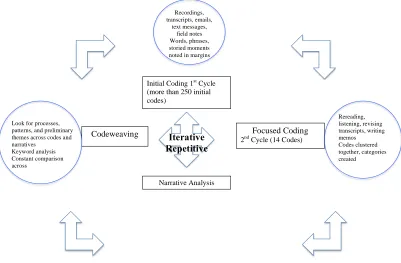
I used qualitative coding methods of analysis to locate themes across data sources
(Bog-dan & Biklen, 2007; Saldaña, 2009) and drew upon narrative methods of analysis to explore
par-ticipants’ understandings, perspectives, and experiences and to notice the ways in which power
and imagination intersected their individual stories and social lives. I was interested in the
soci-ocultural and dialogic dimensions of narrative, as narratives are capable of crossing geopolitical
and cultural borders and may provide a means for straddling borders (Anzaldúa, 1987/2007;
Zhou, 2001). Indeed, the book club itself centered on narrative, as we constructed and told
sto-ries connected to the books we read together. My hybrid approach, which was intended to allow
for multiple ways of knowing, is detailed in chapter 3.
One reason for basing the study on a book club was that I wanted to explore what the
par-ticipants and I might learn from one another by gathering regularly around narratives, talking and
reading together. I also wanted to reimagine the book club, which has traditionally been a White,
middle-class, homogenizing construction (Long, 2003), as a potentially open and more diverse
space where women with different perspectives and experiences could meet, talk, read, and share
their lives with one another. I chose to convene the book club outside of school in order to avoid
institutional structure and surveillance (Foucault, 1995), as well as to avoid the school’s
empha-sis on evaluation. Any of these factors could have impeded a free and open sharing of
perspec-tives and experiences.
Qualitative research was appropriate for this study of refugee women in a book club
be-cause, as Creswell (2009) noted, qualitative research is “exploratory” and is suitable when “not
much has been written about the topic or the population being studied” (p. 26). In the case of
ref-ugee literacy studies, numerous scholars and researchers have used qualitative inquiries to
globalized world (Bigelow, 2010; Oikonomidoy, 2007; Perrry, 2006; Sarroub, 2008; Townsend
& Fu, 2001; Walker-Dalhouse & Dalhouse, 2009; Warriner, 2004a, 2004b; Woods, 2009).
Binder and Tošić (2005) argued that more ethnographic and anthropological research is
needed in refugee studies and may provide valuable insights and knowledge. They suggested that
when refugees move, they “recompose” and “reconstruct” (p. 609) their histories, lives, and
eth-nic identities and contend this is worthy and valuable study within the growing globalized world.
Purcell-Gates (2004) suggested that ethnography is particularly suited to the study of literacy
be-cause literacy is a cultural practice. She argued that ethnography offers a cultural lens through
which to view literacy practices and the lives of learners, who are not considered part of the
mainstream.
Researchers have identified the ethnographic method as being appropriate for studies
concerning power structures. Street (2004) contends that ethnographic literacy studies are suited
to the study of local and out-of-school literacy practices; he argues for ethnographic studies that
can or will call into question social privilege and power, political power structures that “define
and rank” (p. 327) some literacy practices as better or more valuable than others. Literacy and
language are deeply connected to issues of culture, power, and agency and should be studied in
ways that may offer insight into the complexity of literacy practices. Similarly, Grbich (2007)
suggests that critical ethnography goes beyond describing the culture under study to reveal
rela-tions of power and ways power inequalities might be problematized and subverted—including
the researcher’s own roles and positions of power. Critical lenses allowed me to better examine
concepts of literacy, language, power, and agency (Freire, 1968/1993; Foucault, 1978; hooks,
1994; Luke, 2003, 2004a, 2004b; Norton, 2000; Norton & Toohey, 2004; Pavlenko, 2004;
richness of qualitative study with critical perspectives and ethnographic approaches. The critical
ethnographic approach to literacy that frames this study draws upon Street’s (1997, 2003, 2005)
ideological conception of literacy as multiple, situated, and shifting social practices.
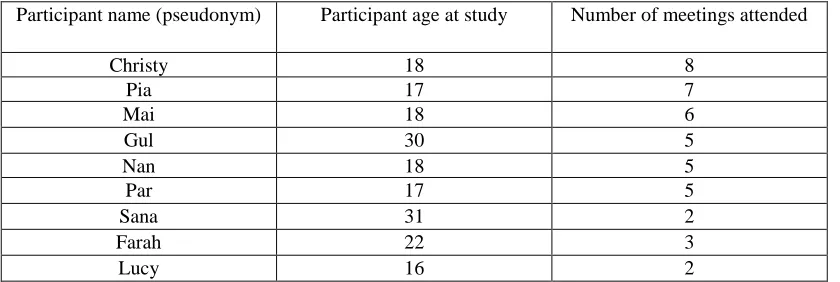
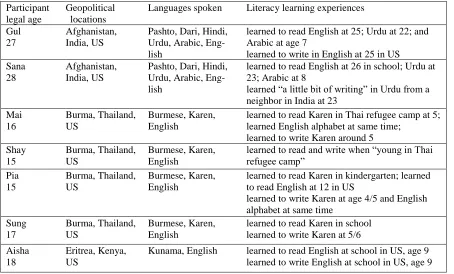
The nine women who participated in this study were purposefully recruited based on
pre-vious relationships, reading levels, and availability. All were refugee women from Afghanistan,
Burma, Burundi, and South Sudan. The women and I met regularly over a period of six months,
conducting book club meetings in relatively private spaces including my home, participants’
homes, a public park, and a restaurant. The methods and methodology are described in greater
detail in chapter 3.
Conceptual Frames: Theories and Lenses
For refugee women whose lives and subjectivities are shifting and situated in multiple
spaces, nuanced approaches and critical awareness were required to uncover and trace the
histo-ries of their practices as they are enmeshed in and highly influenced by a dynamic and complex
social and political world. I envisioned this study of refugee women’s literacies and lives in a
book club as an opportunity to better understand and reimagine different conceptions of literacy
and language use and the ways in which these intersect with learning and life in resettled spaces.
I drew upon and wove together multiple theories and constructs in order to develop a more
com-prehensive and complex view of the stories and lives that participants shared with me in this
study. These included (a) socio-cultural theories of learning and related concepts such as funds
of knowledge; (b) dialogic theories of language and learning; (c) poststructural theories and
fem-inist approaches; (d) theories of power and transnationalism; (e) a New Literacy Studies (NLS)
perspective, which assumes a critical ethnographic orientation to research; and (f) narrative
complex lives are lived across spaces, in multiple languages and with shifting literacies. The
ap-proach also rendered visible the refugee women’s practices of resistance and reimagining and
suggested how they may be influenced by a book club community. Stitched together, multiple
theories provided a theoretical framework of support for the study. Figure ____ shows a visual
representation of the framework I fashioned.
As a sociocultural study, I connect Vygotsky (1978, 1986) and Bakhtin (1981, 1984,
1986) to funds of knowledge (González, Moll, & Amanti, 2005) and community of practice
(Lave & Wenger, 1991) approaches and to transactional theory (Rosenblatt, 1994, 1995) in order
to reveal the complex relationships between language, literacy, and learning. Multiple
poststruc-tural and feminist critical perspectives (Anzaldúa, 1987/2007; Freire, 1968/1993; Foucault, 1978,
1995; Grewal & Kaplan, 1994; Hajdukowski-Ahmed, 2009; hooks, 1994; Lather, 1992, 2004;
Minh-ha, 2010; Mohanty, 2003; Noddings, 1984; Pennycook, 1999; Weedon, 1991, 1999, 2004)
brought social theories of language, literacy, and learning into particular focus as they
illuminat-ed aspects of refugee women’s everyday lives in genderilluminat-ed, classilluminat-ed, and racializilluminat-ed spaces.
Partic-ular attention to relations of power and transnationalism (Binder & Tošić, 2005; Grewal &
Kaplan, 1994; Lam & Warriner, 2012; Levitt & Schiller, 2006; Piller & Takahashi, 2010;
Ver-tovec, 2001; Warriner, 2007c, 2009b) in refugee women’s lives and literacy practices proved
im-portant in understanding their stories and the multiple ways in which they positioned themselves
in the book club and felt they were positioned by others outside the club.
In line with New Literacy Studies (Baynham, 2002; Street, 1997, 2005; Purcell-Gates,
2006; Barton & Hamilton, 1998, 2000), I attempted to critique normalizing discourses and
nar-row understandings of what literacy is and how it is taken up. I used social cultural theories and
Lantolf, 2011; Norton, 2000; Norton & Toohey, 2004; Pavlenko, 2004; Pavlenko & Norton,
2007; Swain & Deters, 2007) to give specific insights into refugees’ experiences as multilingual
English learners engaged in dialogic communities. Narrative approaches to research and analysis
(Bamberg, 2006; Bamberg & Georgakopoulou, 2008; Bell, 2002, 2011; Clandinin & Connelly,
2000; Frank, 2002, 2012; Georgakopoulou, 2006; Holstein & Gubrium, 2012; Norton & Early,
2011; Pavlenko, 2002; Riessman, 2008; Vitanova, 2013) afforded particular insights into the
dia-logic aspects and interactions in the book club and participants’ negotiations and navigations in
positioning and practices.
Taken together, these theories and approaches were tools for uncovering and
understand-ing the complex ways in which refugee women engage in meanunderstand-ing-makunderstand-ing in a book club and
beyond. My intention was to tie together theory and practice in critical praxis, or “reflection and
action upon the world in order to transform it” (Freire, 1968/1993).
Socio-cultural theories of language, learning, and literacy. Socially situated theories
of language, learning, and literacy offered an overarching frame for this study of literacy
practic-es in a women’s book club. Vygotsky (1978, 1986) characterized language and learning as being
constructed in social contexts. He contended that language and thought are inextricably linked
and suggested that individuals learn through language in social interactions and with scaffolded
support. In his view, “the true development of thinking is not from the individual to the social,
but from the social to the individual” (Vygotsky, 1986, p. 36). Social constructivist work
recog-nizes that “meaning is not discovered but is constituted or constructed in interaction” and is
“al-ways partial and perspectival” (Kamberelis & Dimitraidis, 2004, p. 14). A sociocultural frame
focuses upon language in use, and it situates practices of learning and knowing within everyday
Also drawing on sociocultural theories of learning to broaden understandings of literacy,
Street (1997, 2003, 2005) conceptualized literacy as a set of multiple, situated, social practices.
His ideological model responds to, and contrasts with, autonomous models of literacy as a set of
neutral, decontextualized technical skills and ties social literacy to communicative practices. For
Barton and Hamilton (1998), the study of local literacies in Britain revealed what they call
ver-nacular literacy practices, which are based in everyday experiences and used for everyday
pur-poses (p. 251). The authors organized these practices into categories, including organizing life,
personal communication, private leisure, documenting life, sense-making, and social
participa-tion. In contrast to dominant school-sanctioned literacies that are mostly controlled and
struc-tured by expert others, vernacular literacies are self-regulated, often self-motivated, and shifting.
Thus, they challenge the privilege of particular literacy practices over others.
I see literacy practices and learning as being situated in the everyday interactions and
in-tersections among people; they are socially, historically, and culturally embedded in funds of
knowledge. According to González, Moll, and Amanti (2005), funds of knowledge are the
accu-mulated and culturally situated knowledges and skills that people have acquired from and
through their lives, and that are essential for functioning and well-being (pp. 71–72). A funds of
knowledge approach connects learning and contexts in meaning-making. This approach is
situat-ed within everyday lives and real-world experiences, and it rejects deficit discourses. It is a
strengths-based approach to learning that focuses upon the valuable resources learners have and
use. Everyday literacy practices are tightly tied to refugee learners’ funds of knowledge
(Bige-low, 2010; Fong, 2004; Perry, 2009; Sarroub, 2002, 2008). I saw my exploration into refugee
Social learning can be conceptualized as occurring in communities of practice. Eckert
and McConnell-Ginet (1992), following Lave and Wenger (1991), described a community of
practice as “an aggregate of people who come together around mutual engagement in an
endeav-or. Ways of doing things, ways of talking, beliefs, values, power relations—in short, practices—
emerge in the course of this mutual endeavor” (p. 464). Lave and Wenger (1991) proposed that
from a community of practice perspective of learning,
The key to legitimate peripheral participation is access by newcomers to the
community of practice and all that membership entails. But though this is
essen-tial to the reproduction of the community, it is always problematic at the same
time. To become a full member of a community of practice requires access to a
wide range of ongoing activity, old-timers, and other members of the community;
and to information, resources and opportunities for participation. (p. 100)
Lave and Wenger (1991) based their conceptions of situated learning in communities of practice
on sociocultural theory. In their view, “learning is configured through the process of becoming a
full participant in a sociocultural practice” (p. 29) and is “an integral part of generative social
practice in the lived-in world” (p. 35). I saw this focus on generative practices as being essential
to understanding the possibilities in a book club, and as being connected to imagination.
A community of practice often has a strong imaginative component. Anderson (2006)
conceptualized a nation as an imagined community because it is not and cannot be based on
eve-ryday, face-to-face interaction among its members. Instead, members in the community share
perceived ideals, affinities, practices, and purposes. As Anderson suggested, a nation “is
imag-ined because the members of even the smallest nation will never know most of their
communion” (p. 6). The concept of an imagined community has been useful in second language
studies and has been influential in theorizing investment and identity in learning (e.g. Norton,
2001; Pavlenko & Norton, 2007; Ryan, 2006).
Conceptions of actual and imagined communities of practice are important to
understand-ing the ways in which refugee learners experience everyday lives in transnational spaces, or
“multi-layered, multi-sited social fields” that span space and time (Levitt & Glick Schiller, 2006,
p. 596), and engage in a women’s book club. In this study, I imagined the refugee women’s book
club as a potential community of practice through which newcomers became more
knowledgea-ble participants, aknowledgea-ble to support others through situated, reciprocal practices. I viewed this study
and the book club community of practice as an opportunity for members to imagine themselves
as legitimate members of a literate community and as potential future leaders, capable of
sup-porting and spreading book clubs of their own should they so desire.
A final point about communities of practice is the potential for peripherality, or
participa-tion from the margins. Through apprentice-like, peripheral participaparticipa-tion in communities,
new-comers can learn and move toward full participation. Peripherality suggests “an opening, a way
of gaining access” (Lave & Wenger, 1991, p. 37) and the multiple and varied, more or less
en-gaged ways of being located in participation. Thus, legitimate peripherality always involves
rela-tions of power and requires access to communities. However, participation in communities does
not imply “co-presence, a well-defined, identifiable group, or socially visible boundaries” (p. 98)
and is therefore sometimes connected to imagined communities (Anderson, 2006). Communities
of practice and imagined communities, as constructs, offer ways of conceptualizing the social
practices of refugee women who imagine themselves as new and legitimate members of
Dialogic theories of language and learning. Vygostsky’s sociocultural theory connects
to Bakhtin’s (1981) dialogic perspectives, and together they offer powerful insights into the
in-fluence of interaction, context, and dialogue on language, learning, and lives. For Bakhtin,
lan-guage and knowing are intertwined in and through a creative and imaginative dialogic process
that occurs in the utterance, or speech act, which is language-in-use. He contends that every
lin-guistic utterance, “having taken meaning and shape at a particular historical moment in a socially
specific environment,” cannot help but become “an active participant in social dialogue” (p.
276). He argues that dialogue, whether internal or external, is always part of and present in
meaning-making; he further insists that each word uttered or encountered “tastes of the context
and contexts in which it has lived its socially charged life” and is “populated by intentions” (p.
293). In this way, Bakhtin suggests that language “lies on the borderline between oneself and the
other” (p. 293) and is therefore not “neutral” territory (p. 293) but a powerfully charged space—
unstable, filled with meaning, and open to social conditioning and hybridization.
For Bakhtin, dialogue connects languages, discourses, and texts from the past, present, or
even the imagined future, and shapes knowing. The process of dialogization recognizes the
in-teraction of competing meanings, strips them of privilege, rejects absolute authority, and reveals
the ways in which languages and meanings change (p. 411–412) and may be appropriated in
multiple ways (p. 293–294). Bakhtin describes it as a dynamic and almost dangerous process, a
“collision between differing points of view on the world” (p. 360).
Bakhtin’s conceptions of language use differ from Vygotsky’s more structured,
hierar-chical, and apprentice-like approach. Swain and Deters (2007) suggested that Bakhtin’s dialogic
perspective “creates a greater space for human agency” (p. 829) than other sociocultural
dialog-ic practdialog-ices were explored in relation power and resistance, plurality, and the possibilities for
im-agination in a book club space. His conceptions taken together with Vygotskian approaches to
language and learning helped shape my understandings of dialogue in contextualized
communi-ties of practice.
I saw Rosenblatt’s (1994, 1995) transactional theory as related to Bahktin’s dialogic in
that a transaction is transformative and occurs in relationships between readers and texts. She
rejected the monologic notion that texts had one inherent meaning and instead conceived of a
transaction between reader and text in meaning making. Rosenblatt’s theory is sociocultural and
situates transactions in particular contexts wherein readers engage with texts and one another in
the process of composing.I imagined the book club as a space for collaborative learning and
transformation in and through the collision of multiple ways of knowing around texts.
Poststructural and feminist approaches. For the purposes of this study, I suggest that
multiple feminist (Anzaldúa, 1987/2007; Grewal & Kaplan, 1994; Hajdukowski-Ahmed, 2009;
hooks, 1994; Minh-ha, 2010; Mohanty, 2003; Noddings, 1984; Weedon, 1991, 1999, 2004) and
critical perspectives (Bakhtin, 1981, 1984; Freire, 1968/1993; Foucault, 1978, 1995; hooks,
1994; Luke, 2004b; Pennycook, 1999; Street, 2003; Weedon, 1991, 2004) bring social theories
of learning and literacy into particular focus as aspects of refugee women’s everyday lives.
These approaches often overlap and intersect in their efforts to expose inequity and affect
change. They rest on the notion that it is not enough to reveal relations of power, and thus,
re-quire transformative action. Rendering the “scattered hegemonies” (Grewal & Kaplan, 1994) and
“multiple discrimination against refugee women” (Pittaway & Bartolomei, 2001) visible through
critical and feminist lenses exposes how these are socially produced and reproduced, especially
power; it reinforces it, but also undermines and exposes it, renders it fragile and makes it
possi-ble to thwart it” (p. 101).
Traditionally, scholarship and research has focused on the ways in which migration and
displacement affects the lives of refugee men (Martin, 2004). Ezzy (2002) contended that
“main-stream social science routinely silences and masks women and women’s concerns” (p. 43). Thus,
feminist methods of research that reveal rather than conceal gender and render visible the ways
in which gender intersects with relations of power are necessary and needed. Feminist methods
recognize the ways in which relations of power permeate life and research. In addition, feminist
approaches are committed to political action and transformation. Feminist methodologies work
to uncover inequity in research and in the lives of women, bringing ethics and responsibility to
the fore.
In conducting this study, my understandings are also informed by a feminist approach
that is closely tied to ethics of care, responsible relatedness, and reciprocity in teaching and
re-search. Noddings (1984) argued that teachers must deeply and ethically care for their students—
for their minds, their learning, their welfare, their lives, their histories, their families, and their
languages. I believe this care is related to what González et al. (2005) described as “the nurturing
of students’ strengths and resources” (p. ix), in their funds of knowledge approach. Knowing
students and participants, discovering their strengths, and validating their experiences come from
an ethic of care. Although there are many distinct feminist epistemologies and approaches to
re-search, they largely emphasize the situated and subjective experiences of women and work to
resist homogeneity and hegemony.
According to Weedon (1991), poststructural feminist practice works to “denaturalize” (p.
in-fluenced approaches to literacy research and practice. Focused on destabilizing, decentering, and
deconstructing, poststructuralism challenges universal claims to knowledge by revealing the
dis-courses that reinforce them. Influenced by French thinkers such as Foucault (1972, 1970),
post-structural theory deconstructs dominant discourses and creates spaces for resistance. Rapidly
changing local and global contexts complicate simplified conceptions of language, learning, and
literacy, and poststructural theories offer frameworks for investigating these in changing times
(Norton, 2000).
This study affirmed the ways in which literacies vary across contexts, relate to refugee
women’s everyday experiences, and were used to rewrite and reimagine their real-world lives. It
is also intended as an exploration of an approach to informal literacy learning in communities of
practice and an examination of the relations of power that shape literacies and affect access to
learning communities. It was my hope that these understandings might offer insights into
differ-ent ways of learning and new possibilities for pedagogy in formal school settings. It is my belief
that multiple theoretical and conceptual lenses can render visible the complexity of literacies and
lives and potentially open up spaces to rewrite the dominant discourses of deficiency and
disabil-ity that often surround displaced women.
Theories of power and transnationalism. I imagined this study of language and literacy
practices among resettled refugee women as being related to the archeological and genealogical
work of Foucault. For Foucault (1978, 1972, 1970), archeology is the unearthing of relations of
power that work to control and monitor bodies and the boundaries of thought and action.
Gene-alogy is historical work that closely examines dominant discursive formations, rejects unified,
normalizing narratives, and reveals the complexity of the subject. In order to make sense of the
practic-es in a book club and navigate relations of power in their everyday livpractic-es, it is important to
recog-nize and render visible the global and local discourses and systems of power that cross social,
cultural, historical, and geopolitical spaces and times and work to influence their perceptions and
practices. It is also important to illuminate the ways in which imagination works to colonize and
liberate, particularly through dialogic texts and discourses.
I came to see imagination as intertwined with power and resistance. I realized the power
that imagination holds to construct common discourses and to contest and critique them. I
viewed this study of language, literacies, and everyday lives as situated within a context that
holds power and imagination together in tension. This dialectic, when revealed for what it is,
of-fers space for movement and change that can directly influence lives. This study of refugee
women required close attention to power and imagination, as the women’s lives reflected and
were shaped by both the local and global. Appadurai’s (2000) influential work exposes the ways
in which globalization works with imagination to colonize and decolonize the mind:
Imagination is no longer a matter of individual genius, escapism from ordinary
life, or just a dimension of aesthetics. It is a faculty that informs the daily lives of
ordinary people in myriad ways: It allows people to consider migration, resist
state violence, seek social redress, and design new forms of civic association and
collaboration, often across national boundaries. This view of the role of the
imag-ination as a popular, social, collective fact in the era of globalization recognises
its split character. On the one hand, it is in and through the imagination that
mod-ern citizens are disciplined and controlled—by states, markets, and other powerful
interests. But it is also the faculty through which collective patterns of dissent and