http://dx.doi.org/10.4236/ajc.2015.33007
How to cite this paper: Kwon, S. H., Cha, M. K., & Lee, S. Y. (2015). Hierarchical Value Maps of Smart Phones, Portal Sites, and Social Network Services Based on User Involvement. Advances in Journalism and Communication, 3, 56-70.
http://dx.doi.org/10.4236/ajc.2015.33007
Hierarchical Value Maps of Smart Phones,
Portal Sites, and Social Network Services
Based on User Involvement
Sang Hee Kwon
1, Min Kyung Cha
1, Seo Young Lee
2* 1Sungkyunkwan University, Seoul, Korea2Yonsei University, Seoul, Korea
Email: *[email protected]
Received 27 August 2015; accepted 26 September 2015; published 29 September 2015
Copyright © 2015 by authors and Scientific Research Publishing Inc.
This work is licensed under the Creative Commons Attribution International License (CC BY).
http://creativecommons.org/licenses/by/4.0/
Abstract
This study compares the hierarchical value maps (HVMs) for portal sites, smart phones, and social network services (SNSs) according to means-end chain theory. Means-end chain theory offers in-sights into how a media product satisfies the personal values of consumers. We derive the HVM for each media and investigate the effect of involvement on the HVM structure. A total of 424 individ-uals were queried for their opinions on the attributes, functional consequences, psychological consequences, and value of each media product through association pattern technique laddering. These elements constitute the value chain structure. Our findings show that the value of each me-dia is determined by involvement levels. For each meme-dia, high-involvement user groups regard self-satisfaction as the most important value they aspire for. This study determines that different levels of involvement do not affect the relationships among the elements of the value chain. HVMs for smart phones, portal sites, and SNSs are focused on a special value. However, the level of in-volvement generally does not seem to alter the structures of HVMs.
Keywords
Value Chain Structure, Involvement, Smart Phone, Portal Site, Social Network Service
1. Introduction
In today’s media-diverse world, technology has spawned a plethora of products and services, each with their own values and usage. Usage value has a large bearing over many aspects of a product or service. Moreover,
user needs evolve as the media environment evolves. Users tend to be financially self-sufficient and intellec-tually sophisticated; thus, their aspirations resonate with the high levels of Maslow’s hierarchy of needs (Mas-low, 1943; Baudrillard, 1970), such as desire to belong, respect, and self-actualization. New media creates shifts in the psychological needs of users along with their intentions for media use. Media usage will continue to evolve because technological advances enable easy access to content through different types of media at a low price.
We are interested in the selection of communication medium of users, who are influenced not only by the attributes of the medium but also by their psychological needs and values.
Given that user intention is the dominant motivation that drives media consumption, we must understand the motives, needs, and values of consumers. In particular, we should consider the services that media should pro-vide as time passes and values change.
Consumer motives, needs, and values are particularly pertinent in the current media environment, where we see the proliferation of new media products, services, and functionality. Understanding consumer values pro-vides media companies an advantage in the fiercely competitive consumer IT industry.
Christensen and Olson (2001) say that consumers prefer media services or functions involving consequences that are congruent with their personal values; in other words, the cognitive structures behind a consumers’ per-sonal values, and goals. This concept is the basis behind means-end chain theory, whereby the motivation of consumers in choosing a product is determined by the attributes and consequences that are in line with their personal values (Gutman, 1982; Peter & Olson, 2005).
This study aims to understand the consumer decision-making process that underlies the value structure in the choice of using smart phones, portal sites, and social network services (SNSs). In addition, this study examines the effect of involvement on value structure.
We can observe rapid developments in media products and services and the tremendous enrichment of func-tionality. Understanding consumer values provides an advantage to media companies racing to stay ahead in the fiercely competitive consumer IT industry.
2. Theoretical Background
Means and Chain Approach on Adoption of Smart Media
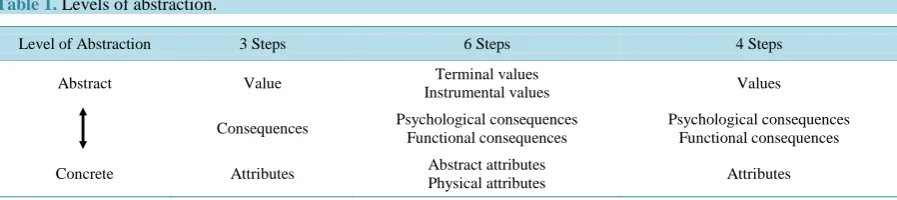
Means-ends chain theory links a chain of attributes, consequences, and values to define the relationship between motives and goal states of consumers (Gutman, 1981). Attributes are the specific, concrete, and physical traits of a product. Consequences are the attributes of a product with perceived benefits. Value is linked to the abstract goals of an individual (ter Hofstede, Audenaert, Steenkamp, & Wedel, 1998). Through the aforementioned rela-tionship, we can construct a hierarchical value map (HVM) of the consumer decision-making process by consi-dering not only the visual aspects of attributes but also the psychological, abstract, and symbolic steps to delve deep into the inner motives behind consumer behavior (see Table 1).
HVM provides a holistic framework to understand the choices made by media consumers. An HVM begins with product attributes and ends in personal values (Woodruff & Gardial, 1996).
[image:2.595.89.538.621.721.2]Involvement is defined as an individual’s internal desire and interest for a product. It determines motivation, which may influence the goals that individuals strive for (Celsi & Olson, 1988). Involvement causes a differing perception of products and individual values (Petty & Cacioppo, 1986)because the matters that users consider important affect their motivations for information processing, attributes, and consequences. Differences in mo-tivation affect the desires and satisfaction of individuals (Petty & Cacioppo, 1986). Through this process, in-volvement affects attributes, consequences, and values, namely, the overall means-end chain structure.
Table 1. Levels of abstraction.
Level of Abstraction 3 Steps 6 Steps 4 Steps Abstract Value Instrumental values Terminal values Values
Consequences Psychological consequences Functional consequences
Psychological consequences Functional consequences Concrete Attributes Abstract attributes
In the present study, we investigate the supposition that involvement has an effect on any segment of HVM for media products. Accordingly, we propose the following research questions:
1) How does involvement affect media (smart phone, portal sites, and SNSs) users’ perception of items in the four categories, namely, attributes, functional consequences, psychological consequences, and values? 2) Does involvement affect media (smart phones, portal sites, and SNSs) users’ perception of the relationships
among the categories, namely, attributes, functional consequences, psychological consequences, and values? 3) Does involvement change the HVM for users of smart phones, portal sites, and SNSs?
3. Methodology
Laddering Interview Method
Means-end chain theory was used to analyze the perception of users on smart phones, portal sites, and SNSs. User groups were queried on a list of items in each of the three categories (attributes, benefits, and values), rela-tionships, and associations among the categories. The key variable involvement was used to assess if an influ-ence exists on the value structure for media usage.
Consumers must understand how the attributes and benefits (consequences) of media relate to their inner val-ues. To this end, researchers developed laddering as a method to investigate the minds of consumers. Laddering questionnaires can be either soft laddering or hard laddering(Grunert & Grunert, 1995). Soft laddering involves one-on-one in-depth interview to assess the psychological disposition of respondents (Grunert & Grunert, 1995). Hard laddering is a quantitative research method capable of overcoming the limitations of soft laddering. Nu-merous hard laddering techniques exist, but association pattern technique (APT) is the most sophisticated re-search method. In this study, we used APT laddering method to collect data for our means-end chain analysis.
First, we developed a list of attributes, functional consequences, psychological consequences, and values for measurements that are relevant for users of smart phones, portal sites, and SNSs. The items for these categories were extracted from a review of current literature. APT laddering was used to determine the relationships of items among categories (i.e., attributes-functional consequences, functional consequences-psychological conse-quences, and psychological consequences-value) for each media and establish a complete picture of the value structure. We also investigated the involvement factor for each media through a modified version of the Zaich-kowsky personal involvement index (Zaichkowsky, 1985; Celsi & Olsen, 1988; Petty & Cacioppo, 1986; Huber, Beckmann, & Hermann, 2004). We used SPSS 18.0 software and derived an average involvement score of 5.1773 for smart phones, 4.9008 for portal sites, and 4.3358 for SNSs. Media involvement scoring below the average score was categorized as low involvement. Conversely, media involvement scoring higher than the av-erage was considered high involvement.
Frequency scoring is commonly used in APT laddering to extract the value structure from survey participants. Survey respondents marked in the implication matrix all the relationship pairs (e.g., attributes-functional conse-quences, psychological consequences-value) that are relevant to a consumer. The frequency score summarized the total number of times a relationship pair was marked by all survey respondents. However, the implication matrix can be quite complex and can be filled with unimportant relationships. To lessen the number of frequen-cy scores, means-end chain theory only extracted the relevant relationships for the construction of the HVM di-agram. Unimportant relationships were ignored.
Given that all important relationships (i.e., attributes, consequences, and values) for each item were extracted, we developed a comprehensive HVM summarizing the relationship between motivation and behavior (ladder).
4. Research Results
In this study, 424 individuals were surveyed about their use of smart phones, portal sites, and SNSs. The survey was conducted from April 2, 2014 to May 5, 2014. Most respondents were in their 20s (70.5%). In total, 55.7% were female and 44.3% were male. The most commonly used smart phone was Galaxy (49.1% of respondents). In total, 54.7% of portal sites used Daum, and 93.9% of users used Kakao Talk.
4.1. Results for Research Question 1
Table 2. Cross tabulation of functional consequence involvement for smart phones.
Items
Involvement
Total High Involvement Low Involvement
Daily life support 194 (11.8%) 223 (12.2%) 417 (12.0%) Self-expression 136 (8.3%) 139 (7.6%) 275 (7.9%) Social relationship 179 (10.9%) 205 (11.2%) 384 (11.1%) Mutual communication 179 (10.9%) 197 (10.8%) 376 (10.8%) Speedy information retrieval/content acquisition 174 (10.6%) 194 (10.6%) 368 (10.6%) Variety of information and content/acquisition 175 (10.6%) 198 (10.8%) 373 (10.7%) Personal information and content storage 162 (9.8%) 179 (9.8%) 341 (9.8%)
Sharing information/content 112 (6.8%) 128 (7.0%) 240 (6.9%) Work (mobile office) 148 (9.0%) 165 (9.0%) 313 (9.0%) Entertainment 186 (11.3%) 199 (10.9%) 385 (11.1%)
Total 1645 (100.0%) 1827 (100.0%) 3472 (100.0%)
χ2 = 9.066, p = 0.526.
indicates that user perception of smart phone functional consequence is not dependent on the involvement factor. Involvement affects user perception of psychological consequence for smart phone users (see Table 3). The results of the chi-square test showed no significant difference (χ2 = 14.112, p = 0.294) in the frequency of high- and low-involvement user groups.
The most important smart phone values are shown in Table 4. Involvement has an influence on people’s per-ception of value (χ2 = 26.302, p < 0.01).
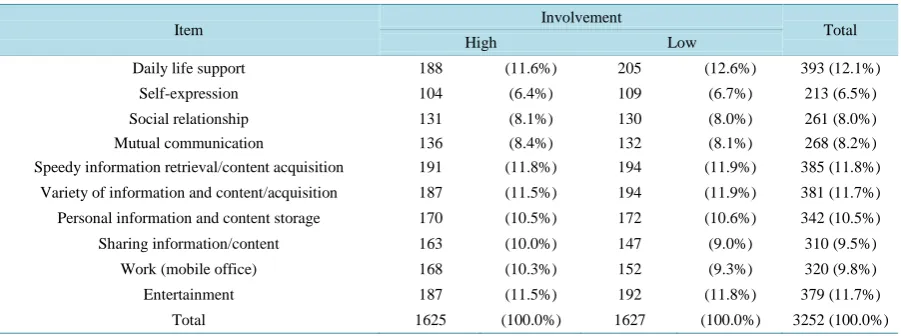
The functional consequence involvement for portal sites (Table 5) indicates that the high-involvement group has a statistically significant difference with the low-involvement group (χ2 = 26.656, p = 0.003).
For portal site users, involvement does not affect psychological consequence items (χ2 = 15.810, p = 0.200; see Table 6).
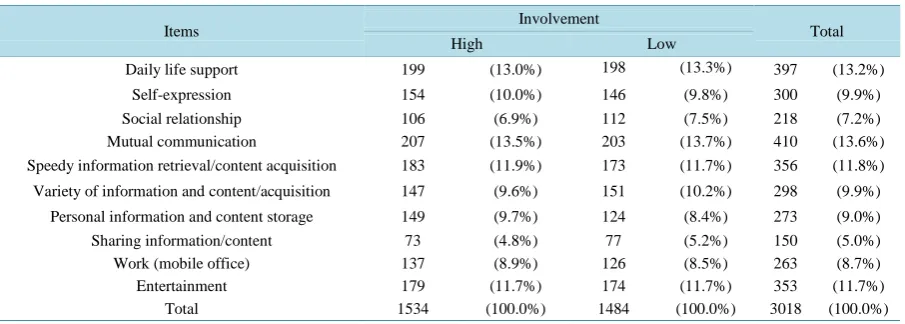
Involvement levels have an effect on value items for portal site users (see Table 7; χ2 = 26.123, p = 0.01). No statistical significance exists between high- and low-involvement SNS user groups for functional items (χ2 = 12.451, p = 0.256; see Table 8).
The high-involvement user group has no statistically significant difference with the low-involvement user group for psychological consequence items of SNS users (χ2 = 17.353, p = 0.136; see Table 9).
Finally, the important values pursued by SNS users are shown in Table 10. The high-involvement user group has a high statistically significant difference with the low-involvement user group (χ2 = 35.834, p = 0.000).
4.2. Results for Question 2
After the text edit has been completed, the paper is ready for the template. Duplicate the template file by using the Save As command, and use the naming convention prescribed by your journal for the name of your paper. In this newly created file, highlight all of the contents and import your prepared text file. You are now ready to style your paper.
4.2.1. Impact of Involvement on the Means and Chains Relationships for Smart Phone User
Table 3. Cross tabulation of psychological consequence involvement for smart phones.
Item Involvement Total High Low
Self satisfaction 152 (10.8%) 185 (12.3%) 337 (11.6%) Self pride 64 (4.5%) 60 (4.0%) 124 (4.3%) Self cultivation 124 (8.8%) 126 (8.4%) 250 (8.6%) Sincerity 80 (5.7%) 80 (5.3%) 160 (5.5%) Individual personality 117 (8.3%) 114 (7.6%) 231 (7.9%) Desire to possess 82 (5.8%) 72 (4.8%) 154 (5.3%) Well-rounded social life 174 (12.4%) 195 (13.0%) 369 (12.7%)
Convenience 188 (13.4%) 206 (13.7%) 394 (13.6%) Trust 77 (5.5%) 86 (5.7%) 163 (5.6%) Preference 95 (6.8%) 97 (6.5%) 192 (6.6%) Interest 160 (11.4%) 178 (11.9%) 338 (11.6%) Trendy/sophisticated 94 (6.7%) 101 (6.7%) 195 (6.7%)
[image:5.595.90.539.315.504.2]χ2 = 14.112, p = 0.294.
Table 4. Cross tabulation of value and involvement for smart phones.
Item Involvement Total High Low
Self-realization 162 (9.6%) 174 (9.5%) 336 (9.6%) Vibrant life 157 (9.3%) 188 (10.3%) 345 (9.8%) Self-satisfaction 180 (10.7%) 190 (10.4%) 370 (10.5%)
Self-respect 133 (7.9%) 157 (8.6%) 290 (8.3%) Sense of belonging 116 (6.9%) 140 (7.6%) 256 (7.3%) Being well-respected 134 (8.0%) 118 (6.4%) 252 (7.2%) Fun and enjoyment 164 (9.8%) 189 (10.3%) 353 (10.0%) Warm relationship with others 167 (9.9%) 184 (10.0%) 351 (10.0%) Empowerment 125 (7.4%) 134 (7.3%) 259 (7.4%)
Happiness 162 (9.6%) 163 (8.9%) 325 (9.3%) Inner Balance 111 (6.6%) 101 (5.5%) 212 (6.0%) Aesthetic aspect 71 (4.2%) 93 (5.1%) 164 (4.7%) Total 1682 (100.0%) 1831 (100.0%) 3513 (100.0%)
χ2
= 26,302, p < 0.01.
Table 5. Cross tabulation of functional consequence and involvement for portal sites.
Item Involvement Total High Low
Daily life support 188 (11.6%) 205 (12.6%) 393 (12.1%) Self-expression 104 (6.4%) 109 (6.7%) 213 (6.5%) Social relationship 131 (8.1%) 130 (8.0%) 261 (8.0%) Mutual communication 136 (8.4%) 132 (8.1%) 268 (8.2%) Speedy information retrieval/content acquisition 191 (11.8%) 194 (11.9%) 385 (11.8%)
Variety of information and content/acquisition 187 (11.5%) 194 (11.9%) 381 (11.7%) Personal information and content storage 170 (10.5%) 172 (10.6%) 342 (10.5%) Sharing information/content 163 (10.0%) 147 (9.0%) 310 (9.5%)
Work (mobile office) 168 (10.3%) 152 (9.3%) 320 (9.8%) Entertainment 187 (11.5%) 192 (11.8%) 379 (11.7%)
Total 1625 (100.0%) 1627 (100.0%) 3252 (100.0%)
χ2
[image:5.595.89.540.542.710.2]Table 6. Cross tabulation of psychological consequence and involvement for portal site users.
Items Involvement Total High Low
Self-satisfaction 152 (14.5%) 158 (15.0%) 307 (14.8%) Self-pride 64 (6.8%) 56 (5.3%) 126 (6.1%) Self-cultivation 124 (11.3%) 105 (10.0%) 221 (10.6%)
Sincerity 80 (7.0%) 74 (7.0%) 146 (7.0%) Individual personality 117 (10.2%) 93 (8.9%) 198 (9.5%) Desire to possess 82 (7.6%) 72 (6.9%) 150 (7.2%) Well-rounded social life 174 (17.3%) 191 (18.2%) 368 (17.7%)
Convenience 188 (18.4%) 204 (19.4%) 393 (18.9%) Trust 77 (8.5%) 88 (8.4%) 175 (8.4%) Preference 95 (8.6%) 102 (9.7%) 190 (9.2%) Interest 160 (16.3%) 166 (15.8%) 333 (16.0%) Trendy/sophisticated 94 (8.3%) 79 (7.5%) 164 (7.9%)
Total 1026 (100.0%) 1050 (100.0%) 2076 (100.0%)
χ2
[image:6.595.91.540.326.512.2]= 15.810, p = 0.200.
Table 7. Cross tabulation of value and involvement for portal sites users.
Items Involvement Total High Low
Self-realisation 162 (9.8%) 172 (10.4%) 334 (10.1%) Vibrant life 166 (10.0%) 171 (10.3%) 337 (10.2%) Sense of accomplishment 177 (10.7%) 168 (10.1%) 345 (10.4%) Self-respect 138 (8.3%) 144 (8.7%) 282 (8.5%) Sense of belonging 122 (7.3%) 116 (7.0%) 238 (7.2%) Being well-respected 120 (7.2%) 116 (7.0%) 236 (7.1%) Fun and enjoyment 176 (10.6%) 163 (9.8%) 339 (10.2%) Warm relationship with others 162 (9.8%) 166 (10.0%) 328 (9.9%)
Empowerment 123 (7.4%) 113 (6.8%) 236 (7.1%) Happiness 158 (9.5%) 156 (9.4%) 314 (9.5%) Inner balance 93 (5.6%) 95 (5.7%) 188 (5.7%) Aesthetic aspect 63 (3.8%) 77 (4.6%) 140 (4.2%) Total 1660 (100.0%) 1657 (100.0%) 3317 (100.0%)
χ2
= 26.123, p = 0.01.
Table 8. Cross tabulation of functional consequence and involvement for SNS users.
Items Involvement Total High Low
Daily life support 199 (13.0%) 198 (13.3%) 397 (13.2%) Self-expression 154 (10.0%) 146 (9.8%) 300 (9.9%) Social relationship 106 (6.9%) 112 (7.5%) 218 (7.2%) Mutual communication 207 (13.5%) 203 (13.7%) 410 (13.6%) Speedy information retrieval/content acquisition 183 (11.9%) 173 (11.7%) 356 (11.8%) Variety of information and content/acquisition 147 (9.6%) 151 (10.2%) 298 (9.9%)
Personal information and content storage 149 (9.7%) 124 (8.4%) 273 (9.0%) Sharing information/content 73 (4.8%) 77 (5.2%) 150 (5.0%) Work (mobile office) 137 (8.9%) 126 (8.5%) 263 (8.7%) Entertainment 179 (11.7%) 174 (11.7%) 353 (11.7%)
Total 1534 (100.0%) 1484 (100.0%) 3018 (100.0%)
χ2
[image:6.595.88.541.547.709.2]Table 9. Cross tabulation of psychological consequence and involvement for SNS users.
Items Involvement Total High Low
Self-satisfaction 162 (11.0%) 163 (11.9%) 325 (11.4%) Self-pride 64 (4.3%) 59 (4.3%) 123 (4.3%) Self-cultivation 104 (7.1%) 99 (7.2%) 203 (7.1%) Sincerity 128 (8.7%) 122 (8.9%) 250 (8.8%) Individual personality 80 (5.4%) 64 (4.7%) 144 (5.1%) Desire to possess 183 (12.4%) 171 (12.5%) 354 (12.4%) Well-rounded social life 164 (11.1%) 147 (10.7%) 311 (10.9%) Convenience 182 (12.3%) 181 (13.2%) 363 (12.8%) Trust 69 (4.7%) 54 (3.9%) 123 (4.3%) Preference 85 (5.8%) 81 (5.9%) 166 (5.8%) Interest 174 (11.8%) 163 (11.9%) 337 (11.8%) Trendy/sophisticated 79 (5.4%) 66 (4.8%) 145 (5.1%)
Total 1474 (100.0%) 1370 (100.0%) 2844 (100.0%)
χ2
[image:7.595.89.539.322.501.2]= 17.353, p = 0.136.
Table 10. Cross tabulation of value and involvement for SNS users.
Items Involvement Total High Low
Self-realisation 149 (8.9%) 158 (9.8%) 307 (9.3%) Vibrant life 174 (10.4%) 157 (9.8%) 331 (10.1%) Sense of accomplishment 182 (10.9%) 163 (10.1%) 345 (10.5%) Self-respect 138 (8.2%) 135 (8.4%) 273 (8.3%) Sense of belonging 141 (8.4%) 125 (7.8%) 266 (8.1%) Being well-respected 135 (8.1%) 120 (7.5%) 255 (7.8%) Fun and enjoyment 173 (10.3%) 170 (10.6%) 343 (10.4%) Warm relationship with others 180 (10.7%) 177 (11.0%) 357 (10.9%) Empowerment 106 (6.3%) 101 (6.3%) 207 (6.3%)
Happiness 167 (10.0%) 139 (8.6%) 306 (9.3%) Inner balance 80 (4.8%) 88 (5.5%) 168 (5.1%) Aesthetic aspect 50 (3.0%) 77 (4.8%) 127 (3.9%) Total 1675 (100.0%) 1610 (100.0%) 3285 (100.0%)
χ2 = 35.834, p = 0.000.
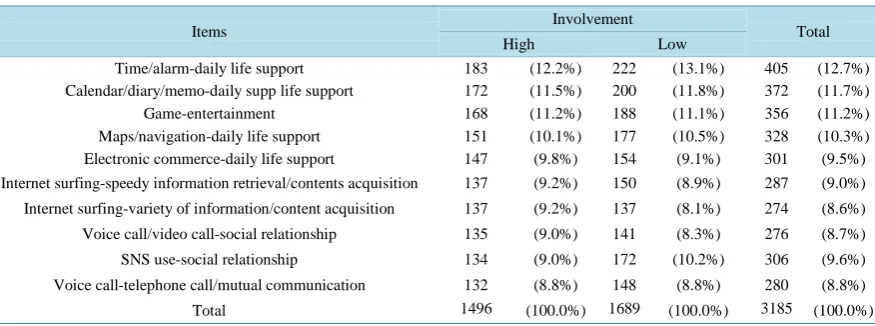
Table 11. Implication matrix of relationships between attributes and functional consequences for smart phone users by invol- vement.
Items Involvement Total High Low
Time/alarm-daily life support 183 (12.2%) 222 (13.1%) 405 (12.7%) Calendar/diary/memo-daily supp life support 172 (11.5%) 200 (11.8%) 372 (11.7%) Game-entertainment 168 (11.2%) 188 (11.1%) 356 (11.2%) Maps/navigation-daily life support 151 (10.1%) 177 (10.5%) 328 (10.3%) Electronic commerce-daily life support 147 (9.8%) 154 (9.1%) 301 (9.5%) Internet surfing-speedy information retrieval/contents acquisition 137 (9.2%) 150 (8.9%) 287 (9.0%) Internet surfing-variety of information/content acquisition 137 (9.2%) 137 (8.1%) 274 (8.6%) Voice call/video call-social relationship 135 (9.0%) 141 (8.3%) 276 (8.7%) SNS use-social relationship 134 (9.0%) 172 (10.2%) 306 (9.6%) Voice call-telephone call/mutual communication 132 (8.8%) 148 (8.8%) 280 (8.8%) Total 1496 (100.0%) 1689 (100.0%) 3185 (100.0%)
χ2
[image:7.595.98.536.546.709.2]As shown in Table 12, the top three functional consequence-psychological consequence relationships for high and low involvement groups are entertainment-fun, followed by mutual communication-Well-rounded social life and social Relationship-Well-rounded social life. There was very little difference in how the high and low in-volvement groups rated importance of the lesser ranked relationships.
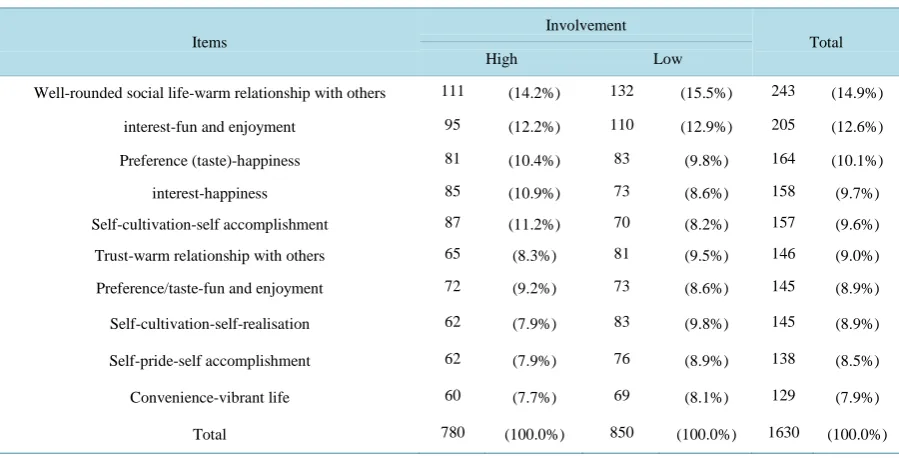
[image:8.595.104.537.217.461.2]As shown in Table 13, the top three psychological consequences relationships for both high and low users are well-rounded social life-warm relationship with others, interest-Fun and enjoyment and Preference (taste)-hap- piness. There was very little difference between how the high and low involvement groups ranked the other 7 relationships.
Table 12. Implication matrix of relationships between function consequences and psychological consequences for smart phone users by involvement.
Items
Involvement
Total High Low
Entertainment-fun 134 (12.0%) 151 (11.4%) 285 (11.7%) Mutual communication-well-rounded social life 129 (11.5%) 149 (11.2%) 278 (11.4%) Social Relationship-well-rounded social life 127 (11.4%) 149 (11.2%) 276 (11.3%) Work (mobile office)-convenience 123 (11.0%) 123 (9.3%) 246 (10.1%) Daily life support-convenience 115 (10.3%) 139 (10.5%) 254 (10.4%) Speed information retrieval/content acquisition-convenience 109 (9.7%) 131 (9.9%) 240 (9.8%)
Personal information content storage-convenience 99 (8.9%) 117 (8.8%) 216 (8.8%) Variety of information/content acquisition-convenience 98 (8.8%) 133 (10.0%) 231 (9.5%) Self-expression-self satisfaction 95 (8.5%) 127 (9.6%) 222 (9.1%) Sharing info/contents-convenience 89 (8.0%) 107 (8.1%) 196 (8.0%) Total 1118 (100.0%) 1326 (100.0%) 2444 (100.0%)
Table 13.Implication matrix of relationships between psychological consequences and value for smart phone users by invol- vement.
Items
Involvement
Total High Low
[image:8.595.88.538.494.723.2]4.2.2. Impact of Involvement on the Means and Chains Relationships for Portal Site Users
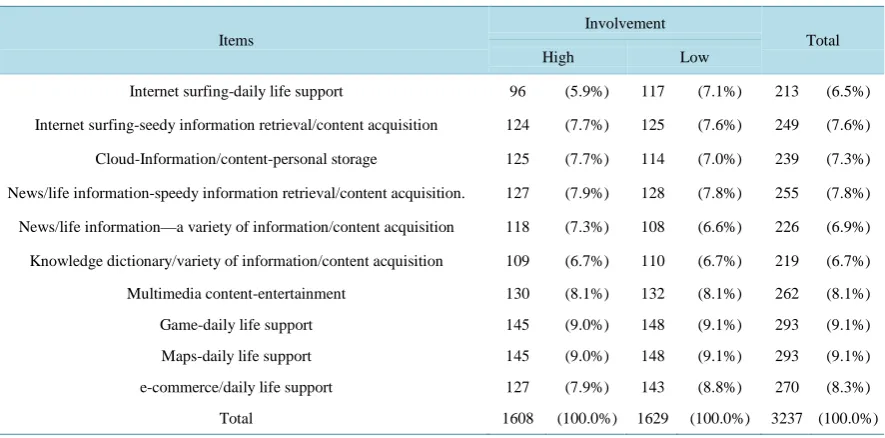
As shown in Table 14, the three most important attributes to functional consequences relationships for portal sites for both high and low involvement groups are game-daily life support, maps-daily life support followed by multimedia content-entertainment. There were differences in how the low and high involvement groups rated the lower rank items.
As shown in Table 15, the three most important relationships between psychological consequences and func-tional consequences for the high involvement group are work (mobile office)-Convenience, social relation-ship-vibrant life followed by mutual communication-vibrant life. For the low involvement group, the most im-portant relationships are social relationship-vibrant life, mutual communication-vibrant life followed by daily life support-convenience.
[image:9.595.96.539.266.485.2]As shown in Table 16, the three most important relationships between psychological consequences and val-ues were the same for both the high and low involvement groups; which were pursuing personal character- warm relationship with others, interest-fun and enjoyment followed by self-satisfaction-self realization.
Table 14. Implication matrix of relationships of attributes and functional consequences for portal site users by involvement.
Items
Involvement
Total High Low
Internet surfing-daily life support 96 (5.9%) 117 (7.1%) 213 (6.5%) Internet surfing-seedy information retrieval/content acquisition 124 (7.7%) 125 (7.6%) 249 (7.6%) Cloud-Information/content-personal storage 125 (7.7%) 114 (7.0%) 239 (7.3%) News/life information-speedy information retrieval/content acquisition. 127 (7.9%) 128 (7.8%) 255 (7.8%) News/life information—a variety of information/content acquisition 118 (7.3%) 108 (6.6%) 226 (6.9%) Knowledge dictionary/variety of information/content acquisition 109 (6.7%) 110 (6.7%) 219 (6.7%) Multimedia content-entertainment 130 (8.1%) 132 (8.1%) 262 (8.1%) Game-daily life support 145 (9.0%) 148 (9.1%) 293 (9.1%) Maps-daily life support 145 (9.0%) 148 (9.1%) 293 (9.1%) e-commerce/daily life support 127 (7.9%) 143 (8.8%) 270 (8.3%) Total 1608 (100.0%) 1629 (100.0%) 3237 (100.0%)
Table 15. Implication matrix of relationships of psychological consequences and functional consequences for portal site users by involvement.
Items
Involvement
Total High Low
Daily life support-convenience 106 (10.3%) 139 (12.3%) 245 (11.3%) Self-expression-self satisfaction 95 (9.2%) 103 (9.1%) 198 (9.2%)
Social relationship-vibrant life 125 (12.2%) 145 (12.8%) 270 (12.5%) Mutual communication-vibrant life 125 (12.2%) 141 (12.5%) 266 (12.3%) Speedy information retrieval/content acquisition-convenience 120 (11.7%) 134 (11.8%) 254 (11.8%) Variety of information/content acquisition-convenience 115 (11.2%) 119 (10.5%) 234 (10.8%) Information content storage-convenience 110 (10.7%) 119 (10.5%) 229 (10.6%) Sharing info/contents-convenience 101 (9.8%) 108 (9.5%) 209 (9.7%) Work (mobile office)-convenience 131 (12.7%) 124 (11.0%) 255 (11.8%)
[image:9.595.87.539.519.722.2]Table 16. Implication matrix of relationships of psychological consequences and values for portal site users by involve- ment
Items
Involvement
Total High Low
Self-satisfaction-self-realisation 91 (10.8%) 93 (11.7%) 184 (11.3%) Self-pride-self accomplishment 78 (9.3%) 65 (8.2%) 143 (8.8%) Self-cultivation-self accomplishment 82 (9.8%) 65 (8.2%) 147 (9.0%) Integrity-self accomplishment 59 (7.0%) 69 (8.7%) 128 (7.8%) Pursuing personal character-warm relationship with others 112 (13.3%) 127 (16.0%) 239 (14.6%)
Desire to possess-vibrant life 66 (7.9%) 75 (9.5%) 141 (8.6%) Well-rounded social life-warm relationship with others 65 (7.7%) 74 (9.3%) 139 (8.5%) Preference taste-fun and enjoyment 80 (9.5%) 69 (8.7%) 149 (9.1%) Interest-fun and enjoyment 116 (13.8%) 97 (12.2%) 213 (13.1%)
Interest-happiness 90 (10.7%) 59 (7.4%) 149 (9.1%) Total 839 (100.0%) 793 (100.0%) 1632 (100.0%)
4.2.3. Impact of Involvement on the Means and Chains Relationships for SNS Users
For SNS users, Table 17 shows the importance rankings of the relationships between the attributes and func-tional consequences were the exactly the same for both the high and low involvement groups. The three most important relationships were my account/scheduling-daily life support, online social networking-social relation-ships and friends/institution introduction-social relationrelation-ships.
Table 18 shows the two most important relationships between psychological consequences and functional consequences for bothe the high and low involvement groups were mutual communication-well-round social life followed by a variety of information/content acquisition-convenience. Minor differences appeared in the ranking of lesser important items.
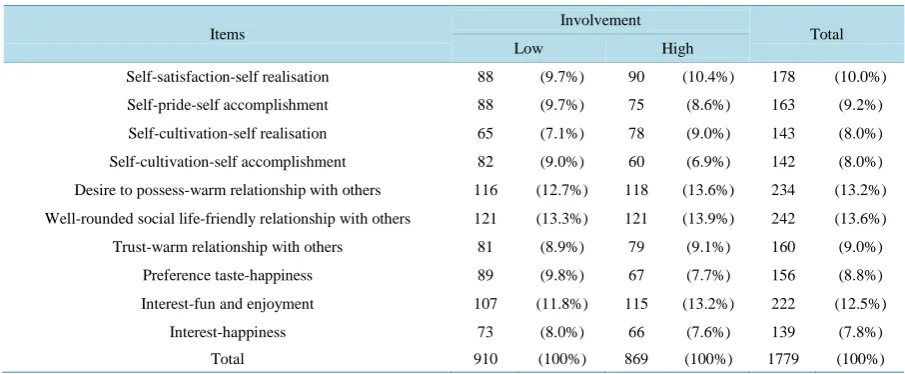
Table 19 shows the three most important relationships between psychological consequences and value for both the low and high involvement groups are Well-rounded social life-Friendly relationship with others, desire to possess-warm relationship with others followed by interest-fun and enjoyment. Minor differences appeared in the ranking of lesser important items.
4.3. Results for Research Question 3
Question 3 aims to construct HVMs through means-end chain theory and to connect the relationships among the categories (attributes, functional consequences, psychological consequences, and value) of smart phones, portal sites, and SNSs. The results for Question 3 is used to generate goal hierarchy for using smart media and incor-porates the results obtained in Questions 1 and 2.
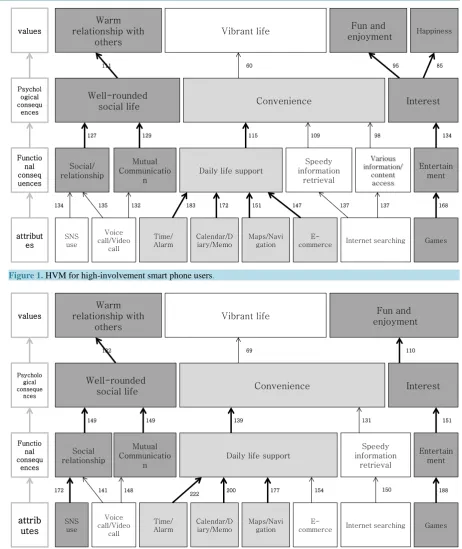
The HVM for high-involvement smart phones users is shown in Figure 1. The most important ladders are game-entertainment-interest-fun and enjoyment, games-entertainment-interest-happiness, time/alarm-daily life support-convenience-vibrant life, calendar/memo/diary-daily life support-convenience-vibrant life, and map na-vigation-daily life support-convenience-vibrant life.
Figure 2 shows that the HVM for low-involvement users is similar to that for high-involvement users. This finding indicates that involvement is not a key factor for smart phone users. Smart phone users derive conveni-ence value from the attributes on offer, such as voice call/video call. For smart phone game players, the values derived by these users are fun, enjoyment, and happiness.
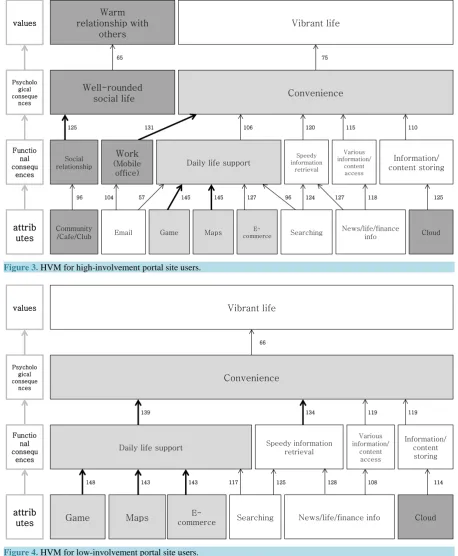
Figure 3 and Figure 4 show that the HVM of portal site users is simpler than that of smart phone users. However, a focus on convenience exists at the psychological consequences stage.
Table 17. Implication matrix of relationships of attributes and functional consequences for SNS users by involvement.
Item Involvement Total Low High
My account/scheduling-daily life support 168 (9.4%) 170 (10.0%) 338 (9.7%) Online social networking-social relationships 178 (9.9%) 165 (9.7%) 343 (9.8%) Friends/institution introduction-social relationships 132 (7.4%) 146 (8.6%) 278 (8.0%) Friends/institution searching-social relationships 133 (7.4%) 123 (7.2%) 256 (7.3%) Aggregation of news-speedy information retrieval/content acquisition 97 (5.4%) 95 (5.6%) 192 (5.5%) Mentionor comments-social relationships 115 (6.4%) 120 (7.0%) 235 (6.7%) Mention or comments-mutual communication 106 (5.9%) 90 (5.3%) 196 (5.6%) Sns game-entertainment 168 (9.4%) 156 (9.2%) 324 (9.3%) E-commerce-daily life support 142 (7.9%) 136 (8.0%) 278 (8.0%) Send gifts and items-social relationship 149 (8.3%) 133 (7.8%) 282 (8.1%) Total 1790 (100.0%) 1703 (100.0%) 3493 (100.0%)
Table 18. Implication matrix of relationships between psychological consequences and functional consequences for SNS Users by Involvement.
Items Involvement Total Low High
Daily life support-convenience 88 (7.7%) 93 (7.9%) 181 (7.8%) Self-expression-self satisfaction 103 (9.0%) 111 (9.4%) 214 (9.2%) Social relationships-well-rounded social life 83 (7.2%) 72 (6.1%) 155 (6.7%) Mutual communication-well-rounded social life 129 (11.3%) 136 (11.5%) 265 (11.4%) Speedy information retrieval/contents acquisition-well-rounded social life. 104 (9.1%) 117 (9.9%) 221 (9.5%) Speedy information retrieval/contents acquisition-empathy 101 (8.8%) 83 (7.0%) 184 (7.9%) A variety of information/contents acquisition-convenience 109 (9.5%) 116 (9.8%) 225 (9.7%) Information/contents individual storage-convenience 108 (9.4%) 107 (9.1%) 215 (9.3%) Sharing info/contents-convenience 94 (8.2%) 107 (9.1%) 201 (8.6%) Work (mobile office)-convenience 74 (6.5%) 83 (7.0%) 157 (6.8%) Total 1146 (100.0%) 1178 (100.0%) 2324 (100.0%)
Table 19. Implication matrix of relationships between psychological consequences and value for SNS users by involvement.
Items Involvement Total Low High
Self-satisfaction-self realisation 88 (9.7%) 90 (10.4%) 178 (10.0%) Self-pride-self accomplishment 88 (9.7%) 75 (8.6%) 163 (9.2%) Self-cultivation-self realisation 65 (7.1%) 78 (9.0%) 143 (8.0%) Self-cultivation-self accomplishment 82 (9.0%) 60 (6.9%) 142 (8.0%) Desire to possess-warm relationship with others 116 (12.7%) 118 (13.6%) 234 (13.2%) Well-rounded social life-friendly relationship with others 121 (13.3%) 121 (13.9%) 242 (13.6%) Trust-warm relationship with others 81 (8.9%) 79 (9.1%) 160 (9.0%)
Preference taste-happiness 89 (9.8%) 67 (7.7%) 156 (8.8%) Interest-fun and enjoyment 107 (11.8%) 115 (13.2%) 222 (12.5%)
[image:11.595.91.537.321.512.2] [image:11.595.86.539.535.722.2]Figure 1.HVM for high-involvement smart phone users.
Figure 2. HVM for low-involvement smart phone users.
5. Discussions
In this study, we derived the HVMs of smart phones, portal sites, and SNSs depending on user involvement based on the concept of involvement and means-chain theory. We identified differences in values among users in the high-involvement group and users in the low-involvement group for all media types.
The most important value for the high-involvement group is self-accomplishment. The members of the high-
Psychol ogical consequ ences Functio nal conseq uences attribut es values Speedy information retrieval SNS use Voice call/Video call Internet searching Calendar/D iary/Memo Games Social/
relationship Daily life support
Entertain ment
Well-rounded
social life Convenience Interest
Happiness
Vibrant life Fun and
enjoyment Warm
relationship with others
111 60 95 85
127 129 115 134
168
134 135 172
Mutual Communicatio n Various information/ content access 98 109 132 Time/ Alarm Maps/Navi gation E-commerce
183 151 147 137 137
Psycholo gical conseque nces Functio nal consequ ences attrib utes values Speedy information retrieval SNS use Voice call/Video call Internet searching Calendar/D iary/Memo Games Social
relationship Daily life support
Entertain ment
Well-rounded
social life Convenience Interest
Vibrant life Fun and
enjoyment Warm
relationship with others
132 69 110
149 149 139 151
188
172 141 200
Mutual Communicatio n 131 148 Time/ Alarm Maps/Navi gation E-commerce
Figure 3. HVM for high-involvement portal site users.
Figure 4. HVM for low-involvement portal site users.
involvement group tend to be very active users who use media as a means to achieve their goals. The most im-portant values for the low-involvement group are self-realization and friendly relationships with others. In addi-tion, high-and low-involvement HVMs are apparently similar with regard to motivation and behavior of media users. However, the perceptions of attributes, consequences, and utilization of media show differences depend-ing on involvement.
Psycholo gical conseque nces Functio nal consequ ences attrib utes values Speedy information retrieval Community /Cafe/Club Email News/life/finance info Maps Cloud Social
relationship Daily life support
Information/ content storing
Well-rounded
social life Convenience
Vibrant life Warm relationship with others 65 75 125 106 125
96 104 145
Work (Mobile office) Various information/ content access 115 120 57
Game commerceE- Searching
145 127 96 127 118
131 110 124 Psycholo gical conseque nces Functio nal consequ ences attrib utes values Speedy information retrieval News/life/finance info Maps Cloud
Daily life support
Information/ content storing Convenience Vibrant life 66 139 114 143 Various information/ content access 119 134
Game commerceE- Searching
148 143 117 128 108
119
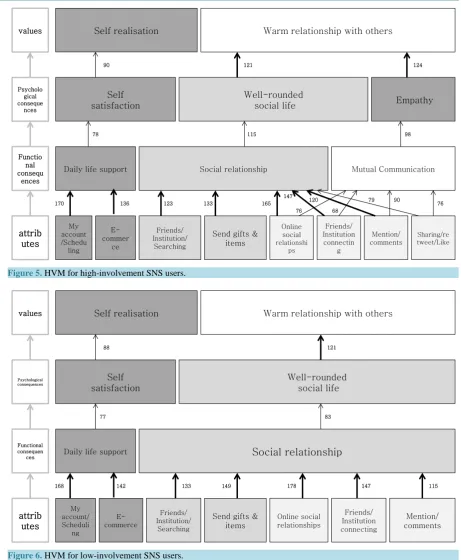
[image:13.595.83.542.86.643.2]Figure 5. HVM for high-involvement SNS users.
Figure 6. HVM for low-involvement SNS users.
The implication of the research findings is that different usage values exist in cyber media. The result shows that the basic values for smart phone users are social life support, entertainment, social relationship, and interac-tion communicainterac-tion. In comparison, the important values for portal site users are quick informainterac-tion acquisiinterac-tion, supporting daily life, and a variety of information/content acquisition and entertainment. The HVMs of smart phones, portal sites, and SNSs were compared with one another, and the result shows that they have different value chains. Psycholo gical conseque nces Functio nal consequ ences attrib utes values My account /Schedu ling E-commer ce Mention/ comments
Send gifts & items
Sharing/re tweet/Like
Daily life support Social relationship
Self satisfaction
Well-rounded
social life Empathy
Warm relationship with others Self realisation
90 121
78 115
76
170 136 133
Mutual Communication 98 Friends/ Institution/ Searching Online social relationshi ps Friends/ Institution connectin g 165 147 90
123 120 79
76 68 124 Psychological consequences Functional consequen ces attrib utes values My account/ Scheduli ng E-commerce Mention/ comments Send gifts &
items
Daily life support Social relationship
Self satisfaction
Well-rounded social life
Warm relationship with others Self realisation
88 121
77 83
168 142 149
The final values of users are also influenced by the characteristics and functional strength of media. New communication devices constantly attempt to meet the basic human desire for communication because desire drives the demand for new social smart devices.
References
Baudrillard, J. (1970). The Consumer Society: Myths and Structures. Theory, Culture & Society. New York: Nottingham University.
Celsi, R. L., & Olson, J. C. (1988). The Role of Involvement in Attention and Comprehension Processes. Journal of
Con-sumer Research, 15, 210-224. http://dx.doi.org/10.1086/209158
Christensen, G. L., & Olson, J. C. (2001). Involved with What? The Impact of Heterogeneity in Goal Hierarchies on High Enduring Involvement. Advances in Consumer Research, 28, 392.
Grunert, K., & Grunert, S. (1995). Measuring Subjective Meaning Structures by the Laddering Method: Theoretical Consid-erations and Methodological Problems. International Journal of Research in Marketing, 12, 209-225.
http://dx.doi.org/10.1016/0167-8116(95)00022-T
Gutman, J. (1981). A Means-End Model for Facilitating Analysis of Product Markets Based on Consumer Judgement.
Ad-vances in Consumer Research, 8, 116-121.
Gutman, J. (1982). A means-End Chain Model based On Consumer Categorisation Processes. Journal of Marketing, 46,
60-72. http://dx.doi.org/10.2307/3203341
Huber, F., Beckmann, S. C., & Herrmann, A. (2004). Means-End Analysis: Does the Affective State Influence Information Processing Style? Psychology & Marketing, 21, 715-737. http://dx.doi.org/10.1002/mar.20026
Maslow, A. (1943). A Theory of Human Motivation. Psychological Review, 50, 370-396.
http://dx.doi.org/10.1037/h0054346
Peter, J. P., & Olson, J. C. (2005). Consumer Behaviour and Marketing Strategy (7th ed). New York: McGraw-Hill/Irwin.
Petty, R. E., & Cacioppo, J. T. (1986). Communication and Persuasion: Central and Peripheral Routes to Attitude Change.
New York: Springer-Verlag. http://dx.doi.org/10.1007/978-1-4612-4964-1
ter Hofstede, F., Audenaert, A., Steenkamp, J. E. M., & Wedel, M. (1998). An Investigation into the Association Pattern Technique as a Quantitative Approach to Measuring Means-End Chain. International Journal of Research in Marketing, 15, 37-50. http://dx.doi.org/10.1016/S0167-8116(97)00029-3
Woodruff, R. B., & Gardial, S. F. (1996). Know Your Customer: New Approaches to Understanding Customer Value and
Satisfaction. Cambridge, MA: Blackwell Publishers, Inc.
Zaichkowsky, J. L. (1985). Measuring the Involvement Construct. Journal of Consumer Research, 12, 341-352.