A Soft Computing Decision Support System in the
Diagnosis of Breast Cancer
Pankaj Srivastava
Department of Mathematics
MNNIT, Allahabad
211004, U.P. India
Amit Srivastava
Applied Mechanics Department
MNNIT, Allahabad
211004, U.P. India
Abdul Mannan
Applied Mechanics Department
MNNIT, Allahabad
211004, U.P. India
ABSTRACT
It is well known that most of Breast cancer diagnosis characterization processes are entirely based on physician’s intuition and experience. Since diagnosis of breast cancer involves several layers of uncertainty and imprecision that makes traditional approaches inappropriate. In the present research paper a soft computing diagnostic support system for breast cancer is proposed which is capable enough to capture ambiguous and imprecise information prevalent in breast cancer diagnosis. It is user friendly and will sharpen diagnostic skill of medical practitioners.
Keywords
Soft Computing, Breast Cancer, Fuzzy Tools
1.
INTRODUCTION
Breast cancer may be one of the oldest known forms of cancer in human. The oldest description of cancer was discovered in Egypt and dates back to approximately 1600 BC. Breast cancer is a disease of humans and other mammals while the overwhelming majority of cases in human are women [1]. Breast cancer is more than 100 times more common in women than breast cancer in men [2]. Prominent women who died of breast cancer include Empress Theodora, wife of Justinine; Anne of Austria, mother of Louis XIV of France; Mary Washington, mother of George and Rachel Carson, the environmentalist [1]. Janet Lane- Claypon conducted the first study on breast cancer epidemiology that has published in 1926 [1]. Worldwide breast cancer comprises 22.9% of all cancers in women. In 2008 breast cancer caused 458,253 deaths worldwide (13.7% of cancer deaths in women) [3]. Landis et al. [4] reported that Breast cancer is most frequently diagnosed cancer and second leading cause of cancer deaths in women after Lung cancer. The latest report of NBCF, 2012 [5] reported that in 2010 approximately 207090 newly diagnosed case of Breast cancer and 30840 deaths due to Breast cancer in USA. Danaei et al. [6] found that 21% of all breast cancer deaths worldwide are attributable to alcohol use, overweight and obesity, and physical inactivity. This proportion was higher in high-income countries (27%). In low- and middle-income countries, the proportion of breast cancers attributable to these risk factors was 18%. IARC and Lacey et al. [7, 8] found that Breastfeeding has a protective effect. Clemons and Goss et al. [9] concluded that Estrogen through direct and indirect proliferative effects play role in development and growth of breast cancer. Prognosis and survival rates vary greatly depending on cancer type, staging and treatment and geographical location of the patient. Survival rates in the western world are very good [3]. Overall more than 8 out of 10 women in England that are diagnosed
with the disease survive it for at least 5 years [10]. In the developing countries, however, survival rates are much poorer. Rao K. V. K et al. [11] discussed that despite advances in cancer treatment over the past decade, the prognosis of patients with breast cancer has improved only to small extent. Ford and Easton et al. [12] were of the view that hormonal imbalance and genetics are considered to be main risk of breast cancer.
2.
METHODOLOGY
In the present study input variables consist of Age, BMI, Age of first MC, Age of last MP, Age at first pregnancy, Alcohol intake, Smoking, Tumor surface area, Duration of breast feeding. Output variable consists of percentage of risk factor for Breast cancer.
2.1
INPUT VARIABLES
a) Age: Women current age is the best documented risk factor for breast cancer. The cumulative incidence of risk increase 1.8 percent at 50 year of age, 3.8 percent at 60 year age and 6.3 percent at 70 year age [28]. The incidence of breast cancer is very-very low before the age of 30 but after which it increase linearly up to the age of 80 [29]. The input variables for Age are classified in six fuzzy sets which as follows:
Age (in years)
Young < 30
Aged young 30- 40
Middle aged 40-55
Aged 55-70
Old 70-85
Very Old > 85
Figure1: Linguistic variables and membership function of Input variables ‘Age’
b) Age of first menstrual cycle: Risk increase significantly with the age of menarche. If the first menstruated age is 15 or above 15, risk factor decreases up to 23 percent than those having menarche prior to the age of 12[30]. The input variables for Age of first menstrual cycle are categorized in four fuzzy sets which are as follows:
First menstrual cycle age (year)
Early 10-12
Normal 12-14
Above normal 14-16
Extreme 16
Figure2: Linguistic variables and membership function of Input variables ‘First MC Age ’
c) Age at last menstrual Period (LMP): At the age after 45 year the risk factor increase by 3 percent per year as the menopause is delayed. The increase in risk may be due to a longer lifetime exposure to the hormones estrogen and progesterone [31]. The input variables for Age of last menstrual period are classified in four fuzzy sets which are as follows:
The last menstrual Period age (year)
Normal
Above Normal 36- 48
Middle aged 45- 60
Figure3: Linguistic variables and membership function of Input variables ‘last Menstrual Period age’
d) Age at First pregnancy: The women having pregnancy before 20 year of age have low risk of breast cancer in compare to the women having pregnancy after the age of 20 [32]. The input variables for Age at first pregnancy are classified in five fuzzy sets which are as follows:
First pregnancy Age (years)
Early 21
Normal 19- 30
Above normal 28- 40
Middle aged 38- 48
Aged
Figure4: Linguistic variables and membership function of Input variables ‘First Pregnancy age’
e) Duration of breast feeding: Breast feeding protects women against developing breast cancer. Some studies have shown that breast-feeding slightly lowers breast cancer risk in women, especially in those women who had breast-feeding for 1½ to 2 years. As longer the women had breast feed to their child the risk of developing breast cancer decrease significantly [33]. The input variables for duration of breast feeding are categorized in six fuzzy sets which are as follows.
Duration of breast feeding (months)
Very less 4
less 2-8
Normal 6-14
Above normal 12-18
High 17-20
Figure5: Linguistic variables and membership function of Input variables ‘Duration of Breast Feeding’
f) Alcohol Intake: Consumption of alcohol might increase
the risk of breast cancer as it stimulates the metabolism of
Alcoholic Intake (per drink)
Very low 0-1
Low 1-3
Moderate 2-4
High 3-5
Very high 4
Figure6: Linguistic variables and membership function of Input variables ‘Alcohol Intake’
12 g alcohol) [36]. The input variables for body mass index are classified in to four fuzzy sets which are as follows:
Body mass index(kg/m2)
Low 10-20
Medium 20- 30
High 30- 40
Very high 40- 50
Figure7: Linguistic variables and membership function of Input variables ‘BMI’
h) Tumor surface: The input variables for tumor surface are categorized in six fuzzy sets. which are as follows:
Tumor surface Area (pixels)
Very small 1000
Small 1000- 2000
Medium 2000- 3500
Above medium 3500- 5000
Large 5000- 6500
Very large 6500
Figure8: Linguistic variables and membership function of Input variables ‘Tumor Surface Area ’
i) Smoking: The input variables for smoking are classified in five fuzzy sets which are as follows:
Smoking
Very Low 2-6
Low 4-12
Moderate 10-16
High 14-22
Very high 20
Figure9: Linguistic variables and membership function of Input variables ‘Smoking’
2.2
OUTPUT VARIABLE:
The output zone reflects the percentage of risk factor for breast cancer in the patient under observation. It is classified in five layers such as; very less, less, medium, high and very high. Increasing order of percentage indicates increasing order of risk factor for breast cancer.
Figure10: Linguistic variables and membership function of Output variables ‘Risk Factor for Breast Cancer’
3.
FUZZY RULES
Input Variables Output variable Age
(Y)
BMI (kg/m2)
First menstrual cycle Age(Y) Last menstrual Period Age(Y) First pregnancy Age (Y) Duration of breast feeding(mo nth) Alcoholic Intake(per drink) Smoking (cig.) Tumour surface (pixel) Risk Factor
Young low normal normal normal Very high no no Very small Very less
Young low normal normal normal High Very low 2 Very small Very less
--- --- --- --- --- --- --- --- --- ---
young medium normal normal Ab. nor High Very low 4 Small less
--- --- --- --- --- --- --- --- --- ---
young high normal Ab. nor normal High low 3 medium medium
--- ---- --- --- --- --- --- ---- --- ---
Aged young
medium Ab. normal Normal Ab. nor Normal low 5 medium medium
--- --- --- --- --- --- --- --- --- ---
Mid aged
High Ab. normal Ab. normal normal Normal low 4 Above
medium
medium
--- --- --- --- --- --- --- --- --- ---
Mid aged
medium Ab. normal Middle aged
Ab. normal Normal moderate 6 Above
medium
medium
--- --- --- --- --- --- --- --- --- ---
Mid aged
High Extreme Middle aged
Middle aged
Low high 12 large High
--- --- --- --- --- --- --- --- --- --- Mid
aged
Very high
Extreme Aged Aged Very low v. high 15 Very large Very high
--- --- --- --- --- --- --- --- --- ---
Aged young
low normal normal normal High Very low 4 small Very less
--- --- --- --- --- --- --- ---- --- ---
Aged low Normal normal Normal High Very low 6 small less
--- --- --- --- --- --- --- --- --- ---
Aged medium Normal Normal Ab. normal normal high 12 medium medium
--- --- --- --- --- --- --- --- --- ---
Aged medium Ab. normal Ab. normal Normal high high 1 medium medium
--- --- --- --- --- --- --- --- --- ---
Aged high Ab. normal Aged Aged Low high 10 large Very high
--- --- --- --- --- --- --- --- --- ---
old medium normal Ab. nor normal Very high Very low 3 small less
--- --- --- --- --- --- --- --- --- ---
old medium Normal Ab. normal Ab. normal Normal high 5 medium medium
--- --- --- --- --- --- --- --- --- ---
old medium Ab. normal Aged Mid aged Ab. normal moderate 8 Medium medium
--- --- --- --- --- --- --- --- --- ---
Very old
high Extreme Mid aged Mid aged Low high 8 large High
--- --- --- --- --- --- --- --- --- --- Very
old
Very high
Extreme Aged Aged Very low Very high 12 Very large Very high
4.
DEFUZZIFICATION:
Under the defuzzification process, rule base description of input variables following mamdani’s approach was evaluated.
5.
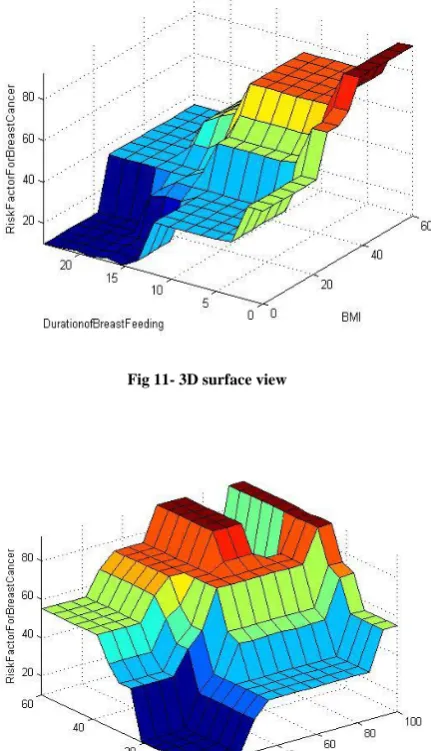
RESULT:
Fig 11- 3D surface view
Fig 12- 3D surface view
6.
CONCLUSION:
The present research article confirms that the soft computing models are competent enough to capture expert’s knowledge and theoretical observations in a scientific way and handle real life problems in satisfactory manner. The proposed soft computing diagnostic system will be helpful for medical experts and it is user friendly that one can use itself.
7.
REFERENCES:
[1] http://www.news-medical.net/health/History-of-Breast-Cancer.asp
[2] Male breast cancer treatment national cancer institute 2011
[3] World cancer report international agency for research on cancer 2008.
[4] Landis, S. H., Murray, T., Bolden, S., and Wingo, P. A, (1999) “Cancer statistics” CA Cancer J. Clin., 49: 8–31 [5] National Brest Cancer Foundation, Inc,
http//www.nationalbrestcancer.org
[7] IARC (2008). “World cancer report 2008”. Lyon, International Agency for Research on Cancer.
[8] Lacey JV Jr. et al. (2009). “Breast cancer epidemiology according to recognized breast cancer risk factors in the Prostate, Lung, Colorectal and Ovarian” (PLCO) Cancer Screening Trial Cohort. BMC Cancer, 9, 84.
[9] Clemons M, Goss P, (2011) “Estrogen and the risk of Breast cancer”, The New England journal of medicine., 344: 276-285,
[10]ONS cancer survival in England, patient diagnosed
2004-08 followed up to 2009,
http://www.one.gov.uk/ons/publications/re-reference-tables.html
[11]Indap.M.A., Radhika.S., Motiwale,L., Rao K.V.K., ( 2006) “Anticancer activity of phenolic antioxidants against Breast cancer cells and a spontaneous tumour.”, Indian journal of pharmaceutical science,68(4), 470-474. [12]Ford D and Easton D.F, (1995) “The genetics of breast
and ovarian cancer”, British Journal of Cancer 72, 805-812
[13]Lotfi, A.Z., (1997) “The Roles of Fuzzy Logic and Soft Computing in the Conception, Design and Deployment of Intelligent Systems, in Software Agents and Soft Computing: Towards Enhancing Machine Intelligence, Concepts and Applications”, Springer-Verlag.
[14]Victor Balanica, Ioan Dumitrache, Mihai Caramihai, William Rae, Charles Herbst, (2011) “Evolution of Brest Cancer Risk By Using Fuzzy Logic”, U.P.B. Sci. Bull., Series C, Vol. 73, Issue 1.
[15]Sipper M., Reyes C. A. P., (1999) “A fuzzy genetic approach to breast cancer diagnosis”, Artificial Intelligence in Medicine 17 131–155.
[16]Khosravi A., Addeh J., Ganjipour J. (2011) “Breast cancer detection using BA-BP Based neural networks and efficient features. IEEE.
[17]Oprea A., Strungaru R., Ungureanu G. M., (2007)“New segmentation techniques for breast cancer detection based on mammography”, 1st National Symposium on e-Health and Bioengineering, pp. 153-156.
[18]Ekeh A.P., Alleyne R. S., Duncan O. A., (2000) “Role of Mammography in diagnosis of breast cancer in inner-city hospital”, Journal of the National Medical Association, 92:372-374.
[19]Cheng H.D., Cui M., (2004) “Mass lesion detection with a fuzzy neural Network”, Pattern Recognition, 37, 6: 1189-1200.
[20]Pandey D., MahajanVaishali&SrivastavaPankaj (2006) “Rule Based System for Cardiac Analysis”, NATL ACAD SCI LETT, Vol. 29, No. 7&8, pp 299-309 [21]Novruz ALLAHVERDI, Serhat and TORUN Ismail
SARITAS, (2007) “Fuzzy Expert System Design for Determination of Coronary Heart Disease Risk” International Conference on Computer Systems and Technologies .
[22]Djam X.Y. and Kimbi Y.H., (2011) “Fuzzy Expert System for the Management of Hypertension” The Pacific Journal of Science and Technology Volume 12. Number 1.May 2011 (Spring)
[23]SrivastavaPankaj, SrivastavaAmit (2012) “A Soft Computing Approach for Cardiac Analysis” Journal of Basic and Applied Scientific Research, 2(1)376-385 [24]SrivastavaPankaj, SrivastavaAmit (2012) “Spectrum of
Hepatitis B” International journal of research and reviews in soft and intelligent computing, vol-2, No. 2 [26]SrivastavaPankaj and Sharma Neeraja (2012) “ Soft
computing decision support Diagnostic system for Diabetes” International Journal of Computer Applications,Volume 47– No.18
[27]SrivastavaPankaj and Sharma Neeraja (2012) “ soft computing criterion for ECG beat classification and cardiac analysis” International Journal of Intelligent Systems (communicated)
[28]Steiner E., Klubert D., Knutson D.(2008) “Assessing Breast Cancer Risk in Women”, American Family Physician,78(2008), 12
[29]Ries L. A. G., Eisner M. P., Kosary C. L., et al.(2000) (eds). SEER Cancer Statistics Review, 1973–1997, National Cancer Institute. NIH Pub. No. 00– 2789. Bethesda, MD,
[30]Brinton L. A., Schaiere C, Hoover R. N., (1988) “Menstrual factors and risk of breast cancer”. Cancer Invest. 1988; 6: 145–154.
[31]McTiernan A, Kooperberg C, White E, et al, (2003) for the Women’s Health Initiative Cohort Study.
Recreational physical activity and the risk of breast cancer in postmenopausal women. JAMA. 290(10):1331-1336.
[32]Lambe M, Hsieh C, Trichopoulos D, Ekbom A, Pavia M, Adami HO. (1994) “Transient increase in the risk of breast cancer after giving birth”. N Engl J Med. 1994; 331(1):5-9.
[33]
http://cancerhelp.cancerresearchuk.org/about- cancer/cancer-questions/how-is-breast-feeding-related-to-breast-cancer, 2012
[34]Vogel VG. (1998) “Breast cancer risk factors and preventive approaches to breast cancer”. In: Kavanagh JJ, Singletary SE, Einhorn N, et al. (eds). Cancer in women. Malden, MA: Blackwell Science, 58–91. [35]Andrew G Renehan, Margaret Tyson, Matthias Egger,
Richard F Heller, and Marcel Zwahlen., (2008) “Body-mass index and incidence of cancer: a systematic review and meta-analysis of prospective observational studies”, The Lancet; 371:569-578.