An Improvement of Wang. et. al.’s Remote User
Authentication Scheme Against Smart Card Security
Breach
Ruhul Amin
Haldia Institute of Technology Haldia, West Bengal-721657, IndiaTanmoy Maitra
Haldia Institute of Technology Haldia, West Bengal-721657, IndiaSoumya Prakash Rana
Jadavpur university Jadavpur, West Bengal-721657, IndiaABSTRACT
User authentication is one of the fundamental procedures to provide secure communications between user and server over an insecure public channel. Recently, Wang et. al. proposed password-based user authentication scheme based on hash function and modular exponentiation and they claimed that their scheme provides strong authentication than related scheme. But in this paper, it is pointed out that their scheme suffers from off-line password guessing attack, off-line identity guessing attack, user impersonation attack, server masquerading attack, smart card stolen attack and password change attack. Then an improved scheme over Wang et. al.’s scheme has been proposed to overcome their weaknesses. The proposed scheme resists all possible attacks and provides more security than wang et. al’s scheme, published earlier.
Keywords:
Attack, Authentication, Password, Smart Card
1. INTRODUCTION
A user authentication scheme provides a legitimate user to log onto a remote server over an insecure channel. There are so many applications of user authentication protocol such as e-commeres, wireless sensor networks etc. In the ordinary authentication system server maintains a password verification table to verify the authenticated users. But the password verification table takes huge maintenance cost and also has a risk of tempering for the server end. First Lamport proposed a password-based authentication scheme based on one way hash function [1] to withstand the above mention problem. But his scheme suffers from different possible attacks [2]. After that so many remote user authentication schemes [3, 4, 5, 6] based on one way hash function has been proposed. But those schemes can not fulfill the properties of good user authentication scheme such that time synchronization problem, strong mutual authentication, freely changing of password etc. In 2005, Fan et. al. [7] and in 2007, Khan-Zhang [8] proposed user authentication scheme to provide strong authentication. But in 2009, Hyun et. al. [9] pointed out that both schemes [7],[8] suffer from impersonation attack and dictionary attack and also proposed an extension to authentication scheme without using smart cards. In 2011, Li and Lee proposed an enhanced remote authentication scheme [10]. Wang et. al. [11] shows that [10] scheme cannot withstand denial of service attack and is still vulnerable to off-line password guessing attack.
Recently, Wang et. al. proposed a secure password-based remote user authentication scheme [11] against smart card security
breach. But in this paper it is pointed out that Wang et. al.’s scheme [11] suffers from different possible attacks such as off-line password guessing attack, off-off-line identity guessing attack, user impersonation attack, server masquerading attack, smart card stolen attack and password change attack.
The remainder of this paper is organized as follows: Section 2 briefly introduces some preliminary mathematical concepts for introducing the proposed scheme. Section 3 briefly reviews the Wang et. al.’s scheme [11]. Section 4 shows the brief description of attacks on Wang et. al.’s scheme [11]. Section 5 describes the proposed scheme which withstand the weaknesses of Wang et. al.’s scheme [11]. Section 6 describes cryptanalysis of the proposed improved scheme. Section 7 shows the security comparison between proposed scheme and Wang et. al.’s scheme [11]. Conclusion of this paper appears in section 8. Finally References are given in section 9.
2. PRELIMINARIES
In this section, a briefly review the basic concepts on hash function and a related mathematical problem are introduced.
2.1 Cryptographic Hash Function
A hash function is a deterministic function which takes a string of arbitrary length and produces a string of fixed length called the hashed value. Cryptographic hash functions are used universally in cryptography such as digital signatures, public-key cryptosystems, the random sequence generators used in key agreement, authentication protocols etc. Collisions in hash
function is possible. Consider two messagesm0andm1which
are two arbitrary elements∈hash functionH(·),∃m, m0such
thatH(m) = H(m0), where m 6= m0. Cryptographic hash
function satisfies the following additional properties:
(1) Mixing-Transformation:On any inputm, the output hashed
value H(m) is computationally indistinguishable from a
uniform binary string in the interval [0,2|H|
], where |H|
denotes the output length ofH.
(2) Preimage Resistant:On any inputm, givenyfrom the range H(·), it is hard to findmsuch thatH(m) =y.
(3) Second-Preimage Resistant:Givenmfrom the domain of H(·), it is hard to findm06=msuch thatH(m) =H(m0).
(4) Collision Resistant: It is hard to find a pair of distinct
2.2 Diffie-Hellman Problem
The Diffie-Hellman problem [12] is stated as follows: given an
elementgand the values ofgxandgy, find the value ofgxyis
impossible without knowing the values ofxandy, wheregis a
generator of some group (multiplicative group of a finite field or
an elliptic curve group) andx,y∈RZ∗.
3. BRIEF REVIEW OF WANG ET. AL.’S
SCHEME
This section presents briefly description of Wang et. al.’s secure password-based remote user authentication scheme against smart card security breach [11]. The notation used throughout this paper are summarized in Table 1.
Table 1. notation used
RS −→ remote server
Ui −→ i−thremote user
IDi −→ identity ofUi
P Wi −→ password chosen byUi
IDai −→ identity guessed by an adversary
P Wai −→ password guessed by an adversary
P Wnewi −→ new password chosen byUi
x −→ secret key of RS
y −→ public key of RS
b −→ random number chosen by userUi
H(·) −→ cryptographic one way hash function
g −→ primitive element overGF(p)
n −→ a large prime number
Zn −→ set of integer numbers over modulon
SK −→ shared secret key between user and server
⊕ −→ bitwise xor operation
k −→ concatenate operation
Wang et. al.’s scheme [11] consists of four phases: registration phase, login phase, verification phase and password change phase.
3.1 Registration Phase
In this phase, userUisubmitsIDiandP W Ri=H(P Wikb)
to the remote server for registration, wherebis a random number
chosen by userUi. After receiving registration messageIDiand
P W Ri, remote server computesNi=P W Ri⊕H(xkIDi)
andAi =H(IDi k P W Ri). Then RS issues smart card for
userUiby storing the parametershNi,Ai,n,g,y,H(·)iinto
memory of smart card, wherey=gxmodnis the public key of
remote serverRS. After getting smart card userUistoresbinto
the smart card.
3.2 Login Phase
This phase will be invoked whenever an existing user wants to
get the service from the remote server. In this phase, userUifirst
inserts his/her smart card into the card reader and submitsIDi
andP Wito the terminal. Then smart card computesP W R∗i=
H(P Wi k b),A∗i =H(IDi k P W R∗i)and checks whether
computedA∗
iequals to the storedAi. If it holds good then smart
card further computesC1 =gumodn,Y1=yumodn,H(xk
IDi)=Ni⊕P W R∗i,CIDi=IDi⊕H(C1 k Y1)and Mi
=H(CIDi k C1 kH(xk IDi)). Then terminal sends login
messagehC1, CIDi, Miito the remote server RS over public
channel.
3.3 Verification Phase
After receiving login request messagehC1, CIDi, Mii, remote
server performs the following operations to verify userUi. First,
remote server computes Y2 = C1x mod n, IDi = CIDi⊕
H(C1 k Y2) and Mi∗ =H(CIDi k C1 k H(x k IDi)).
Then checks computedM∗
i equals with the receivedMior not.
If it equals then remote serverRSgenerates a random number
vand computes the session keySK =C1v modn, C2 =gv
modn andC3 =H(SK k C2 k H(x k IDi)). Then sends
hC2, C3ito the userUi. After receiving the reply message from
the remote server RS, userUicomputesSK=C2umodn,C3∗
=H(SKkC2kH(xkIDi))and checks computedC3∗equals
with the receivedC3or not. If equality holdsUicomputesC4=
H(C3 kH(xkIDi)kSK)and sends it to the remote server.
After gettingC4,RSderivesC4∗=H(C3kH(xkIDi)kSK)
and checksC∗
4equals to sendingC4or not. If it holds good then
both user and remote server agree upon a common shared secret
keySKfor future communication.
3.4 Password Change phase
If userUiwants to change his/her password, user submits correct
IDi,P Wiand new passwordP Wnewi to the smart card. Then
smart card computesP W R∗i =H(P Wi k b),A∗i=H(IDi k
P W R∗i)and checks whether computedA ∗
i equals to the stored
Ai. If it holds good then smart card storesNinew and Anewi
instead ofNiandAiby computingNinew =Ni⊕P W R
∗ i⊕
H(P Wnew
i kb),Anewi =H(IDikH(bkP Wnewi ))into the
memory of smart card. Thus userUican change his/her desired
password without help of remote server RS.
4. CRYPTANALYSIS OF WANG ET. AL.’S
SCHEME
In this section, the cryptanalysis of Wang et. al.’s scheme [11] is presented. To analyze the security weaknesses of [11] scheme, the assumptions are given in the following:
Assumption 1.It can be assumed that an attacker could obtain the secret values stored in the smart card by monitoring the power consumption [13][14].
Assumption 2. Due to the low entropy of IDi and P Wi,
it can be assumed that an adversary is able to off-line guess
Ui’s identityIDi and passwordP Wi individually. However,
he/she cannot off-line guessIDi and P Wi simultaneously in
polynomial time as pointed out by Sood et. al. [15].
4.1 Off-line Password Guessing Attack
After extracting smart card parameterNiand after intercepting
login messagehC1, CIDi, Mii, the attacker can easily find out
P Wiusing following steps:
Step 1:Attacker knowsMi=H(CIDikC1kH(xkIDi)).
Then replaceH(x k IDi) withNi⊕H(b k P Wi), where
Ni is the stored smart card parameter. So,Mi =H(CIDi k
C1 kNi⊕H(b k P Wi)). Now fromMi, attacker knows all
parameters except user passwordP Wi.
Step 2:Attacker chooses a passwordP Wa
i and computesMia
=H(CIDi k C1 k Ni⊕H(b k P Wia)). Then checks the
correctness whetherMa
i is equal withMior not.
Step 3:An attacker repeats the above process until the correct password is obtained. After some guessing, an attacker can find out the correct password. Thus an attacker can successfully launch off-line password guessing attack.
4.2 Off-line Identity Guessing Attack
Step 1: Attacker can extractAi from memory of smart card
by monitoring power consumption. Then attacker chooses an
identityIDa
i and computesAai =H(IDia k H(P Wi k b)),
whereP Wi,bare known parameter to the attacker. Then attacker
checks the correctness whether computedAa
iis equal with stored
Aior not.
Step 2:An attacker repeats the above process until the correct identity is obtained. After some guessing, an attacker can find out the correct identity. Thus an attacker can successfully launch off-line identity guessing attack.
4.3 User Impersonation Attack
After successfully perform off-line password guessing attack and under assumption 1, an attacker can perform user impersonation attack as follows:
Step 1: Attacker computesH(xkIDi)=N i⊕H(bkP Wi)
using user’s correct passwordP Wi. Then attacker chooses a
random numberrand computesC∗
1=grmodn,Y ∗
1 =yrmodn,
CID∗i=IDi⊕H(C1∗kY ∗ 1)andM
∗
i =H(CID ∗ ikC
∗
1kH(xk
IDi)). Then attacker sends forged messagehCID∗i, C1∗, Mi∗,i
to the remote server.
Step 2: After receiving the forged message, remote server
computesY∗
2 =C1xmodn,IDi=CID∗i⊕H(C1∗ kY2∗),G1
=H(x kIDi)andMs
i =H(CID ∗
i k C1∗ kG1)then checks
whether computedMs
i with receivedMi∗It can be shown that
the above condition are equal. Then authenticated server will be convinced the message sent from the legal user.
Thus, an attacker can perform user impersonation attack.
4.4 Server Masquerading Attack
After successfully perform off-line password guessing attack and under assumption 1, an attacker can perform server masquerading attack as follows:
Step 1: Attacker computesH(xkIDi)=N i⊕H(bkP Wi)
using user’s correct passwordP Wi. Then attacker generates a
random numberv∗and computesSK
a=Cv
∗
1 modn,C2a=gv
∗
modnandC3a=H(SKakC2akH(xkIDi)). Then attacker
sendsC2a, C3ato the userUi.
Step 2: After receivingC2a, C3a, smart card computesSK =
Cu
2amodnandC ∗
3a=H(SKkC2akH(xkIDi))and checks
whether computedC3a∗ is equals with receivedC3a. It can be
easily shown that the above condition is holds good. Then smart card user’s will be convinced the message sent from the legal server.
Thus an attacker can perform server masquerading attack on wang et. al.’s scheme [11].
4.5 Smart Card Stolen Attack
Suppose a userUieither lost or stolen by an attacker of his/her
smart card. After getting the smart card, the attacker can extract the secret informationhNi,Ai,n,g,y,H(·)ifrom the user’s
smart card. It also can be assumed that attacker stores thei−
thlogin message of the userUi. As a result attacker can store
the values,hC1, CIDi, Mii. By using these secret information
and stored parameters, attacker can create valid login message, described in user impersonation attack procedure in subsection 4.3. So their scheme is insecure against smart card stolen attack.
4.6 Password Change Attack
After intercepting login messagehC1, CIDi, Mii from login
messages, the attacker can easily find out user’s correct password
P Wi by performing the password guessing technique as
describe in subsection 4.1. After getting correct P Wi, the
attacker can change the valid user’s password from the password change phase. So card reader will always reject the valid user in login phase.
5. PROPOSED SCHEME
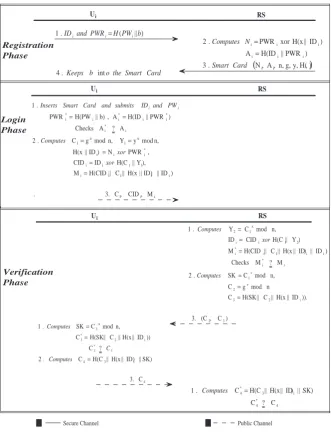
In this section, we will present the improvement of wang et. al.’s scheme [11] to overcome their weaknesses. The proposed scheme consists of four phases namely registration phase, login phase, authentication phase and password change phase. Fig. 1 shows the layout of the proposed scheme. The all phases of the proposed scheme are as follows:
5.1 Registration Phase
In this phase, userUisubmitsIDiandP W Ri=H(P Wikb)
to the remote server for registration wherebis a random number
chosen by userUi. After receiving IDi and P W Ri, remote
server computesNi=P W Ri⊕H(xkIDi)andAi=H(IDik
P W Ri). Then RS issues smart card for userUiby storing the
parametershNi,Ai,n,g,y,H(·)iinto memory of smart card,
wherey=gxmodnis the public key of remote serverRS. After
getting smart card userUistoresbinto the smart card.
5.2 Login Phase
This phase will be invoked whenever an existing user wants to
get the service from the remote server. In this phase, userUifirst
inserts his/her smart card into the card reader and submitsIDi
andP Wito the terminal. Then smart card computesP W R∗i=
H(P Wi k b),A∗i =H(IDi k P W R∗i)and checks whether
computed A∗
i equals to the stored Ai. If it holds good then
smart card further computesC1=gumodn,Y1 =yumodn,
H(xkIDi)=Ni⊕P W R∗i,CIDi=IDi⊕H(C1 kY1)and
Mi=H(CIDi kC1 k H(xk IDi) kIDi). Then terminal
sends login messagehC1, CIDi, Miito the remote server RS
over public channel.
5.3 Verification Phase
After receiving login request messagehC1, CIDi, Mii, remote
server performs the following operations to verify userUi. First,
remote server computesY2=C1xmodn, derivesIDi=CIDi⊕
H(C1 kY2)andMi∗=H(CIDikC1kH(xkIDi)kIDi).
Then checks computedM∗
i equals with the receivedMior not.
If it equals then remote serverRSgenerates a random number
vand computes the session keySK =C1v modn, C2 =gv
modn andC3 =H(SK k C2 k H(x k IDi)). Then sends
hC2, C3ito the userUi. After receiving the reply message from
the remote server RS, userUicomputesSK=C2umodn,C3∗
=H(SKkC2kH(xkIDi))and checks computedC3∗equals
with the receivedC3or not. If equality holdsUicomputesC4=
H(C3 kH(xkIDi)kSK)and sends it to the remote server.
After gettingC4,RSderivesC4∗=H(C3kH(xkIDi)kSK)
and checksC∗
4equals to sendingC4or not. If it holds good then
both user and remote server agree upon a common shared secret
keySKfor future communication.
6. SECURITY ANALYSIS OF PROPOSED
SCHEME
In this section, we will analyze the security of the proposed scheme under the following assumption.
Assumption 1. It can be assumed that an attacker could obtain the secret values stored in the smart card by monitoring the power consumption [13][14] and intercept messages communicating between the user and the server.
Assumption 2.Due to the low entropy ofIDiandP Wi, it can
Ui RS
) || ( .
1 IDiandPWRi=H PWi b
(
N,A,n,g,y,H(.))
. 3 ) PWR || H(ID A ) ID || H(x xor PWR . 2 i i i i i i i Card Smart N Computes i = = Card Smart the o b Keeps int . 4 i i 1 i i 1 i i 1 1 i i * i i i u 1 u 1 * i * i i * i i * i M , CID , C 3. . ) ID || ) ID || H(x || C || H(CID M ), Y || H(C ID CID , PWR N ) ID || H(x n, mod y Y n, mod g C . 2 A ? A Checks ) PWR || H(ID A , b) || H(PW PWR . 1 = = = = = = = xor xor Computes PW and ID submits and Card Smart Inserts i i i
Ui RS
Secure Channel Public Channel
) C , (C 3. )). ID || H(x || C || H(SK C n mod g C n, mod C SK . 2 M ? M Checks ) ID || ) ID || H(x || C || H(CID M ) Y || H(C CID ID n, mod C Y . 1 3 2 i 2 3 v 2 v 1 * i i i 1 i * i 2 1 i i x 1 2 = = = = = = Computes xor Computes i
Ui RS
C 3. SK) || ) ID || H(x || H(C C . 2 ? C )) ID || H(x || C || H(SK C n, mod C SK . 1 4 i 3 4 3 * 3 i 2 * 3 u 2 = = = Computes C Computes 4 * 4 i 3 * 4 C ? C SK) || ) ID || H(x || H(C C .
1 Computes =
[image:4.595.133.465.95.530.2]Verification Phase Login Phase Registration Phase
Fig. 1. Layout of proposed scheme
IDi and passwordP Wiindividually. However, he/she cannot
off-line guessIDiandP Wisimultaneously in polynomial time
as pointed out by Sood et. al. [15].
6.1 Off-line Password Guessing Attack
Attacker can derived or guessed valid user’s password using either (i) stored parameters in the memory of smart card (ii) all communicating messages between the user and server or from both. After getting smart card parameters and communicating message, attacker can not perform off-line password guessing attack described as follows:
(1) It can be assumed that an attacker has got secret valueshNi,
Ai,n,g,y,b,H(·)ifrom the memory of smart card. Then
attacker attempts to guess user’s correct password using
Ni, Ai. But under assumption 2, attacker can not guessIDi
and P Wi simultaneously in polynomial time. So off-line
password guessing attack is not possible usingNiandAi.
(2) It can be assumed that an attacker has gothC1, CIDi, Mii
andhC2, C3ifrom communicating messages between user
and server. To guess correct password of a valid userUi, the
attacker have to guessIDiandP Wisimultaneously which
is not possible described by Sood et. al. [15].
It can be easily shown that if attacker extract all parameters from the memory of smart card and from all communicating messages, then also he/she can not guess valid user’s password. As a result, the proposed scheme provides strong security on off-line password guessing attack.
6.2 Off-line Identity Guessing Attack
After getting secret valueshNi,Ai,n,g,y,b,H(·)istored in
the user’s smart card and after intercepting login message, the
attacker attempts to guess user identityIDiusingNi, Aiin the
registration phase. To guess user’s identity attacker has to guess
at least user’s identity, and user’s passwordP Wisimultaneously
but it is not possible in polynomial time. So the proposed scheme is secure against Off-line identity guessing attack.
6.3 User Impersonation Attack
to a server. However, the attacker can not impersonate as the legitimate user by forging the login request message even if the attacker can extract the stored secret valueshNi, Ai, n,g,y,
b, H(·)i from the user’s smart card, because the attacker can
not compute the valid login request messagehC1, CIDi, Mii
without knowing the secret passwordP WiandIDiof valid user
Ui, and server secret keyx. If the attacker wants to get the secret
parametersIDi, P Wi, x, he/she must have to solve the inversion
of cryptographic hash function which is computationally hard. So the proposed scheme is secure against user impersonation attack.
6.4 Server Masquerading Attack
To masquerade as a legitimate server, an attacker attempts to make the forged reply message which can be masqueraded to the user when receiving the user’s login request message. However, the attacker can not masquerade as the server by forging the
reply message because it is hard to computehC2, C3i by an
attacker without knowing the secret values user’s password
P Wi, random number v and server secret keyx. Hence the
attacker can not masquerade as the legitimate server to the user by launching the server masquerading attack.
6.5 Smart card stolen attack
It can be assumed that the userUihas either lost his/her smart
card or stolen by an attacker. After getting the smart card, an attacker can extract the secret informationhNi, Ai,n,g,y,b,
H(·)ifrom the memory of smart card. It also can be assumed
that attacker stores thei−thlogin messagehC1, CIDi, Mii
of the userUi. After getting all these parameters from login
message and from memory of smart card, it is hard to derive
or guess user’s identityIDi, passwordP Wiand server secret
keysby the attacker. So attacker can not create the valid login
message. As a result proposed scheme is secure against smart card stolen attack.
6.6 Privileged Insider Attack
The proposed scheme is secure against privileged insider attack
because in proposed scheme, userUi provides P W Ri which
equals to H(P Wi, y) instead of P Wi. As a result, system
manager or privileged insider of the server can not derive valid user’s password. So the proposed scheme provides security against privileged insider attack.
6.7 Password Change Attack
As described in this section, the proposed scheme can withstand the Password guessing attack and smart card stolen attack. To perform password change attack, an attacker have to provide
correct IDi and P Wi to the card reader. But in proposed
scheme, there is no way to get or guess correct user’s password
P Wi to the attacker. So proposed scheme is secure against
password change attack.
7. PERFORMANCE COMPARISON
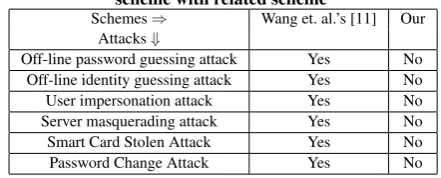
[image:5.595.318.539.112.201.2]In this section, we will compare the performance of the improved proposed scheme with wang et. al.’s scheme [11]. We have shown that [11] scheme is not applicable for the practical implementation in terms of security because [11] scheme is insecure against line password guessing attack, off-line identity guessing attack, user impersonation attack, server masquerading attack, smart card stolen attack and password change attack described in section 4. The improved proposed scheme and [11] scheme takes equal bits for computation and storage cost. Hence the proposed scheme is better than wang et. al.’s scheme [11] in terms of security. Table 2 shows the attack comparison of proposed scheme and related scheme.
Table 2. comparison of security analysis of proposed scheme with related scheme
Schemes⇒ Wang et. al.’s [11] Our
Attacks⇓
Off-line password guessing attack Yes No
Off-line identity guessing attack Yes No
User impersonation attack Yes No
Server masquerading attack Yes No
Smart Card Stolen Attack Yes No
Password Change Attack Yes No
8. CONCLUSION
This paper demonstrated that the wang et. al.’s scheme is insecure against different possible attacks described in section 4. To overcome these weaknesses, an improved scheme over wang et. al.’s scheme has been proposed. The proposed improved scheme is more strong and efficient than related scheme in terms of security, described in section 6. Communication and storage complexity of both the scheme that is proposed improved scheme and wang et. al’s scheme are same but in future, we will reduces both the complexity. Further, it can be incorporated biometric features to achieve high security in remote user authentication scheme.
9. REFERENCES
[1] L. Lamport, “Password authentication with insecure communication”, Communications of the ACM, Vol. 24, No. 11, PP. 770-772, 1981.
[2] A. Shimizu, T. Horioka and H. Inagaki, “A password authentication methods for contents communication on the Internet”, IEICE Transactions on Communications, Vol. 81, No. 8, PP. 1666-1673, 1998.
[3] C.C. Chang and T.C. Wu, “Remote password
authentication with smart cards”, IEE Proceedings-E, Vol. 138, No. 3, PP. 165-168, 1993.
[4] S.B. Wilson, D. Johnson and A. Menezes, “Key agreement protocols and their security analysis”, in proceedings of 6th IMA International Conference on Cryptography and Coding, Cirencester, LNCS, Vol. 1355, PP. 30-45, 1997. [5] W.C. Ku and S.M. Chen, “Weaknesses and improvements
of an efficient password based remote user authentication scheme using smart cards”, IEEE Transactions on Consumer Electronics, Vol. 50, No. 1, PP. 204-207, 2004. [6] E.J. Yoon, E.K. Ryu and K.Y. Yoo, “Further improvement
of an efficient password based remote user authentication scheme using smart cards”, IEEE Transactions on Consumer Electronics, Vol. 50, No. 2, PP. 612-614, 2004. [7] C.I. Fan, Y.C. Chan and Z.K. Zhang, “Robust remote
authentication scheme with smart cards”, Computers & Security, Vol. 24, No. 8, PP. 619-628, 2005.
[8] M.K. Khan and J. Zhang, “Improving the security of a flexible biometrics remote user authentication scheme”, Computer Standards & Interfaces, Vol. 29, No. 1, PP. 82-85, 2007.
[9] Hyun Sook Rhee, Jeong Ok Kwon and Dong Hoon Lee, “A remote user authentication scheme without using smart cards”, Computer Standards & Interfaces, Vol. 31, PP. 6-13, 2009.
Breach”, Journal of Networks, Vol. 8, No. 1, PP. 148-155, January 2013.
[12] Whitfield Diffie and Martin E. Hellman, “New Directions in Cryptography”, IEEE Transactions on Information Theory, Vol. 22, No. 6, PP. 644-654, November 1976.
[13] P. Kocher, J. Jaffe, and B. Jun, “Differential power analysis”, Proceedings of Advances in Cryptology, PP. 388-397, 1999.
[14] T. S. Messerges, E. A. Dabbish and R. H. Sloan, “Examining smart-card security under the threat of power analysis attacks”, IEEE Transactions on Computers, Vol. 51, No. 5, PP. 541-552, 2002.