Factorization of Symmetric Complete Bipartite
Digraph
U S Rajput
Department of mathematics and astronomy, Lucknow University, Lucknow (India)
Bal Govind Shukla
Department of mathematics and astronomy, Lucknow University, Lucknow (India)
ABSTRACT
In path factorization, Ushio K [1] gave the necessary and sufficient conditions for design when is odd. Factorization of a complete bipartite graph for an integer was studied by Wang [2]. Further, Beiling [3] extended the work of Wang [2], and studied factorization of complete bipartite multigraphs. For even value of in factorization the spectrum problem is completely solved [1, 2, 3]. However, for odd value of i .e.
and the path factorization have been studied by a number of researchers [4, 5, 6, 7, 8]. The necessary and sufficient conditions for the existences of factorization of symmetric complete bipartite digraph were given by Du B [9]. Earlier we have discussed the necessary and sufficient conditions for the existence of and factorization of symmetric complete bipartite digraph [10, 11]. Now, in the present paper, we give the necessary and sufficient conditions for the existence of factorization of symmetric complete bipartite digraph of .
Mathematics Subject Classification
:
68R10, 05C70, 05C38.Key words:
Complete bipartite Graph, Factorization of Graph, Symmetric Graph.1.
INTRODUCTION
Let be a complete bipartite symmetric digraph with two partite sets having and vertices. A spanning sub graph of is called a path factor if each component of is a path of order at least two. In particular, a spanning sub graph of
is called a factor if each component of is isomorphic to . If is expressed as an arc disjoint sum of factors, then this sum is called
factorization of . Here, we take path of order
. A is the directed path on vertices.
2.
MATHEMATICAL ANALYSIS
The necessary and sufficient conditions for the existence of
factorization of complete bipartite symmetric digraph are given below in theorem 2.1.
Theorem 2.1
: Let be the positive integers then has a factorization iff:(1)
(2)
(3) and
(4) is an integer.
Proof of necessity of theorem 2.1
Proof:
Let be the number of factor in the factorization, and be the number of copies of factor in a factorization, which can be computed by using
and
respectively.
Obviously, and will be integers. Thus conditions (3) and (4) in theorem 2.1 are necessary. Let and be the number of copies of with its end points in and respectively in a particular factor. Then by simple arithmetic we can obtain, and .
From this, we can compute and which are as follows:
Since, by definition and are integers, therefore equation (1) and (2) imply,
and
40 (2) in theorem 2.1 are necessary. This proves the necessity of
theorem 2.1.
Proof of sufficiency of theorem 2.1
Further, we need the following number theoretic result (lemma 2.2) to prove the sufficiency of theorem 2.1. Its proof can be found in any good text related to number theory [12].
Lemma 2.2:
If gcd then gcdwhere and are positive integers.
We prove the following result of lemma 2.3, which will be used further.
Lemma 2.3:
If has factorization, thenhas a factorization for every positive integer .
Proof:
Let is 1- factorable [13] and be a 1- factorization of it. For each with , replace every edge of by a to get a spanning sub-graph of such that the graph s are pair wise edge disjoint , and there union is . Since has afactorization, it is clear that is also
factorable, and hence , factorization.
Now to prove the sufficiency of theorem 2.1, there are three cases to consider:
[image:2.595.64.249.423.587.2]Case (i)
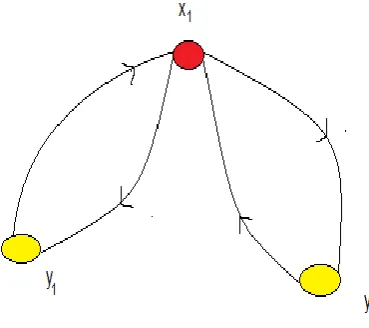
; In this case from lemma 2, has factorization. Consider the trivial case at and then number of copy and total number of factor Path factor is given below:
Fig :1 shows the path
Case (ii)
;
Obliviously, has factorization since in this case position of andchanges only from previous case.
Case (iii):
and
. In this case, let
Then from condition (1)-(4) of theorem 2.1, and are integers and and . As obtained previously and Hence
Let
be a positive integer. Again let gcd then and where and are integer and gcd .
Then
These equality implies the following equality:
Let are distinct prime number.
Let are positive number, and
are positive integers, where are positive integer.
If gcd
Where (when ) or
(when ),
gcd
Where (when ) or
(when ), and let
,
and
and
Then and .
Also let and Now by using
and the parameter and satisfying the condition are expressed in the following lemma . The purpose of lemma is to discuss the detail of factorization, and reduce it to number of base cases, which are then solve in later lemma.
Lemma 2.4:
Case 1:
If and , then
for some positive integer .
Case 2
: If , and then
,
for some positive integer .
Case 3:
If , and . , then
for some positive integer .
Proof
: Let us assume that gcd and gcd .If gcd and and hold,
then
gcd
Which implies that, if gcd and
and
hold, then gcd
Since
is an integer, therefore by using lemma 2.2, we see that
gcd
implies that
gcd
and
gcd
implies that
gcd
Since is an integer therefore must be an integer.
Let then we have
is an integer.
Now for the values of .and there are three cases will possible.
Case I:
When and . Since,gcd gcd gcd
therefore is an integer. Letting we have
Since
gcd gcd
Therefore is an integer. Let . Then all the values
and in case ( 1) hold.
Case 2:
When and Since gcdgcd gcd
therefore is an integer. Let , then
42 Since gcd gcd gcd
therefore is an integer. Let . Then all the values of and in case (2), hold.
Case 3:
When mod 2), and Since
Therefore is an integer. Let , then
Since therefore is an integer. Let .
Then all the values of and in case (3), hold.
This proves the lemma 2.4.
For the parameters and in lemma 2.4 case (1) - case (3) when , we can construct a factorization of
It is easy to see that the existence of a factorization of
implies the existence of a factorization of For our main result we need to prove the following lemma:
Lemma
2.5
: For any positive integers, and let
Then has a factorization if where
Proof.
The proof is by construction (case 1 of lemma 2.4). Let, hence
,
and , where
and
Let and be the two partite sets of vertices of such that:
Where first subscript of ’s and ’s taken additional modulo and respectively and the second subscript of
’s and ’s taken additional modulo and respectively, where and i.e.,
and
Now we construct a model of factor of , here type copies of denote the with its end point in and type with its end point in
Type copies of .
For each and , ,
, and let
and
Hence set
Each of , consists of vertex disjoint type copies. And contains
vertex disjoint type copies of .
Type copies .
For each and , ,
, and
let
and
Hence set
Each of , consists of vertex disjoint
type copies of . And contains vertex disjoint type copies of . It is important that
Let then contains number of vertex disjoint and
edge disjoints components, and spans . Then the graph is factor of . Further, in the graph
each of the second subscript of ’s meets
each of the second subscripts of ’s once and only once.
Define a bijection such that in such a way that:
,
It is shown that the graphs , are edge disjoints
factor of and there union is .
Thus is a factorization of .
This proves the lemma 2.5.
By Similar manner we can also prove the other two cases of lemma 2.4.
Applying lemma 2.3 – 2.4 and 2.5, we see that for parameter and satisfying conditions in theorem 2.1, has a factorization.
3.
REFERENCES
[1] Ushio K: -designs and related designs, Discrete Math., 116(1993), 299-311.
[2] Wang H: factorization of a complete bipartite graph,
discrete math.120 (1993) 307-308.
[3] Beiling Du: factorization of complete bipartite multigraph. Australasian Journal of Combinatorics 21(2000), 197 - 199.
[4] Ushio K: factorization of complete bipartite graphs. Discrete math.72 (1988) 361-366.
[5] Wang J and Du B: factorization of complete bipartite graphs. Discrete math. 308 (2008) 1665 – 1673.
[6] Wang J : factorization of complete bipartite graphs. Australasian Journal of Combinatorics, volume 33 (2005), 129-137.
[7] U. S. Rajput and Bal Govind Shukla: factorization of complete bipartite graphs. Applied Mathematical Sciences, volume 5(2011), 921- 928.
[8] Du B and Wang J: factorization of complete bipartite graphs. Science in China Ser. A Mathematics 48 (2005) 539 – 547.
[9] Du B: factorization of complete bipartite symmetric digraphs. Australasian Journal of Combinatorics, volume 19 (1999), 275-278.
[10] U. S. Rajput and Bal Govind Shukla: factorization of complete bipartite symmetric digraph. .IJCA(12845-0234) Volume 73 Number 18 year 2013.
[11] U. S. Rajput and Bal Govind Shukla: factorization of complete bipartite symmetric digraph. International Mathematical Forum, vol . 6(2011), 1949-1954.
[12] David M. Burton: Elementary Number Theory. UBS Publishers New Delhi, 2004.
[13] Harary F: Graph theory. Adison Wesley. Massachusettsf complete bipartite symmetric digraph. .IJCA(12845-0234) Volume 73 Number 18 year 2013.
[14] U. S. Rajput and Bal Govind Shukla: factorization of complete bipartite symmetric digraph. International Mathematical Forum, vol . 6(2011), 1949-1954.
[15] David M. Burton: Elementary Number Theory. UBS Publishers New Delhi, 2004.