M
[x]
/G/1 Queue with Two Phase of Service and
Optional Server Vacation
G. Ayyappan
Department of Mathematics Pondicherry Engineering
College Pondicherry, India
A. Muthu Ganapathi
Subramanian
Department of Mathematics Tagore Arts College
Pondicherry, India
K. Sathiya
Department of Mathematics
Krishna Engineering College Pondicherry, India
ABSTRACT
In this paper we analyze a single server queue with batch arrival Poisson input, two heterogeneous service with different general (arbitrary) service time distributions and two phase (compulsory and optional) server vacations with general (arbitrary) vacation period. The first phase of service is essential for all customers, as soon as the first service of a customer is completed, then with probability θ, he may opt for the second service or else with probability (1- θ), he leaves the system. After completion of each service, the server will take compulsory vacation. The vacation period of the server has two heterogeneous phases. However, after returning from first compulsory vacation the server may take one more optional vacation with probability p or return back to the system with probability (1- p). No server can take more than two vacations at a time. The probability generating function for the number of customers in the queue is found using the supplementary variable technique. The mean number of customers and the mean waiting time in the queue also found. Some particular cases are discussed. Numerical results are also obtained.
AMS Subject Classification: 60K25, 60K30
KEYWORDS
Batch Arrival, Optional service, Optional Vacation, Probability Generating Function, Stability Condition, Mean Queue Size.
1.
INTRODUCTION
In recent years, queues with server vacations have emerged as an important area of queueing theory and have been studied extensively and successfully due to their various applications in computer and communication networks, manufacturing and production systems, inventory system, bank services etc. For overhauling or maintenance the system the server may go to vacation. The server works continuously as long as there is at least one customer in the system. When the server finishes serving a customer and finds the system empty, he goes away for a length of time called a vacation. For example, maintenance activities, telecommunication networks, production systems, etc.
Recently, there have been several contributions considering queueing system of M/G/1 type in which the server may provide a second phase service. Such queueing situations occur in day-to-day life, for example in many applications such as hospital services, production systems, bank services, computer and communication networks there is two phase of services such that the first phase is essential for all customers, but as soon as the essential services completed, it may leave the system or may immediately go for the second phase of service. One may refer to Kleinrock [11], Medhi [15], Choudhury [5],
[4], Choudhury and Paul [7], Kalyanaraman and Pazhani Bala Mururgan [9], Badamchi and Shankar [3], Madan et al. [14]. Madan and Choudhury [13] proposed an Mx/G/1 queueing system, assuming batch arrivals with restricted admissibility of arriving batches and Bernoulli schedule server vacation. Earlier, Madan et al.[12] studied this type of model and studied some aspects of batch arrivals Bernoulli vacation models with restricted admissibility, where all arriving batches are not allowed into the system at all time.
The concept of vacation in the M/G/1 queueing system was studied by Keilson and Servi in [10]. For the systems with batch arrival the vacation time were analyzed by Baba in [1], Doshi [8], Takagi [16] presented an excellent survey of queueing system with server vacations. Choudhury and Madan [6] have studied a queueing system modified Bernoulli schedule with vacation under N- policy. Badamchi Zadeh [2] studied a batch arrival queueing system with two phases of heterogeneous service with optional second service and restricted admissibility with single vacation policy.
In this paper we consider batch arrival queue with two phases of service and optional server vacation. The first phase of service is essential for all customers, as soon as the first service of a customer is completed, then with probability θ, he may opt for the second service or else with probability (1- θ), he leaves the system. After completion of each service, the server will take compulsory vacation. The vacation period of the server has two heterogeneous phases. However, after returning from first compulsory vacation the server may take one more optional vacation with probability p or return back to the system with probability (1- p).
This paper is organized as follows. The mathematical description of our model is given in section 2. Definitions and notations are given in section 3. Equations governing the model are given in section 4. In section 5 supplementary variables technique has been used to obtain steady state results in explicit and closed form in terms of the probability generating functions for the number of customers in the queue. The mean queue size and mean waiting time are found in section 6. Some particular cases are discussed in section 7. Numerical results and conclusion are given in section 8 and 9 respectively.
2. MATHEMATICAL DESCRIPTION OF
THE MODEL
We assume the following to describe the queueing model of our study.
served basis’. Let λi dt (i = 1, 2, 3, . . .) be the first order probability that a batch of i customers arrives at the system during a short interval of time (t, t + dt], where 0≤ ≤1 and and λ > 0 is the arrival rate of batches.
b) There is a single server who provides the first phase of service which is essential for all customers, as soon as the first service of a customer is completed, then with probability θ, he may opt for the second service or else with probability (1- θ), he leave the system.
c) The service time follows a general (arbitrary) distribution with distribution function Bi(s) and density function bi(s). Let μi(x) dx be the conditional probability density of service completion during the interval (x, x + dx], given that the elapsed time is x, so that
(x) = , i=1, 2 ,
and therefore,
(s) = (s) , i=1, 2
d) After completion of each service, the server will take compulsory vacation of random length. The vacation time has two phases with phase one is compulsory. However, after phase one vacation, the server takes phase two optional vacation with probability p or may return back to the system with probability 1 – p. e) The server’s vacation time follows a general (arbitrary) distribution with distribution function Vi(t) and density function vi(t). Let βi(x)dx be the conditional probability of a completion of a vacation during the interval (x, x + dx) given that the elapsed vacation time is x, so that
, i=1, 2,
and therefore,
(t) = (t) i=1, 2.
3.
DEFINITIONS AND NOTATIONS
Define denote the queue size (excluding one in service) at time t. We introduce the random variable Y (t) as follows
0 if the server is idle at time t
1 if the server is busy with first phase of service at time t
Y (t) = 2 if the server is busy with second phase of service at time t
3 if the server is on the first phase vacation at time t
4 if the server is on the second phase vacation at time t
Let L (t) be the queue size at time t. we introduce the supplementary variable
L (t) =
where
(t) = elapsed service time of the customer at the first phase of the service at time t,
(t) = elapsed service time of the server at the second phase of the service at time t,
(t) = elapsed vacation time of the server at the first phase of the vacation at time t,
(t) = elapsed vacation time of the server at the second phase of the vacation at time t.
The process {( , L (t)), t ≥ 0} is a continuous time Markov process.
We define the probabilities for i=1, 2
0
with assumption that steady state exist, we have
we define
Pr {at time t, the server is active providing service and there are n (n ≥ 0) customers in the queue excluding the one customer in the first phase of service being served and the elapsed service time for this customer is x} (t)=
denotes the probability that at time t there are n customers in the queue excluding one customer in the first phase of service irrespective of the value of x.
Pr {at time t, the server is active providing service and there are n (n ≥ 0) customers in the queue excluding the one customer in the second phase of service being served and the elapsed service time for this customer is x}. (t)= denotes the probability that at time t there are n customers in the queue excluding one customer in the second phase of service irrespective of the value of x.
Pr {at time t, the server is on vacation with elapsed vacation time x and there are n (n ≥ 0) customers in the queue}. (t)= denotes the probability that at time t there are n customers in the queue and the server is on vacation irrespective of the value of x.
: Pr {at time t, there are no customers in the system and the server is idle}.
4. EQUATIONS GOVERNING THE
SYSTEM
Now, analysis of this queueing model can be performed with the help of the following Kolmogorov forward equations.
(1)
(2)
(3)
(4) (4)
(5)
(6)
(7)
(8)
(9)
Equation (1) and (9) are to solved subject to the following boundary conditions: (11)
(12)
(13) (13)
The normalization condition is given by
(14)
5. QUEUE SIZE DISTRIBUTION AT
RANDOM EPOCH
Let us define the following probability generating functions as ; |z| ≤ 1, x > 0 ; |z| ≤ 1 (15) (15); |z|≤ 1, x > 0 ; |z| ≤ 1 Now multiplying equation (2), (4), (6), (8) and adding (1), (3), (5), (7) by suitable powers of z summing over n and using the generating functions defined in (15) and we get (16) (16) (17) (17) (18) (18) (19) (19) Next we multiply both sides of equation (10) by zn and sum over n from 0 to ∞ using (15) we have z (20) (20)
Performing similar operation on equation (11), (12) and (13) using (15) we have = (21) (21)
(22)
(23)
where R = λ (1-C (z)) Using equations (22) and (23) in (20) , we get = (24) (24) Similarly using (24) in (21), we get = (25) (25) Similarly using (24) and (25) in (22), we get = (26) (26)
= (27) (27)
Integrating equations (16), (17), (18) and (19) we have
(28)
(29)
(30)
(31)
where have been
obtained in equations (24), (25), (26) and (27) respectively. After integrating equation (28) with respect to x, we have
=
(32)
is the Laplace transform of first phase of service time.
Now integrate equation (29) with respect to x, we have
(33)
is the Laplace transform of second phase of service time.
Integrate equation (30) with respect to x, we have
(34)
is the Laplace steiltjes transform of first phase of vacation time.
In the same way, we integrate equation (31) with respect to x, we have
(35)
is the Laplace steiltjes transform of the optional vacation time.
In order to determine completely,
we have to determine the only unknown which appears in the numerators of the right hand sides of equations (32), (33), (34) and (35) respectively. For that purpose, we shall use the normalizing condition
(36)
are the steady state probabilities that the server is providing first phase of service, second optional service, the server under first phase of vacation and the server under optional vacation respectively without regard to the number of customers in the queue.
(37)
(38)
(39)
(40)
By substituting (37), (38), (39) and (40) in (36), we get
(41)
is the steady state probability that the server is idle. Hence if ρ < 1 be the stability condition under which the steady states solution exits.
ρ = (42)
where
E (Bi) = E (Vi) = for i = 1, 2 .
Let denote the probability generating function of the queue size irrespective of the server state.
Then adding equations (32), (33), (34) and (35) we obtain
(43)
= (44)
Substituting for from (41) into (44), we have completely and explicitly determined the probability generating function of the queue size.
6. THE MEAN QUEUE SIZE AND THE
MEAN WAITING TIME
Let Lq denote the mean number of customers in the queue
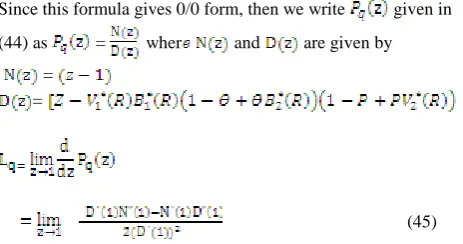
Since this formula gives 0/0 form, then we write given in
(44) as = wher and are given by =
=
(45)
where primes and double primes in (45) denote first and second derivatives at z = 1, respectively. Carrying out the derivatives at z = 1 we have
,
N´(1) = 1 (46)
N˝(1) = 0 (47)
) =
(48)
(49)
Then if we substitute the values of N′(1), N′′(1), D′(1) and D′′(1) from (46), (47), (48) and (49) into (45) we obtain Lq in a
closed form.
(50)
Further, the mean waiting time of a customer could be found using Wq =
7. PARTICULAR CASES:
Case 1. Assume service and vacation time follows exponential distribution.
The most common distribution for the service time and vacation is the exponential distribution. For this distribution, the rate of first phase of service μ1 > 0, second phase of service
µ2 > 0 and the rate of first phase of vacation completions is β1 >
0, second phase of vacation completions β2 > 0 and we have
, , ,
The idle probability p00, the probability generating function of
the number of customers in the queue and the mean queue size can be simplified to the following expressions
(51)
= (52
(53)
Case 2. The server has no optional vacation
When the server has no optional vacation, we let p = 0. Using this in the main result of (41), (44) and (50) we have
(54)
= (55)
(56)
8. NUMERICAL RESULTS
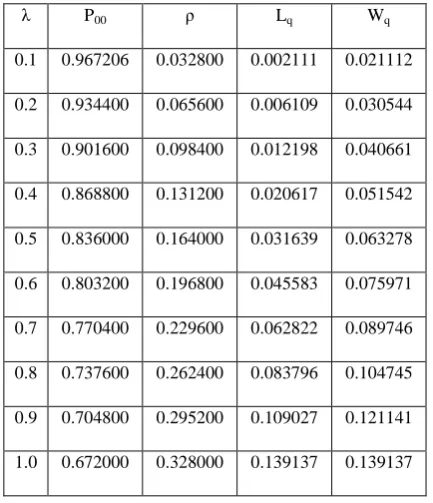
For the purpose of a numerical result, we choose
The following arbitrary values: In table -I
, p = 0.1,
θ = 0.2, µ1= 2, μ2 = 4 and in table –II, β 1= 2, β 2= 3,
μ1= 4 while λ varies from 0.1 to 1.0 such that the steady state
condition is satisfied. The tables I-II give computed values of various states of the server, the idle time, the utilization factor, the mean queue size and customers mean wating time in the queue.
[image:5.595.55.287.73.195.2]Table (1): Computed values of various queue characteristics.
λ P00 ρ Lq Wq
0.1 0.967206 0.032800 0.002111 0.021112
0.2 0.934400 0.065600 0.006109 0.030544
0.3 0.901600 0.098400 0.012198 0.040661
0.4 0.868800 0.131200 0.020617 0.051542
0.5 0.836000 0.164000 0.031639 0.063278
0.6 0.803200 0.196800 0.045583 0.075971
0.7 0.770400 0.229600 0.062822 0.089746
0.8 0.737600 0.262400 0.083796 0.104745
0.9 0.704800 0.295200 0.109027 0.121141
1.0 0.672000 0.328000 0.139137 0.139137
Table (II): Computed values of various queue characteristics ( p = 0 ).
λ P00 ρ Lq Wq
0.1 0.967333 0.032667 0.000847 0.008471
0.2 0.934667 0.065333 0.003524 0.017619
0.3 0.902000 0.098000 0.008255 0.027516
0.4 0.869333 0.130667 0.015299 0.038247
0.5 0.836667 0.163333 0.024955 0.049910
0.6 0.804000 0.196000 0.037571 0.062618
0.7 0.771333 0.228667 0.053552 0.076504
0.8 0.738667 0.261333 0.073359 0.091724
0.9 0.706000 0.294000 0.097617 0.108463
1.0 0.673333 0.326667 0.126944 0.126944
9. CONCLUSION
This paper clearly analyses a two phase queueing system with optional service and optional vacation. An application of this model can be found in mobile network where the messages are in batch form, the service may have two phases such that first phase is essential but the second phase may be chosen randomly as optional. The probability generating function of the number of customers in the queue is found using the supplementary variable technique. Also by some numerical approaches the validity of the results are examined.
10. ACKNOWLEDGEMENTS
The authors are grateful to the referees for their incredible comments and suggestions to enhance the paper in this present form.
11. REFERENCES
[image:6.595.190.407.91.343.2] [image:6.595.188.409.381.633.2][2] Badamchi Zadeh .A, “An M[x]/(G1, G2)/1/G(BS)Vs with Optional Second Services and Admissibility Restricted,” International journal of Information and Management Sciences, Vol. 20, 2009, pp. 305-316.
[3] Badamchi Zadeh. A and Shahkar .G.H, A two phase queue system with Bernoulli feedback and Bernoulli schedule server vacation, Information and Management science, Vol. 19, 2008, 329- 338.
[4] Choudhury .G, some aspects of an M/G/1 queueing system with second optional service, Vol. 11, No. 1, 2003, 141-150.
[5] Choudhury .G, A batch arrival queue with a vacation time under single vacation policy, Computers and Operations Research, Vol. 29, No. 14, 2002, 1941-1955.
[6] Choudhury. G and Madan .K.C, a two stage batch arrival queueing system with a modified Bernoulli schedule vacation under N-policy, Mathematics and Computer Modeling,Vol. 42, 2005, 71-85.
[7] Choudhury .G and Paul .M, A two phase queueing system with Bernoulli feedback, Information and Management Sciences, Vol.16, No.1, 2005, 773-784.
[8] Doshi B.T, “Queueing Systems with Vacations–a Survey,”Queueing System, Vol. 1, No. 1, 1986, pp. 29-66.
[9] Kalyanaraman .R and Pazhani Bala Murugan .S, A single server queue with additional optional service in
batches and server vacation, Applied Mathematical Sciences, No. 2, 2008, 2765-2776
[10] Keilson .J and Servi .L.D, “Dynamic of the M/G/1 Vacation Model, ”Operations Research, Vol. 35, No. 4, 1987, pp. 575-582.
[11] Kleinrock, L., Queueing System; Vol. 1,Wiley, New York, 1975.
[12] Madan K.C, Abu-Dayyeh .W and Saleh .M.F, an M/G/1 queue with second optional service and Bernoulli schedule server vacations, Queueing Systems, Vol.28, 2002, 51-62.
[13] Madan, K. C. and Choudhury, G., An M[x]/G/1 queue with Bernoulli vacation schedule under re-stricted admissibility policy, Sankhaya, Vol. 66, No.1, 2004, pp.175-193.
[14] Madan .K.C, Maraghi F.A, and Dowman .K.D, Batch arrival queueing system with random breakdowns and Bernoulli schedule server vacations having general vacation time distribution, Information and Management Sciences, Vol.20, 2009, 55-70.
[15] Medhi, J. Stochastic Models in Queueing Theory.
Second edition, Academic Press, USA , 2002