Visco-Elastic MHD Flow through a Porous Medium
Bounded by Horizontal Parallel Plates Moving in
Opposite Direction in Presence of Heat and Mass
Transfer
Rita Choudhury
Department of Mathematics Gauhati University Guwahati- 781 014
Paban Dhar
Department of Mathematics Gauhati University Guwahati- 781 014
Debasish Dey
Department of Mathematics Dibrugarh University
Dibrugarh- 786 004
ABSTRACT
An analysis of two dimensional unsteady electrically conducting visco-elastic fluid flow through a porous medium has been carried out in this paper in presence of simultaneous heat and mass transfer. The porous medium is bounded by two horizontal plates moving in opposite directions. The visco-elastic fluid is characterized by Walters liquid (Model ). A magnetic field of uniform strength B0 is applied in the
direction perpendicular to the plate. The suction at the plate is assumed to be periodic in nature. The governing equations of fluid motion are solved analytically by using perturbation scheme. The effects of visco-elastic parameter on the governing fluid motion are analyzed graphically for various values of flow parameters involved in the solution. .
Keywords
Visco-elastic, Walters liquid (Model ), Hartmann number, Prandtl number, Reynolds number and Eckert number.
2010 Mathematics Subject Classification 76A10
1.
INTRODUCTION
Walters liquid (Model B/) is a type of non-Newtonian fluid which have characteristics of bothe viscosity and elasticity. Walters [1] reported that the mixture of polymethyl methacrylate and pyridine at 250 C containing 30.5 gm of polymer per litre and having density 0.98 gm/ml fits very nearly to this model.
Berman [2] has studied the laminar flow in channels with porous walls. Heat transfer in magneto-hydrodynamic flow between parallel plates has been analyzed by Alpher [3]. Flow of an incompressible fluid between two parallel plates, one in uniform motion and the other at rest with uniform suction at the stationary plate has been analyzed by Verma and Bansal [4]. Verma and Gaur [5] have investigated the velocity and temperature distributions of a viscous incompressible fluid flow between two parallel plates. Kaviany [6], Sharma and Singh [7], Attia [8], Sharma and Mishra [9] and Sharma and Patidar [10] have studied the behavior of steady viscous flow between two infinite parallel porous plates under the influence of various physical considerations. Hassanien [11], Sharma and Sharma [12], Sharma and Kumar [13], Sharma et al. [14], Sarangi and Sharma [15] have investigated the unsteady viscous fluid flow in presence various physical properties like heat transfer or MHD or heat source/ sink etc.
Problem of MHD Couette flow with heat transfer between two horizontal plates in presence of uniform transverse magnetic field is examined by Bodosa and Borkakati [16]. Ganesh and Krishnambal [17] have analyzed the problem of unsteady magneto-hydrodynamic Stokes flow of viscous fluid between two porous parallel plates. Umavathi et al. [18] have discussed the behavior of unsteady oscillatory flow and heat transfer in a horizontal composite porous medium channel. Kumar et al. [19] have investigated the heat and mass transfer effects on unsteady flow of a viscous incompressible electrically conducting fluid through a porous medium of time dependent permeability bounded by two infinite parallel porous plates moving in the opposite direction in presence of radiation and magnetic field.
Ajadi [20] has given the analytical solutions of unsteady oscillatory particulate visco-elastic fluid between two parallel walls. Unsteady MHD Couette flow of a visco-elastic fluid with heat transfer has been studied by Attia [21]. Sreekanth et al. [22] have investigated hydromagnetic natural convection flow of an incompressible visco-elastic fluid between two infinite vertical moving and oscillating parallel two infinite vertical moving and oscillating parallel plates.
The purpose of the present paper is to investigate the visco-elastic effects in an unsteady hydromagnetic flow with heat and mass transfer of electrically conducting Walter’s liquid (Model B/) through a porous medium bounded by two parallel porous plates with time dependent suction and injection moving in opposite directions.
The constitutive equation for Walters liquid (Model B/) is
, (1.1)
where is the stress tensor, is isotropic pressure, is the
metric tensor of a fixed co-ordinate system is the
velocity vector, the contravarient form of is given by
, (1.2) It is the convected derivative of the deformation rate tensor
defined by
Here is the limiting viscosity at the small rate of shear which is given by
(1.4)
N( ) being the relaxation spectrum. This idealized model is a valid approximation of Walters liquid (Model ) taking very short memories into account so that terms involving
, (1.5) have been neglected.
2.
MATHEMATICAL FORMULATION
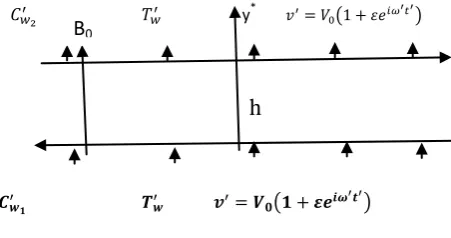
Let us consider an unsteady hydromagnetic, forced convective flow with heat and mass transfer of visco-elastic fluid through a porous medium bounded by two infinitely long parallel horizontal thin porous plates with time dependent suction and injection moving in opposite directions with same velocity U. A magnetic field of uniform strength B0 is applied along the
normal direction to the plate. Induced magnetic field is neglected by considering smaller values of magnetic Reynolds number. The parallel plates are kept at a distance h apart and maintained at uniform temperature and uniform concentration . Let - axis be taken along the direction of the plates and - axis be taken in the normal direction to the plates (Figure 1). The strength of injection and suction at the plates are of same order of magnitude. The effect of energy dissipation due to viscosity has been considered in this problem. For force convection flow, it is also assumed that Since the bounding surface is infinite in length along - axis therefore, the physical quantities are functions of the space co-ordinate - and -only.
y*
h
[image:2.595.55.281.428.547.2]
Fig 1: Physical model of the Problem
The following assumptions have been used to formulate the problem
i. The plate is electrically non-conducting.
ii. No external voltage is applied so the effects of polarization of fluid are negligible.
iii. The effects of variation in density ( ) with temperature and species concentration have no effect on the flow
iv. The pore size of porous plate is significantly larger than a characteristic microscopic length scale of the porous medium.
With these assumptions and usual boundary layer approximations, the governing equations of fluid motions are:
Equation of Continuity
(2.1)
Equation of Motion
(2.2)
Equation of Energy
(2.3)
Equation of Species Continuity
(2.4) The corresponding boundary conditions are
(2.5)
3.
METHOD OF SOLUTION
:On introducing the following non-dimensional quantities
into the equations (2.2), (2.3) and (2.4) and using equation (2.1), we get the following set of differential equations which are dimensionless
(3.1)
(3.2) (2.7)
(3.3) (2.8) (2.8)
where Pr is the Prandtl number, Gr is the thermal Grashof number, M is the magnetic parameter, Ec is the Eckert number, K is the permeability parameter, k is the visco-elastic parameter, Sc is the Schmidt number, Re is the cross flow Reynolds number, is the wall temperature and is the concentration of the fluid at the wall.
The transformed boundary conditions in dimensionless form are given as follows
(3.4) Let us assume that
(3.5)
where A is a positive constant.
In order to solve the partial differential equations (3.1)-(3.3), separating , , into mean flow and unsteady flow, we assume
(3.6) This is a valid assumption because the small amplitude oscillation , therefore the solutions of the differential equations (3.1) to (3.3) converge. Substituting (3.5) and (3.6) into the equations (3.1) to (3.3) and by equating the harmonic terms and neglecting the following differential equations are obtained:
(3.7)
(3.8)
(3.9)
(3.10)
(3.11)
(3.12)
The relevant boundary conditions are
(3.9)
The equations (3.3) to (3.8) are coupled ordinary differential equations , which are solved subjected to the boundary condition (3.9) and the solutions obtained for velocity u , temperature T and mass concentration C are not included here for the sake of brevity.
The Shearing Stress is given by
The rate of heat transfer at the lower as well as upper plate in terms of Nusselt number is given by
4.
RESULTS & DISCUSSION
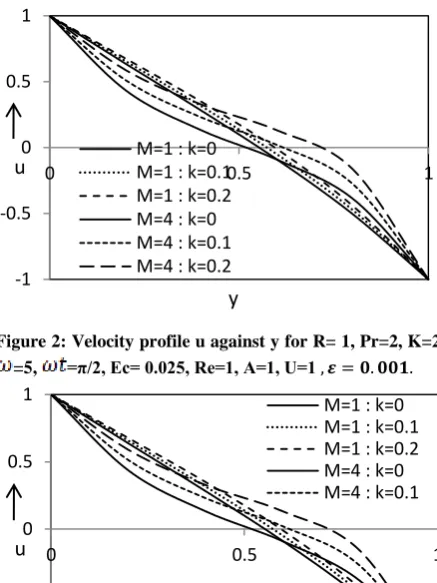
:The objective of the present paper is to investigate the effects of visco-elasticity on the governing fluid flow through a channel in presence of energy dissipation. Figures 2-3 represent the fluid velocity against the displacement variable y for various values of flow parameters involved in the solution. The visco-elasticity is exhibited through the non-zero values of dimensionless parameter k. The figures enable the fact that a growth in visco-elasticity accelerates the fluid motion. Also, it is noticed that the effect of visco-elasticity is prominent in the centre of the channel. The figures also reveal the phenomenon of back flow in the vicinity of the upper plate.
Application of transverse magnetic field generates the Lorentz force and it has a retarding effect in the neighborhood of the lower plate which is moving in the positive direction. An accelerating fluid flow is noticed from the midway of the channel as the upper plate is moving in the opposite direction of the lower plate (Figure 2). The retarding effect of Lorentz force is more prominent in the vicinity of the lower plate. Reynolds number signifies the combined effect of inertia force and viscous force in the fluid flow phenomenon and it is seen that as Reynolds number increases, speed of both Newtonian and non-Newtonian fluid flows increases throughout the channel (Figure 3). The influence of various flow parameters on the fluid temperature are illustrated in figures 4-6. Figure 4 shows that the modification of visco-elastic parameter from k=0 to k >0 decelerates the fluid temperature and the effect of visco-elasticity is maximum in the centre of the flow channel. In addition, the effect of intensity of magnetic field on the temperature distribution is noticed on figure 4. It is perceived from figure 4 that the magnetic field slightly affects the Newtonian fluid temperature while it affects non-Newtonian fluid temperature vigorously. As the intensity of magnetic field increases, the magnitude of the fluid temperature slightly rises for Newtonian fluid but the non-Newtonian fluid temperature decreases rapidly due to increase of magnetic field. This magnitude is higher in Newtonian fluid than visco-elastic fluid.
slightly slows down the temperature of Newtonian fluid near the lower plate but maximum discrepancies has been observed near the upper plate. Also, for k=0.1, the maximum effect of Prandtl number on fluid temperature is noticed in lower plate but when elasticity factor is , magnitude of visco-elastic fluid temperature achieved its peak value in the middle of the fluid region with the modification of Prandtl number.
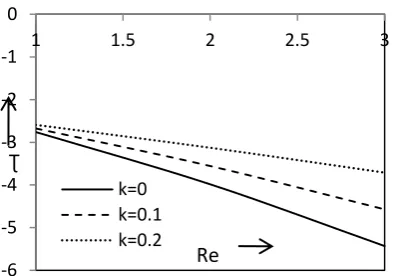
Knowing the velocity field, it is now important to discuss the formation of shearing stress or viscous drag on both the plates. Figures 7-8 depict that the rise in visco-elasticity enhances the strength of viscous drag in both lower and upper plates. Also, the strength of Lorentz force accelerate the shearing stress generated on lower plate but declines the same on upper plate. Reynolds number has an accelerating effect at both the plates along with the increasing values of visco-elastic parameter. Permeability parameter (K) gives the idea about the permeability of the porous medium and its effect is represented by figures 11 and 12 and we can conclude that enhancement of K raises the magnitude of shearing stress for both Newtonian as well as non-Newtonian fluid flows in the neighborhood of the lower and upper plates.
The rate of heat transfer or Nusselt number is analyzed numerically (Table 2 and 3) for different values of flow parameters (Table 1) involved in the solution. The presence of visco-elasticity increases the strength of heat transfer at both the plates (Case I). Increasing values of Prandtl number decreases the thermal diffusivity and hence heat transfer will decrease in the neighborhood of lower plate but on the upper plate, the effect of Prandtl number seems to be less effective as heat transfer increases on the upper plate (Cases I & IV). Amplification of Reynolds number has an increasing effect on Nusselt number at the upper plate but an opposite pattern is noticed at the lower plate for both Newtonian and non-Newtonian fluids (Cases I & III). Also, with the modification of magnetic Parameter, rate of heat transfer for lower plate experienced a rising trend while for upper plate a diminished in magnitude is identified (Cases I & II) In addition to that, influences of Permeability parameter lessen the rate of heat transfer in the lower plate but enhance the rate of heat transfer in the upper plate for both kind of fluid systems (Cases I &V).
The rate of mass transfer in terms of Sherwood number is not significantly affected by the visco-elastic parameter.
5.
CONCLUSIONS
:The present investigation leads to the following conclusions:
The growth of visco-elastic parameter accelerates the speed of non-Newtonian fluid as compared to Newtonian fluid.
Modification of visco-elastic parameter decelerates the fluid temperature and the rate of heat transfer is not significantly affected through the fluid motion.
The rate of mass transfer number is not significantly affected by the visco-elastic parameter.
The shearing stress of visco-elastic fluids is more than Newtonian fluid against Re, K for Lower as well as upper plates but in case of M, the magnitude of shearing stress for Newtonian fluid is higher in the lower surface, whereas this magnitude is maximum for visco-elastic fluids on the upper plate.
[image:4.595.316.536.72.236.2] [image:4.595.318.537.84.376.2]6.
FIGURES & TABLES:
Figure 2: Velocity profile u against y for R= 1, Pr=2, K=2,
[image:4.595.318.533.472.640.2]=5, =π/2, Ec= 0.025, Re=1, A=1, U=1
Figure 2: Velocity profile u against y for R= 1, Pr=2, K=2,
=5, =π/2, Ec= 0.025, Re=1, A=1, U=1
Figure 3: Velocity profile u against y for M= 1, Pr=2, K=2,
=5, =π/2, Ec= 0.025, Re=1, A=1, U=1
-1 -0.5 0 0.5 1
0 0.5 1
M=1 : k=0 M=1 : k=0.1 M=1 : k=0.2 M=4 : k=0 M=4 : k=0.1 M=4 : k=0.2
u
y
-1 -0.5 0 0.5 1
0 0.5 1
M=1 : k=0 M=1 : k=0.1 M=1 : k=0.2 M=4 : k=0 M=4 : k=0.1
u
y
-1 -0.5 0 0.5 1 1.5
0 0.2 0.4 0.6 0.8 1
Re=1 : k=0 Re=1 : k=0.1 Re=1 : k=0.2 Re=2 : k=0 Re=2 : k=0.1 Re=2 : k=0.2
u
Figure 4: Temperature distribution versus y when Re=
1, Pr=2, K=2, =5, =π/2, Ec= 0.025, A=1, U=1
[image:5.595.58.284.57.696.2]
Figure 5: Temperature distribution versus y when Pr=2,
K=2, =5, =π/2, Ec= 0.025, M=1, A=1, U=1
[image:5.595.64.284.74.246.2]
Figure 6: Temperature distribution versus y when M= 1,
K=2, =5, =π/2, Ec= 0.025, Re=1, A=1, U=1
Figure 7: Shearing Stress at Lower Plate against M for
Pr=2, K=2, =5, =π/2, Ec= 0.025, Re=1, A=1, U=1
1.
Figure 8: Shearing Stress at Upper Plate against M for
Pr=2, K=2, =5, =π/2, Ec= 0.025, Re=1, A=1,
U=1 0.001.
Figure 9: Shearing Stress at Lower Plate against Re For
Pr=2, M=1, K=2, =5, =π/2, Ec= 0.025, A=1, U=1
.
0.96 0.97 0.98 0.99 1 1.01 1.02
0 0.5 1
M=1 : k=0 M=1 : k=0.1 M=1 : k=0.2 M=2 : k=0 M=2 : k=0.1 M=2 : k=0.2
T
y
0.98 0.99 1 1.01 1.02 1.03 1.04 1.05 1.06
0 0.2 0.4 0.6 0.8 1
Re=1 : k=0 Re=1 : k=0.1 Re=1 : k=0.2 Re=2 : k=0 Re=2 : k=0.1
T
y
0.985 0.99 0.995 1 1.005 1.01 1.015 1.02
0 0.2 0.4 0.6 0.8 1
Pr=2 : k=0 Pr=2 : k=0.1 Pr=2 : k=0.2 Pr=3 : k=0 Pr=3 : k=0.1 Pr=3 : k=0.2
T
y
-5 -4 -3 -2
2 2.5 3 3.5 4
k=0 k=0.1 k=0.2
Ʈ
M
-5 -4.5 -4 -3.5 -3 -2.5 -2
2 2.5 3 3.5 4
k=0 k=0.1 k=0.2
Ʈ
M
-2 -1.5 -1 -0.5 0 0.5
1 1.5 2 2.5 3
k=0
k=0.1
k=0.2
Ʈ
[image:5.595.317.537.84.429.2] [image:5.595.322.535.437.670.2]Figure 10: Shearing Stress at Upper Plate against Re For
Pr=2, M=1, K=2, =5, =π/2, Ec= 0.025, A=1, U=1
.
Figure 11: Shearing Stress Lower Plate against K for
Pr=2, M=1, Re=1, =5, =π/2, Ec= 0.025, A=1,
[image:6.595.58.257.77.215.2]U=1
Figure 12: Shearing Stress at Upper Plate against K for
Pr=2, M=1, Re=1, =5, =π/2, Ec= 0.025, A=1,
U=1 .
[image:6.595.309.549.91.223.2]Table 1: Various Cases used to study the problem.
Table 2: Rate of Heat transfer in terms of Nusselt number at lower plate for various values of physical parameters
with, , =5, =π/2.
Cases Nu
Lower Plate
k=0 k=0.1 k=0.2
I -0.0052 0.0015 0.0066
II 0.0051 0.0137 0.0145
III -0.0123 -0.0093 -0.0323
IV -0.0084 -0.0085 -0.0121
V -0.0057 -0.00047 0.0031
Table 3: Rate of Heat transfer in terms of Nusselt number at upper plate for various values of physical parameters
with, , =5, =π/2.
Cases Nu
Upper Plate
k=0 k=0.1 k=0.2
I 0.1325 0.3218 0.5186
II -0.0174 0.0833 0.1762
III 0.1615 0.7431 1.5359
IV 0.3360 0.4055 0.5680
V 0.1626 0.3625 0.5700
-6 -5 -4 -3 -2 -1 0
1 1.5 2 2.5 3
k=0 k=0.1 k=0.2
Ʈ
Re
-2 -1.95 -1.9 -1.85 -1.8 -1.75 -1.7
1 1.5 2 2.5 3
k=0 k=0.1 k=0.2
Ʈ
K
-2.85 -2.8 -2.75 -2.7 -2.65 -2.6 -2.55
1 1.5 2 2.5 3
k=0 k=0.1
Ʈ
K
Cases M Re Pr K
I 1 1 2 2
II 4 1 2 2
III 1 2 2 2
IV 1 1 3 2
[image:6.595.333.526.287.456.2] [image:6.595.338.519.523.691.2]7. REFERENCES
[1] Walters K., 1962, Non-Newtonian effects in some elastico-viscous liquids whose behaviour at small rates of shear is characterized by a general linear equation of state, Quart. J. Mech. Appl. Math., 15 (1), 63-76. [2] Berman A. S., 1953, Laminar flow in channels with
porous walls. J. Appl. Phys., 24, 1232-1235.
[3] Alpher, R. A., 1961, Heat Transfer in Magnetohydrodynamic Flow between Parallel Plates, Int. J. Heat and Mass Transfer, 3(2), 108-112.
[4] Verma P. D., Bansal J. L., 1966, Flow of an incompressible fluid between two parallel plates, one inuniform motion and the other at rest with uniform suction at the stationary plate. Proc. Indian Acad. Sci., 64 (6), 385-396.
[5] Verma P. D., and Gaur, Y. N., 1972, On the unsteady flow and temperature distributions of a viscous incompressible fluid flow between two parallel plates, Proc. Indian Acad. Science, 75 (3), 108-116.
[6] Kaviany, M., 1985, Laminar flow through a porous channel bounded by isothermal parallel plates. Int. J.Heat Mass Transfer, 28(4), 851-858.
[7] Sharma, P. R. and Singh R., 1992, Steady flow and heat transfer of an ordinary viscous fluid between two parallel plates. Proc. Nat. Acad. Sci., 62(A), I, 35-54.
[8] Attia, H. A., Kotb N. A., 1996, M.H.D. flow between two parallel plates with heat transfer. ActaMechanica, 117(1-4), 215-220.
[9] Sharma, P. R. and Mishra, U., 2002, Steady heat transfer through laminar flow between parallel plates with different permeability, J. Ultra Scientist Physical Sciences, 14(1), 79-82.
[10] Sharma, P. R. and Patidar, R. P., 1994, Steady laminar flow and heat transfer for a viscous incompressible fluid through parallel walls with suction/injection, J. Ultra Scientist Physical Sciences, India, 6,193.
[11] Hassanien, I. A., 1991, Unsteady MHD flow between two infinite parallel porous plates with time varying suction at the plates, Astrophysics space science, 175, 135-147.
[12] Sharma, P. R. and Sharma, R. P., 1997, Unsteady flow and heat transfer between two parallel plates, Bull. Pure and Applied Sciences, 16E, 183
[13] Sharma, P. R. and Kumar, N., 1998, Unsteady flow and heat transfer between two horizontal plates in the presence of magnetic field, Bull. Pure and Applied Sciences, 17E(1), 39-49.
[14] Sharma, P. R., Sharma, R. P., Mishra, U., Kumar, N. and Gaur, Y. N., 2004, Unsteady flow and heat transfer between parallels porous plates with heat sink/source, J. Appl. Sci. Periodical, VI(2), 97- 109.
[15] Sarangi, K. C. and Sharma, V. K., 2005, Unsteady MHD flow and heat transfer of a viscous incompressible fluid through a porous medium of variable permeability bounded by two parallel porous plates with heat source/sink, Rajasthan Ganita parishad, 19(2), 179-188. [16] Bodosa, G. and Borkakati, A. K., 2003, MHD coutte
flow with heat transfer between two horizontal plates in the presence of a uniform transverse magnetic field, Theoret. Appl. Mech., 30(1), 1-9.
[17] Ganesh, S. and Krishnambal, S., 2007, Unsteady Magnetohydrodynamic stokes flow of viscous fluid between two parallel porous plates, J. of Appl. Sci., 7(3), 374-379.
[18] Umavathi, J. C., Chamkha, A. J., Mateen, A. and Al-Mudhaf, A., 2009, Unsteady oscillatory flow and heat transfer in a horizontal composite porous medium channel, Nonlinear Analysis: Modelling and Control, 14(3), 397-415.
[19] Kumar, N., Gupta, S., and Jain, T., 2011, Effects of thermal radiation and mass transfer on MHD unsteady flow through a porous medium bounded by two porous horizontal parallel plates moving in opposite directions, Heat and Technology, 29(2), 41-50.
[20] Ajadi, S. O., 2010, Analytical Solutions of Unsteady Oscillatory Particulate Visco-Elastic Fluid Between Two Parallel Walls, International Journal of nonlinear Science, Vol.9(2), 131-138.
[21] Attia, H. A., 2010, Unsteady mhd couette flow of a viscoelastic fluid with heat transfer, Kragujevac J. Sci. 32, 5-15.