Munich Personal RePEc Archive
How Law Affects Lending
Haselmann, Rainer and Pistor, Katharina and Vig, Vikrant
September 2006
Online at
https://mpra.ub.uni-muenchen.de/157/
How Law Affects Lending
∗
Rainer Haselmann, Katharina Pistor and Vikrant Vig
†First Version: August 2004
This Version: September 2006
ABSTRACT
A voluminous literature seeks to explore the relation between law and finance, but offers little insights into dynamic relation between legal change and behavioral out-comes or about the distributive effects of law on different market participants. The cur-rent paper disentangles the law-finance relation by using disaggregate data on banks’ lending patterns in 12 transition countries over a 8 year period. This allows us to con-trol for country level heterogeneity and differentiate between different types of lenders. Employing a differences-in-differences methodology in an exclusive ”laboratory” set-ting as well as unique hand collected datasets on legal change as well as changes in bank ownership, we find that lending volume responds positively to legal change. How-ever, not all legal change is equally effective. The introduction of a legal regime that enhances each lender’s individual prospects of enforcing her claims (collateral law) re-sults in greater increases in lending volume than changes in bankruptcy law, the essence of which is to provide an orderly liquidation or reorganization process in the presence of multiple creditors. Finally, we find that banks that newly enter the market respond more strongly to legal change than do incumbents. In particular, foreign-owned banks extend their lending volume substantially more than domestic banks.
JEL Codes: F34, F37, G21, G28, G33, K39.
∗We would like to thank Viral Acharya, Heitor Almeida, Ken Ayotte, Patrick Bolton, Charles Calomiris,
Steve Drucker, Laurie Hodrick, Rafael La Porta, Hagit Levy, Francisco Perez-Gonzalez, Maria Guadalupe, Wei Jiang, Bentley Macleod, Daniel Paravisini, Mark Ramseyer, Bernard Salani´e, Yuthika Sharma, Andrei Shleifer Paul Wachtel, and Daniel Wolfenzon for their helpful comments. We would also like to thank the seminar par-ticipants at the American Law and Economics Association (NYU-2005), LBS Doctoral Conference, Columbia Business School, EFA (2005) Moscow meeting, Columbia Law School, NYU Stern, Penn/NYU Conference on Law and Finance (2006). The usual disclaimer on errors applies here as well.
1. Introduction
This paper furthers the scholarship on law and finance by examining the influence of law
on credit market development. It addresses three major questions that are at the core of the
interaction: Does law promote lending? If so, do some laws matter more for credit market
development than other laws? Do all creditors benefit from legal change in the same way or
does legal change play into the strengths of some as opposed to other lenders?
The paper by La Porta, Lopez-de-Silanes, Shleifer, and Vishny (1998, henceforth
LLSV) titled “Law and Finance” establishes law as an important determinant of credit
mar-ket development by documenting strong correlations between creditor rights and size of
credit markets. The major function attributed to law is that it empowers creditors to enforce
their contracts. Efficient legal institutions reduce the risk of lending by mitigating both
moral hazard as well as adverse selection problems, thereby increasing lenders’ willingness
to lend. This has a benign effect of increasing capital mobility in the economy which in turn
leads to financial development.
A series of papers (LLSV 1997, 1998; Levine 1998, 1999; Djankov, McLiesh, and
Shleifer forthcoming) document the positive impact of legal institutions on broad economic
outcomes.1 There is an emergence of a general consensus amongst scholars that good legal
1Another important strand of this literature looks at the effect of legal codes on financial contracts (e.g.,
institutions foster financial development. There is, however, scant attention paid to
un-derstanding the channel through which changes in legal institutions get transmitted to the
economy. How do improvements of creditor rights get transmitted to the economy? Which
laws matter more? Do laws affect all market participants in the same manner? A good
and thorough understanding of these questions is essential if one has to incorporate creditor
rights into broader discussions on policy. This paper addresses these important questions.
There are many hurdles that hinder any empirical research in this area. First, and most
seriously, are endogeneity concerns regarding legal changes. Ideally, there should be an
exogenous variation in the legal variable of interest. The general problem is that legal
vari-ables are very sticky. Institutions do not change that often. Most of the existing research,
therefore, relies on cross-sectional studies that relate differences in legal institutions to
vari-ous economic parameters. Clearly, though, countries that differ in their legal framework also
differ in other observed, as well as unobserved, dimensions. Thus, comparing countries with
good legal institutions to those with bad legal institutions may capture the effect of omitted
variables or unobserved differences. This can create biases in the results. We overcome
this problem by focusing our study on twelve Central Eastern European (CEE) transition
economies. This provides us with an ideal laboratory for the following five reasons: 1) these
countries have undergone major legal reforms in 1990s, 2) these countries form a fairly
reforms, 4) the reforms are motivated by pressures from outside governing bodies such as
the European Union (EU)2, European Bank for Reconstruction and Development (EBRD),
and USAID, and 5) these are all bank-based economies, therefore creditor rights should play
an important role in these countries.
Second, most of prior research uses macro level indicators, such as the size of credit
markets as a share of GDP. These aggregated outcome measures make it impossible to
disen-tangle the impact of legal change on different market participants. We deal with this problem
by assembling a unique matched database comprising bank level information, ownership
in-formation, and information on law for these countries.
We find that law does in fact promote lending. The overall level of formal creditor
rights protection is positively associated with the lending volume, and so is legal change
with increases in lending volume over time. Differentiating between legal rules designed to
protect individual creditors’ claims outside bankruptcy (“Collateral”) and the collective
en-forcement regime bankruptcy establishes (“Bankruptcy”), we find “Collateral” to be more
important than “Bankruptcy”. This is in contrast to previous papers that have used
mea-sures related to collective enforcement/reorganization (LLSV’s index) as a proxy for
cred-itor rights. The findings of our paper suggest the importance of collateral laws (laws that
facilitate pledgeability of assets) as an important variable for the creditor’s lending decision.
2Most CEE countries were seeking EU membership and there were strict guidelines which these countries
Finally, our data suggest that new entrants to the market, and in particular foreign banks,
respond more strongly to legal change than do incumbents by increasing their lending
vol-ume. The same is true when comparing greenfield banks with incumbents. An important
implication of this finding is that financial development in these countries takes place by
increasing the number of banks as well as the lending volume per bank.
2. Analytical Framework
If lenders had perfect information about their borrowers and effective substitutes to formal
law at their disposal to prevent and/or punish strategic default, law and legal change would
have no impact on lending behavior. Thus, in a market where players can effectively monitor
each other and punish, default law should not be of great importance for banks’ willingness
to lend. By the same token, legal change should have little effect on changes in the lending
volume. Even in the absence of such ideal conditions, law may not be the primary ordering
mechanism for lending relations. An extensive literature has analyzed substitutes for formal
legal creditor protection. They include multilateral governance devices such as networks
of middlemen (Greif, Milgrom, and Weingast 1994; Rauch and Casella 1998), or company
groups that internalize credit markets (Kali 1999). Lending in the market may still take
specifying in detail the terms of the contracts could be written as well. Finally, lenders can
charge interest rates that reflect their full risks.
All of the above strategies entail costs and may reduce creditors’ willingness to lend.
Multilateral governance devices typically work well for networks or relations linked not only
by commercial, but also by ethnic and/or religious ties, thus subjecting defectors to multiple
punishments (Landa 1981). While this reduces the costs of monitoring for those
partici-pating in the network relation, outsiders are denied access to credit or face substantially
higher costs. Similarly, the internalization of credit markets benefits members of a company
group, but crowds out others and may change the quality of borrowers in the market, as most
players will seek membership in a group, leaving the least viable firms outside (Kali 1999).
Assets turned over as a security or hostage need to be stored and kept in good condition lest
the lender’s threat to destroy or sell them should be undermined. Moreover, the borrower
loses valuable economic assets when transferring them to the lender to secure a loan, which
otherwise might enhance his ability to generate the returns necessary to pay back the lender.
Contracts can only be of limited help, as the borrower can repeatedly pledge the same assets
to multiple lenders.3 Finally, lenders can charge interest rates that reflect their full risks;
3The limitation of a simple contract regime is that the creditors’ claims in secured assets cannot be easily
however, adverse selection leads to credit rationing by banks (Stiglitz and Weiss 1981).
Fur-ther, higher interest rates can also lead to moral hazard problems, resulting in suboptimal
efforts exerted by borrowing firms.
2.1. Law and Debt Finance
The advantage of law over the informal mechanisms described above is that it can
signifi-cantly reduce the costs of external finance by offering investor rights protection as a public
good. In particular, Bebchuk (1994) and Grossman and Hart (1988) suggest that law
en-hances investors’ willingness to part with their money in expectation of future returns on
their investment. In a series of empirical studies LLSV (1997, 1998) have shown the
rele-vance of legal investor rights protection for financial market development in a cross-country
setting coding both shareholder and creditor rights. They measure the quality of creditor
rights by coding key provisions typically found in bankruptcy codes. Their intuition is that
the ability of creditors to enforce their claims against defaulting firms will enhance their
willingness to lend to firms whose creditworthiness is difficult to establish ex ante. For the
size of the credit market, they use total claims financial institutions hold against the
pri-vate sector as a share of GDP. Previous results have been strengthened in a recent paper
by Djankov et al. (forthcoming) by focusing on creditor rights in 129 countries. In a
and Franks (2004) find a relationship between creditor rights and the nature of financial
contracts. Levine (1999) expands these findings by tracing the empirical linkages between
the legal environment, financial development, and economic growth. He shows that high
quality legal protection promotes economic growth. Using a similar framework for
inves-tigating the impact of legal change in transition economies between 1994 and 1998, Pistor,
Raiser, and Gelfer (2000) show that the level of creditor rights protection is not significantly
related to credit market development in 24 transition economies. However, they do find that
improvements in creditor rights protection appear to have a positive impact.
The above studies establish a general pattern between formal legal protection and
finan-cial market development. However, they do not explain the transmission channels through
which law affects finance. In this study we begin to explore these transmission channels by
using micro data rather than aggregate data. This allows us to trace changes in the behavior
of individual banks that supply external finance in the economies we study. Using bank
lending data as well as refined legal indicators (to be further discussed below) we revisit the
question of whether law affects debt finance in transition economies. Our first hypothesis
therefore is:
Hypothesis 1 (H1): The introduction and/or strengthening of formal legal creditor
2.2. Bankruptcy vs. Collateral Regimes
As stated above, the law and finance literature suggests that legal protection of creditor rights
will reduce the costs of external finance. A critical issue that is mostly ignored is what kind
of creditor protection lenders might reasonably be looking for. The existent empirical
lit-erature uses devices that protect creditors in bankruptcy, ignoring components that pertain
to collateral laws. Thus, LLSV code four indicators: secured creditors first; management
out; no automatic stay on assets; and creditor consent for re-organization. These indicators
protect creditors not only, and perhaps not even primarily, against a defaulting debtor, but
against competing claims by other creditors. This is most apparent with regards to “secured
creditors first” and “no automatic stay on assets”, where secured creditors first means that
creditors with a valid security interest are satisfied before all other creditors; and “no
au-tomatic stay” implies that secured creditors can take out the secured assets, even if other
creditors prefer reorganization. The two other indicators have a strong anti-debtor flavor,
but are essentially also protections in a situation where multiple creditors enforce against a
single debtor in default.
From a theoretical perspective, it is a priori not clear as to which law (Bankruptcy
or Collateral) is more important. Aghion et al. (1992) recognize the collective
economies to facilitate the settlement of competing claims without extensive state
interven-tion. However, recovery rates in bankruptcy tend to be low and the prospects of sustainable
reorganization are dim even in developed market economies (Baird and Morrison 2005),
and arguably even more so in transition economies. Further, it is often argued that
collat-eral in real markets acts as a signaling device, in markets characterized by incomplete and
asymmetric information (Bester 1985 and Besanko and Thakor 1987). This helps lenders
sort firms into their respective risk classes. The effectiveness of this mechanism is
depen-dent on the credibility of the liquidation threat. An effective collateral regime by providing
a credible liquidation threat relaxes both credit rationing (Stiglitz and Weiss 1981) as well
as deters strategic default thus disciplines management. It may therefore be critical for the
overall growth of the lending market.
In order to assess the relative importance of collateral and bankruptcy, we code the
quality of a country’s collateral regime in addition to coding the four indicators suggested
by LLSV. In particular, we ask whether or not land can be secured; whether a valid security
interest can be established in personal property without transferring possession over the asset
to the creditor; and whether a registration system for security interests in movable assets
has been established.4 It is clear that these indicators do not capture the range of security
4Such systems are common for security interests (mortgages) in real estate where land registries have long
interests many legal systems offer, which include security interests not only in tangible
assets, but also in present and future rights. Further, they do not include important functional
substitutes, such as the transfer of full ownership title as a security in lieu of legal rules that
would allow the perfection of collateral without the creditor obtaining possession over the
relevant asset. However, in emerging as well as transition economies an effective legal
regime for security interests in tangible assets appears to be of primary importance (Pistor
et al. 2000). This leads us to our next test, where we run a horserace between collateral laws
and bankruptcy laws to gauge the relative importance of these laws.
Hypothesis 2a (H2a): A collateral regime is of greater relevance to lenders than a
bankruptcy regime.
Hypothesis 2b (H2b): A bankruptcy regime is of greater relevance to lenders than
a collateral regime.
2.3. Winners and Losers of Legal Change
So far our analysis has focused on the first two questions we posed: Does law affect lending
behavior? And if so, what law? We now turn to the third question, namely whether all
lenders benefit from legal change in the same way. If all lenders started with an equal
information set, they all should benefit equally from legal change that reduces the cost of
lending. Yet, not all lenders necessarily start from the same position. Incumbent lenders
with well-established relation-based network of borrowers may be less dependent on formal
legal protection than new entrants that lack similar networks of relations.
In the transition economies in our sample, many new entrants were foreign banks.
Buch (2003) suggests that foreign banks entering a new market are disadvantaged vis-`a-vis
incumbents as they may find it difficult to break into existing relational networks.
More-over they lack the information and cultural know-how to effectively compete with domestic
players. The strengthening of formal creditor rights protection may benefit foreign players
by reducing the cultural and informational barriers to entry. Moreover, if, as suggested in
some of the literature, (Claessens, Demirg¨uc-Kunt, and Huizinga 2001, Khanna and Palepu
2000 and Mian forthcoming) foreign banks are indeed more efficient lenders than domestic
banks in emerging markets, strengthening creditor rights should help foreign banks take full
advantage of their greater expertise, as legal protections may offer a substitute for cultural
and local knowledge. Sengupta (forthcoming) develops a formal model that captures the
intuition of these findings. Finally, new entrants may develop new markets (i.e., consumer
lending vs. lending to enterprises) and might require additional protection to mitigate risks
Hypothesis 3 (H3): Improvements in creditor rights are associated with higher
lending volume of new entrants (foreign banks) as compared to incumbents (domestic
banks).
3. Data
Our study analyzes changes in legal regimes and lending markets in the context of CEE
transition economies. These countries were chosen for three reasons. Firstly, in all
coun-tries under consideration bank-based financing is of crucial importance for financial
mar-ket development, as equity-based financing plays only a marginal role (Bergl¨of and Bolton
2002). Second, virtually all countries have experienced major revisions of their creditor
rights regimes, including collateral and bankruptcy regimes, since the inception of economic
reforms in the early 1990s and throughout the period we investigate. Third, the composition
of the banking market has changed considerably in these countries, allowing us to
investi-gate the impact of legal change on different types of lenders.
3.1. Bank Data
In order to gain detailed information about the behavior of banks in transition economies, we
Bankscope database, which covers banks controlling at least 85 percent of the banking assets
in each nation, served as the main source of information. We decided to eliminate all
uncon-solidated statements whenever both conuncon-solidated and unconuncon-solidated statements were
re-ported by Bankscope. Furthermore, we only report commercial banks, since the behavior of
non-commercial banks might not reflect profit-maximizing banking behavior. In particular,
we exclude national banks, trade banks, agricultural banks, cooperative banks, development
banks, automotive banks, and investment banks. We collect annual data for twelve CEE
transition countries (Bulgaria, Croatia, Czech Republic, Estonia, Hungary, Latvia,
Lithua-nia, Poland, RomaLithua-nia, Slovak Republic, SloveLithua-nia, and Ukraine) from 1995 throughout 2002.
Overall we have 1874 bank year observations from 323 banks available.5
A central issue of this study is the ownership of banks, specifically whether a bank is
foreign or domestically owned. Bankscope offers incomplete shareholder information for
2002. A classification into foreign and domestically owned banks based on shareholder
information of the year 2002 is likely to be misleading, since a considerable number of
banks were privatized during the sample period. A time series information was gathered
by consulting central banks reports, annual reports of the banks and the banks’ Internet
presence. A bank is defined as foreign owned if foreigners or foreign entities own 50 percent
or more of its assets. In addition, a bank is considered foreign if it is a subsidiary of a
5In a previous version of this paper our sample period was from 1994 until 2002. We decided to exclude
domestic bank that is itself owned by foreigners.6 Furthermore, details about the merger
and acquisition activities of all banks were hand-collected.
Based on this database, we also analyze bank-specific information. Loans are defined
as total customer loans. The solvency of a bank is defined as the ratio of total equity to
total assets. A bank’s liquidity is determined by the ratio of liquid to total assets, where
liquid assets are the sum of trading and marketable securities, cash, dues from the central
bank, and treasury bills. Table I presents descriptive statistics of these indicators divided into
ownership categories. These ownership categories encompass foreign and domestic banks;
foreign banks are further divided into those that enter the market by taking a over a domestic
bank (take-over) and those that found a new bank (greenfield). On average, foreign banks
are slightly bigger in terms of assets and average total loans. The foreign take-over banks
are more than three times larger than the greenfield banks. Domestic banks are divided
into government and privately owned banks. Domestic government owned banks are clearly
bigger than domestic private banks. These differences are less pronounced in the equity
to asset, loan to asset, profit to asset and liquidity ratios. Domestic private banks have the
highest solvency ratio.
The Bankscope database does not provide information on the extent to which collateral
and bankruptcy mechanisms are used in practice by banks. In order to verify our findings
with further empirical evidence, we present statistics from a new EBRD Banking
Environ-ment and Performance Survey (BEPS). This survey was conducted on a random sampling of
423 banks in 20 transition countries in summer 2005. From this sample, 219 banks agreed
to a face-to-face interview with a senior bank officer, providing detailed information on the
use of collateral and bankruptcy proceedings.7 Finally, data on stock market performance is
obtained from the World Federation of Exchanges and our macro indicators are taken from
the World Bank World Development Indicators (GDP overall and per capita) and the IMF
International Financial Statistics 2005 (lending and deposit rates).
3.2. Legal Data
To capture formal legal change, we code statutory legal change for the twelve countries
in our sample for the period from 1993 through 2003. Earlier data were drawn from
(Pistor et al. 2000). Information on additional indicators and the period after 1998 was
hand collected from statutory law in the twelve countries. We distinguish between the
individual creditor rights regime (“Collateral”) from the collective creditor rights regime
(“Bankruptcy”).
For “Collateral” we first code the possibility to secure land by way of establishing a
mortgage that would be recorded in local land or court registries.8 Introducing an effective
collateral regime for security interests in movable assets (personal property) expands the
scope of assets a creditor may secure in return for a loan. The critical issue is not whether
a country allows that movable assets may be secured - all countries did this early on in the
transition process. Instead it is, whether they recognize non-possessory security interests
(collateral) in movable assets. To capture this, we code two additional indicators. First,
whether a country’s law recognizes that a legally valid security interest can be established
without transferring possession over this asset to the lender. And second, whether a country
has a system in place for the registration of such security interests. The first of the two
vari-ables notes the existence of a non-possessory charge, the second checks for the verifiability
of a charge. This is crucial, because an asset may be secured more than once.
Register-ing security interests allows creditors to establish their priority vis-`a-vis each other. The
cumulative index “Collateral” is the sum of the three sub-indicators.
For the collective creditor rights regime (“Bankruptcy”), we use the three indicators
included in the LLSV (1998) coding discussed above, namely “Secured Creditors First”,
“Management Out” and “No Stay on Assets”. In addition, we include indicators for the
initiation reorganization procedures and for creditor initiated triggers. LLSV also code
re-8Since all countries in question formally recognized by 1993 the possibility to secure land, there is no
organization asking whether there can be reorganization without creditors’ consent. By
contrast, we deem the timing of creditor consent crucial. We therefore require that creditor
consent must be given at the initiation stage. Only where this is not the case do we code
that reorganization does not require creditor consent. Finally, many transition economies
have experimented with a so-called “automatic trigger”. The most widely discussed case
has been the debtor-trigger Hungary introduced in 1992 (Bonin and Schaffer 2002). The
law required each debtor who was unable to pay her debts after they became due for 90 days
to file for reorganization. The trigger was, however, soon removed, because it caused an
excessive number of debtor-filed bankruptcies. However, Hungary, as well as many other
countries, also introduced creditor-triggers allowing creditors to file for bankruptcy when
the debtor had failed to pay her dues for a minimum amount for 90 days (or other time
frame depending on the legal system) after they had become due. Creditor triggers lower
the verification costs of bankruptcy and creditors suffer from information problems
partic-ularly in the context of transition economies. Allowing them to file for bankruptcy when
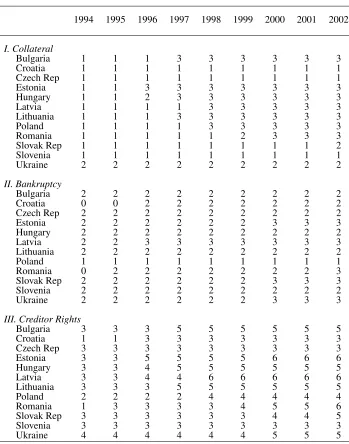
events they can easily verify occur, addresses this problem. Table II below summarizes the
definitions of indicators. The sum of the two indicators is the main legal variable of this
study referred to as “Creditor Rights”. The codings of these indicators are reported in Table
4. Empirical Analysis
We use a differences-in-differences (henceforth DID) approach. Using bank-level data we
test the following specification.
yit =αt+αi+γ·Xit+δ·CreditorRightsjt−1+εit (1)
whereiindexes banks,9 j indexes countries andt indexes year. The log of loans is denoted
asyit.10 The year fixed effects and the bank fixed effects are given respectively byαt andαi.
The set of control variables is referred to asXit. Bank specific control variables are the log of
assets as well as the solvency and liquidity ratio. In order to control for the macroeconomic
environment a bank operates in, we include the lending and deposit rate,11 GDP, inflation
rate, measures for the size and concentration of the credit markets, as well as the market
share of each bank. CreditorRightsjt−1 is our legal variable as described in the previous
section. Our variable of interest in the regressions is δ. The coefficient δ measures the
sensitivity of the dependent variable to the legal change. Table IV provides definitions and
sources of all variables included in the subsequent regressions.
A similar research design has been used in several studies, particularly in labor
eco-nomics, of which Card and Krueger (1994) and Bertrand and Mullainathan (2003) are some
9This refers to an entity owning a separate commercial banking license.
notable examples. The multiple pre-intervention and post-intervention time periods take
care of many threats concerning validity. This methodology is best illustrated by the
follow-ing example.12 Suppose we have two countries, A and B, undergoing legal changes at times
t=1 and t=2, respectively. Consider t=0 to be the starting period in our sample. From t=1
to t=2, country B initially serves as a control group for legal change and after that serves as
a treated group for subsequent years. Therefore most countries belong to both treated and
control groups at different points of time. This specification is robust to the fact that some
groups might not be treated at all, or other groups that were treated prior to 1995, which is
our sample’s beginning date.
For the DID approach to be meaningful, two aspects need to be accounted for. First,
a similarity between comparison groups is desirable. Meyer (1995) has emphasized the
importance of group similarity in research while suggesting that “for a given degree of
sim-ilarity within the treatment group, however, greater differences across comparison groups
are desirable if they are likely to lead to different biases.” Second, the change in creditor
rights should be exogenous.
The first issue surrounding similar comparison groups has little effect on our analysis
since our sample consists of CEE economies, which are similar along several critical
dimen-sions. All countries in our sample share the legacy of socialism and introduced substantial
12Here we assume that the legal variable is a 0-1 binary variable. However, this intuition extends when the
economic reforms in the early 1990s. Moreover, all countries share a proximity to
West-ern Europe and most were slated for membership in the EU, which served as an important
anchor for economic and legal reforms. Furthermore, the pooling of data from different
countries is helpful if each country has a different bias.
The second issue, i.e., whether changes in creditor rights are exogenous or endogenous,
is an important concern. However, legal change in these countries was largely induced by
external pressures from multilateral and bilateral development agencies such as the EBRD,
the World Bank and USAID as well as the quest to join the EU (Pistor et al. 2000). These
agencies identified the need to adapt the legal framework for commercial socialist
coun-tries (see Ajani 1995 for details about the supply of new legal models through international
organizations in the CEE countries). Special emphasis was placed on introducing creditor
protection devices. Dahan (2000) explains that already in 1992 the EBRD established the
secured transactions project within the office of the General Counsel, leading in 1994 to the
production of the so-called model law on secured transaction. This model law as well as
the relevant provisions of the American Uniform Commercial Code (UCC) were used in a
number of reform projects throughout the region to induce and shape reform.13 In Poland,
13A description of the transplant of creditor laws in each CEE country would go beyond the scope of this
for example, the first proposal on the creation of a registered pledge regime was as early as
1990. Nevertheless, this draft was rejected by the Polish parliament, so that a final
adapta-tion of this law lasted until 1996, becoming effective only on January 1998. This example
illustrates both the exogenous nature as well as the randomness in adoption of these
re-forms, brought about by political process, that characterized the passage of these laws. It
is important to note that our analysis is at the bank level as opposed to the country level,
which eliminates most endogeneity concerns. Finally, in the subsequent analysis we use
block bootstrapped robust clustered standard errors as suggested by Bertrand, Duflo, and
Mullainathan (2004).14
5. Results
In this section we present the results of our empirical analysis. In the first subsection we
report the influence of legislation on the loan supply of banks. In the second subsection we
analyze what law affects banks’ lending behavior. Finally, in the third subsection we test
whether law has separate effects on different players, in particular on incumbents vs. new
entrants. We conclude by discussing some robustness tests.
14We cluster our standard errors by country. In some of the following specifications, bootstrapping of
5.1. Loan Supply
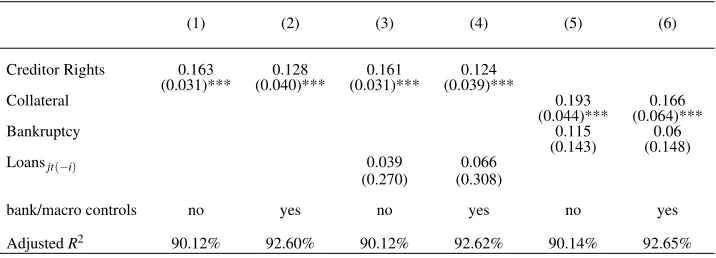
We begin by running specification 1. Table V reports the relevance of the “Creditor Rights”
variable. As can be seen, the coefficients on the legal variable are positive and highly
sig-nificant (column 1). In column 2 we use bank level controls that have been shown to be
important in previous research. The advantage of doing this is that it reduces the residual
variance, thereby increasing the efficiency of the results. Including these variables does not
change our results and in many cases strengthens them. However, because of the possibility
of these variables endogenously affecting the dependent variable we consistently present
regressions with and without these controls. The economic impact of a legal change on
bank lending is considerable. Even after controlling for bank and macro control variables,
an improvement of our legal indicator by 1 implies an increase of loan supply by 13.66
percent.15
The above specification does not control for country specific time-varying shocks. In
order to fully account for such shocks, the inclusion of interacted year and country dummies
(αt∗αj) would be required. These dummies, however, would fully absorb the variation of
our legal indicator. In order to address this issue we follow the methodology of Bertrand
and Mullainathan (2003). Instead of including a whole set ofαt∗αj dummies, we include
15According to Halvorsen and Palmquist (1980) the effect of dummy variables in semilogarithmic equations
is(exp(δ)−1), withδbeing the coefficient of interest. Kennedy (1981) proposes a variance correction for this
the mean value of the dependent variable of each country and each year excluding each
respective bankiitself, denoted asLoansjt(−i). As presented in Table V, columns 3 and 4,
this leaves our results unchanged.
A special feature of our dataset allows us to strengthen our previous findings. The
sample includes 27 multinational banks that operate in at least two different countries at
the same point of time. We exploit this feature to test whether banks’ allocation of credit
responds to legal change. This constitutes a test for the effect of law on banks’ lending
behavior by focusing on within multinational bank variation in the data. An example
illus-trates the intuition behind this test. A bank supplies a certain amount of loans via different
subsidiaries in country A and country B att =0. Further, country A has a legal change
be-tweent=0 andt=1, while country B has none. Comparing the difference in loan supply at
t=1 andt=0 between both subsidiaries allows us to measure the impact of the legislative
change within the same banking institution. The specification for this test is as follows:
yst=αt+αk+αj+γ·Xit+δ·CreditorRightsjt−1+εst (2)
wheres indexes subsidiaries,k indexes multinational banks, j indexes countries, andt
in-dexes year. The level of loans for each subsidiary at each point in time is denoted as yst.
We control for bank fixed effects, country of operation fixed effects, and year fixed effects.
measures the sensitivity to the legal change. As presented in Table VI, columns 1 and 2,
Creditor Rightsjt−1is significant. One possible concern of the previous specification is that
multinational banks channel their funds in countries with better investment opportunities.
In order to address this issue we include the mean value of the loans of each country and
each year (excluding each respective bank i itself) in specification 2. Our results remain
unchanged (see Table VI, columns 3 and 4).
5.2. Collateral vs. Bankruptcy
We now disaggregate the general measure for creditor rights protection into its two
com-ponents, “Collateral” and “Bankruptcy. “Collateral” measures whether creditors can use
security interests in assets to protect their loans. Collateral protects an individual creditor
against default even before a debtor enters bankruptcy. By contrast, “Bankruptcy” creates a
collective enforcement regime once a debtor has become insolvent and specifies which
cred-itors have priority over others. In Table V, columns 5 and 6, we run a horserace between
“Bankruptcy” and “Collateral” by including both legal variables together in specification 1.
Results show that collateral law seem to have a statistically significant effect on bank
lend-ing, while improvements in bankruptcy legislation have not. Thus we find evidence for H2a
pledge-ability of assets as a driver of credit supply. Thus it is important to look at collateral laws.16
Our results show that it is the collateral laws that turn out to be stronger, at least for
emerg-ing/transition economies. Once again, we use block bootstrapped robust clustered standard
errors where the clustering is at the country level. Furthermore, we also test for H2a and H2b
by only analyzing the loans supply of multinational banks via their subsidiaries. Table VI,
columns 5 and 6, reports very similar results compared to specification 1. We conclude from
this that creditors’ ability to protect and enforce their individual claims against a defaulting
debtor by using a collateral regime is of greater importance for banks’ lending behavior than
bankruptcy’s collective enforcement regime.
5.3. Incumbents versus new entrants
The third question we try to answer in this paper is whether formal legal change affects
different types of lenders in different ways. One would expect that foreign players are
more receptive than domestic players to legal change since as new entrants to the domestic
markets they benefit from the creation of a level playing field. This is consistent with the
claim by Buch (2003), who suggests that foreign players might be disadvantaged due to
cultural constraints. Taking advantage of formal legal protection may allow foreign banks
to fully optimize their comparative lending advantage (Khanna and Palepu 2000).
16The creditor rights variable (LLSV index) used in most of the empirical literature is primarily a bankruptcy
The specification for this test is the following:
yit =αt+αi+γ·Xit+β·OW Nit+θ·Legaljt+δ·OW Nit·CreditorRightsjt+εit (3)
where all variables and subscripts are defined as in specification 1. OW Nit is a dummy
vari-able that takes the value of 1 if a bank is majority foreign owned and 0 otherwise. Our
variable of interest in the regressions isδ, which measures the sensitivity to the interaction
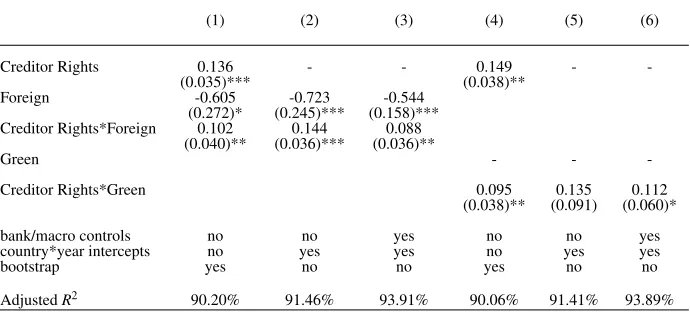
of the legal change and foreign ownership dummy. Our results as presented in Table VII,
columns 1 through 3, suggest that foreign banks indeed increase their lending volume in
response to legal change more than do domestic banks. This is illustrated by the positive
interaction coefficient of our legal variable with the foreign ownership dummy (Foreign).
Since bank ownership varies over the sample period specification 3 also allows for the
in-clusion of interacted country and year dummies (αj∗αt), eliminating all shocks specific to
each country in a given year. Results are robust to this test (columns 2 and 3).
So far we have treated foreign banks as new entrants and domestic banks as
incum-bents. In fact, many banks that became foreign owned banks were domestic private or state
owned banks prior to the ownership change. To further investigate our proposition that law
benefits primarily new entrants over incumbents, we reclassify new entrants and incumbents.
4 to 6). The results are similar to that of foreign vs. domestic banks but the significance is
somewhat lower.
5.4. Robustness tests
A number of caveats have not been fully dealt with in our analysis. In this section we
consider alternative specifications and definitions of our legal variable. Furthermore, we
investigate other events in our sample period that could potentially confound our results.
5.4.1. Nature of the legal indicator
Throughout the previous analysis, all legal indicators applied have entered our specifications
with a time lag of one period. However, it is a priori not clear that legal changes affect bank
lending in such a manner. It can be argued that there is a possibility that legal change is
anticipated before the actual introduction of a law. In order to test for the possible exogeneity
of our legal variable, we include the “Creditor Rights” indicator in the period of change
(t), one period before the change took place (t+1), one period lagged (t-1) and two period
lagged (t-2). Only the coefficients of the legal indicator in the actual period of legal change
and lagged by one period are statistically significant (see Table VIII, columns 1 and 2).17
17When “Collateral” is used as a legal variable results are similar. The coefficients of “Bankruptcy” remain
Consequently, the legal changes in this sample have not been anticipated. This excludes the
possibility of reverse causation.
Our analysis focuses on changes in the law of the books and so far leaves out possible
differences in law enforcement aside. LLSV (1998) have pointed out the importance of good
law enforcement for the implementation of legislation. To account for effectiveness of legal
institutions we introduce the “Rule of Law” index provided by Kaufmann, Kraay, and
Mas-truzzi (2003), which combines various surveys to construct a comprehensive enforcement
variable. As can be seen from Table VIII, columns 3 and 4, the “Rule of Law” index does
not enter significantly in our regressions, while our “Creditor Rights” index is unaffected.18
This could partly be due to the lack of time series variation of the “Rule of Law” index in
the sample.
A general critique of applying indicators in an empirical framework is that a linear
relationship between the indicators and the dependent variable is assumed. For example, an
increase in the indicator from 0 to 1 is assumed to have the same impact on loan supply as
an increase between 4 and 5. Since most countries in our sample had at most only one
col-lateral and/or bankruptcy change we can address this concern by constructing a 1/0 dummy
variable. Thus, we construct two additional legal indicators, one (“Colldum”) that takes a
18As an additional test we included the interaction of “Creditor Rights” and “Rule of Law” in our regression
value of 1 after a country had an improvement in its collateral law19 (and zero otherwise)
and a second indicator (“Bankdum”) that takes the value of 1 if a country had an
improve-ment in its bankruptcy law (and zero otherwise).20 Applying these dummy indicators as
our legal variables supports previous findings. Improvements in collateral law have a
posi-tive significant effect on bank lending (Table VIII, columns 5 and 6), while the coefficient
of “Bankdum” is statistically insignificant.21 Finally, alternative specifications of our legal
indicator were applied. E.g. instead of summing up the two components “Collateral” and
“Bankruptcy” the product of these two was included in our main specification. Results also
hold for such modifications.
5.4.2. Sample-related issues
Having established exogeneity as well as the robustness of our legal variable we now address
some sample-related concerns. The sample used is unbalanced, as it includes banks that have
entered the market during the sample period and banks that ceased to exist, due to take-over
or bankruptcy.22 In order to examine whether these issues are responsible for our findings,
we reestimate our results excluding all banks that do not provide data over the entire sample
19Hungary and Romania are the only two countries that had two changes in collateral law during our sample
period. Results are not sensitive to either defining “Colldum” being 1 after the first or second change in each country.
20Romania is the only country that had two improvements in its bankruptcy legislation during the sample
period. We have constructed our “Bankdum” variable either interpreting the first or the second legal change as a major improvement in bankruptcy legislation. Results are not sensitive to this choice.
21Results are not reported, but are available from the authors upon request.
period (1995-2002). This leaves us with a balanced panel of 946 bank year observations.
Results remain unchanged for the balanced sample as shown in Table IX, columns 1 and 2.
Another potential concern is the acquisition of banks during the sample period. When
bank A acquires another bank B, we see an increase in lending by bank A. However, we do
not document a similar decrease for bank B as it simply disappears from our sample. This
survivorship issue might create a bias towards finding a positive effect of a legal change on
bank lending. To address this problem we exclude all banks that were involved in merger
and acquisitions of other banks (so we exclude both the bank taken over as well as the
acquiring bank).23 As shown in Table IX, columns 3 and 4, results are only slightly affected
by this correction of survivorship bias.
By choosing twelve CEE transition economies for our analysis we aimed to find a
rel-atively homogeneous sample. Nevertheless, economic development has differed between
countries that are located close to the EU and the South Eastern transition countries (e.g.,
Ukraine). In order to illustrate that these development differences within our sample do
not affect our findings, we estimate specification 1 again for only those CEE countries that
had joined the EU by spring 2004. These countries have in common that they are
consid-ered the more advanced transition economies and had to pass certain development criteria
23Most bank take-overs and mergers during our sample period occurred in the Czech Republic and Poland.
for EU membership.24 Considering this more homogeneous group of countries also yields
significant results as presented in Table IX, columns 5 and 6. When including bank and
macroeconomic controls, the significance of the coefficient of the legal variable decreases
somewhat, which might be explained by the reduction in sample size.
A possible concern with our analysis is that results could be caused by factors other
than changes in the law. Thus, it is important to examine for other events that took place
during our sample period that might drive our results. In general, such events should be
con-trolled for by the chosen methodology, unless they are correlated with our legal indicators.
Several countries in our sample underwent a banking crisis or restructuring during transition
from a command to a market economy. Bulgaria had a banking crisis from 1995 to 1997,
experiencing a bank run in 1996.25 But the banking sectors in Latvia (1995-1997), Slovakia
(1996-2000), and Ukraine (1997-1998) also experienced considerable solvency problems
that might be classified as banking crises. Croatia (1996), Czech Republic (1995-1997),
Lithuania (1995-1996), and Romania (1998-1999) had bank restructuring in the periods
given in parentheses. To control for these events, we remove all observations related to
cri-sis and bank restructuring periods (we also exclude the year after each cricri-sis/restructuring
period). Our results are robust to this sample adjustment (Table IX, columns 7 and 8).
24These countries are: Czech Republic, Estonia, Hungary, Latvia, Lithuania, Poland, Slovakia, and
Slove-nia. Thus, the EU sample excludes: Bulgaria, Croatia, Romania, and Ukraine.
25See Caprio and Klingebiel (2003) and de Haas and van Lelyveld (2006) for a summary on banking crises
Furthermore, we exclude countries with major banking crises completely from our sample,
leaving previous results unaffected (Table IX, columns 9 and 10).
A considerable fraction of banking assets have been privatized during our sample
pe-riod (Bonin, Hasan, and Wachtel 2005). A possible concern resulting from this
observa-tion is that the previously observed increases in bank lending are caused through efficiency
gains from bank privatization instead of improvements in the legal system. Furthermore, a
considerable fraction of government banks were privatized by being sold to foreign banks.
An inflow of foreign capital as a consequence of foreign banking privatization might also
explain increases in lending. In order to address these concerns we reestimate our main
specifications, excluding banks that were privatized during our sample period. In Table IX,
columns 11 and 12, all banks that gained a foreign owner during our sample period, both
through privatization or take-overs, as well as banks that were domestically privatized are
excluded from our sample. All prior stated results are robust to this sample adjustment. It
is worth noting that banking privatization had a considerable effect on total banking assets
since banks being privatized were generally large in size. However, the number of banks
being privatized during our sample period is relatively small in comparison to our
over-all sample size. Finover-ally, we analyze whether the dates of bank privatization are clustered
contin-uous process with mostly only one or two banks being privatized at each given year in each
country.
One possible concern for our third hypotheses is that our findings are driven by
for-eign banking penetration due to the abolition of entrance barriers for forfor-eign banks. The
countries in our sample started off as closed economies, but liberalized entry quickly for
foreign institutions to their domestic markets. While it is difficult to exactly date when
for-eign banks were allowed to totally freely enter the national banking markets, we find in all
CEE states foreign banks that entered before 1995. Hungary allowed entry of foreign banks
already in the mid-eighties. Finally, as an additional check we exclude each year as well as
each country at a time from our sample. No specific country or year is driving our findings.
5.5. Interpretations and further evidence
Hypothesis 1 of this paper is in line with previous findings of the law and finance
litera-ture. Our second hypothesis has received less attention in the literature so far. Therefore,
we want to shed further light into the plausibility of these findings. Unfortunately, the
Bankscope database does not provide information on the nature of collateral banks take or
the bankruptcy proceeding banks are involved in. To gain these insights, we provide data
from the EBRD BEPS survey. H2a suggests the importance of collateral law in
personal (movable) assets. Table X, panel I, offers insight about the relative acceptance of
movable assets as collateral. In practice, only 11.7 percent of banks state that they never
or only seldom accept movable assets as collateral to secure loans. About 88 percent of
banks respond that they accept movable assets sometimes to always to the same answer. In
the next two columns, responses are split according to foreign and domestic banks. Also,
foreign banks mostly accept movable assets. This underlines the importance of allowing
for pledges on movable assets. In a recent study, Liberti and Mian (2005) have shown that
banks generally accept movable assets from low agency risk firms, while banks prefer
non-movable assets for firms subject to agency risk. Furthermore, non-movable assets are especially
important for consumer finance when the face value of credit contracts is relatively small.
Our finding about the importance of collateral law in comparison to bankruptcy law becomes
evident when observing the high proportion of defaulted secured debt that is settled outside
formal bankruptcy. As shown in Table X, panel II, more than 50 percent of recovered loans
are proceeded outside formal bankruptcy, while banks indicate that they only recover about
21 percent of defaulted loans under formal bankruptcy (reorganization under bankruptcy
makes up for only 5 percent of recovered loans). These figures offer a rough idea about the
6. Conclusion
This paper attempts to improve our understanding of how law affects lending by focusing on
legal changes in twelve transition economies. This allows us to deal with endogeneity
con-cerns that have plagued previous research. Using bank level data and a DID methodology,
we find that formal legal change does indeed promote lending by banks. We also find that a
collateral regime is of greater importance for lenders than a bankruptcy regime. The
collat-eral regime, however, has been vastly ignored in empirical work. This paper suggests that
it may play a very important role, especially for emerging and transition economies where
information asymmetries tend to be a greater concern. Further, we find that new entrants,
in particular foreign banks, benefit more from legal change by expanding their lending
vol-ume to a greater extent than do incumbent domestic banks. Finally, our findings offer some
important insights into the dynamics of how law affects financial development. We find that
law affects financial development through both an increase in the number of banks in an
economy as well as increased lending volume per bank. This paper thus sheds new light on
References
Acharya, V. V., John, K., Sundaram, R. K., 2005. Cross-country variations in capital structures: The role of bankruptcy codes. CEPR Discussion Papers 4916, C.E.P.R. Discussion Papers.
Aghion, P., Hart, O., Moore, J., 1992. The economics of bankruptcy reform. Journal of Law, Eco-nomics and Organization 8 (3), 523–46.
Ajani, G., 1995. By chance and prestige: Legal transplants in Russia and Eastern Europe. American Journal of Comparative Law 43 (1), 93–117.
Baird, D. G., Morrison, E. R., 2005. Serial entrepreneurs and small business bankruptcies. Law and Economics Working Paper 265, Columbia University.
Bankscope, 2004. Internet database, Bureau van Dijk Electronic Publishing.
Bebchuk, L. A., 1994. Efficient and inefficient sales of corporate control. The Quarterly Journal of Economics 109 (4), 957–93.
Bergl¨of, E., Bolton, P., 2002. Law enforcement, fiscal responsibility and economic development. Working paper, Princeton University.
Bertrand, M., Duflo, E., Mullainathan, S., 2004. How much should we trust differences-in-differences estimates? The Quarterly Journal of Economics 119 (1), 249–275.
Bertrand, M., Mullainathan, S., 2003. Enjoying the quiet life? Corporate governance and managerial preferences. Journal of Political Economy 111 (5), 1043–1075.
Besanko, D., Thakor, A. V., 1987. Collateral and rationing: Sorting equilibria in monopolistic and competitive credit markets. International Economic Review 28 (3), 671–89.
Bester, H., 1985. Screening vs. rationing in credit markets with imperfect information. American Economic Review 75 (4), 850–855.
Bonin, J. P., Schaffer, M., 2002. Revisiting Hungary’s bankruptcy episode. In: Meyendorff, A., Thakor, A. (Eds.), Designing Financial Systems in Transition Economies: Strategies for Reform in Central and Eastern Europe. The MIT-Press, Cambridge, London.
Buch, C. M., 2003. Information or regulation: What drives the international activities of commercial banks? Journal of Money, Credit and Banking 35 (6), 851–869.
Caprio, G., Klingebiel, D., 2003. Episodes of systematic and borderline financial crises. World Bank Policy Research Working Paper Update of WBPR 1620, The World Bank.
Card, D., Krueger, A. B., 1994. Minimum wages and employment: A case study of the fast-food industry in new jersey and pennsylvania. American Economic Review 84 (4), 772–93.
Claessens, S., Demirg¨uc-Kunt, A., Huizinga, H., 2001. How does foreign entry affect domestic bank-ing markets? Journal of Bankbank-ing and Finance 25 (5), 891–911.
Dahan, F., 2000. Law reform in central and eastern europe: The ”transplantation” of secured trans-action laws. European Law Journal 2 (3), 369–384.
Davydenko, S. A., Franks, J. R., 2004. Do bankruptcy codes matter? A study of defaults in France, Germany, and the UK. Tech. rep.
de Haas, R., van Lelyveld, I., 2006. Foreign banks and credit stability in Central and Eastern Europe: A panel data analysis. Journal of Banking & Finance forthcoming.
Djankov, S., McLiesh, C., Shleifer, A., forthcoming. Private credit in 129 countries. Journal of Polit-ical Economy.
Greif, A., Milgrom, P., Weingast, B. R., 1994. Coordination, commitment, and enforcement: The case of the merchant guild. Journal of Political Economy 102 (4), 745–76.
Grossman, S. J., Hart, O., 1988. One share-one vote and the market for corporate control. Journal of Financial Economics 20, 175–202.
Haselmann, R. F., Wachtel, P., 2006. Bank risk and bank management in transition. Policy Confer-ence Tokyo, European Bank for Reconstruction and Development.
Kali, R., 1999. Endogenous business networks. Journal of Law, Economics and Organization 15 (3), 615–36.
Kaufmann, D., Kraay, A., Mastruzzi, M., 2003. Governance matters III: Governance indicators for 1996-2002. Policy Research Working Paper 3106, World Bank.
Kennedy, P. E., 1981. Estimation with correctly interpreted dummy variables in semilogarithmic equations. American Economic Review 71 (4), 801.
Khanna, T., Palepu, K., 2000. Emerging market business groups, foreign intermediaries, and corpo-rate governance. In: Morck, R. K. (Ed.), Concentcorpo-rated Corpocorpo-rate Ownership. The University of Chicago Press, Chicago, USA.
La Porta, R., Lopez-de-Silanes, F., Shleifer, A., Vishny, R. W., 1997. Legal determinants of external finance. Journal of Finance 52, 1131–1150.
La Porta, R., Lopez-de-Silanes, F., Shleifer, A., Vishny, R. W., 1998. Law and finance. Journal of Political Economy 106 (6), 1113–1155.
Landa, J. T., 1981. A theory of the ethnically homogeneous middleman group: an institutional alter-native to contract law. Journal of Legal Studies 10, 349–362.
Levine, R., 1998. The legal environment, banks, and long-run economic growth. Journal of Money, Credit and Banking 30 (3), 596–613.
Levine, R., 1999. Law, finance, and economic growth. Journal of Financial Intermediation 8 (1), 8–35.
Liberti, J., Mian, A., 2005. Uncovering collateral. Working paper, London Business School.
Mian, A., forthcoming. Distance constraints: The limits of foreign lending in poor economies. Jour-nal of Finance.
Pistor, K., Raiser, M., Gelfer, S., 2000. Law and finance in transition economies. Economics of Transition 8 (2), 325–368.
Qian, J., Strahan, P. E., 2005. How law and institutions shape financial contracts: The case of bank loans. Working Paper 11052, National Bureau of Economic Research, Inc.
Rauch, J. E., Casella, A., 1998. Overcoming informational barriers to international resource alloca-tion: Prices and group ties. NBER Working Papers 6628, National Bureau of Economic Research, Inc.
Sengupta, R., forthcoming. Foreign entry and bank competition. Journal of Financial Economics.
Stiglitz, J. E., Weiss, A., 1981. Credit rationing in markets with imperfect information. American Economic Review 71 (3), 393–410.
Summers, R. S., 1997. Recent secured transaction law reforms in the newly independent states and Central and Eastern Europe. Review of Central and East European Law 23 (3/4), 177–203.
Table I
Descriptive Statistics
Notes: This table reports mean values of the most important balance sheet items for 1874 bank year observa-tions of 323 different banks for the years 1995 to 2002. The sample is split up between foreign and domestic owned banks. Foreign banks are further classified into banks that have entered the market by a greenfield op-eration and those that have entered the market by take-over. Domestic banks are further split up into domestic private and government owned banks. All values are in millions of US dollars.
Variables Foreign Domestic
total green take-over total gov dompriv
Obs. 814 487 327 1060 297 763
Loans 493.08 232.60 875.87 420.41 848.89 263.98
Assets 1070.14 498.16 1906.97 916.45 1913.63 551.19
Equity 95.97 43.04 173.50 80.37 148.74 55.33
Equity/Assets 0.12 0.12 0.12 0.16 0.13 0.17
Loan/Assets 0.47 0.47 0.49 0.46 0.46 0.45
Profit/Assets 0.01 0.01 0.01 0.01 0.01 0.01
Solvency 0.12 0.12 0.12 0.16 0.13 0.17
Liquidity 0.23 0.23 0.23 0.23 0.17 0.25
Market share 0.04 0.02 0.07 0.06 0.09 0.05
Table II
Overview of legal indicators
Definition Collateral Bankruptcy Cred. Rights
Land as Security x x
Law Recognizes Non-Possessory x x
Security Interest
Law Establishes Registration System x x
for Non-Possessory Security Interests
Secured Creditors First x x
No Automatic Stay on Assets x x
Debtor Requires Creditor Consent x x
for Filing for Reorganization
Creditor Trigger x x
Table III
Coding of legal indicators
1994 1995 1996 1997 1998 1999 2000 2001 2002
I. Collateral
Bulgaria 1 1 1 3 3 3 3 3 3
Croatia 1 1 1 1 1 1 1 1 1
Czech Rep 1 1 1 1 1 1 1 1 1
Estonia 1 1 3 3 3 3 3 3 3
Hungary 1 1 2 3 3 3 3 3 3
Latvia 1 1 1 1 3 3 3 3 3
Lithuania 1 1 1 3 3 3 3 3 3
Poland 1 1 1 1 3 3 3 3 3
Romania 1 1 1 1 1 2 3 3 3
Slovak Rep 1 1 1 1 1 1 1 1 2
Slovenia 1 1 1 1 1 1 1 1 1
Ukraine 2 2 2 2 2 2 2 2 2
II. Bankruptcy
Bulgaria 2 2 2 2 2 2 2 2 2
Croatia 0 0 2 2 2 2 2 2 2
Czech Rep 2 2 2 2 2 2 2 2 2
Estonia 2 2 2 2 2 2 3 3 3
Hungary 2 2 2 2 2 2 2 2 2
Latvia 2 2 3 3 3 3 3 3 3
Lithuania 2 2 2 2 2 2 2 2 2
Poland 1 1 1 1 1 1 1 1 1
Romania 0 2 2 2 2 2 2 2 3
Slovak Rep 2 2 2 2 2 2 3 3 3
Slovenia 2 2 2 2 2 2 2 2 2
Ukraine 2 2 2 2 2 2 3 3 3
III. Creditor Rights
Bulgaria 3 3 3 5 5 5 5 5 5
Croatia 1 1 3 3 3 3 3 3 3
Czech Rep 3 3 3 3 3 3 3 3 3
Estonia 3 3 5 5 5 5 6 6 6
Hungary 3 3 4 5 5 5 5 5 5
Latvia 3 3 4 4 6 6 6 6 6
Lithuania 3 3 3 5 5 5 5 5 5
Poland 2 2 2 2 4 4 4 4 4
Romania 1 3 3 3 3 4 5 5 6
Slovak Rep 3 3 3 3 3 3 4 4 5
Slovenia 3 3 3 3 3 3 3 3 3
Table IV
Definition of variables
Variable Definition Source
I. Bank variables/ controls
Loans total customer loans in millions of US dollar Bankscope (2004)
Assets total assets in millions of US dollar Bankscope (2004)
Solvency ratio of equity capital divided by assets of each bank Bankscope (2004)
Liquidity ratio of liquid assets to total assets Bankscope (2004)
Dumliquid value of 1 if bank does not report liquid assets (0 otherwise) Bankscope (2004)
Foreign value of 1 if bank is foreign owned (0 otherwise) hand collected
Green value of 1 if bank entered market by greenfield operation hand collected
(0 otherwise)
II. Macro controls
Lending rate average lending rate prevailing in a country World Bank (2004)
Deposit rate average deposit rate prevailing in a country World Bank (2004)
GDP real GDP per capita growth World Bank (2004)
Inflation consumer price index World Bank (2004)
Concentration Herfindahl index of banks’ market shares Bankscope (2004)
Market share bank’s share of assets of total banking assets Bankscope (2004)
LIBOR London interbank offered rate World Bank (2004)
III. Legal indicators
Creditor Rights Sum of Collateral and Bankruptcy hand collected
Creditor Rights Mul Product of Collateral and Bankruptcy hand collected
Collateral see Table II hand collected
Colldum value of 1 after improvement in collateral law (0 before) hand collected
Bankruptcy see Table II hand collected
Bankdum value of 1 after improvement in bankruptcy law (0 before) hand collected
Rule of Law index developed to measure law enforcement capabilities Kaufmann et al. (2003)
Table V
Regression results for the legal indicators - Testing for H1 and H2a/b
Notes: Regression results from estimating specificationyit=αt+αi+γ·Xit+δ·CreditorRightsjt−1+εit. In all regressions the dependent
variable is the logarithm of loans. Variables are defined as in Table II. Standard errors are reported in parentheses. The regressions were run for 1874 bank year observations of 323 different banks for the years 1995 to 2002. Standard errors are block bootstrapped by clusters of their country of operation. The bottom line of the table states the adjusted R-squared of each estimation. ***Significantly different from 0 at the 1-percent level.
(1) (2) (3) (4) (5) (6)
Creditor Rights 0.163 0.128 0.161 0.124
(0.031)*** (0.040)*** (0.031)*** (0.039)***
Collateral 0.193 0.166
(0.044)*** (0.064)***
Bankruptcy 0.115 0.06
(0.143) (0.148)
Loansjt(−i) 0.039 0.066
(0.270) (0.308)
bank/macro controls no yes no yes no yes
Table VI
Multinational banks
Notes: Regression results from estimating specificationyst=αt+αk+αj+γ·Xit+δ·CreditorRightsjt−1+εst. In all regressions the
dependent variable is the logarithm of loans. Variables are defined as in Table II. Standard errors are reported in parentheses. The regressions were run for 534 subsidiary year observations of 27 multinational banks for the years 1995 to 2002. Standard errors clustered by country of operation. The bottom line of the table states the adjusted R-squared of each estimation. * Significantly different from 0 at the 10-percent level. **Significantly different from 0 at the 5-percent level.
(1) (2) (3) (4) (5) (6)
Creditor Rights 0.119 0.107 0.286 0.212
(0.049)** (0.054)* (0.124)** (0.099)*
Collateral 0.134 0.135
(0.060)** ( 0.056)**
Bankruptcy 0.079 0.020
( 0.039)* ( 0.040)
Loansjt(−i) -0.159 0.268
(0.189) (0.091)**
bank/macro controls no yes no yes no yes
AdjustedR2 50.82% 65.08% 50.84% 65.30% 50.77% 65.23%
Table VII
Regression results testing for H3
Notes: Regression results from estimating specificationyit=αt+αi+γ·Xit+β·OW Nit+θ·Legaljt+δ·OW Nit·CreditorRightsjt+εit.
In all regressions the dependent variable is the logarithm of loans. Variables are defined as in Table II and Table IV. Standard errors are reported in parentheses. The regressions were run for 1874 bank year observations of 323 different banks for the years 1995 to 2002. All standard errors are clustered by country of operation and block bootstrapped when indicated at the bottom of the table. The bottom line of the table states the adjusted R-squared of each estimation. A reported dash means that the respective coefficient got absorbed by the fixed effects in the specification. * Significantly different from 0 at the 10-percent level. **Significantly different from 0 at the 5-percent level. ***Significantly different from 0 at the 1-percent level.
(1) (2) (3) (4) (5) (6)
Creditor Rights 0.136 - - 0.149 -
-(0.035)*** (0.038)**
Foreign -0.605 -0.723 -0.544
(0.272)* (0.245)*** (0.158)***
Creditor Rights*Foreign 0.102 0.144 0.088
(0.040)** (0.036)*** (0.036)**
Green - -
-Creditor Rights*Green 0.095 0.135 0.112
(0.038)** (0.091) (0.060)*
bank/macro controls no no yes no no yes
country*year intercepts no yes yes no yes yes
bootstrap yes no no yes no no