Citation:
Finlay, J (2004) Context-Neutral E-Learning Objects: a tale of Two Projects. In: The 7th HCI Educators Workshop: Effective Teaching and Training in HCI, 1st April 2004 - 2nd April 2004, Preston, UK. (Unpublished)
Link to Leeds Beckett Repository record: http://eprints.leedsbeckett.ac.uk/776/
Document Version:
Conference or Workshop Item
The aim of the Leeds Beckett Repository is to provide open access to our research, as required by funder policies and permitted by publishers and copyright law.
The Leeds Beckett repository holds a wide range of publications, each of which has been checked for copyright and the relevant embargo period has been applied by the Research Services team.
We operate on a standard take-down policy. If you are the author or publisher of an output and you would like it removed from the repository, please contact us and we will investigate on a case-by-case basis.
C
ONTEXT
-N
EUTRAL
E-L
EARNING
O
BJECTS
:
A
T
ALE OF
T
WO
P
ROJECTS
Janet Finlay
Interactive Systems
Technology Research Group
School of Computing
Leeds Metropolitan University
The Grange, Beckett Park
Leeds, LS16 5JZ
[email protected]
A
BSTRACTWe discuss two European projects: eDILEMA, which ended in September 2003 and REPLIKA, which started in October 2003. The primary focus of both projects is e-learning objects. eDILEMA, led by colleagues at Hradec Kralove in the Czech Republic, focused on developing a multi-lingual repository for reusable learning objects, and included initial work on a pattern language to capture good practice in the design and use of learning objects.
REPLIKA, led by Trans HEurope, starts with a repository, and focuses on the development of content, particularly in the areas of multimedia and entrepreneurship. We will explore possible HCI learning objects that might be included, such as model or interface simulations, case studies or process models. The project will also explore the use of patterns as a way of capturing our knowledge of successful examples of learning objects in HCI and other areas.
Keywords
e-learning, learning objects, context-neutral, patterns.
1. I
NTRODUCTIONIn this paper we review two European projects for which the primary focus is reusable learning objects. eDILEMA was led by colleagues at Hradec Kralove in the Czech Republic and focused on developing a multi-lingual repository for reusable learning objects. It included initial work on a pattern language to capture good practice in the design and use of learning objects.
REPLIKA is led by Trans HEurope and starts with a repository. Its focus is the development of content,
particularly in the areas of multimedia and entrepreneurship.
We will summarise each project, outlining the work achieved so far, and discuss the contribution this might make to HCI education.
We begin by presenting our view of learning objects and their benefits and challenges.
2. L
EARNINGO
BJECTSA learning object is a reusable learning resource that can be used to support learning in a range of contexts and environments. Ideally it should be context-neutral and be able to be integrated with other learning resources with flexibility and variety. The learning object comprises the component of learning materials together with meta-data that expands on its potential use.
Learning objects provide a mechanism for reusing material within education, while still enabling the educator to develop customized and individual learning experiences suitable to the particular context of their students.
Lui and Ginther [6] identified four classes of learning object, a categorization that is useful when we come to explore the use of patterns to support learning object use. Learning objects can be
• Theory-based, providing conceptual and factual material that require the learner to read, listen or watch (Figure 1);
• Application-based, which require the learner to respond with some reasoned action (Figure 2);
• Cooperative, which require learners to work together (Figure 3);
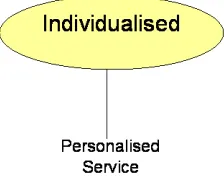
• Individualised, which are customised to particular learning needs (Figure 4).
still able to develop individual courses but using common components.
Figure 1: Theory-based learning resources
[image:3.595.373.485.134.223.2]Figure 2: Application-based learning resources
Figure 3: Cooperative learning resources
However, it also introduces a new problem: how to select appropriate learning objects for a particular context or use. Meta-data describing each learning object is helpful in clarifying the potential role of specific individual objects
[image:3.595.58.274.303.455.2]but does not provide support at a higher level for educators to decide what type of learning object they should be looking for, or indeed for educators designing their own learning objects.
Figure 4: Individualised learning resources
In addition, context-neutral learning objects, though an intuitively useful concept in principle, are notoriously difficult to produce in practice. To be genuinely context-neutral a learning object should be platform and language independent, as well as course and (potentially) level independent. Obviously learning objects vary in how effectively they achieve this aim.
The two projects outlined in this paper focus on these issues. eDILEMA, which is now complete, looked in particular at the use of learning objects by educators. REPLIKA, which is just starting, will focus more on their generation and the issues surrounding that.
3. A T
ALE OFT
WOP
ROJECTS3.1 eDILEMA
The eDILEMA project was funded by the EU under the SOCRATES-MINERVA programme (Project No 90683-CP-1-2001-MINERVA) [4]. Led by University of Hradec Kralove in the Czech Republic, the project consortium included colleagues from the Institute of Public Administration, Dublin, the Czecho-Moravian Society for Automation, Prague, the EMWAC Group, Hradec Králové, and the University of Economics, Bratislava, Slovak Republic, as well as Leeds Metropolitan University.
The aim of the project was to explore ways of supporting educators in their use of electronic learning resources, through the development of a multi-lingual learning object repository (DILLEO [7]) and guidelines for educators in using learning objects. Given the range of potential learning objects and their uses, we decided to use patterns [1] to capture best practice in using and designing learning objects. Although the project is complete, the development of the pattern language is still ongoing [5].
The aim was to capture patterns that would support educators in making decisions about the choice and use of learning objects in the eDILEMA repository.
[image:3.595.77.285.507.654.2]What type of learning object is appropriate? Possible examples include virtual lectures, simulation, tests etc. This relates to the learning object types discussed earlier.
How can learning objects be combined to create a learning environment? This includes issues of course design and management.
How should a learning object be designed? This includes questions of appropriate media, layout, navigation and user support.
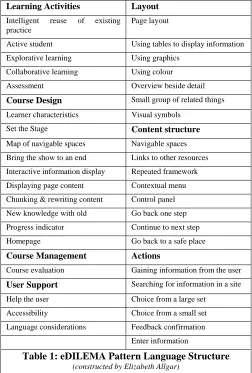
A pattern language can provide the educator with access to design knowledge in these areas. In order to address these requirements, a pattern language was constructed covering a range of information levels, from high-level patterns addressing pedagogical issues to patterns on course design, content structure and interface features (see structure in Table 1). The pattern language was not been developed from scratch but was constructed from existing patterns and research studies on good practice [2,3,8,9,10]. Patterns were collected, adapted and reformatted to provide a coherent collection, with new patterns being added where necessary. Currently patterns are organised by learning activities, course design, content structure, course management, layout, actions and user support. Like all pattern languages it is subject to revision through use and the discovery of new patterns: the aim is not to provide a rigid set of guidelines but a living repository of knowledge about good practice in e-learning. Ongoing post-project work focuses on evaluating the language in use and revising it accordingly.
An unusual aspect of the use of patterns in this area is the requirement for the pattern language to be used, without facilitation, with non-experts in design. In most cases (including Alexander’s although he does provide advice for people using his published language on their own), pattern languages are used by designers, or with facilitators to support users. In this case the educator is liable to be working independently. The pattern language therefore has to be clear and the method for using it explained. The language therefore needs to be supported by tools to support use, such as maps, usage guidelines and examples. Project partners were asked to feedback on the patterns in the language and contribute to the pattern language by writing and submitting patterns. The intention was that the pattern language would belong to the community and evolve through use. Evaluation is ongoing, but initial feedback through project meetings has been positive. The next phase of evaluation is for the pattern language to be used by the partner educators as a support for using the learning object repository. As has been noted, a key challenge in this process will be supporting users to make use of the pattern language independently without facilitation by a designer. Evaluation therefore also focuses on the usability of the language. It is hoped that the pattern
language will develop in and through the REPLIKA project now that the eDILEMA project is complete.
Learning Activities Layout
Intelligent reuse of existing practice
Page layout
Active student Using tables to display information Explorative learning Using graphics
Collaborative learning Using colour Assessment Overview beside detail
Course Design Small group of related things Learner characteristics Visual symbols
Set the Stage Content structure
Map of navigable spaces Navigable spaces Bring the show to an end Links to other resources Interactive information display Repeated framework Displaying page content Contextual menu Chunking & rewriting content Control panel New knowledge with old Go back one step Progress indicator Continue to next step Homepage Go back to a safe place
Course Management Actions
Course evaluation Gaining information from the user
User Support Searching for information in a site Help the user Choice from a large set
Accessibility Choice from a small set Language considerations Feedback confirmation
[image:4.595.300.552.114.487.2]Enter information
Table 1: eDILEMA Pattern Language Structure (constructed by Elizabeth Allgar)
3.2 REPLIKA
The REPLIKA project started in October 2003. It is funded under the EU Leonardo programme (project number UK/03/B/F/PP-162_053) and is led by Trans HEurope, based at the University of Huddersfield. The consortium includes four Yorkshire HE institutions (Leeds Metropolitan University, University of Hull, Doncaster College and University of Huddersfield) as well as the Technical University of Liberec (Cz), Odense Technical College (Dk), Fundacion Universidad Empresa Region de Murcia (Es) and employer organisations (Charlesworth and Engineering Employers Federation).
REPLIKA provides two opportunities that are of particular relevance to HCI educators. First it provides an opportunity to develop and progress the learning object pattern language to a point where it is usable by other educators and developers. Our aim at Leeds Met. is to extend and evolve the language through our experience on REPLIKA. The second opportunity is in the development of learning objects directly usable within HCI teaching. Clearly a multimedia remit makes the development of learning objects relevant to interface design and evaluation very pertinent. Our role will be to develop learning objects. Possible examples might be graphical simulations of dialogue and task processes, interface walkthroughs, design case studies but it is unclear what the nature of such objects might be. We are currently consulting on learning objects that we might usefully develop and hope that the workshop will provide an opportunity to discuss the possibilities.
The challenge is to identify learning objects that are sufficiently generic to be reusable across a range of courses and which can be developed to be context neutral, that are also relevant to the community and to industry needs.
4. S
UMMARYThis paper highlights two European projects in which the author is involved, both of which focus on learning objects. One outcome of the first was the construction of an initial pattern language aimed at supporting the use and development of learning objects by educators. This work is ongoing in the second project, which is particularly concerned with developing learning object content.
It is hoped that highlighting both projects and identifying the need for HCI learning objects will open debate as to the nature of such objects. Colleagues interested in being involved in testing either pattern language and learning objects are invited to contact the author.
5. R
EFERENCES[1] Alexander, C., Ishikawa, S. and Silverstein, M. (1977)
A Pattern Language: Towns, Buildings, Construction.
Oxford,Oxford University Press.
[2] Bergin, J. (2002) A Pattern Language for Course Development in Computer Science, Pace University.
http://csis.pace.edu/~bergin/patterns/coursepatternlang uage.html Last accessed: 12/3/04
[3] Coram, T. and Lee, J. (1996) Experiences -- A Pattern Language for User Interface Design.
http://www.maplefish.com/todd/papers/experiences/Ex periences.html Last accessed: 12/3/04
[4] eDILEMA project (2003) e-dilema.uhk.cz/default.asp Last accessed: 12/3/04
[5] Finlay, J. and Allgar, E. (2003) Reusing Good Practice in Education: A Pattern Language to Support the Use of Learning Objects. In Dynybyl (ed.) Developments in E-Learning 2003 (DEL-03), Prague, pp. 55-66. [6] Lui, Y. and Ginther, D. (1999) Cognitive Styles and
Distance Education. Online Journal of Distance Learning Administration 2 (3).
[7] Mikulecký, S. (2003) Dilleo: Digital Library of Learning Objects. In Dynybyl (ed.) Developments in E-Learning 2003 (DEL-03), Prague, pp70-82.
[8] Plowman, K. (2001) A pattern language for travel website design. MSc Dissertation, School of Computing and Management Sciences,Sheffield Hallam University, UK
[9] Tidwell, J. (1999) Common Ground: A Pattern Language for Human-Computer Interface Design http://www.mit.edu/~jtidwell/common_ground.html
Last accessed: 12/3/04
[10] Welie, M. v., Veer, G. C. v. d. and Eliëns, A. (2000) Patterns as Tools for User Interface Design. In: