A Monthly Double-Blind Peer Reviewed Refereed Open Access International e-Journal - Included in the International Serial Directories.
International Research Journal of Human Resources and Social Sciences (IRJHRSS)
1 | P a g e International Research Journal of Human Resources and Social Sciences Impact Factor- 3.866
Vol. 3, Issue 3, March 2016 ISSN(O): (2349-4085) ISSN(P): (2394-4218)
© Associated Asia Research Foundation (AARF)
Website: www.aarf.asia Email : [email protected] , [email protected]
A STUDY OF PERCEPTION OF STUDENTS ON AFFORDABILITY, FINANCING AND PRIVATIZATION OF HIGHER EDUCATION IN INDIA
Dr. Tania Gupta
Head, Department of Education
Mewar Institute of Management, Ghaziabad, India
ABSTRACT
Globalization has brought immense opportunities in the field of education but on the other
hand it is felt that the benefits of education flow to them who can pay for it. Has higher
education in India become a commodity, and if at all it has, then how far are the stakeholders
willing to accept it as something that can be bought or sold at a price which may not
necessarily be affordable to many? Students are central to the teaching- learning process.
The present descriptive study draws conclusions on affordability, financing and privatization
of higher education in India based on the perceptions of a purposively drawn sample of
students pursuing both general and professional courses from various types of higher
education institutions, by administering a self- designed questionnaire.
The major findings of the study revealed that higher education has become a gateway to earn
more money. The preference for studying in public universities precedes the preference for
private counterparts. The annual fee range for professional courses is higher than the
general courses at both the graduate and post- graduate level. Across the types of higher
education institutions, the range for annual fees is higher in private universities and self-
financing institutions for similar courses being offered in government universities and
colleges. Students perceived that the government is not adequately financing higher
education in India and this has led to proliferation of private institutions of higher education.
A rational fee regulation mechanism should put in place by the government to be followed by
A Monthly Double-Blind Peer Reviewed Refereed Open Access International e-Journal - Included in the International Serial Directories.
International Research Journal of Human Resources and Social Sciences (IRJHRSS)
2 | P a g e remain predominantly within the government domain. However, regulated growth of private
sector may be encouraged for expansion of higher education in India.
Keywords: Affordability, Financing, Higher Education in India, Privatization
INTRODUCTION
The market orientation of higher education has gained currency, stifling the academic
autonomy that is central to creating a dynamic learning environment. The quantum of public
funding has decreased over the years. The concept of academic excellence has undergone a
change. In the present scenario it means acquisition of skills by the student „customer‟ that
allows her/him to get a good market price for these skills. For the institutions, excellence
entails providing skills that is to be judged according to the fee charged for it. This means that
„those who pay less, get less‟ (Prasad, 2005).
The present day higher education system in India has undergone a change its role and
purpose, overall functioning and relevance for the society. On one hand, globalization has
brought immense opportunities in the field of education but on the other hand it is felt that the
benefits of education flow to them who can pay for it. Has higher education in India become
a commodity, and if at all it has, then how far are the stakeholders willing to accept it as
something that can be bought or sold at a price which may not necessarily be affordable to
many? In a democratic country, the voices of the community members need to be heard and
their views and perceptions understood for evolving appropriate changes.
RATIONALE FOR THE STUDY
Students are central to the teaching- learning process. They hold the highest stake in the
higher education system. Their entire future would be at risk if the system does not prepare
them adequately to meet the challenges of life. Students sustain an emotional bond with their
educational institution only when the experiences they have had during the learning phase
were fulfilling, satisfying and enriching. The positive experiences of being taught by good
faculty, proper infrastructure and support systems in the institution are always nurtured by
students. On the contrary, they wish to forget bad experiences in a poor quality institution.
Further, it is in the hands of high quality higher education institutions to produce students
A Monthly Double-Blind Peer Reviewed Refereed Open Access International e-Journal - Included in the International Serial Directories.
International Research Journal of Human Resources and Social Sciences (IRJHRSS)
3 | P a g e perception of students on various aspects related to affordability, financing and privatization
of higher education in India.
OBJECTIVES OF THE STUDY
1. To identify the reasons for choice of a particular course by students studying in various
higher education institutions in India.
2. To identify the reasons for choice of a higher education institution by students.
3. To compare the existing fee structure for general education courses being offered in
higher education institutions in India.
4. To compare the existing fee structure for professional education courses being offered in
higher education institutions in India.
5. To gain the perception of students on financing of higher education in India.
6. To gain the perception of students on privatization of higher education in India.
DELIMITATIONS
1. Perception of students on affordability, financing and privatization of higher education
were studied in National Capital Region (NCR) Delhi.
2. Perception of students on affordability, financing and privatization of higher education
were studied with respect to general and professional education.
3. Perception of students on affordability, financing and privatization of higher education
were examined both at the graduation as well as the post graduation level.
RESEARCH DESIGN
Descriptive method of research was selected for quantitative analysis. An initial draft of a
questionnaire was designed after in – depth discussions with academicians in and students of
higher education institutions to clarify important dimensions of the topic. Several steps such
as preparation of the first version of the questionnaire, its validation by experts, preparation
of the second version after including the changes suggested by the experts, pilot testing and
ascertaining the reliability were undertaken before the elaboration of the definite version of
A Monthly Double-Blind Peer Reviewed Refereed Open Access International e-Journal - Included in the International Serial Directories.
International Research Journal of Human Resources and Social Sciences (IRJHRSS)
4 | P a g e Sample
A sample of 460 students was purposively selected so that an even distribution across various
types of higher education such as central universities, state universities, private universities,
deemed universities, government aided institutions and self- financing institutions could be
gained. Out of these 460 students, 250 students were studying at the graduation level (89
students pursuing general courses like B.Sc., B.Com., B.A. and 161 students pursuing
professional courses like B.C.A., B.B.A, B.Ed., B.J.M.C) while the rest 210 at the post-
graduation level (93 students pursuing general courses like M.Sc., M.Com., M.A. and 117
students pursuing professional courses like M.C.A., M.B.A, M.Ed., M.J.M.C). Out of the
total sample of students, 198 were males and 262 were females.
Tool
The questionnaire for seeking the perceptions and views of students in higher education
institutions consisted of closed –ended questions. The questionnaire was divided into three
sections. Section A of the questionnaire, requested the respondents to provide their personal
information. In Section B, information related to the institution from which the student was
pursuing a higher education course was sought in the form of a check list (Yes/ No type
questions) and some information seeking questions on fee and other related matter. Section C
of the questionnaire comprised of statements to be rated on a three point scale of response
(i.e. Agree, Agree to some extent and Disagree) to seek the perceptions of students on
affordability, privatization and financing of higher education.
Statistical Treatment
Percentages were computed for the data generated from the respondents in the questionnaire.
ANALYSIS AND INTERPRETATION
Choice of Course
The students were asked to state the reasons for their choice of a particular course of study at
the higher education level. Many students gave multiple responses to state the reasons. A
percentage analysis of their responses was undertaken by the investigator. Overall
percentages exceeded hundred as the respondents were free to give multiple responses to the
A Monthly Double-Blind Peer Reviewed Refereed Open Access International e-Journal - Included in the International Serial Directories.
International Research Journal of Human Resources and Social Sciences (IRJHRSS)
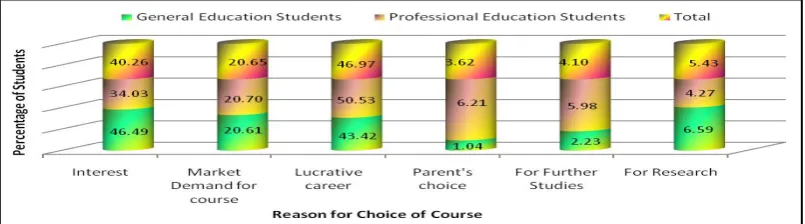
5 | P a g e are the two major reasons for choice of a higher education course by students of both the
general and professional education streams. The other reasons include market demand for the
course, parent‟s choice, desire to pursue further studies and research. Figure 1 highlights the
reasons for choice of course by higher education students in total, and specifically for general
[image:5.595.97.500.190.302.2]and professional streams.
Figure 1: Reasons for Choice of Course by Higher Education Students
Choice of Higher Education Institution
Choice of a good educational institution plays a pivotal role for the aspirants of higher
education. Both students and their parents dedicate all efforts in selecting an educational
institution for pursuing higher education. The decision becomes even tougher when there are
limited public institutions and numerous private counterparts are available. Apart from the
aspiration to study in a public higher education institution (HEI) such as a central or state
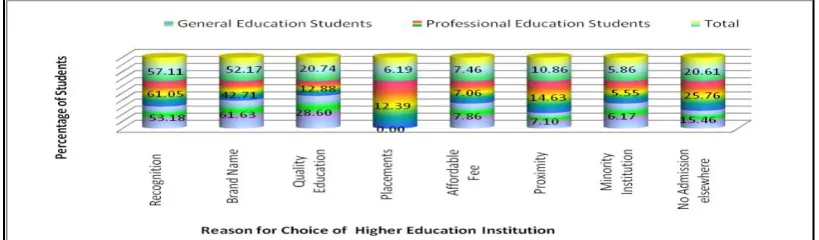
university or a government aided college, students also follow other reasons such as the brand
name, quality of education, proximity to home and placements offered by the institutes. Some
students choose an institution for higher education simply because they do not get admission
elsewhere in a desired course of study. A few students accord importance to educational
institutions that are run by their minority group. Responses from students revealed very clear
reasons for choice of a particular higher education institution for study. Figure 2 is a
diagrammatic representation of the reasons given by students in total and specifically in
A Monthly Double-Blind Peer Reviewed Refereed Open Access International e-Journal - Included in the International Serial Directories.
International Research Journal of Human Resources and Social Sciences (IRJHRSS)
6 | P a g e Figure2: Reasons Given by Students for Choice of Higher Education Institution for
Pursuing Studies
Price of Prospectus
A prospectus serves as a written evidence for public disclosure of various facts and
information related to the educational institution. Since application does not ensure admission
in a particular higher education institution, a student may have to apply in different
universities and colleges and purchase their prospectus. Many a times, a student may have to
buy separate prospectus containing an application form when she/he intends to apply for
different courses in the same university or college. With a large number of aspirants of higher
education applying for admission in various courses, the prospectus becomes an object of
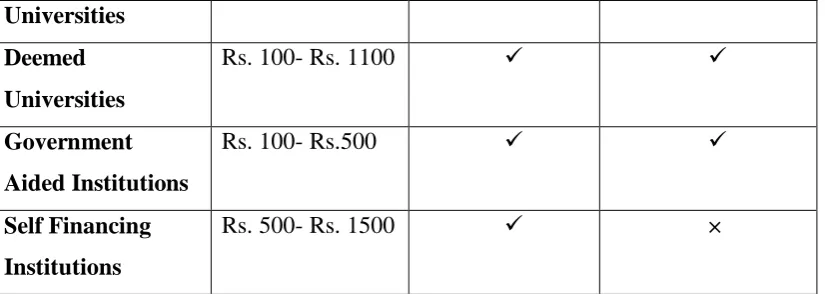
revenue generation for the educational institution. The price of prospectus of various higher
[image:6.595.71.481.93.213.2]education institutions selected as sample for study has been presented in Table 1.
Table 1: Price of Prospectus of Various Higher Education Institutions
Nature of Higher
Education
Institution
Price (in Indian
Rupees)
(For academic
Session 2013-14)
Mode of Availability
Print Copy Online Access on
Institution’s
Website
Central
Universities
Rs. 100- Rs. 500
State Universities Rs. 1000
A Monthly Double-Blind Peer Reviewed Refereed Open Access International e-Journal - Included in the International Serial Directories.
International Research Journal of Human Resources and Social Sciences (IRJHRSS)
7 | P a g e Universities
Deemed
Universities
Rs. 100- Rs. 1100
Government
Aided Institutions
Rs. 100- Rs.500
Self Financing
Institutions
Rs. 500- Rs. 1500 ×
It can be seen from the table that the price of prospectus in various higher education
institutions ranges from Rs. 100 to Rs. 1500.
Fee Structure
“Fee is a price for education” (Tilak & Varghese 1985, p.2). Increasing fees is a commonly
suggested cost recovery method in higher education (Varghese, 2000). In India, it is a dual
combination of resource crunch in the public sector and the emergence of a significant private
sector. In India, fee constitutes 15 per cent of expenditure on higher education (Prakash,
2007, p. 3257). The Indian household incurs as much expenditure as the government in
education (Tilak, 1991). “The total fee paid by a student comprises of the (i) tuition fees and
(ii) other fees which include special fees, examination fees, laboratory fee, eligibility fee,
transfer fee, convocation fee, etc.”(Tilak & Varghese, 1985, p.8). Table 2 presents an
overview of the existing fee structure in various higher education institutions selected as
[image:7.595.95.508.36.183.2]sample for the study.
Table 2:Existing Fee Structure in Sampled Higher Education Institutions
Nature of HEI
Annual Total Fee* Range (in Indian Rupees)
* (for academic session 2013-14)
General Education Stream
(Science, Commerce and
Humanities)
Professional Education Stream
(Management, Computer
Application, Education,
Journalism and Mass
Communication)
Graduation
Level
Post
Graduation
Level
Graduation
Level
Post
Graduation
A Monthly Double-Blind Peer Reviewed Refereed Open Access International e-Journal - Included in the International Serial Directories.
International Research Journal of Human Resources and Social Sciences (IRJHRSS)
8 | P a g e Central Universities Rs. 5,600- Rs, 6,500 Rs. 4,500- Rs, 12,500
Rs. 5,800 Rs. 5,000-
Rs, 48,000
State
Universities
Rs. 32,000 Rs. 36,000-
Rs. 53,000
- Rs. 48,000-
Rs. 53,000 Private Universities Rs. 83,000- Rs. 1,41,000 Rs. 35,000- Rs. 1,85,000 Rs. 35,000- Rs. 3,83,000 Rs. 60,000- Rs. 7,00,000 Deemed Universities Rs. 65,000- Rs. 1,00,000 Rs. 50,000- Rs. 1,10,000 Rs. 10,000- Rs. 65,000 Rs. 7,000- Rs. 1,00,000 Government Aided Institutions Rs. 3,500- Rs. 35,000
- Rs.3,500-
Rs. 12,000
Rs. 3,000
Self - Financing
Institutions
- Rs. 45,000 Rs. 40,000-
Rs. 80,000
Rs. 15,000
Source: Data collected from Students and verified from Official Website of Universities and
Colleges
It may be inferred that the annual fee range in various higher education institutions is higher
in professional stream in contrast to the annual fee range for general stream. Additionally, it
may be noted that the annual fee range in various higher education institutions is higher for
post-graduate courses in contrast to the annual fee range for graduate courses in various
higher education institutions.
Capitation Fee
Charging capitation fees from students at the time of admission has been banned by the
Supreme Court of India. Though institutions claim that they do not charge capitation fee, it
has been reported by a few students that higher education institutions do ask for donation at
the time of admission. Many higher education institutions like private universities and
deemed universities charge fee under „sponsored „and „non- sponsored‟ category. The
students of general education stream studying in private universities (67.50 percent students)
and deemed universities (41.66 percent students) revealed that their university charges
capitation fee in the form of „sponsored‟ and „non- sponsored‟ category while all the students
in central universities, state universities, government aided colleges and self financing
A Monthly Double-Blind Peer Reviewed Refereed Open Access International e-Journal - Included in the International Serial Directories.
International Research Journal of Human Resources and Social Sciences (IRJHRSS)
9 | P a g e private universities, 18.38 percent in deemed universities and 29.86 percent in self- financing
institutions stated that capitation fee is charged from students who do not qualify for
admission in the institution. All the students studying in central universities, state universities
and government aided institutions revealed that capitation fee is not charged at the time of
admission. In total, 18.19 percent general education students and 14.08 percent professional
education students revealed that capitation fee is charged at the time of admission against
management/paid seat or sponsored and non- sponsored category.
Demand for Money (other than fee) during the Academic Session
Out of the total students in general education stream, 90.16 percent students expressed that
the higher education institution in which they were studying does not demand for money
other than fee, during the academic session. While all the students in central universities,
state universities, government aided colleges and self financing institutions denied that they
were asked for money by the university/ college during the academic session, 35 percent
students of private universities and 24.09 percent students of deemed universities reported
that the institution charged them for education tours, fresher‟s and farewell parties and sale of
uniform and stationery items.
Moreover, 16.13 percent students of professional education stream reported that
money other than the scheduled fee is demanded during the academic session. While 47.5
percent students of private universities, 5 percent students of deemed universities and 44.32
percent of self- financing colleges expressed that money other than fee was demanded by
their institution, all the students in central universities, state universities and government
aided colleges denied the same. The reasons stated by professional education students were
the same as those given by general education students- that is, money is charged for
education tours, sale of placement brochure and contribution for fresher‟s and farewell
parties. A few B.Ed. students studying in self financing institutions revealed that money was
demanded during practice teaching and final practical examination.
Imposing Fine on Students
Students in central universities, state universities, and government aided institutions stated
that their institutions do not impose fine on students for minor reasons. Though all the general
A Monthly Double-Blind Peer Reviewed Refereed Open Access International e-Journal - Included in the International Serial Directories.
International Research Journal of Human Resources and Social Sciences (IRJHRSS)
10 | P a g e students pursuing a professional course from private universities, 5 percent students from
deemed universities and 21.40 percent students from self financing institutions ascertained
that fine for late coming, shortage of attendance and late submission of assignments was
collected from them. In total, only 11.78 percent of students pursuing professional courses
had revealed that fine is imposed for minor reasons.
Views on Financing of Higher Education
The views of students on the financing of higher education were gathered through the
questionnaire in the following areas:
Decline in Public Expenditure
Out of the total number of students, 58.32 percent students agreed, 21.77 percent students
agreed only to an extent and the remaining 19.91 percent students disagreed with the
statement that the government is not adequately financing higher education and this had led
to the proliferation of private higher education institutions.
Free Higher Education
Out of the total students, 69.08 percent students agreed with the statement while 24.76
percent students agreed to some extent and the remaining 6.16 percent students disagreed
with that free higher education should be provide in India.
Education Loans
To enhance access and equity in higher education, education loans are seen as an effective
method of cost sharing. The governments in many countries offer public finances through
loans to students. Another way of obtaining education loans is through the banks. At present
many public banks as well as private banks offer education loans to students. 89.85 percent
students agreed with the statement, 8.23 percent students agreed to some extent and just 1.92
percent students disagreed that both public and private sector banks must offer students same
eligibility criteria of availing education loan.
In addition, education loans may be unavailable to the students from economically
weaker sections of the society due to high rate of interest charged by lending financial
A Monthly Double-Blind Peer Reviewed Refereed Open Access International e-Journal - Included in the International Serial Directories.
International Research Journal of Human Resources and Social Sciences (IRJHRSS)
11 | P a g e available to the needy students to bear the escalating cost of higher education, it may not be
possible for them to pursue higher education. Even for students who wish to pursue higher
education from universities abroad, a high rate of interest on education loan may make it
difficult to avail the opportunity of getting a higher amount of loan. Out of the total students,
94.48 percent students agreed, 5.23 percent students agreed to some extent and the remaining
0.29 percent students disagreed that the rate of interest charged by various banks on
education loan should not be high for the aspirants of higher education. Furthermore, 82.73
percent students agreed, 10.68 percent students agreed to some extent and a meager 0.59
percent of students disagreed with the statement that government should provide subsidy on
education loans to the weaker sections. Vis-à-vis subsidization of education loans for the
socially disadvantaged students 89.08 percent students agreed, 9.18 percent students agreed
to some extent and just 1.74 percent of students disagreed with the statement. Concerning
subsidy on education loans to the women, 89.29 percent students agreed, 9.31percent agreed
to an extent and 1.40 percent disagreed with the statement.
Views on Privatization of Higher Education
The views of students on privatization of higher education were gathered on the following
dimensions:
Privatization and Access to Higher Education
In total, 51.26 percent students agreed, 32.29 percent students agreed to an extent and the
remaining 16.45 percent students disagreed with the statement that privatization has increased
access to higher education in India.
Privatization and Commercialization of Higher Education
While 69.77 percent students in total were of the perception that privatization of higher
education has led to commercialization of higher education in India, 23.50 percent students
A Monthly Double-Blind Peer Reviewed Refereed Open Access International e-Journal - Included in the International Serial Directories.
International Research Journal of Human Resources and Social Sciences (IRJHRSS)
12 | P a g e Transparency in Functioning of Private Higher Education Institutions
A majority of students perceived that private institutions are not transparent in their
functioning as it was found that on the whole, 45.33 percent students disagreed with the
statement that private institutions are transparent in their functioning. While 26.56 percent
students agreed that private institutions are transparent in functioning, 28.11 percent students
agreed only to an extent, indicating that a greater percentage of students either disagreed or
agreed only to an extent with the statement.
Insufficient Disclosure of Information in the Prospectus and on Website
Often it is found that the private institutions do not disclose in their prospectus details on
admission requirements, fees to be charged, details on faculty and results of students.
Students were asked to give their perception on this issue. Responses from students revealed
that out of the total number of students, 56.06 percent students agreed that private institutions
do not disclose in their prospectus details on admission requirements. Further, 62 percent
students viewed that fees to be charged is not mentioned in the prospectus of private
institutions. While 71.20 percent students perceived that private institutions do not disclose in
their prospectus details of faculty; 72.59 percent students agreed that results of students are
not publically disclosed in the institution‟s prospectus. This clearly indicates that students
perceived that private institutions engage in insufficient disclosure of information in the
prospectus.
Higher education institutions are expected to provide relevant information related to
admissions, fee, faculty profile and results of students on their official website. Responses
given by the students revealed that in total, 59.22 percent students agreed that private
institutions do not disclose on their website details on admission requirements. In addition,
61.21 percent students viewed that fees to be charged is not mentioned on the official website
of private institutions. While 50.29 percent students perceived that private institutions do not
disclose on their website details of faculty, 72.13 percent students agreed that results of
students are not publically disclosed on the institution‟s website.
Misleading Advertisements for Admission
In order to lure students to take admission, many private institutions adopt malpractices such
A Monthly Double-Blind Peer Reviewed Refereed Open Access International e-Journal - Included in the International Serial Directories.
International Research Journal of Human Resources and Social Sciences (IRJHRSS)
13 | P a g e prospective students. Often the infrastructure, facilities and activities that are advertised by
private institutions lack authenticity. In this study, 66.22 percent students in total agreed,
21.44 percent students agreed only to an extent and the remaining 12.34 percent students
disagreed that advertising is used to misrepresent mislead and misinform prospective students
for admissions into private institutions and universities.
Views on Expansion of Higher Education
Expansion in Private Sector
For expanding opportunities of higher education it is sometimes argued that privatization is
not only inevitable but also crucial. However, it is also feared that growth in the number of
private higher education institutions may lead to commercialization of higher education. In
total, 54.16 percent students did not support the view of opening more private higher
education institutions.
Expansion in Public Sector
The need for expansion of higher education through establishment of public institutions of
higher education in India has been reiterated in various five year plans and policies on higher
education. The percentage analysis of student responses revealed that on the whole, 76.19
percent general education students, 88.72 percent professional education students and 82.45
percent students in total agreed with the statement that there is a need for an enormous
expansion of public institutions of higher education in India.
MAJOR FINDINGS
1. A majority of students (in both the general and professional streams and at the graduation
and post graduation level) pursue a particular course at the higher education level mainly
for acquiring skills for a lucrative career in the near future. This clearly speaks of the
materialistic view that higher education has acquired as it has become a gateway to earn
more money.
2. Students perceive government recognition to be the main reason for selecting a higher
education institution for pursuing studies. Thus the preference for public universities
precedes the preference for private counterparts. Another major reason for choosing an
A Monthly Double-Blind Peer Reviewed Refereed Open Access International e-Journal - Included in the International Serial Directories.
International Research Journal of Human Resources and Social Sciences (IRJHRSS)
14 | P a g e higher education, proximity of the institution to home and good placement record of the
institution are other for choosing a particular higher education institution.
3. The price of prospectus in public higher education institutions is lower than that in private
counterparts indicating that prospectus is an object of revenue generation, especially for
private higher education institutions.
4. The annual fee range for professional courses is higher than the general courses at both
the graduate and post- graduate level. Moreover, the annual fee range at the post-
graduation level is higher than the graduation level for both general and professional
education streams in most of the higher education institutions. In addition, the annual fee
range in central universities and government aided institutions is the lower for both
general and professional education courses in comparison to the annual fee range in
private universities which is the higher. Furthermore, the annual fee range in state
universities is lower than the annual fee range in private universities and self- financing
institutions for similar courses.
5. Private educational institutions like private universities; private deemed universities and
self financing colleges impose fine on students for minor reasons such as late coming,
shortage of attendance and late submission of assignments.
CONCLUSIONS
The government is not adequately financing higher education in India and this has led to
proliferation of private institutions of higher education. A rational fee regulation mechanism
should put in place by the government to be followed by all the higher education institutions.
In addition, national schemes for provision of free higher education should be initiated by the
government. Meritorious students should be provided scholarships by higher education
institutions. Education loans should be available as a cost- sharing device for the aspirants of
higher education. Both public and private sector banks must offer students same eligibility
criteria of availing education loan. Rate of interest charged by various banks on education
loan should not be high for the aspirants of higher education. The government should also
provide subsidy on education loans to economically weaker section students, socially
disadvantaged and women so as to enhance their equitable participation in higher education.
Although privatization of higher education has improved access to higher education; it
has led to commercialization of higher education in India. Many private institutions are not
A Monthly Double-Blind Peer Reviewed Refereed Open Access International e-Journal - Included in the International Serial Directories.
International Research Journal of Human Resources and Social Sciences (IRJHRSS)
15 | P a g e website; the details on admission requirements, fees to be charged, details on faculty and
results of students. The private institutions and universities use advertising to misrepresent
mislead and misinform prospective students for admissions.
Expansion of higher education in India entails an enormous expansion of public
institutions. In their view, more and more colleges and universities should not be opened in
India in the private sector. Higher education system in India must remain predominantly
within the public sector (government domain). However, regulated growth of private sector
may be encouraged for expansion of higher education in India.
REFERENCES
Prakash, V. (2007). Trends in Growth and Financing of Higher Education in India. Economic and Political Weekly, August 4, 3249- 3258.
Prasad, M. (2005). Autonomy and Commercialization of Higher Education. Social Scientist, 33(11/12), November- December, 43-48.
Tilak, J.B.G. (1991). Privatization of Higher Education. Prospects-Quarterly Review of Education, 21(2), 227-239.
Tilak, J.B.G. & Varghese, N.V. (1985). Discriminatory Pricing in Education. NIEPA
Occasional Papers. New Delhi: National Institute of Educational Planning and