Effective Cleaning of Educational Web Site Usage
Patterns and Predicting their Next Visit
Harish Kumar
PhD Scholar, Mewar University, Chittorgarh
Anil Kumar Solanki,
Ph.D Director,ABSTRACT
Universities with web education rely on web usage analysis to
obtain students behavior for education promotion. The
Internet is an information gateway and as a medium for
business and education industry. Finding hidden information
from Web log data is called Web usage mining. The aim of
discovering similar patterns in Web log data is to obtain
information about the navigational behavior of the users.
Web usage mining, from the data mining aspect, is the task of
applying data mining techniques to discover usage patterns
from Web data in order to understand and better serve the
needs of users navigating on the Web. Web usage mining aim
is to find out useful information from the educational
weblogs. These useful data pattern are used to analyze
behavior of user. The focus of this paper is to generate a
cleaning algorithm and provide an overview how to use
frequent pattern mining techniques for discovering different
types of patterns in a Web log. In this paper we premeditated
different pattern for web pages, general statics, activity statics,
visitor’s statics, browser used
Keywords
Web mining, Web usage, Web logs, Navigational behavior.
1.
INTRODUCTION
The Internet grows at an amazing rate as an information
gateway and as a medium for online education industry.
Students use Internet to find out the required information
because the Internet is an infinite source of data that can come
either from the Web content, represented by the billions of
pages publicly available, or from the Web usage, represented
by the log information daily collected by all the servers
around the world [1] [2].Web based higher education is
growing very quickly. The number of students taking
advantage of online education is increasing by about 25%
percent every year in India. But Registration at a college and
University are growing by only 1.5% a year. So we need to be
storing their personal information and their web navigation
patterns in web log data. Various search engines, and other
large educational document repositories (e.g. customer support databases, product specification databases, press
release archives, news story archives, etc.) are growing so rapidly that it is difficult and costly to categorize every
document. The information collection through data mining
has allowed E-education Applications to make more revenues
by being able to better use of the internet that helps students to
make more decisions. Web-based applications for electronic
commerce, online education, news etc., are becoming
common practice and widespread. So many servers manage
their cookies for distinguishing server address. User
Navigation pattern are in the form of web logs .These
Navigation patterns are refined and resized and modeled as a
new format. This method is known as “Loginizing”[3].Web
log mining has been applied to the e- education system, the
main purpose of which is to get the access and interaction
information of students through the access of server log files.
Various data mining techniques are used to discover the
hidden information in the Web. Knowledge Discovery and
Data Mining (KDD) is an interdisciplinary area focusing upon
methodologies for mining useful information or knowledge
from data [3]. Web mining does not only mean applying data
mining techniques to the data stored in the Web. Web mining
involves a wide range of applications that aims at discovering
and extracting hidden information in data stored on the Web.
Another important purpose of Web mining is to provide a
mechanism to make the data access more efficiently and
adequately. Users leave navigation traces, which can be pulled
up as a basis for a user behavior analysis. In the field of web
applications similar analyses have been successfully executed
by methods of Web Usage Mining. The challenge of
extracting knowledge from data draws upon research in
statistics, databases, pattern recognition, machine learning,
data visualization, optimization, web user behavior and
high-performance computing, to deliver advanced business
paper is to provide an overview how to use pattern mining
techniques for discovering different types of patterns in an
e-Educational Web log. The three web patterns to be discussed are frequent item sets, sequences and tree patterns.
2.
WEB MINING
Web mining may be classified into three categories, namely
weblog mining, web content mining, and web structure
mining.
Figure1: Categorization of Web Data mining
Web content mining (WCM) is to find useful information in
the content of web pages[4] e.g. free Semi-structured data
such as HTML code, pictures, and various unloaded files.
Web structure mining (WSM) is use to generating a structural
summary about the web site and web pages. Web structure
mining tries to discover the link structure of the hyperlinks at
the inter document level. Web content mining mainly focuses
on the structure of inner document, Web usage mining
(WUM) is applied to the data generated by visits to a web site,
especially those contained in web log files. I only highlighted
and discussed research issues involved in web usage data
mining. Web usage mining (WUM) or web log mining, users’
behavior or interests is revealed by applying data mining
techniques on web. Three main sources of web log file are
1. Client Log File,
2. Proxy Log File
3. Server Log File.
A log file contains the following field
The client's host name or its IP address,
The client id (generally empty and represented by a \-")
The user login (if applicable),
The date and time of the request,
The operation type (GET, POST, HEAD, etc.),
The requested resource name,
The request status,
The requested page size,
The user agent (a string identifying the browser and the operating system used),and
The referrer of the request which is the URL of the Web page containing the link that the user followed to get to the current page.
User behavior can be best analyzed from client log file
because log files collected from client logs are much reliable
and accurate then server log file and proxy log file. An
extended log file contains a sequence of lines containing
ASCII characters terminated by either the sequence LF or
CRLF. Log file generators should follow the line termination
convention for the platform on which they are executed.
Analyzers should accept either form. Each line may contain
either a directive or an entry. Entries consist of a sequence of
fields relating to a single HTTP transaction. Fields are
separated by whitespace; the use of tab characters for this
purpose is encouraged. If a field is unused in a particular entry
dash "-" marks the omitted field. Directives record
information about the logging process itself. Lines beginning
with the # character contain directives. The following
directives are defined:
Version: <integer>.<integer>
The version of the extended log file format used. This draft defines version 1.0.
Fields: [<specifier>...]
Specifies the fields recorded in the log.
Software: string
Identifies the software which generated the log.
Start-Date: <date> <time>
The date and time at which the log was started.
End-Date :< date> <time>
The date and time at which the log was finished.
Date:<date> <time>
The date and time at which the entry was added.
Remark: <text>
Comment information. Data recorded in this field should be
Ignored by analysis tools.
Sample web log format is as follows.
Web Mining
Web Content
Mining
Web Structure
Mining
Web UsageFigure 2: Categorization of Web log Mining
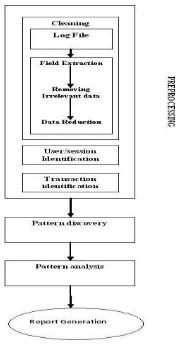
User profile was derived from the analysis of web log file and
meta data of page contents. For discovery and analysis of
usage patterns from the available data, it is necessary to
perform three steps: Preprocessing, Pattern Discovery, Pattern
Analysis.
Figure 3: Basic steps of Web log Mining
3.
DATA CLEANING ALGORITHEM
Data cleaning is the first preprocessing step. In this step all
redundant, irrelevant and bulky noise data are eliminated from
the web log files. When we request an educational web page
which contains additional Web information like images or
script files, on that time web navigator generate several
requests. Data cleaning is depends on the web site i.e. if a site
contains more irrelevant data then requires more cleaning
steps otherwise simple cleaning is sufficient for web analysis.
My proposed algorithm is worked on USP identification. USP
identification algorithm has three phases
1. User identification phase.
2. Session Identification phase.
3. Path completion and identification phase.
Data cleaning is the first preprocessing step. In this step all
redundant, irrelevant and bulky noise data are eliminated from
the web log files. When we request an educational web page
which contains additional Web information like images or
script files, on that time web navigator generate several
requests. If these requests are still present when the data mining step is performed, uninteresting patterns like “Page,
Img1, Img2, Img3" may be found, making the pattern analysis
step more complex [3] [4]. Also, Web robots, generally, have
a predefined (programmed) behavior and the analysts are not
interested in mining these requests.
It involves irrelevant reference to embedded objects. That
may not be important for purpose of analysis, including
references to style files, graphics or sound files. We filter out
documents that are not requested directly by users. These are
image requests in the log that are retrieved automatically after
accessing requests to a document containing links to these
files.
1. Collect log file data from weblog folder of the www
root (FTP path of a web site).
2. Swap the data into text file.
3. Arrange the text file according to the date of
created.
4. Pass the text file one by one in function
clean(textfile.log)
5. Call Function clean(“weblogfile.log”, “ string” )
6. Main Function
7. Call Function removeLineFromFile(String file,
String lineToRemove) {
8. If filename not found
9. Exit
10. Else
11. Read the file
12. Create a temp file for deletion
13. Pass the string S to Function isSubstring
14. Check whether the string is present or not
15. IF present
16. Call MAIN FUNCTION CALLING
17. Else
18. Handel the exception and EXIT from main
Function
19. Function isSubstring (String s1, String s2)
[image:3.595.142.233.349.521.2]Match the string
If found
Then
Pass to main Function
Else
Exit
}
21. MAIN FUNCTION CALLING(STRING S[ ])
22. Remove the irrelevant data with desired
extension(like .gif,.css etc)
23. }
The function complexity is much lesser then the other
cleaning algorithms. Before Compiling size of web log file is
3153Kb. So this code helps to clean the irrelevant field from
the log file. Clean data is use for designing Web Graph. This
method increased the average length of the request data
reduction for dataset.
After 1 step cleaning size is reduce up to 1,289 Kb.
After 2 step of cleaning size is approximate 1.1 Mb.
4.
RELATED WORK
The pages and hyperlinks of the World-Wide Web may be
viewed as nodes and arcs in a directed graph. The
relationship between sites and pages indicated by these
hyperlinks gives rise to what is called a Web graph. When it
is viewed as a purely mathematical object, each page forms a
node in this graph and each hyperlink forms a directed edge
from one node to another. Generally user visit a web site in
sequential nature means user visit first home page then
second page and then third and then finish his work with this
user leaves his navigation marks on a server. These navigation
marks are called navigation pattern that can be used to decide
the next likely web page request based on significantly
statistical correlations. If that sequence is occurring very
frequently then this sequence indicated most likely traversal
pattern. If this pattern occurs sequentially, Markov chains
have been used to represent navigation pattern of the web site
[5][7]. Important properties of Markov Chain:
Log Set
Step No
Website Name Duration Size before Filtering
Size after Filterin g
LS
1
1 www.krishnacol
lege.ac.in
1-01-12
To
2-01012
3153 Kb 1.1 Mb
LS
1
2 www.krishnacol
lege.ac.in
1-01-12
To
2-01012
1.1 Mb 786 Kb
LS
1
2 www.krishnacol
lege.ac.in
1-01-12
To
2-01012
Markov Chain is successful in sequence
matching generation. Markov model is
depending on previous state.
Markov Chain model is Generative.
Markov Chain is a discrete – time stochastic
process.
The log file records the entry for each navigation click and
can be processed into the specific manner of time ordered
session. Every navigation session includes a trail that the user
followed through the space, which we take without loss of
generality to be a web site This trail can be as a sequence of
clicks that has taken no longer than a given time span, or one
such that the time between clicks in the sequence is no longer
than a given short time span [2][8]. Markov chain present
state is depending on previous state. If a web site contains
more navigation pattern (“Interesting Pattern”) and high
supporting threshold is assign to it and less interesting
patterns are ignored. This concludes that at various level of
web site a different threshold value is assigned. Suppose the
navigation patterns for above cleaned web logs with their
frequency of use are as follows.
Pattern Name Frequency of
occurrence
S A B C D T 4
S E F G T 8
S B C E F T 4
S A C D T 4
S B C D T 6
S A C E T 14
S B C T 4
S D F G T 2
S D FT 10
S D T 12
S B C D F T 6
S E F T 2
This pattern is similar to [3] pattern and first order Markov
chain model for the same is as follows.
The above graph is represented by matrix.
Above matrix indicates that every node having number of
forward links and backward links. If we plot the graph with
forward and backward link .If we download any web page this
shows all the forward links of that particular page. This
indicates that we need to be drawing a graph which shows all
the forward and backward link of a page or say node
.
4.1 ADVANCE MODEL
State C is not accurately showing his actual probability. The
by separating the in paths to it [10]. For solve this accuracy
problem state cloning is required or need to find out another
improved method for accuracy increasing. Cloning increase
the data structure overhead because it is required to be created
for those nodes having problem of accuracy. But the friend
node can easy solve this problem. This is similar to friend
function but does not have own importance.
In this model all the states are connected with this, the
probability estimation for the node C-D is accurate and
approx 0.099 which is equal to first order Markov chain. So
this model can be successfully implemented. Now need to
find out the new pattern with probability matrix and from their
occurrence.
5.
BENEFITS OF CURRENT MODEL
Benefits of this model are as follows.
1. Decrease overhead.
2. Precise Probability calculation.
3. Adopted by dynamic model.
4. Accurate results.
5. Predict the next pattern on the basis of probability
ratio.
6.
REFRENCES
[1] Ajith Abraham, “Business Intelligence from Web Usage Mining” Journal of Information & Knowledge Management, Vol. 2, No. 4 (2003) 375-390.
[2] Jos´e Borges, Mark Levene “An Average Linear Time Algorithm for Web Usage Mining” Sept 2003.
[3] Kumar Harish, Solanki A.K “Adaptive Markov Chain For Next Page Access Prediction” Vol. 9 No. 7 JUL 2011 Aug 25, 2011 by IJCSIS .
[4] Hengshan Wang, Cheng Yang, Hua Zeng “ Design and Implementation of a Web Usage Mining Model Based On Fpgrowth and Prefixspan”, Communications of the IIMA, Volume 6 Issue 2
[5] Jaideep Srivastava_y, Robert Cooleyz, Mukund Deshpande, Pang-Ning Tan “Web Usage Mining: Discovery and Applications of UsagePatterns from Web Data” Volume 1 Issue 2-Page13
[6] Alice Marques, Orlando Belo “Discovering Student web Usage Profiles Using Markov Chains” The Electronic Journal of e-Learning Volume 9 Issue 1 2011, (pp63-74)
[7] Ji He,Man Lan, Chew-Lim Tan,Sam-Yuan Sung, Hwee-BoonLow, “Initialization of Cluster refinement algorithms: a review and comparative study”, Proceeding of International Joint Conference on Neural Networks[C].Budapest,2004.
[8] Renata Ivancsy, Ferenc Kovacs “Clustering Techniques Utilized in Web Usage Mining” International Conference on Artificial Intelligence, Knowledge Engineering and Data
[9] Bhawna.N and Suresh. J “Generating a New Model for Predicting the Next Accessed Web Page in Web Usage Mining” Third International Conference on Emerging Trends in Engineering and Technology, ICETET.2010.56
[10] Bindu Madhuri, Dr. Anand Chandulal.J, Ramya. K, Phanidra.M “Analysis of Users’ Web Navigation Behavior using GRPA with Variable Length Markov Chains” IJDKP.2011.1201.
[11] Renata Iváncsy, István Vajk: A time- and memory-efficient frequent itemset discovering algorithm for association rule mining. IJCAT 27(4): 270-280 (2006).
AUTHOR PROFILE
Harish Kumar has completed his M.Tech (IT) from Guru
Gobind Singh Indraprastha University, Delhi. He is currently
pursuing his PhD from Mewar University, Chittorgarh.
PROF. Anil Kumar Solanki has obtained his PhD in
Computer Science & Engineering from Bundelkhand
University.He has published various paper in National and
International journal. He has published various papers in