© 2016, IRJET | Impact Factor value: 4.45 | ISO 9001:2008 Certified Journal | Page 1367
GENETIC ALGORITHM BASED 2D NESTING OF SHEET METAL PARTS
G. HARISH KUMAR REDDY
PG-Scholar, Department of Mechanical Engineering, SVCET CHITTOOR, ANDHRAPRADESH, INDIA
---***---Abstract -
Nesting of 2D sheet metal parts is a complex issue faced by many manufacturing industries, such as glass industry, leather industry, sheet metal industry etc. Finding optimum layout of 2D parts consisting of different shapes and sizes using the available sheet should be done to ensure maximum material utilization, Other criteria, if any should also be accomplished (such as by product utility etc). This will also result in cost reduction. This paper aim to solve these problem using genetic algorithm and bottom left technique. The influence parameters of genetic algorithm such as cross over probability, mutation probability, and termination criteria etc. To be studied to arrive at the best sequence of parts for generating an effective nesting pattern and bottom left technique as placement policy. Auto CAD will be used to plan the 2D parts and the geometry data will be fed to GA toolbox of MATLAB for generating the best possible nesting. Output of GA is fed to AutoCAD for pictorial representation of the nesting.Key Words: 2D parts, nesting, genetic algorithm, bottom left technique, MATLAB, AUTOCAD.
1. INTRODUCTION
In the shipbuilding, gadgets, metal, glass, paper, article of
clothing commercial ventures the issue of cutting/laying rectangular pieces from stock sheets is a regular element. High material usage is exceptionally compelling to large scale manufacturing commercial enterprises since little upgrades in the format can bring about substantial investment funds of material and impressively lessening underway expense. Nesting issues are improvement issues that are worried with finding a decent plan of various things in bigger containing regions without overlap, with the target of minimizing squandered space, or pieces should be cut from crude material, with the goal of minimizing waste. This kind of issue is experienced in numerous territories of business and industry is material, paper, wood, glass, steel and cowhide commercial ventures. It is structures part of the combinatorial issue found in Operational Research. These commercial enterprises produce enormous measures of items to answer the worldwide interest. To minimize the material waste making these items, a great cutting and packing format is useful.2. NESTING
Sheet metal is a well know material many types of products. Framing a section from sheet metal incorporates preliminary and completing operation, for example, blanking, de-burring and twisting. A clear is middle of the road part that cut from sheet metal and changed by different operations to shape the completed part. In current environment, numerous organizations are utilizing littler part sizes and attempting to lessening costs any place conceivable. Nesting is a potential answer for sheet metal industry.
Nesting is a great issue of finding the most effective format for removing parts of given sheet with least waste material. Nested parts must require the same materials and same sheet thickness. Manual strategy is utilized to decide the course of action in a few commercial enterprises. Administrators choose the format from their experience, yet this not productive strategy since it is tedious and results don't effectively use the material. Nesting can decrease the ideal opportunity for machine set up and sheet stacking and diminish material expense.
2.1 Step involved in nesting process.
Fig 1: Nesting process
2.2 Types of Nesting
One dimension nesting
Two dimension nesting
© 2016, IRJET | Impact Factor value: 4.45 | ISO 9001:2008 Certified Journal | Page 1368
One Dimension Nesting
One-dimensional structure: An arrangement of one dimensional article is given alongside a set of bin of the same size. The goal is to put the articles in the receptacles keeping in mind the end goal to occupy the minimum number of containers (see figure) this is known as one-dimensional Bin packing or essentially, bin packing. A utilization of this issue is for cutting bits of stock from accessible bars of a settled length. The goal is to minimize the quantity of bars used, while cutting all the bits of required sizes.
Two Dimension Nesting
An arrangement of two-dimensional articles is to be set
on a plane with the target of minimizing the aggregate territory involved. This issue is known as two-dimension nesting.In two dimension nesting there is some cases is accessible:
1. Blank boundary is regular and parts are regular. 2. Blank boundary is regular and the parts are irregular. 3. Blank boundary is irregular and the parts are regular 4. Both blank and parts with irregular boundaries.
Three Dimension Nesting
An arrangement of three-dimensional shapes is to be set in the smallest walled in area. Frequently, the fenced in area is pre-decided; the goal is to fit all the given shapes inside. For transportation of payload, the shapes are generally straightforward, e.g. rectangular boxes. Additionally, there is couple of limitations on the arrangement and introduction of shapes. The situation of the mechanical get together in the engine of a vehicles requires dealing with complex shapes and an assortment of useful limitations on the area and orientation of parts that emerge from necessities, for example, simple access to certain parts, anticipation of harm because of the warmth created, kinematic and useful associations, practicality of assembly, and so forth.
In this paper solved the 2D nesting problem with two conditions:
This anticipates concentrate on enhancing the design for normal and unpredictable pieces cut out from a metal sheet, utilized as a part of the auto business. This nesting issue is otherwise called the 2 dimensional Bin packing issue, or 2-dimensional irregular open measurement issues (2D irregular ODP). Open measurement issue alludes to the measurements of the sheet: one dimension is fixed (the width W) and one measurement differs (the length L). It is beneficial, given a specific sheet with a specific width and a characterized set of pieces, additionally called stencils, to
minimize the length of the sheet keeping in mind the end goal to minimize the material waste
.
2.3 Problem Formulation
The issue comprises of the accompanying info:
A rectangular sheet material with width and height.
A set of arbitrary shapes {1, 2, 3, 4……..}. And we are to fit the arbitrary shapes in such a way that the following conditions are to be meeting:
No shape has any of its parts outside the bound of the sheet material.
No two shapes overlap.
All the shapes are packed in such a way that the height required for the sheet is minimized.
The last arrangement may have shapes with introduction not quite the same as their unique information however the fundamental dimension must stay same, i.e. the shapes can't be extended, sheared or misshaped by any methods however just pivoted around some fixed point.
2.3 (a) 2D Nesting Problem (Condition 1):
The problem consists set of a required 2D shapes from the sheet, which as to be cut. There is sufficient sheet material available to meet the demand. The size of the sheet is standard, where height (H) and width (W) is fixed. In this type determine the nesting configuration maximizes utilization of sheet.
2.3 (b) 2D Nesting Problem (Condition 2):
Given set of 2D shapes is fitted in rectangle sheet or container with width W and infinite height determine the nesting configuration that minimizes the nesting height of the sheet.
3. APPROACH TO SOLVE THE PROBLEM
Presently a day parcel of nesting software is accessible, to nest the parts, but they not giving exactness result. So by using optimization search can solving this problem, there are many optimization search techniques is available, but most popular search techniques is chosen i.e., Genetic algorithm , with this we chosen the placement strategy i.e., Bottom-left placement strategy.
Genetic Algorithm
© 2016, IRJET | Impact Factor value: 4.45 | ISO 9001:2008 Certified Journal | Page 1369
procedures in regular framework essential for advancement;particularly those take after the standards first set around Charles Darwin of "SURIVAL OF THE FITEST". A GA starts its hunt with an arbitrary arrangement of arrangements as a rule coded in twofold strings. Each arrangement is relegated a wellness which is straightforwardly identified with the target capacity of the inquiry and streamlining issue. From there on, the number of inhabitants in arrangements is changed to another populace by applying three administrators like regular hereditary administrator’s multiplication, hybrid, and transformation. It works iteratively by progressively applying these three administrators in every era till an end measure is fulfilled. Over the previous decade and the sky is the limit from there, GAs has been effectively connected to a wide assortment of issues, in view of their straightforwardness, worldwide point of view, and natural parallel handling.
The genetic algorithm uses three main types of rules at each step to create the next generation from the current population:
Selection rules select the individuals, called parents that contribute to the population at the next generation.
Crossover rules combine two parents to form children for the next generation.
Mutation rules apply random changes to individual parents to form children.
Placement Strategy
The ultimate industrial aim is normally to cut out a
number of shapes from a given stock sheet. However, the problem is often reduced to simply laying out the shapes and disregarding the cutting operation. To find the best layout is often acceptable but to finding the best layout, first we want to know that placing of shapes in sheet i.e. placement strategy.In the placement strategy, explain the how the piece is placing in the sheet to develop the best layout. One of the most popular strategies is BOTTOM LEFT PLACEMENT STRATEGY.
Bottom left Strategy
In nesting problem a given set of piece into a sheet of fixed width in such a way as to minimize the length required occurs in a range of practical situations. This popular approach to minimize the sheet length and the surface density is to order the pieces and placing them one by one, choosing the leftmost feasible position, closest to the bottom of the sheet, this is called as bottom-left placement policy. The sequence of placing is usually based on the dimensions of the pieces, or a random sequence is used.
Several bottom-left policies are used with small differences, they is two main different policies are in bottom
left. In the first placement strategy, pieces can only be placed to the right of the already placed pieces, using Bottom-Left placement strategy, and see Figure 4.3 it doesn’t allow smaller pieces to be placed in unused sheet areas, created by the placement of other stencil. To solve this problem by allowing the pieces to be placed to the left of the already placed pieces, it is the second strategy in bottom left placement policy; it is also called bottom left fill strategy
.
In this paper genetic algorithm is used in MATLAB i.e. optimization toolbox: Genetic algorithm tool box, which as to determine the best sequence of parts to arrange in sheet material. AUTO CAD will be used to plan the 2D parts, with geometry data written the coding to run the genetic algorithm in MATLAB. Output of the GA fed to AUTOCAD with placement policy for pictorial representation of the nesting.
4. EXPERIMENT
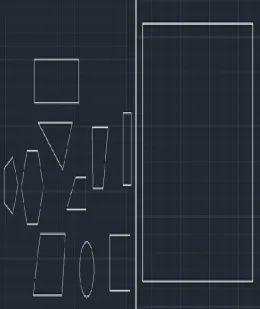
Condition 1: The problem consists set of a required 2D shapes from the sheet, which as to be cut. There is sufficient sheet material available to meet the demand. The size of the sheet is standard, where height (H) and width (W) is fixed. In this type determine the nesting configuration maximizes utilization of sheet.
[image:3.595.313.574.426.736.2]© 2016, IRJET | Impact Factor value: 4.45 | ISO 9001:2008 Certified Journal | Page 1370
Some of the tests are to be done with different
crossover function:
TEST 1:
Input parameters are:
Table 1: Input parameter
S. No Parameter Initial value
1 Population type Double vector
2 Population Size 200
3 Scaling function Rank
4 Selection function Stochastic uniform
5 Elite count 0.05*population size
6 Crossover fraction 0.8
7 Crossover function Single point
8 Mutation Adaptive feasible
9 Generations 200
10 Stall generations 50
11 Object function value 0.92
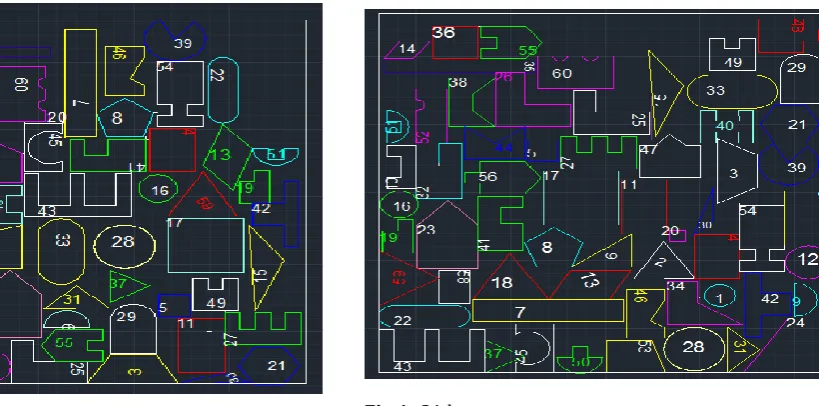
To run 200 iteration in MATLAB shown the best sequences of the parts;
6, 56, 12, 25, 3, 30, 21, 2, 47, 23, 55, 29, 11, 27, 38, 10, 57, 53, 9, 5, 49, 15, 33, 28, 59, 48, 58, 24, 43, 16, 19, 34, 45, 41, 4, 13, 18, 52, 60, 20, 7, 8, 54, 22, 51, 44, 1, 35, 46, 39
By using the above sequence, placing the parts in sheet with bottom left strategy in AUTOCAD.
Fig 3:GA layout
TEST 2:
[image:4.595.326.542.154.424.2]Input parameters are:
Table 2: Input parameter
S.NO Parameter Initial value
1 Population type Double vector
2 Population Size 200
3 Scaling function Rank
4 Selection function Stochastic uniform
5 Elite count 0.05*population size
6 Crossover 0.8
7 Crossover function Two point
8 Mutation Adaptive feasible
9 Generations 300
10 Stall generations 50
11 Objective value 0.90
To run 300 iteration in MATLAB shown the best sequences of the parts;
43, 37, 45, 50, 53, 28, 31, 24, 22, 7, 46, 34, 42, 9, 59, 58, 18, 13, 2, 1, 12, 19, 23, 41, 8, 6, 4, 54, 57, 16, 32, 56, 17, 11, 20, 30, 3, 39, 10, 5, 27, 47, 40, 21, 51, 52, 38, 26, 25, 15, 33, 29, 35, 60, 49, 48, 14, 36.
[image:4.595.57.267.181.429.2]By using the above sequence, placing the parts in sheet with bottom left strategy in AUTOCAD.
[image:4.595.126.536.544.747.2]© 2016, IRJET | Impact Factor value: 4.45 | ISO 9001:2008 Certified Journal | Page 1371
TEST 3:
[image:5.595.312.552.157.422.2]Input parameters are: Table 3: Input parameter
S.NO Parameter Initial value
1 Population type Double vector
2 Population Size 200
3 Scaling function Rank
4 Selection function Stochastic uniform
5 Elite count 0.05*population size
6 Crossover fraction 0.8
7 Crossover function Scattered
8 Mutation Adaptive feasible
9 Generations 200
10 Stall generations 50
11 Objective value 0.89
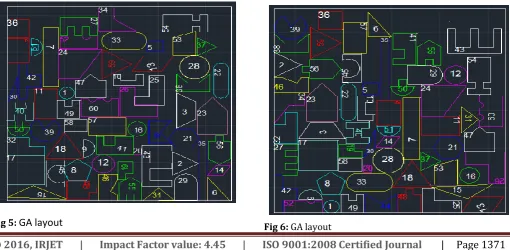
To run 200 iteration in MATLAB shown the best sequences of the parts;
15, 48, 46, 55, 31, 29, 35, 6, 17, 45, 8, 12, 19, 43, 2, 14, 32, 18, 9, 41, 20, 21, 56, 50, 39, 58, 57, 16, 44, 3, 23, 40, 11, 49, 60, 26, 38, 22, 30, 42, 7, 1, 47, 25, 28, 24, 59, 10, 13, 53, 37, 4, 51, 52, 33, 5, 54, 36, 27, 34.
[image:5.595.29.257.160.429.2]By using the above sequence, placing the parts in sheet with bottom left strategy in AUTOCAD.
Fig 5:
GA layout
TEST 4:
Input parameters are:
Table 4:
Input parameter
S.NO Parameter Initial value
1 Population type Double vector
2 Population Size 200
3 Scaling function Rank
4 Selection function Stochastic uniform
5 Elite count 0.05*population size
6 Crossover fraction 0.8
7 Crossover function Intermediate, Ratio:1.0
8 Mutation Adaptive feasible
9 Generations 200
10 Stall generations 50
11 Objective value 0.90
To run 200 iteration in MATLAB shown the best sequences of the parts;
42, 52, 1,49, 44, 48, 25, 13, 27, 9, 8, 33, 18, 15, 32, 17, 58, 20, 28, 53, 16, 26, 34, 3, 19, 30, 14, 7, 37, 21, 47, 46, 23, 40, 51, 11, 31, 60, 2, 56, 22, 10, 4, 24, 54, 38, 59, 45, 5, 35, 50, 29, 12, 43, 39, 36, 57, 6, 41, 55.
By using the above sequence, placing the parts in sheet with bottom left strategy in AUTOCAD.
[image:5.595.44.555.542.792.2]© 2016, IRJET | Impact Factor value: 4.45 | ISO 9001:2008 Certified Journal | Page 1372
Condition 2: Given set of 2D shapes is fitted in rectanglesheet or container with width W and infinite height determine the nesting configuration that minimizes the nesting height of the sheet.
Fig 7:
Allocating the pieces in sheet with variable height.
In this problem, one criterion is using the minimum sheet height, often referred to H; it is also define as distance of the bottom sheet boundary to the most top vertex of the most top place piece.
For above problem, consider example the 40 random parts are selected, which are fitted into the fixed width and variable height.
Sheet dimension: Width= 300mm; Height =variable.
Steps for Solving:
Step1: Randomly allocated the shapes in sheet material, finding the utilization of material. In this allocation the shapes are not consider the any principle or any algorithm randomly allocated, determining the height.
Fig 8:
Randomly allocated, height=318.2140.
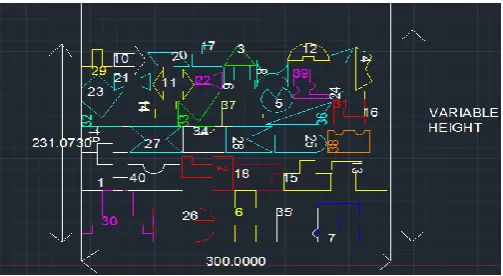
[image:6.595.35.274.155.290.2]Step 2: Allocate with bottom left method: Bottom left method is one of the nesting algorithm, which is consider the placing of pieces in left most position of bottom of the sheet. The sequence of placing is usually based on the area of the pieces, or a random sequence is used, among the all parts area, large area is allocated first at leftmost position of bottom of the sheet.
Fig 9: BL layout, height=231.0730.
Step 3: Allocated with GA output.
In the step 3, three tests are done in GA with different crossover function. Input parts are drawn in AUTOCAD; this data will be making use to nesting algorithm (genetic algorithm). Genetic algorithm is made in MATLAB TOOLBOX which as to be finding best sequences of arranging the parts. In MATLAB, written the coding which is in .m file, that file run in MATLAB to get best sequence.
Test 1:
Input parameter for GA:
Table 5: Test1 input parameter for GA
S. No Parameter Initial value
1 Population type Double vector
2 Population Size 200
3 Scaling function Rank
4 Selection function Stochastic uniform
5 Elite count 0.05*population size
6 Crossover fraction 0.8
7 Crossover function Single point
8 Mutation Adaptive feasible
9 Generations 200
[image:6.595.309.561.190.328.2] [image:6.595.50.552.497.764.2] [image:6.595.48.289.499.745.2]© 2016, IRJET | Impact Factor value: 4.45 | ISO 9001:2008 Certified Journal | Page 1373
To run 200 iteration in MATLAB shown the best sequencesof the parts;
23, 13, 28, 5, 2, 36, 30, 12, 22, 18, 20, 19, 32, 15, 39, 17, 26, 9, 7, 40, 8, 24, 37,10, 4, 27, 11, 29, 38, 16, 35, 21, 31, 3, 33, 25, 14, 6, 1, 34,
[image:7.595.308.552.134.314.2]By using the above sequence, placing the parts in sheet with bottom left strategy in AUTOCAD.
Fig 10:Test 1 GA layout, height=195.5
Test 2:
[image:7.595.35.284.193.354.2]Input parameter:
Table 6:Test 2 Input parameter for GA
S. No Parameter Initial value
1 Population type Double vector
2 Population Size 200
3 Scaling function Rank
4 Selection function Stochastic uniform
5 Elite count 0.05*population size
6 Crossover fraction 0.8
7 Crossover function Two point
8 Mutation Adaptive feasible
9 Generations 200
10 Stall generations 50
To run 200 iteration in MATLAB shown the best sequences of the parts;
31, 5, 12, 20, 16, 7, 18, 36, 3, 27, 14, 39, 13, 23, 21, 30, 37, 8, 29, 34, 4, 10, 35, 1, 9, 2, 33, 19, 22, 25, 24,28, 15, 40, 26, 17, 38, 6, 32,11.
[image:7.595.322.546.399.649.2]By using the above sequence, placing the parts in sheet with bottom left strategy in AUTOCAD.
Fig 11: Test 2 GA layout, height=203.63
Test 3:
Input parameter:
Table 7: Test 3 Input parameter for GA
S. No Parameter Initial value
1 Population type Double vector
2 Population Size 200
3 Scaling function Rank
4 Selection function Stochastic uniform
5 Elite count 0.05*population size
6 Crossover fraction 0.8
7 Crossover function Intermediate, Ratio=1.0
8 Mutation Adaptive feasible
9 Generations 200
10 Stall generations 50
To run 200 iteration in MATLAB shown the best sequences of the parts;
21, 5, 36, 23, 11, 9, 14, 19, 40, 18, 8, 2, 20, 1, 35, 24, 10, 7, 32, 31, 13, 27, 37, 6, 22, 3, 28, 38, 17, 4, 12, 25, 16, 29, 30, 26, 34, 15, 39, 33.
[image:7.595.43.283.448.695.2]© 2016, IRJET | Impact Factor value: 4.45 | ISO 9001:2008 Certified Journal | Page 1374
Fig 12: Test 3 GA layout, height =2125. RESULTS AND
DISCUSSION
In two type of nesting problem, first problem all parts to be fitted into fixed dimension and second problem is fixed width, variable height; optimize the height of the sheet i.e. minimizing the height. In the first problem, according to the utility, numerator is varies and denominator is fixed, but in the second problem, according to utility numerator is fix and denominator is varies, due height is changes in allocating of parts. Effectively solved the problem with GA and BL techniques used. For the first problem, compare GA output with nesting software, utility factor is more. Second problem, comparing with three steps, GA output is more efficiency.
Problem 1:
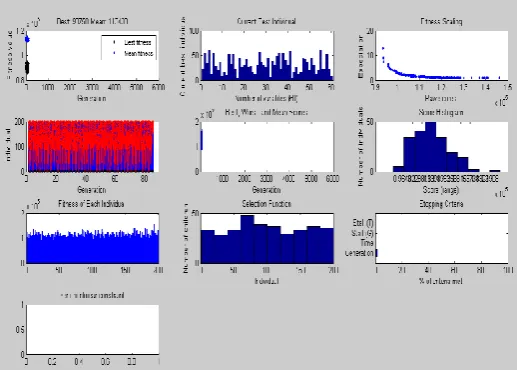
[image:8.595.308.570.163.352.2]After the optimization, we can visualize the results of different parameters in plots as show in figure
Fig 13:MATLAB Plots during optimization of the function
Problem 2:
After the optimization, we can visualize the results of different parameters in plots as show in figure
Fig 14:
MATLAB Plots during optimization of the function6. CONCLUSIONS
GA has emerged as a power full tool to help decision making in many area. The present project explores the use of the one of the important problems of sheet metal planning. The following two problems are addressed.
1. Given a sheet of metal of known dimensions and the set of parts to be produced.GA selects groups of parts so as to maximize material parts.
2. Given a set of parts, used GA and determine the strip dimensions to have maximum material utilization.
The present work glorifies the application of GA.
The experiment gave us some light on how the adjust parameters while running the GA algorithm
.
Future Work
1) With concept of Genetic algorithm can solve the 3-Dimension nesting problem.
2) With help this concept of GA and Visual Basic; develop the nesting optimization tool in AUTOCAD.
Acknowledgments
[image:8.595.37.296.532.717.2]© 2016, IRJET | Impact Factor value: 4.45 | ISO 9001:2008 Certified Journal | Page 1375
7. REFERENCES
[1] H. Dyckhoff, “A topology of cutting and packing
problems,”European Journal of Operational Research no. 44, pp. 145-159,1990
[2] E. Hopper and B.Turton, “A review of the application of meta-heuristic Algorithms to 2D strip packing
problems,”Artificial Intelligence Review 16, pp. 257- 300, 2001.
[3] S. Jakobs, “On genetic algorithms for the packing of polygons,” European Journal of Operational Research 88, pp. 165-181,1996.
[4] J.Bennell and J. Oliveira, “The geometry of nesting problems: A tutorial, European Journal of Operational Research 184, pp. 397-415, 2008.
[5] E. Hopper and B. Turton, “A genetic algorithm for 2D industrial packing Problem ,” Computer Industrial Engineering, pp. 375-378, 1999.
[6] K. Ramakrishnan, J. Bennell and M. K.Omar, “Solving two dimensional layout optimization problems with irregular is apes by using meta-heuristic,” InternationalConference on Industrial Engineering and Engineering Management, 36, no.2, pp.3489-3496, 2009.
[7] E. Burke, R. Hellier, G. Kendall and G. Whitwell, “A new bottom-left-fill heuristic algorithm for the two- dimensional irregular packing problem,” Operations Research, no. 54, pp. 587-601, 2006.
[8] Albano A, Sapuppo G. Optimal Allocation of Two Dimensional Irregular shapes using Shapes Using Heuristic Search Methods. IEEE Transactions on systems, Man, and Cybernetics May 1980; SMC 10(5). [9] Berkey J. O. and Wang P. Y., 1987. Two-dimensional finite bin-packing algorithms. Journal of the Operational Research Society 38, 423-429.
[10]Goldberg D. E., 1989. Genetic Algorithms in Search , Optimization and Machine Learning. Addison-Wesley Publishing Company, Reading.
[11] Jakobs S., 1996. On genetic algorithms for the packing of polygons. European Journal of Operations Research 88, 165-181
[12] Prasad and Somasundaram, 1991. CASNS-A heuristic algorithm for the nesting of irregular shaped sheet- metal blanks. Computer Aided Engineering Journal 8, 69-73.
[13] Ratanapan K. and Dagli C. H., 1998. An object-based evolutionary algorithm: the nesting solution. In: IEEE (eds.) Proceedings of the International Conference on Evolutionary Computation 1998, ICEC '98,IEEE, Piscataway, NJ, USA, pp. 581-586
[14] Adamowicz, M., and Albano, A., "Nesting two-
dimensional shapes in rectangular modules", Computer AidedDesign 8, (1976) 27-33.
[15] Kroger, B., Schwenderling, P., Vornberger, 0. (1990). "Parallel Genetic Packing of Rectangles",Proceedings of Parallel Problem solving from Nature, 1st Workshop, Springer-Verlag, pp. 160-164.
[16] Adamowicz, M., and Albano, A., "Nesting two-
dimensional shapes in rectangular modules", Computer AidedDesign 8, (1976) 27-33.
[17] Ramesh Babu, A. and Ramesh Babu, N., “Effective nesting of rectangular parts in multiple rectangular sheets using genetic and heuristic algorithms”, International Journal of ProductionResearch, Vol. 37, Issue 7, 1999,pp. 1625-1643.
[18]Jacobs S., “Theory and methodology on genetic algorithm for packing of polygons”, EuropeanJournal of Operations Research, Vol. 88, 1996,pp. 165 – 181. [19] Godfrey C. Onwubolu and Michael Mutingi, “A genetic algorithm approach for cutting stock problem”, Journal of intelligent manufacturing, Vol. 14, 2003, pp. 209-218. [20] Liu Hu-yao and He Yuan-jun, “Algorithm for 2D irregular-shaped nesting problem based on the NFP algorithm and lowest-gravity-center principle”, Journal of Zhejiang University ScienceA, Vol. 7, No. 4, 2006, pp. 570–576.
[21] Hopper, E., Turton, B.C.H., 2001. A review of the application of meta-heuristic Algorithms to 2D strip nesting problems. Artificial Intelligence Review, 16(4):257-300.
[22] Goldberg, D. E., "Genetic Algorithms in Search Optimization and Machine Learning,"Reading. Massachusetts, Addison Wesley, (1989).
[23] Gomes, A.M., Ovilveira, J.F.,2002.A2-exchange heuristic for nesting problem. European journal of Operation Research.141(2):359-370.
[24] Fisher,A.D ., Dagil, H.,2004.Employing subgroup evolution for irregular-shape nesting.Journal of intelligent Manufacturing,15(2):187-199. [25] Kroger, B.Guillotineable bin packing: A genetic approach.European Journal of Operation Research, 84:645-661,1995.