An Optimized Algorithm for Enhancement of
Performance of Distributed Computing System
Pankaj Saxena
Department of Computer Applications Teerthanker Mahaveer University, Moradabad
(U.P), INDIA.
Kapil Govil,
PhD.Department of Computer Applications Teerthanker Mahaveer University, Moradabad
(U.P), INDIA.
ABSTRACT
Distributed Computing System (DCS) presents a platform consisting of multiple computing nodes connected in some fashion to which various modules of a task can be assigned. A node is any device connected to a computer network. Nodes can be computers or various other network applications. A task should be assigned to a processor whose capabilities are most appropriate for the execution of that task. In a DCS, a number of tasks are allocated to different processors in such a way that the overall performance in terms of time, cost should be minimized and reliability should be maximized. For a large set of tasks that is being allocated into a DCS, several allocation methods are possible. These allocations can have significant impact on quality of services such as time, cost or reliability. Execution time is the time in which a single instruction is executed. Execution cost can be termed as the amount of value of resource used. In DCS reliability is highly dependent on its network and failures of network have adverse impact on the system performance. In DCS the whole workload is divided into small and independent units, called tasks and it allocates onto the available processors. In this paper a simple algorithm for task allocation in terms of optimum time or optimum cost or optimum reliability is presented where the numbers of tasks are more then the number of processors.
Keywords
Distributed Computing System (DCS), Task, Time, Cost, Reliability.
1.
INTRODUCTION
In this paper we consider the problem of designing an algorithm in a Distributed Computing System (DCS) for handling a set of tasks for getting the optimized results in terms of time or cost or reliability. A task is a piece of code that is to be executed andtask allocation [10, 18, 20]refers to the way that tasks are chosen, assigned, and coordinated. It is the process that results in specific processor being engaged to process in specific tasks. Task allocation [14, 19, 23] algorithms assign any particular task to specific processor in the distributed network for execution. In DCS for optimized results the cost [3] of system and time factors should be
minimized. A highly reliable system is one that will continue working for a long period of time. Reliability [5, 24] analysis is one of the important parameters to achieve the system
efficiency. In a DCS [7], a number of tasks may need to be allocated to different processors such that the reliability of processing successfully these tasks modules is maximized. Execution time is the time in which a single instruction is executed. Execution cost [9] can be termed as the amount of value of resource used [8]. It means paying something to achieve some services. Reliability [16] is defined to be the probability that the system will not fail during the time that it is processing the tasks. Different processors used in distributed systems typically vary in cost [13] based depending on their computing efficiencies. Task allocation [15, 17] is also often done based on estimates of the computation time of each task on each processor. In this paper, we have presented an algorithm, considering DCS with heterogeneous processors in order to achieve optimal time, cost and reliability by allocating the tasks to the processors, in such a way that the load of tasks [25] on each processor is balanced [6]. The required processing power for these applications can not be achieved with a single processor. One approach to this problem is to use DCS that concurrently process an application program by using multiple processors. To optimize the performance of a DCS, several issues arise such as the minimization of time and cost as well as maximization of system reliability.
2.
OBJECTIVE
The objective of the present paper is to determine a task allocation [4, 22] scheme so as to enhance the performance of Distributed Computing System (DCS) by minimizing the overall execution cost, or execution time or maximizing the reliability [4] in order to optimize system utilization. The type of assigning task [11] to the processor is static [1, 2, 12,] in nature in this paper. Here we have taken an example of distributed network [21] where the number of processors is lesser in comparison to the number of tasks. Performance is measured in terms of either time or cost or reliability of the modules of a task that have to process on the processors of the network.
3.
NOTATIONS
T : Set of tasks
P : Set of processors
CM : Communication Matrix
PCTR : Processor Cost Time Reliability
4. TECHNIQUE
For obtaining the optimal time or cost or reliability for each task initially the emphasis will be on those modules of tasks which have the maximum probability of data transfer. Now, in case of time and cost the elements will be added and in case of reliability they will be multiplied. We have considered a set of task T, which contains three tasks t1, t2, and t3, a set of
processors P which contains three processors p1, p2 and p3,
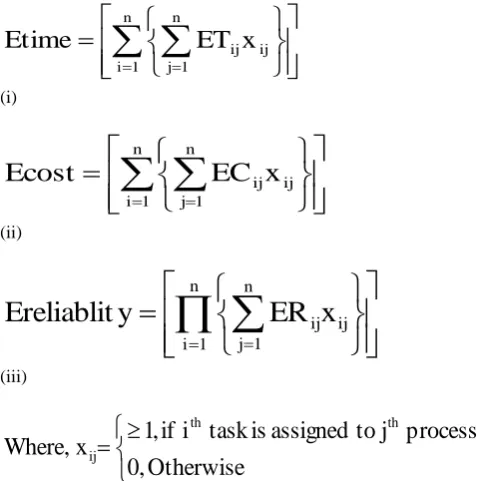
also every task contains some number of modules. Now we have taken a matrix in which the time, cost and reliability of modules are defined and define a communication matrix by considering the communication between tasks. On the basis of highest communication we get a matrix namely FPCTR (,,). Now from this table we can get the separate tables for time, cost and reliability. Load count is taken as an integer variable which contains binary values either 1 or 0. We will assign it a value 0 to the processor if no task is assigned otherwise a value 1 will be assigned to the load count. By considering that the preference should be given to the idle processor we assign load count as 1 or 0. The function for obtaining the overall execution time [Etime], cost [Ecost], and reliability [Ereliablity] is as follows-
n
1 i
n
1 j
ij ij
x
ET
Etime
(i)
n
1 i
n
1 j
ij ij
x
EC
Ecost
(ii)
n
1 i
n
1 j
ij ij
x
ER
y
Ereliablit
(iii)
Otherwise
0,
processor
j
to
assigned
is
task
i
if
,
1
x
Where,
th th
ij
Macintosh, use the font named Times. Right margins should be justified, not ragged.
5. ALGORITHM
Step 1: Start AlgorithmStep 2: Take the set of different tasks T, Set of different processors P and different modules in each task.
Step 3: Input the matrix PCTR (,,). Select time/cost/reliability data corresponding to each task as needed.
Step 4: Input matrix CM (,,) by considering the communication time between modules of each task.
Step 5: Consider each task on the basis of time or cost or reliability.
Step 6: On the basis of Step 5 we get the matrix MPCTR (,,).This matrix will be derived from matrix PCTR (,,).
Step 7: Fused the modules of tasks in MPCTR (,,), on the basis of highest communication we get the matrix FPCTR (,,).
Step 8: From FPCTR(,,) we can take bifurcate tables for time, cost and reliability with table names Table I for Time, Table II for Cost and Table III for Reliability. The tasks will be allocated on the basis of minimization of time and cost and maximization of reliability.
Step 9: Assign a load count 0 to the processor if no task is assigned and give preference to this processor in such a way that an idle processor should be busy for allocating task; otherwise assign a load count as 1.
Step 10: Calculate Etime, Ecost and Ereliability form the table in step 9.
Step 11: End algorithm
6. IMPLEMENTATION
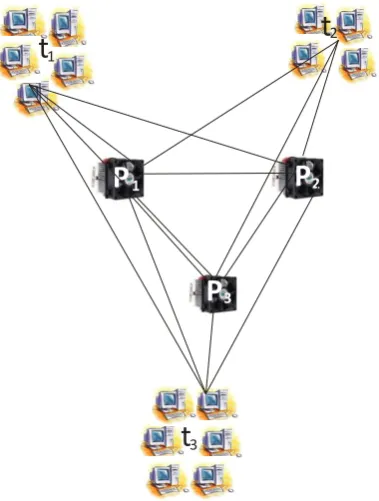
Let us consider a set of tasks T. This set consists three tasks t1,
t2, and t3.We may define it as, T= {t1, t2, t3}. Now, consider
the task t1 has a set of task M1. This set consists the five
modules. We may define it as, M1= {m11, m12, m13, m14, m15}.
Now, for task t2 consider the set of task M2. This set consists
the four modules. We may define it as, M2= {m21, m22, m23,
m24}. Now, for task t3 consider the set of task M3. This set
consists the six modules. We may define it as, M3= {m31, m32,
m33, m34, m35, m36}. The total number of processors are three
[image:2.595.54.293.346.587.2]representation of this problem is shown in figure 1.
Figure 1: Processors and Tasks
For different task t1, t2 and t3 there are three set of tasks M1,
M2 and M3. These set of tasks contains different individual
tasks components which are called modules. The processing time (t), cost (c) and reliability (r) of each module of every task on various processors are known and mentioned in the matrix namely, PCTR (,,)-
999899 . 0 2900 140 999671 . 0 2300 150 999221 . 0 2400 170 m 999667 . 0 2300 130 999111 . 0 2500 140 999221 . 0 2700 120 m 999788 . 0 2200 120 999444 . 0 2400 110 999222 . 0 2900 140 m t 999555 . 0 2750 130 999447 . 0 2500 140 999123 . 0 2800 170 m 999200 . 0 2000 140 999229 . 0 2100 150 999444 . 0 2300 180 m 999123 . 0 2400 150 999412 . 0 2300 165 999567 . 0 2800 170 m 999333 . 0 2390 170 999334 . 0 2390 170 999555 . 0 2700 160 m 999899 . 0 2360 180 999786 . 0 2560 160 999123 . 0 2800 150 m t 999678 . 0 2200 175 999765 . 0 2100 170 999227 . 0 2700 180 m 999800 . 0 2400 120 999666 . 0 2600 160 999100 . 0 2800 110 m 999700 . 0 2000 110 999566 . 0 2800 130 999120 . 0 2200 120 m 999988 . 0 2300 160 999456 . 0 2200 170 999150 . 0 2700 160 m 999899 . 0 2600 150 999342 . 0 2700 145 999231 . 0 2600 150 m t 999787 . 0 2300 130 999234 . 0 2200 135 999188 . 0 2700 140 m 999234 . 0 2500 140 999132 . 0 2300 127 999276 . 0 2500 132 m r c t r c t r c t Modules Tasks p p p Processors 36 35 34 3 33 32 31 24 23 2 22 21 15 14 13 1 12 11 3 2 1
The considered communication time amongst the modules of each task is mentioned in the matrices, namely CM (,,).
For task t1, the matrix CM (1,) is as:
0
m
4
0
m
1
4
0
m
3
4
6
0
m
5
8
6
4
0
m
m
m
m
m
m
15 14 13 12 11 15 14 13 12 11For task t2, the matrix CM (2,) is as:
0
m
5
0
m
2
8
0
m
3
5
2
0
m
m
m
m
m
24 23 22 21 24 23 22 21For task t3, the matrix CM (3,) is as:
0
m
6
0
m
1
8
0
m
6
7
7
0
m
2
4
4
3
0
m
1
5
3
4
2
0
m
m
m
m
m
m
m
36 35 34 33 32 31 36 35 34 33 32 31Here it is considered that task t1 is based on the constraint of
execution time (one may choose the either cost or reliability constraint), task t2 is based on the constraint of cost (one may
choose the either time or reliability constraint), and task t3 is
based on the constraint of reliability (one may choose the either time or cost constraint).
Hence, we can use the following form of data from matrix PCTR (,,) i.e. execution time for task t1, execution cost for
task t2, and execution reliability for task t3 and can get the
matrix namely MPCTR (,,) in the following way-
999899 . 0 999671 . 0 999221 . 0 m 999667 . 0 999111 . 0 999221 . 0 m 999788 . 0 999444 . 0 999222 . 0 m t 999555 . 0 999447 . 0 999123 . 0 m 999200 . 0 999229 . 0 999444 . 0 m 999123 . 0 999412 . 0 999567 . 0 m 2390 2390 2700 m 2360 2560 2800 m t 2200 2100 2700 m 2400 2600 2800 m 110 130 120 m 160 170 160 m 150 145 150 m t 130 135 140 m 140 127 132 m r c t r c t r c t M odules Tasks p p p Processors 36 35 34 3 33 32 31 24 23 2 22 21 15 14 13 1 12 11 3 2 1
Now, the task t1 have five modules so on the basis of highest
communication the modules m11&m14, m12&m13 will be
fused. The task t2 have four modules so on the basis of highest
communication the modules m22&m23 will be fused. The task
t3 have six modules so on the basis of highest communication
the modules m34&m35, m33&m36, m31&m32 will be fused. The
resulting matrix namely FPCTR (,,) will be-
998323
.
0
998641
.
0
999011
.
0
m
*
m
999454
.
0
999118
.
0
998344
.
0
m
*
m
t
999455
.
0
998555
.
0
998443
.
0
m
*
m
2390
2390
2700
m
2400
2600
2800
m
t
4560
4660
5500
m
*
m
110
130
120
m
280
280
290
m
*
m
t
300
297
292
m
*
m
r
c
t
r
c
t
r
c
t
M odules
Tasks
P
P
p
Processors
32 31 36 33 3 35 34 24 21 2 23 22 15 13 12 1 14 11 3 2 1 [image:4.595.313.567.538.675.2]Now, from the table FPCTR (,,), we can get the three tables namely Table I, Table II and Table III which are given below-
Table I
110
280
300
p
130
280
297
p
120
290
292
p
m
m
*
m
m
*
m
3 2 1 15 13 12 14 11 Table II2390
2400
4560
p
2390
2600
4660
p
2700
2800
5500
p
m
m
m
*
m
3 2 1 24 21 23 22 Table III998323
.
0
999454
.
0
999455
.
0
p
998641
.
0
999118
.
0
998555
.
0
p
999011
.
0
998344
.
0
998443
.
0
p
m
*
m
m
*
m
m
*
m
3 2 1 32 31 36 33 35 34In the context of Table I we have to assign unallocated task to processor where load count will take place when we assign any task to the processor. In Table I we have to allocate module m11*m14 to any processor which has load count 0
and/or less execution time. So we assign m11*m14 to processor
p1and mark load count 1 to processor p1.for m12*m13, we
assign it to processor p2 with load count 1 and m15 to
processor p3 with load count 1.
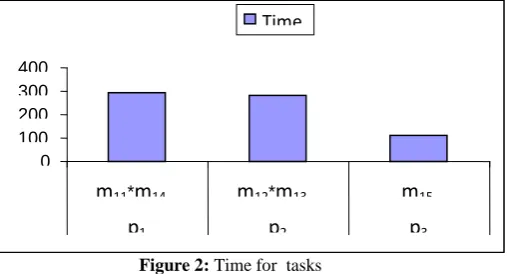
Table IV 1 110 m p 682 1 280 m * m p 1 292 m * m p Etime Count Load Time Tasks Alllocated Processors 15 3 13 12 2 14 11 1
[image:4.595.88.247.620.703.2]Results of Table IV can be shown graphically as in figure 2-
Figure 2: Time for tasks
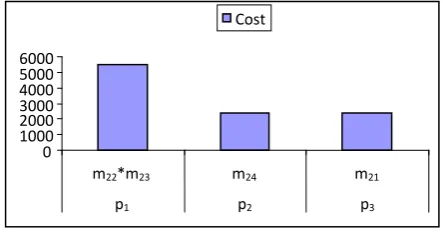
Similarly we can compute allocation on the basis of execution cost and are mentioned in Table V
0 100 200 300 400
m
11*m
14m
12*m
13m
15p
1p
2p
3Table V
1 2400
m p
10290 1
2390 m
p
1 5500
m * m p
Ecost Count Load Cost Tasks Alllocated Processors
21 3
24 2
23 22 1
[image:5.595.54.276.198.315.2]Results of Table V can be shown graphically as in figure 3-
Figure 3: Cost for tasks
Computation for execution reliability is mentioned in table VI-
Table VI
1 999455 . 0 m * m p
997585 . 0 1 999118 . 0 m * m p
1 999011 . 0 m * m p
y Ereliablit Count
Load Reliablity Tasks
Alllocated Processors
35 34 3
36 33 2
32 31 1
[image:5.595.55.289.522.642.2]Results of Table VI can be shown graphically as in figure 4-
Figure 4: Reliability for tasks
4.
CONCLUSION
The performance tests show that the proposed algorithm is almost always superior in comparison with others by providing different inputs. In the present paper we have taken a problem where the numbers of tasks are greater then the number of processors in a Distributed Computing System
(DCS). The presented algorithm describes an efficient way to calculate the optimal results for time, cost and reliability. The three tasks taken in this paper which are t1, t2, and t3 are
solved in such a way to process the task t1 in minimum time,
to process the task t2 in minimum cost and to process the task
t3 in maximum reliability. The calculated optimal results can
be shown the following table-
997585 . 0 m
* m m * m m * m t
10290 m
m m * m t
682 m
m * m m * m t
y Ereliablit Ecost
Etime p
p p
Tasks
Optimal Optimal
Optimal Processors
35 34 36 33 32 31 3
21 24
23 22 2
15 13 12 14 11 1
3 2
1
5.
REFERENCES
[1]. Braun Tracy, D., Siegel Howard Jay, Maciejewski Anthony, A., and Hong Ye, 2008. Static resource allocation for heterogeneous computing environments with tasks having dependencies, priorities, deadlines, and multiple versions. Journal of Parallel and Distributed Computing, Volume 68, Issue 11, 1504-1516.
[2]. Bo Yang, Huajun Hu, and Suchang Guo, 2009. Cost-oriented task allocation and hardware redundancy policies in heterogeneous distributed computing systems considering software reliability. Journal of Computers & Industrial Engineering, Volume 56, Issue 4, 1687-1696.
[3]. Dr. Kapil Govil, 2011. Processing Reliability based a Clever Task Allocation Algorithm to Enhance the Performance of Distributed Computing Environment. International Journal of Advanced Networking and Applications, Volume 3, Issue 1, 1025-1030.
[4]. Deo Prakash Vidyarthia, and Anil Kumar Tripathib, 2001. Maximizing reliability of distributed computing system with task allocation using simple genetic algorithm. Journal of Systems Architecture, Volume 47, Issue 6, 549-554.
[5]. Ghjh Edward, A., Billard, Joseph, C., and Pasquale,
1997.Load balancing to adjust for proximity in some network topologies. Journal of Parallel Computing, Volume 22, Issue 14, 2007-2023.
[6]. Herlihy Maurice, and Luchangco Victor, 2008. Distributed computing and the multicore revolution. Journal of ACM SIGACT News, Volume 39, Issue 1, 62-72.
[7]. Henri Casanova, Frederic Desprez, and Frederic Suter, 2010. On cluster resource allocation for multiple parallel task graphs. Journal of Parallel and Distributed Computing, Volume 70, Issue 12, 1193-1203.
[8]. Hsieh, Chung-Chi, and Hsieh Yi-Che, 2003. Reliability and cost optimization in distributed computing systems. Journal of Computers & Operations Research, volume 30, Issue 8, 1103-1119.
[9]. Kołodziej Joanna, and Xhafa Fatos, 2007. Modern approaches to modeling user requirements on resource and task allocation in hierarchical computational grids.
0.99890.999 0.9991 0.9992 0.9993 0.9994 0.9995
m31*m32 m33*m36 m34*m35
p1 p2 p3
Reliability 0
1000 2000 3000 4000 5000 6000
m22*m23 m24 m21
p1 p2 p3
International Journal of Applied Mathematics and Computer Science, Volume 21, Issue 2, 243–257.
[10]. Marwa Shouman, Gamal Attiya, Ibrahim, Z., Morsi, 2011. Static Workload Distribution of Parallel Applications in Heterogeneous Distributed Computing Systems with Memory and Communication Capacity Constraints. International Journal of Computer Applications, Volume 34, Issue 6, 18-24.
[11]. Manoj, B.S., Sekhar Archana, and Siva Ram Murthy, C., 2009. A state-space search approach for optimizing reliability and cost of execution in distributed sensor networks, Journal of Parallel and Distributed Computing, Volume 69, Issue 1, 12-19.
[12]. Manisha Sharma, Harendra Kumar, and Deepak Garg, 2012. An Optimal Task Allocation Model through Clustering with Inter-Processor Distances in Heterogeneous Distributed Computing Systems. International Journal of Soft Computing and Engineering, Volume 2, Issue 1, 50-55.
[13]. Nirmeen, A., Bahnasawy, Fatma Omara, Magdy, A., Koutb, and Mervat Mosa, 2011. A new algorithm for static task scheduling for heterogeneous distributed computing system. International Journal of Information and Communication Technology Research, Volume 1, Issue 1, 10-19.
[14]. Pankaj Saxena, Kapil Govil, Rajendra Belwal, and Umesh Kumar, 2011. An efficient approach for optimal task allocation through optimizing processing time in Distributed Network. In Proceeding of International Conference on the Next Generation Information Technology Summit, Amity University, Noida, January 27-28.
[15]. Pankaj Saxena, Dr. Kapil Govil, Neha Agrawal, Saurabh Kumar, and Deep Narayan Mishra, 2012. An approach for allocating tasks in optimized time in a distributed processing environment. International Journal of Innovative Research and Development, Volume 1, Issue 5, 431-437.
[16]. Pankaj Saxena, and Dr. Kapil Govil, 2012. A time efficient algorithm for static allocation of tasks on processors in a distributed computing system. In Proceeding of International Conference on System Modeling & Advancement in Research Trends, Teerthanker Mahaveer University, Moradabad, Oct 20-21.
[17]. Pankaj Saxena, Dr. Kapil Govil, Gaurav Saxena, Saurabh Kumar, and Neha Agrawal, 2012. An algorithmic approach and comparative analysis of task assignment to processor for achieving time efficiency in process completion. International Journal of Applied Engineering and Technology, Volume 2, Issue 1, 114-119.
[18]. Peng-Yeng Yin, Shiuh-Sheng Yu, Pei-Pei Wang, and Yi-Te Wang, 2007. Task allocation for maximizing reliability of a distributed system using hybrid particle swarm optimization, Journal of Systems and Software, Volume 80, Issue 5, 724-735.
[19]. Pradeep Kumar Yadav, Singh, M.P., and Kuldeep Sharma, 2011. Task Allocation Model for Reliability and Cost optimization in Distributed Computing System, International Journal of Modeling, Simulation and Scientific Computations, Volume 2, Issue 2, 1-19.
[20]. Qin-Ma Kang, Hong He, Hui-Min Song, and Rong Deng, 2010. Task allocation for maximizing reliability of distributed computing systems using honeybee mating optimization, Journal of Systems and Software, Volume 83, Issue 11, 2165–2174.
[21]. Santhanam Srinivasan, and Niraj, K., Jha, 1999. Safety and Reliability Driven Task Allocation in Distributed Systems, IEEE Transactions on Parallel and Distributed Systems, Volume 10, Issue 3, 238-251.
[22]. Shatz, S.M., Wang, J.P., Goto, M., 1992. Task Allocation for Maximizing Reliability of Distributed Computer Systems, IEEE Transaction on Computers, Volume 41, Issue 9, 1156-1168.
[23]. Ueno Yoichiro, Miyaho, and Suzuki Shuichi, 2009. Disaster recovery mechanism using widely distributed networking and secure metadata handling technology, Workshop on Use of P2P, GRID and agents for the Development of Content Networks, 45-48.
[24]. Vidyarthi, D.P., and Tripathi, A.K., 2001.Maximizing reliability of distributed computing system with task allocation using simple genetic algorithm, Journal of System Architecture, Volume 47, Issue 6, 549-554.